
 A SCHOLARLY BOOK REPOSITORY
33 start with P start with P

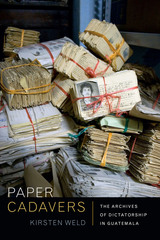
The unearthing of the archives renewed fierce debates about history, memory, and justice. In Paper Cadavers, Weld explores Guatemala's struggles to manage this avalanche of evidence of past war crimes, providing a firsthand look at how postwar justice activists worked to reconfigure terror archives into implements of social change. Tracing the history of the police files as they were transformed from weapons of counterinsurgency into tools for post-conflict reckoning, Weld sheds light on the country's fraught transition from war to an uneasy peace, reflecting on how societies forget and remember political violence.
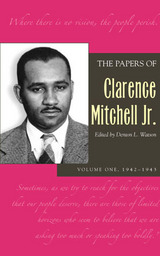
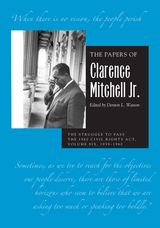
Clarence Mitchell Jr. was the driving force in the movement for passage of civil rights laws in America. The foundation for Mitchell’s struggle was laid during his tenure at the Fair Employment Practice Committee, where he led implementation of President Roosevelt’s policy barring racial discrimination in employment in the national defense and war industry programs. Mitchell’s FEPC reports and memoranda chart the beginning of the modern civil rights movement.
The first two volumes of a projected five-volume documentary edition of The Papers of Clarence Mitchell Jr. illuminate the FEPC’s work as a federal affirmative-action agency and the government’s struggle to enforce the nation’s antidiscrimination policy in industry, federal agencies, and labor unions.
Subsequent volumes will trace Mitchell’s successive enlistment of seven presidents in establishing and enforcing a permanent national nondiscrimination policy. Through his efforts, Congress passed the 1957, 1960, and 1964 Civil Rights Acts prohibiting discrimination in public accommodations, federal spending, and employment based on race, color, sex, and national origin; the 1965 Voting Rights Act; and the 1968 Fair Housing Act.
Editor Denton L. Watson introduces and annotates Mitchell’s writings, providing context and insight for students and scholars of civil rights history, government, law, and sociology.
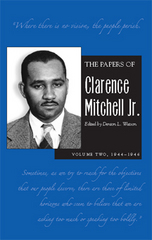
Clarence Mitchell Jr. was the driving force in the movement for passage of civil rights laws in America. The foundation for Mitchell’s struggle was laid during his tenure at the Fair Employment Practice Committee, where he led implementation of President Roosevelt’s policy barring racial discrimination in employment in the national defense and war industry programs. Mitchell’s FEPC reports and memoranda chart the beginning of the modern civil rights movement.
The first two volumes of a projected five-volume documentary edition of The Papers of Clarence Mitchell Jr. illuminate the FEPC’s work as a federal affirmative-action agency and the government’s struggle to enforce the nation’s antidiscrimination policy in industry, federal agencies, and labor unions.
Subsequent volumes will trace Mitchell’s successive enlistment of seven presidents in establishing and enforcing a permanent national nondiscrimination policy. Through his efforts, Congress passed the 1957, 1960, and 1964 Civil Rights Acts prohibiting discrimination in public accommodations, federal spending, and employment based on race, color, sex, and national origin; the 1965 Voting Rights Act; and the 1968 Fair Housing Act.
Editor Denton L. Watson introduces and annotates Mitchell’s writings, providing context and insight for students and scholars of civil rights history, government, law, and sociology.
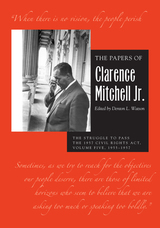
Volume V of The Papers of Clarence Mitchell Jr. records the successful effort to pass the 1957 Civil Rights Act: the first federal civil rights legislation since 1875.
Prior to the US Supreme Court’s landmark 1954 decision in Brown v. Board of Education, the NAACP had faced an impenetrable wall of opposition from southerners in Congress. Basing their assertions on the court’s 1896 “separate but equal” decision in Plessy v. Ferguson, legislators from the South maintained that their Jim Crow system was nondiscriminatory and thus constitutional. In their view, further civil rights laws were unnecessary. In ruling that legally mandated segregation of public schools was unconstitutional, the Brown decision demolished the southerners’ argument. Mitchell then launched the decisive stage of the struggle to pass modern civil rights laws.
The passage of the Civil Rights Act of 1957 was the first comprehensive lobbying campaign by an organization dedicated to that purpose since Reconstruction. Coming on the heels of the Brown decision, the 1957 law was a turning point in the struggle to accord Black citizens full equality under the Constitution. The act’s passage, however, was nearly derailed in the Senate by southern opposition and Senator Strom Thurmond’s record-setting filibuster, which lasted more than twenty-four hours. Congress later weakened several provisions of the act but—crucially—it broke a psychological barrier to the legislative enactment of such measures.
The Papers of Clarence Mitchell Jr. is a detailed record of the NAACP leader’s success in bringing the legislative branch together with the judicial and executive branches to provide civil rights protections during the twentieth century.
The Civil Rights Act of 1960 aimed to close loopholes in its 1957 predecessor that had allowed continued voter disenfranchisement for African Americans and for Mexicans in Texas.
In early 1959, the newly seated Eighty-Sixth Congress had four major civil rights bills under consideration. Eventually consolidated into the 1960 Civil Rights Act, their purpose was to correct the weaknesses in the 1957 law. Mitchell’s papers from 1959 to 1960 show the extent to which congressional resistance to the passage of meaningful civil rights laws contributed to the lunch counter sit-ins in Greensboro, North Carolina, and to subsequent demonstrations. The papers reveal how the repercussions of these events affected the NAACP’s work in Washington and how, despite their dislike of demonstrations, NAACP officials used them to intensify the civil rights struggle.
Among the act’s seven titles were provisions authorizing federal inspection of local voter registration rolls and penalties for anyone attempting to interfere with voters on the basis of race or color. The law extended the powers of the US Commission on Civil Rights and broadened the legal definition of the verb to vote to encompass all elements of the process: registering, casting a ballot, and properly counting that ballot. Ultimately, Mitchell considered the 1960 act unsuccessful because Congress had failed to include key amendments that would have further strengthened the 1957 act. In the House, representatives used parliamentary tactics to stall employment protections, school desegregation, poll-tax elimination, and other meaningful civil rights reforms. The fight would continue.
The Papers of Clarence Mitchell Jr. series is a detailed record of the NAACP leader’s success in bringing the legislative branch together with the judicial and executive branches to provide civil rights protections during the twentieth century.
In late October 1890, a British force led by Admiral Fremantle assaulted and subdued the East African town of Witu, the mainland capital of the Nabahani rulers of Pate; five years later, the entire region and the adjacent coastal islands came under British administration. One of the great tragedies suffered as a result of Admiral Fremantle's initial attack was the loss of the original manuscript of the history of Pate, The Book of the Kings of Pate.
This historical work in its various forms is representative of a living historical tradition developed in the coastal city-states of East Africa and is considered one of the important literary treasures of their culture and society. It also stands as the most important indigenous source for Swahili history, the history of the Swahili language, its dialects, and its written tradition. The four Arabic-Swahili versions (manuscripts 177, 321, 344, and 358 of the Library of the University of Dar es Salaam) presented here in The Pate Chronicle add significantly to the growing pool of information available about Pate and East Africa before the era of European colonialism.
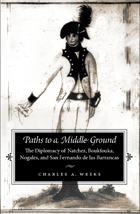
Weeks shows how diplomatic relations were established and maintained in the Gulf South between Choctaw, Chickasaw, Creek, and Cherokee chiefs and their Spanish counterparts aided by traders who had become integrated into Indian societies. He explains that despite the absence of a European state system, Indian groups had diplomatic skills that Europeans could understand: full-scale councils or congresses accompanied by elaborate protocol, interpreters, and eloquent metaphorical language.
Paths to a Middle Ground is both a narrative and primary documents. Key documents from Spanish archival sources serve as a basis for the examination of the political culture and imperial rivalry playing out in North America in the waning years of the 18th century.
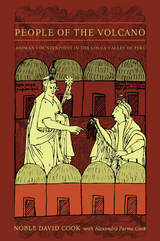
Social structures, the domestic export and economies, and spiritual spheres within native Andean communities are key elements of analysis. Also highlighted is the persistence of duality in the Andean world: perceived dichotomies such as those between the coast and the highlands, Europeans and Indo-Peruvians. Even before the conquest, the Cabana and Collagua communities sharing the Colca Valley were divided according to kinship and location. The Incas, and then the Spanish, capitalized on these divisions, incorporating them into their state structure in order to administer the area more effectively, but Colca Valley peoples resisted total assimilation into either. Colca Valley communities have shown a remarkable tenacity in retaining their social, economic, and cultural practices while accommodating various assimilationist efforts over the centuries. Today’s population maintains similarities with their ancestors of more than five hundred years ago—in language, agricultural practices, daily rituals, familial relationships, and practices of reciprocity. They also retain links to ecological phenomena, including the volcanoes from which they believe they emerged and continue to venerate.
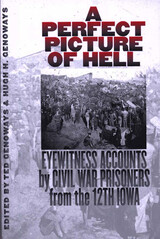
From the shooting of an unarmed prisoner at Montgomery, Alabama, to a successful escape from Belle Isle, from the swelling floodwaters overtaking Cahaba Prison to the inferno that finally engulfed Andersonville, A Perfect Picture of Hell is a collection of harrowing narratives by soldiers from the 12th Iowa Infantry who survived imprisonment in the South during the Civil War.
Editors Ted Genoways and Hugh Genoways have collected the soldiers' startling accounts from diaries, letters, speeches, newspaper articles, and remembrances. Arranged chronologically, the eyewitness descriptions of the battles of Shiloh, Corinth, Jackson, and Tupelo, together with accompanying accounts of nearly every famous Confederate prison, create a shared vision

Assembling extracts from letters, journals, diaries, and memoirs from a remarkably diverse cast of both Russians and foreign nationals who were there when the revolution broke, Petrograd, 1917 is a strikingly close-up account of these world-shaking events. Each entry is supplemented with a short introductory note that sets it in context, and the book is rounded out with more than seventy illustrations, including photographs of the Romanovs and the violence in the streets as well as propaganda posters, postcards to loved ones, and more. In these pages, the drama and terror of those days comes to life once more, a century on.
Presenting a wide-ranging selection of works and commentary in religious phenomenology
Phenomenology is a central method employed to study religious phenomena within religious studies, philosophy of religion, and philosophical theology. This expertly edited collection brings together historical sources and newly commissioned essays from various ways of investigating religion phenomenologically both to diversify the field and to make available important works that have not been previously translated into English. The Phenomenological Study of Religion includes not only representative texts from well-known phenomenological philosophers and scholars of religion but also selections from significant thinkers that have not been studied as widely, along with contributions from leading contemporary voices. This volume offers scholars and students at all levels of expertise broad exposure to the various configurations of the phenomenological study of religion.

This edition shows that what is consistent in Poe is not any single theory. Rather, always present are wit, playfulness, concern for the strong effect, a bin of recyclable allusions, anecdotes and quotations, and a writer’s discipline. His writing on theory is of a piece with his fiction, poetry, and journalism. The Levines explain how these pieces also tie in tightly to the social, political, economic, and technological history of the world in which Poe lived.
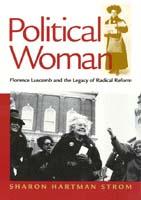
Politcal Women counters the traditional narratives that place men at the center of political thinking and history. Showing how three generations of Luscomb's family had set the stage for her activism, this biography presents her story against the backdrop of Boston's politics and larger struggles for social justice. Luscomb participated in every significant social reform movement of her time -- from securing women's right to vote and supporting trade unionism to advocating an end to the war in Vietnam. Luscomb also ran for public office; she was narrowly defeated when she ran for Boston's city council in 1922. Although unsuccessful as a third-party candidate for Congress (in 1936 and 1950) and for Governor of Massachusetts (in 1952), she was one of the few women of her time to seek office. Independent, athletic, and spirited, she apparently never thought that traditional gender prescriptions applied to her. A practicing architect before the First World War, an exuberant hiker all her life, and a member in collective-living arrangements, Luscomb enjoyed a life of rich experiences and sustaining relationships.
In Florence Luscomb's biography, Sharon Hartman Strom suggests that although women were excluded from the activities and sites associated with conventional politics until recently, they did political work that gave purpose to their lives and affected political thinking in their communities, states, and ultimately the nation.
By collecting, sifting, and cross-referencing these varied documents, Franklin proves it possible to trace the major political alliances of the times, explore the remains of their houses, and find traces of their personalities. A few families, like the powerful Holconii, developers of the region's most famous grape vine, prove to have been steady players throughout Pompeii's history; but most families rose and fell within two generations at most. Chapters examine the men and families most prominent in each imperial period, including an analysis of their houses, and concludes with family trees. The documents themselves, elsewhere difficult to access, are prominently featured and translated in the text, making these discussions available and vivid to all readers.
This book is the first such attempt to cross-reference and animate all kinds of writing found at this legendary site. Outside of the city of Rome itself, this is the largest collection of writing from Roman antiquity, and it has lain mostly unexamined in the course of three centuries of excavations at Pompeii. This volume will interest not only students of Pompeii and classical scholars, but also historians, political scientists, sociologists, and enthusiasts of human behavior of all eras.
James L. Franklin is Professor of Classical Studies, Indiana University.
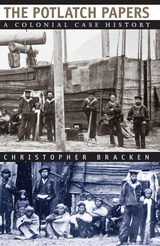
However, as Christopher Bracken shows in this elegantly argued work, the potlatch was in fact invented by the nineteenth-century Canadian law that sought to destroy it. In addition to giving the world its own potlatch, the law also generated a random collection of "potlatch papers" dating from the 1860s to the 1930s. Bracken meticulously analyzes these documents—some canonical, like Franz Boas's ethnographies, others unpublished and little known—to catch a colonialist discourse in the act of constructing fictions about certain First Nations and then deploying those fictions against them. Rather than referring to objects that already exist, the "potlatch papers" instead gave themselves something to refer to; a mirror in which to observe not "the Indian," but "the European."


Presented in a highly readable form, the book offers top-level documents from Kremlin Politburo meetings, multi-lateral sessions of the Warsaw Pact leading up to the decision to invade, and even transcriptions of KGB-recorded phone conversations between Leonid Brezhnev and Alexander Dubcek. Once highly classified American documents from the National Security Council, CIA, and other relevant agencies acquired through the U.S. Freedom of Information Act have also been included.
In order to provide a historical and political context, the editors have included an introductory essay for each section of the volume. A chronology, glossary, and bibliography offer further background information for the reader. As members of the commission appointed by Václav Havel to investigate the events of 1967-1970, the editors have a unique Czech-Slovak perspective to offer to foreign audiences.
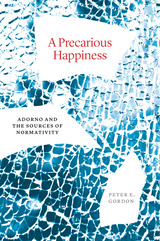
A strikingly original account of Theodor Adorno’s work as a critique animated by happiness—now in paperback.
"Gordon’s confidently gripping and persistently subtle interpretation brings a new tone to the debate about Adorno’s negativism."—Jürgen Habermas
Theodor Adorno is often portrayed as a totalizing negativist, a scowling contrarian who looked upon modern society with despair. Peter E. Gordon thinks we have this wrong: if Adorno is uncompromising in his critique, it is because he sees in modernity an unfulfilled possibility of human flourishing. In a damaged world, Gordon argues, all happiness is likewise damaged but not wholly absent. Through a comprehensive rereading of Adorno’s work, A Precarious Happiness recovers Adorno’s commitment to traces of happiness—fragments of the good amid the bad. Ultimately, Gordon argues that social criticism, while exposing falsehoods, must also cast a vision for an unrealized better world.
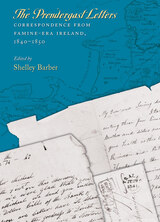
Most important, the letters offer a rare contemporary, firsthand account of Ireland's an Gorta Mor, the Great Famine that began with the failure of the potato crop in 1845. Letters written in the months and years following the announcement of the first crop failure provide insight into not only the sufferings of one family but also the response of the community and nation as this crisis transformed Ireland.
James and Elizabeth Prendergast were the parents of six children. Their letters from Milltown, County Kerry, dictated to a scrivener, were posted to sons Thomas and Jeffrey and daughter Julia Riordan and her husband Cornelius, all of whom had emigrated in search of employment to Boston, Massachusetts—a city that would itself be transformed by the famine-era influx of Irish immigrants.
In addition to transcriptions of the forty-eight letters in the collection, this volume includes contextual essays by historian Ruth-Ann Harris and genealogist Marie Daly. The evidence of the letters themselves, along with the contributions of Harris and Daly, demonstrate the ways in which the family of James Prendergast was at once exceptional and typical.
This selection of Arabic and English translations illuminates the changes of eighteenth-century government in the northern Nile Valley of Sudan, and provides reliable chronological points of reference for the history of the region.
The documents offered in this volume, including charter grants of land and privilege, administrative letters, judicial rulings, and other official government records, date form 1702 to 1820. This period marks the apogee of the wealth, power, and geographical extent of the realm of the Funji kings of Sinnar who reigned over much of the Sudan from about 1500 until the Turkish colonial conquest of 1821.
These records document with concrete precision and eloquence the dissolution of the agrarian social order of an old African kingdom under the corroding influence of intrusive Mediterranean commercial practices and culture. They reveal the Sudan's legacy of a traditionally weak government vulnerable to manipulation or conquest by foreign powers and a divided and impoverished society dominated by a minority of urban interests.

The Pyramid under the Cross looks at the epic project of Christianization as well as the limits of the Spanish spiritual colonizers' power to accomplish it. The book focuses on activities of Franciscan missionaries who, as the first religious order to arrive, occupied the most important political and social centers in the Valley of Mexico and set the strategies of evangelization that others would follow. One such activity, the Nahua theater of evangelization, is represented as an exemplary case of the inevitable cultural negotiation involved in the missionary process. The author explores not only the imposition of a Eurocentric worldview upon the Nahua but also the hybridization of this view as the spiritual colonizer attempted to encompass a new non-Western constituency and the latter interpreted Christianity according to its own cultural paradigms.
The book treats a wide range of texts—the Historia eclesiástica indiana, the Confessionario Mayor, the Coloquios de los Doce, and more—both by renowned Franciscan figures such as Gerónimo de Mendieta, Alonso de Molina, Bernardino de Sahagún, and by Nahua grammarians Antonio Valeriano de Azcapotzalco, Andrés Leonardo de Tlatelolco, and others. Díaz Balsera engages the cultural constraints of all the actors in the episodes she relates in order to show how the exchange between them resulted in the appropriation and/or alteration of the Spanish discourses of spiritual domination—sometimes even in their breakdown—and how it brought about the emergence of Nahua Christian subjects that would never fully leave behind their ancient ways of relating to the gods.
The Pyramid under the Cross will be of interest to readers in the areas of Hispanic literatures, history, religion, anthropology, Latin American and cultural studies, and to those working in the field of colonial studies.
READERS
Browse our collection.
PUBLISHERS
See BiblioVault's publisher services.
STUDENT SERVICES
Files for college accessibility offices.
RECENTLY PUBLISHED


UChicago Accessibility Resources
home | accessibility | search | about | contact us
BiblioVault ® 2001 - 2026
The University of Chicago Press