
 A SCHOLARLY BOOK REPOSITORY
43 start with T start with T

In this visually stunning volume, Polly Schaafsma, leading authority on pre-Hispanic Indian rock imagery and kiva murals of the greater American Southwest, provides an insightful journey into the petroglyphs and rock paintings of the Jornada Mogollon farmers in southern New Mexico's lower Chihuahuan Desert.
Talking to the Rain defines the Rio Grande Tradition, emphasizing the foundational Jornada Style as exemplified by its Mimbres-like imagery as well as its diverse and complex rain-making symbolism. By examining visual metaphors of cosmology and place-making, the book reveals an ancient dialogue between farmers and the cosmos that places rain for crops as its central concern. Exceptional color photographs by François Gohier invite readers to experience the landscapes and locations selected for creating these images. Both scholarly and accessible, Talking to the Rain offers a fresh perspective on cultural landscapes and the profound connections between people, art, and environment, making it essential for understanding Southwest cultural history.
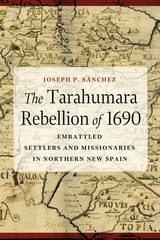
Previous histories have interpreted this revolt, and other borderlands uprisings, as localized and spontaneous events aimed at rectifying specific grievances. Historian Joseph P. Sánchez argues that the revolts of the Tepehuanes and the Tarahumaras in northern New Spain, or Nueva Vizcaya, were well-planned, inspired by outside events, and drew in multiple communities and ethnicities. Drawing on a wealth of primary sources, including Jesuit accounts and archival documents, Sánchez offers a comprehensive narrative that challenges conventional interpretations of colonial Mexican uprisings.
Far from localized, the Indigenous rebellions in the northern Mexican borderlands during the colonial period were part of the overall Indigenous struggle for defense of homeland throughout the Americas. The Tarahumara Rebellion of 1690 brings together a rich history of localized events and broader historical trends and offers a compelling narrative that enriches our understanding of the colonial experience in northern New Spain.
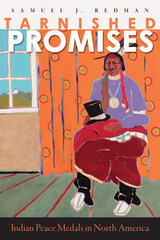
Using a collection of medals held at the Denver Museum of Nature & Science, Tarnished Promises presents an updated overview of the history and story of peace medals through an examination of their legacy in the modern world. Accompanying the history and analysis are images of thirteen exemplar peace medals from the DMNS collections and their accompanying object biographies.
Peace medals paradoxically worked as tools of colonialism and also Native American agency, sovereignty, power, resistance, and change in response to growing challenges. Their widespread adoption by Native people in North America both prefigured and coincided with the many ways in which Native Americans and First Nations peoples worked to adapt to the unwelcome and undesirable changes wrought by expanding western colonialism. The unique individual histories behind the medals and the larger peace medal story suggest how material objects can hold several, sometimes contradictory, meanings and be influenced by varied strands of culture and historical memory. Tarnished Promises tells this complex story in two parts, with the first detailing the history of Indian peace medals from 1670 to the present day and the second part exploring their meaning at different points in time and to different peoples.
The first book-length treatment of peace medals using an anticolonialist perspective, Tarnished Promises is significant to scholars and the general public interested in numismatics, American history, Indigenous studies, and museum collections.
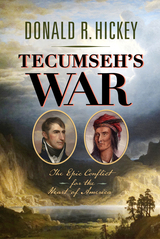
The Shawnee leader Tecumseh came to prominence in a war against the United States waged from 1811 to 1815. In 1805, Tecumseh’s younger brother Lalawethika (soon to be known as “the Prophet”) had a vision for an Indian revitalization movement that would restore Native culture and resist American expansion. Tecumseh organized the growing support for this movement, which came from Indigenous peoples across the Old Northwest and parts of the Great Plains, into a loose but powerful military alliance.
In late 1811, while Tecumseh was away on a recruiting mission in the South, General William Henry Harrison led an army to the center of Native resistance at Prophetstown in present-day Indiana. In the early morning hours of November 7, in what came to be known as the Battle of Tippecanoe, Harrison’s men fought off an Indian attack, which marked the beginning of Tecumseh’s War. Seven months later, when the United States declared war on Britain, thus initiating the War of 1812, the British and Tecumseh forged an alliance against the United States. Initially, the Anglo-Indian alliance enjoyed considerable success at Detroit, Chicago, Mackinac, and elsewhere, exposing much of the Old Northwest to border warfare, but the tide turned in 1813 when Harrison invaded Canada. On October 5 the American army defeated a much smaller Anglo-Indian force in the climactic Battle of the Thames. Tecumseh was killed in this battle, and although his confederacy disintegrated, British support ensured that the Indian war would continue for another two years with the Sauk chief Black Hawk now providing the inspiration and leadership. Tecumseh’s War ended only in late 1815 after the British made peace with the United States and abandoned their native allies.
Tecumseh’s War: The Epic Conflict for the Heart of America is the first complete story of this major conflict. Distinguished historian Donald R. Hickey detaches it from the War of 1812, moving Tecumseh’s confederation to center stage to tell the sweeping and engrossing story of this last great Indian War—the last time that Indigenous Peoples had a powerful European ally to oppose United States expansion and thus the lastchance they had of shaping the future of the continent.
“All my work fits in my mouth,” Jo Carson says. “I write performance material no matter what else the pieces get called, and whether they are for my voice or other characters’ voices … they are first to be spoken aloud.” Following an oral tradition that has strong roots in her native Tennessee, the author of Teller Tales invites the reader to participate in events in a way that no conventional history book can.
Both stories in this book are set in East Tennessee in the mid-eighteenth century and share certain characters. The first narrative, “What Sweet Lips Can Do,” recounts the story of the Overmountain Men and the battle of King’s Mountain, a tide-turning battle in the American Revolution. “Men of Their Time” is an exploration of white-Cherokee relationships from early contact through the time of the Revolution.
Although not well known to the outside world, the stories recounted in Teller Tales are cornerstones in the heritage of the Appalachian region and of American history. In ways that will appeal to young and old alike, Jo Carson’s irreverent telling will broaden the audience and the understanding for the stories of native Americans, settlers, explorers, and revolutionaries of early America.
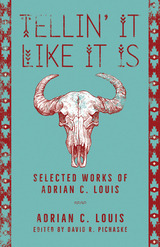
Tellin’ It Like It Is offers a powerful introduction to Adrian C. Louis (1946–2018), one of the most unflinching Native American literary voices of the twentieth century. Drawing from a half-century of published writing—and including a few previously unpublished pieces—this collection captures the evolution of Louis’s voice, worldview, and craft.
Editor David Pichaske, a close friend of Louis in his later years, curates this volume with deep insight into both the public figure and the private man. Selections are arranged chronologically to trace Louis’s transformation from a Nevada reservation teenager to a California hippie, a sixties hitchhiker, a Boston academic, a South Dakota reservation journalist, and finally, a Midwestern college professor.
Louis’s work immerses readers in reservation life, yet its critique reaches the broadest dimensions of American and human experience. To enrich understanding, the book includes literary reviews, scholarly essays (including one by a noted Polish critic), an interview with Louis, and his own reflections on literature and identity. A foreword by poet Bojan Louis provides further context for this essential collection.
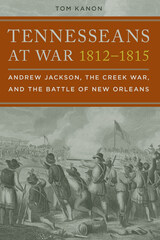
Although frequently discussed as separate military conflicts, the War of 1812 against Great Britain and the Creek War against Native Americans in the territory that would become Alabama were part of the same forceful projection of growing American power. Success in both wars won for America security against attack from abroad and vast tracks of new land in “the Old Southwest.” In Tennesseans at War, 1812–1815, Tom Kanon explains the role Tennesseans played in these changes and how they remade the south.
Because it was a landlocked frontier state, Tennessee’s economy and security depended heavily upon the river systems that traversed the region; some, like the Tennessee River, flowed south out of the state and into Native American lands. Tennesseans of the period perceived that gaining mastery of these waterways formed an urgent part of their economic survival and stability.
The culmination of fifteen years’ research, Kanon’s work draws on state archives, primary sources, and eyewitness accounts, bringing the information in these materials together for first time. Not only does he narrate the military campaigns at the heart of the young nation’s expansion, but he also deftly recalls the economic and social pressures and opportunities that encouraged large numbers of Tennesseans to leave home and fight. He expertly weaves these themes into a cohesive narrative that culminates in the vivid military victories of the War of 1812, the Creek War, and the legendary Battle of New Orleans—the victory that catapulted Tennessee’s citizen-soldier Andrew Jackson to the presidency.
Expounding on the social roles and conditions of women, slaves, minorities, and Native Americans in Tennessee, Kanon also brings into focus the key idea of the “home front” in the minds of Tennesseans doing battle in Alabama and beyond. Kanon shows how the goal of creating, strengthening, and maintaining an ordered society permeated the choices and actions of the American elites on the frontiers of the young nation.
Much more than a history of Tennesseans or the battles they fought in Alabama, Tennesseans at War, 1812–1815, is the gripping story of a pivotal turning point in the history of the young American republic.
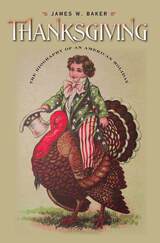
In this, the first in-depth study of the most American of holidays, James Baker sweeps away lingering myths and misconceptions to show how this celebration day was born and grew to be an essential part of our national spirit. Thanksgiving: The Biography of an American Holiday opens with an overview of the popular mythos of the holiday before discussing its possible religious and cultural precedents. This classic Yankee holiday is examined in historical and contemporary detail that embraces everything from proclamations, sermons, and local and regional traditions to family reunions, turkey dinners, and recipes. Thanksgiving's evolving face is illustrated with charming and often revealing period prints that chart our changing attitudes: the influence of Victorian sentiment in Thanksgiving's development, Progressive utilitarianism, intellectual “debunking,” patriotic wartime reclamation, and 1960s-era protest. Thanksgiving remains controversial up to the present day, as Mayflower descendants, Native Americans, and commercial exploiters compete for the American public's opinion of the holiday's contemporary significance and its future status. This is an intelligent and illuminating introduction to a beloved holiday and a fascinating cultural history of America and Americana.
The remarkable story of a North Carolina Cherokee community who avoided forced removal on the Trail of Tears
During the 1838 forced Cherokee removal by the US government, a number of close-knit Cherokee communities in the Southern Appalachian Mountains refused to relinquish their homelands, towns, and way of life. Using a variety of tactics, hundreds of Cherokees avoided the encroaching US Army and remained in the region.
In his book Their Determination to Remain: A Cherokee Community’s Resistance to the Trail of Tears in North Carolina, Lance Greene explores the lives of wealthy plantation owners Betty and John Welch who lived on the southwestern edge of the Cherokee Nation. John was Cherokee and Betty was White. Although few Cherokees in the region participated in slavery, the Welches held nine African Americans in bondage.
During removal, the Welches assisted roughly 100 Cherokees hiding in the steep mountains. Afterward, they provided land for these Cherokees to rebuild a new community, Welch’s Town. Betty became a wealthy and powerful plantation mistress because her husband could no longer own land. Members of Welch’s Town experienced a transitional period in which they had no formal tribal government or clear citizenship yet felt secure enough to reestablish a townhouse, stickball fields, and dance grounds.
Greene’s innovative study uses an interdisciplinary approach, incorporating historical narrative and archaeological data, to examine how and why the Welches and members of Welch’s Town avoided expulsion and reestablished their ways of life in the midst of a growing White population who resented a continued Cherokee presence. The Welch strategy included Betty’s leadership in demonstrating outwardly their participation in modern Western lifestyles, including enslavement, as John maintained a hidden space—within the boundaries of their land—for the continuation of traditional Cherokee cultural practices. Their Determination to Remain explores the complexities of race and gender in this region of the antebellum South and the real impacts of racism on the community.
In “These Are Our Roots”, Allen J. Christenson translates and analyzes historical documents composed by Tamub’ and Ilokab’ nobles of the K’iche’ Maya, who ruled much of the Guatemalan highlands until their lands were invaded by Spanish conquistadors in 1524. Complete original English translations of three Tamub’ texts and a new translation of the “Title of the Ilokab’” reveal how K’iche’ nobility strategically appropriated Christian elements from Dominican missionary texts while maintaining their Indigenous worldview. These documents served multiple purposes: legally establishing land rights, asserting nobility status, preserving cultural identity, and claiming religious legitimacy by positioning themselves as descendants of biblical figures—a sophisticated response to Spanish colonization that balanced accommodation and resistance through literacy, which had become a crucial tool for Indigenous elites navigating the colonial system.
The Tamub’ and Ilokab’ branches of the K’iche’ people have generally been overshadowed by their well-known Kaweq brethren, who wrote such literature masterpieces as the Popol Vuh and the Title of Totonicapán. But it is the voices relegated to the shadows of history that share views of events from different perspectives and whisper about what really happened behind the scenes—family jealousies, political rivalries, and delicious gossip about the great and the good who tend to focus on their own self-aggrandizing stories. “These Are Our Roots” is a valuable scholarly contribution to Maya studies and ethnohistory that makes these important primary sources more accessible to students and scholars.
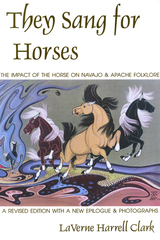
No Native American groups placed more emphasis on the horse in their lives than did the Navajo and Apache of the Southwest. They Sang for Horses, first published in 1966 and now considered a classic, remains the only comprehensive treatment of the profound mystical influence that the horse has exerted for more than 300 years.
In this completely redesigned and expanded edition, LaVerne Harrell Clark examines how storytellers, singers, medicine men, and painters created the animal's evolving symbolic significance by adapting existing folklore and cultural symbols. Exploring the horse's importance in ceremonies, songs, prayers, customs, and beliefs, she investigates the period of the horse's most pronounced cultural impact on the Navajo and the Apache, starting from the time of its acquisition from the Spanish in the seventeenth century and continuing to the mid-1960s, when the pickup truck began to replace it as the favored means of transportation. In addition, she presents a look at how Navajos and Apaches today continue to redefine the horse's important role in their spiritual as well as material lives.
This classic work is a must for historians, readers interested in Native American folklore and mythology, and anyone who has ever been captivated by the magic and romance of the horse.
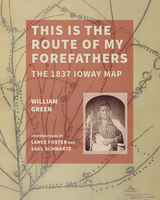
Illustrating nearly 200 years of Ioway history, the 1837 Ioway map provides insights into the tribe’s political and diplomatic strategies, their relationships with neighboring nations, and how they resisted and negotiated in the face of dispossession. This Is the Route of My Forefathers uses an interdisciplinary approach to reveal how group accounts may fade over time, while accounts of origin—legendary histories—remain rich and vibrant.
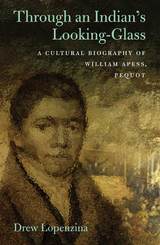
The life of William Apess (1798–1839), a Pequot Indian, Methodist preacher, and widely celebrated writer, provides a lens through which to comprehend the complex dynamics of indigenous survival and resistance in the era of America's early nationhood. Apess's life intersects with multiple aspects of indigenous identity and existence in this period, including indentured servitude, slavery, service in the armed forces, syncretic engagements with Christian spirituality, and Native struggles for political and cultural autonomy. Even more, Apess offers a powerful and provocative voice for the persistence of Native presence in a time and place that was long supposed to have settled its “Indian question” in favor of extinction.
Through meticulous archival research, close readings of Apess's key works, and informed and imaginative speculation about his largely enigmatic life, Drew Lopenzina provides a vivid portrait of this singular Native American figure. This new biography will sit alongside Apess's own writing as vital reading for those interested in early America and indigeneity.
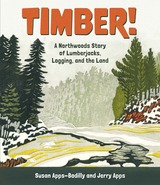
How did the logging boom begin? What was it like to work in the woods? What happened to the land after the trees were cut down? The latest book for young readers from father-daughter duo Jerry Apps and Susan Apps-Bodilly explores the origin story of Wisconsin’s logging boom, the devastation it caused to the land, and the extraordinary efforts to restore the cutover land and log sustainably.
Timber! helps young readers examine a complex and pivotal chapter in our state and nation’s history, covering a wide range of topics, including:
• how Native people used, shared, and relied on natural resources for thousands of years
• the forced removal of Native people from forested lands
• how the lumber industry made possible the westward expansion of the United States
• what it was like to work in a logging camp, on a log drive, and inside a sawmill
• the roles on a logging team, from sawyer to cook
• the destructive legacy of early logging practices and early efforts to restore the land
• the emergence of sustainable forestry practices
This comprehensive yet easy-to-read history includes letters, postcards, and other primary sources paired with discussion questions designed to engage young readers’ creativity and critical-thinking skills. Timber! also features more than 100 images, a glossary, suggested activities, and an extensive list of related resources, including books, websites, teaching materials, museums, and outdoor places to visit. Timber! will inspire readers of all ages to explore, protect, and learn about trees and forests in their own communities.
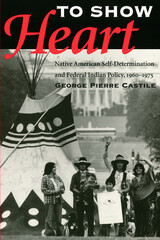
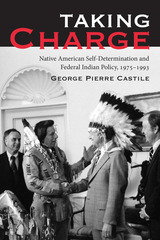
To Show Heart is a detailed and unbiased account of one of the least understood periods in Indian affairs. It tells how "termination" became a political embarrassment during the civil rights movement, how Lyndon Johnson's War on Poverty prompted politicians to rethink Indian policy, and how championing self-determination presented an opportunity for Presidents Nixon and Ford to "show heart" toward Native Americans. Along the way, Castile assesses the impact of the Indian activism of the 1960s and 1970s and offers an objective view of the American Indian Movement and the standoff at Wounded Knee. He also discusses the recent history of individual tribes, which gives greater meaning to decisions made at the national level. Castile's work greatly enhances our understanding of the formulation of current Indian policy and of the changes that have occurred since 1975. To Show Heart is an important book not only for anthropologists and historians but also for Native Americans themselves, who will benefit from this inside look at how bureaucrats have sought to determine their destinies.

In To Win the Indian Heart: Music at Chemawa Indian School, Melissa Parkhurst records the history of the school’s musical life. She explores the crucial role music was meant to play in the total transformation of Indian children, and the cultural recovery and resiliency it often inspired instead. Parkhurst chronicles the complex ways in which students, families, faculty, and administrators employed music, both as a tool for assimilation and, conversely, as a vehicle for student resistance—a subject long overlooked in literature on Indian education and the assimilation campaign.
Combining oral histories of Chemawa alumni with archival records of campus life, the book examines the prominent forms of music making at Chemawa—school band, choirs, private lessons, pageants, dance, garage bands, and powwows. Parkhurst traces the trajectory of federal Indian policy, highlighting students’ creative responses and the ways in which music reveals the inherent contradictions in the U.S. government’s assimilation practices.
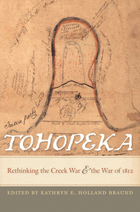
Reexamining the Creek War, the War of 1812, and the Making of the American South.
Tohopeka contains a variety of perspectives and uses a wide array of evidence and approaches, from scrutiny of cultural and religious practices to literary and linguistic analysis, to illuminate this troubled period. Almost two hundred years ago, the territory that would become Alabama was both ancient homeland and new frontier where a complex network of allegiances and agendas was playing out. The fabric of that network stretched and frayed as the Creek Civil War of 1813-14 pitted a faction of the Creek nation known as Red Sticks against those Creeks who supported the Creek National Council. The war began in July 1813, when Red Stick rebels were attacked near Burnt Corn Creek by Mississippi militia and settlers from the Tensaw area in a vain attempt to keep the Red Sticks’ ammunition from reaching the main body of disaffected warriors. A retaliatory strike against a fortified settlement owned by Samuel Mims, now called Fort Mims, was a Red Stick victory. The brutality of the assault, in which 250 people were killed, outraged the American public and “Remember Fort Mims” became a national rallying cry.
During the American-British War of 1812, Americans quickly joined the war against the Red Sticks, turning the civil war into a military campaign designed to destroy Creek power. The battles of the Red Sticks have become part of Alabama and American legend and include the famous Canoe Fight, the Battle of Holy Ground, and most significantly, the Battle of Tohopeka (also known as Horseshoe Bend)—the final great battle of the war. There, an American army crushed Creek resistance and made a national hero of Andrew Jackson.
New attention to material culture and documentary and archaeological records fills in details, adds new information, and helps disabuse the reader of outdated interpretations.
Contributors
Susan M. Abram / Kathryn E. Holland Braund/Robert P. Collins / Gregory Evans Dowd / John E. Grenier / David S. Heidler / Jeanne T. Heidler / Ted Isham / Ove Jensen / Jay Lamar / Tom Kanon / Marianne Mills / James W. Parker / Craig T. Sheldon Jr. / Robert G. Thrower / Gregory A. Waselkov

He toi whakairo, he mana tangata.
Through artistic excellence, there is human dignity.
In six hundred pages and with over five hundred illustrations, this volume takes us on an extraordinary voyage through Māori art—from ancestral weavers to contemporary artists at the Venice Biennale, from whare whakairo to film, and from Te Puea Hērangi to Michael Parekōwhai.
Deidre Brown, Ngarino Ellis, and Jonathan Mane-Wheoki explore a wide field of art practices, including raranga (plaiting), whatu (weaving), moko (tattooing), whakairo (carving), rākai (jewellery), kākahu (textiles), whare (architecture), toi whenua (rock art), painting, photography, sculpture, ceramics, installation art, digital media, and film. The works discussed span a period from the arrival of Pacific voyagers eight hundred years ago to the contemporary artists working around the world today. With expansive chapters and breakout texts focusing on individual artists, movements, and events, Toi Te Mana is an essential book for anyone interested in te ao Māori.
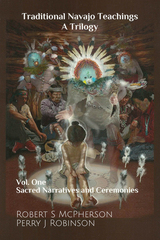
—Cindy Yurth, The Navajo Times
"In Sacred Narratives and Ceremonies, the authors lay the foundation of traditional Navajo beliefs and practices. They provide an inside perspective rarely discussed by non-medicine people and share the beauty and power of a system that unites humans to the holy beings—through teachings, rituals, materials, and daily behavior. This book is pure gold. It is full of traditional wisdom available to those wanting to understand Navajo culture as seen through the eyes of its elders. I highly recommend this book as a treasure trove for the Diné people."
—Clayton Long, participant/creator of the Navajo Rosetta Stone; Bilingual Education Director (retired), San Juan School District, Utah; and curriculum developer for the Navajo Nation
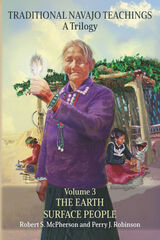
—Clayton Long, a participant/creator of the Navajo Rosetta Stone; Bilingual Education Director (retired), San Juan School District, Utah; and curriculum developer for the Navajo Nation.
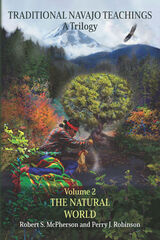
"Navajo teachings provide a classic study of a land-based religion that involves every aspect of the physical world in a spiritual universe. Nothing is too big or small—everything holds a power, provides a teaching, and responds through an inner form. Beyond the material life of daily existence, there lies a world of interconnected relations made apparent in Volume II, The Natural World. This book graphically describes elements of life rooted in the Navajo philosophy of hózhǫ́. A unified harmony results. I highly recommend this book as a study in understanding the power of relationships that populate the Diné worldview."
—Clayton Long, a participant/creator of the Navajo Rosetta Stone; Bilingual Education Director (retired), San Juan School District, Utah; and curriculum developer for the Navajo Nation.
"For days after reading The Natural World, I found myself looking at my surroundings in a different way. The vibrant spirit of the earth and every plant or animal I encountered seemed to glow through a translucent shell. I have always been a nature-lover and gotten a sense of peace from being outdoors, but since reading these beautiful Navajo teachings I am filled with a profound sense of joy and gratitude every time I walk outside."
—Cindy Yurth, The Navajo Times
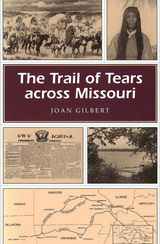
As settlers moved beyond the eastern seaboard during the early nineteenth century, the government forced thousands of American Indians from their ancestral lands. The Cherokees, the largest and most important tribe in the Southeast, fought exile with a combination of passive resistance and national publicity for their plight. Because they had successfully resisted the government's efforts to move them from their homeland, their removal was particularly brutal when it finally came. The Trail of Tears across Missouri is a moving account of the 1837-1838 removal of the Cherokees from the southeastern United States to Indian Territory (now Oklahoma).
After providing an overview of the Cherokees' life in the Southeast and of the events leading up to their exile, Joan Gilbert traces the mass exodus state by state from Tennessee to Arkansas. Successive chapters highlight the experiences and the hardships endured by those forced to travel with inadequate supplies of food, clothing, and transportation. It is estimated that four thousand Cherokees, nearly a quarter of the tribe, died.
In bringing the grim realities of the forced march to life, Gilbert draws from such primary sources as letters, newspaper stories, and the writings of missionaries, guides, and doctors who accompanied them. She focuses on the Cherokees' experiences as they passed through Missouri, using the journals of Dr. W. I. I. Morrow and guide B. B. Cannon.
In addition to chronicling the removal of the Cherokees, Gilbert also brings the story up to date by describing how the nation lives today and how the Trail of Tears has been commemorated.
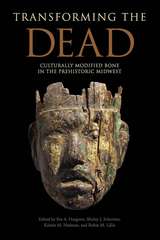
Most research addressing modified human bone has focused on cut marks and trauma associated with warfare, trophy taking, and burial practices. The editors and contributors of Transforming the Dead document the varied and often overlooked ways that human bone was intentionally modified through drilling, incising, cutting, and polishing for utilitarian, ornamental, spiritual, or ritual use. Examples include bracelets and gorgets to be worn, as well as musical rasps, pipe stems, masks, and protective talismans. The form and function of these objects are not unusual; their construction from the remains of “another” sets them apart.
Through a flexible but systematic analysis of the archaeological record, the contributors bring into focus how the careful selection, modification, and retention of particular bones or body parts of an individual after death offer insights into concepts of personhood, the body, life, and death among the prehistoric Native Americans in the Midwest.
Focusing on the Tiwa-speaking communities of Taos, Picuris, and Pot Creek Pueblos, Adler shows how social and ritual organization, architectural change, and sacred geographies were mobilized in response to disruption. He challenges conventional resilience theory, which emphasizes systemic stability, instead centering Indigenous agency, mobility, and sacred practice as key to understanding cultural endurance.
Grounded in decades of collaborative research with Pueblo communities, Transilient Acts and Resilient Villages is a vital contribution to southwestern archaeology. It offers a compelling model for how archaeology can respectfully engage with descendant communities and provides essential insights for scholars, students, and community members seeking to understand the complexities of cultural persistence in the face of change.
In Transit, Chadwick Allen chronicles the surprising history of how the ancient snake effigy known as Serpent Mound, located in what is now southern Ohio, traveled to Seattle, Washington in the 1970s, at the height of American Indian activism associated with the Red Power movement. Allen considers Indigenous earthworks built for thousands of years across the eastern half of the North American continent, questioning what it would mean if they were understood not as static entities fixed in space and time, but as animate forces with the ability to travel. Allen also looks at the origins of the “modern” effigy in the nineteenth century, when archaeologists reconstructed Serpent Mound’s deteriorating form to create a static icon suitable for touristic display within the confines of a settler state memorial.
Drawing from archival research, interviews, and site-specific encounters, Transit meditates on the significance of building an earthen effigy in the Pacific Northwest, as part of what became the Daybreak Star Indian Cultural Center, and on the complexity of the mound’s generative contexts. Allen’s research intersects the mid-twentieth century, when artist Robert Smithson created his iconic Spiral Jetty earth sculpture and when the Muscogee (Creek) Nation designed its innovative Mound Building. The story remains ongoing in the twenty-first century, as new mounds are rising in Oklahoma and artists, activists, and intellectuals are again asserting the power of Indigenous design.
How authors rendered Dakhóta philosophy by literary means to encode ethical and political connectedness and sovereign life within a settler surveillance state
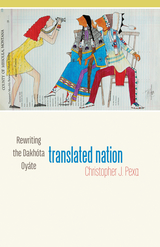
Translated Nation examines literary works and oral histories by Dakhóta intellectuals from the aftermath of the 1862 U.S.–Dakota War to the present day, highlighting creative Dakhóta responses to violences of the settler colonial state. Christopher Pexa argues that the assimilation era of federal U.S. law and policy was far from an idle one for the Dakhóta people, but rather involved remaking the Oyáte (the Očéti Šakówiŋ Oyáte or People of the Seven Council Fires) through the encrypting of Dakhóta political and relational norms in plain view of settler audiences.
From Nicholas Black Elk to Charles Alexander Eastman to Ella Cara Deloria, Pexa analyzes well-known writers from a tribally centered perspective that highlights their contributions to Dakhóta/Lakhóta philosophy and politics. He explores how these authors, as well as oral histories from the Spirit Lake Dakhóta Nation, invoke thióšpaye (extended family or kinship) ethics to critique U.S. legal translations of Dakhóta relations and politics into liberal molds of heteronormativity, individualism, property, and citizenship. He examines how Dakhóta intellectuals remained part of their social frameworks even while negotiating the possibilities and violence of settler colonial framings, ideologies, and social forms.
Bringing together oral and written as well as past and present literatures, Translated Nation expands our sense of literary archives and political agency and demonstrates how Dakhóta peoplehood not only emerges over time but in everyday places, activities, and stories. It provides a distinctive view of the hidden vibrancy of a historical period that is often tied only to Indigenous survival.
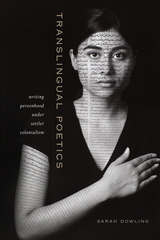
Since the 1980s, poets in Canada and the U.S. have increasingly turned away from the use of English, bringing multiple languages into dialogue—and into conflict—in their work. This growing but under-studied body of writing differs from previous forms of multilingual poetry. While modernist poets offered multilingual displays of literary refinement, contemporary translingual poetries speak to and are informed by feminist, anti-racist, immigrant rights, and Indigenous sovereignty movements. Although some translingual poems have entered Chicanx, Latinx, Asian American, and Indigenous literary canons, translingual poetry has not yet been studied as a cohesive body of writing.
The first book-length study on the subject, Translingual Poetics argues for an urgent rethinking of Canada and the U.S.’s multiculturalist myths. Dowling demonstrates that rising multilingualism in both countries is understood as new and as an effect of cultural shifts toward multiculturalism and globalization. This view conceals the continent’s original Indigenous multilingualism and the ongoing violence of its dismantling. It also naturalizes English as traditional, proper, and, ironically, native.
Reading a range of poets whose work contests this “settler monolingualism”—Jordan Abel, Layli Long Soldier, Myung Mi Kim, Guillermo Gómez-Peña, M. NourbeSe Philip, Rachel Zolf, Cecilia Vicuña, and others—Dowling argues that translingual poetry documents the flexible forms of racialization innovated by North American settler colonialisms. Combining deft close readings of poetry with innovative analyses of media, film, and government documents, Dowling shows that translingual poetry’s avoidance of authentic, personal speech reveals the differential forms of personhood and non-personhood imposed upon the settler, the native, and the alien.
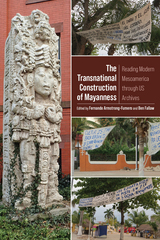
Contributors tap documentary, ethnographic, and ethnoarchaeological sources from North America to expand established categories of fieldwork and archival research conducted within the national spaces of Mexico and Central America. A particularly rich and diverse set of case studies interrogate the historical processes that remove sources from their place of production in the “field” to the US, challenge the conventional wisdom regarding the geography of data sources that are available for research, and reveal a range of historical relationships that enabled US actors to shape the historical experience of Maya-speaking peoples.
The Transnational Construction of Mayanness offers rich insight into transnational relations and suggests new avenues of research that incorporate an expanded corpus of materials that embody the deep-seated relationship between Maya-speaking peoples and various gringo interlocutors. The work is an important bridge between Mayanist anthropology and historiography and broader literatures in American, Atlantic, and Indigenous studies.
Contributors: David Carey, M. Bianet Castellanos, Matilde Córdoba Azcárate, Lydia Crafts, John Gust, Julio Cesar Hoil Gutierréz, Jennifer Mathews, Matthew Watson
In her compelling and controversial arguments, Wickman rejects the myths that erase Native Americans from Florida through the agency of Spaniards and diseases and make the area an empty frontier awaiting American expansion. Through research on both sides of the Atlantic and extensive oral history interviews among the Seminoles of Florida and Oklahoma, Wickman shatters current theories about the origins of the people encountered by the Spaniards and presents, for the first time ever, the Native American perspective. She describes the genesis of the groups known today as Creek, Seminole, and Miccosukee—the Maskoki peoples—and traces their common Mississippian heritage, affirming their claims to continuous habitation of the Southeast and Florida. Her work exposes the rhetoric of conquest and replaces it with the rhetoric of survival.
An important cross-disciplinary work, The Tree That Bends reveals the flexibility of the Maskoki people and the sociocultural mechanisms that allowed them to survive the pressures introduced at contact. Their world was capable of incorporating the New without destroying the Old, and their descendants not only survive today but also succeed as a discrete culture as a result.

In 1889, Sitting Bull addressed the formal, Western-style education of his people. “When you find something good in the white man's road, pick it up,” he intoned. “When you find something that is bad . . . leave it alone. We shall master his machinery, and his inventions, his skills, his medicine, his planning, but we will retain our beauty and still be Indians.”
Sitting Bull's vision—that cultural survival and personal perseverance derive from tribal resilience—lies at the heart of Tribal Strengths and Native Education. Basing his account on the insights of six veteran American Indian educators who serve in three reservation schools on the Northern Plains, Terry Huffman explores how Native educators perceive pedagogical strengths rooted in their tribal heritage and personal ethnicity. He recounts their views on the issues facing students and shows how tribal identity can be a source of resilience in academic and personal success. Throughout, Huffman and the educators emphasize the importance of anchoring the formal education of Indian children in Native values and worldviews—in “tribal strengths.”

Scheub delves into the importance of trickster mythologies and the shifting relationships between tricksters and heroes. He examines protagonists that figure centrally in a wide range of oral narrative traditions, showing that the true hero is always to some extent a trickster as well. The trickster and hero, Scheub contends, are at the core of storytelling, and all the possibilities of life are there: we are taken apart and rebuilt, dismembered and reborn, defeated and renewed.
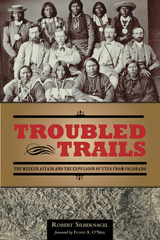
When U.S. Cavalry troops rode onto the Ute Indian Reservation in northwestern Colorado on September 29, 1879, they triggered a chain of events that cost the Utes their homeland: a deadly battle at Milk Creek, the killing of all men at the Indian agency headed by Nathan Meeker, and the taking of three women and two children who were held hostage for 23 days. The Utes didn’t seek a fight with the whites, most of whom they viewed as friends. However, powerful whites in Colorado wanted the Utes expelled. The Meeker affair was an opportunity to achieve that.
In Troubled Trails, Robert Silbernagel casts new light on the story of the Meeker Affair. Using details from historical interview transcripts and newspaper articles, he reveals the personalities of the major characters—both Indian and non-Indian. He tells the story from many perspectives, including that of Indian Agent Nathan Meeker; the U.S. military; Nicaagat, a leader of the White River Utes; and Josephine Meeker, Nathan Meeker’s daughter, who was held hostage by the Utes. Silbernagel took great pains to tell a complete story, even following on horseback the trail taken by the Utes. As a result, his book paints a multifaceted picture of what took place and, most importantly, his portrayal brings the Ute side of the story into focus.
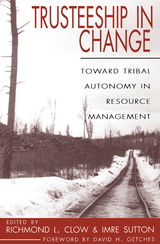
This book also includes case studies focused on wildlife management, forest preservation, tribal hunting laws, and other specific concerns in management, preservation and utilization of Native American land. An excellent source for scholars in the fields of Native American and environmental studies, Trusteeship in Change is sure to spark debate and to be an important reference book for years to come.


In the view of the English colonists and their descendants, Indian converts to Christianity were expected to repudiate native traditions and affirm the superiority of European civilization, to serve as role models, and to spread the gospel far into the wilderness. Yet as Bernd C. Peyer shows, Indian missionaries did not always fulfill the expectations of those who trained them. Once the Indians recognized that conversion alone did not guarantee protection from discrimination, they devised a variety of strategies, theological as well as practical, to resist assimilation into the dominant white culture. Making effective use of their literacy and education, they called attention to the discrepancy between the Protestant ideals they had been taught and the Anglo-American practices to which native people were subjected.
By uncovering this subtext of dissent and resistance, Peyer at once alters and enriches our understanding of the evolution of the American Indian literary tradition.
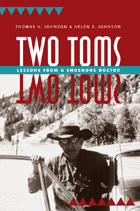
In 1969, Tom Wesaw was an 83-year-old Shoshone doctor and religious leader on the Wind River Reservation in Wyoming. He could no longer drive, which posed problems in making house calls. The arrival of young anthropologist Tom Johnson changed that. Johnson would drive Wesaw, and cook, pump water, and build fires for sweat lodges. In exchange, the elder Tom would show the younger Tom his work. The two were together so often that the people of Wind River began to refer to them affectionately by one name: Two Toms. By the light of the lamp Wesaw gave him, Johnson would write down what he learned. The Shoshone doctor wanted his student to share everything he saw and heard. Now, in Two Toms: Lessons from a Shoshone Doctor, he has.
READERS
Browse our collection.
PUBLISHERS
See BiblioVault's publisher services.
STUDENT SERVICES
Files for college accessibility offices.
RECENTLY PUBLISHED





UChicago Accessibility Resources
home | accessibility | search | about | contact us
BiblioVault ® 2001 - 2026
The University of Chicago Press