Results by title
5448 books match the query 'History and criticism' and 404 start with a
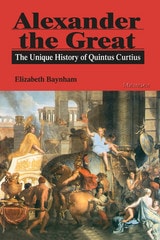
Alexander the Great
The Unique History of Quintus CurtiusElizabeth Baynham
University of Michigan Press, 2004
The reign and personality of Alexander the Great---one of the most romantic and powerful kings in history---have remained a source of fascination from antiquity to the present. But because the ancient information surrounding the conqueror is rich, contradictory, and complex, every historian of this near-mythical ruler-whether ancient or modern-invariably creates his or her own Alexander.
The unique work of one such ancient historian, Quintus Curtius, is the subject of Elizabeth Baynham's book. She mines Curtius' study of power for his contemporary perspective, historical methodology, and his portrait of the famous king and presents us with a brilliant, multifaceted study of this unique account regarding one of the most fascinating rulers in history.
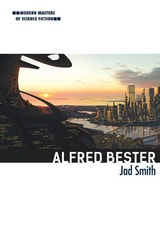
Alfred Bester
Jad Smith
University of Illinois Press, 2016
Jad Smith traces the career of the unlikeliest of SF icons. Winner of the first Hugo Award for The Demolished Man, Bester also worked in comics, radio, and TV, and his intermittent SF writing led some critics to brand him a dabbler. In the 1960s, however, New Wave writers championed his work, and his reputation grew. Smith follows Bester's journey from consummate outsider to an artist venerated for foundational works that influenced the New Wave and cyberpunk revolutions. He also explores the little-known roots of a wayward journey fueled by curiosity, disappointment with the SF mainstream, and an artist's determination to go his own way.
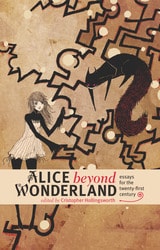
Alice beyond Wonderland
Essays for the Twenty-first CenturyCristopher Hollingsworth
University of Iowa Press, 2008
The scholars in this volume attempt to move beyond the sexually charged permutations of the "Carroll myth," the image of an introverted man fumbling into literary immortality through his love for a prepubescent Alice. Contributions include an essay comparing Dantean and Carrollian underworlds, one investigating child characters as double agents in untamed lands, one placing Wonderland within the geometrical and algebraic “fourth dimension,” one investigating the visual and verbal interplay of hand imagery, and one exploring the influence of Japanese translations of Alice on the Gothic-Lolita subculture of neo-Victorian enthusiasts. This is a bold, capacious, and challenging work.
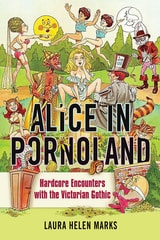
Alice in Pornoland
Hardcore Encounters with the Victorian GothicLaura Helen Marks
University of Illinois Press, 2018
Laura Helen Marks investigates the contradictions and seesawing gender dynamics in Victorian-inspired adult films and looks at why pornographers persist in drawing substance and meaning from the era's Gothic tales. She focuses on the particular Victorianness that pornography prefers, and the mythologies of the Victorian era that fuel today's pornographic fantasies. In turn, she exposes what porning the Victorians shows us about pornography as a genre.
A bold foray into theory and other forbidden places, Alice in Pornoland reveals how modern-day Victorian Gothic pornography constantly emphasizes, navigates, transgresses, and renegotiates issues of gender, sexuality, and race.
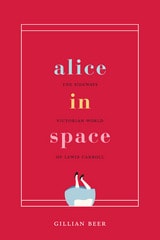
Alice in Space
The Sideways Victorian World of Lewis CarrollGillian Beer
University of Chicago Press, 2016
Gillian Beer explores Carroll’s work through the speculative gaze of Alice, for whom no authority is unquestioned and everything can speak. Parody and Punch, evolutionary debates, philosophical dialogues, educational works for children, math and logic, manners and rituals, dream theory and childhood studies—all fueled the fireworks. While much has been written about Carroll’s biography and his influence on children’s literature, Beer convincingly shows him at play in the spaces of Victorian cultural and intellectual life, drawing on then-current controversies, reading prodigiously across many fields, and writing on multiple levels to please both children and adults in different ways.
With a welcome combination of learning and lightness, Beer reminds us that Carroll’s books are essentially about curiosity, its risks and pleasures. Along the way, Alice in Space shares Alice’s exceptional ability to spark curiosity in us, too.
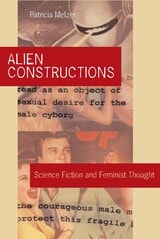
Alien Constructions
Science Fiction and Feminist ThoughtBy Patricia Melzer
University of Texas Press, 2006
Though set in other worlds populated by alien beings, science fiction is a site where humans can critique and re-imagine the paradigms that shape this world, from fundamentals such as the sex and gender of the body to global power relations among sexes, races, and nations. Feminist thinkers and writers are increasingly recognizing science fiction's potential to shatter patriarchal and heterosexual norms, while the creators of science fiction are bringing new depth and complexity to the genre by engaging with feminist theories and politics. This book maps the intersection of feminism and science fiction through close readings of science fiction literature by Octavia E. Butler, Richard Calder, and Melissa Scott and the movies The Matrix and the Alien series.
Patricia Melzer analyzes how these authors and films represent debates and concepts in three areas of feminist thought: identity and difference, feminist critiques of science and technology, and the relationship among gender identity, body, and desire, including the new gender politics of queer desires, transgender, and intersexed bodies and identities. She demonstrates that key political elements shape these debates, including global capitalism and exploitative class relations within a growing international system; the impact of computer, industrial, and medical technologies on women's lives and reproductive rights; and posthuman embodiment as expressed through biotechnologies, the body/machine interface, and the commodification of desire. Melzer's investigation makes it clear that feminist writings and readings of science fiction are part of a feminist critique of existing power relations—and that the alien constructions (cyborgs, clones, androids, aliens, and hybrids) that populate postmodern science fiction are as potentially empowering as they are threatening.
Alienated Women
A Study on Polish Women's Writing, 1845 -1918Grazyna Borkowska
Central European University Press, 2001

Aliens R Us
The Other in Science Fiction CinemaEdited by Ziauddin Sardar and Sean Cubitt
Pluto Press, 2002

Aliens
An Anthropology of Science FictionEdited by George E. Slusser and Eric S. Rabkin
Southern Illinois University Press, 1987
How and when does there come to be an “anthropology of the alien?” This set of essays, written for the eighth J. Lloyd Eaton Conference on Fantasy and Science Fiction, is concerned with the significance of that question. “[Anthropology] is the science that must designate the alien ifit is to redefine a place for itself in the universe,” according to the Introduction.
The idea of the alien is not new. In the Renaissance, Montaigne’s purpose in describing an alien encounter was excorporation—mankind was the “savage” because the artificial devices of nature controlled him. Shakespeare’s version of the alien encounter was incorporation; his character of Caliban is brought to the artificial, political world of man and incorporated into the body politic
“The essays in this volume . . . show, in their general orientation, that the tribe of
This book is divided into three parts: “Searchings: The Quest for the Alien” includes “The Aliens in Our Mind,” by Larry Niven; “Effing the Ineffable,” by Gregory Benford; “Border Patrols,” by Michael Beehler; “Alien Aliens,” by Pascal Ducommun; and “Metamorphoses of the Dragon,” by George E. Slusser.
“Sightings: The Aliens among Us” includes “Discriminating among Friends,” by John Huntington; “Sex, Superman, Sociobiology,” by Joseph D. Miller; “Cowboys and Telepaths,” by Eric S. Rabkin; “Robots,” by Noel Perrin; “Aliens in the Supermarket,” by George R. Guffey; and “Aliens ‘R’ U.S.,” by Zoe Sofia.
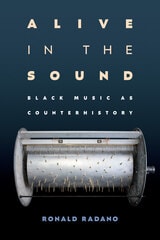
Alive in the Sound
Black Music as CounterhistoryRonald Radano
Duke University Press, 2025
All Contraries Confounded
The Lyrical FictionKaren Kaivola
University of Iowa Press, 1991
Kaivola has worked out a strikingly original means of reading difference—and reading differently—in order to account for what has been inexplicable in different literary texts by women. All Contraries Confounded seeks to problematize feminist theory that celebrates resistance in fiction by women, for it questions the ability of dominant modes of feminist critical theory to recognize and address fully the forms of contradiction and ambivalence that riddle women's writings—and women's lives.
All Is True
The Claims and Strategies of Realist FictionLilian R. Furst
Duke University Press, 1995
In close textual analyses of works ranging across European and American literature, including paradigmatic texts by Balzac, Flaubert, George Eliot, Zola, Henry James, and Thomas Mann, Furst shows how the handling of time, the presentation of place, and certain narrational strategies have served the realists’ claim. She demonstrates how readers today, like those a hundred years ago, are convinced of the authenticity of the created illusion by such means as framing, voice, perspective, and the slippage from metonymy to metaphor. Further, Furst reveals the pains the realists took to conceal these devices, and thus to protect their claim to be employing a simple form. Taking into account both the claims and the covert strategies of these writers, All Is True puts forward an alternative to the conventional polarized reading of the realist text—which emerges here as neither strictly an imitation of an extraneous model nor simply a web of words but a brilliantly complex imbrication of the two.
A major statement on one of the most enduring forms in cultural history, this book promises to alter not only our view of realist fiction but our understanding of how we read it.
All My Relatives
Community in Contemporary Ethnic American LiteraturesBonnie TuSmith
University of Michigan Press, 1994
All My Relatives provides a new way of reading popular works such as The Woman Warrior, The Joy Luck Club, The Color Purple and John Edgar Wideman's Sent for You Yesterday. TuSmith's study will appeal to general readers as well as students and scholars of American culture, ethnic studies, and American literature.
"An original contribution to the field. TuSmith's willingness to step over invisible boundaries and to draw parallels between the cultural contexts of several ethnic groups at once is refreshing and important." --Amy Ling, University of Wisconsin, Madison
"Ambitious and timely . . . a significant work that Americanists will want to read. TuSmith does an excellent job of clarifying the meaning and significance of the term "ethnicity" in relation to American literature."--Ramón Saldívar, Stanford University
". . . TuSmith establishes the importance of traditional (usually oral) modes of expression to ethnic texts that are both relational and accessible . . . . [S]hould become a standard point of reference in the emerging field of comparative American literature."--Choice
Bonnie TuSmith is Assistant Professor of English, Bowling Green State University.
All New, All Different?
A History of Race and the American SuperheroBy Allan W. Austin and Patrick L. Hamilton
University of Texas Press, 2019
Winner, John G. Cawelti Award for the Best Textbook/Primer, Popular Culture Association/American Culture Association, 2019
MPCA/ACA Book Award, Midwest Popular Culture Association / Midwest American Culture Association, 2020
Taking a multifaceted approach to attitudes toward race through popular culture and the American superhero, All New, All Different? explores a topic that until now has only received more discrete examination. Considering Marvel, DC, and lesser-known texts and heroes, this illuminating work charts eighty years of evolution in the portrayal of race in comics as well as in film and on television.
Beginning with World War II, the authors trace the vexed depictions in early superhero stories, considering both Asian villains and nonwhite sidekicks. While the emergence of Black Panther, Black Lightning, Luke Cage, Storm, and other heroes in the 1960s and 1970s reflected a cultural revolution, the book reveals how nonwhite superheroes nonetheless remained grounded in outdated assumptions. Multiculturalism encouraged further diversity, with 1980s superteams, the minority-run company Milestone’s new characters in the 1990s, and the arrival of Ms. Marvel, a Pakistani-American heroine, and a new Latinx Spider-Man in the 2000s. Concluding with a discussion of contemporary efforts to make both a profit and a positive impact on society, All New, All Different? enriches our understanding of the complex issues of racial representation in American popular culture.
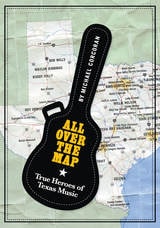
All Over the Map
True Heroes of Texas MusicMichael Corcoran
University of North Texas Press, 2017

All Over the Map
True Heroes of Texas MusicBy Michael Corcoran
University of Texas Press, 2005
From country and blues to rap and punk, Texas music is all over the map, figuratively and literally. Texas musicians have pioneered new musical genres, instruments, and playing styles, proving themselves to be daring innovators who often call the tune for musicians around the country and even abroad. To introduce some of these trailblazing Texas musicians to a wider audience and pay tribute to their accomplishments, Michael Corcoran profiles thirty-two of them in All Over the Map: True Heroes of Texas Music.
Corcoran covers musicians who work in a wide range of musical genres, including blues, gospel, country, rap, indie rock, pop, Cajun, Tejano, conjunto, funk, honky-tonk, rockabilly, rhythm and blues, and Western swing. His focus is on underappreciated artists, pioneers who haven't fully received their due. He also includes well-known musicians who've been underrated, such as Stevie Ray Vaughan and Selena, and invites us to take a closer look at the unique talents of these artists. Corcoran's profiles come from articles he wrote for the Dallas Morning News, Austin American-Statesman, Houston Press, and other publications, which have been expanded and updated for this volume. His musical detective work even uncovers a case of mistaken identity (Washington Phillips) and corrects much misinformation on Blind Willie Johnson and Arizona Dranes. Corcoran closes the book with lively pieces on the Austin music scene and its most famous, if no longer extant, clubs, as well as his personal lists of the forty greatest Texas songs of all time and the twenty-five essential CDs for Texas music fans.
All Play and No Work
American Work Ideals and the Comic Plays of the Federal Theatre ProjectGagliardi, Paul
Temple University Press, 2024
All Play and No Work directly contradicts the promoted ideals of work found in American society, culture, and within the broader New Deal itself. Gagliardi shows how comedies of the Great Depression engaged questions of labor, labor history, and labor ethics. He considers the breadth of the FTP’s production history, staging plays including Ah, Wilderness!, Help Yourself, and Mississippi Rainbow.
Gagliardi examines backstage comedies, middle-class comedies, comedies of chance, and con-artist comedies that employed diverse casts and crew and contained radical economic and labor ideas. He contextualizes these plays within the ideologically complicated New Deal, showing how programs like the Social Security Act straddled progressive ideals and conservative, capitalist norms. Addressing topics including the politicization of theatrical labor and the real dangers of unchecked economic con artists, the comic plays of the FTP reveal acts of political resistance and inequality that reflected the concerns of their audiences.
All That Glitters
Country Music in AmericaGeorge H. Lewis
University of Wisconsin Press, 1993
All the Rage
William Logan
University of Michigan Press, 1998
Logan was among the first critics to review a generation of poets now in creative maturity, and his comments on the early works of Jorie Graham, Gjertrud Schnackenberg, and the late Amy Clampitt show the enthusiasm of fresh discovery. But he is no respecter of old reputation, as his reviews of John Ashbery and Robert Penn Warren demonstrate. In total, his criticism considers virtues with their defects and always speaks its author's mind. Some contemporary poetry has had few better friends, and some few greater enemies, than William Logan.
William Logan is the author of Sad-Faced Men, Difficulty, Sullen Weedy Lakes, and Vain Empires. He is Alumni/ae Professor of English, University of Florida.
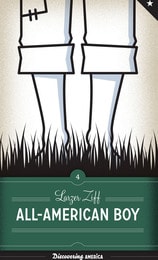
All-American Boy
By Larzer Ziff
University of Texas Press, 2012
From his celebrated appearance, hatchet in hand, in Parson Mason Locke Weems’s Life of Washington to Booth Tarkington’s Penrod, the all-American boy was an iconic figure in American literature for well over a century. Sometimes he was a “good boy,” whose dutiful behavior was intended as a model for real boys to emulate. Other times, he was a “bad boy,” whose mischievous escapades could be excused either as youthful exuberance that foreshadowed adult industriousness or as deserved attacks on undemocratic pomp and pretension. But whether good or bad, the all-American boy was a product of the historical moment in which he made his appearance in print, and to trace his evolution over time is to take a fresh view of America’s cultural history, which is precisely what Larzer Ziff accomplishes in All-American Boy.
Ziff looks at eight classic examples of the all-American boy—young Washington, Rollo, Tom Bailey, Tom Sawyer, Ragged Dick, Peck’s “bad boy,” Little Lord Fauntleroy, and Penrod—as well as two notable antitheses—Huckleberry Finn and Holden Caulfield. Setting each boy in a rich cultural context, Ziff reveals how the all-American boy represented a response to his times, ranging from the newly independent nation’s need for models of democratic citizenship, to the tales of rags-to-riches beloved during a century of accelerating economic competition, to the recognition of adolescence as a distinct phase of life, which created a stage on which the white, middle-class “solid citizen” boy and the alienated youth both played their parts.
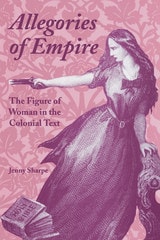
Allegories of Empire
The Figure of Woman in the Colonial TextJenny Sharpe
University of Minnesota Press, 1993
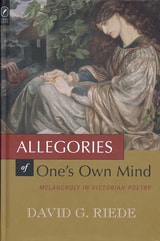
Allegories of One’s Own Mind
MELANCHOLY IN VICTORIAN POETRYDavid G. Riede
The Ohio State University Press, 2005
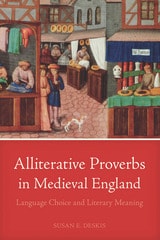
Alliterative Proverbs in Medieval England
Language Choice and Literary MeaningSusan E. Deskis
The Ohio State University Press, 2016
The proverb has been an underutilized resource in tracing the linguistic and intellectual cultures of the past. Making the fullest use of this material, this study, by Susan E. Deskis, is complex in its combination of philology, paroemiology, literary history, and sociolinguistics, ultimately reaching conclusions that are enlightening for both the literary and linguistic histories of medieval England. In the language ecology of England from about 1100 to about 1500, where English, French, and Latin compete for use, alliterative proverbs are marked not only by the choice of English as the language of expression but also because alliteration in Middle English connotes a conscious connection to the past. Alliterative Proverbs in Medieval England: Language Choice and Literary Meaning explores how that connection is exploited in various literary genres from school texts and sermons to romances and cycle plays.
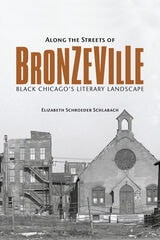
Along the Streets of Bronzeville
Black Chicago's Literary LandscapeElizabeth Schroeder Schlabach
University of Illinois Press, 2017
In this significant recovery project, Elizabeth Schroeder Schlabach investigates the institutions and streetscapes of Black Chicago that fueled an entire literary and artistic movement. She argues that African American authors and artists--such as Gwendolyn Brooks, Richard Wright, Langston Hughes, painter Archibald Motley, and many others--viewed and presented black reality from a specific geographic vantage point: the view along the streets of Bronzeville. Schlabach explores how the particular rhythms and scenes of daily life in Bronzeville locations, such as the State Street "Stroll" district or the bustling intersection of 47th Street and South Parkway, figured into the creative works and experiences of the artists and writers of the Black Chicago Renaissance. She also covers in detail the South Side Community Art Center and the South Side Writers' Group, two institutions of art and literature that engendered a unique aesthetic consciousness and political ideology for which the Black Chicago Renaissance would garner much fame.
Life in Bronzeville also involved economic hardship and social injustice, themes that resonated throughout the flourishing arts scene. Schlabach explores Bronzeville's harsh living conditions, exemplified in the cramped one-bedroom kitchenette apartments that housed many of the migrants drawn to the city's promises of opportunity and freedom. Many struggled with the precariousness of urban life, and Schlabach shows how the once vibrant neighborhood eventually succumbed to the pressures of segregation and economic disparity. Providing a virtual tour South Side African American urban life at street level, Along the Streets of Bronzeville charts the complex interplay and intersection of race, geography, and cultural criticism during the Black Chicago Renaissance's rise and fall.
Ambient Sufism
Ritual Niches and the Social Work of Musical FormRichard C. Jankowsky
University of Chicago Press, 2021
Ambiguity and Gender in the New Novel of Brazil and Spanish America
A Comparative AssessmentPayne, Judith A.
University of Iowa Press, 1993
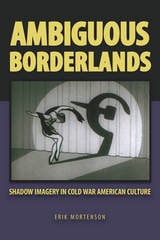
Ambiguous Borderlands
Shadow Imagery in Cold War American CultureErik Mortenson
Southern Illinois University Press, 2016
After contextualizing the postwar use of shadow imagery in the wake of the atomic bomb, Ambiguous Borderlands looks at shadows in print works, detailing the reemergence of the pulp fiction crime fighter the Shadow in the late-1950s writings of Sylvia Plath, Amiri Baraka, and Jack Kerouac. Using Freudian and Jungian conceptions of the unconscious, Mortenson then discusses Kerouac’s and Allen Ginsberg’s shared dream of a “shrouded stranger” and how it shaped their Beat aesthetic. Turning to the visual, Mortenson examines the dehumanizing effect of shadow imagery in the Cold War photography of Robert Frank, William Klein, and Ralph Eugene Meatyard. Mortenson concludes with an investigation of the use of chiaroscuro in 1950s film noir and the popular television series The Twilight Zone, further detailing how the complexities of Cold War society were mirrored across these media in the ubiquitous imagery of light and dark.
From comics to movies, Beats to bombs, Ambiguous Borderlands provides a novel understanding of the Cold War cultural context through its analysis of the image of the shadow in midcentury media. Its interdisciplinary approach, ambitious subject matter, and diverse theoretical framing make it essential reading for anyone interested in American literary and popular culture during the fifties and sixties.
America the Middlebrow
Women's Novels, Progressivism, and Middlebrow Authorship between the WarsJaime Harker
University of Massachusetts Press, 2007
Between the two world wars, American publishing entered a “golden age” characterized by an explosion of new publishers, authors, audiences, distribution strategies, and marketing techniques. The period was distinguished by a diverse literary culture, ranging from modern cultural rebels to working-class laborers, political radicals, and progressive housewives. In America the Middlebrow, Jaime Harker focuses on one neglected mode of authorship in the interwar period—women's middlebrow authorship and its intersection with progressive politics.
With the rise of middlebrow institutions and readers came the need for the creation of the new category of authorship. Harker contends that these new writers appropriated and adapted a larger tradition of women's activism and literary activity to their own needs and practices. Like sentimental women writers and readers of the 1850s, these authors saw fiction as a means of reforming and transforming society. Like their Progressive Era forebears, they replaced religious icons with nationalistic images of progress and pragmatic ideology. In the interwar period, this mode of authorship was informed by Deweyan pragmatist aesthetics, which insisted that art provided vicarious experience that could help create humane, democratic societies.
Drawing on letters from publishers, editors, agents, and authors, America the Middlebrow traces four key moments in this distinctive culture of letters through the careers of Dorothy Canfield, Jessie Fauset, Pearl Buck, and Josephine Herbst. Both an exploration of a virtually invisible culture of letters and a challenge to monolithic paradigms of modernism, the book offers fresh insight into the ongoing tradition of political domestic fiction that flourished between the wars.
America's Gothic Fiction
The Legacy of Magnalia Christi AmericanaDorothy Z. Baker
The Ohio State University Press, 2007
American Audacity
Literary Essays North and SouthChristopher Benfey
University of Michigan Press, 2010
---William H. Pritchard
American Autobiography after 9/11
Megan Brown
University of Wisconsin Press, 2017
This lively and theoretically grounded book analyzes twenty-first-century memoirs from Three Cups of Tea to Fun Home, emphasizing the ways in which they reinforce and circulate ideologies, becoming guides or models for living. Brown expands her inquiry beyond books to the autobiographical narratives in reality television and political speeches. She offers a persuasive explanation for the memoir boom: the genre as a response to an era of uncertainty and struggle.
American Autobiography
Retrospect And ProspectPaul John Eakin
University of Wisconsin Press, 1991
The first four essays review the major historical periods of American autobiography, placing the classic texts of American autobiographical literature from Captain John Smith to Malcolm X in the illuminating context of lesser-known contemporary narratives. Daniel B. Shea writes on colonial America, Lawrence Buell on the American Renaissance, Susanna Egan on the years after the Civil War, and Albert E. Stone on the twentieth century.
The second part of American Autobiography shows the diversity of voices, forms, audiences, and modes of identity in the literature of American autobiography. Provocative essays by William Boelhower and Sau-Ling Cynthia Wong on immigrant autobiography discuss the changes in the sense of self that occur when strangers come to a strange land. Arnold Krupat writes about how American Indians conceptualize the self and about the relationship between oral and written discourse. William L. Andrews evaluates the strong body of critical theory that has grown up around African-American autobiography, showing how both the genre and its criticism have responded to contemporary historical pressures. Carol Holly explores the model of personal identity that underlies nineteenth-century women’s autobiographies, and Blanche Gelfant examines the narrative and political strategies of Emma Goldman’s autobiography, especially her use of popular romance and melodrama.
The last essay offers a more personal perspective on contemporary autobiography: a “dialogue” between Robert and Jane Coles about how they developed their method of eliciting first-person oral narratives for their famous Children of Crisis and Women of Crisis series.
These essays raise theoretical issues that are examined in Paul John Eakin’s incisive introduction: How do we define a literary genre of protean shape and perplexing cultural multiplicity? How do we approach the special problems created by documents that are both historical and literary texts, ones that pose difficult questions about truth and representation? Most important, how is the canon of American autobiography to be constructed, and how is its history to be written? Tracing that critical history, Eakin explains how changing ideas about “the mainstream” and “the marginal” have revitalized our retrospective view of American autobiography and opened up new and exciting prospects for today’s reader.
American Blockbuster
Movies, Technology, and WonderCharles R. Acland
Duke University Press, 2020
American Datelines
Major News Stories from Colonial Times to the PresentEdited by Ed Cray, Jonathan Kotler, and Miles Beller
University of Illinois Press, 1990
The original articles in this compelling collection are arranged chronologically and appear as they were first published, providing a lively and unique view of the events that have most influenced politics and culture. Readers can experience the thrill and excitement of breaking news from the real story of Jesse James and the capture of Al Capone to a vibrant portrayal of baseball's first professional African American player and a probing look at the shocking New York Armory show where modern art was born. This first paperback edition features an updated introduction by the editors and several newsworthy additions, including the fall of the Berlin Wall, the O. J. Simpson trial, the Clinton impeachment trial, the home run race between Mark McGwire and Sammy Sosa, and Bush v. Gore.
American Drama in the Age of Film
Zander Brietzke
University of Alabama Press, 2007
Is theater really dead? Does the theater, as its champions insist, really provide a more intimate experience than film? If so, how have changes in cinematic techniques and technologies altered the relationship between stage and film? What are the inherent limitations of representing three-dimensional spaces in a two-dimensional one, and vice versa?
American Drama in the Age of Film examines the strengths and weaknesses of both the dramatic and cinematic arts to confront the standard arguments in the film-versus-theater debate. Using widely known adaptations of ten major plays, Brietzke seeks to highlight the inherent powers of each medium and draw conclusions not just about how they differ, but how they ought to differ as well. He contrasts both stage and film productions of, among other works, David Mamet’s Glengarry Glen Ross, Sam Shepard’s True West, Edward Albee’s Who’s Afraid of Virginia Woolf, Margaret Edson’s Wit, Tony Kushner’s Angels in America, Tennessee Williams’s Cat on a Hot Tin Roof, Arthur Miller’s Death of a Salesman, and August Wilson’s The Piano Lesson. In reading the dual productions of these works, Brietzke finds that cinema has indeed stolen much of theater’s former thunder, by making drama more intimate, and visceral than most live events.
But theater is still vital and matters greatly, Brietzke argues, though for reasons that run counter to many of the virtues traditionally attributed to it as an art form, such as intimacy and spontaneity. Brietzke seeks to revitalize perceptions of theater by challenging those common pieties and offering a new critical paradigm, one that champions spectacle and simultaneity as the most, not least, important elements of drama.
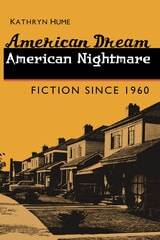
American Dream, American Nightmare
Fiction since 1960Kathryn Hume
University of Illinois Press, 2000
In breaking down the divisions among standard categories of race, religion, ethnicity, and gender, Hume identifies shared core concerns, values, and techniques among seemingly disparate and unconnected writers including T. Coraghessan Boyle, Ralph Ellison, Russell Banks, Gloria Naylor, Tim O'Brien, Maxine Hong Kingston, Walker Percy, N. Scott Momaday, John Updike, Toni Morrison, William Kennedy, Julia Alvarez, Thomas Pynchon, Leslie Marmon Silko, and Don DeLillo.
Hume explores fictional treatments of the slippage in the immigrant experience between America's promise and its reality. She exposes the political link between contemporary stories of lost innocence and liberalism's inadequacies. She also invites us to look at the literary challenge to scientific materialism in various searches for a spiritual dimension in life.
The expansive future promised by the American Dream has been replaced, Hume finds, by a sense of tarnished morality and a melancholy loss of faith in America's exceptionalism. American Dream, American Nightmare examines the differing critiques of America embedded in nearly a hundred novels and points to the source for recovery that appeals to many of the authors.
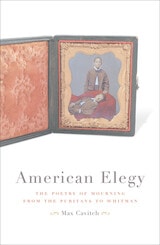
American Elegy
The Poetry of Mourning from the Puritans to WhitmanMax Cavitch
University of Minnesota Press, 2007
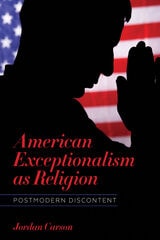
American Exceptionalism as Religion
Postmodern DiscontentJordan Carson
The Ohio State University Press, 2020
As American exceptionalism resurfaces in public discourse, Carson’s timely work invites readers to reconsider the nexus of religion, politics, and culture. Carson argues that defining religion according to secularist criteria has insulated ostensibly secular ideologies as well as traditional religion from public scrutiny. DeLillo’s, Castillo’s, Pynchon’s, Saunders’s, and Robinson’s redefinitions of religion result in a better grasp of how individuals actually live out their religious lives. More importantly, these authors help erect a framework for constructively engaging American exceptionalism and the ideas that support it.
American Fantastic
Myths of Violence and RedemptionDerek J. Thiess
University of Wisconsin Press, 2025
Thiess’s interdisciplinary study examines America’s past and present imperial projects, from the Hawaiian Islands to the Eastern Seaboard, as they proliferate in popular story forms. By interrogating American myths, legends, and fantastic narratives across an impressive array of genres, including folk narratives, science fiction, movies, and more, Thiess exposes how the “myth of redemptive violence” manifests in contemporary constructions of America’s fantastic imaginaries.
American Fiction and the Metaphysics of the Grotesque
Dieter Meindl
University of Missouri Press, 1996
By synthesizing Kayser's and Bakhtin's views of the grotesque and Heidegger's philosophy of Being, American Fiction and the Metaphysics of the Grotesque seeks to demonstrate that American fiction from Poe to Pynchon has tried to convey the existential dimension: the pre-individual totality or flow of life, which defines itself against the mind and its linguistic capacity. Dieter Meindl shows how the grotesque, through its self-contradictory nature, has been instrumental in expressing this reality-conception, an antirationalist stance in basic agreement with existential thought. The historical validity of this new metaphysics, which grants precedence to Being--the context of cognition--over the cognizant subject, must be upheld in the face of deconstructive animadversions upon any metaphysics of presence. The notion of decentering the subject, Meindl argues, did not originate with deconstruction.
The existential grotesque confirms the protomodernist character of classic American fiction. Meindl traces its course through a number of well-known texts by Melville, James, Gilman, Anderson, Faulkner, and O'Connor, among others. To convey life conceived as motion, these writers had to capture--that is, immobilize--it in their art: an essentially distortive and, therefore, grotesque device. Melville's "Bartleby," dealing with a mort vivant, is the seminal text in this mode of indirectness. As opposed to the existential grotesque, which grants access to a preverbal realm, the linguistic grotesque of postmodern fiction works on the assumption that all reality is referable to language in a textual universe.
American Fiction and the Metaphysics of the Grotesque will significantly alter our understanding of certain traditions in American literature.
American Fiction in the Cold War
Thomas H. Schaub
University of Wisconsin Press, 1991
In American Fiction in the Cold War Thomas Hill Schaub makes it clear that Trilling’s summary was in itself a mythic reconstruction, a prominent example of the way liberal writers in the late 1940s and 1950s came to terms with their political past. Schaub’s book brilliantly analyzes their efforts to reshape an “old” liberalism alleged to hold naively optimistic views of human nature, scientific reason, and social progress into a “new,” skeptical liberalism that recognized the persistence of human evil, the fragility of reason, and the ambiguity of moral decision.
Most important, as American Fiction in the Cold War demonstrates, these liberal reassessments of history, politics, human nature, and destiny—what Schaub calls the “liberal narrative”—mediated the critical and imaginative production of the literary community after World War II. Schaub shows that the elements of this narrative are visible in a wide spectrum of cultural narratives in American history, political philosophy, and social criticism during the Cold War era. His analysis of the dominant critical communities of the late 1940s—led by critics such as Lionel Trilling and Irving Howe, Cleanth Brooks and Allen Tate—recovers the political meanings embedded within their debates over the nature of literary realism, the definition of the novel, and speculations on its “death.”
In the second part of his study, Schaub turns to Ralph Ellison, Flannery O’Connor, Norman Mailer, and John Barth. His readings of their fiction isolate the political and cultural content of works often faulted for their apparent efforts to transcend social history. Reviewing John Barth’s End of the Road, for example, he shows the politics of culture concealed within what seems to be a philosophical narrative. In novel after novel, he demonstrates, the liberal narrative is operating from within, tuning and steering the direction of the plot and the creation of the character. Schaub’s penetrating exploration of the relationship between U.S. political and social thought and the literary consciousness in the early postwar years will be of interest to intellectual historians and to students of American literary culture.
American Gothic
New Interventions in a National NarrativeRobert K. Martin
University of Iowa Press, 1998
In America as in Britain, the rise of the Gothic represented the other—the fearful shadows cast upon Enlightenment philosophies of common sense, democratic positivism, and optimistic futurity. Many critics have recognized the centrality of these shadows to American culture and self-identification. American Gothic, however, remaps the field by offering a series of revisionist essays associated with a common theme: the range and variety of Gothic manifestations in high and popular art from the roots of American culture to the present.
The thirteen essayists approach the persistence of the Gothic in American culture by providing a composite of interventions that focus on specific issues—the histories of gender and race, the cultures of cities and scandals and sensations—in order to advance distinct theoretical paradigms. Each essay sustains a connection between a particular theoretical field and a central problem in the Gothic tradition.
Drawing widely on contemporary theory—particularly revisionist views of Freud such as those offered by Lacan and Kristeva—this volume ranges from the well-known Gothic horrors of Edgar Allan Poe and Nathaniel Hawthorne to the popular fantasies of Stephen King and the postmodern visions of Kathy Acker. Special attention is paid to the issues of slavery and race in both black and white texts, including those by Ralph Ellison and William Faulkner. In the view of the editors and contributors, the Gothic is not so much a historical category as a mode of thought haunted by history, a part of suburban life and the lifeblood of films such as The Exorcist and Fatal Attraction.
American History and Contemporary Hollywood Film
McCrisken, Trevor
Rutgers University Press, 2005
Hollywood has always been fascinated by America's past, but never more so than in the past fifteen years. Bringing exciting new perspectives to how and why Hollywood has sought to repicture American history, this book offers analysis of more than twenty mainstream contemporary films, including The Patriot, Amistad, Glory, Ride with the Devil, Cold Mountain, Saving Private Ryan, TheThin Red Line, Pearl Harbor, U-571, Platoon, Born on the Fourth of July, Heaven and Earth, JFK, Nixon, Malcolm X, Ali, Black Hawk Down, and Three Kings.
Both authoritative and engaging, American History and Contemporary Hollywood Film is the first book to comprehensively explore the post-cold war period of filmmaking, and to navigate the complex ways that film mediates history-sometimes challenging or questioning, but more frequently reaffirming traditional interpretations. The authors consider why such films are becoming increasingly integral to the ambitions of a globally focused American film industry.
Structured by historical periods, chapters cover significant events and eras such as the American Revolution, slavery and the Civil War, World War II, the sixties and seventies, civil rights and black nationalism, the Vietnam War, and post-cold war global conflicts. The lessons learned from the examples will be illuminating for general readers and college students alike.
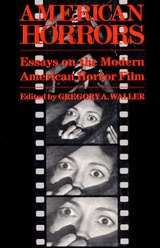
American Horrors
Essays on the Modern American Horror FilmEdited by Gregory A. Waller
University of Illinois Press, 1988
In this collection of twelve essays, Gregory Waller balances detailed studies of both popular films (Night of the Living Dead, The Exorcist, and Halloween) and particularly problematic films (Don't Look Now and Eyes of Laura Mars) with discussions of such central thematic preoccupations as the genre's representation of violence and female victims, its reflexivity and playfulness, and its ongoing redefinition of the monstrous and the normal.
In addition, American Horrors includes a filmography of movies and telefilms and an annotated bibliography of books and articles about horror since 1968.
American Hybrid Poetics
Gender, Mass Culture, and FormAmy Moorman Robbins
Rutgers University Press, 2014
American Indian Literature and the Southwest
Contexts and DispositionsBy Eric Gary Anderson
University of Texas Press, 1999
Culture-to-culture encounters between "natives" and "aliens" have gone on for centuries in the American Southwest—among American Indian tribes, between American Indians and Euro-Americans, and even, according to some, between humans and extraterrestrials at Roswell, New Mexico. Drawing on a wide range of cultural productions including novels, films, paintings, comic strips, and historical studies, this groundbreaking book explores the Southwest as both a real and a culturally constructed site of migration and encounter, in which the very identities of "alien" and "native" shift with each act of travel.
Eric Anderson pursues his inquiry through an unprecedented range of cultural texts. These include the Roswell spacecraft myths, Leslie Marmon Silko's Almanac of the Dead, Wendy Rose's poetry, the outlaw narratives of Billy the Kid, Apache autobiographies by Geronimo and Jason Betzinez, paintings by Georgia O'Keeffe, New West history by Patricia Nelson Limerick, Frank Norris' McTeague, Mary Austin's The Land of Little Rain, Sarah Winnemucca's Life Among the Piutes, Willa Cather's The Professor's House, George Herriman's modernist comic strip Krazy Kat, and A. A. Carr's Navajo-vampire novel Eye Killers.
American Indian Literature, Environmental Justice, and Ecocriticism
The Middle PlaceJoni Adamson
University of Arizona Press, 2001
This powerful book is one of the first to examine the intersections between literature and the environment from the perspective of the oppressions of race, class, gender, and nature, and the first to review American Indian literature from the standpoint of environmental justice and ecocriticism. By examining such texts as Sherman Alexie's short stories and Leslie Marmon Silko's novel Almanac of the Dead, Adamson contends that these works, in addition to being literary, are examples of ecological criticism that expand Euro-American concepts of nature and place.
Adamson shows that when we begin exploring the differences that shape diverse cultural and literary representations of nature, we discover the challenge they present to mainstream American culture, environmentalism, and literature. By comparing the work of Native authors such as Simon Ortiz with that of environmental writers such as Edward Abbey, she reveals opportunities for more multicultural conceptions of nature and the environment.
More than a work of literary criticism, this is a book about the search to find ways to understand our cultural and historical differences and similarities in order to arrive at a better agreement of what the human role in nature is and should be. It exposes the blind spots in early ecocriticism and shows the possibilities for building common ground— a middle place— where writers, scholars, teachers, and environmentalists might come together to work for social and environmental change.
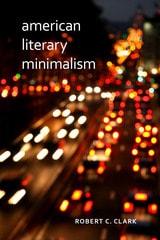
American Literary Minimalism
Robert C. Clark
University of Alabama Press, 2015
Tracing the evolution of minimalist style from Hemingway to the twenty‑first century.
Although a handful of books and articles have been written about American literary Minimalism during the last forty years, the mode remains misunderstood. When in a 2011 interview in The Paris Review author Ann Beattie was asked how she felt about being “classed as a minimalist,” she began her answer: “none of us have ever known what that means.” Her response brings into focus the lack of agreement or clarity about the sources and definitions of literary Minimalism. Robert C. Clark’s American Literary Minimalism fills this significant gap.
Clark demonstrates that, despite assertions by many scholars to the contrary, the movement originated in the aesthetic programs of the Imagists and literary Impressionists active at the turn of the twentieth century. The genre reflects the philosophy that “form is thought,” and that style alone dictates whether a poem, story, or novel falls within the parameters of the tradition. The characteristics of Minimalist fiction are efficiency, frequent use of allusion, and implication through omission.
Organizing his analysis both chronologically and according to lines of influence, Clark offers a definition of the mode, describes its early stages, and then explores six works that reflect its core characteristics: Ernest Hemingway’s In Our Time; Raymond Carver’s Cathedral; Jay McInerney’s Bright Lights, Big City; Susan Minot’s Monkeys; Sandra Cisneros’s Caramelo; and Cormac McCarthy’s The Road. In his conclusion, Clark discusses the ongoing evolution of the category.
American Literature and Culture in an Age of Cold War
A Critical ReassessmentSteven Belletto
University of Iowa Press, 2012
Likewise, the authors describe phenomena—such as the FBI’s surveillance of writers (especially African Americans), biopolitics, development theory, struggles over the centralization and decentralization of government, and the cultural work of Reaganism—that open up new contexts for discussing postwar culture. Extending the timeline and expanding the geographic scope of Cold War culture, this book reveals both the literature and the culture of the time to be more dynamic and complex than has been generally supposed.
American Literature and the Destruction of Knowledge
Innovative Writing in the Age of EpistemologyRonald E. Martin
Duke University Press, 1991
The works of Melville, Emerson, Whitman, and Dickinson, followed by Crane, Frost, Pound, Stein, Hemingway, Dos Passos, Aiken, Stevens, and Williams, are examined as part of a cultural current that casts doubt on the possibility of knowledge itself. The destruction of concepts, of literary and linguistic forms, was for these writers a precondition for liberating the imagination to gain more access to the self and the real world. As part of the exploration of this cultural context, literary and philosophical realisms are examined together, allowing a comparison of their somewhat different objectives, as well as their common epistemological predicament.