Results by title
3576 books match the query 'American' and 225 start with c

Cabin Stories
The Best of Dark Winter Nights: True Stories from AlaskaRob Prince
University of Alaska Press, 2022
From the humorous to the heart-wrenching, these are the stories told up north on dark winter nights. Anyone curious about what living in Alaska is really like will appreciate this wild and fun anthology.
Contributors: Glenner Anderson, Kat Betters, Randy Brown, Melissa Buchta, JB Carnahan, Philip Charette, Roy Churchwell, Richard Coleman, Michael Daku, Wendy Demers, Alexandra Dunlap, Alyssa Enriquez, Jan Hanscom, Mike Hopper, James Mennaker, Ken Moore, Steve Neumeth, Kaiti Ott, Lori Schoening, Bill Schnabel, Guy Schroder, Ed Shirk, Eric Stevens, Chris Zwolinski

Cafe Indiana Cookbook
Joanne Raetz Stuttgen
University of Wisconsin Press, 2010
Joanne Raetz Stuttgen’s cafe guides showcase popular regional diner traditions. In her companion book Cafe Indiana she introduces travelers to the state’s top mom-and-pop restaurants. Now, Cafe Indiana Cookbook allows you to whip up local cafe classics yourself. Breakfast dishes range from Swiss Mennonite eier datch (egg pancakes) to biscuits and gravy; entree highlights include chicken with noodles (or with dumplings) and the iconic Hoosier breaded pork tenderloin sandwich. For dessert, try such Indiana favorites as apple dapple cake or rhubarb, coconut cream, or sugar cream pie . All 130 recipes have been kitchen-tested by Jolene Ketzenberger, food writer for the Indianapolis Star.
Cafe Indiana Cookbook reveals the favorite recipes of Indiana’s Main Street eateries, including some rescued for publication before a diner’s sad closure, and documents old-fashioned delicacies now fading from the culinary landscape—like southern Indiana’s fried brain sandwiches.
Finalist, Cookbook, Midwest Book Awards

Cafe Indiana
A Guide to Indiana’s Down-Home CafesJoanne Raetz Stuttgen
University of Wisconsin Press, 2007
Over plates of chicken and noodles, fried bologna sandwiches, and sugar cream pie, folks are crafting community at the Main Street eatery. In Cafe Indiana, Hoosiers and out-of-staters alike are invited to pull out a chair and sit a spell.
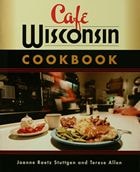
Cafe Wisconsin Cookbook
Joanne Raetz Stuttgen and Terese Allen
University of Wisconsin Press, 2007
Stuttgen tracked down Wisconsin's best small town cafes, from Boscobel to Sturgeon Bay, chatted with owners and customers, took notes, and recorded the history, anecdotes, and recipes behind the food. Tested and fine-tuned by Wisconsin food writer and former chef Terese Allen, these favorite recipes will bring an authentic slice of Wisconsin into your home kitchen.

Cafe Wisconsin
A Guide To Wisconsin's Down-Home CafesJoanne Raetz Stuttgen
University of Wisconsin Press, 2004
Featuring 133 cafes, with another 101 Next Best Bets alternatives, Cafe Wisconsin is every hungry traveler’s guide to real mashed potatoes, melt-in-your-mouth hot beef, from-scratch baked goods, and colorful coffee klatches. At the counter of aptly named cafes like the Coffee Cup, Main Street, and Chatterbox, you’ll laugh with owners, shake dice with customers, and find the authentic taste and flavor of Wisconsin.
Come on. Let’s go out to eat!
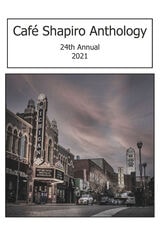
Café Shapiro Anthology 2021
Theresa Stanko
Michigan Publishing Services, 2021
Cairo Traffic
Lloyd Schwartz
University of Chicago Press, 2000
California And The Fictions Of Capital
George Henderson
Temple University Press, 2003
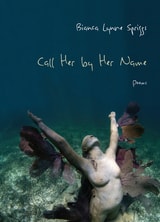
Call Her by Her Name
PoemsBianca Lynne Spriggs
Northwestern University Press, 2016
In Call Her by Her Name, the poet and performance artist Bianca Lynne Spriggs creates a twenty-first-century feminist manifesto suffused with metaphoric depth. This collection is a call-and-response of women—divine and domestic, legend and literal—who shape-shift and traverse generations. Through these narratives and cinematic poems, a chorus emerges of stories and lives rarely told.
Call Her by Her Name seeks to give voice to the voiceless, including lynched black women, the biblical "Potiphar’s wife," and women who tread the rims of phenomenal worlds—the goddess, the bird-woman, the oracle. While these poems reflect an array of women and women’s experiences, each piece could be considered a hue of the same woman, whether home-wrecker, Madonna, or midwife. The woman who sees dragons was perhaps once the roller-skating girl-child. The aging geisha may also be the roots woman next door. The woman who did not speak for ten years could have ended up sinking to the ocean floor. Spriggs gives each one life and limb, breath and voice, in a collection that adds up unequivocally to a poetic celebration of women.
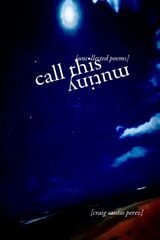
Call This Mutiny
[uncollected poems]Craig Santos Perez
Omnidawn, 2024
The seventh book from award-winning Chamoru author Craig Santos Perez, Call This Mutiny brings together poems that were originally published in journals and anthologies from 2008 to 2023. Throughout these selected poems, Perez offers critical explorations of native cultures, decolonial politics, colonial histories, and the entangled ecologies of his homeland of Guam, his current home of Hawaiʻi, and the larger Pacific region in relation to the Global South and the Indigenous Fourth World. Perez’s poetry draws on the power of storytelling to share Indigenous history and culture and to offer healing from the trauma of colonialism and injustice. As he writes, “If we can write the ocean, we will never be silenced.”
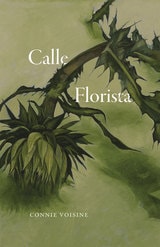
Calle Florista
Connie Voisine
University of Chicago Press, 2015
Sometimes you defy it,
I am not that, watching a stranger
cry like a dog when she thinks she’s alone
at the kitchen window, hands forgotten
under the running tap.
The curtains blow out, flap the other side of the sill.
In you one hole fills another,
stacked like cups.
You remember your hands.
Connie Voisine’s third book of poems centers on the border between the United States and Mexico, celebrating the stunning, severe desert landscape found there. This setting marks the occasion as well for Voisine to explore themes of splitting and friction in both human and political contexts. Whose space is this border, she asks, and what voice can possibly tell the story of this place?
In a wry, elegiac mode, the poems of Calle Florista take us both to the edge of our country and the edge of our faith in art and the world. This is mature work, offering us poems that oscillate between the articulation of complex, private sensibilities and the directness of a poet cracking the private self open—and making it vulnerable to the wider world.
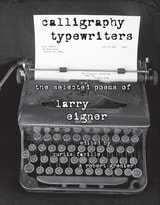
Calligraphy Typewriters
The Selected Poems of Larry EignerLarry Eigner, Edited and introduced by Curtis Faville and Robert Grenier, Foreword by Charles Bernstein
University of Alabama Press, 2016
The first and only single-volume collection of Larry Eigner’s most significant poems, gathering in one place the most celebrated of the several thousand poems that constitute his remarkable life’s work
Larry Eigner began writing poetry at age eight and was first published at age nine. Revered by poets and artists across a broad spectrum of generations and schools, Eigner’s remarkably moving poetry was created through enormous effort: because of severe physical disabilities, he produced his texts by typing with only one index finger and thumb on a 1940 Royal manual typewriter, creating a body of work that is unparalleled in its originality.
Calligraphy Typewriters showcases the most celebrated of Eigner's several thousand poems, which are an important part of the Black Mountain/Projectivist movement that began in the 1950s and which remain a primary inspiration for many younger writers, including those in the Language movement that began in the 1970s. In its two sections—Swampscott and Berkeley, named for the two locales where Eigner lived and worked—the volume traces his fantastic perception of the ordinary and his zeal for language. Eigner’s use of visual space, metaphor, and description provide fascinating insights into both his own life and the world that surrounded him. This volume maintains the distinctive visual spacing of his original typescripts, reminders of his method, aesthetic sensibility, and creative ability to compose on the typewriter.
A collection that reimagines the ordinary, Calligraphy Typewriters is the definitive selection of Eigner’s poems, and will serve well not only poets and students of poetry, but readers and writers of every vein.
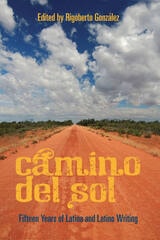
Camino del Sol
Fifteen Years of Latina and Latino WritingEdited by Rigoberto González
University of Arizona Press, 2010
Featuring both established writers and first-time authors, Camino del Sol has published poetry and prose that convey something about the Latina/o experience—works that tap into universal truths through a distinct cultural lens. This volume celebrates fifteen years of books by bringing together some of the series’ best work, such as poetry from Francisco X. Alarcón, fiction from Christine Granados, and nonfiction from Luis Alberto Urrea. These voices echo the entire spectrum of Latina/o writing, from Chicana/o to Puerto Rican to Brazilian-American, and take in themes ranging from migration to gender.
Awards bestowed upon Camino del Sol titles include the PEN/Beyond Margins Award to Richard Blanco’s Directions to the Beach of the Dead; Before Columbus Foundation American Book Awards to Diana García’s When Living Was a Labor Camp and Luis Alberto Urrea’s Nobody’s Son; International Latino Book Awards to Pat Mora’s Adobe Odes and Kathleen Alcalá’s The Desert Remembers My Name; the Premio Aztlán literary prize to Sergio Troncoso’s The Last Tortilla; and the PEN Oakland-Josephine Miles National Literary Award to Kathleen de Azevedo’s Samba Dreamers. All of these works are represented in this outstanding collection.
In a short span of time, Camino del Sol has cultivated an admirable and sizeable list of distinguished contemporary authors—and even garnered the first National Book Critics Circle Award for a Chicana/o for Juan Felipe Herrera’s Half of the World in Light. Camino del Sol: Fifteen Years of Latina and Latino Writing is a benchmark for the series and a wonderful introduction to the world of Latina/o literature.
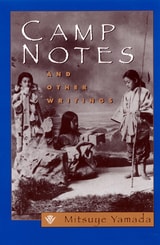
Camp Notes and Other Writings
Yamada, Mitsuye
Rutgers University Press, 1998
Honorable Mention of the 1999 Gustavus Myers Outstanding Book Awards
Two collections by an important Asian American writer -- Camp Notes and Other Poeems and Desert Run: Poems and Stories -- return to print in one volume.
Mitsuye Yamada was born in Kyushu, Japan, and raised in Seattle, Washington, until the outbreak of World War II when her family was removed to a concentration camp in Idaho. Camp Notes and Other Writings recounts this experience.
Yamada's poetry yields a terse blend of emotions and imagery. Her twist of words creates a twist of vision that make her poetry come alive. The weight of her cultural experience-the pain of being perceived as an outsider all of her life-permeates her work.
Yamada's strength as a poet stems from the fact that she has managed to integrate both individual and collective aspects of her background, giving her poems a double impact. Her strong portrayal of individual and collective life experience stands out as a distinct thread in the fabric of contemporary literature by women.
"The core poems of Camp Notes and the title come from the notes I had taken when I was in camp, and it wasn’t published until thirty years after most of it was written. I was simply describing what was happening to me, and my thoughts. But, in retrospect, the collection takes on a kind of expanded meaning about that period in our history. As invariably happens, because Japanese American internment became such an issue in American history, I suppose I will be forever identified as the author of Camp Notes. Of course, I try to show that it’s not the only thing I ever did in my whole life; I did other things besides go to an internment camp during World War II. So, in some ways I keep producing to counteract that one image that gets set in the public mind. At the time that I was writing it, I wasn’t necessarily a political person. Now, when I reread it, even to myself, I think it probably has a greater warning about the dangers of being not aware, not aware of one’s own rights, not aware of helping other people who may be in trouble. I think that it does speak to our present age very acutely." -- Mitsuye Yamada, "You should not be invisible”: An Interview with Mitsuye Yamada, Contemporary Women's Writing, March 2014, Vol. 8 Issue 1
Read the whole interview at: https://academic.oup.com/cww/article/8/1/1/414906/You-should-not-be-invisible-An-Interview-with

Canaan Bound
The African-American Great Migration NovelLawrence R. Rodgers
University of Illinois Press, 1997
The Great Migration--the exodus of more than six million blacks from
their southern homes hoping for better lives in the North--is a defining
event of post-emancipation African-American life and a central feature
of twentieth-century black literature. Lawrence Rodgers explores the historical
and literary significance of this event and in the process identifies
the Great Migration novel as a literary form that intertwines geography
and identity.
Drawing on a wide range of major literary voices, including Richard Wright,
Ralph Ellison, and Toni Morrison, as well as lesser-known writers such
as William Attaway (Blood on the Forge) and Dorothy West (The Living Is
Easy), Rodgers conducts a kind of literary archaeology of the Great Migration.
He mines the writers' biographical connections to migration and teases
apart the ways in which individual novels relate to one another, to the
historical situation of black America, and to African-American literature
as a whole.
In reading migration novels in relation to African-American literary
texts such as slave narratives, folk tales, and urban fiction, Rodgers
affirms the southern folk roots of African-American culture and argues
for a need to stem the erosion of southern memory.

Cannibal Democracy
Race and Representation in the Literature of the AmericasZita Nunes
University of Minnesota Press, 2008
Zita Nunes argues that the prevailing narratives of identity formation throughout the Americas share a dependence on metaphors of incorporation and, often, of cannibalism. From the position of the incorporating body, the construction of a national and racial identity through a process of assimilation presupposes a remainder, a residue.
Nunes addresses works by writers and artists who explore what is left behind in the formation of national identities and speak to the limits of the contemporary discourse of democracy. Cannibal Democracy tracks its central metaphor’s circulation through the work of writers such as Mário de Andrade, W. E. B. Du Bois, and Toni Morrison and journalists of the black press, as well as work by visual artists including Magdalena Campos-Pons and Keith Piper, and reveals how exclusion-understood in terms of what is left out-can be fruitfully understood in terms of what is left over from a process of unification or incorporation.
Nunes shows that while this remainder can be deferred into the future-lurking as a threat to the desired stability of the present-the residue haunts discourses of national unity, undermining the ideologies of democracy that claim to resolve issues of race.
Zita Nunes is associate professor of English at the University of Maryland, College Park.
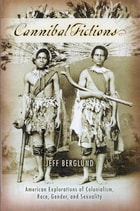
Cannibal Fictions
American Explorations of Colonialism, Race, Gender, and SexualityJeff Berglund
University of Wisconsin Press, 2006
Cannibal Fictions brings together two discrete periods in U.S. history: the years between the Civil War and World War I, the high-water mark in America's imperial presence, and the post-Vietnam era, when the nation was beginning to seriously question its own global agenda. Berglund shows how P. T. Barnum, in a traveling exhibit featuring so-called "Fiji cannibals," served up an alien "other" for popular consumption, while Edgar Rice Burroughs in his Tarzan of the Apes series tapped into similar anxieties about the eruption of foreign elements into a homogeneous culture. Turning to the last decades of the twentieth century, Berglund considers how treatments of cannibalism variously perpetuated or subverted racist, sexist, and homophobic ideologies rooted in earlier times. Fannie Flagg's novel Fried Green Tomatoes invokes cannibalism to new effect, offering an explicit critique of racial, gender, and sexual politics (an element to a large extent suppressed in the movie adaptation). Recurring motifs in contemporary Native American writing suggest how Western expansion has, cannibalistically, laid the seeds of its own destruction. And James Dobson's recent efforts to link the pro-life agenda to allegations of cannibalism in China testify still further to the currency and pervasiveness of this powerful trope.
By highlighting practices that preclude the many from becoming one, these representations of cannibalism, Berglund argues, call into question the comforting national narrative of e pluribus unum.
Canons by Consensus
Critical Trends and American Literature AnthologiesJoseph Csicsila, with a foreword by Tom Quirk
University of Alabama Press, 2004
The first systematic analysis of American literature textbooks used by college instructors in the last century
Scholars have long noted the role that college literary anthologies play in the rising and falling reputations of American authors. Canons by Consensus examines this classroom fixture in detail to challenge and correct a number of assumptions about the development of the literary canon throughout the 20th century.
Joseph Csicsila analyzes more than 80 anthologies published since 1919 and traces not only the critical fortunes of individual authors, but also the treatment of entire genres and groupings of authors by race, region, gender, and formal approach. In doing so, he calls into question accusations of deliberate or inadvertent sexism and racism. Selections by anthology editors, Csicsila demonstrates, have always been governed far more by prevailing trends in academic criticism than by personal bias.
Academic anthologies are found to constitute a rich and often overlooked resource for studying American literature, as well as an irrefutable record of the academy’s changing literary tastes throughout the last century.
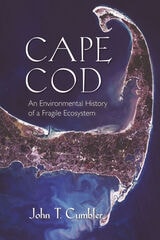
Cape Cod
An Environmental History of a Fragile EcosystemJohn T. Cumbler
University of Massachusetts Press, 2014
John T. Cumbler's book offers an environmental, social, and economic history of Cape Cod told through the experiences of residents as well as visitors. He notes that over the past four hundred years the Cape has experienced three regimes of resource utilization. The first regime of Native Americans who lived relatively lightly on the land was supplanted by European settlers who focused on production and extraction. This second regime began in the age of sail but declined through the age of steam as the soil and seas failed to yield the resources necessary to sustain continuing growth. Environmental and then economic crises during the second half of the nineteenth century eventually gave way to the third regime of tourism and recreation. But this regime has its own environmental costs, as residents have learned over the last half century.
Although the Cape remains a special place, its history of resource scarcity and its attempts to deal with that scarcity offer useful lessons for anyone addressing similar issues around the globe.
Capital Letters
Authorship in the Antebellum Literary MarketDavid Dowling
University of Iowa Press, 2009
In the 1840s and 1850s, as the market revolution swept the United States, the world of literature confronted for the first time the gaudy glare of commercial culture. Amid growing technological sophistication and mounting artistic rejection of the soullessness of materialism, authorship passed from an era of patronage and entered the clamoring free market. In this setting, romantic notions of what it meant to be an author came under attack, and authors became professionals.
In lively and provocative writing, David Dowling moves beyond a study of the emotional toll that this crisis in self-definition had on writers to examine how three sets of authors—in pairings of men and women: Harriet Wilson and Henry David Thoreau, Fanny Fern and Walt Whitman, and Rebecca Harding Davis and Herman Melville—engaged with and transformed the book market. What were their critiques of the capitalism that was transforming the world around them? How did they respond to the changing marketplace that came to define their very success as authors? How was the role of women influenced by these conditions?
Capital Letters concludes with a fascinating and daring transhistorical comparison of how two superstar authors—Herman Melville in the nineteenth century and Stephen King today—have negotiated the shifty terrain of the literary marketplace. The result is an important contribution to our understanding of print culture and literary work.

Captivity and Sentiment
Cultural Exchange in American Literature, 1682–1861Michelle Burnham
Dartmouth College Press, 2000
Capturing Mariposas
Reading Cultural Schema in Gay Chicano LiteratureDoug P. Bush
The Ohio State University Press, 2019
In Capturing Mariposas: Reading Cultural Schema in Gay Chicano Literature, Doug P. Bush looks at the book as only the beginning, considering how this literature has the power to bring understanding to disparate groups, speak truth about repressed sexuality and repressive communities, and recast traditional spaces as ones of inclusion, all through the idea of the cultural schema. Integrating elements of narratology and cognitive studies of literature, the cultural schema speaks to how these authors challenge, reaffirm, and transform commonly held experiences of gay Chicanos—or potentially any audience who reads their works. Focusing on twenty-first-century writers such as Manuel Muñoz, Rigoberto González, and Alex Espinoza, Bush examines the cultural schema of their works and then moves toward a more holistic discussion of the publishing and political implications of this genre. In addition to Bush’s important scholarship, the book includes extensive interviews with the authors themselves.
Capturing the Beat Moment
Cultural Politics and the Poetics of PresenceErik Mortenson
Southern Illinois University Press, 2010
CHOICE Outstanding Academic Title
Examining “the moment” as one of the primary motifs of Beat writing, Erik Mortenson offers the first book to investigate immediacy and its presence and importance in Beat writing. Capturing the Beat Moment: Cultural Politics and the Poetics of Presence places an expanded canon of Beat writers in an early postmodern context that highlights their importance in American poetics and provides an account of Beat practices that reveal how gender and race affect Beat politics of the moment.
Mortenson argues that Beat writers focused on action, desire, and spontaneity to establish an authentic connection to the world around them and believed that “living in the moment” was the only way in which they might establish the kind of life that led to good writing. With this in mind, he explores the possibility that, far from being the antithesis of their times, the Beats actually were a product of them. Mortenson outlines the effects of gender and race on Beat writing in the postwar years, as well as the Beats’ attempts to break free of the constrictive notions of time and space prevalent during the 1950s.
Mortenson discusses such topics as the importance of personal visionary experiences; the embodiment of sexuality and the moment of ecstasy in Beat writing; how the Beats used photographs to evoke the past; and the ways that Beat culture was designed to offer alternatives to existing political and social structures. Throughout the volume, Mortenson moves beyond the Kerouac-Ginsberg-Burroughs triumvirate commonly associated with Beat literature, discussing women—such as Diane di Prima, Janine Pommy Vega, and Joyce Johnson—and African American writers, including Bob Kaufman and Amiri Baraka. With the inclusion of these authors comes a richer understanding of the Beat writers’ value and influence in American literary history.
Carbon 14
Ann Deagon
University of Massachusetts Press, 1974
Ann Deagon first began writing poetry “vigorously” in 1970, “in some kind of forty-year-old renaissance.” Since then her poems have been published widely and have been received numerous awards.
“When I came to forty
that three-headed dog love death and poetry
took me in its teeth and shook me…”
Carbon 14 is the result, a counterpoint of serious and ironic excavations into the mythic and the personal past of a middle-aged woman. Although these poems have grown from her lifelong involvement in the Classics and are basically classical in their structure and concentration, their strength is not academic.
Ann Deagon's poems interweave past and present, person, place, and event, with unexpected and often violent insights. In “The Sybil's Bath,” for example, the sacrifice of a young girl to a god leads to unprecedented counterviolence and to questions which are both contemporary and absolute.
According to Deagon, “All identity is in some sense a translation from the Greek: it cannot be defined except with hyphens. The meaning hovers precisely at the hyphen.” in Carbon 14 Deagon proclaims her identity as poet-woman, woman-teacher, teacher-poet.
Cardinal Points
Pettit, Michael
University of Iowa Press, 1988
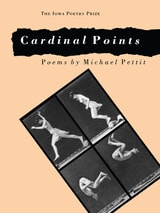
Strung throughout the book are poems based on the Scottish photographer Eadwaerd Muybridge's Animal Locomotion, a historic photographic document. Pettit uses these pioneering images as the basis for his poetic dreaming, and the result is a poignant, integrated sequence of highly moving poems, studded between other vivid lyrics.
Caring for Red
A Daughter's MemoirMindy Fried
Vanderbilt University Press, 2016
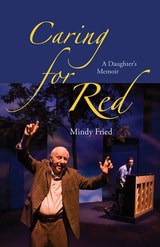
Caring for Red is Mindy Fried's moving and colorful account of caring for her ninety-seven-year-old father, Manny--an actor, writer, and labor organizer--in the final year of his life. This memoir chronicles the actions of two sisters as they discover concentric circles of support for their father and attempt to provide him with an experience of "engaged aging" in an assisted living facility.
The story is also that of a daughter of a powerful and outspoken man who took risks throughout his life and whose political beliefs had an enduring impact on his family. (After Manny was called before the House Un-American Activities Committee, he was blacklisted and his family was shunned.)
As an actor, Manny was affiliated with Elia Kazan's Group Theatre and the Federal Theatre Project. He did Shakespeare, Chekhov, and Ibsen, and played everything from the tormented father in Arthur Miller's All My Sons to an infant in a baby carriage in Thornton Wilder's Infancy, from the Rabbi in Fiddler on the Roof to--poignantly for this book--the role of Morrie in Tuesdays with Morrie.
As she devotes herself to caring for her dying father, Mindy grapples anew with the complexity of their relationship. She questions whether she can be there for him and how to assert her own voice as her father's caregiver in his last days.
Cartographic Fictions
Maps, Race, and IdentityPiper, Karen
Rutgers University Press, 2002
Maps are stories as much about us as about the landscape. They reveal changing perceptions of the natural world, as well as conflicts over the acquisition of territories. Cartographic Fictions looks at maps in relation to journals, correspondence, advertisements, and novels by authors such as Joseph Conrad and Michael Ondaatje. In her innovative study, Karen Piper follows the history of cartography through three stages: the establishment of the prime meridian, the development of aerial photography, and the emergence of satellite and computer mapping.
Piper follows the cartographer’s impulse to “leave the ground” as the desire to escape the racialized or gendered subject. With the distance that the aerial view provided, maps could then be produced “objectively,” that is, devoid of “problematic” native interference. Piper attempts to bring back the dialogue of the “native informant,” demonstrating how maps have historically constructed or betrayed anxieties about race. The book also attempts to bring back key areas of contact to the map between explorer/native and masculine/feminine definitions of space.
Cartoons and Caricatures of Mark Twain in Context
Reformer and Social Critic, 1869–1910Leslie Diane Myrick and Gary Scharnhorst
University of Alabama Press, 2023
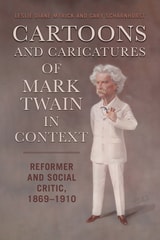
Cartoons and Caricatures of Mark Twain in Context: Reformer and Social Critic, 1869–1910 examines the production, reception, and history of Twain’s reputation as a social and political satirist. Myrick and Scharnhorst trace the evolution of Twain’s depiction throughout his life, career, and even death and across more than seventy illustrations—from portrayals of the famous author as a court jester adorned with cap and bells, to a regally haloed king with a royal train—offering a new perspective on his influence and reputation. Although he was among the most photographed figures of the nineteenth century, Myrick and Scharnhorst focus on a medium that Twain, an expert ofself-promotion and brand management, could not control. As a result, Myrick and Scharnhorst have compiled an innovative and incisive visual reception history.
Cartoons and Caricatures of Mark Twainin Context illustrates the popular and often critical response to many famous and infamous episodes in his career, such as the storm of controversy that surrounded the publication of his anti-imperialist writings at the turn of the twentieth century. Routinely depicted with hair like a fright wig, a beak-like nose, and a cigar in hand, no matter the context or the costume, Twain was instantly recognizable. Yet it was not merely the familiarity of his image that made him a regular feature in visual commentary, but also his willingness to speak out against corruption and to insert himself into controversies of his day.

Cases of Circumstantial Evidence
Janet Lewis
Ohio University Press, 2013
This is the first digital version of Cases of Circumstantial Evidence, a collection of three historical novels by noted American writer Janet Lewis. For the first time, these works have been brought together in a single edition, each with a new introduction by Kevin Haworth:
The Wife of Martin Guerre
Based on a notorious trial in sixteenth-century France, The Wife of Martin Guerre follows Bertrande de Rois and her lost-and-returned husband through a tale of impersonation, conspiracy, and small-town intrigue. Their fascinating story has also inspired a bestselling historical study and two films, including The Return of Martin Guerre.
The Trial of Sören Qvist
Although set in seventeenth-century Denmark, The Trial of Sören Qvist has a contemporary feel and has been praised for its intriguing plot and for Lewis’s powerful writing. In this second novel in the Cases of Circumstantial Evidence, Lewis recounts the story of a murder, an investigation, and a pious town pastor who confesses to the crime, driven perhaps more by a recognition of his own moral flaws than by guilt for the acts of which he stood accused.
The Ghost of Monsieur Scarron
The court of Louis XIV and a modest Paris street provide the incongruous settings for this tale of a humble bookbinder, his wife, and the young craftsman who seduces her and blackmails her husband into covering up a terrible crime. This third and last case of circumstantial evidence bristles with character, the smell of blood, and considerable suspense against a backdrop of national political unrest in the cruel and dingy Paris of the seventeenth century.
Castle Nowhere
Lake-Country SketchesConstance Fenimore Woolson
University of Michigan Press, 2004
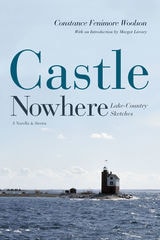
Castle Nowhere is Constance Woolson's collection of stories set for the most part in the Great Lakes, in particular northern Lake Michigan and Lake Huron near Detroit.
Several themes inhabit Woolson's writing: an environmental consciousness and concern with landscapes; an awareness of the complexities of race; and an abidingly careful eye for the shallowness that sometimes accompanies wealth or social pretensions. She also had a unique perspective as a woman who pioneered the use of controversial subjects---such as unrequited or misplaced passion---and methods in fiction during a time that valorized domesticity.
As Margot Livesey notes in her introduction, reading about thwarted love is only one of the pleasures to be found in Castle Nowhere. "The majority of these stories are set in remote areas on the shores of Lake Michigan, which Woolson evokes with great vividness and beauty while always remaining keenly aware that beauty in no way mitigates hardship. As a writer, she was nearly always looking over her shoulder, and many, if not all, of these stories were written at a time when she no longer visited the Lake and her beloved Mackinac Island."
Contemporary readers will find a curiously modern atmosphere in Woolson's stories, as well as a distinct regional flavor in her careful renderings of the Great Lakes landscape. As such, Castle Nowhere represents a rare woman's voice in literature of its period and setting.
Constance Fenimore Woolson (1840-1894) was born in New Hampshire and moved to Cleveland shortly thereafter. She spent time on Mackinac Island, Michigan, then traveled to Florida before moving to Europe. Much of her time there was spent in Italy. She died in Venice in 1894. Novelist Margot Livesey is the author of Eva Moves the Furniture and Homework.
Catering an Affair
Alberta Skaggs
Southern Illinois University Press, 2018
Cather Among the Moderns
Janis P. Stout
University of Alabama Press, 2019
A masterful study by a preeminent scholar that situates Cather as a visionary practitioner of literary modernism
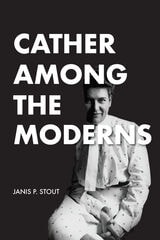
Willa Cather is often pegged as a regionalist, a feminine and domestic writer, or a social realist. In Cather Among the Moderns, Janis P. Stout firmly situates Cather as a visionary practitioner of literary modernism, something other scholars have hinted at but rarely affirmed. Stout presents Cather on a large, dramatic stage among a sizable cast of characters and against a brightly lit social and historical backdrop, invoking numerous figures and instances from the broad movement in the arts and culture that we call modernism.
Early on, Stout addresses the matter of gender. The term “cross-dresser” has often been applied to Cather, but Stout sees Cather’s identity as fractured or ambiguous, a reading that links her firmly to early twentieth-century modernity. Later chapters take up topics of significance both to Cather and to twentieth-century American modernists, including shifting gender roles, World War I’s devastation of social and artistic norms, and strains in racial relations. She explores Cather’s links to a small group of modernists who, after the war, embraced life in New Mexico, a destination of choice for many artists, and which led to two of Cather’s most fully realized modernist novels, The Professor’s House and Death Comes for the Archbishop.
The last chapter addresses Cather’s place within modernism. Stout first places her in relation to Ezra Pound and T. S. Eliot with their shared ties to tradition even while making, sometimes startling, innovations in literary form, then showing parallels with William Faulkner with respect to economic disparity and social injustice.
Catherine
A StoryWilliam Makepeace Thackeray
University of Michigan Press, 1999
The Thackeray Edition proudly announces two additions to its collection: Catherine and The Luck of Barry Lyndon. The Thackeray Edition is the first full-scale scholarly edition of William Makepeace Thackeray's works to appear in over seventy years, and the only one ever to be based on an examination of manuscripts and relevant printed texts. It is also a concrete attempt to put into practice a theory of scholarly editing that gives new insight into Thackeray's own compositional process.
Written in 1839-40 for Fraser's Magazine, Catherine was Thackeray's first novel. Although originally intended as a spoof of the 1830s Newgate school of criminal romance, it has intrinsic merit of its own for its cynical narrator and roguish heroine, both of whom harbinger similar creations in Vanity Fair eight years later.

Celebrity Chefs of New Jersey
Their Stories, Recipes, and SecretsTeresa Politano
Rutgers University Press, 2010
Not so long ago, perhaps even just at the turn of this century, it was easy to lament the lack of sophisticated food in New Jersey. Oh sure, a few restaurants always sparkled, but, for the most part, New Jerseyans looked across at the bright lights of the big city, wistfully yearning for a table in glamorous Manhattan. Now, however, the most sought- after tables are right here and we have the best seats in the house, made even sweeter perhaps because they're our own little secret. We can dine frequently and dine well, with a smug sense that if only New Yorkers knew, they'd be looking across the river wishing they were us.
In Celebrity Chefs of New Jersey, Teresa Politano profiles Craig Shelton, the chef who crystallized New Jersey's place in culinary history with his legendary Ryland Inn, along with other chefs, telling their personal stories of both creativity and survival. Some of these men and women rose from humble or difficult childhoods to fame in the food world. Others were not only talented but lucky enough to be in the right place at the right time. Their stories are arranged into three categories: legends, stars, and chefs to watch, and then topped off with a sweet surprise finish. Politano includes photographs, cooking secrets, and some of their sought-after signature recipes that are sophisticated but manageable for the skilled home chef.
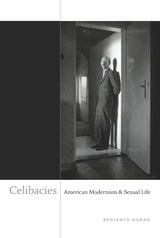
Celibacies
American Modernism and Sexual LifeBenjamin Kahan
Duke University Press, 2013
Cell Traffic
New and Selected PoemsHeid E. Erdrich
University of Arizona Press, 2012
Cement Guitar
Michael Carlson
University of Massachusetts Press, 2003
In this striking debut collection, Michael Carlson offers poems that combine the concrete and the musical, while embodying a tendency toward contradiction. He writes by working with rhythms, structures, images, associational leaps, and an obsession with the sound of words, as opposed to narrative. The book begins, “A thing wants to pounce but can't,” and this spirit of hesitation continues throughout the volume.
The first section of the book contains heavily rhythmic poems measured sometimes by syllable, sometimes by stress, dealing with rural landscapes, a struggle with disillusionment, and a reconciliation of knowledge and belief. The second section confronts the terrain and people of Carlson's childhood in Rhode Island, using longer sentences, riskier enjambments, and a more colloquial and emotional language.
The poems in the third section—which range from Manhattan to Florida, Vietnam, and Paris—share a tendency to be more fantastic and are formal in weird ways. They include an homage to Ezra Pound borrowing the vocabulary of his first book and the syntax of his last, a nod to John Donne borrowing some of his stanza shapes, a sonnet whose constraint is that each of its fourteen lines contains a piece of armor, and a sestina composed of four syllable lines with four end words that rhyme. In the fourth section, Carlson returns to Brooklyn, speaks from the present, and resolves his stances in a brief notational way that is reminiscent of Chinese poetry.
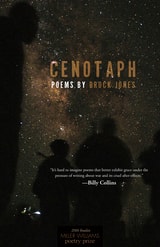
Cenotaph
PoemsBrock Jones
University of Arkansas Press, 2016
Finalist, 2016 Miller Williams Poetry Prize, edited by Billy Collins
Out of the contradiction, paradox, loss, and strange beauty of contemporary warfare, Brock Jones brings us Cenotaph, a collection of poems that have as their genesis Jones’s deployments to Iraq in 2002 and 2005, when he was in the US Army.
These are war poems, but also love poems and hate poems, poems about dying and living, poems about hope and hopelessness. These are poems that beautifully reflect Jones’s resignation to and rejection of the impossibility of saying anything definitive or honest about war.
These are poems that strive to do what poet Bruce Weigl described as the poet’s job: to find “some kind of miraculous way th at if you work hard enough to get the words right, that which you call horrific and wrong is defeated.”
Cenotaph is a poet doing the poet’s work: trying, hoping to get the words right.
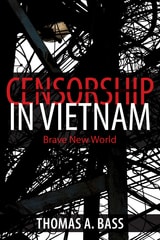
Censorship in Vietnam
Brave New WorldThomas A. Bass
University of Massachusetts Press, 2017
After the book was published, Bass flew to Vietnam to meet his censors, at least the half dozen who would speak with him. In Censorship in Vietnam, he describes these meetings and examines how censorship works, both in Vietnam and elsewhere in the world. An exemplary piece of investigative reporting, Censorship in Vietnam opens a window into the country today and shows us the precarious nature of intellectual freedom in a world governed by suppression.
Centaur
Greg Wrenn
University of Wisconsin Press, 2013
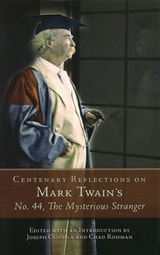
Centenary Reflections on Mark Twain's No. 44, The Mysterious Stranger
Edited with an introduction by Joseph Csicsila and Chad Rohman
University of Missouri Press, 2009
All of these essays attest to the importance of this late work in Twain’s canon, whether considering how Twain’s efforts at truth-telling are premeditated and shaped by his own experiences, tracing the biblical and religious influences that resonate in No. 44, or exploring the text’s psychological dimensions. Several address its importance as a culminating work in which Twain’s seemingly disjointed story lines coalesce in meaningful, albeit not always satisfactory, ways. An afterword by Alan Gribben traces the critical history of the “Mysterious Stranger” manuscripts and the contributions of previous critics. A wide-ranging critical introduction and a comprehensive bibliography on the last century of scholarship bracket the contributions.
Close inspection of this multidimensional novel shows how Twain evolved as a self-conscious thinker and humorist—and that he was a more conscious artist throughout his career than has been previously thought. Centenary Reflections deepens our understanding of one of Twain’s most misunderstood texts, confirming that the author of No. 44 was a pursuer of an elusive truth that was often as mysterious a stranger as Twain himself.
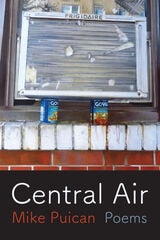
Central Air
PoemsMike Puican
Northwestern University Press, 2020
Puican’s focus on the city, its people and underbellied spaces, pays homage in the tradition of the great Chicago masters: Carl Sandburg, Gwendolyn Brooks, and Campbell McGrath. This contemporary Chicago son finds his own place with lyrical integrity.
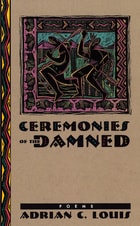
Ceremonies Of The Damned
PoemsAdrian C. Louis
University of Nevada Press, 1997
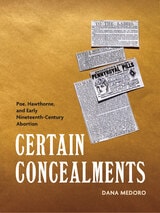
Certain Concealments
Poe, Hawthorne, and Early Nineteenth-Century AbortionDana Medoro
University of Massachusetts Press, 2022
Antebellum America saw a great upsurge in abortion, driven in part by the rise of the pharmaceutical industry. Unsurprisingly, the practice became increasingly visible in the popular culture and literature of the era, appearing openly in advertisements, popular fiction, and newspaper reports. One figure would come to dominate national headlines from the 1840s onward: Madame Restell. Facing public condemnation and mob attacks at her home for her dogged support of women’s reproductive rights, Restell built an empire selling her powders, pills, and services along the Eastern Seaboard.
Edgar Allan Poe and Nathaniel Hawthorne undoubtedly knew of Restell’s work and would go on to depict the incompatibility of abortion and nationalism in their writings. Through the thwarted plotlines, genealogical interruptions, and terminated ideas of Poe’s Dupin trilogy and Hawthorne’s The Scarlet Letter, The House of Seven Gables, and The Blithedale Romance, these authors consider new concepts around race, reproduction, and American exceptionalism. Dana Medoro demonstrates that their work can be usefully read in the context of debates on fetal life and personhood that circulated in the era.
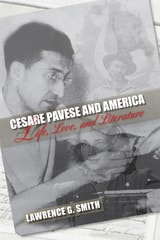
Cesare Pavese and America
Life, Love, and LiteratureLawrence G. Smith
University of Massachusetts Press, 2008
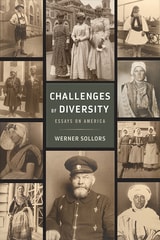
Challenges of Diversity
Essays on AmericaSollors, Werner
Rutgers University Press, 2017
What unites and what divides Americans as a nation? Who are we, and can we strike a balance between an emphasis on our divergent ethnic origins and what we have in common? Opening with a survey of American literature through the vantage point of ethnicity, Werner Sollors examines our evolving understanding of ourselves as an Anglo-American nation to a multicultural one and the key role writing has played in that process.
Challenges of Diversity contains stories of American myths of arrival (pilgrims at Plymouth Rock, slave ships at Jamestown, steerage passengers at Ellis Island), the powerful rhetoric of egalitarian promise in the Declaration of Independence and the heterogeneous ends to which it has been put, and the recurring tropes of multiculturalism over time (e pluribus unum, melting pot, cultural pluralism). Sollors suggests that although the transformation of this settler country into a polyethnic and self-consciously multicultural nation may appear as a story of great progress toward the fulfillment of egalitarian ideals, deepening economic inequality actually exacerbates the divisions among Americans today.
Chamber after Chamber
Saara Myrene Raappana
University of Massachusetts Press, 2024
Chamber after Chamber is about what fractures, fixes, and refills the hearts of two girls as they grow into women. A loose narrative in three sections, the poems follow a speaker and her cousin through their hardscrabble, backwoods childhood to their separation—both physical and emotional—as adults. From the make-believe apocalypses and cut-and-paste valentines of elementary school to the stadium-seating classrooms and multiplexes of southern China, our speaker tries to leave the shame and dysfunction of her family behind. In China, she begins to see America—and herself—clearly for the first time, and in doing so discovers that both her cousin and her country are inextricably woven into
[her body] part that never sleeps the blood
and chambered meat that’s like a rock squeezed
in a fist rapping its knuckles
on the sweet door of the body.

Chameleon Hours
Elise Partridge
University of Chicago Press, 2008
for Steve
Will it be like paragliding—
gossamer takeoff, seedlike drifting down
into a sunlit, unexpected grove?
Or ski-jumping—headlong soaring,
ski-tips piercing clouds,
crystal revelations astonishing my goggles?
. . . . Skittery flicker of a glare-weary lizard
startled into the sheltering wings of a leaf,
rusting freighter with a brimming hold
shimmering onto a crimson edge. . . .
Sad rower pushed from shore,
I'll disappear like circles summoned
by an oar's dip.
However I burn through to the next atmosphere,
let your dear face be the last thing I see.
Praise for Fielder’s Choice
“Partridge is a technical wizard for whom thinking and feeling are not separate activities. She is a hawk-like observer of the particular . . . many times ascending to pitch-perfect verse.”—Ken Babstock, Globe and Mail (Canada)
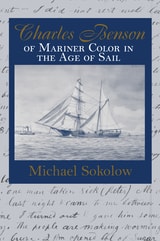
Charles Benson
Mariner of Color in the Age of SailMichael Sokolow
University of Massachusetts Press, 2009
In this volume, Michael Sokolow uncovers the inner world of this remarkable individual. Raised in a small town in Massachusetts, Benson was the great-great-grandson of slaves, the great-grandson of a rare eighteenth-century intermarriage between a black man and a white woman, and the grandson of a veteran of the American Revolution. His own life had been marked by economic struggle, marital conflict, and the social ambiguities of mixed race heritage.
In his personal writings, Benson reflected on both the man he was and the man he wanted to be. Living in a culture that prized "self-made" individuals, he sought to forge his own identity even as he labored under strictures that severely limited opportunities for blacks. From his youth in rural Middlesex County, Massachusetts, to his subsequent adult life in the bustling port city of Salem, Benson measured himself against the mores of white, middle-class America. Undeterred by early failures in both marriage and finance, he held fast to his personal vision and became a respectable husband, provider, worker, and member of the black community.

Charles Johnson in Context
Linda Furgerson Selzer
University of Massachusetts Press, 2009