Results by title
5550 books match the query 'Biography & Autobiography' and 288 start with c
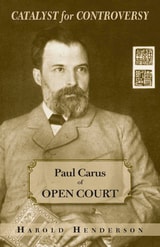
Catalyst for Controversy
Paul Carus of Open CourtHarold Henderson
Southern Illinois University Press, 2009
"I am not a common atheist; I am an atheist who loves God."—Paul Carus, "The God of Science," 1904
In the summer of 1880, while teaching at the military academy of the Royal Corps of Cadets of Saxony in Dresden, Paul Carus published a brief pamphlet denying the literal truth of scripture and describing the Bible as a great literary work comparable to the Odyssey.
This unremarkable document was Carus’s first step in a wide-ranging intellectual voyage in which he traversed philosophy, science, religion, mathematics, history, music, literature, and social and political issues. The Royal Corps, Carus later reported, found his published views "not in harmony with the Christian spirit, in accordance with which the training and education of the Corps of Cadets should be conducted." And so the corps offered the young teacher the choice of asking "most humbly for forgiveness for daring to have an opinion of my own and to express it, perhaps even promise to publish nothing more on religious matters, or to give up my post. I chose the latter. . . . There was thus no other choice for me but to emigrate and, trusting in my own powers, to establish for myself a new home." His resignation was effective on Easter Sunday, 1881.
Carus toured the Rhine, lived briefly in Belgium, and taught in a military college in England to learn English well enough to "thrive in the United States." By late 1884 or early 1885 he was on his way to the New World. Thriving in the United States proved more difficult than it had in England, but before 1885 ended he had published his first philosophical work in English, Monism and Meliorism. The book was not widely read, but it did reach Edward C. Hegeler, a La Salle, Illinois, zinc processor who became his father-in-law as well as his ideological and financial backer.
Established in La Salle, Carus began the work that would place him among the prominent American philosophers of his day and make the Open Court Publishing Company a leading publisher of philosophical, scientific, and religious books. He edited The Open Court and The Monist, offering the finest view of Oriental thought and religion then available in the West, and sought unsuccessfully to bring about a second World Parliament of Religions. He befriended physicist-philosopher Ernst Mach. For eleven years he employed D. T. Suzuki, who later became a great Zen Buddhist teacher. He published more articles by Charles S. Peirce, now viewed as one of the great world philosophers, in The Monist than appeared in any other publication.
Biographer Harold Henderson concludes his study of this remarkable man: "Whenever anyone is so fired with an idea that he or she can’t wait to write it down, there the spirit of Paul Carus remains, as he would have wished, active in the world."
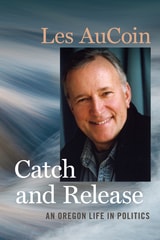
Catch and Release
An Oregon Life in PoliticsLes AuCoin
Oregon State University Press, 2019
In this compelling collection of life stories, AuCoin traces his unlikely rise from a fatherless childhood in Central Oregon to the top ranks of national power. Then came a painful defeat in one of the most controversial races in US Senate history, against incumbent Bob Packwood.
A fly fisher, AuCoin uses “catch and release” as a metaphor for succeeding and letting go of loss with dignity and equanimity. His memories are in turn funny, suspenseful, and revealing. AuCoin takes us to the Kremlin, pre-industrial China, the Arctic National Wildlife Refuge, and into the tortuous politics of the Northwest spotted owl crisis. He interacted with world figures like Mikhail Gorbachev, Ronald Reagan, House Speakers Tip O’Neill and Jim Wright, and Oregon legends Tom McCall and Mark Hatfield. Closer to home, AuCoin allied himself with activists like Sidney Lasseigne of the Newport Fishermen’s Wives.
Catch and Release offers readers a revealing glimpse behind the scenes of congressional life, as lived by the 535 souls who inhabit the US House and Senate—including the author, who assesses his own strengths and foibles with humility and candor.
Catching Stories
A Practical Guide to Oral HistoryDonna M. DeBlasio
Ohio University Press, 2009
In neighborhoods, schools, community centers, and workplaces, people are using oral history to capture and collect the kinds of stories that the history books and the media tend to overlook: stories of personal struggle and hope, of war and peace, of family and friends, of beliefs, traditions, and values—the stories of our lives.
Catching Stories: A Practical Guide to Oral History is a clear and comprehensive introduction for those with little or no experience in planning or undertaking oral history projects. Opening with the key question, “Why do oral history?” the guide outlines the stages of a project from idea to final product—planning and research, the interviewing process, basic technical principles, and audio and video recording techniques. The guide covers interview transcribing, ethical and legal issues, archiving, funding sources, and sharing oral history with audiences.
Intended for teachers, students, librarians, local historians, and volunteers as well as individuals, Catching Stories is the place to start for anyone who wants to document the memories and collect the stories of community or family.
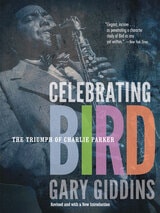
Celebrating Bird
The Triumph of Charlie ParkerGary Giddins
University of Minnesota Press, 2013
Within days of Charlie “Bird” Parker’s death at the age of thirty-four, a scrawled legend began appearing on walls around New York City: Bird Lives. Gone was one of the most outstanding jazz musicians of any era, the troubled genius who brought modernism to jazz and became a defining cultural force for musicians, writers, and artists of every stripe. Arguably the most significant musician in the country at the time of his death, Parker set the standard many musicians strove to reach—though he never enjoyed the same popular success that greeted many of his imitators. Today, the power of Parker’s inventions resonates undiminished; and his influence continues to expand.
Celebrating Bird is the groundbreaking and award-winning account of the life and legend of Charlie Parker from renowned biographer and critic Gary Giddins, whom Esquire called “the best jazz writer in America today.” Richly illustrated and drawing primarily from original sources, Giddins overturns many of the myths that have grown up around Parker. He cuts a fascinating portrait of the period, from Parker’s apprentice days in the 1930s in his hometown of Kansas City to the often difficult years playing clubs in New York and Los Angeles, and reveals how Parker came to embody not only musical innovation and brilliance but the rage and exhilaration of an entire generation.
Fully revised and with a new introduction by the author, Celebrating Bird is a classic of jazz writing that the Village Voice heralded as “a celebration of the highest order”—a portrayal of a jazz virtuoso whose gargantuan talent was haunted by his excesses and a view into the ravishing art of one of jazz’s most commanding and remarkable figures.
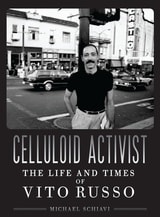
Celluloid Activist
The Life and Times of Vito RussoMichael Schiavi
University of Wisconsin Press, 2011
“Schiavi tells a compelling story in this biography—from his re-creation of life on the streets of East Harlem and in Greenwich Village of the 1960s and 1970s to the way he conveys Russo’s excitement about his film research and popular education to his account of the AIDS years in New York City.”—John D’Emilio, Italian American Review
“In [Schiavi’s] hands Russo’s life is both fascinating in its own right and a window into a larger milieu of activism during two critical decades.”—Italian American Review
Best Books for General Audiences, selected by the Public Library Reviewers
Finalist, Gay Memoir/Biography, Lambda Literary Awards
Finalist, Over the Rainbow Selection, American Library Association
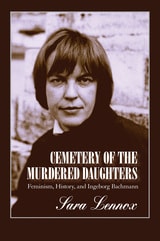
Cemetery of the Murdered Daughters
Feminism, History, and Ingeborg BachmannSara Lennox
University of Massachusetts Press, 2006
Although Austrian writer Ingeborg Bachmann (1926–1973) is widely regarded as one of the most important twentieth-century authors writing in German, her novels and stories have sometimes been viewed narrowly as portraits of women as victims. In this innovative study, Sara Lennox provides a much broader perspective on Bachmann's work, at the same time undertaking an experiment in feminist methodology. Lennox examines Bachmann's poetry and prose in historical context, arguing that the varied feminist interpretations of her writings are the result of shifts in theoretical emphases over a period of more than three decades. Lennox then places her own essays on Bachmann in similar perspective, showing how each piece reflects the historical moment in which it was written. Making use of recent interdisciplinary approaches—Foucauldian theories of sexuality, post-colonial theory, materialist feminism—she explores the extent to which each of her earlier readings was shaped by the methods employed, the questions asked, and the political issues that seemed most germane at the time. Out of this analysis comes a new understanding of the significance of Bachmann's work and new insight into the theory and practice of feminist criticism.
Cenotaph
PoemsBrock Jones
University of Arkansas Press, 2016
Finalist, 2016 Miller Williams Poetry Prize, edited by Billy Collins
Out of the contradiction, paradox, loss, and strange beauty of contemporary warfare, Brock Jones brings us Cenotaph, a collection of poems that have as their genesis Jones’s deployments to Iraq in 2002 and 2005, when he was in the US Army.
These are war poems, but also love poems and hate poems, poems about dying and living, poems about hope and hopelessness. These are poems that beautifully reflect Jones’s resignation to and rejection of the impossibility of saying anything definitive or honest about war.
These are poems that strive to do what poet Bruce Weigl described as the poet’s job: to find “some kind of miraculous way th at if you work hard enough to get the words right, that which you call horrific and wrong is defeated.”
Cenotaph is a poet doing the poet’s work: trying, hoping to get the words right.

Central America and the Treaty of Versailles
Michael Streeter
Haus Publishing, 2010
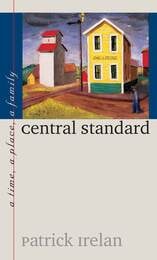
Central Standard
A Time, a Place, a FamilyPatrick Irelan
University of Iowa Press, 2002
Not so long ago, the Rock Island Railroad was a household name, the Great Depression was a recent memory, and family farms dotted the landscape. Today, the great railroads have nearly disappeared, the Depression is a chapter in history books, and family farms are hard to come by. Yet this time is not forgotten.
In Central Standard: A Time, a Place, a Family, Patrick Irelan vividly recaptures a remarkable era in midwestern history in twenty-four beautifully crafted and often witty essays. Beginning with his parents’ marriage in 1932 and continuing into the present, Irelan relates the many wonderful stories and experiences of his Davis County, Iowa, family. In “Country Living,” he describes his parents’ disheartening life as farmers during the worst years of the Depression. “The CB&Q” then relates the happiest years of his family’s life when his parents lived and worked in the Burlington Railroad depots of rural Nebraska.
Irelan’s tales of hard times and harder work, family meals and talkative relatives, depots and farmsteads paint a brilliant yet deceptively simple portrait of one rural, working-class family. At its heart, Central Standard carries a greater message: it reminds us of the enduring strength of the American family.
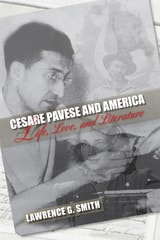
Cesare Pavese and America
Life, Love, and LiteratureLawrence G. Smith
University of Massachusetts Press, 2008

Cezanne
A Study of His DevelopmentRoger Fry
University of Chicago Press, 1989
This study established Fry as a critical "father," the first of his line to explicate the ideas of "vision and design" in an attempt to understand modern art. His critical analysis has in many respects never been surpassed. Fry endeavored both to show the essential development of the painter's style and to approach individual works directly; he wrote that he would detect "the profound difference between Cézanne's message and what we have made of it." The result is a book, couched in Fry's most lucid, penetrating language, which is of great technical value to the painter and student and which offers the layman an illuminating demonstration of the remarkable force of Cézanne's art.
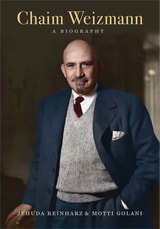
Chaim Weizmann
A BiographyJehuda Reinharz and Motti Golani
Brandeis University Press, 2024
In Chaim Weizmann: A Biography, Jehuda Reinharz and Motti Golani show how Weizmann, a leader of the World Zionist Organization who became the first president of Israel, advocated for a Jewish state by gaining the support of influential politicians and statesmen as well as Jews around the world. Beginning with his childhood in Belorussia and concluding with his tenure as president, Reinharz and Golani describe how a Russian Jew, who immigrated to the United Kingdom in the early twentieth century, was able to advance the goals of Theodor Herzl, the founder of the Zionist Organization. Weizmann is also shown as a man of human foibles—his infatuations, political machinations, and elitism—as well as a man of admirable qualities—intelligence, wit, charisma, and dedication.
Weizmann, who came to the UK to work as a biochemist, was in regular communication with British political figures, including prime ministers Arthur James Balfour, David Lloyd George, Winston Churchill, and Ramsay MacDonald. He also met presidents of the United States from Woodrow Wilson to Harry Truman. His success in earning the support of British political figures helped lead to the Balfour Declaration, which advocated for a “national home” for the Jewish people in Palestine.
As the authors show in this authoritative account of Weizmann’s life, Weizmann was guided by the belief that “Zion shall be redeemed in justice,” a phrase that recurs often in his writings.
Chaim Weizmann
The Making of a StatesmanJehuda Reinharz
Brandeis University Press, 1985
Chaim Weizmann
The Making of a Zionist LeaderJehuda Reinharz
Brandeis University Press, 1985
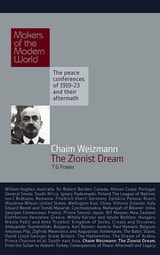
Chaim Weizmann
The Zionist DreamTom Fraser
Haus Publishing, 2009
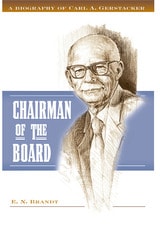
Chairman of the Board
A Biography of Carl A. GerstackerE. N. Brandt
Michigan State University Press, 2003
Carl A. Gerstacker was born in 1916 in Cleveland, Ohio. At an early age his father, Rollin, instilled in him an interest in finance and the stock market. In 1930, when Carl turned fourteen, Rollin advised his son to withdraw his paper-route and odd-job money from a local bank and invest it all in The Dow Chemical Company. It was the beginning of a relationship that would last a lifetime. After high school, Carl landed an hourly position with Dow Chemical as a lab assistant and, at the same time, pursued an engineering degree at the University of Michigan as part of the company’s student training course. After graduating in 1938, Gerstacker continued to work for Dow Chemical until the outbreak of World War II when he joined the U.S. Army. Returning to civilian life in 1946, he was rehired by Dow and quickly moved up the corporate ladder, becoming Treasurer in 1949, Vice-President in 1955, and Chairman of the Board in 1960, a position he retained until 1976. He retired five years later in 1981.
Carl Gerstacker was a business leader who believed that every company had a special personality and that the Dow personality was largely shaped by its employees. “For Dow Chemical, people are the most important asset, not the patents, the plants, nor the products.” Gerstacker’s personal financial acumen was rivaled only by his own contributions to the sound corporate growth of Dow Chemical, a business he loved and to which he devoted his life. Gerstacker died in 1995, leaving a legacy that lives on in the form of numerous philanthropic endeavors he began during his lifetime and on whose boards he once served. Carl A. Gerstacker was one of the towering figures of twentieth-century American industry.
Challenging Pregnancy
A Journey through the Politics and Science of Healthcare in AmericaGenevieve Grabman
University of Iowa Press, 2022
Ultimately, national anti-abortion politics—not medicine or her own choices—determined the outcome of Grabman’s pregnancy. At every juncture, anti-abortion politics limited the care available to her, the doctors and hospitals willing to treat her, the tools doctors could use, and the words her doctors could say. Although she asked for aggressive treatment to save at least one baby, hospital ethics boards blocked all able doctors from helping her.
Challenging Pregnancy is about Grabman’s harrowing pregnancy and the science and politics of maternal healthcare in the United States, where every person must self-advocate for the desired outcome of their own pregnancy.
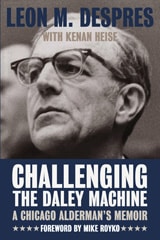
Challenging the Daley Machine
A Chicago Alderman's MemoirLeon M. Despres
Northwestern University Press, 2005
Winner, 2007 The Hyde Park Historical Society Paul Cornell Award
Political war stories from a thorn in the side of Chicago's famous Boss
In 1955, south-sider Leon Despres was elected to the Chicago City Council-the same year that Paddy Bauler famously uttered that "Chicago ain't ready for reform." Ready or not, Chicago got twenty years of reform efforts from Despres, one of the few independents in the council and the most liberal alderman in the city. His demand to cut out the corrupt sale of city driveway permits made him enemies from the very beginning. Over the years his crusades to ban discrimination, preserve Chicago landmark buildings, and gain equality for African-Americans-when Daley-beholden African-American council members refused to help-threw wrench after wrench into the Machine. And, not incidentally, changed the city.
But Challenging the Daley Machine is more than a memoir. It's a historical portrait of the way things were done under the Boss, when changing times and a changing city forced the Machine to confront the problems Despres championed. His battles against the seemingly monolithic Machine are also an inspiration to anyone who is facing long odds, but is convinced he/she is on the side of right.
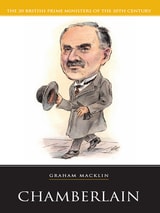
Chamberlain
Graham Macklin
Haus Publishing, 2006
Chamfort
A BiographyClaude Arnaud
University of Chicago Press, 1992
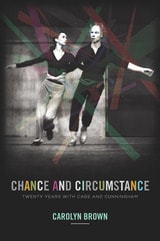
Chance and Circumstance
Twenty Years with Cage and CunninghamCarolyn Brown
Northwestern University Press, 2009
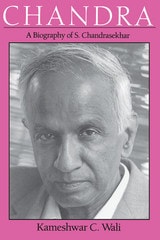
Chandra
A Biography of S. ChandrasekharKameshwar C. Wali
University of Chicago Press, 1992
"Wali has given us a magnificent portrait of Chandra, full of life and color, with a deep understanding of the three cultures—Indian, British, and American—in which Chandra was successively immersed. . . . I wish I had the job of reviewing this book for the New York Times rather than for Physics Today. If the book is only read by physicists, then Wali's devoted labors were in vain."—Freeman Dyson, Physics Today
"An enthralling human document."—William McCrea, Times Higher Education Supplement
"A dramatic, exuberant biography of one of the century's great scientists."—Publishers Weekly
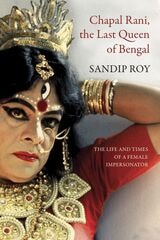
Chapal Rani, the Last Queen of Bengal
The Life and Times of a Female ImpersonatorSandip Roy
Seagull Books, 2025
As the last great female impersonator of Bengali theater, Chapal Bhaduri—known as Chapal Rani—once held audiences spellbound in the jatra tradition, where men became goddesses and heroines. But when women finally took their place on stage, Chapal found himself exiled from the world he had ruled. In this groundbreaking biography, Sandip Roy captures the rise and fall of a performer whose art was inseparable from his identity.
Told in Chapal’s own voice and interwoven with evocative fictional vignettes, Chapal Rani, the Last Queen of Bengal brings to life Kolkata’s golden age of theater and the resilience of a man who refused to disappear. Through decades of research and deeply personal interviews, Roy crafts a moving portrait of gender and belonging.
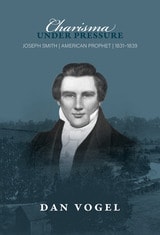
Charisma under Pressure
Joseph Smith, American Prophet, 1831–1839Dan Vogel
Signature Books, 2023
But just who was Joseph Smith? What motivated him? In examining Smith’s life during his Ohio and Missouri sojourns, Vogel seeks to answer those questions. But, Vogel is quick to note, “There are, in fact, many possible constructions of Joseph Smith, and depending on how one assesses the evidence for his truth-claims, a completely different Joseph Smith emerges. But this is probably as Smith wanted it.”
During this period, Smith established a temple, printing presses, additional scripture, expanded church offices, and built a bank—all indicating a sense of permanence and strength for his young church at one level while causing its near collapse at another.
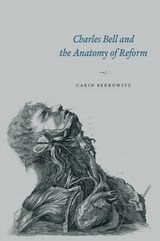
Charles Bell and the Anatomy of Reform
Carin Berkowitz
University of Chicago Press, 2015
In Charles Bell and the Anatomy of Reform, Carin Berkowitz takes readers into Bell’s world, helping us understand the life of medicine before the modern separation of classroom, laboratory, and clinic. Through Bell’s story, we witness the age when modern medical science, with its practical universities, set curricula, and medical professionals, was born.
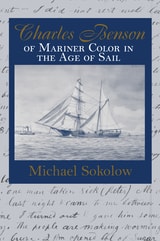
Charles Benson
Mariner of Color in the Age of SailMichael Sokolow
University of Massachusetts Press, 2009
In this volume, Michael Sokolow uncovers the inner world of this remarkable individual. Raised in a small town in Massachusetts, Benson was the great-great-grandson of slaves, the great-grandson of a rare eighteenth-century intermarriage between a black man and a white woman, and the grandson of a veteran of the American Revolution. His own life had been marked by economic struggle, marital conflict, and the social ambiguities of mixed race heritage.
In his personal writings, Benson reflected on both the man he was and the man he wanted to be. Living in a culture that prized "self-made" individuals, he sought to forge his own identity even as he labored under strictures that severely limited opportunities for blacks. From his youth in rural Middlesex County, Massachusetts, to his subsequent adult life in the bustling port city of Salem, Benson measured himself against the mores of white, middle-class America. Undeterred by early failures in both marriage and finance, he held fast to his personal vision and became a respectable husband, provider, worker, and member of the black community.
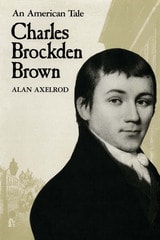
Charles Brockden Brown
An American TaleBy Alan Axelrod
University of Texas Press, 1983
Charles Brockden Brown: An American Tale is the first comprehensive literary, biographical, and cultural study of the novelist whom critic Leslie Fiedler has dubbed "the inventor of the American writer."
The author of Wieland, Arthur Mervyn, Ormond, and Edgar Huntly, Charles Brockden Brown (1771-1810) is considered the first American professional author. He introduced Indian characters into American fiction. His keen interest in character delineation and abnormal psychology anticipates the stories of Poe, Hawthorne, and later masters of the psychological novel.
Brown was eager to establish for himself an American identity as a writer, to become what Crèvecoeur called "the new man in the New World." It is especially this intimate identification of writer with country that makes Brown a telling precursor of our most characteristic authors from Poe, Hawthorne, and Cooper to Fitzgerald, Hemingway, and Faulkner.
To understand its significance, Brown's work must be examined as both art and artifact. Accordingly, Charles Brockden Brown: An American Tale is literary history as well as criticism, embued with insights into a writer's sources and influences and the psychology of literary composition. It is also a fascinating examination of a nation's emotional and intellectual impact on a young man in search of his identity as creative artist.
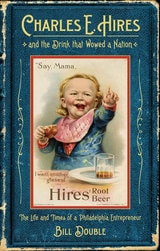
Charles E. Hires and the Drink that Wowed a Nation
The Life and Times of a Philadelphia EntrepreneurBill Double
Temple University Press, 2018
Introduced at the 1876 Centennial Exposition and powered by an historic advertising campaign, Hires Root Beer—launched 10 years before Coca-Cola—blazed the trail for development of the American soft drink industry. Its inventor, Charles Elmer Hires, has been described as “a tycoon with the soul of a chemist.” In addition to creating root beer, Hires, a devoted family man and a pillar of the Quaker community, became a leading importer of botanical commodities, an authority on the vanilla bean. Starting from scratch, he also built one of the world’s largest condensed milk companies.
Charles E. Hires and the Drink that Wowed a Nation chronicles the humble origin and meteoric business success of this extraordinary entrepreneur. Author Bill Double uses published interviews, correspondence, newspaper reports, magazine articles, financial data, and a small family archive to tell this story of native ingenuity. Here, the rough-hewn capitalism of the gilded age, the evolution of the neighborhood drugstore, the rise of advertising in creating mass markets, and the emerging temperance movement all come together in a biography that, well, fizzes with entrepreneurial spirit.
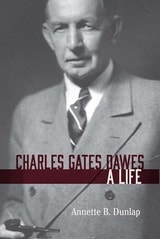
Charles Gates Dawes
A LifeAnnette B. Dunlap
Northwestern University Press, 2016
Charles Gates Dawes: A Life is the first comprehensive biography of an American in whose fascinating story contemporary readers can follow the struggles and triumphs of early twentieth-century America and Europe.
Dawes is most known today as vice president of the United States under Calvin Coolidge, but he also distinguished himself and his hometown of Evanston, Illinois, on the world stage with the 1925 Nobel Peace Prize. This engrossing biography traces how, when the punitive armistice that ended the First World War resulted in a disabled, restive Germany, Dawes’s diplomatic legerdemain averted war through a renegotiation of Germany’s debt repayments.
Dawes’s diplomatic and political achievements, however, were only the illustrious capstones to a multifaceted career that included military service, law, finance, and business on the local, state, national, and global stages. In every arena of his life, he combined the social graces of the Gilded Age with the spirit of service of the Progressive Era.
Despite his life of disciplined service, Dawes was an ebullient and irrepressible figure. Dawes’s salty language was often colorful fodder for tabloid and magazine writers of his era. In this captivating biography, Annette B. Dunlap recounts the story of an original American who enlightened and enlivened his world.
This book was published in cooperation with the Evanston History Center and with generous support from the Tawani Foundation.
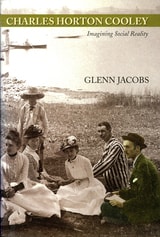
Charles Horton Cooley
Imagining Social RealityGlenn Jacobs
University of Massachusetts Press, 2006
In surveying Cooley's thought, Jacobs emphasizes the role that the sociologist's own "inner work" played in the development of his idea of the self. Particularly important in this respect was Cooley's deep commitment to the essay tradition, a literary genre distinguished by autobiographical reflection and conversational discourse that he described as "a society of men speaking to each other across the ages." A close reading of the journal that Cooley kept for over forty years reveals how he worked out many of his key concepts and theories in his personal writing. It was through this exercise that he developed his distinct literary-aesthetic perspective, eventually resulting in a methodology that stands out for setting qualitative sociology on an epistemological foundation.
In a chapter devoted to Cooley's qualitative approach, Jacobs analyzes his vivid ethnographic observations of the Lower East Side Jewish ghetto and Hull House in Chicago, as well as his reflections on the death of his daughter and his own impending death in 1929. Another chapter looks at Cooley's little-known writing on economic sociology, focusing on his understanding of the market as an institution.
By examining the full range of Charles Horton Cooley's contributions to belles lettres as well as social science, often allowing him to speak for himself, Jacobs makes a strong case for elevating Cooley's rank among the most influential American sociologists.
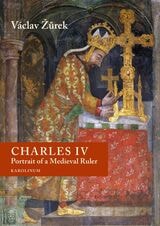
Charles IV
Portrait of a Medieval RulerVáclav Žurek
Karolinum Press, 2023
Charles IV, King of Bohemia and Holy Roman Emperor, has been called “one of the most learned and diplomatically skillful sovereigns” of the fourteenth century. Having moved the seat of the Holy Roman Empire to Prague and founding the first university in Central Europe, Charles IV is a towering figure in Czech history and a crucial character in the story of medieval Europe.
Recent research, especially in art history, has tended to present Charles IV in a purely positive, unblemished light: viewing him and his imperial court as the engine behind a flourishing of culture in the region. This book views Charles IV through a more critical lens, examining the careful construction that went into the way he presented himself and the characteristic manifestations of Charles’ execution of royal power. The first part of the book offers a chronological description of Charles’ life within the broader context of the times and the House of Luxembourg. The second part provides a close look into Charles IV’s style of rule while focusing on phenomena that reveal his personal conception of power and how it was wielded.
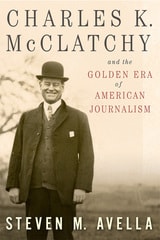
Charles K. McClatchy and the Golden Era of American Journalism
Steven M. Avella
University of Missouri Press, 2016
Charles K. McClatchy was twenty-five when he inherited The Sacramento Bee from his father, and his ensuing career as the paper’s editor extended well beyond the newsroom. Until his death in 1936, McClatchy was a consistent advocate for Progressive politics, a crusader for urban reform, a staunch isolationist, and a voice for Northern California. This biography explores his career as the long-time editor of the Bee in a work that weaves the history of Northern California with that of American newspapers.
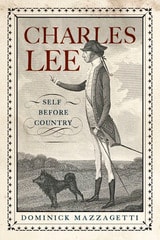
Charles Lee
Self Before CountryMazzagetti, Dominick
Rutgers University Press, 2013
Received an Honorable Mention for the American Revolution Round Table of Richmond's 2014 Book Award
Dominick Mazzagetti presents an engaging account of the life of Charles Lee, the forgotten man of the American Revolution. History has not been kind to Lee—for good reason. In this compelling biography, Mazzagetti compares Lee’s life and attributes to those of George Washington and offers significant observations omitted from previous Lee biographies, including extensive correspondence with British officers in 1777 that reflects Lee’s abandonment of the Patriots’ cause.
Lee, a British officer, a veteran of the French and Indian War, and a critic of King George III, arrived in New York City in 1773 with an ego that knew no bounds and tolerated no rivals. A highly visible and newsworthy personality, he quickly took up the American cause and encouraged rebellion. As a result of this advocacy and his military skills, Lee was granted a commission as a major general in the Continental Army and soon became second-in-command to George Washington. He helped organize the defense of Boston, designed defenses for New York City, and commanded the force that repelled the British attack on Charleston.
Upon his return to New York in 1776, Lee was considered by some leaders of the Revolution to be an alternative to George Washington, who was in full retreat from British forces. Lee’s capture by the British in December 1776 put an end to that possibility. Lee’s subsequent release in a prisoner exchange in 1778 and return to an American command led to a dramatic confrontation with Washington on the battlefield at Monmouth, New Jersey, in June 1778. Washington chastised Lee publicly for ordering an unnecessary retreat. Lee suffered the ignominy of a court-martial conviction for this blunder and spent the remaining years to his death in 1782 attacking Washington. Although few doubted Lee’s loyalty at the time, his actions at Monmouth fueled speculation that he switched sides during his imprisonment.
A discovery years after his death completed Lee’s tale. In 1862, a researcher discovered “Mr. Lee’s Plan,” a detailed strategy for the defeat of the American rebels delivered to British General William Howe while Lee was held in captivity. This discovery sealed Lee’s historical record and ended all further discussion of his contributions to the American Revolution. Today, few people even realize that Fort Lee, on the New Jersey side of the George Washington Bridge, was named in his honor.
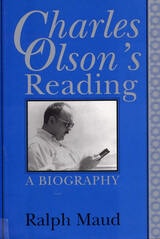
Charles Olson's Reading
A BiographyRalph Maud
Southern Illinois University Press, 1996
In this narrative account of the life and work of Charles Olson, Ralph Maud focuses on what the poet read as a basis for understanding the work he produced.
To an extraordinary degree, Olson’s reading and life were coextensive, according to Maud, who notes that Olson saw his written output over his lifetime as a total cosmology. An individual who rarely traveled, this major American poet explored the world and its history as well as the furthest reaches of the thought of his day through books.
Maud builds upon George Butterick’s annotated listing of Olson’s library, bought by the University of Connecticut after the poet’s death in 1970. The present volume, however, adds categories of books Butterick deliberately omitted: Olson’s childhood books and poetry by his own contemporaries.
Linking Olson’s books to his intellectual and poetic development at each stage of his career, Maud reveals such little-known but important connections as the contracted book project "Operation Red, White and Black" and Olson’s plan for the long poem "West"—two unrealized projects much later shaped into The Maximus Poems.
Maud also outlines the surprisingly multiple role of the painter Corrado Cagli, who brought home to Olson the significance of the Holocaust and introduced him both to the Tarot and to the theories of non-Euclidean geometry that Olson variously incorporated into his poems and essays. In discussing Olson’s relationship to Ezra Pound, Maud defines in some detail what Olson gained from Pound and what he repudiated.
Maud refutes the notion that Olson’s intellectual and creative powers declined during the last years of his life, demonstrating that during these years Olson developed his Jungian interest, his attention to early Greek thought, and a new concern for Northern mythology.
This chronicle of Olson’s reading from childhood to deathbed constitutes a critical biography of the larger-than-life author of Call Me Ishmael and The Maximus Poems. No modern poet is more revealed in his sources than Olson. Maud’s comprehensive and complete study provides a basis for new and fresh modes of thinking about Olson’s great achievement.
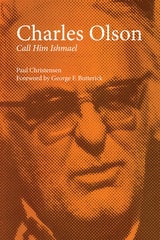
Charles Olson
Call Him IshmaelBy Paul Christensen
University of Texas Press, 1979
Charles Olson was an important force behind the raucous, explicit, jaunty style of much of twentieth-century poetry in America. This study makes a major contribution to our understanding of his life and work.
Paul Christensen draws upon a wide variety of source materials—from letters, unpublished essays, and fragments and sketches from the Olson Archives to the full range of Olson's published prose and poetry. Under Christensen's critical examination, Olson emerges as a stunning theorist and poet, whose erratic and often unfinished writings obscured his provocative intellect and the coherence of his perspective on the arts.
Soon after World War II, Olson emerged as one of America's leading poets with his revolutionary document on poetics, "Projective Verse," and his now-classic poem, "The Kingfishers," both of which declared a new set of techniques for verse composition. Throughout the 1950s Olson wrote many polemical essays on literature, history, aesthetics, and philosophy that outlined a new stance to experience he called objectism.
A firm advocate of spontaneous self-expression in the arts, Olson regarded the poet's return to an intense declaration of individuality as a force to combat the decade's insistence on conformity. Throughout his life Olson fought against the depersonalization of the artist in the modern age; his resources, raw verve and unedited tumultuous lyricism, were weapons he used against generalized life and identity.
This volume begins with an overview of Olson's life from his early years as a student at Harvard through his short-lived political career, his rectorship at Black Mountain College, and his retirement to Gloucester to finish writing the Maximus poems. Christensen provides a systematic review of Olson's prose works, including a close examination of his brilliant monograph on Melville, Call Me Ishmael.
Considerable attention is devoted to Olson's theory of projectivism, the themes and techniques of his short poems, and the strategies and content of his major work, the Maximus series. In addition, there is a critical survey of the works of Robert Creeley, Robert Duncan, Denise Levertov, Paul Blackburn, and other poets who show Olson's influence in their own innovative, self-exploratory poetry.
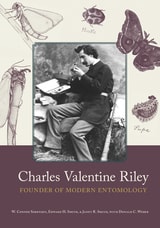
Charles Valentine Riley
Founder of Modern EntomologyW. Conner Sorensen, Edward H. Smith, and Janet R. Smith, with Donald C. Weber
University of Alabama Press, 2019
This definitive biography is the first full account of a fascinating American scientist whose leadership created the modern science of entomology that recognizes both the essential role of insects in natural systems and their challenge to the agricultural food supply that sustains humankind. Charles Valentine Riley: Founder of Modern Entomology tells the story of how Riley (1843–1895), a young British immigrant to America—with classical schooling, only a smattering of natural history knowledge, and with talent in art and writing but no formal training in science—came to play a key role in the reorientation of entomology from the collection and arrangement of specimens to a scientific approach to insect evolution, diversity, ecology, and applied management of insect pests.
Drawing on Riley’s personal diaries, family records, correspondence, and publications, the authors trace Riley’s career as farm laborer, Chicago journalist, Missouri State Entomologist, chief federal entomologist, founder of the National Insect Collection, and initiator of the professional organization that became the Entomological Society of America. Also examined in detail are his spectacular campaigns against the Rocky Mountain Locust that stalled western migration in the 1870s, the Grape Phylloxera that threatened French vineyards in the 1870s and 80s, the Cotton Worm that devastated southern cotton fields after the Civil War, and the Cottony Cushion Scale that threatened the California citrus industry in the 1880s. The latter was defeated through importation of the Vedalia Beetle from Australia, the spectacular first example of biological control of an invasive insect pest by its introduced natural enemy.
A striking figure in appearance and deed, Riley combined scientific, literary, artistic, and managerial skills that enabled him to influence every aspect of entomology. A correspondent of Darwin and one of his most vocal American advocates, he discovered the famous example of mimicry of the Monarch butterfly by the Viceroy, and described the intricate coevolution of yucca moths and yuccas, a complex system that fascinates evolutionary scientists to this day. Whether applying evolutionary theory to pest control, promoting an American silk industry, developing improved spray technologies, or promoting applied entomology in state and federal government and to the public, Riley was the central figure in the formative years of the entomology profession. In addition to showcasing his own renderings of the insects he investigated, this comprehensive account provides fresh insight into the personal and public life of an ingenious, colorful, and controversial scientist, who aimed to discover, understand, and outsmart the insects.
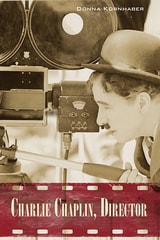
Charlie Chaplin, Director
Donna Kornhaber
Northwestern University Press, 2014
Charlie Chaplin was one of the cinema’s consummate comic performers, yet he has long been criticized as a lackluster film director. In this groundbreaking work—the first to analyze Chaplin’s directorial style—Donna Kornhaber radically recasts his status as a filmmaker. Spanning Chaplin’s career, Kornhaber discovers a sophisticated "Chaplinesque" visual style that draws from early cinema and slapstick and stands markedly apart from later, "classical" stylistic conventions. His is a manner of filmmaking that values space over time and simultaneity over sequence, crafting narrative and meaning through careful arrangement within the frame rather than cuts between frames. Opening up aesthetic possibilities beyond the typical boundaries of the classical Hollywood film, Chaplin’s filmmaking would profoundly influence directors from Fellini to Truffaut. To view Chaplin seriously as a director is to re-understand him as an artist and to reconsider the nature and breadth of his legacy.
Charlotte Delbo
A Life ReclaimedGhislaine Dunant, Translated by Kathryn M. Lachman
University of Massachusetts Press, 2021
Ghislaine Dunant's unforgettable biography of Delbo, La vie retrouvée (2016), captivated French readers and was awarded the Prix Femina. Now translated into English for the first time, Charlotte Delbo: A Life Reclaimed depicts Delbo's lifelong battles as a working-class woman, as a survivor, as a leftist who broke from the Communist Party, and most of all, as a writer whose words compelled others to see.
Chasing Good Sense
A Boy's Life on the FrontierHomer McCarty and Coralie McCarty Beyers
University of Utah Press, 2018
In the spirit of Huck Finn, Buck embarks on adventures and mischief with his loyal friend, Earl. Naïve, eager, and inquisitive, he seeks to make sense of his world. McCarty’s portrayal of the period is often humorous, capturing the intimacy of place and family through a young boy’s eyes.
McCarty completed this work in 1948. Had it not been for a series of fortuitous events and the dedication of his granddaughters, including Coralie Beyers, these pages would have been lost. Thanks to her efforts, her grandfather’s lively, entertaining book is now available for readers to relish and enjoy.
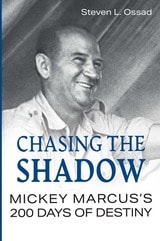
Chasing the Shadow
Mickey Marcus's 200 Days of DestinySteven L. Ossad
University of Missouri Press, 2024
The life of David “Mickey” Marcus has become the stuff of legends and myths (even fantasy), conspiracy, wild exaggeration, and untethered embellishment. The image of Marcus cast by the character portrayed by Kirk Douglas in the film version of his life still dominates most evocations of the man, for good or ill. And these days, reactions to the book or film rest mostly on the current headlines rather than the historical context of the struggle in which Marcus died, or the events that cast him as a real-life player in an event marked by destiny.
Chasing the Shadow: Mickey Marcus’s 200 Days of Destiny is the first comprehensive and balanced biography of David Daniel “Mickey” Marcus, a founder of American Civil Affairs and Military Government doctrine and practice and a seminal figure in early Israeli military history. Far from merely a tribute to Mickey Marcus's legacy, Ossad’s work serves as a critical tool for understanding the realities of mid-20th-century warfare in a Postwar colonial struggle and the dynamics of U.S.-Israeli military and political relations in 1948, the critical year for Israel’s struggle for independence. Indeed, Chasing the Shadow is a valuable read for those interested in Middle East history, Jewish military history, and a fascinating character whose story is told in an engaging, informative, and insightful narrative.
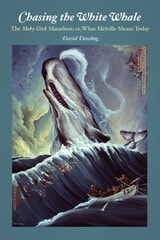
Chasing the White Whale
The Moby-Dick Marathon; or, What Melville Means TodayDavid Dowling
University of Iowa Press, 2010
The experimental artist Peter Fischli once observed, “There’s certainly a subversive pleasure in occupying yourself with something for an unreasonable length of time.” In this same spirit, David Dowling takes it upon himself to attend and report on the all-consuming annual Moby-Dick Marathon reading at the New Bedford Whaling Museum.
The twenty-five-hour nonstop reading of Melville’s titanic epic has inspired this fresh look at Moby-Dick in light of its most devoted followers at the moment of their high holy day, January 3, 2009. With some trepidation, Dowling joined the ranks of the Melvillians, among the world’s most obsessive literary aficionados, to participate in the event for its full length, from “Call Me Ishmael” to the destruction of the Pequod. Dowling not only survived to tell his tale, but does so with erudition, humor, and a keen sense for the passions of his fellow whalers.
The obsession of participants at the marathon reading is startling, providing evidence of Ishmael’s remark that “all men live enveloped in whale-lines. All are born with halters round their necks; but it is only when caught in the swift, sudden turn of death, that mortals realize the silent, subtle, ever-present perils of life.” Dowling organizes his savvy analysis of the novel from its romantic departure to its sledge-hammering seas, detailing the culture of the top brass to the common crew and scrutinizing the inscrutable in and through Melville’s great novel.
Chasing the White Whale offers a case study of the reading as a barometer of how Melville lives today among his most passionate and enthusiastic disciples, who include waterfront workers, professors, naval officers, tattooed teens, and even a member of Congress. Dowling unearths Moby-Dick’s central role in these lives, and by going within the local culture he explains how the novel could have developed such an ardent following and ubiquitous presence in popular culture within our technology-obsessed, quick-fix contemporary world.
Che on My Mind
Margaret Randall
Duke University Press, 2013
Cheap Rooms and Restless Hearts
A Study of Formula in the Urban Tales of William Sydney PorterKaren Charmaine Blansfield
University of Wisconsin Press, 1988
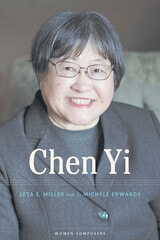
Chen Yi
Leta E. Miller and J. Michele Edwards
University of Illinois Press, 2020
Winner of the Leila Webster Memorial Music Award for the International Alliance for Women in Music of the 2022 Pauline Alderman Awards for Outstanding Scholarship on Women in Music
Chen Yi is the most prominent woman among the renowned group of new wave composers who came to the US from mainland China in the early 1980s. Known for her creative output and a distinctive merging of Chinese and Western influences, Chen built a musical language that references a breathtaking range of sources and crisscrosses geographical and musical borders without eradicating them.
Leta E. Miller and J. Michele Edwards provide an accessible guide to the composer's background and her more than 150 works. Extensive interviews with Chen complement in-depth analyses of selected pieces from Chen's solos for Western or Chinese instruments, chamber works, choral and vocal pieces, and compositions scored for wind ensemble, chamber orchestra, or full orchestra. The authors highlight Chen's compositional strategies, her artistic elaborations, and the voice that links her earliest and most recent music. A concluding discussion addresses questions related to Chen's music and issues such as gender, ethnicity and nationality, transnationalism, border crossing, diaspora, exoticism, and identity.
Chi Boy
Native Sons and Chicago ReckoningsKeenan Norris
The Ohio State University Press, 2022
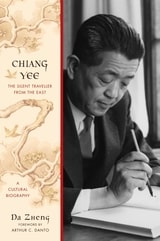
Chiang Yee
The Silent Traveller from the East--A Cultural BiographyZheng, Da
Rutgers University Press, 2010
This biography is more than a recounting of extraordinary accomplishments. It also embraces the transatlantic life experience of Yee who traveled from China to England and then on to the United States, where he taught at Columbia University, to his return to China in 1975, after a forty-two year absence. Interwoven is the history of the communist revolution in China; the battle to save England during World War II; the United States during the McCarthy red scare era; and, eventually, thawing Sino-American relations in the 1970s. Da Zheng uncovers Yee's encounters with racial exclusion and immigration laws, displacement, exile, and the pain and losses he endured hidden behind a popular public image.
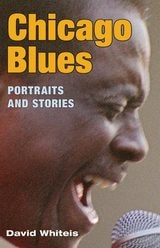
Chicago Blues
Portraits and StoriesDavid Whiteis
University of Illinois Press, 2006
Through revealing portraits of selected local artists and slice-of-life vignettes drawn from the city’s pubs and lounges, Chicago Blues encapsulates the sound and spirit of the blues as it is lived today. As a committed participant in the Chicago blues scene for more than a quarter century, David Whiteis draws on years of his observations and extensive interviews to paint a full picture of the Chicago blues world, both on and off the stage.
In addition to portraits of blues artists he has personally known and worked with, Whiteis takes readers on a tour of venues like East of Ryan and the Starlight Lounge, home to artists such as Jumpin’ Willie Cobbs, Willie D., and Harmonica Khan. He tells the stories behind the lives of past pioneers, including Junior Wells, pianist Sunnyland Slim, and harpist Big Walter Horton, whose music reflects the universal concerns with love, loss, and yearning that continue to keep the blues so vital for so many.
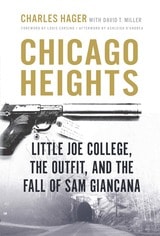
Chicago Heights
Little Joe College, the Outfit, and the Fall of Sam GiancanaCharles Hager with David T. Miller, Foreword by Louis Corsino, Afterword by Ashleigh D'Andrea
Southern Illinois University Press, 2018
In this riveting true story of coming of age in the Chicago Mob, Charles “Charley” Hager is plucked from his rural West Virginia home by an uncle in the 1960s and thrown into an underworld of money, cars, crime, and murder on the streets of Chicago Heights.
Street-smart and good with his hands, Hager is accepted into the working life of a chauffeur and “street tax” collector, earning the moniker “Little Joe College” by notorious mob boss Albert Tocco. But when his childhood friend is gunned down by a hit man, Hager finds himself a bit player in the events surrounding the mysterious, and yet unsolved, murder of mafia chief Sam Giancana.
Chicago Heights is part rags-to-riches story, part murder mystery, and part redemption tale. Hager, with author David T. Miller, juxtaposes his early years in West Virginia with his life in crime, intricately weaving his own experiences into the fabric of mob life, its many characters, and the murder of Giancana.
Fueled by vivid recollections of turf wars and chop shops, of fix-ridden harness racing and the turbulent politics of the 1960s, Chicago Heights reveals similarities between high-level organized crime in the city and the corrupt lawlessness of Appalachia. Hager candidly reveals how he got caught up in a criminal life, what it cost him, and how he rebuilt his life back in West Virginia with a prison record.
Based on interviews with Hager and supplemented by additional interviews and extensive research by Miller, the book also adds Hager’s unique voice to the volumes of speculation about Giancana’s murder, offering a plausible theory of what happened on that June night in 1975.
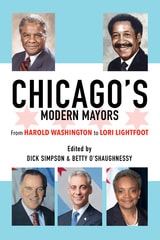
Chicago’s Modern Mayors
From Harold Washington to Lori LightfootEdited by Dick Simpson and Betty O'Shaughnessy
University of Illinois Press, 2024
Chicago’s transformation into a global city began at City Hall. Dick Simpson and Betty O’Shaughnessy edit in-depth analyses of the five mayors that guided the city through this transition beginning with Harold Washington’s 1983 election: Washington, Eugene Sawyer, Richard M. Daley, Rahm Emmanuel, and Lori Lightfoot. Though the respected political science, sociologist, and journalist contributors approach their subjects from distinct perspectives, each essay addresses three essential issues: how and why each mayor won the office; whether the City Council of their time acted as a rubber stamp or independent body; and the ways the unique qualities of each mayor’s administration and accomplishments influenced their legacy.
Filled with expert analysis and valuable insights, Chicago’s Modern Mayors illuminates a time of transition and change and considers the politicians who--for better and worse--shaped the Chicago of today.
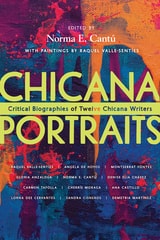
Chicana Portraits
Critical Biographies of Twelve Chicana WritersEdited by Norma E. Cantú; With paintings by Raquel Valle-Sentíes
University of Arizona Press, 2023
Artist Raquel Valle-Sentíes’s portraits bring visual dimension, while essays delve deeply into the authors’ lives for details that inform their literary, artistic, feminist, and political trajectories and sensibilities. The collection brilliantly intersects artistic visual and literary cultural productions, allowing complex themes to emerge, such as the fragility of life, sexism and misogyny, Chicana agency and forging one’s own path, the struggles of becoming a writer and battling self-doubt, economic instability, and political engagement and activism.
Arranged chronologically by birth order of the authors, the book can be read cover to cover for a genealogical overview, or scholars and general readers can easily jump in at any point and read about an individual author, regardless of the chronology.
Biographies included in this work include Raquel Valle-Sentíes, Angela de Hoyos, Montserrat Fontes, Gloria E. Anzaldúa, Norma E. Cantú, Denise Elia Chávez, Carmen Tafolla, Cherríe Moraga, Ana Castillo, Lorna Dee Cervantes, Sandra Cisneros, and Demetria Martínez.
Contributors
Cordelia E. Barrera
Mary Pat Brady
Norma E. Cantú
María Jesus Castro Dopacio
Carlos Nicolás Flores
Myrriah Gómez
Maria Magdalena Guerra de Charur
Gabriella Gutiérrez y Muhs
Georgina Guzmán
Cristina Herrera
María Esther Quintana
Eliza Rodríguez y Gibson
Meagan Solomon
Lourdes Torres
Raquel Valle-Sentíes
Jen Yáñez-Alaniz