Results by title
668 books match the query 'History & Surveys' and 40 start with h
Hans Jonas
The Integrity of ThinkingDavid J. Levy
University of Missouri Press, 2002
Hardship and Happiness
Lucius Annaeus Seneca
University of Chicago Press, 2014
Hardship and Happiness collects a range of essays intended to instruct, from consolations—works that offer comfort to someone who has suffered a personal loss—to pieces on how to achieve happiness or tranquility in the face of a difficult world. Expertly translated, the essays will be read and used by undergraduate philosophy students and experienced scholars alike.
Hayek on Mill
The Mill-Taylor Friendship and Related WritingsF. A. Hayek
University of Chicago Press, 2015
This latest addition to the University of Chicago Press’s Collected Works of F. A. Hayek series showcases the fascinating intersections between two of the most prominent thinkers from two successive centuries. Hayek situates Mill within the complex social and intellectual milieu of nineteenth-century Europe—as well as within twentieth-century debates on socialism and planning—and uncovers the influence of Taylor-Mill on Mill’s political economy. The volume features the Mill-Taylor correspondence and brings together for the first time Hayek’s related writings, which were widely credited with beginning a new era of Mill scholarship.
Hearing Things
Voice and Method in the Writing of Stanley CavellTimothy Gould
University of Chicago Press, 1998
Gould argues that a tension between voice and method unites Cavell's broad and often perplexing range of interests. From Wittgenstein to Thoreau, from Shakespeare to the movies, and from opera to Freud, Gould reveals the connection between the voice within Cavell's writing and the voices Cavell appeals to through the methods of ordinary language philosophy. Within Cavell's extraordinary productivity lies a new sense of philosophical method based on elements of the act of reading. Hearing Things is both an important study of Cavell's work and a major contribution to the construction of American philosophy.
Hegel and the Freedom of Moderns
Domenico Losurdo
Duke University Press, 2004
Hegel and the Freedom of Moderns persuasively argues that the tug of war between “conservative” and “liberal” interpretations of Hegel has obscured and distorted the most important aspects of his political thought. Losurdo unravels this misleading dualism and provides an illuminating discussion of the relation between Hegel’s political philosophy and the thinking of Karl Marx and Friedrich Engels. He also discusses Hegel’s ideas in relation to the pertinent writings of other major figures of modern political philosophy such as Jean-Jacques Rousseau, John Locke, Edmund Burke, John Stuart Mill, Jeremy Bentham, Karl Popper, Norberto Bobbio, and Friedrich Hayek.
Hegel's Energy
A Reading of The Phenomenology of SpiritMichael Marder
Northwestern University Press, 2021
Hegel's Idea of a Phenomenology of Spirit
Michael N. Forster
University of Chicago Press, 1998
The Phenomenology of Spirit emerges as an extraordinarily coherent work with a rich array of important and original ideas. These include a diagnosis of the ills of modernity in terms of its commitment to a series of dualisms, and a project for overcoming them; a sweeping naturalism; a deep rethinking of and response to problems of skepticism; subtle arguments for social theories of meaning and truth; and ideas based on the insight that human thought changes in fundamental ways over the course of history. Forster's unique and compelling reading unlocks the mysteries of Hegel's seminal work.
Hegel's Logic
Between Dialectic and HistoryClark Butler
Northwestern University Press, 2011
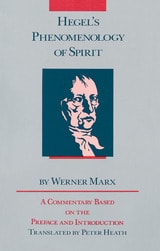
Hegel's Phenomenology of Spirit
A Commentary Based on the Preface and IntroductionWerner Marx
University of Chicago Press, 1988
The primary focus of Marx's book is on the account. Hegel gives of the phenomenological journey from natural consciousness to philosophical wisdom (or absolute knowledge, as Hegel calls it). In showing that Hegel's many statements concerning consciousness 'finding itself' or 'knowing itself' in its world can be understood as discovering the rationality of the conditioning world, Marx offers a solution to several sets of interrelated problems that have troubled students of Hegel. His book contains valuable analyses of the relation between Hegel's thought and that of Descartes and Kant as well as that of Karl Marx, and it also sheds considerable light on the question of the internal unity or coherence of the Phenomenology.
Hegel's Phenomenology, Part 1
Analysis and CommentaryHoward P. Kainz
Ohio University Press, 1976
Kainz provides an accessible entry into the complexities of Hegelian thought by asking a series of questions about such matters as the literary form of the Phenomenology, its "plot," its relation to the "system," its subject matter, the problem of objectivity, dialectical necessity, the concept of "experience," and the Hegelian concept of consciousness. Building of the work of previous commentators, and presenting the work of these commentators in a clear and unbiased manner, Kainz offers an analysis that will be helpful both to experienced Hegelian scholars and to those readers preparing to approach the large and bewildering territory of the Phenomenology for the first time.
Hegel's Realm of Shadows
Logic as Metaphysics in “The Science of Logic”Robert B. Pippin
University of Chicago Press, 2018
Robert B. Pippin offers here a bold, original interpretation of Hegel’s claim that only now, after Kant’s critical breakthrough in philosophy, can we understand how logic can be a metaphysics. Pippin addresses Hegel’s deep, constant reliance on Aristotle’s conception of metaphysics, the difference between Hegel’s project and modern rationalist metaphysics, and the links between the “logic as metaphysics” claim and modern developments in the philosophy of logic. Pippin goes on to explore many other facets of Hegel’s thought, including the significance for a philosophical logic of the self-conscious character of thought, the dynamism of reason in Kant and Hegel, life as a logical category, and what Hegel might mean by the unity of the idea of the true and the idea of the good in the “Absolute Idea.” The culmination of Pippin’s work on Hegel and German idealism, this is a book that no Hegel scholar or historian of philosophy will want to miss.
Hegel's Sole Idea
The Last Great Metaphysical SystemMark Alznauer
University of Chicago Press, 2026
An accessible reconstruction of Hegel’s attempt to derive all reality from a single concept.
In the early decades of the nineteenth century, G. W. F. Hegel came to believe that philosophy was finally in a position to achieve something it had striven for since ancient Greece: becoming an objective, demonstrative science. But to achieve this aim, he thought philosophical knowledge needed to be reconceived in a radically new way—as content contained in a single concept just as the oak tree is hidden in the acorn. In Hegel’s Sole Idea, Mark Alznauer reads Hegel’s mature philosophical system as the unprecedented attempt to comprehend the entire world as the full unfolding of that single concept, which he mysteriously calls “the absolute idea.”
Ever since Hegel set out this program in his Encyclopedia of the Philosophical Sciences in Outline, Hegel’s system has been regarded as the last best hope of philosophy as an autonomous, fully rational science. But while Hegel’s followers regarded the Encyclopedia as the successful realization of the traditional aims of philosophy, his most influential successors thought it instead showed the exhaustion and collapse of that project. Hegel’s Sole Idea offers a comprehensive interpretation of Hegelian philosophy that allows a fair confrontation with its most provocative and ambitious claims.
Hegel's Theory of Intelligibility
Rocío Zambrana
University of Chicago Press, 2015
Zambrana clarifies crucial features of Hegel’s theory of normativity previously thought to be absent from the argument of the Science of Logic—what she calls normative precariousness and normative ambivalence. She shows that Hegel’s theory of determinacy views intelligibility as both precarious, the result of practices and institutions that gain and lose authority throughout history, and ambivalent, accommodating opposite meanings and valences even when enjoying normative authority. In this way, Zambrana shows that the Science of Logic provides the philosophical justification for the necessary historicity of intelligibility. Intervening in several recent developments in the study of Kant, Hegel, and German Idealism more broadly, this book provides a productive new understanding of the value of Hegel’s systematic ambitions.
Hegel, Heidegger, and the Ground of History
Michael Allen Gillespie
University of Chicago Press, 1984
Hegel, Marx, and the Laughing Matter of Spirit
R. A. Aumiller
Northwestern University Press, 2026
What happens when those who have been denied political subjectivity fully play out their negative role in a historical drama that damned them from the beginning? Hegel, Marx, and the Laughing Matter of Spirit locates the eruption of revolutionary laughter in historical cracks across nineteenth- and twentieth-century Europe, where exiled philosophers, partisan fighters, and artists framed their political resistance as a historical comedy. Hegelian comedy fuels the Young Hegelian critique of Prussian censorship, Walter Benjamin’s staging of the anti-fascist resistance, and the Yugoslavian partisan attempt to begin again in fascism’s aftermath. Revolution erupts from a historical stage that can no longer look on its own contradictions with a straight face. Drawing on the defiant spirit of comedy, this Hegelian feminist manifesto defies political despair, overturning the perception that history tragically repeats itself. Invoking the phrase “Nothing changes” as a mantra, R. A. Aumiller turns a concession of defeat into a battle cry for political resistance.
Hegel
The Restlessness Of The NegativeJean-Luc Nancy
University of Minnesota Press, 2002
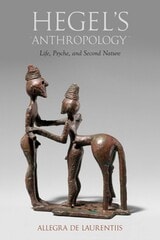
Hegel’s Anthropology
Life, Psyche, and Second NatureAllegra de Laurentiis
Northwestern University Press, 2021
A groundbreaking contribution to scholarship on Hegel and nineteenth-century philosophy, this book shows that the Anthropology is essential to understanding Hegel’s concept of spirit, not only in its connection with nature but also in its more sophisticated realizations as objective and absolute spirit. Future scholarship on this subject will recount—and build upon—de Laurentiis’s innovative study.
Hegel’s Theory of Normativity
The Systematic Foundations of the Philosophical Science of RightKevin Thompson
Northwestern University Press, 2019

Heidegger And The Jews
Jean-Francois Lyotard
University of Minnesota Press, 1990
Heidegger and the Destruction of Aristotle
On How to Read the TraditionSean D. Kirkland
Northwestern University Press, 2023
A bold new conception of Heidegger’s project of Destruktion as a method of interpreting history
For Martin Heidegger, our inherited traditions provide the concepts through which we make our world intelligible. Concepts we can also oppose, disrupt, and even exceed. First, however, if Western philosophy is our inheritance, we must submit it to Destruktion—starting with Aristotle. Heidegger and the Destruction of Aristotle: On How to Read the Tradition presents a new conception of Heidegger’s “destruction” as a way of reading.
Situated between Nietzschean genealogy and Derridean deconstruction, this method uncovers in Aristotle the most vital originating articulations of the Western tradition and gives us the means to confront it. Sean D. Kirkland argues this is not a rejection of the past but a sophisticated and indeed timely hermeneutic tool—a complex, illuminating, and powerful method for interpreting historical texts at our present moment. Acknowledging the historical Heidegger as a politically compromised and still divisive figure, Kirkland demonstrates that Heideggerian destruction is a method of interpreting history that enables us to reorient and indeed transform its own most troubling legacies.
Heidegger and the Myth of a Jewish World Conspiracy
Peter Trawny
University of Chicago Press, 2015
While Heidegger’s affiliation with National Socialism is well known, the anti-Semitic dimension of that engagement could not be fully told until now. Trawny traces Heidegger’s development of a grand “narrative” of the history of being, the “being-historical thinking” at the center of Heidegger’s work after Being and Time. Two of the protagonists of this narrative are well known to Heidegger’s readers: the Greeks and the Germans. The world-historical antagonist of this narrative, however, has remained hitherto undisclosed: the Jews, or, more specifically, “world Judaism.” As Trawny shows, world Judaism emerges as a racialized, destructive, and technological threat to the German homeland, indeed, to any homeland whatsoever. Trawny pinpoints recurrent, anti-Semitic themes in the Notebooks, including Heidegger’s adoption of crude cultural stereotypes, his assigning of racial reasons to philosophical decisions (even undermining his Jewish teacher, Edmund Husserl), his endorsement of a Jewish “world conspiracy,” and his first published remarks on the extermination camps and gas chambers (under the troubling aegis of a Jewish “self-annihilation”). Trawny concludes with a thoughtful meditation on how Heidegger’s achievements might still be valued despite these horrifying facets. Unflinching and systematic, this is one of the most important assessments of one of the most important philosophers in our history.
Heidegger, Strauss, and the Premises of Philosophy
On Original ForgettingRichard L. Velkley
University of Chicago Press, 2011
Heidegger
The Question of Being and HistoryJacques Derrida
University of Chicago Press, 2016
Derrida performs an almost surgical reading of the notoriously difficult text, marrying pedagogical clarity with patient rigor and acting as a lucid guide through the thickets of Heidegger’s prose. At this time in intellectual history, Heidegger was still somewhat unfamiliar to French readers, and Being and Time had only been partially translated into French. Here Derrida mostly uses his own translations, giving his own reading of Heidegger that directly challenges the French existential reception initiated earlier by Sartre. He focuses especially on Heidegger’s Destruktion (which Derrida would translate both into “solicitation” and “deconstruction”) of the history of ontology, and indeed of ontology as such, concentrating on passages that call for a rethinking of the place of history in the question of being, and developing a radical account of the place of metaphoricity in Heidegger’s thinking.
This is a rare window onto Derrida’s formative years, and in it we can already see the philosopher we’ve come to recognize—one characterized by a bravura of exegesis and an inventiveness of thought that are particularly and singularly his.
Heirs and Ancestors
John K. Ryan
Catholic University of America Press, 2018

Heterology and the Postmodern
Bataille, Baudrillard, and LyotardJulian Pefanis
Duke University Press, 1991
Beginning with the introduction of Hegel in French postmodernist thought—largely but not exclusively through the thought of Georges Bataille—Pefanis argues that the core problematics of postmodern aesthetics—history, exchange, representation, and writing—are related to Bataille’s reconceptualization of the Hegelian framework. Pefanis explores how Bataille was influenced by Hegel, Marcel Mauss, Freud, and Nietzsche, and traces the effects of this influence on the analyses and critiques of later postmodernists, most notably Lyotard and Baudrillard. Finally, employing these postmodernists along with Freud and Jacques Lacan, Pefanis discusses discourse on postmodernism and its relation to Freud’s concept of the death drive.
This intellectual history makes valuable contributions to the debates over what the “postmodern” may mean for intellectual and political activity.
Hispanic Philosophy in the Age of Discovery
Kevin White
Catholic University of America Press, 2018
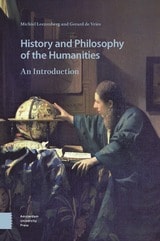
History and Philosophy of the Humanities
An IntroductionMichiel Leezenberg
Amsterdam University Press, 2019
'History and Philosophy of the Humanities: An Introduction' presents a reasoned overview of the conceptual and historical backgrounds of the humanities. In four sections, it discusses:
- the most influential views on scientific knowledge from Aristotle to Thomas Kuhn;
- the birth of the modern humanities and its relation to the natural and social sciences;
- the various methodological schools and conceptual issues in the humanities;
- several themes that set the agenda for current debates in the humanities: critiques of modernity; gender, sexuality and identity; and postcolonialism.
Thus, it provides students in the humanities with a comprehensive understanding of the backgrounds of their own discipline, its relation to other disciplines, and the state of the art of the humanities at large.
History of Christian Philosophy in the Middle Ages
Etienne Gilson
Catholic University of America Press, 2019
History of Political Ideas, Volume 3 (CW21)
The Later Middle AgesEric Voegelin, Edited & Intro by David Walsh
University of Missouri Press, 1998
In The Later Middle Ages, the third volume of his monumental History of Political Ideas, Eric Voegelin continues his exploration of one of the most crucial periods in the history of political thought. Illuminating the great figures of the high Middle Ages, Voegelin traces the historical momentum of our modern world in the core evocative symbols that constituted medieval civilization. These symbols revolved around the enduring aspiration for the sacrum imperium, the one order capable of embracing the transcendent and immanent, the ecclesiastical and political, the divine and human. The story of the later Middle Ages is that of the "civilizational schism"—the movement in which not only the reality but the aspiration for the sacrum imperium gradually disappeared and the unification of faith and reason dissolved.
His recognition of this civilizational schism provides Voegelin with a unique perspective on medieval society. William of Ockham, Dante, Giles of Rome, and Marsilius of Padua all emerge in Voegelin's study as predecessors to modern thought; each turns to personal authority and intellectual analysis in an attempt to comprehend the loss of the sacrum imperium as an authoritative ideal. Voegelin is further drawn into investigations that, despite insufficient attention by scholars, still bear relevance to the study of the later Middle Ages. The mysticism apparent in Piers Plowman and the apocalyptic revolt of Cola di Rienzo are merely two reactions to the disintegration of wholeness.
Yet the story of the later Middle Ages does not merely revolve around disintegration. Voegelin recognizes the emergence of the constitutional political tradition as the most positive development of this period. He is at his best when explaining the difference between the presence of a representative institution and the growth of communal consciousness. Voegelin's study of the English political pattern is matched only by his unique perspective on the German imperial zone, culminating in a fitting conclusion on Nicholas of Cusa—the one political thinker with the ability to evoke the unity of mankind beyond fragmentation.
The Later Middle Ages is at once a brilliant examination of the symbols that characterized medieval society and a remarkable predecessor to Voegelin's study of the modern world, beginning with the Renaissance and the Reformation.
History of Structuralism
Volume 1: The Rising Sign, 1945-1966Francois Dosse
University of Minnesota Press, 1998
The first comprehensive history of one of the most influential intellectual movements of the twentieth century.
Structuralism has had a profound impact on disciplines ranging from literary theory to sociology, from anthropology to philosophy, from history to psychoanalysis. François Dosse tells the story of structuralism from its beginnings in postwar Paris to its culmination as a movement that would reconfigure French intellectual life and reverberate throughout the Western world. This first volume of his study, The Rising Sign, 1945–1966, cogently maps the dizzying array of personalities and ideas of the early structuralist movement, paving the way for later developments.
Hope Now
The 1980 InterviewsJean-Paul Sartre and Benny Lévy
University of Chicago Press, 1996
Shortly before his death, Sartre confirmed the authenticity of the interviews and their puzzling content. Over the past fifteen years, it has become the task of Sartre scholars to unravel and understand them. Presented in this fresh, meticulous translation, the interviews are framed by two provocative essays from Benny Levy himself, accompanied by a comprehensive introduction from noted Sartre authority Ronald Aronson. Placing the interviews in proper biographical and philosophical perspective, Aronson demonstrates that the thought of both Sartre and Levy reveals multiple intentions that taken together nevertheless confirm and add to Sartre's overall philosophy. This absorbing volume at last contextualizes and elucidates the final thoughts of a brilliant and influential mind.
Jean-Paul Sartre (1906-1980) was offered, but declined, the Nobel Prize for literature in 1964. His many works of fiction, drama, and philosophy include the monumental study of Flaubert, The Family Idiot, and The Freud Scenario, both published in translation by the University of Chicago Press.
How Philosophers Saved Myths
Allegorical Interpretation and Classical MythologyLuc Brisson
University of Chicago Press, 2004
How Philosophers Saved Myths also describes how, during the first years of the modern era, allegory followed a more religious path, which was to assume a larger role in Neoplatonism. Ultimately, Brisson explains how this embrace of myth was carried forward by Byzantine thinkers and artists throughout the Middle Ages and Renaissance; after the triumph of Chistianity, Brisson argues, myths no longer had to agree with just history and philosophy but the dogmas of the Church as well.
How Philosophy Became Socratic
A Study of Plato's "Protagoras," "Charmides," and "Republic"Laurence Lampert
University of Chicago Press, 2010
How Socrates Became Socrates
A Study of Plato’s “Phaedo,” “Parmenides,” and “Symposium”Laurence Lampert
University of Chicago Press, 2021
In addition to a careful and precise analysis of Plato’s Phaedo,Parmenides, and Symposium, Lampert shows that properly entwined, Plato’s three dialogues fuse to portray a young thinker entering philosophy’s true radical power. Lampert reveals why this radicality needed to be guarded and places this discussion within the greater scheme of the politics of philosophy.
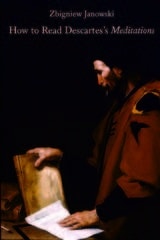
How To Read Descartes's Meditations
Zbigniew Janowski
St. Augustine's Press, 2019
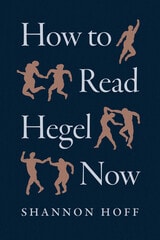
How to Read Hegel Now
Shannon Hoff
University of Chicago Press, 2026
One might be forgiven for feeling that the philosophical tradition, notoriously replete with seemingly aloof and problematic men like Hegel, has little to offer contemporary conversations about justice. Yet for Shannon Hoff, Hegel’s ideas about freedom in particular contain vital resources for efforts to redress racism, sexism, colonialism, ableism, and capitalism today.
In How to Read Hegel Now, Hoff rereads the German philosopher alongside our most compelling thinkers about how oppression disavows our common humanity, including Frantz Fanon, Jessica Benjamin, Saba Mahmood, la paperson, Jean-Paul Sartre, Georges Canguilhem, and Rosemarie Garland-Thomson. Along the way, Hoff recovers in Hegel a new vision for human freedom that challenges the heritage of modern liberalism he helped to construct.
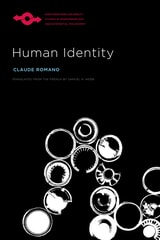
Human Identity
Claude Romano, Samuel R. Webb
Northwestern University Press, 2027
Examining philosophical views of human identity and calling for a shift in how we discuss this essential concept
The problem of identity is one of the most debated contemporary issues in philosophy and the social sciences. Human Identity does not approach this question from a sociological or political position but rather seeks to take a step away from the dominant approach in metaphysics and analytical philosophy, putting forward a dialogical concept of identity inspired mainly by the phenomenological-hermeneutic tradition. Claude Romano argues that the question of identity can only be satisfactorily formulated from the point of view of an intrinsically social understanding of the human being: The identity that matters in our lives is the one we can assume before others in truthful conduct and thus the one for which we can bear responsibility in the first person.
Romano carefully examines the full historical sweep of the philosophy of identity, referencing not only classic thinkers, including Descartes, Locke, Kant, and Husserl, but also contemporary interlocutors, such as Richard Moran and Charles Larmore. He engages in a sustained dialogue with these fellow philosophers, historical and current, while arguing for a complete paradigm shift in our approach to identity. Romano contends that we need to move on from the question Who?, as used by a prosecutor or judge to identify a guilty party, and instead look to the question used by Montaigne to define himself: Who am I?
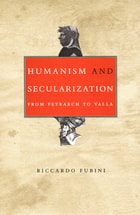
Humanism and Secularization
From Petrarch to VallaRiccardo Fubini
Duke University Press, 2003
Humanism and Secularization offers a nuanced account of humanists contesting medieval ideas about authority not in order to reject Christianity or even orthodoxy, but to claim for themselves the right to define what it meant to be a Christian. Fubini analyzes key texts by major humanists—isuch as Petrarch, Poggio, and Valla—from the first century of the movement. As he subtly works out these authors’ views on religion and the Church from both biographical and textual information, Fubini reveals in detail the new historical consciousness that animated the humanists in their reading of classical and patristic texts. His book as a whole shows convincingly just how radical the humanism of the first half of the fifteenth century was and how sharply it challenged well-entrenched ideas and institutions. Appearing here in English for the first time, his work provides a model set of readings of humanist texts and a critical perspective on Italian humanism that will alter and enrich discussion and understanding of the nature of the humanist movement.
Husserl and Transcendental Intersubjectivity
A Response to the Linguistic-Pragmatic CritiqueDan Zahavi
Ohio University Press, 2001
Against this background the book compares his view with the approaches to intersubjectivity found in Heidegger, Sartre, and Merleau-Ponty, and it then attempts to establish to what extent the phenomenological approach can contribute to the current discussion of intersubjectivity. This is achieved through a systematic confrontation with the language-pragmatical positions of Apel and Habermas.
Hypocrisy and Integrity
Machiavelli, Rousseau, and the Ethics of PoliticsRuth W. Grant
University of Chicago Press, 1997