Results by title
547 books match the query 'California' and 32 start with m
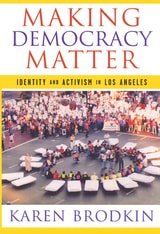
Making Democracy Matter
Identity and Activism in Los AngelesBrodkin, Karen
Rutgers University Press, 2007
This book seeks to answer these questions through conversations and interviews with a generation of activists who came of political age in Los Angeles during the 1990s. Politically schooled in the city's vibrant immigrant worker and youth-led campaigns against xenophobic and racist voter initiatives, these young activists created a new political cohort with its own signature of democratic practice and vision. Combining analytical depth, engaging oral history, and rich description, this absorbing and accessible book will appeal to all those interested in social movements, racial justice, the political activism of women and men of color, and the labor movement today.
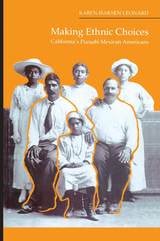
Making Ethnic Choices
California's Punjabi Mexican AmericansKaren Isaksen Leonard
Temple University Press, 1994
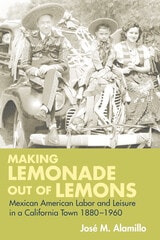
Making Lemonade out of Lemons
Mexican American Labor and Leisure in a California Town 1880-1960José M. Alamillo
University of Illinois Press, 2006
Out of the “lemons” handed to Mexican American workers in Corona, California--low pay, segregated schooling, inadequate housing, and racial discrimination--Mexican men and women made “lemonade” by transforming leisure spaces such as baseball games, parades, festivals, and churches into politicized spaces where workers voiced their grievances, debated strategies for advancement, and built solidarity. Using oral history interviews, extensive citrus company records, and his own experiences in Corona, José Alamillo argues that Mexican Americans helped lay the groundwork for civil rights struggles and electoral campaigns in the post-World War II era.
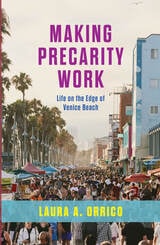
Making Precarity Work
Life on the Edge of Venice BeachLaura A. Orrico
University of Chicago Press, 2025
In Making Precarity Work, sociologist Laura A. Orrico shows how Los Angeles’s Venice Beach boardwalk, which is a magnet for tourists, is also a workplace, one that wouldn’t exist without the motley crew of people selling art, drinking, performing, using drugs, and working odd jobs who gather daily to engage in varied activities, from selling crafts to minding each other’s wares and asking for spare change.
Throughout the book, Orrico lifts up this workplace as a collective accomplishment, demonstrating how it can be a safety net to manage insecurity and inequality for those opting into its flexible and precarious structure, as well as how the LA government’s efforts to stabilize this work often disrupt the success of this collaborative and creative ecosystem. She also presents the ways this work can exacerbate those very inequalities. Sharing the personal stories of boardwalk workers, Orrico considers these juxtaposed realities and asks her audience to question how we can and should respond to a society whose best option for the disadvantaged is precarity.
Making a Better World
Public Housing, the Red Scare, and the Direction of Modern Los AngelesDon Parson
University of Minnesota Press, 2005
Making the Mission
Planning and Ethnicity in San FranciscoOcean Howell
University of Chicago Press, 2015
In Making the Mission, Ocean Howell tells the story of how residents of the Mission District organized to claim the right to plan their own neighborhood and how they mobilized a politics of place and ethnicity to create a strong, often racialized identity—a pattern that would repeat itself again and again throughout the twentieth century. Surveying the perspectives of formal and informal groups, city officials and district residents, local and federal agencies, Howell articulates how these actors worked with and against one another to establish the very ideas of the public and the public interest, as well as to negotiate and renegotiate what the neighborhood wanted. In the process, he shows that national narratives about how cities grow and change are fundamentally insufficient; everything is always shaped by local actors and concerns.
Malibu Diary
Notes From An Urban RefugeePenelope O'Malley
University of Nevada Press, 2004
Many Californias
Literature from the Golden StateGerald W. Haslam
University of Nevada Press, 1999
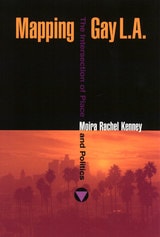
Mapping Gay L.A.
Intersection Of Place And PoliticsMoira Rachel Kenney
Temple University Press, 2001
By tracking the terrain of the movement since the beginnings of gay liberation in 1960s Los Angeles, Kenney shows how activists laid claim to streets, buildings, neighborhoods, and, in the example of West Hollywood, an entire city. Exploiting the area's lack of cohesion, they created a movement that maintained a remarkable flexibility and built support networks stretching from Venice Beach to East LA. Taking a different path from San Francisco and New York, gays and lesbians in Los Angeles emphasized social services, decentralized communities (usually within ethnic neighborhoods), and local as well as national politics. Kenney's grounded reading of this history celebrates the public and private forms of activism that shaped a visible and vibrant community.
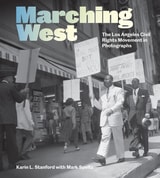
Marching West
The Los Angeles Civil Rights Movement in PhotographsKarin L. Stanford
J. Paul Getty Trust, The, 2026
This volume presents the first visual history of the people and organizations that led the fight for change during the civil rights era in Los Angeles.
During a 1963 speech to a crowd of nearly forty thousand at Wrigley Field in Los Angeles, Dr. Martin Luther King Jr. addressed the question of how Angelenos could contribute to the civil rights movement: “The most important thing that you can do is to set Los Angeles free, because you have segregation and discrimination here, and police brutality.”
Marching West illuminates the dynamic history of civil rights activism in Los Angeles and explores how the medium of photography both witnessed and advanced the fight for Black equality. Over one hundred images, some of which have never been previously published, reveal connections between the local and national movements and document the actions of Western coalitions, religious leaders, Hollywood stars, and concerned citizens. Drawn from the Tom & Ethel Bradley Center at California State University, Northridge (CSUN), the Getty Research Institute, and other Southern California collections—including prints by Harry Adams, Howard Bingham, Charles Brittin, Joe Flowers, Vera Jackson, and Charles Williams—this unprecedented volume presents less familiar but essential stories about American progress toward social justice.
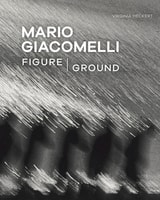
Mario Giacomelli
Figure/GroundVirginia Heckert
J. Paul Getty Trust, The, 2021
Mario Giacomelli (1925–2000) was born into poverty and lived his entire life in Senigallia, a seaside town along the Adriatic coast in Italy’s Marche region. He purchased his first camera in 1953 and quickly gained recognition for the raw expressiveness of his images. His preference for grainy, high-contrast film and paper produced bold, geometric compositions with glowing whites and deep blacks. Giacomelli most frequently focused his camera on the people, landscapes, and seascapes of the Marche, and he often spent several years expanding and reinterpreting a single body of work or repurposing an image made for one series for inclusion in another. By applying titles derived from poetry and literature to his photographs, he transformed ordinary subjects into meditations on time, memory, and existence.
Spanning the photographer’s earliest pictures to those made in the final years of his life, this publication celebrates the J. Paul Getty Museum’s extensive Giacomelli holdings, formed in large part through a significant gift from Daniel Greenberg and Susan Steinhauser.
This volume is published to accompany an exhibition on view at the J. Paul Getty Museum at the Getty Center from June 29 to October 10, 2021.

Married To A Daughter Of The Land
Spanish-Mexican Women And Interethnic Marriage In California, 1820-80Maria Raquel Casas
University of Nevada Press, 2009
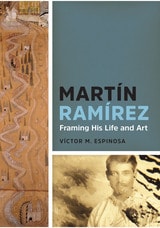
Martín Ramírez
Framing His Life and ArtBy Víctor M. Espinosa
University of Texas Press, 2015
Martín Ramírez, a Mexican migrant worker and psychiatric patient without formal artistic training, has been hailed by leading New York art critics as one of the twentieth century’s greatest artists. His work has been exhibited alongside masters such as José Clemente Orozco, Diego Rivera, Rufino Tamayo, Salvador Dalí, Marc Chagall, Paul Klee, and Joan Miró. A landmark exhibition of Ramírez’s work at the American Folk Art Museum in 2007 broke attendance records and garnered praise from major media, including the New York Times, New Yorker, and Village Voice.
Martín Ramírez offers the first sustained look at the life and critical reception of this acclaimed artist. Víctor Espinosa challenges the stereotype of outsider art as an indecipherable enigma by delving into Ramírez’s biography and showing how he transformed memories of his life in Mexico, as well as his experiences of displacement and seclusion in the United States, into powerful works of art. Espinosa then traces the reception of Ramírez’s work, from its first anonymous showings in the 1950s to contemporary exhibitions and individual works that have sold for as much as a half-million dollars. This eloquently told story reveals how Ramírez’s three-decades-long incarceration in California psychiatric institutions and his classification as “chronic paranoid schizophrenic” stigmatized yet also protected what his hands produced. Stripping off the labels “psychotic artist” and “outsider master,” Martín Ramírez demonstrates that his drawings are not passive manifestations of mental illness. Although he drew while confined as a psychiatric patient, the formal elements and content of Ramírez’s artwork are shaped by his experiences of cultural and physical displacement.
Medina by the Bay
Scenes of Muslim Study and SurvivalMaryam Kashani
Duke University Press, 2023
Meet Me at the West Beach Café
Art, Restaurants, and the Rebirth of L.A.Alison Pearlman
University of Nevada Press, 2027
When fine dining met fine art, a new Los Angeles was born.
Between 1979 and 1987, the city witnessed two cultural breakthroughs that may seem unrelated. A wave of bold, design‑forward restaurants helped launch the nationwide “New American” movement, serving innovative cuisine in sleek, modern spaces adorned with contemporary art. At the same time, Los Angeles celebrated a milestone: the opening of the Museum of Contemporary Art (MOCA), its first major museum devoted solely to contemporary art—an institution long missing from a city with global ambitions.
Though often told separately, these stories are deeply intertwined. In this lively, revelatory book, Alison Pearlman uncovers how restaurants became galleries as well as vital crossroads for the chefs, artists, collectors, architects, and civic leaders who reshaped L.A.’s cultural identity. Together, they revived hopes that L.A. could reclaim the creative energy of its 1960s heyday and join the ranks of the world’s cultural capitals.
Drawing on extensive interviews with those who built this transformative era, Pearlman shows how L.A.—through distinctive architecture, daring personalities, and unconventional collaborations—created a cultural moment with national impact. Vivid, engaging, and richly researched, this book brings to life a heady period in the city’s history.
A must‑read for lovers of art, food, and the vibrant alchemy that emerges when creative worlds collide.
Menace to the Future
A Disability and Queer History of Carceral EugenicsJess Whatcott
Duke University Press, 2024
Mercury and the Making of California
Mining, Landscape, and Race, 1840–1890Andrew Scott Johnston
University Press of Colorado, 2015
Gold and silver could not be refined without mercury; therefore, its production and use were vital to securing power and wealth in the West. The first industrialized mining in California, mercury mining had its own particular organization, structure, and built environments. These were formed within the Spanish Empire, subsequently transformed by British imperial ambitions, and eventually manipulated by American bankers and investors. In California, mercury mining also depended on a workforce differentiated by race and ethnicity. The landscapes of work and camp and the relations among the many groups involved in the industry—Mexicans, Chileans, Spanish, English, Irish, Cornish, American, and Chinese—form a crucial chapter in the complex history of race and ethnicity in the American West.
This pioneering study explicates the mutual structuring of the built environments of the mercury-mining industry and the emergence of California’s ethnic communities. Combining rich documentary sources with a close examination of the existing physical landscape, Johnston explores both the detail of everyday work and life in the mines and the larger economic and social structures in which mercury mining was enmeshed, revealing the significance of mercury mining for Western history.
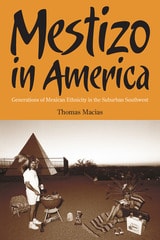
Mestizo in America
Generations of Mexican Ethnicity in the Suburban SouthwestThomas Macias
University of Arizona Press, 2006
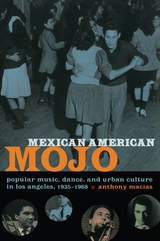
Mexican American Mojo
Popular Music, Dance, and Urban Culture in Los Angeles, 1935–1968Anthony Macías
Duke University Press, 2008
Macías conducted numerous interviews for Mexican American Mojo, and the voices of little-known artists and fans fill its pages. In addition, more famous musicians such as Ritchie Valens and Lalo Guerrero are considered anew in relation to their contemporaries and the city. Macías examines language, fashion, and subcultures to trace the history of hip and cool in Los Angeles as well as the Chicano influence on urban culture. He argues that a grass-roots “multicultural urban civility” that challenged the attempted containment of Mexican Americans and African Americans emerged in the neighborhoods, schools, nightclubs, dance halls, and auditoriums of mid-twentieth-century Los Angeles. So take a little trip with Macías, via streetcar or freeway, to a time when Los Angeles had advanced public high school music programs, segregated musicians’ union locals, a highbrow municipal Bureau of Music, independent R & B labels, and robust rock and roll and Latin music scenes.
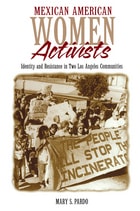
Mexican American Women Activists
Mary Pardo
Temple University Press, 1998
By focusing on women in two contiguous but very different communities -- the working-class, inner-city neighborhood of Boyle Heights in Eastside Los Angeles and the racially mixed middle-class suburb of Monterey Park -- Pardo is able to bring class as ell as gender and ethnic concerns to bear on her analysis in ways that shed light on the complexity of mobilizing for urban change.
Unlike many studies, the stories told here focus on women's strengths rather than on their problems. We follow the process by which these women empowered themselves by using their own definitions of social justice and their own convictions about the importance of traditional roles. Rather than becoming political participants in spite of their family responsibilities, women in both neighborhoods seem to have been more powerful because they had responsibilities, social networks, and daily routines separate from the men in their communities.
Pardo asserts that the decline of real wages and the growing income gap means that unforunately most women will no longer be able to focus their energies on unpaid community work. She reflects on the consequences of this change for women's political involvement, as well as on the politics of writing about women and politics.
Mexican Folk Narrative from the Los Angeles Area
Introduction, Notes, and ClassificationBy Elaine K. Miller
University of Texas Press, 1973
Urban Los Angeles is the setting in which Elaine Miller has collected her narratives from Mexican-Americans. The Mexican folk tradition, varied and richly expressive of the inner life not only of a people but also of the individual as each lives it and personalizes it, is abundantly present in the United States. Since it is in the urban centers that most Mexican-Americans have lived, this collection represents an important contribution to the study of that tradition and to the study of the changes urban life effects on traditional folklore.
The collection includes sixty-two legendary narratives and twenty traditional tales. The legendary narratives deal with the virgins and saints as well as with such familiar characters as the vanishing hitchhiker, the headless horseman, and the llorona. Familiar characters appear in the traditional tales—Juan del Oso, Blancaflor, Pedro de Ordimalas, and others. Elaine Miller concludes that the traditional tales are dying out in the city because tale telling itself is not suited to the fast pace of modern urban life, and the situations and characters in the tales are not perceived by the people to be meaningfully related to the everyday challenges and concerns of that life. The legendary tales survive longer in an urban setting because, although containing fantastic elements, they are related to the beliefs and hopes of the narrator—even in the city one may be led to buried treasure on some dark night by a mysterious woman.
The penchant of the informants for the fantastic in many of their tales often reflects their hopes and fears, such as their dreams of suddenly acquiring wealth or their fears of being haunted by the dead. Miller closely observes the teller's relation to the stories—to the duendes, the ánimas, Death, God, the devil—and she notes the tension on the part of the informant in his relation to their religion.
The material is documented according to several standard tale and motif indices and is placed within the context of the larger body of Hispanic folk tradition by the citation of parallel versions throughout the Hispanic world. The tales, transcribed from taped interviews, are presented in colloquial Spanish accompanied by summaries in English.
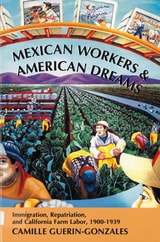
Mexican Workers and the American Dream
Immigration, Repatriation, and California Farm Labor, 1900-1939Guerin-Gonzales, Camille
Rutgers University Press, 1994
"Based on exhaustive research in U.S. and Mexican archives, this study offers a richly-textured history of Mexican immigrants in rural California. A work of exceptional breadth, especially with regard to repatriation, [it] is a pivotal contribution to Chicano historiography and immigration studies."--Vicki L. Ruiz, Andrew W. Mellon All-Claremont Professor in the Humanities, The Claremont Graduate School
In the first forty years of this century, over one million Mexican immigrants moved to the United States, attracted by the prospect of farm work in California. They became workers in industrial agriculture --barely recognized, never respected, and poorly paid. Native white American workers did not resent the Mexicans during prosperous times, when everyone who wanted to work could do so. But during the Great Depression, native workers began to realize that many of the Mexican workers were here to stay. Native workers, blaming their unemployment on the immigrants, joined with government officials to demand that Mexican workers and their families return to Mexico. During the 1930s, the federal government and county relief agencies cooperated in a nasty repatriation program, forcing half a million Mexicans living in the U.S. to return to Mexico.
Camille Guerin-Gonzales tells the story of their migration, their years here, and of the repatriation program--one of the largest mass removal operations ever sanctioned by the U.S. government.She documents both their efforts to resist and the overpowering forces that worked against them.
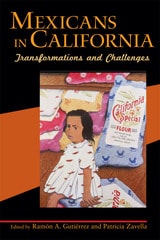
Mexicans in California
Transformations and ChallengesEdited by Ramon A. Gutierrez and Patricia Zavella
University of Illinois Press, 2008
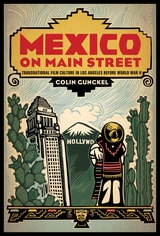
Mexico on Main Street
Transnational Film Culture in Los Angeles before World War IIGunckel, Colin
Rutgers University Press, 2015

Misconceiving Mothers
Legislators, Prosecutors, and the Politics of Prenatal Drug ExposureLaura Gomez
Temple University Press, 1997
Misconceiving Mothers is a case study of how public policy about reproduction and crime is made. Laura E. Gomez uses secondary research and first-hand interviews with legislators and prosecutors to examine attitudes toward the criminalization and/or medicalization of drug use during pregnancy by the legislature and criminal justice systems in California. She traces how an initial tendency toward criminalization gave way to a trend toward seeing the problem of "crack babies" as an issue of social welfare and public health.
It is no surprise that in an atmosphere of mother-blaming, particularly targeted at poor women and women of color, "crack babies" so easily captured the American popular imagination in the late 1980s. What is surprising is the was prenatal drug exposure came to be institutionalized in the state apparatus. Gomez attributes this circumstance to four interrelated cause: the gendered nature of the social problem; the recasting of the problem as fundamentally "medical" rather than "criminal"; the dynamic nature of t he process of institutionalization; and the specific feature of the legal institutions -- that is, the legislature and prosecutors' offices -- the became prominent in the case.
At one level Misconceiving Mothers tells the story of a particular problem at a particular time and place -- how the California legislature and district attorneys grappled with pregnant women's drug use in the late 1980s and early 1990s. At another level, the book tells a more general story about the political nature of contemporary social problems. The story it tells is political not just because it deals with the character of political institutions but because the process itself and the nature of the claims-making concern the power to control the allocation of state resources.
A number of studies have looked at how the initial criminalization of social problems takes place. Misconceiving Mothers looks at the process by which a criminalized social problem is institutionalized through the attitudes and policies of elite decision-makers.
Modern Oceans, Ancient Sites
Archaeology and Marine Conservation on San Miguel Island, CaliforniaTodd J Braje
University of Utah Press, 2010

Mormon Battalion
United States Army of the West, 1846-1848Norma Baldwin Ricketts
Utah State University Press, 1997
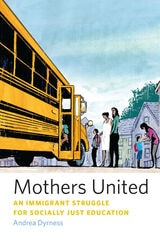
Mothers United
An Immigrant Struggle for Socially Just EducationAndrea Dyrness
University of Minnesota Press, 2010
In Mothers United, Andrea Dyrness chronicles the experiences of five Latina immigrant mothers in Oakland, California—one of the most troubled urban school districts in the country—as they become informed and engaged advocates for their children’s education. These women, who called themselves “Madres Unidas” (“Mothers United”), joined a neighborhood group of teachers and parents to plan a new, small, and autonomous neighborhood-based school to replace the overcrowded Whitman School. Collaborating with the author, among others, to conduct interviews and focus groups with teachers, parents, and students, these mothers moved from isolation and marginality to take on unfamiliar roles as researchers and community activists while facing resistance from within the local school district.
Mothers United illuminates the mothers’ journey to create their own space—centered around the kitchen table—that enhanced their capacity to improve their children’s lives. At the same time, Dyrness critiques how community organizers, teachers, and educational policy makers, despite their democratic rhetoric, repeatedly asserted their right as “experts,” reproducing the injustice they hoped to overcome. A powerful, inspiring story about self-learning, consciousness-raising, and empowerment, Mothers United offers important lessons for school reform movements everywhere.
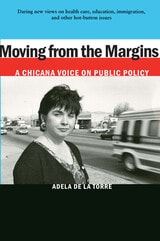
Moving from the Margins
A Chicana Voice on Public PolicyAdela de la Torre
University of Arizona Press, 2002
Addressing immigration, education, health care, and economic and political concerns, Adela de la Torre provides a distinctly Chicana perspective that often differs from that of mainstream readers and voters. Drawn from the author's syndicated column in the Los Angeles Times along with writings from other publications, Moving from the Margins includes incisive and often provocative commentaries that provide insights into the roots of ethnic tensions in the Golden State.
The book also includes readers' reactions to the articles, creating a dialogue of ideas while confronting fears of what many Americans view as an alien culture. Whether addressing entitlements granted to noncitizens, the future of public schools, or access to health care, de la Torre challenges readers to move beyond their own frame of reference and consider new points of view. The issues she faces have shaped today's California—and they also lie at the heart of urban public policy in America for the twenty-first century.

Mujeres de Maiz en Movimiento
Spiritual Artivism, Healing Justice, and Feminist PraxisEdited by Amber Rose González, Felicia ‘Fe’ Montes, and Nadia Zepeda
University of Arizona Press, 2024
MdM’s political-ethical-spiritual commitments, cultural production, and everyday practices are informed by Indigenous and transnational feminist of color artistic, ceremonial, activist, and intellectual legacies. Contributors fuse stories of celebration, love, and spirit-work with an incisive critique of interlocking oppressions, both intimate and structural, encouraging movement toward “a world where many worlds fit.”
The multidisciplinary, intergenerational, and critical-creative nature of the project coupled with the unique subject matter makes the book a must-have for high school and college students, activist-scholars, artists, community organizers, and others invested in social justice and liberation.

Murder in Hollywood
Solving a Silent Screen MysteryCharles Higham
University of Wisconsin Press, 2004
When it was discovered that a famous star of the day had probably killed Taylor, a massive cover-up began—from the removal of crucial evidence to the naming of innocent people as killers—which has continued until now to protect the truth. Murder in Hollywood goes beyond the killing to unearth unknown details about the life of Taylor before his arrival in Hollywood, as well as the stories and histories buried by the crooked authorities and criminals involved the case. The author’s exclusive interviews with the culpable star, his unique possession of long-vanished police records, and the support of the present-day Los Angeles county coroner—who examined the evidence as if the murder had taken place now—have ensured a hair-raising thriller.
Charles Higham successfully presents the most plausible and convincing solution yet to the mystery. In the process he paints a vivid portrait of Hollywood in the 1920s—from its major stars to its bisexual subculture. The result is a compelling answer to a long-standing mystery and a fascinating study of a place, and an industry that, as today, let people reinvent themselves. Murder in Hollywood is more extraordinary than any crime of fiction and more exciting than any action adventure movie.
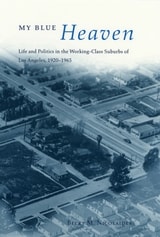
My Blue Heaven
Life and Politics in the Working-Class Suburbs of Los Angeles, 1920-1965Becky M. Nicolaides
University of Chicago Press, 2002
As Becky M. Nicolaides shows in My Blue Heaven, this ethic of self-reliance and homeownership formed the core of South Gate's identity. With post-World War II economic prosperity, the community's emphasis shifted from building homes to protecting them as residents tried to maintain their standard of living against outside threats—including the growing civil rights movement—through grassroots conservative politics based on an ideal of white homeowner rights. As the citizens of South Gate struggled to defend their segregated American Dream of suburban community, they fanned the flames of racial inequality that erupted in the 1965 Watts riots.