Results by title
4413 books match the query 'Anthropology' and 221 start with r
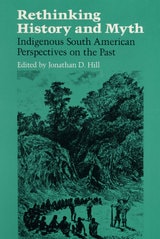
RETHINKING HISTORY
Indigenous South American Perspectives on the PastEdited by Jonathan D. Hill
University of Illinois Press, 2000
Examining specific cultural and linguistic traditions that shape the social consciousness of native South Americans, the authors show that historical and mythic consciousness work together in forming new symbolic strategies that allow indigenous peoples to understand their societies as at least partially autonomous groups within national and global power structures. This complex process is used to interpret the history of interethnic relations, allowing both individuals and groups to change themselves and alter their own circumstances.
RSF
The Russell Sage Foundation Journal of the Social Sciences: Biosocial Pathways of Well-Being Accross the Life CourseThomas W. McDade
Russell Sage Foundation, 2018
Several articles explore the effects of disadvantage and discrimination on individuals’ health. Douglas Massey and colleagues find that residential segregation and concentrated poverty—which disproportionately affects African Americans—contribute to more rapid cellular aging, a condition associated with a higher risk of disorders such as diabetes and heart disease. Bridget Goosby and colleagues track the sleep patterns of adolescents and find that compared to their white peers, African American and biracial youth who report experiencing frequent discrimination have worse sleep, which is associated with longer-term negative physical and mental health outcomes.
Other contributors explore the extent to which social and family environments influence biological processes. Yang Qu and colleagues study the cognitive development of Mexican American youth, focusing on the hippocampus, a region of the brain that produces improved memory and learning. They find that teens who were able to navigate between the cultural values of their parents and fitting in with their peers had different hippocampus volume and higher academic achievement. Other researchers explore the relationship between individuals’ genes and their environments. Melinda Mills and colleagues examine the role of genes in reproductive behavior. They find that while social and behavioral factors are strongly associated with when mothers first give birth and how many children they have, genetic factors are related to other fertility traits, such as childlessness and menopause.
The findings in this issue demonstrate the value of integrating the social and biological sciences for understanding how biological mechanisms influence, and are influenced by, socioeconomic conditions and lay the foundation for further advances in biosocial scholarship.
RSF
The Russell Sage Foundation Journal of the Social Sciences: Immigration and Changing IdentitiesKay Deaux
Russell Sage Foundation, 2018
Several articles explore how immigrants negotiate their positions in the racial hierarchy and how they perceive themselves in relation to native-born groups. Michael Jones-Correa and coauthors find that while Mexican immigrants are more likely to identify as Americans the more they report positive interactions with both native-born whites and blacks, Indian immigrants’ identification with being American is largely shaped by positive interactions just with whites. Prema Kurien shows that in response to the wave of hate crimes after 9/11, Sikh Americans sought to be recognized as an American religious minority, as well as an ethnic group distinct from Indian Americans. In their study of the children of immigrants in middle adulthood, Cynthia Feliciano and Rubén G. Rumbaut find that some second-generation immigrants retain a strong attachment to an ethnic identity into their late thirties, but that ethnic identification for others wanes as their social identities as parents, workers, or spouses become more important.
Other contributors investigate the extent to which longer-established Americans respond to increased immigration. Maureen Craig and Jennifer Richeson show that whites living in areas with large or increasing racial minority populations are more likely to believe that anti-white discrimination is on the rise. Deborah Schildkraut and Satia Morotta similarly find that when millennials—particularly those who identify as white and Republican—are exposed to information on the changing racial makeup of the U.S., they express more conservative political views.
At a time when questions of immigration and national identity are at the forefront of our political and public discourse, understanding how immigrants and their offspring influence—and are influenced by—conceptions of race and identity is critical for social scientists. This issue provides key insights into the challenges of a rapidly changing population.
Race
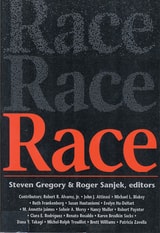
Gregory, Steven
Rutgers University Press, 1994
“What unites these essays is a common focus on the ‘social construction’ of racial categories and a desire to expose the exercise of racism and its intersection with other forms of social domination such as class, gender, and ethnicity . . . Fascinating.”––Multicultural Review
“The coming together of theoretical, multiethnic, and ‘on-the-ground’ perspectives makes this book a particularly valuable contribution to the discourse on race.”––Paula Giddings
“Timely and thoughtful. . . contributes to our understanding of how race operates as a social process and in the contextualization of power and status.”––Contemporary Sociology
“A treasure chest full of gems. Virtually every article is fascinating and important, and as a collection, its impact is tremendous. Neo-conservative myths and fantasies fall like nine-pins before its well-researched and tightly argued papers.”––Martin Bernal, author of Black Athena
“A timely antidote to that reaction tome, The Bell Curve.”––Daily News (New York)
“Let’s be clear from the start what this book is about,” writes Roger Sanjek. “Race is the framework of ranked categories, segmenting the human population, that was developed by Western Europeans following their global expansion.”To contemporary social scientists, this ranking is baseless, though it has had all-too-real effects.
Drawing on anthropology, history, sociology, ethnic studies, and women's studies, this volume explores the role of race in a variety of cultural and historical contexts. The contributors show how racial ideologies intersect with gender, class, nation and sexuality in the formation of complex social identities and hierarchies. The essays address such topics as race and Egyptian nationalism, the construction of “whiteness” in the United States, and the transformation of racial categories in post-colonial Haiti. They demonstrate how social elites and members of subordinated groups construct and rework racial meanings and identities within the context of global political, economic, and cultural change. Race provides a comprehensive and empirically grounded survey of contemporary theoretical approaches to studying the complex interplay of race, power, and identity.
Race Becomes Tomorrow
North Carolina and the Shadow of Civil RightsGerald M. Sider
Duke University Press, 2015
Race and Nation in Puerto Rican Folklore
Franz Boas and John Alden Mason in Porto RicoRafael Ocasio
Rutgers University Press, 2020
Race and Religion Among the Chosen People of Crown Heights
Goldschmidt, Henry
Rutgers University Press, 2006
In August of 1991, the Brooklyn neighborhood of Crown Heights was engulfed in violence following the deaths of Gavin Cato and Yankel Rosenbaum—a West Indian boy struck by a car in the motorcade of a Hasidic spiritual leader and an orthodox Jew stabbed by a Black teenager. The ensuing unrest thrust the tensions between the Lubavitch Hasidic community and their Afro-Caribbean and African American neighbors into the media spotlight, spurring local and national debates on diversity and multiculturalism. Crown Heights became a symbol of racial and religious division. Yet few have paused to examine the nature of Black-Jewish difference in Crown Heights, or to question the flawed assumptions about race and religion that shape the politics—and perceptions—of conflict in the community.
In Race and Religion among the Chosen Peoples of Crown Heights, Henry Goldschmidt explores the everyday realities of difference in Crown Heights. Drawing on two years of fieldwork and interviews, he argues that identity formation is particularly complex in Crown Heights because the neighborhood’s communities envision the conflict in remarkably diverse ways. Lubavitch Hasidic Jews tend to describe it as a religious difference between Jews and Gentiles, while their Afro-Caribbean and African American neighbors usually define it as a racial difference between Blacks and Whites. These tangled definitions are further complicated by government agencies who address the issue as a matter of culture, and by the Lubavitch Hasidic belief—a belief shared with a surprising number of their neighbors—that they are a “chosen people” whose identity transcends the constraints of the social world.
The efforts of the Lubavitch Hasidic community to live as a divinely chosen people in a diverse Brooklyn neighborhood where collective identities are generally defined in terms of race illuminate the limits of American multiculturalism—a concept that claims to celebrate diversity, yet only accommodates variations of certain kinds. Taking the history of conflict in Crown Heights as an invitation to reimagine our shared social world, Goldschmidt interrogates the boundaries of race and religion and works to create space in American society for radical forms of cultural difference.
Race and the Education of Desire
Foucault's History of Sexuality and the Colonial Order of ThingsAnn Laura Stoler
Duke University Press, 1995
Drawing on Foucault’s little-known 1976 College de France lectures, Stoler addresses his treatment of the relationship between biopower, bourgeois sexuality, and what he identified as “racisms of the state.” In this critical and historically grounded analysis based on cultural theory and her own extensive research in Dutch and French colonial archives, Stoler suggests how Foucault’s insights have in the past constrained—and in the future may help shape—the ways we trace the genealogies of race.
Race and the Education of Desire will revise current notions of the connections between European and colonial historiography and between the European bourgeois order and the colonial treatment of sexuality. Arguing that a history of European nineteenth-century sexuality must also be a history of race, it will change the way we think about Foucault.
Race, Culture, and Evolution
Essays in the History of AnthropologyGeorge W. Stocking, Jr
University of Chicago Press, 1982
Race, Language, and Culture
Franz Boas
University of Chicago Press, 1940
"Franz Boas is the father of American anthropology and one of the founders of the field of modern anthropology. The book, Race, Language, and Culture, is a collection of some of his most important essays."—David Schneider, University of Chicago
"An exceptional book. Exceptional because it brings into one volume sixty-two papers written by the most influential figure in American anthropology. . . . Exceptional in that it exhibits the wide range of interests and scientific exactness which made it possible for one man to exert such a profound influence on the growing science of anthropology. . . . This is a volume every student of anthropology will wish to possess; it will also have a wide distribution among other students of the social sciences, and all interested in the problems of race."—Fay-Cooper Cole, American Anthropologist

Race, Nature and Culture
An Anthropological PerspectivePeter Wade
Pluto Press, 2002
Wade is critical of contemporary theoretical studies of race formulated within the contexts of colonial history, sociology and cultural studies. Instead he argues for a new direction; one which anthropology is well placed to explore. Taking the study of race beyond Western notions of the individual, Wade argues for new paradigms in social science, in particular in the development of connections between race, sex and gender. An understanding of these issues within an anthropological context, he contends, is vital for defining personhood and identity.
Race is often defined by its reference to biology, 'blood,' genes, nature or essence. Yet these concepts are often left unexamined. Integrating material from the history of science, science studies, and anthropological studies of kinship and new reproductive technologies, as well as from studies of race, Peter Wade explores the meaning of such terms and interrogates the relationship between nature and culture in ideas about race.
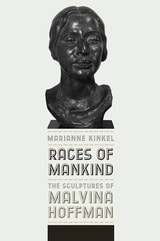
Races of Mankind
The Sculptures of Malvina HoffmanMarianne Kinkel
University of Illinois Press, 2011
A fascinating cultural history, Races of Mankind examines how we continually re-negotiate the veracity of race through collaborative processes involved in the production, display, and circulation of visual representations.
Racial Conditions
Politics, Theory, ComparisonsHoward Winant
University of Minnesota Press, 1994
More than a quarter-century after the passage of civil rights legislation in the United States and decades since the last European colonies attained their independence, race continues to play a central role in cultural, political, and economic life, both in the United States and around the globe. Race divides societies and individuals, shapes social policies of the most diverse sort, and organizes basic ideas about human identity and difference. Why?
This ambitious book addresses the gaps in our understanding of contemporary racial dynamics, and develops a powerful theoretical approach to the vast subject of race. Howard Winant, one of the leading writers in the United States on the subject, argues that race cannot be understood as a "social problem" or as a "survival" of earlier, more benighted ages. Indeed, from the rise of Europe to the present, race has been a social condition, a permanent though flexible feature of human society and identity. The key to Winant's analysis is racial formation theory, an approach he refines and advances as he considers a wide range of contemporary controversies in racial theory and politics. Among these are the relationship between race and class, as well as the racial dimensions of gender, diaspora, colonialism, and fascism. Other key topics include the changing nature of racial identity in the post-civil rights era, the 1992 Los Angeles riot, and politics of race in Brazil. Intellectually challenging and clearly written, well informed and deeply committed to social and racial justice, Racial Conditions marks an important advance in critical thinking about race today. Howard Winant teaches sociology at Temple University.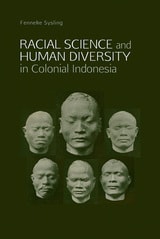
Racial Science and Human Diversity in Colonial Indonesia
Fenneke Sysling
National University of Singapore Press, 2016
In this new monograph, Fenneke Sysling draws on published works and private papers to describe the way Dutch racial scientists tried to make sense of the human diversity in the Indonesian archipelago. The making of racial knowledge, it contends, cannot be explained solely in terms of internal European intellectual developments. It was ‘on the ground’ that ideas about race were made and unmade with a set of knowledge strategies that did not always combine well. Sysling describes how skulls were assembled through the colonial infrastructure, how measuring sessions were resisted, what role photography and plaster casting played in racial science and shows how these aspects of science in practice were entangled with the Dutch colonial Empire.
Racializing the Ummah
Muslim Humanitarians beyond Black, Brown, and WhiteRhea Rahman
University of Minnesota Press, 2026
A robust ethnography of Islamic Relief explores difficult questions about the extensive reach of white supremacy
An ethnography of Islamic Relief (IR), the largest Islamic NGO based in the West, Racializing the Ummah explores how a Muslim organization can do good in a world that defines Muslimness as less than human. Rooted in more than a decade of international research, Rhea Rahman’s study on the organization’s projects, methods, and limitations reveals how racial capitalism permeates all aspects of humanitarianism.
Beginning with a counterhistory of Muslims in the United Kingdom following World War II, Rahman analyzes IR’s mission and transnational activities in and across places including the UK, South Africa, and Mali in the broader context of global white supremacy. She shows how IR’s approaches often effectively secularize Islam to evade anti-Muslim racism and Islamophobia, implicating concepts such as the “good” Muslim aid worker, who complies with War on Terror surveillance while attending to victims of Western colonialism. Meanwhile, Rahman theorizes the tactics of aid workers on the ground, who creatively draw on an Islamic Black radical tradition to drive real change.
Through her engagement with IR and other organizations, Rahman paints a frank, nuanced portrait of the constraints Islamic aid entities face in the effort to disentangle themselves from neocolonialism and Western hegemony. Yet she also locates the possibility of escape from the all-encompassing dictates of racial capitalism in alternative visions of doing good—ones that are grounded in Islam as the foundation of a revolutionary praxis.
Retail e-book files for this title are screen-reader friendly.
Racism in a Racial Democracy
The Maintenance of White Supremacy in BrazilTwine, Francine Winddance
Rutgers University Press, 1997
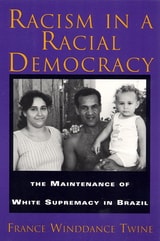
In Racism in a Racial Democracy, France Winddance Twine asks why Brazilians, particularly Afro-Brazilians, continue to have faith in Brazil's "racial democracy" in the face of pervasive racism in all spheres of Brazilian life. Through a detailed ethnography, Twine provides a cultural analysis of the everyday discursive and material practices that sustain and naturalize white supremacy.
This is the first ethnographic study of racism in southeastern Brazil to place the practices of upwardly mobile Afro-Brazilians at the center of analysis. Based on extensive field research and more than fifty life histories with Afro- and Euro-Brazilians, this book analyzes how Brazilians conceptualize and respond to racial disparities. Twine illuminates the obstacles Brazilian activists face when attempting to generate grassroots support for an antiracist movement among the majority of working class Brazilians. Anyone interested in racism and antiracism in Latin America will find this book compelling.
"Twine offers one of the most sophisticated analyses to date of the intransigence of Brazilian racism. Her nuanced account of the complex interplay of gender, race, and class is particularly exciting. This book will have a powerful impact not only on the field of Brazilian racial studies, but on the whole burgeoning literature on the African Diaspora." -- Howard Winant, author of Racial Conditions: Politics, Theory, Comparisons
"A revealing and sharply observed dissection of how racism works 'on the ground' in Brazil." -- George Reid Andrews, author of Blacks and Whites in Sao Paulo, Brazil, 1888-1988
Radical Territories in the Brazilian Amazon
The Kayapó’s Fight for Just LivelihoodsLaura Zanotti
University of Arizona Press, 2016
Radical Territories in the Brazilian Amazon sheds light on the creative and groundbreaking efforts Kayapó peoples deploy to protect their lands and livelihoods. Now at the front lines of cultivating diversified strategies for resistance, the Kayapó are creating a powerful activist base, experimenting with nontimber forest projects, and forging strong community conservation partnerships. Tracing the complex politics of the Kayapó’s homeland, Laura Zanotti advances approaches to understanding how indigenous peoples cultivate self-determination strategies in conflict-ridden landscapes.
Kayapó peoples are providing a countervision of what Amazonia can look like in the twenty-first century, dominated neither by agro-industrial interests nor by uninhabited protected landscapes. Instead, Kayapó peoples see their homeland as a living landscape where indigenous vision engages with broader claims for conservation and development in the region.
Weaving together anthropological and ethnographic research with personal interactions with the Kayapó, Zanotti tells the story of activism and justice in the Brazilian Amazon, and how Kayapó communities are using diverse pathways to make a sustainable future for their peoples and lands. The author interweaves Kayapó perspectives with a political ecology framework to show how working with indigenous peoples is vital to addressing national and global challenges in the present time, when many environmentally significant conditions and processes are profoundly altered by human activities.
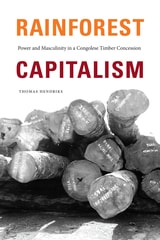
Rainforest Capitalism
Power and Masculinity in a Congolese Timber ConcessionThomas Hendriks
Duke University Press, 2022
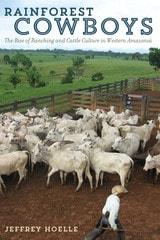
Rainforest Cowboys
The Rise of Ranching and Cattle Culture in Western AmazoniaBy Jeffrey Hoelle
University of Texas Press, 2015
This ambitious interdisciplinary study is the first to examine the interlinked economic uses and cultural practices and beliefs surrounding cattle in Western Amazonia, where cattle raising is at the center of debates about economic development and environ
Winner, Brazil Section Book Award, Latin American Studies Association, 2016
The opening of the Amazon to colonization in the 1970s brought cattle, land conflict, and widespread deforestation. In the remote state of Acre, Brazil, rubber tappers fought against migrant ranchers to preserve the forest they relied on, and in the process, these “forest guardians” showed the world that it was possible to unite forest livelihoods and environmental preservation. Nowadays, many rubber tappers and their children are turning away from the forest-based lifestyle they once sought to protect and are becoming cattle-raisers or even caubois (cowboys). Rainforest Cowboys is the first book to examine the social and cultural forces driving the expansion of Amazonian cattle raising in all of their complexity.
Drawing on eighteen months of fieldwork, Jeffrey Hoelle shows how cattle raising is about much more than beef production or deforestation in Acre, even among “carnivorous” environmentalists, vilified ranchers, and urbanites with no land or cattle. He contextualizes the rise of ranching in relation to political economic structures and broader meanings to understand the spread of “cattle culture.” This cattle-centered vision of rural life builds on local experiences and influences from across the Americas and even resembles East African cultural practices. Written in a broadly accessible and interdisciplinary style, Rainforest Cowboys is essential reading for a global audience interested in understanding the economic and cultural features of cattle raising, deforestation, and the continuing tensions between conservation and development in the Amazon.
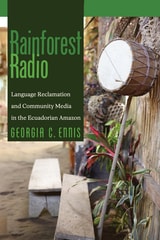
Rainforest Radio
Language Reclamation and Community Media in the Ecuadorian AmazonGeorgia C. Ennis
University of Arizona Press, 2025
Napo Kichwa communities in the Upper Ecuadorian Amazon find themselves doubly marginalized by settler colonialism and well-intentioned language revitalization projects.
In Rainforest Radio Georgia C. Ennis provides a comprehensive ethnographic exploration of Amazonian Kichwa community media, offering a unique look at how Indigenous broadcast and performance media facilitate linguistic and cultural reclamation in the Ecuadorian Amazon.
This work offers a critical analysis of how standardized language revitalization efforts, like the imposition of Unified Kichwa, can inadvertently perpetuate linguistic oppression. Ennis follows producers, performers, and consumers to understand the role of media in language reclamation. Through extensive fieldwork, she provides vivid portrayals of community efforts to sustain the language and cultural practices of their elders amid environmental and social upheaval.
Meticulously researched and beautifully written, Rainforest Radio is an essential work for anthropologists, linguists, and social scientists interested in language revitalization, Indigenous media, and environmental justice. This book showcases the transformative potential of community-driven media initiatives, highlighting the innovative responses of Napo Kichwa activists to the unique challenges they face. It serves as a powerful model for those working on similar issues worldwide, demonstrating the critical role of community media in language reclamation and cultural sustainability.
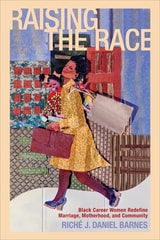
Raising the Race
Black Career Women Redefine Marriage, Motherhood, and CommunityBarnes, Riché J. Daniel
Rutgers University Press, 2015
Popular discussions of professional women often dwell on the conflicts faced by the woman who attempts to “have it all,” raising children while climbing up the corporate ladder. Yet for all the articles and books written on this subject, there has been little work that focuses on the experience of African American professional women or asks how their perspectives on work-family balance might be unique.
Raising the Race is the first scholarly book to examine how black, married career women juggle their relationships with their extended and nuclear families, the expectations of the black community, and their desires to raise healthy, independent children. Drawing from extensive interviews with twenty-three Atlanta-based professional women who left or modified careers as attorneys, physicians, executives, and administrators, anthropologist Riché J. Daniel Barnes found that their decisions were deeply rooted in an awareness of black women’s historical struggles. Departing from the possessive individualistic discourse of “having it all,” the women profiled here think beyond their own situation—considering ways their decisions might help the entire black community.
Giving a voice to women whose perspectives have been underrepresented in debates about work-family balance, Barnes’s profiles enable us to perceive these women as fully fledged individuals, each with her own concerns and priorities. Yet Barnes is also able to locate many common themes from these black women’s experiences, and uses them to propose policy initiatives that would improve the work and family lives of all Americans.
Rancheros in Chicagoacán
Language and Identity in a Transnational CommunityBy Marcia Farr
University of Texas Press, 2006
Rancheros hold a distinct place in the culture and social hierarchy of Mexico, falling between the indigenous (Indian) rural Mexicans and the more educated city-dwelling Mexicans. In addition to making up an estimated twenty percent of the population of Mexico, rancheros may comprise the majority of Mexican immigrants to the United States. Although often mestizo (mixed race), rancheros generally identify as non-indigenous, and many identify primarily with the Spanish side of their heritage. They are active seekers of opportunity, and hence very mobile. Rancheros emphasize progress and a self-assertive individualism that contrasts starkly with the common portrayal of rural Mexicans as communal and publicly deferential to social superiors.
Marcia Farr studied, over the course of fifteen years, a transnational community of Mexican ranchero families living both in Chicago and in their village-of-origin in Michoacán, Mexico. For this ethnolinguistic portrait, she focuses on three culturally salient styles of speaking that characterize rancheros: franqueza (candid, frank speech); respeto (respectful speech); and relajo (humorous, disruptive language that allows artful verbal critique of the social order maintained through respeto). She studies the construction of local identity through a community's daily talk, and provides the first book-length examination of language and identity in transnational Mexicans.
In addition, Farr includes information on the history of rancheros in Mexico, available for the first time in English, as well as an analysis of the racial discourse of rancheros within the context of the history of race and ethnicity in Mexico and the United States. This work provides groundbreaking insight into the lives of rancheros, particularly as seen from their own perspectives.
Rarities
Conservation Science in a Time of Unintended ConsequencesZoe Nyssa
University of Chicago Press, 2026
A sweeping study that reveals how conservation science does more than simply protect by inadvertently making nature valuable in new ways.
Climate change and other environmental transformations are causing species to go extinct at accelerating rates. What, then, should a science of saving nature look like? In Rarities, Zoe Nyssa traces how conservation emerged as a distinct scientific endeavor in the United States over the twentieth century and how this history has shaped environmental research practices and policy today. Drawing on archival and ethnographic research with leading conservation labs and programs, Nyssa explores how conservation science appears to generate contradictory, even counterintuitive, results as scientists, policymakers, and the public all take up, respond to, and repurpose scientists’ ideas about rarity, vulnerability, and endangerment. The designation of new nature reserves can lead to increased poaching and habitat destruction. The listing of a species as endangered fuels their black-market consumption as pets, food, or luxury items. Protection of natural resources can push resource extraction into unprotected areas. Other effects are less simple to calculate; persuading the public to care about one species might siphon support for another, and paying for one kind of conservation behavior can discourage other forms of conservation activity.
The science of saving nature spans a century of work by ecologists and others to develop a scientific basis for conservation. Yet Nyssa shows how their efforts to understand the natural world in terms of endangerment and extinction unleashed new ways for nonscientists to experience and understand nature as well. The scientific values that emerge, she argues, can transform the complex interconnections between human and nonhuman life. Rarities offers a framework for understanding these surprising socio-ecological dynamics and why they matter, both for contemporary science and for the planet.
Rational Lives
Norms and Values in Politics and SocietyDennis Chong
University of Chicago Press, 2000
Chong's book yields insights about the circumstances under which preferences, beliefs, values, norms and group identifications are formed. It offers a provocative explanation of how ingrained social norms and values can change over time despite the forces maintaining the status quo.
"Going beyond the tired polemics on both sides, [Chong] constructs a new interpretation of human behavior in which culture and individual rationality both matter. The synthesis is a more comprehensive and powerful explanatory framework than either side could have produced, and Chong's creativity should influence subsequent interpretations of our social life in fundamental ways."—Christopher H. Achen, University of Michigan
Re-Creating Primordial Time
Foundation Rituals and Mythology in the Postclassic Maya CodicesGabrielle Vail and Christine Hernández
University Press of Colorado, 2013
Remarkable similarities exist within the Maya tradition, even as new mythologies were introduced through contact with the Gulf Coast region and highland central Mexico. Vail and Hernández analyze the extant Maya codices within the context of later literary sources such as the Books of Chilam Balam, the Popol Vuh, and the Códice Chimalpopoca to present numerous examples highlighting the relationship among creation mythology, rituals, and lore. Compiling and comparing Maya creation mythology with that of the Borgia codices from highland central Mexico, Re-Creating Primordial Time is a significant contribution to the field of Mesoamerican studies and will be of interest to scholars of archaeology, linguistics, epigraphy, and comparative religions alike.

Re-Imagining the City
Art, Globalization and Urban SpacesEdited by Elizabeth Grierson and Kristen Sharp
Intellect Books, 2013

Re-enchanting Modernity
Ritual Economy and Society in Wenzhou, ChinaMayfair Yang
Duke University Press, 2020
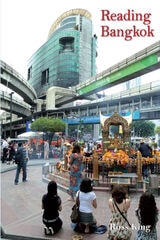
Reading Bangkok
Ross King
National University of Singapore Press, 2011
The author structures the book around external intrusions and local resistance. Geographically, this process is seen in movement from centre to periphery (Thonburi, Rattanakosin, Ratchadamnoen, Sukhumvit, Ratchadapisek, Khlong Toei, the universities). Chronologically, the city underwent various forms of colonization: incorporation of the periphery, which in turn colonized Bangkok; the economic colonization of the 19th and 20th centuries; colonization by consumption brought on in large part by globalized tourism; colonization by the "better" ideas of others (typically from the West); and finally colonization by "better" ways of thinking - notably the intrusions of the universities and of popular democracy.
This exceptionally innovative study draws on urban planning and development, history, anthropology, and political economy, and a rich body of empirical data to provide insights into the maze of power relations, inequalities and global influences that is normally hidden from view. Reading Bangkok is that rare thing, a study that genuinely changes the way its subject is seen and understood.
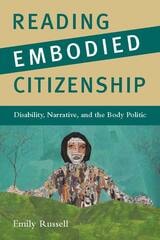
Reading Embodied Citizenship
Disability, Narrative, and the Body PoliticRussell, Emily
Rutgers University Press, 2011
Liberal individualism, a foundational concept of American politics, assumes an essentially homogeneous population of independent citizens. When confronted with physical disability and the contradiction of seemingly unruly bodies, however, the public searches for a story that can make sense of the difference. The narrative that ensues makes "abnormality" an important part of the dialogue about what a genuine citizen is, though its role is concealed as an exception to the rule of individuality rather than a defining difference. Reading Embodied Citizenship brings disability to the forefront, illuminating its role in constituting what counts as U.S. citizenship.
Drawing from major figures in American literature, including Mark Twain, Flannery O'Connor, Carson McCullers, and David Foster Wallace, as well as introducing texts from the emerging canon of disability studies, Emily Russell demonstrates the place of disability at the core of American ideals. The narratives prompted by the encounter between physical difference and the body politic require a new understanding of embodiment as a necessary conjunction of physical, textual, and social bodies. Russell examines literature to explore and unsettle long-held assumptions about American citizenship.
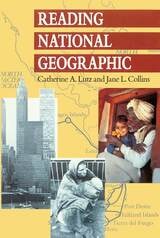
Reading National Geographic
Catherine A. Lutz and Jane L. Collins
University of Chicago Press, 1993
Lutz and Collins take us inside the National Geographic Society to investigate how its photographers, editors, and designers select images and text to produce representations of Third World cultures. Through interviews with the editors, they describe the process as one of negotiating standards of "balance" and "objectivity," informational content and visual beauty. Then, in a close reading of some six hundred photographs, they examine issues of race, gender, privilege, progress, and modernity through an analysis of the way such things as color, pose, framing, and vantage point are used in representations of non-Western peoples. Finally, through extensive interviews with readers, the authors assess how the cultural narratives of the magazine are received and interpreted, and identify a tension between the desire to know about other peoples and their ways and the wish to validate middle-class American values.
The result is a complex portrait of an institution and its role in promoting a kind of conservative humanism that acknowledges universal values and celebrates diversity while it allows readers to relegate non-Western peoples to an earlier stage of progress. We see the magazine and the Society as a key middlebrow arbiter of taste, wealth, and power in America, and we get a telling glimpse into middle-class American culture and all the wishes, assumptions, and fears it brings to bear on our armchair explorations of the world.
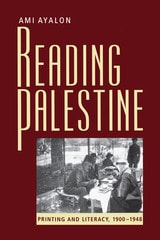
Reading Palestine
Printing and Literacy, 1900-1948By Ami Ayalon
University of Texas Press, 2004
Prior to the twentieth century, Arab society in Palestine was predominantly illiterate, with most social and political activities conducted through oral communication. There were no printing presses, no book or periodical production, and no written signs in public places. But a groundswell of change rapidly raised the region's literacy rates, a fascinating transformation explored for the first time in Reading Palestine.
Addressing an exciting aspect of Middle Eastern history as well as the power of the printed word itself, Reading Palestine describes how this hurried process intensified the role of literacy in every sphere of community life. Ami Ayalon examines Palestine's development of a modern educational system in conjunction with the emergence of a print industry, libraries and reading clubs, and the impact of print media on urban and rural populations. Drawn from extensive archival sources, official reports, autobiographies, and a rich trove of early Palestinian journalism, Reading Palestine provides crucial insight into the dynamic rise of literacy that revolutionized the way Palestinians navigated turbulent political waters.
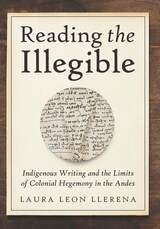
Reading the Illegible
Indigenous Writing and the Limits of Colonial Hegemony in the AndesLaura Leon Llerena
University of Arizona Press, 2023
The concept of legibility allows us to reconsider this unique manuscript within the intertwined histories of literacy, knowledge, and colonialism. Reading the Illegible shows that the anonymous author(s) of the Huarochirí Manuscript, along with two contemporaneous Andean-authored texts by Joan de Santa Cruz Pachacuti and Felipe Guaman Poma de Ayala, rewrote the history of writing and the notion of Christianity by deploying the colonizers’ technology of alphabetic writing.
Reading the Illegible weaves together the story of the peoples, places, objects, and media that surrounded the creation of the anonymous Huarochirí Manuscript to demonstrate how Andean people endowed the European technology of writing with a new social role in the context of a multimedia society.
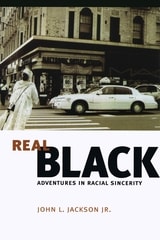
Real Black
Adventures in Racial SincerityJohn L. Jackson Jr.
University of Chicago Press, 2005
Jackson argues that authenticity caricatures identity as something imposed on people, imprisoning them within stereotypes: an African American high school student who excels in the classroom, for instance, might be dismissed as "acting white." On the other hand, sincerity, as Jackson defines it, imagines authenticity as an incomplete measuring stick, an analytical model that attempts to deny people agency in their search for identity.
Drawing on more than ten years of ethnographic research in and around New York City, Jackson offers a kaleidoscope of subjects and stories that directly and indirectly address how race is negotiated in today's world—including tales of book-vending numerologists, urban conspiracy theorists, corrupt police officers, mixed-race neo-Nazis, and gospel choirs forbidden to catch the Holy Ghost. Jackson records and retells their interconnected sagas, all the while attempting to reconcile these stories with his own crisis of identity and authority as an anthropologist terrified by fieldwork. Finding ethnographic significance where mere mortals see only bricks and mortar, his invented alter ego Anthroman takes to the streets, showing how race is defined and debated, imposed and confounded every single day.
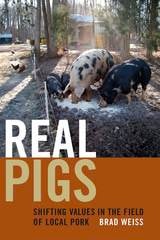
Real Pigs
Shifting Values in the Field of Local PorkBrad Weiss
Duke University Press, 2016
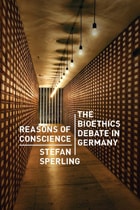
Reasons of Conscience
The Bioethics Debate in GermanyStefan Sperling
University of Chicago Press, 2013
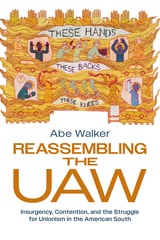
Reassembling the UAW
Insurgency, Contention, and the Struggle for Unionism in the American SouthAbe Walker
Temple University Press, 2026
Abe Walker chronicles the organizing campaign from its origin in 2014 to the union’s breakthrough victory in 2024, illustrating what went wrong—and what went right—along the way. Walker provides a systematic analysis of the strategic challenges and tactical shifts, showing the patterns that persisted across three election cycles while highlighting their differences, from global-level alliances to local labor issues.
Reassembling the UAW also demonstrates how rebel rank-and-file workers ousted the old-guard leadership and transformed the UAW into a militant union to achieve results. Ultimately, Walker offers valuable lessons for organizational strategy, the power of collective action, and the future of the labor movement.
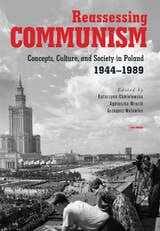
Reassessing Communism
Concepts, Culture, and Society in Poland 1944–1989Instytutem Badan Literackich PAN Chmielewska
Central European University Press, 2021
The thirteen authors of this collective work undertook to articulate matter-of-fact critiques of the dominant narrative about communism in Poland while offering new analyses of the concept, and also examining the manifestations of anticommunism. Approaching communist ideas and practices, programs and their implementations, as an inseparable whole, they examine the issues of emancipation, upward social mobility, and changes in the cultural canon.
The authors refuse to treat communism in Poland in simplistic categories of totalitarianism, absolute evil and Soviet colonization, and similarly refuse to equate communism and fascism. Nor do they adopt the neoliberal view of communism as a project doomed to failure. While wholly exempt from nostalgia, these essays show that beyond oppression and bad governance, communism was also a regime in which people pursued a variety of goals and sincerely attempted to build a better world for themselves.
The book is interdisciplinary and applies the tools of social history, intellectual history, political philosophy, anthropology, literature, cultural studies, and gender studies to provide a nuanced view of the communist regimes in east-central Europe.
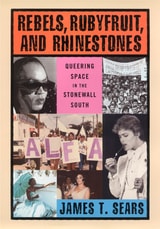
Rebels, Rubyfruit, and Rhinestones
Queering Space in the Stonewall SouthSears, James T.
Rutgers University Press, 2001

Recasting Commodity and Spectacle in the Indigenous Americas
Edited by Helen Gilbert and Charlotte Gleghorn
University of London Press, 2014
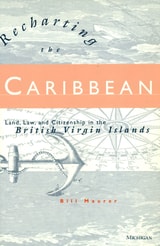
Recharting the Caribbean
Land, Law, and Citizenship in the British Virgin IslandsBill Maurer
University of Michigan Press, 2000
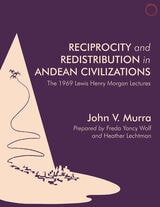
Reciprocity and Redistribution in Andean Civilizations
The 1969 Lewis Henry Morgan LecturesJohn V. Murra
HAU, 2017
Murra intermixes a study of Andean ecology with an exploration of the ideal of economic self-sufficiency, stressing two foundational socioeconomic forces: reciprocity and redistribution. He shows how both enabled Andean communities to realize direct control of a maximum number of vertically ordered ecological floors and the resources they offered. He famously called this arrangement a “vertical archipelago,” a revolutionary model that is still examined and debated almost fifty years after it was first presented in these lecture. Written in a crisp and elegant style and inspired by decades of ethnographic fieldwork, this set of lectures is nothing less than a lost classic, and it will be sure to inspire new generations of anthropologists and historians working in South America and beyond.
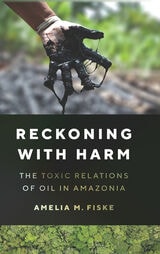
Reckoning with Harm
The Toxic Relations of Oil in AmazoniaAmelia Fiske
University of Texas Press, 2023
2025 Margaret Mead Award, Society for Applied Anthropology (SfAA) and the American Anthropological Association (AAA)
An ethnography of the Ecuadorian Amazon that demonstrates the need for a relational, place-based, contingent understanding of harm and toxicity.
Reckoning with Harm is a striking ethnographic analysis of the harm resulting from oil extraction. Covering fifty years of settler colonization and industrial transformation of the Ecuadorian Amazon, Amelia Fiske interrogates the relations of harm. She moves between forest-courtrooms and oily waste pits, farms and toxic tours, to explore both the ways in which harm from oil is entangled with daily life and the tensions surrounding efforts to verify and redress it in practice. Attempts to address harm from the oil industry in Ecuador have been consistently confounded by narrow, technocratic understandings of evidence, toxicity, and responsibility. Building on collaborators’ work to contest state and oil company insistence that harm is controlled and principally chemical in nature, Fiske shows that it is necessary to refigure harm as relational in order to reckon with unremediated contamination of the past while pushing for broad forms of accountability in the present. She theorizes that harm is both a relationship and an animating feature of relationships in this place, a contingent understanding that is needed to contemplate what comes next when living in a toxic world.
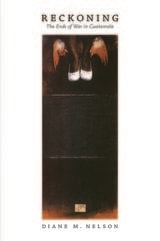
Reckoning
The Ends of War in GuatemalaDiane M. Nelson
Duke University Press, 2009
Nelson brings together stories of human rights activism, Mayan identity struggles, coerced participation in massacres, and popular entertainment—including traditional dances, horror films, and carnivals—with analyses of mass-grave exhumations, official apologies, and reparations. She discusses the stereotype of the Two-Faced Indian as colonial discourse revivified by anti-guerrilla counterinsurgency and by the claims of duplicity leveled against the Nobel laureate Rigoberta Menchú, and she explores how duplicity may in turn function as a survival strategy for some. Nelson examines suspicions that state power is also two-faced, from the left’s fears of a clandestine para-state behind the democratic façade, to the right’s conviction that NGOs threaten Guatemalan sovereignty. Her comparison of antimalaria and antisubversive campaigns suggests biopolitical ways that the state is two-faced, simultaneously giving and taking life. Reckoning is a view from the ground up of how Guatemalans are finding creative ways forward, turning ledger books, technoscience, and even gory horror movies into tools for making sense of violence, loss, and the future.
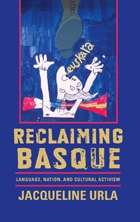
Reclaiming Basque
Language, Nation, and Cultural ActivismJacqueline Urla
University of Nevada Press, 2015
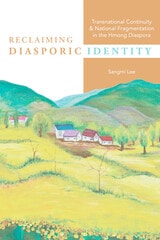
Reclaiming Diasporic Identity
Transnational Continuity and National Fragmentation in the Hmong DiasporaSangmi Lee
University of Illinois Press, 2024
In-depth and interdisciplinary, Reclaiming Diasporic Identity blends ethnography and history to provide a fresh consideration of Hmong life today.
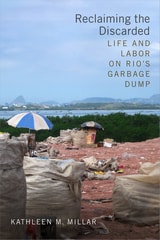
Reclaiming the Discarded
Life and Labor on Rio's Garbage DumpKathleen M. Millar
Duke University Press, 2018
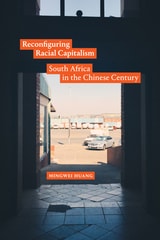
Reconfiguring Racial Capitalism
South Africa in the Chinese CenturyMingwei Huang
Duke University Press, 2024
Reconsidering Mississippian Communities and Households
Edited by Elizabeth Watts Malouchos and Alleen Betzenhauser
University of Alabama Press, 2021
Advancing the study of Mississippian societies through innovative archaeological theory and method.
Published in 1995, Mississippian Communities and Households, edited by J. Daniel Rogers and Bruce D. Smith, was a foundational text that advanced southeastern archaeology in significant ways and brought household-level archaeology to the forefront of the field. Reconsidering Mississippian Communities and Households revisits and builds on what has been learned in the years since the Rogers and Smith volume, advancing the field further with the diverse perspectives of current social theory and methods and big data as applied to communities in Native America from the AD 900s to 1700s and from northeast Florida to southwest Arkansas.
Watts Malouchos and Betzenhauser bring together scholars researching diverse Mississippian Southeast and Midwest sites to investigate aspects of community and household construction, maintenance, and dissolution. Thirteen original case studies prove that community can be enacted and expressed in various ways, including in feasting, pottery styles, war and conflict, and mortuary treatments.
Reconstructing Ancient Maya Diet
Christine White
University of Utah Press, 1999
The collapse of classic Maya civilization at the end of the eighth century A.D. is still an enigma, but the story behind it is likely more than a clash of warring city-states. New research indicates that ecological degradation and nutritional deficiency may be as important to our understanding of Maya cultural processes as deciphering the rise and fall of kings.
Reconstructing Ancient Maya Diet integrates recent data from bone-chemistry research, paleopathology, paleobotany, zooarchaeology, and ethnobotany to show what the ancient Maya actually ate at various periods (as opposed to archaeological suppositions) and how it affected the quality of their lives. It is now evident that to feed a burgeoning population the Maya relied on increasingly intensive forms of agriculture.
Exploring the relationship between these practices, ecological degradation, and social collapse, this book uses dietary data to investigate the rise of agricultural systems and class structure; the characterization of social relationships along lines of gender and age (i.e., who ate what); and the later effects of the Spanish conquest on diet and extant modes of agriculture.
Maya subsistence has been investigated intensively for the past two decades, but this is the first volume that unites work across the spectrum of Maya bioarchaeology.
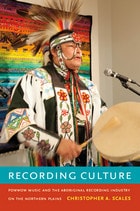
Recording Culture
Powwow Music and the Aboriginal Recording Industry on the Northern PlainsChristopher A. Scales
Duke University Press, 2012