Results by title
3785 books match the query 'Poetry' and 342 start with s
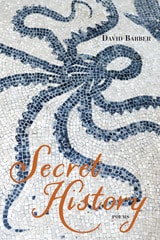
Secret History
PoemsDavid Barber
Northwestern University Press, 2020
In David Barber’s third collection of poetry, the past makes its presence felt from first to last. Drawing on a wealth of eclectic sources and crafted in an array of nonce forms, these poems range across vast stretches of cultural and natural history in pursuit of the forsaken, long-gone, and unsung.
Here is the stuff of lost time unearthed from all over: ballyhoo and murder ballad, the lacrimarium and the xylotheque, the Game of Robbers and the Indian Rope Trick, the obsolete o’o, the old-school word hoard, sunshowers and beaters and breaker boys. Here, to mark the twilight of print and type, are gleanings and borrowings from a mixed bag of throwback bound volumes: The Magic Moving Picture Book, Mandeville’s Travels, The Golden Bough, Franklin Arithmetic, The Millennial Laws of the Shakers, A Conjuror’s Confessions.
Here too are guiding spirits whose like will not pass this way again: Cab Calloway at the Cotton Club; Henry Walter Bates in darkest Amazon; George Catlin among the Choctaw; Little Nemo in Slumberland; Yogi Berra in all his oracular glory. Reveling in vernacular lingo of every vintage even while brooding on dark ages without end, Secret History chronicles a world of long shadows and distant echoes that bears more than a passing resemblance to our own.
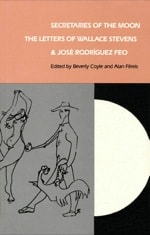
Secretaries of the Moon
The Letters of Wallace Stevens and José Rodriguez FeoBeverly Coyle and Alan Filreis, eds.
Duke University Press, 1986
Coyle and Filreis present the entire extant correspondence between the two men. The fifty-one Rodriguez Feo letters and ten of the numerous Stevens letters are printed here for the first time, and the exchange between the two is unusually complete. The work includes a critical introduction and complete annotation of the letters.

Secrets Need Words
Indonesian Poetry, 1966–1998Harry Aveling
Ohio University Press, 2001
Short listed for the 2007 New South Wales Premier's Translation Prize
The period from 1966 to 1999 represents a distinct era in Indonesian history. Throughout the “New Order” regime of President Suharto, the policies of economic development and political stability were dominant. However, the public opinion of personal expression was consistently under suspicion, and indeed dissent was severely punished.
Secrets Need Words traces the development of Indonesian poetry throughout this entire period. Texts are presented both in the original Indonesian and in careful, stylistically sensitive English translations.
In this anthology of contemporary work by Indonesian poets, the renowned translator and editor Harry Aveling presents a series of ongoing analyses detailing the political and social shifts that have influenced the work of particular poets.
Professor Aveling's analyses, along with the poems themselves, demonstrate how the poets responded to the power of the state in a variety of ways ranging from direct confrontation to withdrawal into personal and private realms characterized by fantasy and the use of heavily rhythmic language.
Secrets Need Words will be of interest to scholars of Indonesia and comparative literature, and will be for many years to come a basic text for scholarship and teaching. But it also offers all readers of poetry an opportunity to explore a new, complex, and exciting body of literature from one of the world's largest nations.

Secrets from the Center of the World
Joy Harjo and Stephen E. Strom
University of Arizona Press, 1989
This is Navajo country, a land of mysterious and delicate beauty. "Stephen Strom's photographs lead you to that place," writes Joy Harjo. "The camera eye becomes a space you can move through into the powerful landscapes that he photographs. The horizon may shift and change all around you, but underneath it is the heart with which we move." Harjo's prose poems accompany these images, interpreting each photograph as a story that evokes the spirit of the Earth. Images and words harmonize to evoke the mysteries of what the Navajo call the center of the world.
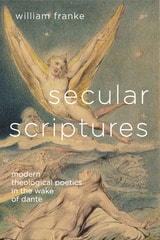
Secular Scriptures
Modern Theological Poetics in the Wake of DanteWilliam Franke
The Ohio State University Press, 2015
Secular Scriptures examines, through its own original speculative outlook, some of the most compelling exemplars of religious-poetic revelation in modern Western literature. The essays taken as an ensemble revolve around and are bookended by Dante, but they also explore the work of Chaucer, Shakespeare, Milton, Blake, Leopardi, Baudelaire, Dickinson, and Yeats. Looking both backward and forward from the vantage of Dante, Franke explores the roots of secularized religious vision in antiquity and the Middle Ages, even as he also looks forward toward its fruits in modern poetry and poetics. Ultimately, Franke’s analyses demonstrate the possibilities opened by understanding literature as secularized religious revelation.
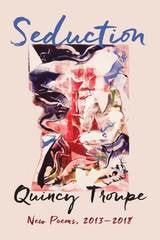
Seduction
New Poems, 2013-2018Quincy Troupe
Northwestern University Press, 2019
time is a bald eagle, a killer soaring high in the blue, / music to men
dodging bullets in speeding cars, / knew death, hoped it'd never come . . .
In this collection we are seduced by Troupe's opus. This is the poet's art laid bare. He is our "Eye." Visions of the transatlantic slave trade, portraits of American violence, pop culture, and historical voices are the lyrical relics in Troupe's masterful verse. One of American literature's most important rhythmical artists, Troupe has created a chronicle reaching through history for the collective "I/Eye" that is all of us.
See You Soon
PoemsLaura McKee
University of Arkansas Press, 2016
Finalist, 2016 Miller Williams Poetry Prize
The poems in See You Soon explore the limits of metaphor and language as their voices speak from the beauty and strangeness of daily experience, testing how we make sense of ourselves to ourselves and to one another. There is love in these poems, there is failure and absurdity. The characters, in their various situations and guises, find themselves outside of time, space, and identity—at sunset, in an airport, outside a hookah lounge, as a birthday party clown, after a flood. Its message is the invitation of the title. See You Soon is a statement of the complexity of our mutual direction in time, of camaraderie along the way.
See You in the Dark
PoemsLynne Sharon Schwartz
Northwestern University Press, 2012
Despite her indifference to genre, Schwartz takes a profound delight in poetic forms, appropriating the sonnet, the prose poem, and the envoi. She brings an easygoing musicality to her work, which ranges from parodic translations of Verlaine to instructions for making the perfect soup to a meditation on an Ecstasy trip. No artificial line between high and low culture divides Schwartz's world: she is equally intrigued by the metaphor of gardening, the work of artist Jenny Holzer, the bandits Frank and Jesse James (maybe distant relatives of Henry and William?), and the unintentional poetry of Craigslist's "missed connection" section.
Filled with wisdom, humor, and deep insight, See You in the Dark is poetry for readers not bounded by genre.
Seeing Double
Baudelaire's ModernityFrançoise Meltzer
University of Chicago Press, 2011
The poet Charles Baudelaire (1821–1867) has been labeled the very icon of modernity, the scribe of the modern city, and an observer of an emerging capitalist culture. Seeing Double reconsiders this iconic literary figure and his fraught relationship with the nineteenth-century world by examining the way in which he viewed the increasing dominance of modern life. In doing so, it revises some of our most common assumptions about the unresolved tensions that emerged in Baudelaire’s writing during a time of political and social upheaval.
Françoise Meltzer argues that Baudelaire did not simply describe the contradictions of modernity; instead, his work embodied and recorded them, leaving them unresolved and often less than comprehensible. Baudelaire’s penchant for looking simultaneously backward to an idealized past and forward to an anxious future, while suspending the tension between them, is part of what Meltzer calls his “double vision”—a way of seeing that produces encounters that are doomed to fail, poems that can’t advance, and communications that always seem to falter. In looking again at the poet and his work, Seeing Double helps to us to understand the prodigious transformations at stake in the writing of modern life.
Seeing through the Sun
Linda Hogan
University of Massachusetts Press, 1985
Keen observation and vivid imagery mark this collection of poems by a Chickasaw Indian. Linda Hogan's subjects are often drawn from events of everyday life—gathering wood, watching her daughters sleep, witnessing changes in the weather, awaiting nightfall. But beneath the surface of these daily happenings runs a powerful undercurrent, a sureness of life's basic rhythms and a sensitivity to the pressures of survival.
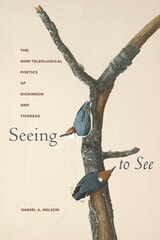
Seeing to See
The Non-Teleological Poetics of Dickinson and ThoreauDaniel A. Nelson
University of Massachusetts Press, 2025
Seeing to See focuses on two American authors who are notoriously hard to classify: Emily Dickinson and Henry David Thoreau. Dickinson proves challenging due to her short and obscure poems and Thoreau due to his insistence on capturing even the most seemingly mundane information. Daniel A. Nelson uncovers evidence that the works of these authors are often intentionally and painstakingly without aim or purpose. He argues that in their texts there is in fact an avoidance of teleological structures of writing and thinking, whereby a thing’s—or a word’s, or a text’s—value hinges on its relation to the world or other contexts.
In Nelson’s reading, Thoreau and Dickinson seem to be able to set aside all thought of distinct personal and professional goals, through which readers typically try to make an overarching sense out of, and to derive some form of profit from, disparate experiences, events, actions, and feelings. Further, both authors seem to be able to get outside of the worldview according to which the value and meaning of something, be it a natural object, a word, or an experience, is a function of its participation in a larger system. Examples of such systems include an ecosystem, taxonomic system, or syntactic system; a writer’s career, or life, or philosophy; even a single poem or journal entry. In the absence of such connections to broader categorical spheres, both writers force readers to contemplate the ineffable, constantly changing relation between words and the natural world. This contemporary reading of two iconic writers reframes their work and how readers think of nature, accepting, as these authors did, the potential freedom of the unknown.
Seize
Brian Komei Dempster
Four Way Books, 2020

Selected Drama and Verse
Franciszka Urszula Radziwillowa
Iter Press, 2015
Selected Epigrams
Martial, Translated with notes by Susan McLean, Introduction by Marc Kleijwegt
University of Wisconsin Press, 2014
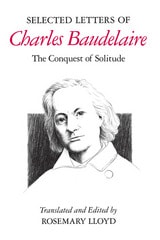
Selected Letters of Charles Baudelaire
The Conquest of SolitudeCharles Baudelaire
University of Chicago Press, 1986
Writing to family, friends, and lovers, Baudelaire reveals the incidents and passions that went into his poetry. In letters to editors, idols, and peers—Hugo, Flaubert, Vigny, Wagner, Cladel, among others—he elucidates the methods and concerns of his own art and criticism and comments tellingly on the arts and politics of his day. In all, ranging from childhood to days shortly before his death, these letters comprise a complex and moving portrait of the quintessential poet and his time.

Selected Letters of Stéphane Mallarmé
Stéphane Mallarmé
University of Chicago Press, 1988
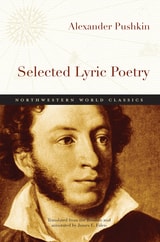
Selected Lyric Poetry
Alexander Pushkin, Translated from the Russian and annotated by James E. Falen
Northwestern University Press, 2009
Renowned translator James Falen’s collection of 167 of Pushkin’s lyrics is arranged chronologically, beginning with verse written in the poet’s teenage years—Pushkin published his first poem at fifteen and was widely revered by his later teens—and closing with lines composed shortly before his death. As a whole, these selections reveal Pushkin's development as a poet, but they also capture the wide range of subjects and styles in Pushkin’s poetry.
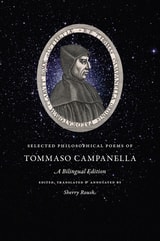
Selected Philosophical Poems of Tommaso Campanella
A Bilingual EditionTommaso Campanella
University of Chicago Press, 2011
A contemporary of Giordano Bruno and Galileo, Tommaso Campanella (1568–1639) was a controversial philosopher, theologian, astrologer, and poet who was persecuted during the Inquisition and spent much of his adult life imprisoned because of his heterodox views. He is best known today for two works: The City of the Sun, a dialogue inspired by Plato’s Republic, in which he prophesies a vision of a unified, peaceful world governed by a theocratic monarchy; and his well-meaning Defense of Galileo, which may have done Galileo more harm than good because of Campanella’s previous conviction for heresy.
But Campanella’s philosophical poems are where his most forceful and undiluted ideas reside. His poetry is where his faith in observable and experimental sciences, his astrological and occult wisdom, his ideas about deism, his anti-Aristotelianism, and his calls for religious and secular reform most put him at odds with both civil and church authorities. For this volume, Sherry Roush has selected Campanella’s best and most idiosyncratic poems, which are masterpieces of sixteenth-century Italian lyrics, displaying a questing mind of great, if unorthodox, brilliance, and showing Campanella’s passionate belief in the intrinsic harmony between the sacred and secular.
Selected Poems
Lee Gerlach
Ohio University Press, 2005
Lee Gerlach’s Selected Poems is a rigorous culling from the life’s work of a remarkable and prolific poet. Written over a period of fifty years, the poetry of Lee Gerlach is a full spectrum of human expression, vision, and experience. It reflects a wisdom and maturity of character that has been constant during the entire span of Gerlach’s writing career. This selection, chosen by the poet, is the retrospective of a true twentieth-century American original.
Selected Poems
James Applewhite
Duke University Press, 2005
In impeccable and surprising language, Applewhite depicts the social conventions, changes, frictions, and continuities of small southern towns. He celebrates that which he values as decent and life-enhancing, and his veneration is perhaps most apparent in his response to the natural world, to the rivers and trees and flowers. Yet Applewhite’s love for his native land is not straightforward. His verse chronicles his conflicted feelings for the region that gave him the initial, evocative language of place and immersed him in a blazing sensory world while it also bequeathed the distortions, denials, and prejudices that make it so painful a labyrinth. Rendering troubled legacies as well as profound decency, Applewhite reveals the universally human in a distinctively local voice, within dramatic and mundane moments of hope and sorrow and faith.
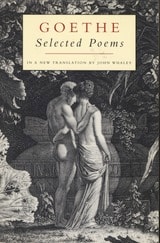
Selected Poems
Johann W. Goethe
Northwestern University Press, 1998
Selected Poems
John Frederick Nims
University of Chicago Press, 1982
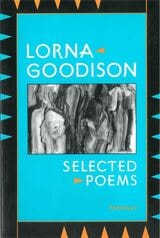
Selected Poems
Lorna Goodison
University of Michigan Press, 1993
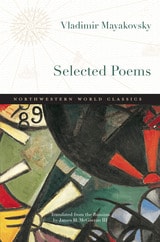
Selected Poems
Vladimir Mayakovsky, Translated from the Russian by James H. McGavran III
Northwestern University Press, 2013

Selected Poems
Jean Garrigue. Introduction by J. D. McClatchy
University of Illinois Press, 1992
Selected Poems is compiled from the best works in Jean Garrigue's eight published collections. Garrigue (1914-72) is recognized as a leading American poet of the fifties and sixties. Among her awards and honors were a Guggenheim fellowship and a National Institute of Arts and Letters grant.
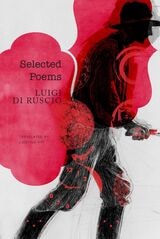
Selected Poems
Luigi Di Ruscio
Seagull Books, 2023
Born in a sub-proletarian ghetto in Italy in 1930 under the fascist regime, Luigi Di Ruscio was an urchin running wild in the countryside, a Communist with clear anarchist leanings, a jack-of-all-trades. In 1957 he emigrated to Oslo, where he worked for forty years in a steel-wire factory, spending his evenings at the typewriter, delving with furious energy into his native Italian. Di Ruscio insisted that whereas the language of power is always a contrived, one-way fabrication, the language of the underprivileged is upfront and direct, aiming straight and sharp for the truth. Caustic as a shopfloor scouring agent, exhilarating in its overabundance, humor, and outspokenness, Selected Poems stands as a testament of tenacity, a record of class struggle, and a vital presence for our times.
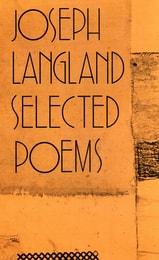
Selected Poems
Joseph Langland
University of Massachusetts Press, 1991
This book offers a selection of sixty-five poems from forty years of distinguished and prize-winning publication by Joseph Langland. These poems speak in a strong, natural voice that has mastered the craft and moves confidently within it. In them, one hears speech and music together in a wide-ranging world of ideas.
Selected Poems Of Janet Lewis
Janet Lewis
Ohio University Press, 2000
Since the appearance in print of her early poems over seventy-five years ago, the poetry of Janet Lewis has grown in quiet acclaim and popularity. Although she is better known as a novelist of historical fiction, her first and last writings were poems. With the publication of her selected poems, Swallow Press celebrates the distinguished career of one of its most cherished authors.
Critics as disparate as Kenneth Rexroth, Timothy Steele, Theodore Roethke, Larry McMurtry, N. Scott Momaday, and Dana Gioia have sung the praises of her work over the decades. Her career as a poet was remarkable not only for its longevity but also for the fact that even well into her tenth decade she wrote poems that stand with her very best work.
Characterized by the vigor and sharpness of her images and the understated lyricism that permeates her rhythmic lines, The Selected Poems of Janet Lewis is a survey of modern poetry unto itself.
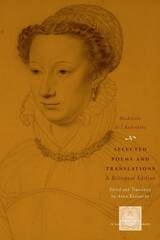
Selected Poems and Translations
A Bilingual EditionMadeleine de l'Aubespine
University of Chicago Press, 2007
Rather than adopt the conventional self-effacement that defined female poets of the time, l’Aubespine’s speakers are sexual, dominant, and defiant; and her subjects are women who are able to manipulate, rebuke, and even humiliate men.
Unavailable in English until now and only recently identified from scattered and sometimes misattributed sources, l’Aubespine’s poems and literary works are presented here in Anna Klosowska’s vibrant translation. This collection, which features one of the first French lesbian sonnets as well as reproductions of l’Aubespine’s poetic translations of Ovid and Ariosto, will be heralded by students and scholars in literature, history, and women’s studies as an important addition to the Renaissance canon.
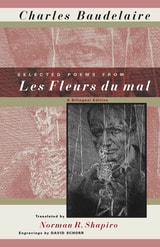
Selected Poems from Les Fleurs du mal
A Bilingual EditionCharles Baudelaire
University of Chicago Press, 1998
"A fine, formal translation of the best poems of France's founder of the symbolist movement."—St. Louis Post-Dispatch
"It's rare to find a rewarding translation of a masterwork, particularly a collection of groundbreaking poetry. . . . Through Shapiro's skillful wordsmithing, the reader can fully appreciate Baudelaire's control of the soul and the word which is the ancient and indefatigable ambition of all great poets. . . . Shapiro's interpretations set the standard for future English translations."—Virginia Quarterly Review
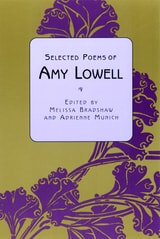
Selected Poems of Amy Lowell
Bradshaw, Melissa
Rutgers University Press, 2002
Amy Lowell (1874–1925), American poet and critic, was one of the most influential and best-known writers of her era. Within a thirteen-year period, she produced six volumes of poetry, two volumes of criticism, a two-volume biography of John Keats, and countless articles and reviews that appeared in many popular periodicals. As a herald of the New Poetry, Lowell saw herself and her kind of work as a part of a newly forged, diverse, American people that registered its consciousness in different tonalities but all in a native idiom. She helped build the road leading to the later works of Allen Ginsberg, May Sarton, Sylvia Plath, and beyond. Except for the few poems that invariably appear in American literature anthologies, most of her writings are out of print. This will be the first volume of her work to appear in decades, and the depth, range, and surprising sensuality of her poems will be a revelation.
The poetry is organized according to Lowell’s characteristic forms, from traditional to experimental. In each section the works appear in chronological order. Section one contains sonnets and other traditional verse forms. The next section covers her translations and adaptations of Chinese and Japanese poetry, whereby she beautifully renders the spirit of these works. Also included here are several of Lowell’s own Asian-influenced poems. Lowell’s free, or cadenced verse appears in the third part. The last section provides samples of Lowell’s polyphonic prose, an ambitious and vigorous art form that employs all of the resources of poetry.
The release of The Selected Poems of Amy Lowell will be a major event for readers who have not been able to find a representative sampling of work from this vigorous, courageous poet who gave voice to an erotic, thoroughly American sensibility.
Selected Poems of August Strindberg
Lotta Lofgren
Southern Illinois University Press, 2002
August Strindberg (1849–1912) was one of the great innovators of modern drama as well as a novelist, poet, and master of the Swedish language. In this collection, Selected Poems of August Strindberg, editor and translator Lotta M. Löfgren has chosen poems from all three volumes of Strindberg’s verse—Poems in Verse and Prose, Sleepwalking Nights on Awake Days, and Word Play and Minor Art—to illustrate to the English-speaking reader the development, strengths, and versatility of Strindberg the poet.
Löfgren explains, “Although August Strindberg is internationally acknowledged as a pioneering realist, expressionist, and surrealist playwright, his poetry is still relatively unknown outside Sweden. The only English translation of [his] poems to date is the 1978 translation of Sleepwalking Nights by Arvid Paulson . . . that gives an incomplete and misleading picture of Strindberg’s poetry.”
Löfgren’s translation seeks to correct that picture. Strindberg’s stature as a dramatist alone may be adequate justification for offering a translation of his verse, but his poetry stands well on its own. All three volumes broke new ground and paved the way for younger generations of poets. Löfgren hopes that her translation will not only introduce Strindberg’s verse to English-speaking readers but will also inspire other scholars to revisit his poetry and give it the attention it deserves.
Selected Poems of August Strindberg received the American-Scandinavian Foundation’s Translation Prize in 2000.
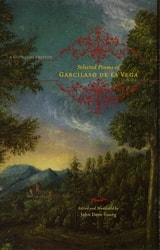
Selected Poems of Garcilaso de la Vega
A Bilingual EditionGarcilaso de la Vega
University of Chicago Press, 2009
Garcilaso de la Vega (ca. 1501–36), a Castilian nobleman and soldier at the court of Charles V, lived a short but glamorous life. As the first poet to make the Italian Renaissance lyric style at home in Spanish, he is credited with beginning the golden age of Spanish poetry. Known for his sonnets and pastorals, gracefully depicting beauty and love while soberly accepting their passing, he is shown here also as a calm student of love’s psychology and a critic of the savagery of war.
This bilingual volume is the first in nearly two hundred years to fully represent Garcilaso for an Anglophone readership. In facing-page translations that capture the music and skill of Garcilaso’s verse, John-Dent Young presents the sonnets, songs, elegies, and eclogues that came to influence generations of poets, including San Juan de la Cruz, Luis de Leon, Cervantes, and Góngora. The Selected Poems of Garcilaso de la Vega will help to explain to the English-speaking public this poet’s preeminence in the pantheon of Spanish letters.
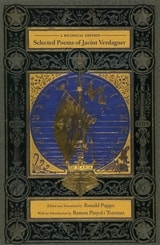
Selected Poems of Jacint Verdaguer
A Bilingual EditionJacint Verdaguer
University of Chicago Press, 2007
Selected Poems is the first book-length translation of Verdaguer’s works into English. Ronald Puppo offers readable and faithful verse adaptations of poetry from all periods of the poet-priest’s life, from his days as a seminary student and farmhand to his journeys as a ship’s chaplain and eventual spiritual crisis. These adroit translations will recover Verdaguer as a major figure in the modern literary tradition of the West, restoring him to the pantheon of world letters.
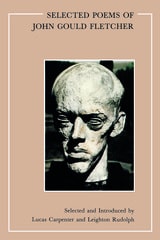
Selected Poems of John Gould Fletcher
John Fletcher
University of Arkansas Press, 1988
A Pulitzer Prize winner best known as an imagist, John Gould Fletcher experimented with every facet of Modernist poetry and influenced poets in both England and the United States. this is the first collection to span his entire career, and brings again to the public eye work that has been unavailable for thirty-five years.
Fletcher is responsible for introducing Ezra Pound to French symbolism, and Amy Lowell to “polyphonic prose,” and his connection with the Southern Fugitive Agrarian movement adds to his significance as the first modern Southern poet. The editors have chosen representative works for his many stages of development and discuss in the introduction Fletcher’s influence on the better-known modernists.
Selected Poems of John Gould Fletcher is the first n a series of books by or about Fletcher to fill an important space in home and public libraries with American literature collections.
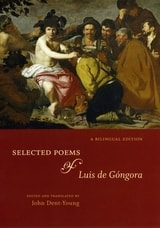
Selected Poems of Luis de Góngora
A Bilingual EditionLuis de Góngora
University of Chicago Press, 2007
Making Luis de Góngora’s work available to contemporary English-language readers without denying his historical context, Selected Poems of Luis de Góngora presents him as not only one of the greatest and most complex poets of his time, but also the funniest and most charismatic. From longer works, such as “The Fable of Polyphemus and Galatea,” to shorter ballads, songs, and sonnets, John Dent-Young’s free translations capture Góngora’s intensely musical voice and transmit the individuality and self-assuredness of the poet. Substantial introductions and extensive notes provide personal and historical context, explain the ubiquitous puns and erotic innuendo, and discuss translation choices. A significant edition of this seminal and challenging poet, Selected Poems of Luis de Góngora will find an eager audience among students of poetry and scholars studying the history and literature of Spain.
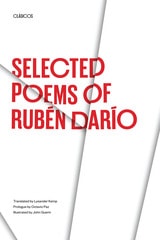
Selected Poems of Rubén Darío
By Rubén Darío
University of Texas Press, 1965
Toward the close of the last century, the poetry of the Spanish-speaking world was pallid, feeble, almost a corpse. It needed new life and a new direction. The exotic, erratic, revolutionary poet who changed the course of Spanish poetry and brought it into the mainstream of twentieth-century Modernism was Félix Rubén García Sarmiento (1867-1916) of Nicaragua, who called himself Rubén Darío.
Since its original publication in 1965, this edition of Darío's poetry has made English-speaking readers better acquainted with the poet who, as Enrique Anderson Imbert said, "divides literary history into 'before' and 'after.'" The selection of poems is intended to represent the whole range of Darío's verse, from the stinging little poems of Thistles to the dark, brooding lines of Songs of the Argentine and Other Poems. Also included, in the Epilogue, is a transcript of a radio dialogue between two other major poets, Federico García Lorca of Spain and Pablo Neruda of Chile, who celebrate the rich legacy of Rubén Darío.
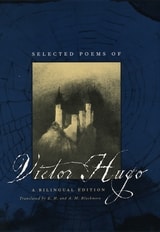
Selected Poems of Victor Hugo
A Bilingual EditionVictor Hugo
University of Chicago Press, 2001
Although best known as the author of Notre Dame de Paris and Les Misérables, Victor Hugo was primarily a poet—one of the most important and prolific in French history. Despite his renown, however, there are few comprehensive collections of his verse available and even fewer translated editions.
Translators E. H. and A. M. Blackmore have collected Victor Hugo's essential verse into a single, bilingual volume that showcases all the facets of Hugo's oeuvre, including intimate love poems, satires against the political establishment, serene meditations, religious verse, and narrative poems illustrating his mastery of the art of storytelling and his abiding concern for the social issues of his time. More than half of this volume's eight thousand lines of verse appear here for the first time in English, providing readers with a new perspective on each of the fascinating periods of Hugo's career and aspects of his style. Introductions to each section guide the reader through the stages of Hugo's writing, while notes on individual poems provide information not found in even the most detailed French-language editions.
Illustrated with Hugo's own paintings and drawings, this lucid translation pays homage to this towering figure of nineteenth-century literature by capturing the energy of his poetry, the drama and satirical force of his language, and the visionary beauty of his writing as a whole.
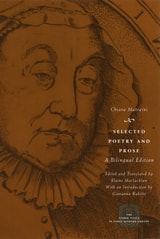
Selected Poetry and Prose
A Bilingual EditionChiara Matraini
University of Chicago Press, 2007
Mostly available in only a handful of rare book collections, her writings are now adeptly translated here for an English-speaking audience and situated historically in an introduction by noted Matraini expert Giovanna Rabitti. Selected Poetry and Prose allows the poet to finally take her place as one of the seminal authors of the Renaissance, next to her contemporaries Vittoria Colonna and Laura Battiferra, also published in the Other Voice series.
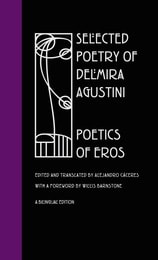
Selected Poetry of Delmira Agustini
Poetics of ErosEdited and Translated by Alejandro Cáceres. Foreword by Willis Barnstone.
Southern Illinois University Press, 2008
This graceful translation and bilingual edition, now in paperback, is the first to bring English readers a representative sampling of the poetry Delmira Agustini published before her untimely death on July 6, 1914 at the age of twenty-seven. Translated by native Uruguayan Alejandro Cáceres and including work from each of Agustini's four published books, Selected Poetry of Delmira Agustini: Poetics of Eros is a response to a resurgent interest not just in the poems but in the passionate and daring woman behind them and the social and political world she inhabited.
Delmira Agustini was born in Montevideo, Uruguay, on October 24, 1886 to wealthy parents of German and Italian descent. She published her first volume of poetry when she was twenty-one and followed with two more in the next six years: the fourth volume was a posthumous publication. Her life was cut short in 1914, when Enrique Job Reyes, her ex-husband, shot her to death and then turned the gun on himself.
Carefully selected for this bilingual, en face edition, the poems collected here track and highlight Agustini's development and strengths as an artist—including her methods of experimentation, first relying on modernista forms and later abandoning them—and her focus on the figure of the male, which she portrays as the crux of devotion and attention but deems ultimately unreachable. Cáceres's introduction presents biographical information and situates Agustini's work and life in a larger political, historical, and literary context, particularly the modernismo movement, whose followers broke linguistic and political ties with the pathos and excesses of romanticism.
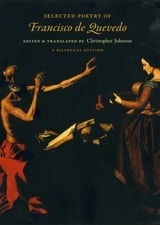
Selected Poetry of Francisco de Quevedo
A Bilingual EditionFrancisco de Quevedo
University of Chicago Press, 2009
Francisco de Quevedo (1580–1645), one of the greatest poets of the Spanish Golden Age, was the master of the baroque style known as “conceptismo,” a complex form of expression fueled by elaborate conceits and constant wordplay as well as ethical and philosophical concerns. Although scattered translations of his works have appeared in English, there is currently no comprehensive collection available that samples each of the genres in which Quevedo excelled—metaphysical and moral poetry, grave elegies and moving epitaphs, amorous sonnets and melancholic psalms, playful romances and profane burlesques.
In this book, Christopher Johnson gathers together a generous selection of forty-six poems—in bilingual Spanish-English format on facing pages—that highlights the range of Quevedo’s technical expertise and themes. Johnson’s ingenious solutions to rendering the difficult seventeenth-century Spanish into poetic English will be invaluable to students and scholars of European history, literature, and translation, as well as poetry lovers wishing to reacquaint themselves with an old master.
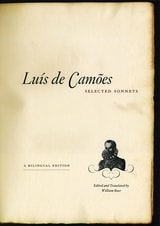
Selected Sonnets
A Bilingual EditionLuís de Camões
University of Chicago Press, 2005
The first significant English translation of Camões's sonnets in more than one hundred years, Selected Sonnets: A Bilingual Edition collects seventy of Camões's best—all musically rendered into contemporary, yet metrical and rhymed, English-language poetry by William Baer, with the original Portuguese on facing pages—and reintroduces the genius of a poet whom Cervantes called "the incomparable treasure of Lusus." A comprehensive selection of sonnets that demonstrates the full range of Camões's interests and invention, Selected Sonnets will prove indespensible for both students and teachers in comparative and Renaissance literature, Portuguese and Spanish history, and the art of literary translation.
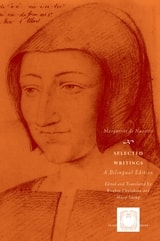
Selected Writings
A Bilingual EditionMarguerite de Navarre
University of Chicago Press, 2008
Selected Writings brings together a representative sampling of Marguerite’s varied writings, most of it never before translated into English, enabling Anglophone readers to enjoy the full breadth of her work for the first time. From verse letters and fables to mythological-pastoral tales, from spiritual songs to a selection of novellas from the Heptameron, the wide range of works included here will reveal Marguerite de Navarre to be one of the most important writers—male or female—of sixteenth-century France.
Self-Evidence
A Selection of Verse, 1977-1997Pamela White Hadas
Northwestern University Press, 1997
Pamela White Hadas won enthusiastic recognition for her early books of poetry, Designing Women and Beside Herself. In Self-Evidence, she selects the best of her published work and combines it with poems never before collected. This collection contains legendary, mythic, historical, and imaginary characters--Lilith, Pocahontas, Simone Weil, the wives of Watergate, a circus performer, and others. With playful originality and virtuoso voicing, Hadas weaves breathtaking tapestries of women's loves and labors.
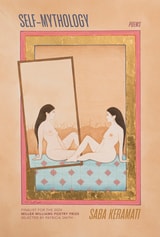
Self-Mythology
PoemsSaba Keramati
University of Arkansas Press, 2024
Winner, 2025 Nossrat Yassini Poetry Prize
In the search for a true home, what does it mean to be confronted instead by an insurmountable sense of otherness? This question dwells at the center of Saba Keramati’s Self-Mythology, which explores multiraciality and the legacy of exile alongside the poet’s uniquely American origin as the only child of political refugees from China and Iran. Keramati navigates her ancestral past while asking what language and poetry can offer to those who exist on the margins of contemporary society. Constantly scanning her world for some likeness that would help her feel less of an outsider, the poet writes, “You could cut me in half. Send the left side with my mother, / right with my father. Shape what’s missing out of clay // from their lands and still I would not belong.” Blending the personal and the political, Self-Mythology considers the futurity of diaspora in America while revealing its possibilities.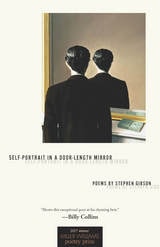
Self-Portrait in a Door-Length Mirror
PoemsStephen Gibson
University of Arkansas Press, 2017
Winner of the 2017 Miller Williams Poetry Prize, edited by Billy Collins
“Shows this exceptional poet at his rhyming best.”
—Billy Collins
Self-Portrait in a Door-Length Mirror presents the mirror that reflects not always what is, but what is desired, or not desired. In the opening poem, the speaker, Diane Arbus, looks at her very early pregnant self and asks, “Why would I bring you into this world?” This book answers that question, or tries to: the world is what it is as we try to live as our best selves in that world. But that knowledge of the world is hard and has consequences, and not in the abstract, as Gibson’s poetry dynamically shows.
Employing new formalism, Self-Portrait in a Door-Length Mirror examines historical, familial, and personal pasts as those pasts continue into the present, reminding us, as Faulkner wrote, “The past is never dead. It’s not even past.”
Self/Pity
Susan Hahn
Northwestern University Press, 2005
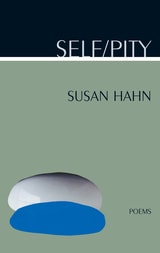
As with her previous collections, the poems in Self/Pity can be read as a cohesive whole.
From the simple prayer "To Jacob Four Months In The Womb" to the complex territory of the poem sequence "The Pornography of Pity," in which Mother Goose, the Marquis de Sade, Godot, Lewis Carroll's Alice, The Cat and the Fiddle, Zeus, and many others are called upon, Hahn creates a tour-de-force exploration of the book's central themes.
Selfwolf
Mark Halliday
University of Chicago Press, 1998
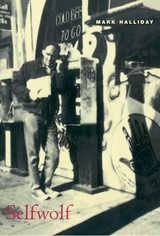
"If Selfwolf were a pop music CD, it would be hailed as Mark Halliday's breakthrough album. . . . This third collection of poems teems with unsparing confessions of misdirected lust, lost faith, regret and a winningly goofy cheerfulness in the face of all that bad stuff. . . . The informal, conversational quality of Halliday's work almost hides its artfulness, which seems to be precisely his intention."—Ken Tucker, New York Times Book Review
"With unflinching, often comic honesty about how 'ego-fetid, hostile, grasping' we are, Halliday exposes the self's wolfish hungers and weaknesses."—Andrew Epstein, Boston Review
"Mark Halliday's new book offers more of his trademark riffs on self-consciousness. His subversive, surprising, hugely enjoyable poems will make you laugh out loud, squirm in uncomfortable recognition, and appreciate anew the comedy of our daily battles for self-preservation. . . reading Halliday is pure delight. . . . I love the daring and intelligence with which Halliday skates along the shifting boundary between self within and world outside. Selfwolf slows down our habitual negotiations between 'in here' and 'out there,' exposing the edgy comedy of how we survive."—Damaris Moore, Express Books
Senegal Taxi
Juan Felipe Herrera
University of Arizona Press, 2013
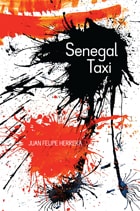
Unflinching in its honesty, brutality, and beauty, the collection fiercely addresses conflict and childhood, inviting readers to engage in complex and often challenging issues. Senegal Taxi weaves together verse, dialogue, and visual art created by Herrera specifically for the book. Stylistically genre-leaping, these many layers are part of the collection’s innovation. Phantom-like televisions, mud drawings, witness testimonies, insects, and weaponry are all storytellers that join the siblings for a theatrical crescendo. Each poem is told from a different point of view, which Herrera calls “mud drawings,” referring to the evocative symbols of hope the children create as they hide in a cave on their way to Senegal, where they plan to catch a boat to the United States.
This collection signals a poignant shift for Herrera as he continues to use his craft to focus attention on global concerns. In so doing, he offers an acknowledgment that the suffering of some is the suffering of all.
Senses of Style
Poetry before InterpretationJeff Dolven
University of Chicago Press, 2017