210 books match the query 'African Studies' and 38 start with t
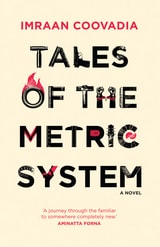
cover of Tales of the Metric System: A Novel

Tales of the Metric System

A Novel

Imraan Coovadia

Ohio University Press, 2016

In Tales of the Metric System, Coovadia explores a turbulent South Africa from 1970 into the present. He takes his home country’s transition from imperial to metric measurements as his catalyst, holding South Africa up and examining it from the diverse perspectives of his many characters. An elite white housewife married to a radical intellectual; a rock guitarist; the same guitarist’s granddaughter thirty years later; a teenaged boy at the mercy of mob justice—each story takes place over one of ten days across the decades, and each protagonist has his own stakes, her own moment in time, but each is equally caught in the eddies of change. Tales of the Metric System is clear eyed, harrowing, and daring.
[more]
cover of Tear Down the Walls: White Radicalism and Black Power in 1960s Rock

Tear Down the Walls

White Radicalism and Black Power in 1960s Rock

Patrick Burke

University of Chicago Press, 2021
From the earliest days of rock and roll, white artists regularly achieved fame, wealth, and success that eluded the Black artists whose work had preceded and inspired them. This dynamic continued into the 1960s, even as the music and its fans grew to be more engaged with political issues regarding race. In Tear Down the Walls, Patrick Burke tells the story of white American and British rock musicians’ engagement with Black Power politics and African American music during the volatile years of 1968 and 1969. The book sheds new light on a significant but overlooked facet of 1960s rock—white musicians and audiences casting themselves as political revolutionaries by enacting a romanticized vision of African American identity. These artists’ attempts to cast themselves as revolutionary were often naïve, misguided, or arrogant, but they could also reflect genuine interest in African American music and culture and sincere investment in anti-racist politics. White musicians such as those in popular rock groups Jefferson Airplane, the Rolling Stones, and the MC5, fascinated with Black performance and rhetoric, simultaneously perpetuated a long history of racial appropriation and misrepresentation and made thoughtful, self-aware attempts to respectfully present African American music in forms that white leftists found politically relevant. In Tear Down the Walls Patrick Burke neither condemns white rock musicians as inauthentic nor elevates them as revolutionary. The result is a fresh look at 1960s rock that provides new insight into how popular music both reflects and informs our ideas about race and how white musicians and activists can engage meaningfully with Black political movements.
[more]
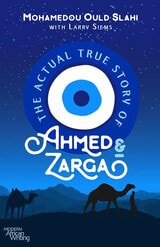
cover of The Actual True Story of Ahmed and Zarga

The Actual True Story of Ahmed and Zarga

Mohamedou Ould Slahi

Ohio University Press, 2021

An epic story of a Bedouin family’s survival and legacy amid their changing world in the unforgiving Sahara Desert. Ahmed is a camel herder, as his father was before him and as his young son Abdullahi will be after him. The days of Ahmed and the other families in their nomadic freeg are ruled by the rhythms of changing seasons, the needs of his beloved camel herd, and the rich legends and stories that link his life to centuries of tradition. But Ahmed’s world is threatened—by the French colonizers just beyond the horizon, the urbanization of the modern world, and a drought more deadly than any his people have known. At first, Ahmed attempts to ignore these forces by concentrating on the ancient routines of herding life. But these routines are broken when a precious camel named Zarga goes missing. Saddling his trusted Laamesh, praying at the appointed hours, and singing the songs of his fathers for strength, Ahmed sets off to recover Zarga on a perilous journey that will bring him face to face with the best and the worst of humanity and test every facet of his Bedouin desert survival skills.
[more]
cover of The Cape Cod Bicycle War: and Other Stories

The Cape Cod Bicycle War

and Other Stories

Billy Kahora

Ohio University Press, 2020
Each of the realistic worlds Billy Kahora brings us in the short stories and novella that make up The Cape Cod Bicycle War and Other Stories explores the tensions and transitions of characters moving between youthful folly and a precarious adulthood. In the title story, immigrant workers with varying ambitions work at a Wendy’s in wintry Cape Cod. Sharing one house, they must also share, or rather compete for, bicycles—crucial transportation—which are in short supply. In other stories, a young man caught between a broken family and political violence befriends an aged gorilla in a Nairobi zoo; a pastor struggles to come to terms with the arrest of his brother, who is suspected of terrorism; and a dissolute bank employee on a serious bender returns to work to face a review board. The Cape Cod Bicycle War and Other Stories is Billy Kahora’s long-awaited debut collection. Stories in this volume have appeared in Granta and McSweeney’s and have been shortlisted for the Caine Prize for African Writing.
[more]
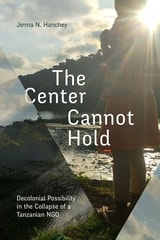
cover of The Center Cannot Hold: Decolonial Possibility in the Collapse of a Tanzanian NGO

The Center Cannot Hold

Decolonial Possibility in the Collapse of a Tanzanian NGO

Jenna N. Hanchey

Duke University Press, 2023
In The Center Cannot Hold Jenna N. Hanchey examines the decolonial potential emerging from processes of ruination and collapse. Drawing on ethnographic fieldwork in rural Tanzania at an internationally funded NGO as it underwent dissolution, Hanchey traces the conflicts between local leadership and Western paternalism as well as the unstable subjectivity of Western volunteers—including the author—who are unable to withstand the contradictions of playing the dual roles of decolonializing ally and white savior. She argues that Western institutional and mental structures must be allowed to fall apart to make possible the emergence of decolonial justice. Hanchey shows how, through ruination, privileged subjects come to critical awareness through repeated encounters with their own complicity, providing an opportunity to delink from and oppose epistemologies of coloniality. After things fall apart, Hanchey posits, the creation of decolonial futures depends on the labor required to imagine impossible futures into being.
[more]
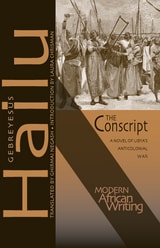
cover of The Conscript: A Novel of Libya’s Anticolonial War

The Conscript

A Novel of Libya’s Anticolonial War

Gebreyesus Hailu

Ohio University Press, 2013
Eloquent and thought-provoking, this classic novel by the Eritrean novelist Gebreyesus Hailu, written in Tigrinya in 1927 and published in 1950, is one of the earliest novels written in an African language and will have a major impact on the reception and critical appraisal of African literature. The Conscript depicts, with irony and controlled anger, the staggering experiences of the Eritrean ascari, soldiers conscripted to fight in Libya by the Italian colonial army against the nationalist Libyan forces fighting for their freedom from Italy’s colonial rule. Anticipating midcentury thinkers Frantz Fanon and Aimé Césaire, Hailu paints a devastating portrait of Italian colonialism. Some of the most poignant passages of the novel include the awakening of the novel’s hero, Tuquabo, to his ironic predicament of being both under colonial rule and the instrument of suppressing the colonized Libyans. The novel’s remarkable descriptions of the battlefield awe the reader with mesmerizing images, both disturbing and tender, of the Libyan landscape—with its vast desert sands, oases, horsemen, foot soldiers, and the brutalities of war—uncannily recalled in the satellite images that were brought to the homes of millions of viewers around the globe in 2011, during the country’s uprising against its former leader, Colonel Gaddafi.
[more]
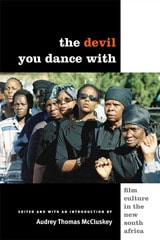
cover of The Devil You Dance With: Film Culture in the New South Africa

The Devil You Dance With

Film Culture in the New South Africa

Edited and with an Introduction by Audrey McCluskey

University of Illinois Press, 2008

South African film culture, like so much of its public life, has undergone a tremendous transformation during its first decade of democracy. Filmmakers, once in exile, banned, or severely restricted, have returned home; subjects once outlawed by the apparatchiks of apartheid are now fair game; and a new crop of insurgent filmmakers are coming to the fore.

This extraordinary volume presents twenty-five in-depth interviews with established and emerging South African filmmakers, collected and edited by Audrey Thomas McCluskey. The interviews capture the filmmakers’ spirit, energy, and ambition as they attempt to give birth to a film culture that reflects the heart and aspirations of their diverse and emergent nation. The collection includes a biographical profile of each filmmaker, as well an introductory essay by McCluskey, pointing to the themes, as well as creative differences and similarities, among the filmmakers.

[more]
cover of The Essential Senghor: African Philosophy and Black Aesthetics

The Essential Senghor

African Philosophy and Black Aesthetics

Léopold Sédar Senghor. Edited and Translated by Doyle D. Calhoun, Alioune B. Fall, and Cheikh Thiam.

Duke University Press, 2026
Senegalese poet, philosopher, and politician Leopold Sédar Senghor, together with Aimé Césaire and others, developed the influential and perennially relevant negritude movement—a Black artistic, philosophical, and political expression of Black presence in the modern colonial world. The Essential Senghor provides a new opportunity for English-language readers to engage with Senghor’s critical and philosophical writings spanning from 1937 to 1985. This collection includes Senghor’s key philosophical interventions in discourses on freedom, Blackness and being, humanism, history, and more. It portrays Senghor as a pivotal intellectual in the fields of African and Black studies whose work engages a wide range of disciplines, including literature, linguistics, anthropology, religion, and art history. The Essential Senghor invites readers not only to reflect on negritude and its importance for our political present, but also to reconsider intellectual genealogies of decolonial thought, Black liberation, and African philosophy.
[more]
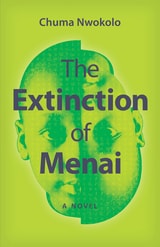
cover of The Extinction of Menai: A Novel

The Extinction of Menai

A Novel

Chuma Nwokolo

Ohio University Press, 2017

In the early 1980s, a pharmaceutical company administers an unethical drug trial to residents of the Niger Delta village of Kreektown. When children die as a result of the trial, the dominoes of language extinction and cultural collapse begin to topple. Decades later the end looms for the Menai people. Continents-apart twin brothers separated at birth, an excommunicated daughter living an urbane life with her doctor husband, and an infamous vigilante are among the indelible characters whose lives are shaped by this collective tragedy. Not least of these is the spiritual leader Mata Nimito, who retraces his people’s ancient migration on his quest to preserve the soul of the Menai and resolve the consequences of a centuries-old betrayal. In The Extinction of Menai, Chuma Nwokolo moves across time and continents to deliver a story that speaks to urgent contemporary concerns. He confronts power relations between large corporations and small communities, corporate lobbies and governments, and big pharma and consumers, all expressed through the competing narratives that record the life and death of a civilization.In a novel of stunning scope, Chuma Nwokolo moves across time and place to deliver a story that speaks to urgent contemporary concerns. His characters’ indelible voices offer perspectives that are simultaneously global, political, and intimately human.
[more]
cover of The Genealogical Imagination: Two Studies of Life over Time

The Genealogical Imagination

Two Studies of Life over Time

Michael Jackson

Duke University Press, 2021

In The Genealogical Imagination Michael Jackson juxtaposes ethnographic and imaginative writing to explore intergenerational trauma and temporality. Drawing on over fifty years of fieldwork, Jackson recounts the 150-year history of a Sierra Leone family through its periods of prosperity and powerlessness, war and peace, jihad and migration. Jackson also offers a fictionalized narrative loosely based on his family history and fieldwork in northeastern Australia that traces how the trauma of wartime in one generation can reverberate into the next. In both stories Jackson reflects on different modes of being-in-time, demonstrating how genealogical time flows in stops and starts—linear at times, discontinuous at others—as current generations reckon with their relationships to their ancestors. Genealogy, Jackson demonstrates, becomes a powerful model for understanding our experience of being-in-the-world, as nobody can escape kinship and the pull of the past. Unconventional and evocative, The Genealogical Imagination offers a nuanced account of how lives are lived, while it pushes the bounds of the forms that scholarship can take.
[more]
cover of The Hairdresser of Harare: A Novel

The Hairdresser of Harare

A Novel

Tendai Huchu

Ohio University Press, 2015

In this delicious and devastating first novel, which The Guardian named one of its ten best contemporary African books, Caine Prize finalist Tendai Huchu (The Maestro, the Magistrate, and the Mathematician) portrays the heart of contemporary Zimbabwean society with humor and grace. Vimbai is the best hairdresser in Mrs. Khumalo’s salon, and she is secure in her status until the handsome, smooth-talking Dumisani shows up one day for work. Despite her resistance, the two become friends, and eventually, Vimbai becomes Dumisani’s landlady. He is as charming as he is deft with the scissors, and Vimbai finds that he means more and more to her. Yet, by novel’s end, the pair’s deepening friendship—used or embraced by Dumisani and Vimbai with different futures in mind—collapses in unexpected brutality. The novel is an acute portrayal of a rapidly changing Zimbabwe. In addition to Vimbai and Dumisani’s personal development, the book shows us how social concerns shape the lives of everyday people.
[more]
cover of The Healing Stage: Black Women, Incarceration, and the Art of Transformation

The Healing Stage

Black Women, Incarceration, and the Art of Transformation

Lisa Biggs

The Ohio State University Press, 2022
Winner, 2023 NCA Lilla A. Heston Award for Outstanding Scholarship in Interpretation and Performance Studies Winner of the 2023 ASTR Errol Hill Award Finalist, 2023 ASTR Barnard Hewitt Award for Outstanding Research in Theatre History Over the last five decades, Black women have been one of the fastest-growing segments of the global prison population, thanks to changes in policies that mandate incarceration for nonviolent offenses and criminalize what women do to survive interpersonal and state violence. In The Healing Stage, Lisa Biggs reveals how four ensembles of currently and formerly incarcerated women and their collaborating artists use theater and performance to challenge harmful policies and popular discourses that justify locking up “bad” women. Focusing on prison-based arts programs in the US and South Africa, Biggs illustrates how Black feminist cultural traditions—theater, dance, storytelling, poetry, humor, and protest—enable women to investigate the root causes of crime and refute dominant narratives about incarcerated women. In doing so, the arts initiatives that she writes about encourage individual and collective healing, a process of repair that exceeds state definitions of rehabilitation. These case studies offer powerful examples of how the labor of incarcerated Black women artists—some of the most marginalized and vulnerable people in our society—radically extends our knowledge of prison arts programs and our understanding of what is required to resolve human conflicts and protect women’s lives.
[more]
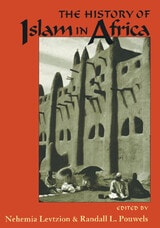
cover of The History Of Islam In Africa

The History Of Islam In Africa

Nehemia Levtzion

Ohio University Press, 2000

A CHOICE Outstanding Academic Title

The history of the Islamic faith on the continent of Africa spans fourteen centuries. For the first time in a single volume, The History of Islam in Africa presents a detailed historic mapping of the cultural, political, geographic, and religious past of this significant presence on a continent-wide scale. Bringing together two dozen leading scholars, this comprehensive work treats the historical development of the religion in each major region and examines its effects.

Without assuming prior knowledge of the subject on the part of its readers, The History of Islam in Africa is broken down into discrete areas, each devoted to a particular place or theme and each written by experts in that particular arena. The introductory chapters examine the principal “gateways” from abroad through which Islam traditionally has influenced Africans. The following two parts present overviews of Islamic history in West Africa and the Sudanic zone, and in subequatorial Africa. In the final section, the authors discuss important themes that have had an impact on Muslim communities in Africa.

Designed as both a reference and a text, The History of Islam in Africa will be an essential tool for libraries, scholars, and students of this growing field.

Contributors: Edward A. Alpers, René A. Bravmann, Abdin Chande, Eric Charry, Allan Christelow, Roberta Ann Dunbar, Kenneth W. Harrow, Lansiné Kaba, Lidwien Kapteijns, Nehemia Levtzion, William F. S. Miles, David Owusu-Ansah, M. N. Pearson, Randall L. Pouwels, Stefan Reichmuth, David Robinson, Peter von Sivers, Robert C.-H. Shell, Jay Spaulding, David C. Sperling with Jose H. Kagabo, Jean-Louis Triaud, Knut S. Vikør, John O. Voll, and Ivor Wilks

[more]
cover of The Krobo People of Ghana to 1892: A Political and Social History

The Krobo People of Ghana to 1892

A Political and Social History

Louis E. Wilson

Ohio University Press, 1991

This book presents a broad analytical framework for the history of southeastern Ghana within the context of a representative study of one of the country’s most important political and economic forces. The 150,000 Krobo are the most numerous of the Adangme-speaking peoples. They are located in the mountains just inland from the coast and are the fourth largest ethnic group in the country. During the nineteenth century they were one of the small states of the Gold Coast in the formative stages of political and cultural development. After the middle of the nineteenth century they became economically and politically one of the most important groups in the country because of their dominant role in commercial production of export crops. Historical research on Ghana has produced mostly case studies of the large, centralized Akan states. Wilson’s study is an account of one of the smaller societies without which a history of Ghana would be incomplete.
[more]
cover of The Lion's Historian: Africa's Animal Past

The Lion's Historian

Africa's Animal Past

Sandra Swart

Ohio University Press, 2025

“Until the lion has a historian of his own, the tale of the hunt will always glorify the hunter.” Sandra Swart takes up the challenge of that African proverb and, with this book, becomes the lion’s historian. As a species, humans are not alone; but our history has been written as though we were. Swart insists on a multispecies retelling of our more-than-human past as she reconstructs a shifting series of significant interspecies relationships, from quirky, idiosyncratic connections to others that triggered major changes. Embracing a radical interdisciplinarity informed by a background in history and environmental studies, Swart combines the natural sciences with the social sciences, oral history, indigenous knowledge, and archival research. She blends current thinking about animal sentience, agency, cognition, and emotion to offer a new way to understand animals’ role in our shared history. The animals in this book—baboons, cows, elephants, hippos, horses, jackals, lions, Nazi cattle, okapi, police dogs, quagga, sheep, and white ants—exemplify different facets of our shared past. With this animal-centric lens, decades of research are brought together in a collection that takes animals seriously. It is a book with claws and fangs, tearing through conventional narratives to ask, Are we prepared to move beyond the convention that “history” is the story of only our own species? The entanglements between humans and other animals have shaped our past, but they suggest something more. The possibility of our shared future pivots on a reckoning with our shared pasts. Swart shows what human-animal history can do, not only to understand our place in the world better but to make our world—however slightly—a better place.

[more]
cover of The Maestro, the Magistrate and the Mathematician: A Novel

The Maestro, the Magistrate and the Mathematician

A Novel

Tendai Huchu

Ohio University Press, 2016
The Hairdresser of Harare, which the New York Times Book Review called “a fresh and moving account of contemporary Zimbabwe,” announced Tendai Huchu as a shrewd and funny social commentator. In The Maestro, the Magistrate & the Mathematician, Huchu expands his focus from Zimbabwe to the lives of expatriates in Edinburgh, Scotland. The novel follows three Zimbabwean men as they struggle to find places for themselves in Scotland. As he wanders Edinburgh with his Walkman on a constant loop of the music of home, the Magistrate—a former judge, now a health aide—tries to find meaning in new memories. The depressed and quixotic Maestro—gone AWOL from his job stocking shelves at a grocery store—escapes into books. And the youthful Mathematician enjoys a carefree and hedonistic graduate school life, until he can no longer ignore the struggles of his fellow expatriates. In this novel of ideas, Huchu deploys satire to thoughtful end in what is quickly becoming his signature mode. Shying from neither the political nor the personal, he creates a humorous but increasingly somber picture of love, loss, belonging, and politics in the Zimbabwean diaspora.
[more]
cover of The Moral Economy of the State: Conservation, Community Development, and State-Making in Zimbabwe

The Moral Economy of the State

Conservation, Community Development, and State-Making in Zimbabwe

William A. Munro

Ohio University Press, 1998
The Moral Economy of the State examines state formation in Zimbabwe from the colonial period through the first decade of independence. Drawing on the works of Gramsci, E. P. Thompson, and James Scott, William Munro develops a theory of “moral economy” that explores negotiations between rural citizens and state agents over legitimate state incursions in social life. This analysis demonstrates how states try to shape the meanings of citizenship for agrarian populations by redefining conceptions of the public good, property rights, and community membership. The book’s focus on the moral economy of the state offers a refreshing perspective on the difficulties experienced by postcolonial African states in building stronger state and rural institutions.
[more]
cover of The Moulids of Egypt: Egyptian Saint’s Day Festivals

The Moulids of Egypt

Egyptian Saint’s Day Festivals

J.W. McPherson

Gingko, 2022

A fascinating and highly original contribution to the study of Egypt’s religious folklore.

First published in Cairo during World War II, The Moulids of Egypt is a study of moulids, the popular Egyptian religious festivals celebrated by both Muslims and Christians in the first half of the twentieth century. The book talks in detail about the secular side of moulids, where sports, games, theatres, dancing, and laughter were as much part of the festivals as the religious processions and the whirling of dervishes. Some of the rites and customs analyzed here date from as far back as the Pharaonic period, but the moulids are gradually dying out; many of the 126 festivals described in Moulids of Egypt have since faded away, making the book of lasting interest.
[more]
cover of The Noise Silence Makes: Secularity and Ghana's Drum Wars

The Noise Silence Makes

Secularity and Ghana's Drum Wars

Mariam Goshadze

Duke University Press, 2025
For generations, the Ga community in Accra, Ghana, has enforced an annual citywide ban on noisemaking during an important religious festival. In the 1990s and 2000s, this “ban on drumming” became a point of conflict between the Ga people and the newly popular Pentecostal/Charismatic churches, which refused to subdue their loud worship during the ban. Although the Ghanaian state constitutionally and institutionally grants superior status to Christianity and Islam, it ruled in favor of the Ga community, which emphasized its “cultural” rather than religious rights. In The Noise Silence Makes, Mariam Goshadze traces the history of noise regulation in Accra, showing how the Ga people have adopted colonial mechanisms of noise control to counter Pentecostal/Charismatic dominance over Accra’s soundscape. Goshadze shows how the drumming ban represents a reversal of the top-down model of noise regulation and illuminates the reality of Ghanaian secularity, in which the state unofficially collaborates with indigenous religious authorities to control sound. In so doing, Goshadze counters the tendency to push African “traditional religions” to the margins, demonstrating that they are instrumental players in contemporary African urbanity.
[more]
cover of The Other Zulus: The Spread of Zulu Ethnicity in Colonial South Africa

The Other Zulus

The Spread of Zulu Ethnicity in Colonial South Africa

Michael R. Mahoney

Duke University Press, 2012
In 1879, the British colony of Natal invaded the neighboring Zulu kingdom. Large numbers of Natal Africans fought with the British against the Zulus, enabling the British to claim victory and, ultimately, to annex the Zulu kingdom. Less than thirty years later, in 1906, many of those same Natal Africans, and their descendants, rebelled against the British in the name of the Zulu king. In The Other Zulus, a thorough history of Zulu ethnicity during the colonial period, Michael R. Mahoney shows that the lower classes of Natal, rather than its elites, initiated the transformation in ethnic self-identification, and they did so for multiple reasons. The resentment that Natal Africans felt toward the Zulu king diminished as his power was curtailed by the British. The most negative consequences of colonialism may have taken several decades to affect the daily lives of most Africans. Natal Africans are likely to have experienced the oppression of British rule more immediately and intensely in 1906 than they had in 1879. Meanwhile, labor migration to the gold mines of Johannesburg politicized the young men of Natal. Mahoney's fine-grained local history shows that these young migrants constructed and claimed a new Zulu identity, both to challenge the patriarchal authority of African chiefs and to fight colonial rule.
[more]
cover of The Post-Global City: Theorizing Technology Cultures in Urban Africa

The Post-Global City

Theorizing Technology Cultures in Urban Africa

Editors: Katrien Pype, Omolade Adunbi and Michael M.J. Fischer

University of Michigan Press, 2026

The Post-Global City seeks to open a new field of analytical inquiry that examines knowledge production and technological developments in urban Africa rooted in local, historical realities, while also partaking in transnational, global processes. This work explores the ways in which urban residents have utilized technologies and networks to operate around, under, and beyond the state and the international “order,” and challenges the stereotypical images of Africa as a continent either devoid of technology or filled with either broken technologies or technologies from the Global North or Asia. This book focuses on accounts and critiques of new “Rising Africa” ideologies, examining megaprojects such as geothermal and hydroelectric plants with new networked startups that circumvent state and patriarchal hierarchies, women vendors selling online, youths designing and constructing oil refining technologies and tech startups working across diasporas.

Grounded in ethnographic fieldwork carried out in urban spaces in Nigeria, Kenya, the Democratic Republic of Congo, Sudan, Gabon, Cameroon, and Tanzania, The Post-Global City brings together voices from Africa, Europe, and the United States to inquire into the dialectics between technology and the urban on the African continent. 

[more]
cover of The Power of Their Will: Slaveholding Women in Nineteenth-Century Cuba

The Power of Their Will

Slaveholding Women in Nineteenth-Century Cuba

Teresa Prados-Torreira

University of Alabama Press, 2021

CHOICE OUTSTANDING ACADEMIC TITLE, 2022

“This fascinating book explores the unique circumstances of white slaveholding women in 19th-century Cuba and the enslaved peoples they controlled . . .This is a must read for scholars of the Caribbean and the African diaspora. Essential.” —CHOICE

In the early nineteenth century, while abolitionism was rising and the slave trade was declining in the Atlantic world, Spain used this opportunity to massively expand plantation slavery in Cuba. Between 1501 and 1866, more than 778,000 Africans were torn from their homelands and brought to work for the Cuban slaveholding class.

An understudied aspect of Cuban slaveholding society is the role of the white Cuban slave mistress (amas). The Power of Their Will: Slaveholding Women in Nineteenth-Century Cuba illuminates the interaction of female slaveholders and the enslaved during this time. Teresa Prados-Torreira shows, despite the lack of political power in a highly patriarchal society, Cuban women as property owners were instrumental in supporting the long duration of slavery, whether by enforcing the disciplining of the enslaved in the domestic sphere or helping to create the illusion of slavery as a humane institution. Thousands of Creole slaveholding women relied on slaves to lead a comfortable life. Even the subsistence of many poor women depended on the income derived from the hiring out of their enslaved.

In this accessible cultural history, culled from government documents, fiction, newspaper articles, traveler’s accounts, women’s wills, and archival research, Prados-Torreira coalesces a valuable narrative out of the often paradoxical and conflicting stories of the human bonds between the female owner and the enslaved. Narrative chapters, enlivened by vignettes, describe the daily life of slave mistresses in the main cities of Havana and Santiago and other towns, workings of sugar mills and coffee plantations, how slaveholding women coping with slave rebellions and wartime during the Ten Years’ War, and how personal relationships could occasionally affect the balance of power.

 

[more]
cover of The Problem of the Fetish

The Problem of the Fetish

William Pietz

University of Chicago Press, 2022

A groundbreaking account of the origins and history of the idea of fetishism.
 
In recent decades, William Pietz’s innovative history of the idea of the fetish has become a cult classic. Gathered here, for the first time, is his complete series of essays on fetishism, supplemented by three texts on Marx, blood sacrifice, and the money value of human life. Tracing the idea of the fetish from its origins in the Portuguese colonization of West Africa to its place in Enlightenment thought and beyond, Pietz reveals the violent emergence of a foundational concept for modern theories of value, belief, desire, and difference. This book cements Pietz’s legacy of engaging questions about material culture, object agency, merchant capitalism, and spiritual power, and introduces a powerful theorist to a new generation of thinkers.

[more]
cover of The Sacred Door and Other Stories: Cameroon Folktales of the Beba

The Sacred Door and Other Stories

Cameroon Folktales of the Beba

Makuchi

Ohio University Press, 2007

The Sacred Door and Other Stories: Cameroon Folktales of the Beba offers readers a selection of folktales infused with riddles, proverbs, songs, myths, and legends, using various narrative techniques that capture the vibrancy of Beba oral traditions. Makuchi retells the stories that she heard at home when she was growing up in her native Cameroon. The collection of thirty-four folktales of the Beba showcases a wide variety of stories that capture the richness and complexities of an agrarian society’s oral literature and traditions. Revenge, greed, and deception are among the themes that frame the story lines in both new and familiar ways. In the title story, a poor man finds himself elevated to king. The condition for his continued success is that he not open the sacred door. This tale of temptation, similar to the story of Pandora’s box, concludes with the question, “What would you have done?” Makuchi relates the stories her mother told her so that readers can make connections between African and North American oral narrative traditions. These tales reinforce the commonalities of our human experiences without discounting our differences.
[more]
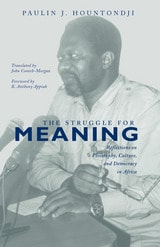
cover of The Struggle For Meaning: Reflections on Philosophy, Culture, and Democracy in Africa

The Struggle For Meaning

Reflections on Philosophy, Culture, and Democracy in Africa

Paulin J. Hountondji

Ohio University Press, 2002
The Struggle for Meaning is a landmark publication by one of African philosophy’s leading figures, Paulin J. Hountondji, best known for his critique of ethnophilosophy in the late 1960s and early 1970s. In this volume, he responds with autobiographical and philosophical reflection to the dialogue and controversy he has provoked. He discusses the ideas, rooted in the work of such thinkers as Husserl and Hountondji’s former teachers Derrida, Althusser, and Ricoeur, that helped shape his critique. Applying his philosophical ideas to the critical issues of democracy, culture, and development in Africa today, he addresses three crucial topics: the nexus between scientific extraversion and economic dependence; the nature of endogenous traditions of thought and their relationship with modern science; and the implications—for political pluralism and democracy—of the emergence of “philosophies of subject” in Africa. While the book’s immediate concern is with Africa, the densely theoretical nature of its analyses, and its bearing on current postmodern theories of the “other,” will make this timely and elegant translation of great interest to many disciplines, especially ethnic, gender, and multicultural studies.
[more]
cover of The Struggle for Liberation: A History of the Rwandan Civil War, 1990-1994

The Struggle for Liberation

A History of the Rwandan Civil War, 1990-1994

John Burton Kegel

Ohio University Press, 2025

The story of the Rwandan Genocide has been told many times by scholars and journalists. Over the course of a hundred days in the spring and summer of 1994, about eight hundred thousand Tutsi and moderate Hutu were murdered by their extremist Hutu compatriots. Those hundred days were the final phase of a four-year civil war, also known as the Struggle for Liberation, which formed the immediate context of the genocide. Though scholars have researched preparations for the genocide and the international community’s role in it, none has placed the Struggle for Liberation at the heart of the narrative. However, the preparation of the genocide, the rise and fall of the moderate opposition, the degradation of the Forces armées rwandaises (FAR) from a respected fighting force to a genocidal militia, the role of the international community, the Arusha negotiations, and the execution of the genocide all took place in the context of that war. John Burton Kegel contends that the Struggle for Liberation forms the bedrock of any genuine understanding of Rwanda between 1990 and 1994, and indeed beyond. The Struggle for Liberation, which eventually led to the genocide, was fought between the FAR and the civilians and soldiers of the Rwandan Patriotic Front (RPF) and its armed wing, the Rwandan Patriotic Army (RPA). The civil war started on October 1, 1990, when the RPF entered Rwanda from Uganda, where Rwandan refugees had lived throughout the Great Lakes region since roughly 1959. This book traces the history of those refugees—and Rwanda’s deeper Hutu-Tutsi divide—from the precolonial period up to 1990. It also provides a wholly new take on how the disciplined RPF, which rules Rwanda to this day, was born and organized.
[more]
cover of The Twelve Best Books by African Women: Critical Readings

The Twelve Best Books by African Women

Critical Readings

Chikwenye Okonjo Ogunyemi

Ohio University Press, 2009

In 2002, at the annual Zimbabwe International Book Fair, twelve literary books by African women were included for the first time in the category of “Africa’s 100 Best Books of the Twentieth Century.” This was an important but belated affirmation of women writers on the continent and a first step toward establishing a recognized canon of African women’s literature.

The Twelve Best Books by African Women is a collection of critical essays on eleven works of fiction and one play. The titles by African women that were included in the list of “Africa’s 100 Best Books of the Twentieth Century” are: Anowa, Ama Ata Aidoo (1970); A Question of Power, Bessie Head (1974); Woman at Point Zero, Nawal El Saadawi (1975); The Beggars’ Strike, Aminata Sow Fall (1979); Burger’s Daughter, Nadine Gordimer (1979); The Joys of Motherhood, Buchi Emesheta (1979); So Long a Letter, Mariama Bâ (1980); Fantasia: An Algerian Cavalcade, Assia Djebar (1983); Nervous Conditions, Tsitsi Dangarembga (1988); Living, Loving and Lying Awake at Night, Sindiwe Magona (1991); Butterfly Burning, Yvonne Vera (1998); Riwan ou le chemin de sable, Ken Bugul (1999).

This collection of original essays recognizes the gesture of inclusion as an important shift in consciousness and creates a fresh awareness of the literary works by African women writers. Each essay offers a penetrating analysis of individual texts and opens up a fresh perspective that allows scholars and students alike to explore new dimensions of these writers’ work.
[more]
cover of The Upright Farmer: Racial Capitalism and Agricultural Modernization in Burkina Faso

The Upright Farmer

Racial Capitalism and Agricultural Modernization in Burkina Faso

Jessie K. Luna

Duke University Press, 2026

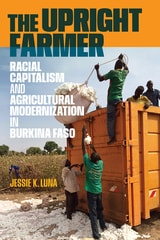
Debates over African agricultural development have been deeply polarized between those who see capitalism and modern technology as saving African farmers and those who see those forces as destroying them. The Upright Farmer reframes this debate through a flagship case of agricultural modernization: the cotton sector of Burkina Faso, where farmers have rapidly adopted pesticides and genetically modified seeds. This process has produced inequality, debt, and social and ecological harm, yet many farmers embrace these technologies. Through rich, multi-sited ethnographic data, Jessie K. Luna untangles this puzzle by arguing that the material and ideological dynamics of colonial capitalist expansion have been interwoven with racialized hierarchies. The lens of racial capitalism reveals how agricultural modernization creates and justifies structural inequalities. At the same time, people throughout this system, from farmers to extension agents to scientists, actively navigate what W. E. B. Du Bois called “the global color line,” using agricultural technologies as pathways for status and tools of resistance. Invoking Thomas Sankara’s anticolonial vision of Burkina Faso as “the land of upright people,” Luna reveals how Burkinabè strive to stand upright as modern subjects, even as they participate in a process that compounds ecological and social splintering.
[more]
cover of The Western Bahr Al Ghazal under British Rule, 1898–1956: Mis Af#57

The Western Bahr Al Ghazal under British Rule, 1898–1956

Mis Af#57

Ahmad Alawad Sikainga

Ohio University Press, 1991

Western Bahr al-Ghazal is perhaps one of the least known places in Africa. Yet this remote part of the Republic of Sudan can be regarded as a historical barometer, registering major developments in the history of the Nile valley. In the nineteenth century the region became one of the most active slave-exporting zones in Africa. The area is distinguished from the rest of southern Sudan by its veneer of Muslim influence and an Arabic pidgin. British officials regarded it as a Muslim enclave and in the twentieth century, western Bahr al-Ghazal became a laboratory in which the British colonial administration applied one of its most controversial policies in the Sudan, the so-called Southern Policy. Several decades of colonial rule failed to establish any significant links between the western Bahr al-Ghazal and the world economy. It is hoped that this book will contribute to the understanding of the general impact of colonialism on rural societies in the southern Sudan and the roots of their underdevelopment.
[more]
cover of The Western Disease: Contesting Autism in the Somali Diaspora

The Western Disease

Contesting Autism in the Somali Diaspora

Claire Laurier Decoteau

University of Chicago Press, 2021

Because autism is an increasingly common diagnosis, North Americans are familiar with its symptoms and treatments. But what we know and think about autism is shaped by our social relationship to health, disease, and the medical system. In The Western Disease Claire Laurier Decoteau explores the ways that recent immigrants from Somalia to Canada and the US make sense of their children’s diagnosis of autism. Having never heard of autism before migrating to North America, they often determine that it must be a Western disease. Given its apparent absence in Somalia, they view it as Western in nature, caused by environmental and health conditions unique to life in North America. 

Following Somali parents as they struggle to make sense of their children's illness and advocate for alternative care, Decoteau unfolds how complex interacting factors of immigration, race, and class affect Somalis’ relationship to the disease. Somalis’ engagement with autism challenges the prevailing presumption among Western doctors that their approach to healing is universal.   Decoteau argues that centering an analysis on autism within the Somali diaspora exposes how autism has been defined and institutionalized as a white, middle-class disorder, leading to health disparities based on race, class, age, and ability. The Western Disease asks us to consider the social causes of disease and the role environmental changes and structural inequalities play in health vulnerability.

[more]
cover of The Wolf at Number 4: A Novel

The Wolf at Number 4

A Novel

Ayo Tamakloe-Garr

Ohio University Press, 2018
Desire Mensah, a disgraced schoolteacher in her thirties, sees moving to sleepy little Cape Coast, Ghana, as her chance to get away from a shameful secret not buried deeply enough. And maybe, just maybe, she will find the love she craves and the husband her mother craves for her. But in Cape Coast, the past isn’t dead. It isn’t even past. That’s the kind of thing Wolfgang “Wolf” Ofori would say. Everyone says the eleven-year-old is a genius—eccentric though he is—and is bound to win Wonderkids, a quiz competition ordinarily for high school students. Wolf and Desire form a strange friendship, even as their mutual understanding both precipitates and reinforces the downfall of each. Before long, their struggles to exist in a world that dehumanizes and then throws the first stone whip up a perfect storm, with deadly consequences. Debut novelist Ayo Tamakloe-Garr drew inspiration from works such as A Streetcar Named Desire and Frankenstein to create The Wolf at Number 4, a story set in 1990s Ghana. The result is a chilling and funny gothic tale that will disarm readers even as it forces them to confront whether the wolves around us are born or made.
[more]
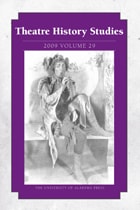
cover of Theatre History Studies 2009, Vol. 29

Theatre History Studies 2009, Vol. 29

Edited by Rhona Justice-Malloy, with contributions from Christin Essin, Carolyn D. Roark, Meredith Lowe, Valleri J. Hohman, Fonzie D. Geary II, Robert B. Shimko, Robert B. Theatre History Studies, Elizabeth Osborne, Paul Cornwell, Harry J. Elam Jr., etc.

University of Alabama Press, 2009

Reimagining the archive, one performance at a time.

Theatre History Studies is a peer-reviewed journal dedicated to excellence in theatre historiography. Volume 29, edited by Rhona Justice-Malloy, includes essays that span a wide range of historical periods, geographic regions, and thematic concerns. Highlights include explorations of pain and torment in performance, the aesthetics of American modernity through Belasco and Jones, and the cultural politics of prohibition on stage. The volume also features visual and archival studies, including an interview with playwright Wendy Wasserstein and analyses of Shakespeare’s reception in Restoration theatre. With contributions from over thirty scholars, this edition offers a rich and multifaceted view of how theatre reflects, resists, and reshapes historical narratives.


[more]
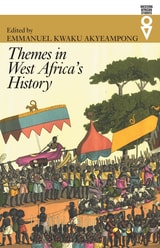
cover of Themes in West Africa’s History

Themes in West Africa’s History

Emmanuel Kwaku Akyeampong

Ohio University Press, 2006

There has long been a need for a new textbook on West Africa’s history. In Themes in West Africa’s History, editor Emmanuel Kwaku Akyeampong and his contributors meet this need, examining key themes in West Africa’s prehistory to the present through the lenses of their different disciplines.

The contents of the book comprise an introduction and thirteen chapters divided into three parts. Each chapter provides an overview of existing literature on major topics, as well as a short list of recommended reading, and breaks new ground through the incorporation of original research. The first part of the book examines paths to a West African past, including perspectives from archaeology, ecology and culture, linguistics, and oral traditions. Part two probes environment, society, and agency and historical change through essays on the slave trade, social inequality, religious interaction, poverty, disease, and urbanization. Part three sheds light on contemporary West Africa in exploring how economic and political developments have shaped religious expression and identity in significant ways.

Themes in West Africa’s History represents a range of intellectual views and interpretations from leading scholars on West Africa’s history. It will appeal to college undergraduates, graduate students, and scholars in the way it draws on different disciplines and expertise to bring together key themes in West Africa’s history, from prehistory to the present.
[more]
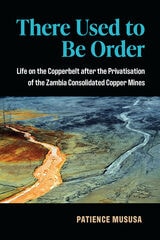
cover of There Used to Be Order: Life on the Copperbelt after the Privatisation of the Zambia Consolidated Copper Mines

There Used to Be Order

Life on the Copperbelt after the Privatisation of the Zambia Consolidated Copper Mines

Patience Mususa

University of Michigan Press, 2021
In There Used to Be Order, Patience Mususa considers social change in the Copperbelt region of Zambia following the re-privatization of the large state mining conglomerate, the Zambia Consolidated Copper Mines (ZCCM), in the mid-1990s. As the copper mines were Zambia’s most important economic asset, the sale of ZCCM was considered a major loss to the country. More crucially, privatization marked the end of a way of life for mine employees and mining communities. Based on three years of ethnographic field research, this book examines life for those living in difficult economic circumstances, and considers the tension between the life they live and the nature of an “extractive area.” This account, unusual in its examination of middle-income decline in Africa, directs us to think of the Copperbelt not only as an extractive locale for copper whose activities are affected by the market, but also as a place where the residents’ engagement with the harsh reality of losing jobs and struggling to earn a living after the withdrawal of welfare is simultaneously changing both the material and social character of the place. Drawing on phenomenological approaches, the book develops a theoretical model of “trying,” which accounts for both Copperbelt residents’ aspirations and efforts.
[more]
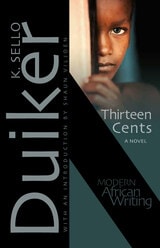
cover of Thirteen Cents: A Novel

Thirteen Cents

A Novel

K. Sello Duiker

Ohio University Press, 2013

Every city has an unspoken side. Cape Town, between the picture postcard mountain and sea, has its own shadow: a place of dislocation and uncertainty, dependence and desperation, destruction and survival, gangsters, pimps, pedophiles, hunger, hope, and moments of happiness. Living in this shadow is Azure, a thirteen-year-old who makes his living on the streets, a black teenager sought out by white men, beholden to gang leaders but determined to create some measure of independence in this dangerous world. Thirteen Cents is an extraordinary and unsparing account of a coming of age in Cape Town. Reminiscent of some of the greatest child narrators in literature, Azure’s voice will stay with the reader long after this short novel is finished. Based on personal experiences, Thirteen Cents is Duiker’s debut novel, originally published in 2000. This first edition to be published outside South Africa includes an introduction by Shaun Viljoen and a special glossary of South African words and phrases from the text translated into English.
[more]
cover of Thomas Sankara: An African Revolutionary

Thomas Sankara

An African Revolutionary

Ernest Harsch

Ohio University Press, 2014

Thomas Sankara, often called the African Che Guevara, was president of Burkina Faso, one of the poorest countries in Africa, until his assassination during the military coup that brought down his government. Although his tenure in office was relatively short, Sankara left an indelible mark on his country’s history and development. An avowed Marxist, he outspokenly asserted his country’s independence from France and other Western powers while at the same time seeking to build a genuine pan-African unity. Ernest Harsch traces Sankara’s life from his student days to his recruitment into the military, early political awakening, and increasing dismay with his country’s extreme poverty and political corruption. As he rose to higher leadership positions, he used those offices to mobilize people for change and to counter the influence of the old, corrupt elites. Sankara and his colleagues initiated economic and social policies that shifted away from dependence on foreign aid and toward a greater use of the country’s own resources to build schools, health clinics, and public works. Although Sankara’s sweeping vision and practical reforms won him admirers both in Burkina Faso and across Africa, a combination of domestic opposition groups and factions within his own government and the army finally led to his assassination in 1987. This is the first English-language book to tell the story of Sankara’s life and struggles, drawing on the author’s extensive firsthand research and reporting on Burkina Faso, including interviews with the late leader. Decades after his death, Sankara remains an inspiration to young people throughout Africa for his integrity, idealism, and dedication to independence and self-determination.
[more]
cover of Transforming Vòdún: Musical Change and Postcolonial Healing in Benin's Jazz and Brass Band Music

Transforming Vòdún

Musical Change and Postcolonial Healing in Benin's Jazz and Brass Band Music

Sarah Politz

University of Michigan Press, 2023
Transforming Vòdún examines how musicians from the West African Republic of Benin transform Benin’s cultural traditions, especially the ancestral spiritual practice of vòdún and its musical repertoires, as part of the process of healing postcolonial trauma through music and ritual. Based on fieldwork in Benin, France, and New York City, Sarah Politz uses historical ethnography, music analysis, and participant observation to examine three case studies of brass band and jazz musicians from Benin. The multi-sited nature of this study highlights the importance of mobility, and diasporic connections in musicians’ professional lives, while grounding these connections in the particularities of the African continent, its histories, its people, and its present.  
[more]
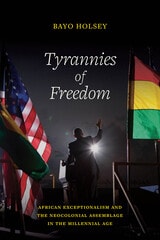
cover of Tyrannies of Freedom: African Exceptionalism and the Neocolonial Assemblage in the Millennial Age

Tyrannies of Freedom

African Exceptionalism and the Neocolonial Assemblage in the Millennial Age

Bayo Holsey

University of Chicago Press, 0

Examines the enduring myth of Ghanaian exceptionalism and neoliberal freedom.

What is the legacy of the African Revolution today? Black Studies scholar and anthropologist Bayo Holsey addresses this question by examining the twenty-first-century relationship between the United States and Ghana, a nation that was once associated with a powerful vision of Black freedom. In Tyrannies of Freedom, she demonstrates that the period that saw the expansion of the US counterterror state also witnessed attempts to discredit this vision of freedom and replace it with another—one that centers the agency of US politicians, media pundits, and development experts.

Analyzing international development discourses, the anti-trafficking regime’s representational economy, and the expansion of Ghana’s branding as a homeland of the African diaspora, Holsey interrogates the operation of a millennial neocolonial assemblage that asserts, in various ways, that the United States is the guarantor of Ghanaian freedom while simultaneously implementing policies of surveillance, endangerment, and exploitation. At the same time, Holsey shows how Ghanaians and other Black subjects have contested these projects. Tracking the transformation of the Ghanaian nation from a beacon of Black freedom and Pan-African possibility to a battleground over the meanings of African sovereignty in a post-9/11 world, this important book addresses pressing questions concerning the operation of US power in Africa and the production and legitimation of a racialized global hierarchy.

[more]