Results by title
321 books match the query 'Mexican Americans' and 55 start with t
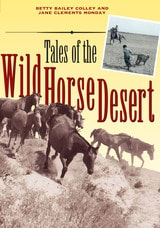
Tales of the Wild Horse Desert
By Betty Bailey Colley and Jane Clements Monday
University of Texas Press, 2001
Highly skilled, hard-working, and loyal to each other and to the ranches that employ them, the Mexican and Mexican American vaqueros who work on the famous King and Kenedy Ranches of South Texas' Wild Horse Desert are some of America's best cowboys. Many of them come from families who have lived and worked on the ranches for over a hundred years. They preserve the memories of ranch life handed down by their grandparents and great-grandparents, even as they use modern technologies to keep the ranches running smoothly in the twenty-first century.
This book tells the stories of the vaqueros of the Wild Horse Desert for fourth- through eighth-grade students. It begins with a brief history of the vaqueros and the King and Kenedy Ranches. Then, using in the words of today's vaqueros and their families, it describes many aspects of past and present life on the ranches. Young readers will learn what it's like to grow up on the ranches and how vaqueros learn their work. They'll also discover how much goes into being a vaquero, from using all the different ropes and equipment, to working a round-up, to showing prize-winning cattle and horses. Teachers and parents will appreciate all the supplemental material in the appendix, including a glossary, lists of related books and websites, hands-on learning activities, and even range and camp house recipes.
Tejano Journey, 1770-1850
Edited by Gerald E. Poyo
University of Texas Press, 1996
A century before the arrival of Stephen F. Austin's colonists, Spanish settlers from Mexico were putting down roots in Texas. From San Antonio de Bexar and La Bahia (Goliad) northeastward to Los Adaes and later Nacogdoches, they formed communities that evolved their own distinct "Tejano" identity.
In Tejano Journey, 1770-1850, Gerald Poyo and other noted borderlands historians track the changes and continuities within Tejano communities during the years in which Texas passed from Spain to Mexico to the Republic of Texas and finally to the United States. The authors show how a complex process of accommodation and resistance—marked at different periods by Tejano insurrections, efforts to work within the political and legal systems, and isolation from the mainstream—characterized these years of changing sovereignty.
While interest in Spanish and Mexican borderlands history has grown tremendously in recent years, the story has never been fully told from the Tejano perspective. This book complements and continues the history begun in Tejano Origins in Eighteenth-Century San Antonio, which Gerald E. Poyo edited with Gilberto M. Hinojosa.
Tejano Religion and Ethnicity
San Antonio, 1821-1860By Timothy M. Matovina
University of Texas Press, 1995
While the flags of Spain, Mexico, the Republic of Texas, and the United States successively flew over San Antonio, its Tejano community (Texans of Spanish or Mexican descent) formed a distinct ethnic identity that persisted despite rapid social and cultural changes. In this pioneering study, Timothy Matovina explores the central role of Tejano Catholicism in forging this unique identity and in binding the community together.
The first book-length treatment of the historical role of religion in a Mexican-origin community in the United States, this study covers three distinct periods in the emergence of Tejano religious and ethnic identity: the Mexican period (1821-1836), the Texas Republic (1836-1845), and the first decade and a half after annexation into the United States (1845-1860). Matovina's research demonstrates how theories of unilateral assimilation are inadequate for understanding the Tejano community, especially in comparison with the experiences of European immigrants to the United States.
As residents of the southwestern United States continue to sort out the legacy of U.S. territorial expansion in the nineteenth century, studies like this one offer crucial understanding of the survival and resilience of Latino cultures in the United States. Tejano Religion and Ethnicity will be of interest to a broad popular and scholarly audience.
Tejano South Texas
A Mexican American Cultural ProvinceBy Daniel D. Arreola
University of Texas Press, 2002
Winner, John Brinckerhoff Jackson Prize, Association of American Geographers
On the plains between the San Antonio River and the Rio Grande lies the heartland of what is perhaps the largest ethnic region in the United States, Tejano South Texas. In this cultural geography, Daniel Arreola charts the many ways in which Texans of Mexican ancestry have established a cultural province in this Texas-Mexico borderland that is unlike any other Mexican American region.
Arreola begins by delineating South Texas as an environmental and cultural region. He then explores who the Tejanos are, where in Mexico they originated, and how and where they settled historically in South Texas. Moving into the present, he examines many factors that make Tejano South Texas distinctive from other Mexican American regions—the physical spaces of ranchos, plazas, barrios, and colonias; the cultural life of the small towns and the cities of San Antonio and Laredo; and the foods, public celebrations, and political attitudes that characterize the region. Arreola's findings thus offer a new appreciation for the great cultural diversity that exists within the Mexican American borderlands.
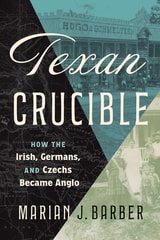
Texan Crucible
How the Irish, Germans, and Czechs Became AngloMarian J. Barber
University of Texas Press, 2026
A history of European immigrants in Texas and how they redefined racial identity.
While the creation of a Black-White racial binary was foundational to most of the United States, nineteenth-century Texas developed a unique tripartite system that acknowledged the role of individuals of Mexican ancestry in a region that was Spanish, Mexican, and an independent nation before becoming a US (and briefly Confederate) state. Yet this framework was fraught, struggling to accommodate new arrivals from beyond North America, in particular the Irish, Germans, and Czechs. Texan Crucible tells the story of these immigrants and how they became Anglo.
Marian Barber reveals the ways language, religion, alcohol use, and attitudes toward slavery distinguished these newcomers to Texas from those arriving from the eastern United States and how they nevertheless created thriving, influential communities. Their status was shaped by events inside and far beyond Texas, including an 1887 prohibition fight, the Civil War, and two world wars that encouraged them to erase their distinctiveness. As segregation was formally outlawed and civil rights activism grew, understandings of race shifted, cementing these groups’ status as Anglo. Texan Crucible recovers the histories of German, Irish, and Czech immigrants and unveils the social construction of racial difference underpinning Texan identity.
Texas Mexican Americans and Postwar Civil Rights
By Maggie Rivas-Rodriguez
University of Texas Press, 2015
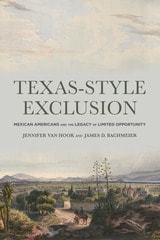
Texas-Style Exclusion
Mexican Americans and the Legacy of Limited OpportunityJennifer Van Hook
Russell Sage Foundation, 2024
Drawing on census and archival data on the quality of public schooling, Van Hook and Bachmeier find that Industrial Era European immigrants, who were primarily located in the northeastern U.S., benefited from programs and policies championed by the Americanization and Progressive movements. The Americanization movement sought to help acclimate new arrivals and transform “foreigners” into “Americans” by providing night school programs to promote civic integration and basic education, as well as other services. The Progressive movement, which aimed to improve education, work, and health conditions, sought to expand investment in public schools and make primary and secondary schooling mandatory, which kept working class children in school as opposed to entering the workforce. This access to education allowed for integration and astonishing intergenerational mobility.
Mexican immigrants in the 1920s and 1930s, the majority of whom resided in Texas, had radically different experiences from their European counterparts. Mexicans in Texas were subjected to racism, segregation, labor exploitation, and intentional school failures. This resulted in tremendous generational disadvantage that persists to the current day. Mexicans from this cohort who left Texas for states with strong Americanization and Progressive movements saw improved educational outcomes and integration. Additionally, Mexicans who immigrated after the Civil Rights Movement saw significantly greater inter-generational mobility and educational attainment than earlier cohorts due to the protections provided by civil rights laws. Van Hook and Bachmeier conclude that whether one is optimistic or pessimistic about the integration of Mexican Americans depends on when and where one looks.
Texas-Style Exclusion is an engaging examination of policies and practices that have been glossed over and forgotten that promoted mobility and integration for certain immigrant groups and impeded them for others.
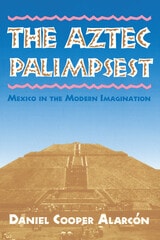
The Aztec Palimpsest
Mexico in the Modern ImaginationDaniel Cooper Alarcón
University of Arizona Press, 1997
He shows how the Chicano myth of Aztlan was constructed upon earlier Mesoamerican myths, discusses representations of Mexico in texts by nineteenth- and twentieth-century writers, and analyzes the content of tourist literature, thereby revealing the economic, social, and political interests that drive the production of Mexicanness today. This original linking of seemingly incongruous discourses corrects the misconception that Mexicanness is produced only by hegemonic groups. Cooper shows how Mexico has been defined and represented, by both Mexicans and non-Mexicans, as more than a political or geographic entity, and he particularly reveals how Mexicanness has been exploited by Mexicans themselves through the promotion of tourism as a form of neocolonialism.
Cooper's work is valuable both for identifying attempts to revise and control Mexican myth, history, and culture and for defining the intricate relationship between history, historiography, and cultural nationalism. The Aztec Palimpsest extends existing analyses of Mexicanness into new theoretical realms and provides a fresh perspective on the relationship between the United States and Mexico at a time when these two nations are becoming more intimately linked.
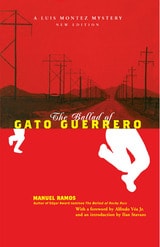
The Ballad of Gato Guerrero
Manuel Ramos
Northwestern University Press, 2003
The answer: his friend, Felix "Gato" Guerrero.
Trouble has always followed the larger-than-life Felix the Cat. Now it has jumped all over him. His girlfriend is the wife of a ruthless local crime lord and in spite of bullets and hit men he won't give her up. His former father-in-law blames him for a family tragedy and is bent on revenge. Worst of all, Felix is determined to remain unaware of the dangers. It's up to Montez-and not for the first time-to step in and save him.
As in his Edgar-nominated The Ballad of Rocky Ruiz, Manuel Ramos immerses readers not only in a thrilling mystery but also in the fascinating Chicano culture of the West. Fast-paced and richly textured, The Ballad of Gato Guerrero is an entertaining addition to the acclaimed Luis Montez mystery series.
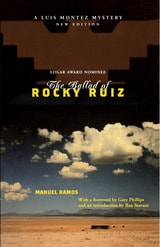
The Ballad of Rocky Ruiz
Manuel Ramos
Northwestern University Press, 2003
Twenty years ago, a gang attacked four Chicano student activists and shot down their leader, Rocky Ruiz. Now the survivors, Montez's former compatriots in the movement, are in danger. One is killed, another beaten, and a third driven into hiding. Enter Teresa Fuentes, a beautiful young lawyer determined to solve the mystery and just as determined to avoid becoming involved with Montez. To save his friends, Montez must reexamine the central event of their shared past-the murder of Rocky Ruiz. Just as difficult, he finds, may be to untangle his feelings for Teresa Fuentes.
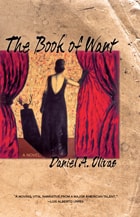
The Book of Want
A NovelDaniel A. Olivas
University of Arizona Press, 2011
Conchita, a voluptuous, headstrong single woman of a certain age, sees nothing wrong with enjoying the company of handsome—and usually much younger—men...that is, until she encounters a widower with unusual gifts and begins to think about what she really wants out of life.
Julieta, Conchita’s younger sister, walks a more traditional path, but she and her husband each harbor secrets that could change their marriage and their lives forever. Their twin sons, both in college, struggle to find fulfillment. Mateo refuses to let anyone stand in the way of his happiness, while Rolando grapples with his sexuality and the family’s expectations. And from time to time, Belén, the family’s late matriarch, pays a visit to advise, scold, or cajole her hapless descendants.
A delightful family tapestry woven with the threads of all those whose lives are touched by Conchita, The Book of Want is an enchanting blend of social and magical realism that tells a charming story about what it means to be fully human.
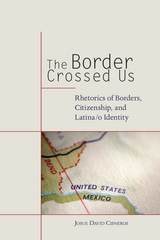
The Border Crossed Us
Rhetorics of Borders, Citizenship, and Latina/o IdentityJosue David Cisneros
University of Alabama Press, 2013
Explores efforts to restrict and expand notions of US citizenship as they relate specifically to the US-Mexico border and Latina/o identity.
Borders and citizenship go hand in hand. Borders define a nation as a territorial entity and create the parameters for national belonging. But the relationship between borders and citizenship breeds perpetual anxiety over the purported sanctity of the border, the security of a nation, and the integrity of civic identity.
In The Border Crossed Us, Josue David Cisneros addresses these themes as they relate to the US-Mexico border, arguing that issues ranging from the Mexican-American War of 1846–1848 to contemporary debates about Latina/o immigration and border security are negotiated rhetorically through public discourse. He explores these rhetorical battles through case studies of specific Latina/o struggles for civil rights and citizenship, including debates about Mexican American citizenship in the 1849 California Constitutional Convention, 1960s Chicana/o civil rights movements, and modern-day immigrant activism.
Cisneros posits that borders—both geographic and civic—have crossed and recrossed Latina/o communities throughout history (the book’s title derives from the popular activist chant, “We didn’t cross the border; the border crossed us!”) and that Latina/os in the United States have long contributed to, struggled with, and sought to cross or challenge the borders of belonging, including race, culture, language, and gender.
The Border Crossed Us illuminates the enduring significance and evolution of US borders and citizenship, and provides programmatic and theoretical suggestions for the continued study of these critical issues.
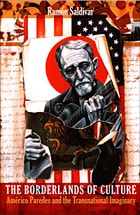
The Borderlands of Culture
Americo Paredes and the Transnational ImaginaryRamón Saldívar
Duke University Press, 2006
Saldívar demonstrates how Paredes’s poetry, prose, and journalism prefigured his later work as a folklorist and ethnographer. In song, story, and poetry, Paredes first developed the themes and issues that would be central to his celebrated later work on the “border studies” or “anthropology of the borderlands.” Saldívar describes how Paredes’s experiences as an American soldier, journalist, and humanitarian aid worker in Asia shaped his understanding of the relations between Anglos and Mexicans in the borderlands of south Texas and of national and ethnic identities more broadly. Saldívar was a friend of Paredes, and part of The Borderlands of Culture is told in Paredes’s own words. By explaining how Paredes’s work engaged with issues central to contemporary scholarship, Saldívar extends Paredes’s intellectual project and shows how it contributes to the remapping of the field of American studies from a transnational perspective.
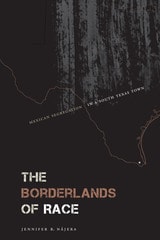
The Borderlands of Race
Mexican Segregation in a South Texas TownBy Jennifer R. Nájera
University of Texas Press, 2015
Throughout much of the twentieth century, Mexican Americans experienced segregation in many areas of public life, but the structure of Mexican segregation differed from the strict racial divides of the Jim Crow South. Factors such as higher socioeconomic status, lighter skin color, and Anglo cultural fluency allowed some Mexican Americans to gain limited access to the Anglo power structure. Paradoxically, however, this partial assimilation made full desegregation more difficult for the rest of the Mexican American community, which continued to experience informal segregation long after federal and state laws officially ended the practice.
In this historical ethnography, Jennifer R. Nájera offers a layered rendering and analysis of Mexican segregation in a South Texas community in the first half of the twentieth century. Using oral histories and local archives, she brings to life Mexican origin peoples’ experiences with segregation. Through their stories and supporting documentary evidence, Nájera shows how the ambiguous racial status of Mexican origin people allowed some of them to be exceptions to the rule of Anglo racial dominance. She demonstrates that while such exceptionality might suggest the permeability of the color line, in fact the selective and limited incorporation of Mexicans into Anglo society actually reinforced segregation by creating an illusion that the community had been integrated and no further changes were needed. Nájera also reveals how the actions of everyday people ultimately challenged racial/racist ideologies and created meaningful spaces for Mexicans in spheres historically dominated by Anglos.
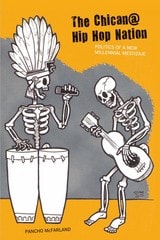
The Chican@ Hip Hop Nation
Politics of a New Millennial MestizajePancho McFarland
Michigan State University Press, 2013
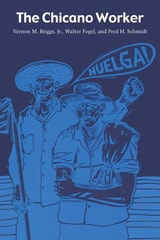
The Chicano Worker
By Vernon M. Briggs, Jr., Walter Fogel, and Fred H. Schmidt
University of Texas Press, 1977
The Chicano Worker is an incisive analysis of the labor-market experiences of Mexican American workers in the late twentieth century. The authors—each established in the fields of labor economics and research on Chicano workers—describe the major employment patterns of the Chicano labor force and discuss the historical and institutional factors determining these patterns. This work speaks to the continuing widespread public interest in Mexican immigration, migrant farm labor, unionization of farm workers, Chicano education and training needs, and the legacy of discriminatory treatment against Chicanos. The authors treat the convergence of these issues and their public policy implications.
Drawing from census data as well as other sources, The Chicano Worker reports on Chicano unemployment, labor-force participation, occupational and industrial distributions of employment, and various indices of earnings. It also deals with such issues as history, family size, health, and culture. The Chicano Worker is likely to open new areas of interest, discussion, and criticism concerning Chicanos in the United States.
The Chicanos
As We See OurselvesEdited by Arnulfo D. Trejo
University of Arizona Press, 1979
“We have come a long way,” says Arnulfo D. Trejo, editor of this volume, “from the time when the Mexicano silently accepted the stereotype drawn of him by the outsider.” He identifies himself as a Chicano, and his “promised land” is Aztlán, home of the ancient Aztecs, which now provides spiritual unity and a vision of the future for Chicanos.
In these twelve original compositions, says Trejo, “our purpose is not to talk to ourselves, but to open a dialogue among all concerned people.” The personal reactions to Chicano women’s struggles, political experiences, bicultural education and history provide a wealth of information for laymen as well as scholars. In addition, the book provides the most complete recorded definition of the Chicano Movement, what it has accomplished, and its goals for the future.
Contributors:
Fausto Avendaño
Roberto R. Bacalski-Martínez
David Ballesteros
José Antonio Burciaga
Rudolph O. de la Garza
Ester Gallegos y Chávez
Sylvia Alicia Gonzales
Manuel H. Guerra
Guillermo Lux
Martha A. Ramos
Reyes Ramos
Carlos G. Vélez-Ibáñez
Maurilio E. Vigil
The Concrete River
PoemsLuis J. Rodríguez
Northwestern University Press, 1995
The Concrete River is a collection of poems by poet laureate of Los Angeles Luis Rodríguez. They illuminate the gritty idiosyncrasies of immigrant life in urban barrios spanning Los Angeles to Chicago to Harlem. Rodríguez lends powerful voices to those struggling to keep the gas on, to find work, and to keep love. Populated by a vibrant cast of characters, ranging from the drugged, to the eccentric, to the heartbroken, Rodríguez’s poems protest capitalism, violence, and exploitation while reveling in the potential of compassion.
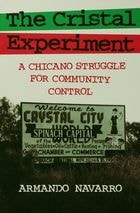
The Cristal Experiment
A Chicano Struggle for Community ControlArmando Navarro
University of Wisconsin Press, 1998
Amidst the turbulence and militancy of the 1960s and early 1970s, the Mexicano population of the dusty agricultural town of Crystal City, Texas (Cristal in Spanish), staged two electoral revolts, each time winning control of the city council and school board. The landmark city council victory in 1963 was a first for Mexican Americans in South Texas, and Cristal—the “spinach capital of the world”—became for a time the political capital of the Chicano Movement.
In The Cristal Experiment, Armando Navarro presents the most comprehensive examination to date of the rise of the Chicano political movement in Cristal, its successes and conflicts (both internal and external), and its eventual decline. He looks particularly at the larger and more successful “Second Revolt” in 1970 and its aftermath up to 1981, examining the political, economic, educational, and social changes for Mexicanos that resulted. Drawing upon nearly 100 interviews, a wealth of secondary materials, and his own experiences as a political organizer in the Chicano Movement, Navarro offers a shrewd and insightful analysis not only of the events in Cristal, but also of the workings of local politics generally, the politics of community control, and the factors inherent in the American political system that lead to the self-destruction of political movements. As both a political scientist and an organizer, he outlines important lessons to be learned from what happened in Cristal and to the Chicano Movement.
The Crusade for Justice
Chicano Militancy and the Government's War on DissentErnesto B. Vigil
University of Wisconsin Press, 1999
This definitive account of the Chicano movement in 1960s Denver reveals the intolerance and brutality that inspired and accompanied the urban Chicano organization known as the Crusade for Justice. Ernesto Vigil, an expert in the discourse of radical movements of this time, joined the Crusade as a young draft resistor where he met Rodolfo “Corky” Gonzales, the founder of the CFJ. Vigil follows the movement chronologically from Gonzales’s early attempts to fight discrimination as a participant in local democratic politics to his radical stance as an organizer outside mainstream politics.
Drawing extensively upon FBI documentation that became available under the Freedom of Information Act, Vigil exposes massive surveillance of the Crusade for Justice by federal agents and local police and the damaging effects of such methods on ethnic liberation movements. Vigil complements these documents and the story of Gonzales’s development as a radical with the story of his personal involvement in the movement. The Crusade for Justice describes one of the most important Chicano organizations against prejudice.

The Faith Healer of Olive Avenue
StoriesManuel Muñoz and Cherríe Moraga
Northwestern University Press, 2025
From the divergent paths of triplet brothers to a grieving father confronting his mistreatment of his son, these stories interweave a recurring cast of neighborhood characters, many of them in search of escape or release. Lauded for its empathetic portrayals of communities often ignored, The Faith Healer of Olive Avenue won a Whiting Award and an O. Henry Award; it was shortlisted for the Frank O’Connor International Short Story Award as one of the best collections published in English worldwide. A new foreword by author and activist Cherríe Moraga gives testament to Muñoz’s status as “the cartographer of a people.”
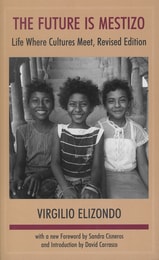
The Future is Mestizo
Life Where Culture Meet, Revised EditionVirgilio Elizondo
University Press of Colorado, 2000
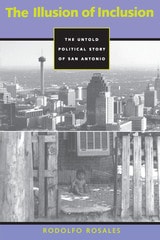
The Illusion of Inclusion
The Untold Political Story of San AntonioBy Rodolfo Rosales
University of Texas Press, 2000
To many observers, the 1981 election of Henry Cisneros as mayor of San Antonio, Texas, represented the culminating victory in the Chicano community's decades-long struggle for inclusion in the city's political life. Yet, nearly twenty years later, inclusion is still largely an illusion for many working-class and poor Chicanas and Chicanos, since business interests continue to set the city's political and economic priorities.
In this book, Rodolfo Rosales offers the first in-depth history of the Chicano community's struggle for inclusion in the political life of San Antonio during the years 1951 to 1991, drawn from interviews with key participants as well as archival research. He focuses on the political and organizational activities of the Chicano middle class in the context of post-World War II municipal reform and how it led ultimately to independent political representation for the Chicano community. Of special interest is his extended discussion of the role of Chicana middle-class women as they gained greater political visibility in the 1980s.
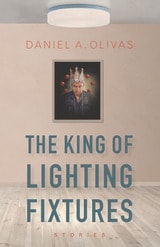
The King of Lighting Fixtures
StoriesDaniel A. Olivas
University of Arizona Press, 2017
The characters here represent all walks of L.A. life—from Satan’s reluctant Craigslist roommate to a young girl coping with trauma at her brother’s wake—and their tales ebb and flow among various styles, including magical realism, social realism, and speculative fiction. Like a jazz album, they glide and bop, tease and illuminate, sadden and hearten as they navigate effortlessly from meta to fabulist, from flash fiction to longer, more complex narratives.
These are literary sketches of a Los Angeles that will surprise, connect, and disrupt readers wherever they may live.
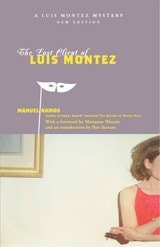
The Last Client of Luis Montez
Manuel Ramos
Northwestern University Press, 2004
What a difference a day makes. Inside of twenty-four hours, a cop rumored to have received bribes from Montez takes a header off a mountain, Jimmy Esch is found butchered, and the cops consider the attorney their top suspect. Lisa—Montez's alibi—has conveniently disappeared. As if all that wasn't enough, Montez must also cope with the news his father is in the hospital.
Distracted by family strife and a media circus, Montez broods on the latest wrong turns in his life. Then he decides to act. Jumping bail, he heads across the Rockies to the barrios of San Diego. It's not easy to unravel the perfect set-up when you're down to your last cent. But Montez pursues the truths that will clear his name, and ultimately confronts the powerful force that is Family.
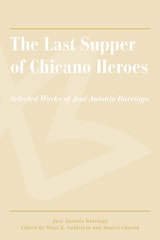
The Last Supper of Chicano Heroes
Selected Works of José Antonio BurciagaJosé Antonio Burciaga; Edited by Mimi R. Goldstein and Daniel Chacón
University of Arizona Press, 2008
Best known for his books Weedee Peepo, Drink Cultura, and Undocumented Love, Burciaga was also a poet, cartoonist, founding member of the comedy troupe Cultura Clash, and a talented muralist whose well-known work The Last Supper of Chicano Heroes became almost more famous than the man. This first and only collection of Burciaga’s work features thirty-eight illustrations and incorporates previously unpublished essays and drawings, including selections from his manuscript “The Temple Gang,” a memoir he was writing at the time of his death. In addition, Gladstein and Chacón address Burciaga’s importance to Chicano letters.
A joy to read, this rich compendium is an important contribution not only to Chicano literature but also to the preservation of the creative, spiritual, and political voice of a talented and passionate man.
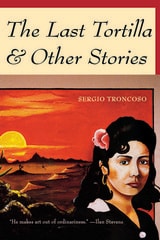
The Last Tortilla
and Other StoriesSergio Troncoso
University of Arizona Press, 1999
Writing in a straightforward, light-handed style reminiscent of Grace Paley and Raymond Carver, he spins charming tales that reflect his experiences in two worlds. Troncoso's El Paso is a normal town where common people who happen to be Mexican eat, sleep, fall in love, and undergo epiphanies just like everyone else. His tales are coming-of-age stories from the Mexican-American border, stories of the working class, stories of those coping with the trials of growing old in a rapidly changing society. He also explores New York with vignettes of life in the big city, capturing its loneliness and danger.
Beginning with Troncoso's widely acclaimed story "Angie Luna," the tale of a feverish love affair in which a young man rediscovers his Mexican heritage and learns how much love can hurt, these stories delve into the many dimensions of the human condition. We watch boys playing a game that begins innocently but takes a dangerous turn. We see an old Anglo woman befriending her Mexican gardener because both are lonely. We witness a man terrorized in his New York apartment, taking solace in memories of lost love. Two new stories will be welcomed by Troncoso's readers. "My Life in the City" relates a transplanted Texan's yearning for companionship in New York, while "The Last Tortilla" returns to the Southwest to explore family strains after a mother's death—and the secret behind that death. Each reflects an insight about the human heart that has already established the author's work in literary circles.
Troncoso sets aside the polemics about social discomfort sometimes found in contemporary Chicano writing and focuses instead on the moral and intellectual lives of his characters. The twelve stories gathered here form a richly textured tapestry that adds to our understanding of what it is to be human.
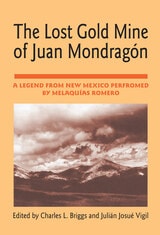
The Lost Gold Mine of Juan Mondragón
A Legend from New Mexico performed by Melaquías RomeroEdited by Charles L. Briggs and Julián Josué Vigil
University of Arizona Press, 1990
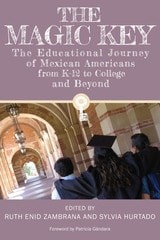
The Magic Key
The Educational Journey of Mexican Americans from K-12 to College and BeyondEdited by Ruth Enid Zambrana and Sylvia Hurtado
University of Texas Press, 2015
Mexican Americans comprise the largest subgroup of Latina/os, and their path to education can be a difficult one. Yet just as this group is often marginalized, so are their stories, and relatively few studies have chronicled the educational trajectory of Mexican American men and women. In this interdisciplinary collection, editors Zambrana and Hurtado have brought together research studies that reveal new ways to understand how and why members of this subgroup have succeeded and how the facilitators of success in higher education have changed or remained the same.
The Magic Key’s four sections explain the context of Mexican American higher education issues, provide conceptual understandings, explore contemporary college experiences, and offer implications for educational policy and future practices. Using historical and contemporary data as well as new conceptual apparatuses, the authors in this collection create a comparative, nuanced approach that brings Mexican Americans’ lived experiences into the dominant discourse of social science and education. This diverse set of studies presents both quantitative and qualitative data by gender to examine trends of generations of Mexican American college students, provides information on perceptions of welcoming university climates, and proffers insights on emergent issues in the field of higher education for this population. Professors and students across disciplines will find this volume indispensable for its insights on the Mexican American educational experience, both past and present.
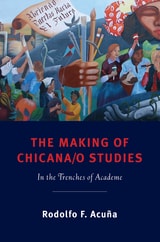
The Making of Chicana/o Studies
In the Trenches of AcademeAcuña, Rodolfo F
Rutgers University Press, 2011
The Making of Chicana/o Studies traces the philosophy and historical development of the field of Chicana/o studies from precursor movements to the Civil Rights era to today, focusing its lens on the political machinations in higher education that sought to destroy the discipline. As a renowned leader, activist, scholar, and founding member of the movement to establish this curriculum in the California State University system, which serves as a model for the rest of the country, Rodolfo F. Acuña has, for more than forty years, battled the trend in academia to deprive this group of its academic presence.
The book assesses the development of Chicana/o studies (an area of studies that has even more value today than at its inception)--myths about its epistemological foundations have remained uncontested. Acuña sets the record straight, challenging those in the academy who would fold the discipline into Latino studies, shadow it under the dubious umbrella of ethnic studies, or eliminate it altogether.
Building the largest Chicana/o studies program in the nation was no easy feat, especially in an atmosphere of academic contention. In this remarkable account, Acuña reveals how California State University, Northridge, was instrumental in developing an area of study that offers more than 166 sections per semester, taught by 26 tenured and 45 part-time instructors. He provides vignettes of successful programs across the country and offers contemporary educators and students a game plan--the mechanics for creating a successful Chicana/o studies discipline--and a comprehensive index of current Chicana/o studies programs nationwide.
Latinas/os, of which Mexican Americans are nearly seventy percent, comprise a complex sector of society projected to be just shy of thirty percent of the nation's population by 2050. The Making of Chicana/o Studies identifies what went wrong in the history of Chicana/o studies and offers tangible solutions for the future.
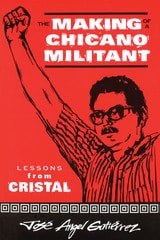
The Making of a Chicano Militant
Lessons from CristalJose Angel Gutierrez
University of Wisconsin Press, 1999
Texas, for years, was a one-party state controlled by white democrats. In 1962, a young eighteen-year-old heard the first rumblings of Chicano community organization in the barrios of Cristal. The rumor in the town was that five Mexican Americans were going to run for all five seats on the city council. But first, poor citizens had to find a way to pay the $1.75 poll tax. Money had to be raised—through bake sales of tamales, cake walks, and dances. So began the political activism of José Angel Gutiérrez.
Gutiérrez's autobiography, The Making of a Chicano Militant, is the first insider's view of the important political and social events within the Mexican American communities in South Texas during the 1960s and 1970s. A controversial and dynamic political figure during the height of the Chicano movement, Gutiérrez offers an absorbing personal account of his life at the forefront of the Mexican-American civil rights movement—first as a Chicano and then as a militant.
Gutiérrez traces the racial, ethnic, economic, and social prejudices facing Chicanos with powerful scenes from his own life: his first summer job as a tortilla maker at the age of eleven, his racially motivated kidnapping as a teenager, and his coming of age in the face of discrimination as a radical organizer in college and graduate school. When Gutiérrez finally returned to Cristal, he helped form the Mexican American Youth Organization and, subsequently the Raza Unida Party to confront issues of ethnic intolerance in his community. His story is soon to be a classic in the developing literature of Mexican American leaders.
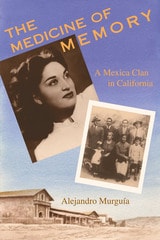
The Medicine of Memory
A Mexica Clan in CaliforniaBy Alejandro Murguía
University of Texas Press, 2002
"People who live in California deny the past," asserts Alejandro Murguía. In a state where "what matters is keeping up with the current trends, fads, or latest computer gizmo," no one has "the time, energy, or desire to reflect on what happened last week, much less what happened ten years ago, or a hundred." From this oblivion of memory, he continues, comes a false sense of history, a deluded belief that the way things are now is the way they have always been.
In this work of creative nonfiction, Murguía draws on memories—his own and his family's reaching back to the eighteenth century—to (re)construct the forgotten Chicano-indigenous history of California. He tells the story through significant moments in California history, including the birth of the mestizo in Mexico, destruction of Indian lifeways under the mission system, violence toward Mexicanos during the Gold Rush, Chicano farm life in the early twentieth century, the Chicano Movement of the 1960s, Chicano-Latino activism in San Francisco in the 1970s, and the current rebirth of Chicano-Indio culture. Rejecting the notion that history is always written by the victors, and refusing to be one of the vanquished, he declares, "This is my California history, my memories, richly subjective and atavistic."
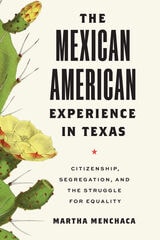
The Mexican American Experience in Texas
Citizenship, Segregation, and the Struggle for EqualityBy Martha Menchaca
University of Texas Press, 2022
A historical overview of Mexican Americans' social and economic experiences in Texas
For hundreds of years, Mexican Americans in Texas have fought against political oppression and exclusion—in courtrooms, in schools, at the ballot box, and beyond. Through a detailed exploration of this long battle for equality, this book illuminates critical moments of both struggle and triumph in the Mexican American experience.
Martha Menchaca begins with the Spanish settlement of Texas, exploring how Mexican Americans’ racial heritage limited their incorporation into society after the territory’s annexation. She then illustrates their political struggles in the nineteenth century as they tried to assert their legal rights of citizenship and retain possession of their land, and goes on to explore their fight, in the twentieth century, against educational segregation, jury exclusion, and housing covenants. It was only in 1967, she shows, that the collective pressure placed on the state government by Mexican American and African American activists led to the beginning of desegregation. Menchaca concludes with a look at the crucial roles that Mexican Americans have played in national politics, education, philanthropy, and culture, while acknowledging the important work remaining to be done in the struggle for equality.
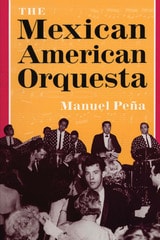
The Mexican American Orquesta
Music, Culture, and the Dialectic of ConflictBy Manuel Peña
University of Texas Press, 1999
The Mexican American orquesta is neither a Mexican nor an American music. Relying on both the Mexican orquesta and the American dance band for repertorial and stylistic cues, it forges a synthesis of the two. The ensemble emerges historically as a powerful artistic vehicle for the expression of what Manuel Peña calls the "dialectic of conflict." Grounded in ethnic and class conflict, this dialectic compels the orquesta and its upwardly mobile advocates to waver between acculturation and ethnic resistance. The musical result: a complex mesh of cultural elements—Mexican and American, working- and middle-class, traditional and contemporary.
In this book, Manuel Peña traces the evolution of the orquesta in the Southwest from its beginnings in the nineteenth century through its pinnacle in the 1970s and its decline since the 1980s. Drawing on fifteen years of field research, he embeds the development of the orquesta within a historical-materialist matrix to achieve the optimal balance between description and interpretation. Rich in ethnographic detail and boldly analytical, his book is the first in-depth study of this important but neglected field of artistic culture.
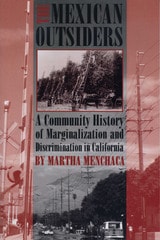
The Mexican Outsiders
A Community History of Marginalization and Discrimination in CaliforniaBy Martha Menchaca
University of Texas Press, 1995
People of Mexican descent and Anglo Americans have lived together in the U.S. Southwest for over a hundred years, yet relations between them remain strained, as shown by recent controversies over social services for undocumented aliens in California. In this study, covering the Spanish colonial period to the present day, Martha Menchaca delves deeply into interethnic relations in Santa Paula, California, to document how the residential, social, and school segregation of Mexican-origin people became institutionalized in a representative California town.
Menchaca lived in Santa Paula during the 1980s, and interviews with residents add a vivid human dimension to her book. She argues that social segregation in Santa Paula has evolved into a system of social apartness—that is, a cultural system controlled by Anglo Americans that designates the proper times and places where Mexican-origin people can socially interact with Anglos.
This first historical ethnographic case study of a Mexican-origin community will be important reading across a spectrum of disciplines, including anthropology, sociology, race and ethnicity, Latino studies, and American culture.
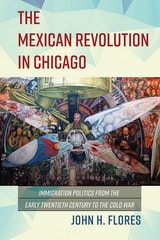
The Mexican Revolution in Chicago
Immigration Politics from the Early Twentieth Century to the Cold WarJohn H Flores
University of Illinois Press, 2018
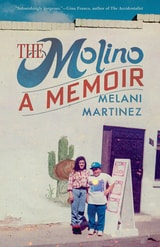
The Molino
A MemoirMelani Martinez
University of Arizona Press, 2024
Set in one of Tucson’s first tamal and tortilla factories, The Molino is a hybrid memoir that reckons with one family’s loss of home, food, and faith.
Weaving together history, culture, and Mexican food traditions, Melani Martinez shares the story of her family’s life and work in the heart of their downtown eatery, El Rapido. Opened by Martinez’s great-grandfather, Aurelio Perez, in 1933, El Rapido served tamales and burritos to residents and visitors to Tucson’s historic Barrio Presidio for nearly seventy years. For the family, the factory that bound them together was known for the giant corn grinder churning behind the scenes—the molino. With clear eyes and warm humor, Martinez documents the work required to prepare food for others, and explores the heartbreaking aftermath of gentrification that forces the multigenerational family business to close its doors.
The Molino is also Martinez’s personal story—that of a young Tucsonense coming of age in the 1980s and ’90s. As a young woman she rejects the work in her father’s popular kitchen, but when the business closes, her world shifts and the family disbands. When she finds her way back home, the tortillería’s iconic mural provides a gateway into history and ruin, ancestry and sacrifice, industrial myth and artistic incarnation—revealing a sacred presence still alive in Tucson.
A must-read for foodies, history lovers, and anyone searching for spiritual truth in the desert, this is a story of belonging and transformation in the borderlands.
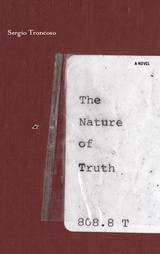
The Nature of Truth
Sergio Troncoso
Northwestern University Press, 2003
Helmut Sanchez is a young researcher in the employ of the renowned scholar Werner Hopfgartner. By chance Sanchez discovers a letter written in the 1950s by Hopfgartner mocking feelings of guilt over the Holocaust. Appalled, he digs into the scholar's life, determined to find the truth and finally uncovering the evidence of Hopfgartner's sordid past. Sure of his conclusions, Helmut decides that only one shocking act is morally correct. When he does, the consequences are immense, and the toll taken on his mind and conscience is amplified when one of his friends is wrongly accused of the crime-and is wrongly left to pay for it.
Intelligent and literate, The Nature of Truth breaks new ground in Latino literature, focusing on how a contemporary man of unique heritage--a Mexican-German who has come to America by way of Germany--navigates a complex moral universe and how his journey reflects the tension between justice and righteousness in American life.
Further information about the author can be found at his web site: <A HREF="http://sergiotroncoso.com">http://sergiotroncoso.com.</A>
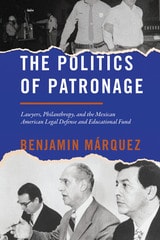
The Politics of Patronage
Lawyers, Philanthropy, and the Mexican American Legal Defense and Educational FundBy Benjamin Márquez
University of Texas Press, 2021
Co-winner, Latino Politics Best Book Award, American Political Science Association
The first book about the Mexican American Legal Defense and Educational Fund, the influential work it has done for the Latina/o community, and the issues stemming from its dependence on large philanthropic organizations.
Founded in 1968, the Mexican American Legal Defense and Educational Fund (MALDEF) is the Latino equivalent to the NAACP: a source of legal defense for the Latina/o community in cases centered on education, state immigration laws, redistricting, employment discrimination, and immigrant rights. Unlike the NAACP, however, MALDEF was founded by Mexican American activists in conjunction with the larger philanthropic structure of the Ford Foundation—a relationship that has opened it up to controversy and criticism.
In the first book to examine this little-known but highly influential organization, Benjamin Márquez explores MALDEF’s history and shows how it has thrived and served as a voice for the Latina/o community throughout its six decades of operation. But he also looks closely at large-scale investments of the Ford Foundation, Rockefeller Foundation, and others, considering how their ties to MALDEF have influenced Mexican American and Latinx politics. Its story crafted from copious research into MALDEF and its benefactors, this book brings to light the influence of outside funding on the articulation of minority identities and the problems that come with creating change through institutional means.
The Revolutionary Imaginations of Greater Mexico
Chicana/o Radicalism, Solidarity Politics, and Latin American Social MovementsBy Alan Eladio Gómez
University of Texas Press, 2016
Bringing to life the stories of political teatristas, feminists, gunrunners, labor organizers, poets, journalists, ex-prisoners, and other revolutionaries, The Revolutionary Imaginations of Greater Mexico examines the inspiration Chicanas/os found in social movements in Mexico and Latin America from 1971 to 1979. Drawing on fifteen years of interviews and archival research, including examinations of declassified government documents from Mexico, this study uncovers encounters between activists and artists across borders while sharing a socialist-oriented, anticapitalist vision. In discussions ranging from the Nuevo Teatro Popular movement across Latin America to the Revolutionary Proletariat Party of America in Mexico and the Peronista Youth organizers in Argentina, Alan Eladio Gómez brings to light the transnational nature of leftist organizing by people of Mexican descent in the United States, tracing an array of festivals, assemblies, labor strikes, clandestine organizations, and public protests linked to an international movement of solidarity against imperialism.
Taking its title from the “greater Mexico” designation used by Américo Paredes to describe the present and historical movement of Mexicans, Mexican Americans, and Chicanas/os back and forth across the US-Mexico border, this book analyzes the radical creativity and global justice that animated “Greater Mexico” leftists during a pivotal decade. While not all the participants were of one mind politically or personally, they nonetheless shared an international solidarity that was enacted in local arenas, giving voice to a political and cultural imaginary that circulated throughout a broad geographic terrain while forging multifaceted identities. The epilogue considers the politics of going beyond solidarity.
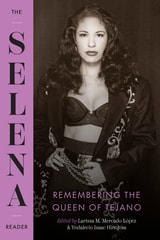
The Selena Reader
Remembering the Queen of TejanoEdited by Larissa M. Mercado-López and Yndalecio Isaac Hinojosa
University of Texas Press, 2026
A literary collection honoring and memorializing Selena, the Queen of Tejano.
Thirty years after her death, Selena Quintanilla-Pérez remains a cherished figure of Mexican American popular culture, her music and celebrity resounding across the decades. This unique collection of creative and scholarly works traces Selena’s lasting impact as an entertainer and focal point of community and identity.
Assembling essays, memoir, short stories, and poems, The Selena Reader memorializes a beloved singer while also exploring the politics and personal meaning of what we remember. Selena’s devoted admirers tell us what they took from her lyrics and stage presence, the official and fan tributes, and the media and products she inspired. In one essay, Tejana coming-of-age is sharply refracted through the prism of Selena’s art and social status. Another piece considers how Selena’s body and distinctive clothing have shaped the author’s sense of queer self. Honey Avila (aka Honey Andrews), the renowned Selena impersonator, shares vivid recollections of her hero. A father and daughter describe how their conversations about Selena changed their relationship and contributed to Chicana feminist consciousness in their lives. All told, this anthology amplifies the gratitude of generations who have loved, and learned from, Selena.
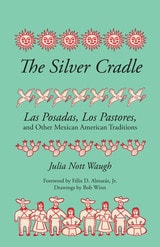
The Silver Cradle
Las Posadas, Los Pastores, and Other Mexican American TraditionsBy Julia Nott Waugh
University of Texas Press, 1955
Originally published in 1955, The Silver Cradle is the story of a year in the life of the Mexican American people of San Antonio, Texas. During the 1950s, Julia Nott Waugh recorded the performances of such seasonal and religious traditions as Las Posadas, Los Pastores, Las Calaveras, the Blessing of the Animals, the liturgical observances of Holy Week, and festivities of el diez y seis de septiembre (Mexican Independence Day), among others.
Although years have passed and many of the details of observances have changed, the festival calendar and the joy and sincerity of the Mexican American people in honoring its customs and obligations have not disappeared. Now, in fact, a much wider population shares and appreciates the pageantry preserved for us by people like Graciana Reyes, in whose prized silver cradle the Christ Child slept every year at Christmas, and like Doroteo Domínguez, whose annual devotion to presenting a thousand-year-old pastoral epic in his back yard was legendary.
Waugh has done much more than just open a window onto a charming past. She has captured for us one of the true gifts of our Mexican American heritage—the willingness to ritually celebrate the passage of time and to embellish the occasions with sensitivity and fervor. This book will appeal to the general reader as well as to those interested in folk traditions and Mexican American culture.
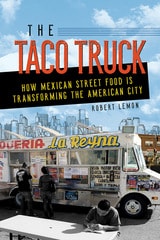
The Taco Truck
How Mexican Street Food Is Transforming the American CityRobert Lemon
University of Illinois Press, 2019
Drawing on interviews with taco truck workers and his own skills as a geographer, Robert Lemon illuminates new truths about foodways, community, and the unexpected places where ethnicity, class, and culture meet. Lemon focuses on the San Francisco Bay Area, Sacramento, and Columbus, Ohio, to show how the arrival of taco trucks challenge preconceived ideas of urban planning even as cities use them to reinvent whole neighborhoods. As Lemon charts the relationships between food practices and city spaces, he uncovers the many ways residents and politicians alike contest, celebrate, and influence not only where your favorite truck parks, but what's on the menu.
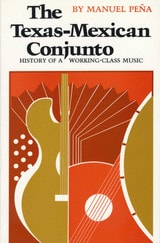
The Texas-Mexican Conjunto
History of a Working-class MusicBy Manuel H. Peña
University of Texas Press, 1985
Around 1930, a highly popular and distinctive type of accordion music, commonly known as conjunto, emerged among Texas-Mexicans. Manuel Peña's The Texas-Mexican Con;unto is the first comprehensive study of this unique folk style. The author's exhaustive fieldwork and personal interviews with performers, disc jockeys, dance promoters, recording company owners, and conjunto music lovers provide the crucial connection between an analysis of the music itself and the richness of the culture from which it sprang.
Using an approach that integrates musicological, historical, and sociological methods of analysis, Peña traces the development of the conjunto from its tentative beginnings to its preeminence as a full-blown style by the early 1960s. Biographical sketches of such major early performers as Narciso Martínez (El Huracán del Valle), Santiago Jiménez (El Flaco), Pedro Ayala, Valerio Longoria, Tony de la Rosa, and Paulino Bernal, along with detailed transcriptions of representative compositions, illustrate the various phases of conjunto evolution.
Peña also probes the vital connection between conjunto's emergence as a powerful symbolic expression and the transformation of Texas-Mexican society from a pre-industrial folk group to a community with increasingly divergent socioeconomic classes and ideologies. Of concern throughout the study is the interplay between ethnicity, class, and culture, and Peña's use of methods and theories from a variety of scholarly disciplines enables him to tell the story of conjunto in a manner both engaging and enlightening. This important study will be of interest to all students of Mexican American culture, ethnomusicology, and folklore.
The Truth about Alicia
and Other StoriesAna Consuela Matiella
University of Arizona Press, 2002
Alicia is not the only woman with problems. In these stories about contemporary and traditional Latinas, Ana Consuelo Matiella uses sensitivity and wit to address issues faced by women of color and women everywhere—issues largely having to do with love: between men and women, mothers and daughters, women and friends. In engaging stories about family myths, gossip, and lies, comadres converse over afternoon café con leche. "I'm sure that I was the only wife whose husband was teaching their daughter to do Cheech Marin imitations," remarks one of Matiella's characters. Another sings the praises of the chocolate milkshake diet: "That’s one advantage of living on the border. You get to try all the latest gringo inventions as soon as they hit the streets." Through encounters with angels, conversations with dogs, and relationships with men overly concerned with the dimensions of their manhood, Matiella offers a new exploration of the human condition—one showing us that if we cannot laugh at life, no matter how tragic the circumstances, we are surely doomed.
With humor and insight that come only through close observation of her fellow human beings, this gifted writer brings new twists to familiar scenes. The Truth about Alicia and Other Stories is an authentic portrayal of the world of contemporary Chicanas that will delight everyone who enters it.
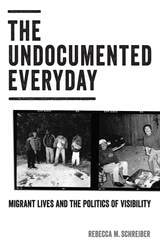
The Undocumented Everyday
Migrant Lives and the Politics of VisibilityRebecca M. Schreiber
University of Minnesota Press, 2018
Examining how undocumented migrants are using film, video, and other documentary media to challenge surveillance, detention, and deportation
As debates over immigration increasingly become flashpoints of political contention in the United States, a variety of advocacy groups, social service organizations, filmmakers, and artists have provided undocumented migrants with the tools and training to document their experiences.
In The Undocumented Everyday, Rebecca M. Schreiber examines the significance of self-representation by undocumented Mexican and Central American migrants, arguing that by centering their own subjectivity and presence through their use of documentary media, these migrants are effectively challenging intensified regimes of state surveillance and liberal strategies that emphasize visibility as a form of empowerment and inclusion. Schreiber explores documentation as both an aesthetic practice based on the visual conventions of social realism and a state-administered means of identification and control.
As Schreiber shows, by visualizing new ways of belonging not necessarily defined by citizenship, these migrants are remaking documentary media, combining formal visual strategies with those of amateur photography and performative elements to create a mixed-genre aesthetic. In doing so, they make political claims and create new forms of protection for migrant communities experiencing increased surveillance, detention, and deportation.
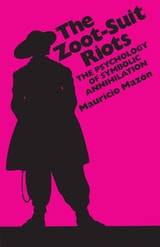
The Zoot-Suit Riots
The Psychology of Symbolic AnnihilationBy Mauricio Mazón
University of Texas Press, 1984
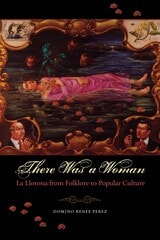
There Was a Woman
La Llorona from Folklore to Popular CultureBy Domino Renee Perez
University of Texas Press, 2008
"How is it that there are so many lloronas?" A haunting figure of Mexican oral and literary traditions, La Llorona permeates the consciousness of her folk community. From a ghost who haunts the riverbank to a murderous mother condemned to wander the earth after killing her own children in an act of revenge or grief, the Weeping Woman has evolved within Chican@ imaginations across centuries, yet no truly comprehensive examination of her impact existed until now. Tracing La Llorona from ancient oral tradition to her appearance in contemporary material culture, There Was a Woman delves into the intriguing transformations of this provocative icon.
From La Llorona's roots in legend to the revisions of her story and her exaltation as a symbol of resistance, Domino Renee Perez illuminates her many permutations as seductress, hag, demon, or pitiful woman. Perez draws on more than two hundred artifacts to provide vivid representations of the ways in which these perceived identities are woven from abstract notions—such as morality or nationalism—and from concrete, often misunderstood concepts from advertising to television and literature. The result is a rich and intricate survey of a powerful figure who continues to be reconfigured.
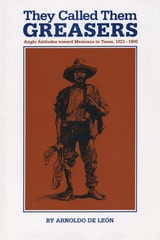
They Called Them Greasers
Anglo Attitudes toward Mexicans in Texas, 1821–1900by Arnoldo De León
University of Texas Press, 1983
Tension between Anglos and Tejanos has existed in the Lone Star State since the earliest settlements. Such antagonism has produced friction between the two peoples, and whites have expressed their hostility toward Mexican Americans unabashedly and at times violently.
This seminal work in the historical literature of race relations in Texas examines the attitudes of whites toward Mexicans in nineteenth-century Texas. For some, it will be disturbing reading. But its unpleasant revelations are based on extensive and thoughtful research into Texas' past. The result is important reading not merely for historians but for all who are concerned with the history of ethnic relations in our state.
They Called Them Greasers argues forcefully that many who have written about Texas's past—including such luminaries as Walter Prescott Webb, Eugene C. Barker, and Rupert N. Richardson—have exhibited, in fact and interpretation, both deficiencies of research and detectable bias when their work has dealt with Anglo-Mexican relations. De León asserts that these historians overlooled an austere Anglo moral code which saw the morality of Tejanos as "defective" and that they described without censure a society that permitted traditional violence to continue because that violence allowed Anglos to keep ethnic minorities "in their place."
De León's approach is psychohistorical. Many Anglos in nineteenth-century Texas saw Tejanos as lazy, lewd, un-American, subhuman. In De León's view, these attitudes were the product of a conviction that dark-skinned people were racially and culturally inferior, of a desire to see in others qualities that Anglos preferred not to see in themselves, and of a need to associate Mexicans with disorder so as to justify their continued subjugation.
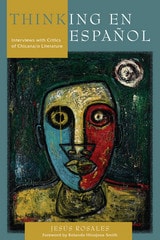
Thinking en español
Interviews with Critics of Chicana/o LiteratureJesús Rosales; Foreword by Rolando Hinojosa-Smith
University of Arizona Press, 2014
The twelve critics interviewed for this project share certain characteristics. For each one, Mexico plays an essential role in his or her personal and academic background, and each is bilingual and bicultural, having received formal literary education in Spanish graduate programs. As products of the working class, each scholar here shares a sense of social consciousness and commitment that lends an urgency to their desire to promote Chicano literature and culture at the local, regional, national, and international levels. They serve as a source of inspiration and commitment for future generations of scholars of Chicano literature and leave a lasting legacy of their own.
Thinking en español legitimizes Chicana/o criticism as an established discipline, and documents the works of some of the most important critics of Chicano literature at the turn of the twentieth and into the twenty-first century. This timely book immortalizes literary historical figures and documents the trajectory of Chicano criticism.