Results by title
4743 books match the query 'Religion' and 1168 start with t
The Making of a Sage
A Study in Rabbinic EthicsJonathan Wyn Schofer
University of Wisconsin Press, 2005
Jonathan Schofer offers the first theoretically framed examination of rabbinic ethics in several decades. Centering on one large and influential anthology, The Fathers According to Rabbi Nathan, Jonathan Schofer situates that text within a broader spectrum of rabbinic thought, while at the same time bringing rabbinic thought into dialogue with current scholarship on the self, ethics, theology, and the history of religions.
Notable Selection, Jordan Schnitzer Book Award for Philosophy and Jewish Thought, Association for Jewish Studies
The Making of the Christian Mind
The Adventure of the Paraclete: Vol. 3: Confessions and RuleJames Patrick
St. Augustine's Press, 2022
Patrick's work is both fine scholarship and epic story-telling, a key component to both the education and fascination of the Christian mind, which in turn has shaped the world more deeply than any other influence in human history. "The Christian intellect will guide the heart to the place where the knee can bend and the eye see; the making of the Christian mind will continue from age to age, locating eternal truth in a human history that will endure as God wills so that many may be saved, pointing beyond itself to the reality that thoughts and words represent, making all things new."
The Making of the Christian Mind
The Adventure of the Paraclete: Volume I: The Waiting WorldJames Patrick
St. Augustine's Press, 2020
This is not a history of dogma or systematic account of the building of doctrine. It is a narrative that follows the major moments wherein the Christian heart so in tune with the Paraclete has rendered the seminal texts and literature of this new culture, from the Didache to the Rule of Saint Benedict and The Consolation of Philosophy. Patrick succeeds in presenting a narrative that reads more like the experience lived by those directly involved in its realization, and although he cannot include every individual accomplishment of the major Christian writers, he illuminates the context in which Christianity was born and how faith grew and allowed itself to be shaped by its participation in the “adventure” and its grasp of objective truth. The Christian mind is, says Patrick, not only inspired and moved by the restless Paraclete, but revolves around the event of Jesus Christ. Christian history is therefore best understood not simply as chronology of events but as the vision of “the new heart in time,” one that strives to be like that of the one who sent the Spirit into history.
Patrick writes with a voice of a teacher, and although this work is very well referenced and accurate he does not intend this work to be a scholarly presentation of data and careful arguments, nor does he include every aspect of this intellectual faith journey of Christianity found in writing. As a comprehensive review, Patrick acknowledges the limitations of his own project to tell a complete story. Nevertheless, The Making of the Christian Mind accomplishes the no less formidable feat of illustrating the vivacious quality of the authentic Christian intellectual life. “Christianity is a survivor, not because it possessed the instruments of power but because, as Jesus of Nazareth said before Pilate, the foundation of the Kingdom is truth, its instruments of conquest are its renewing gifts, its consequences are the substitution of truth for error and ignorance, of faith for skepticism, humility for pride, and of charity and friendship for emulation, all this realized never perfectly but always as possibilities having the power to make all things new.”
This work is divided into three volumes, of which the present work is the first. Highlights of this first volume, The Waiting World, include following revelation as it first moved uncertain hearts to write and then to offer explicit witness. In this first installment, Patrick sets the groundwork for following the faith and history of Israel to Justin Martyr’s great claim that what is true belongs to Christians.
The Making of the Christian Mind
The Adventure of the Paraclete: Volume II: Fire and WitnessJames Patrick
St. Augustine's Press, 2021
The second installment presents the parallel struggle to build heart and mind, as heresy and temporal demands challenge the memory and vitality of what Christians have received. The writing mind in this sense sustains and gives purpose to the heart, pressed under the burden of doubt and worldly expectation. The reader knows that Christianity endures, but how did this happen? Patrick at every turn discloses the role of the Paraclete who remains the unseen protagonist. In this sense, Patrick surprises even those who think they know the story, and no one is safe from being exposed to a bit of the same inspiration that moves the characters in history passed. Indeed, the reader will feel like a part of this same narrative, in a new unwritten chapter but encountering the same Paraclete who has meddled in and marked events with holy breath that even Patrick cannot fully represent.
Highlights of Fire and Witness are Patrick’s presentation of pivotal yet forgotten works such as The Shepherd of Hermes, and his treatment of Origen and Athanasius in their respective social and spiritual contexts. This volume grants the reader a glimpse into a time when resolutions needed to be made and defended with argument, but also with silent witness and the flame of a resolve dimmed not even by death. Patrick’s description of imperial Christianity and the Christian imagination that ultimately fashions the proper image of Christian places is likewise stunning and not to be missed.
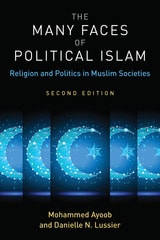
The Many Faces of Political Islam, Second Edition
Religion and Politics in Muslim SocietiesMohammed Ayoob and Danielle N. Lussier
University of Michigan Press, 2020
Analysts and pundits from across the American political spectrum describe Islamic fundamentalism as one of the greatest threats to modern, Western-style democracy. Yet very few non-Muslims would be able to venture an accurate definition of political Islam. Fully revised and updated, The Many Faces of Political Islam thoroughly analyzes the many facets of this political ideology and shows its impact on global relations.
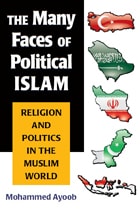
The Many Faces of Political Islam
Religion and Politics in the Muslim WorldMohammed Ayoob
University of Michigan Press, 2009
---Peter J. Katzenstein, Walter S. Carpenter, Jr. Professor of International Studies and Stephen H. Weiss Presidential Teaching Fellow, Cornell University
---Fawaz A. Gerges, Carnegie Scholar, and holds the Christian A. Johnson Chair in International Affairs and Middle Eastern Studies, Sarah Lawrence College
---François Burgat, Director, French National Centre for Scientific Research (CNRS) and the Institute for Research and Study on the Arab and Muslim World (IREMAM), Aix-en-Provence, France
---Shibley Telhami, Anwar Sadat Professor for Peace and Development, University of Maryland, and Senior Fellow, Brookings Institution
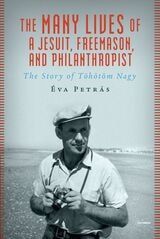
The Many Lives of a Jesuit, Freemason, and Philanthropist
The Story of Töhötöm NagyÉva Petrás
Central European University Press, 2024
The life of Töhötöm Nagy (1908–1979), Jesuit, Mason, and secret service agent, offers fascinating insights into interwar Hungary, the Catholic Church and Vatican diplomacy, Freemasonry, and the activities of communist state security service.
As a young Jesuit Nagy was one of the leaders of a successful Catholic youth movement in interwar Hungary. After World War II he played an important role acting as an intermediary between the Vatican, the Red Army, and the Hungarian Catholic Church. After being sent to South America, he was attracted by liberation theology, but left the Society of Jesus, joined the Freemasons, and did social and philanthropic work in the slums of Buenos Aires. However, in the late 1960s he agreed to work for the Hungarian state security service in return for his repatriation. This latter period is reconstructed from the files of the Historical Archives of State Security in Budapest. Éva Petrás writes with empathy but with a sense of distance of the courage and restless energy of her subject. Her discussion of the limits of free choice and Nagy’s intense struggle to live a meaningful life make this biography breathtaking.
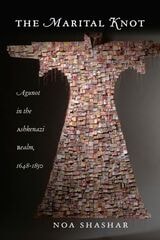
The Marital Knot
Agunot in the Ashkenazi Realm, 1648–1850Noa Shashar
Brandeis University Press, 2024
Noa Shashar sheds light on Jewish family life in the early modern era and on the activity of rabbis whose Jewish legal rulings determined the fate of agunot, literally “chained women,” who were often considered a marginal group. Who were these men and women? How did Jewish society deal with the danger of a woman’s becoming an agunah? What kind of reality was imposed on women who found themselves agunot, and what could they do to extricate themselves from their plight? How did rabbinic decisors discharge their task during this period, and what were the outcomes given the fact that the agunot were dependent on the male rabbinic establishment?
This study describes the lives of agunot, and by reexamining the halakhic activity concerning agunot in this period, proposes a new assessment of the attitude that decisors displayed toward the freeing of agunot.
The Mass
The Presence of the Sacrifice of the CrossCharles Cardinal Journet
St. Augustine's Press, 2008

The Medieval Mediterranean
Cross-Cultural ContactsMarilyn J. Chiat and Kathryn L. Reyerson, Editors
University of Minnesota Press, 1991
The Medieval Mediterranean was first published in 1991. Minnesota Archive Editions uses digital technology to make long-unavailable books once again accessible, and are published unaltered from the original University of Minnesota Press editions.
"Three faiths—Jewish, Christian, and Muslim—became the dominant religions of western civilization in the course of the Middle Ages. Within each, there is and was great cultural and ethnic diversity. The complex relationships today among Jews, Christians, and Muslims in the Mediterranean, the tensions and attempts at resolution of conflicts among these groups, have their roots in the Middle Ages."
Contributors: Oleg Grabar, The Meaning of the Dome of the Rock; Oliver Nicholson, Golden Age and the End of the World: Myths of Mediterranean Life from Lactantius to Joshua the Stylite; Ivan Havener, OSB, Two Early Anecdotes Concerning Gregory the Great from the Greek Tradition; Catherine B. Asher, The Public Baths of Medieval Spain: An Architectural Study; Jonathan M. Bloom, The Revival of Early Islamic Architecture by the Umayyads of Spain; Marvin Mills, Scenario for a Roman Provenance for the Mosque of Cordoba; Sybil H. Mintz, The Carpet Pages of the Spanish-Hebrew Farhi Bible; Ann Thorson Walton, The Three Hebrew Children in the Fiery Furnace: A Study of Christian Iconography; W. Eugene Kleinbauer, Pre-Carolingian Concepts of Architectural Planning; Clara Estow, Iberia and North Africa: A Comparative View of Religious and Sexual Discrimination in a Medieval Plural Society; Moshe Sokolow, Arabic Books in Jewish Libraries: The Evidence of Genizah Booklist; Leslie S. B. MacCoull, Coptic Alchemy and Craft Technology in Islamic Egypt: The Papyrological Evidence; Thomas S. Noonan, Technology Transfer Between Byzantium and Eastern Europe: A Case Study of the Glass Industry in Early Russia; Stephanie Cain Van D'Elden, Black and White: Contact with the Mediterranean World in Medieval German Narrative; Gerhard Weiss, The Pilgrim as Tourist: Travels to the Holy Land as Reflected in the Published Accounts of German Pilgrims Between 1450 and 1550
The Medieval Monastery
Andrew MacLeish, Editor
University of Minnesota Press, 1991
The Medieval Monastery was first published in 1991. Minnesota Archive Editions uses digital technology to make long-unavailable books once again accessible, and are published unaltered from the original University of Minnesota Press editions.
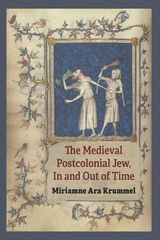
The Medieval Postcolonial Jew, In and Out of Time
Miriamne Ara Krummel
University of Michigan Press, 2022
The Megachurch and the Mainline
Remaking Religious Tradition in the Twenty-first CenturyStephen Ellingson
University of Chicago Press, 2007
Religious traditions provide the stories and rituals that define the core values of church members. Yet modern life in America can make those customs seem undesirable, even impractical. As a result, many congregations refashion church traditions so they may remain powerful and salient. How do these transformations occur? How do clergy and worshipers negotiate which aspects should be preserved or discarded?
Focusing on the innovations of several mainline Protestant churches in the San Francisco Bay Area, Stephen Ellingson’s The Megachurch and the Mainline provides new understandings of the transformation of spiritual traditions. For Ellingson, these particular congregations typify a new type of Lutheranism—one which combines the evangelical approaches that are embodied in the growing legion of megachurches with American society’s emphasis on pragmatism and consumerism. Here Ellingson provides vivid descriptions of congregations as they sacrifice hymns in favor of rock music and scrap traditional white robes and stoles for Hawaiian shirts, while also making readers aware of the long history of similar attempts to Americanize the Lutheran tradition.
This is an important examination of a religion in flux—one that speaks to the growing popularity of evangelicalism in America.
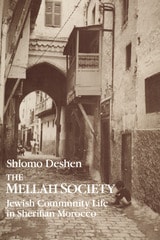
The Mellah Society
Jewish Community Life in Sherifian MoroccoShlomo Deshen
University of Chicago Press, 1989
Shlomo Deshen, author of several books on North African Jewish immigrants to Israel, here turns his attention to the past. Taking as his focus the tension between individualism and communal authority—symbolized by the walls of the mellahs, the Jewish quarters—he applies to traditional Moroccan Jewish society questions of concern to sociologists everywhere regarding political organization, economic activity, religion, and the family.
From such documents as private correspondence, archival photographs, and the legal commentaries of rabbis who served in the Jewish community courts, Deshen draws out details of daily life: disputes between spouses, businessmen, craftsmen, and inheritors; the ramifications of marriage contracts; and claims involving community taxes and extortions by Muslim potentates. Linking this material with recent historical and anthropological studies of the Maghreb, Deshen reconstructs a community about which little has been known and places it squarely within the context of traditional Moroccan society.
Individual chapters deal with relations between Muslims and Jews, the material conditions of Jewish life, and the nature of politics within the mellah. Deshen devotes particular attention to the nature of the Moroccan rabbinate, the sociology of the mellah synagogue, lay community leadership, and the historic role of the Sephardic heritage in Morocco after the expulsion from medieval Spain. His close study of the nature of the extended family in traditional Morocco corrects popular misconceptions.
Originally published in Israel in 1983, now translated and expanded by its author, The Mellah Society draws upon Middle Eastern and Jewish history, textual Judaic studies, and social anthropology to make an original contribution that will interest scholars of the Middle East and North Africa as well as anyone concerned with Jewish history and ethnicity.
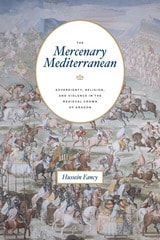
The Mercenary Mediterranean
Sovereignty, Religion, and Violence in the Medieval Crown of AragonHussein Fancy
University of Chicago Press, 2016
They were not the first or only Muslim soldiers to do so. Over the course of the thirteenth and fourteenth centuries, the Christian kings of Aragon recruited thousands of foreign Muslim soldiers to serve in their armies and as members of their royal courts. Based on extensive research in Arabic, Latin, and Romance sources, The Mercenary Mediterranean explores this little-known and misunderstood history. Far from marking the triumph of toleration, Hussein Fancy argues, the alliance of Christian kings and Muslim soldiers depended on and reproduced ideas of religious difference. Their shared history represents a unique opportunity to reconsider the relation of medieval religion to politics, and to demonstrate how modern assumptions about this relationship have impeded our understanding of both past and present.
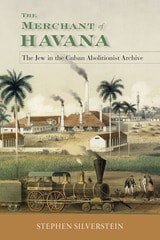
The Merchant of Havana
The Jew in the Cuban Abolitionist ArchiveStephen Silverstein
Vanderbilt University Press, 2016
As Cuba industrialized in the nineteenth century, an epochal realignment of the social order occurred. In this period of change, two seemingly disparate, yet nevertheless intertwined, ideological forces appeared: anti-Semitism and abolitionism. As the antislavery movement became organized in Cuba, the argument grew that Jews participated in the African slave trade and in New World slavery, and that this participation gave Jews extraordinary influence in the new Cuban economy and culture. What was remarkable about this anti-Semitism was the decidedly small Jewish population on the island in this era. This form of anti-Semitism, Silverstein reveals, sprang almost exclusively from mythological beliefs.
The Middle East Remembered
Forged Identities, Competing Narratives, Contested SpacesJacob Lassner
University of Michigan Press, 2000
In the first of the book's three parts, Lassner examines what he calls the stratigraphy of the text--he makes sense of the unusual organization of medieval Islamic narrative. The second section investigates issues such as work on city planning and on the creation of imperial centers. The last portion studies the interplay between Jewish and Muslim memory and the trading of themes and ideas between the cultures.
Shorter studies in the volume have been revised, and the author weaves new and complementary essays around them. Earlier work has been transformed and made more available to the general public. The style is accessible, and technical and arcane usages have been kept to a minimum. Throughout there are flashes of the author's wry humor.
Jacob Lassner is Philip M. and Ethel Klutsnick Professor of Jewish Civilization, Northwestern University, and Professor of Middle East History, Tel Aviv University.
The Middle Maccabees
Archaeology, History, and the Rise of the Hasmonean KingdomAndrea M. Berlin
SBL Press, 2021
A focused, interdisciplinary examination of a tumultuous, history-making era
The Middle Maccabees lays out the charged, complicated beginnings of the independent Jewish state founded in the second century BCE. Contributors offer focused analyses of the archaeological, epigraphic, numismatic, and textual evidence, framed within a wider world of conflicts between the Ptolemies of Egypt, the Seleucids of Syria, and the Romans. The result is a holistic view of the Hasmonean rise to power that acknowledges broader political developments, evolving social responses, and the particularities of local history. Contributors include Uzi ‘Ad, Donald T. Ariel, Andrea M. Berlin, Efrat Bocher, Altay Coşkun, Benedikt Eckhardt, Gerald Finkielsztejn, Christelle Fischer-Bovet, Yuval Gadot, Erich Gruen, Sylvie Honigman, Jutta Jokiranta, Paul J. Kosmin, Uzi Leibner, Catharine Lorber, Duncan E. MacRae, Dvir Raviv, Helena Roth, Débora Sandhaus, Yiftah Shalev, Nitsan Shalom, Danny Syon, Yehiel Zelinger, and Ayala Zilberstein.
Features
- Up-to-date, generously illustrated essays analyzing the relevant archaeological remains
- A revised understanding of how local and imperial histories overlapped and intersected
- New analysis of the book of 1 Maccabees as a tool of Hasmonean strategic interest

The Millenarian World of Early Mormonism
Grant Underwood
University of Illinois Press, 1994
"A model of first-rate scholarship and balanced interpretation; it has much to say not only to those interested in Mormon history but also to anyone seeking to understand the role of millenarian ideas in the American experience." -- Michael Barkun, Journal of American History
"No serious student of early Mormon history should fail to read this book." -- L. B. Tipson, Choice
"A signal contribution to Mormon studies. Anyone who wishes to explore the core of the Mormon identity in the nineteenth century will have to come to terms with this book." -- Richard T. Hughes, author of Reviving the Ancient Faith: The Story of Churches of Christ in America
The Mind That Is Catholic
Philosophical and Political EssaysJames V. Schall
Catholic University of America Press, 2008
The Minor Works
Catholic University of America Press, 1965
The Miracle of Immortality
What Follows This Earthly Life?Gerhard Cardinal Muller
Catholic University of America Press, 2026
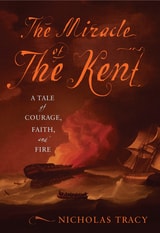
The Miracle of the Kent
A Tale of Courage, Faith, and FireNicholas Tracy
Westholme Publishing, 2008
“A naturally gripping adventure tale.”—Publishers Weekly
“Powerful and intensely focused.”—Booklist
“Tracy's satisfying narrative constitutes the first modern account. A finely detailed maritime history.”—Kirkus Reviews
In 1825, the Kent, an East Indiaman, set sail from England for India with a crew and nearly 600 men, women, and children on board. North of Spain, the ship was slammed by a ferocious gale, and while a sailor was inspecting the hold for damage, his lantern ignited a cask of spirits. A fire quickly erupted, and even with the desperate expedient of opening hatches and flooding the ship, the fire burned out of control. As night wore on, the ship became an inferno, with the flames moving toward stores of gunpowder. At this point, everyone on board knew that they would perish, and they began preparing for their ghastly deaths. Despite the raging tempest a sailor climbed one last time to the top of the Kent’s mainmast and—miraculously—a sail was sighted on the horizon. It was the Cambria, a small brig on its way to Mexico. The Cambriaspied the burning Kentand through determination and dogged seamanship in towering seas, the little brig closed the doomed vessel. Launching their boats, the Kent’s and Cambria’s crews were able to transfer nearly all of the children, women, and men to the brig and pull away before the Kent exploded. Dangerously overloaded, the Cambriamade the Cornish coast three days later.
In The Miracle of the Kent: A Tale of Courage, Faith, and Fire, award-winning historian Nicholas Tracy reconstructs this extraordinary tale through records left by the participants, revealing how those aboard the Kent faced their deaths, and their reactions to being offered a second chance. The story of the Kentis both a page-turning adventure and an inspirational homage to the capacity of the human spirit.

The Miracles of St. John of Capistran
Stanko Andric
Central European University Press, 2000
Religious history and, in particular, the history of the cult of saints and their miracles has recently become one of the most popular fields of historical investigation. Together with continuing interest in the related ecclesiastic motivations and the well organized craft of hagiography, this new interest might be explained by the marvellously rich details of thousands of witness accounts testifying to the miraculous help they received from the saint in times of desparate need. These accounts provide an unparalleled insight into the history of everyday life and into the various hardships, illnesses, hopes dreams and anxieties during the late medieval and early modern period.
Only two records exist on the history of the medieval Hungarian kingdom- the thirteenth century canonization trial of St. Margaret of Hungary and the miracle collections promoting the canonization of St. John of Capistran, the victorious Crusader at Belgrade in 1456, who died thereafter in Ilok (a city located on the periphery of western Christianity in Croatia). Based on a careful study of the widely scattered manuscripts on Capistranean miracles and with the help of a microscopic philological analysis, the author has managed to reconstruct, for the first time, one of the most complex miracle collections in the history of medieval hagiography.
Covering the recording of the first miracle series by the urban notaries of Ilok, the local hagiographer of Ilok Franciscans (John Geszti), the vicar general of the Hungarian province (Stephen Varsányi), and a number of subsequent editions and amplifications of this material recycling into the canonization campaign of St. John of Capistran and the miracles he himself recorded, The Miracles of St. John of Capistran, is an outstanding debut by a representative of a new generation of Central European medievalists.
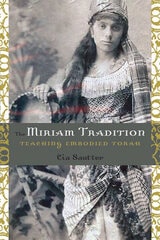
The Miriam Tradition
Teaching Embodied TorahCia Sautter
University of Illinois Press, 2010
The Mishnah in Contemporary Perspective, Volume 1
Alan J. Avery-Peck
SBL Press, 2016
Now in Paperback!
In the past thirty years, the Mishnah has taken its place as a principal focus in the academic study of religion and of Judaism. Many university scholars have participated in the contemporary revolution in the description, analysis, and interpretation of the Mishnah. Nearly all the publishing scholars of the academy who are now at work are represented in this project. Both essential volumes present a broad selection of approaches to the study of the Mishnah. What they prove in diverse ways is that the Mishnah defines the critical focus of the study of Judaism. It is a document that rewards study in the academic humanities.
Features:
- The best of contemporary scholarship on the Mishnah
- The most representative selection of contemporary Mishnah-study contributions available in any collection in a Western language
- Paperback format of an essential Brill reference work
The Mishnah in Contemporary Perspective, Volume 2
Alan J. Avery-Peck
SBL Press, 2016
Now in Paperback!
This second volume of a two-part project on the Mishnah displays a broad selection of approaches to the study of the Mishnah in the contemporary academy. The work derives from Israel, North America, and Europe and shows the intellectual vitality of scholarship in all three centers of learning. What these articles show in diverse ways is that the Mishnah forms a critical focus of the study of Judaism.
Features:
- The best of contemporary scholarship on the Mishnah
- The most representative selection of contemporary Mishnah-study contributions available in any collection in a Western language
- Paperback format of an essential Brill reference work
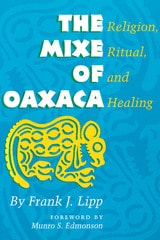
The Mixe of Oaxaca
Religion, Ritual, and HealingBy Frank J. Lipp
University of Texas Press, 1991
The Mixe of Oaxaca was the first extensive ethnography of the Mixe, with a special focus on Mixe religious beliefs and rituals and the curing practices associated with them. It records the procedures, design-plan, corresponding prayers, and symbolic context of well over one hundred rituals. Frank Lipp has written a new preface for this edition, in which he comments on the relationship of Mixe religion to current theoretical understandings of present-day Middle American folk religions.
The Modernist Impulse in American Protestantism
William R. Hutchison
Duke University Press, 1992
The Modernist as Philosopher
Selected Writings of Marcel HebertC. J. T. Talar
Catholic University of America Press, 2011

The Monastic In Each of Us
Heart, Mind, Body, Soul and SpiritTim Vivian
Catholic University of America Press, 2026
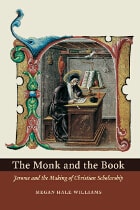
The Monk and the Book
Jerome and the Making of Christian ScholarshipMegan Hale Williams
University of Chicago Press, 2006
In the West, monastic ideals and scholastic pursuits are complementary; monks are popularly imagined copying classics, preserving learning through the Middle Ages, and establishing the first universities. But this dual identity is not without its contradictions. While monasticism emphasizes the virtues of poverty, chastity, and humility, the scholar, by contrast, requires expensive infrastructure—a library, a workplace, and the means of disseminating his work. In The Monk and the Book, Megan Hale Williams argues that Saint Jerome was the first to represent biblical study as a mode of asceticism appropriate for an inhabitant of a Christian monastery, thus pioneering the enduring linkage of monastic identities and institutions with scholarship.
Revisiting Jerome with the analytical tools of recent cultural history—including the work of Bourdieu, Foucault, and Roger Chartier—Williams proposes new interpretations that remove obstacles to understanding the life and legacy of the saint. Examining issues such as the construction of Jerome’s literary persona, the form and contents of his library, and the intellectual framework of his commentaries, Williams shows that Jerome’s textual and exegetical work on the Hebrew scriptures helped to construct a new culture of learning. This fusion of the identities of scholar and monk, Williams shows, continues to reverberate in the culture of the modern university.
"[Williams] has written a fascinating study, which provides a series of striking insights into the career of one of the most colorful and influential figures in Christian antiquity. Jerome's Latin Bible would become the foundational text for the intellectual development of the West, providing words for the deepest aspirations and most intensely held convictions of an entire civilization. Williams's book does much to illumine the circumstances in which that fundamental text was produced, and reminds us that great ideas, like great people, have particular origins, and their own complex settings."—Eamon Duffy, New York Review of Books
The Moon in the Water
Reflections on an Aging ParentKathy J. Phillips
Vanderbilt University Press, 2008
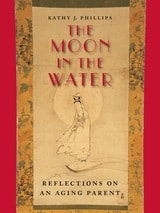
In a series of moving vignettes, the author begins by describing a particular representation of Water-Moon Kuan Yin, a Buddhist teacher and goddess associated with compassion, who often sits on a precarious overhang or floats on a flimsy petal. Then Kuan Yin steps out of the frame to join the author in the mundane challenges of caring for her father-transferring his health insurance, struggling with a wheelchair van, managing adult diapers, or playing in the fictions of dementia. From perplexed to poignant to funny, the vignettes record the working-class English of a fading but still wise dad, and they find other human versions of Kuan Yin in a doctor who will still make house calls or kind strangers in the street.
The book includes ten illustrations: both classical representations of Kuan Yin and also the author's own drawings, which adapt Kuan Yin in an act of practical spirituality, reading art through life and life through art. Each vignette invites the harried caregiver to take a deep breath and meditate on the trials and joys of caring for an aging parent.
The Moral Meaning of Nature
Nietzsche’s Darwinian Religion and Its CriticsPeter J. Woodford
University of Chicago Press, 2018
We start with Friedrich Nietzsche, whose writings staged one of the first confrontations with the Christian tradition using the resources of Darwinian thought. The lebensphilosophie, or “life-philosophy,” that arose from his engagement with evolutionary ideas drew responses from other influential thinkers, including Franz Overbeck, Georg Simmel, and Heinrich Rickert. These critics all offered cogent challenges to Nietzsche’s appropriation of the newly transforming biological sciences, his negotiation between science and religion, and his interpretation of the implications of Darwinian thought. They also each proposed alternative ways of making sense of Nietzsche’s unique question concerning the meaning of biological evolution “for life.” At the heart of the discussion were debates about the relation of facts and values, the place of divine purpose in the understanding of nonhuman and human agency, the concept of life, and the question of whether the sciences could offer resources to satisfy the human urge to discover sources of value in biological processes. The Moral Meaning of Nature focuses on the historical background of these questions, exposing the complex ways in which they recur in contemporary philosophical debate.

The Moral Tradition of American Constitutionalism
A Theological InterpretationH. Jefferson Powell
Duke University Press, 1993
Powell locates the origins of constitutional law in the Enlightenment attempt to control the violence of the state by subjecting power to reason. He then traces constitutionalism's rapid evolution into a tradition of rational inquiry centered in the practice of adjudication and embodied in a community of lawyers and judges. Finally, Powell shows how the tradition's nineteenth-century presuppositions about the autonomy and rationality of constitutional argument have been undermined in the twentieth century, within the constitutional community itself, by the acceptance of a positivist and "democratic" understanding of law. Powell shows how the continued willingness of the courts to resolve moral questions by invoking "the Constitution" has thrown the constitutional tradition into an epistemological crisis. He critiques the work of many major theorists—John Hart Ely, Bruce Ackerman, Frank Michaelman, Rogers Smith, Michael Perry, Mark Tushnet, Robert Bork, Sanford Levinson—who, he claims, persist in attempting to resolve the crisis by redefining constitutionalism as American social morality.
With reference to Alasdair MacIntyre's concepts of moral tradition and social practice and John Howard Yoder's theological account of the state, Powell places his analysis of current constitutionalism within a contemporary Christian theological critique of Western liberalism. With certain exceptions, Powell concludes, there are theological grounds in the United States to prefer decision making by elected officials to decision by constitutional courts. Despite the controversial implications for judicial practice and legal argument, Powell ultimately argues that the liberal tradition of rational inquiry--American constitutionalism--be renounced by the Christian community in favor of the majoritarian political process.
The Mormon Church and Blacks
A Documentary HistoryEdited by Matthew L. Harris and Newell G. Bringhurst
University of Illinois Press, 2015
The Mormon Hierarchy
Extensions of PowerD. Michael Quinn
Signature Books, 1997
But by interviewing former church aides, examining hundreds of diaries, and drawing from his own past experience as an insider within the Latter-day Saint historical department, D. Michael Quinn presents a fuller view. His extensive research documents how the governing apostles, seventies, and presiding bishops are likely to be at loggerheads, as much as united. These strong-willed, independent men–like directors of a large corporation or supreme court justices–lobby among their colleagues, forge alliances, out-maneuver opponents, and broker compromises.
There is more: clandestine political activities, investigative and punitive actions by church security forces, personal “loans” from church coffers (later written off as bad debts), and other privileged power-vested activities. Quinn considers the changing role and attitude of the leadership toward visionary experiences, the momentous events which have shaped quorum protocol and doctrine, and day-to-day bureaucratic intrigue from the time of Brigham Young to the dawn of the twenty-first century.
The hierarchy seems at root well-intentioned and even at times aggressive in fulfilling its stated responsibility, which is to expedite the Second Coming. Where they have become convinced that God has spoken, they have set aside personal differences, offered unqualified support, and spoken with a unified voice. This potential for change, when coupled with the tempering effect of competing viewpoints, is something Quinn finds encouraging about Mormonism. But one should not assume that these men are infallible or work in anything approaching uninterrupted unanimity.
The Mormon Hierarchy
Origins of PowerD. Michael Quinn
Signature Books, 1994
Not until seven years later did Mormons first learn that authority had been restored by angels or of the need for a hierarchy mirroring the Pauline model. That same year (1835) a Quorum of Twelve Apostles was organized, but their jurisdiction was limited to areas outside established stakes (dioceses). Stakes were led by a president, who oversaw spiritual development, and by a bishop, who supervised temporal needs.
At Smith’s martyrdom in 1844, the church had five leading quorums of authority. The most obvious successor to Smith, Illinois stake president William Marks, opposed the secret rites of polygamy, anointing, endowments, and the clandestine political activity that had characterized the church in Illinois. The secret Council of Fifty had recently ordained Smith as King on Earth and sent ambassadors abroad to form alliances against the United States.
The majority of church members knew nothing of these developments, but they followed Brigham Young, head of the Quorum of the Twelve, who spoke forcefully and moved decisively to eliminate contenders for the presidency. He continued to build on Smith’s political and doctrinal innovations and social stratification. Young’s twentieth-century legacy is a well-defined structure without the charismatic spontaneity or egalitarian chaos of the early church.
Historian D. Michael Quinn examines the contradictions and confusion of the first two tumultuous decades of LDS history. He demonstrates how events and doctrines were silently, retroactively inserted into the published form of scriptures and records to smooth out the stormy, haphazard development. The bureaucratization of Mormonism was inevitable, but the manner in which it occurred was unpredictable and will be, for readers, fascinating.
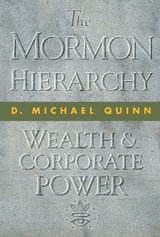
The Mormon Hierarchy
Wealth and Corporate PowerD. Michael Quinn
Signature Books, 2017
Early in the twentieth century, it was possible for Latter-day Saints to have lifelong associations with businesses managed by their leaders or owned and controlled by the church itself. For example, one could purchase engagement rings from Daynes Jewelry, honeymoon at the Hotel Utah, and venture off on the Union Pacific Railroad, all partially owned and run by church apostles.
Families could buy clothes at Knight Woolen Mills. The husband might work at Big Indian Copper or Bullion-Beck, Gold Chain, or Iron King mining companies. The wife could shop at Utah Cereal Food and buy sugar supplied by Amalgamated or U and I Sugar, beef from Nevada Land and Livestock, and vegetables from the Growers Market. They might take their groceries home in parcels from Utah Bag Co. They probably read the Deseret News at home under a lamp plugged into a Utah Power and Light circuit. They could take out a loan from Zion’s Co-operative and insurance from Utah Home and Fire.
The apostles had a long history of community involvement in financial enterprises to the benefit of the general membership and their own economic advantage. This volume is the result of the author’s years of research into LDS financial dominance from 1830 to 2010.

The Mormon History Association’s Tanner Lectures
The First Twenty YearsEdited by Dean L. May and Reid L. Neilsonwith Richard Lyman Bushman, Jan Shipps, and Thomas G. Alexander
University of Illinois Press, 2000
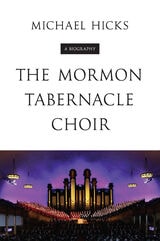
The Mormon Tabernacle Choir
A BiographyMichael Hicks
University of Illinois Press, 2015
Drawing on decades of work observing and researching the Mormon Tabernacle Choir, Michael Hicks examines the personalities, decisions, and controversies that shaped "America's choir." Here is the miraculous story behind the Tabernacle's world-famous acoustics, the anti-Mormonism that greeted early tours, the clashes with Church leaders over repertoire and presentation, the radio-driven boom in popularity, the competing visions of rival conductors, and the Choir's aspiration to be accepted within classical music even as Mormons sought acceptance within American culture at large. Everything from Billboard hits to TV appearances to White House performances paved the way for Mormonism's crossover triumph. Yet, as Hicks shows, such success raised fundamental concerns regarding the Choir's mission, functions, and image.
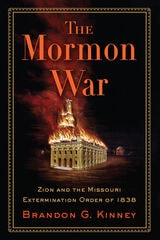
The Mormon War
Zion and the Missouri Extermination Order of 1838Brandon G. Kinney
Westholme Publishing, 2011
How the Violent Expulsion of the Mormons from Missouri Changed the History of America and the West
In 1831, Joseph Smith, Jr., the founder of the Church of Christ—later to be renamed the Church of Jesus Christ of Latter Day Saints—revealed that Zion, or “New Jerusalem,” was to be established in Jackson County, Missouri. Smith sent some of his followers to begin the settlement, but they were soon expelled by locals who were suspicious of their religion and their abolitionist sympathies. Smith led an expedition to regain the settlement, but was unsuccessful. Seven years later, in January 1838, Smith fled to Missouri from Ohio to avoid a warrant for his arrest, and joined the Mormon community in the town of Far West, which became the new Zion. The same prejudices recurred and the Mormons found themselves subject to attacks from non-Mormons, including attempts to prevent them from voting. Despite his abhorrence of violence, Smith decided that it was necessary for Mormons to defend themselves, which resulted in a short and sharp conflict known as the Mormon War. A covert Mormon paramilitary unit, the Danites, was formed to pillage non- Mormon towns, while angry rhetoric rose from both sides. After the Missouri state militia was attacked at the Battle of Crooked River, Missouri governor Liburn William Boggs issued Executive Order 44, which called for Mormons to be “exterminated or driven from the State.” Non-Mormons responded by attacking a Mormon settlement at Haun’s Mill, killing men and boys and firing on the women. Following this massacre, the state militia surrounded Far West and arrested Smith and other Mormon leaders. Smith was tried for treason and narrowly avoided execution, but was allowed to go and join the rest of his followers who were forced from Missouri to Illinois, where they founded their next major town, Nauvoo. There, Smith would be murdered and the church would split into several factions, with Brigham Young leading the movement’s largest group to Utah.
In The Mormon War: Zion and the Missouri Extermination Order of 1838, Brandon G. Kinney unravels the complex series of events that led to a religious and ideological war of both blood and words. The Mormon War not only challenged the protection afforded by the First Amendment, it foreshadowed the partisan violence over slavery and states’ rights that would erupt across Missouri and Kansas. The war also fractured Smith’s Church and led ultimately to the unexpected settlement of a vast area of the West as a Mormon homeland. By tracing the life of Joseph Smith, Jr. and his quest for Zion, the author reveals that the religion he founded was destined for conflict—both internal and external—as long as he remained its leader.
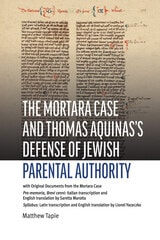
The Mortara Case and St. Thomas Aquinas's Defense of Jewish Parental Authority
with Original Documents from the Mortara Case: <i>Pro-memoria, Syllabus, Brevi cenni</i>Matthew Tapie
Catholic University of America Press, 2024
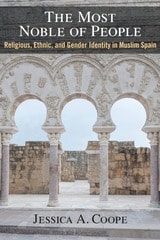
The Most Noble of People
Religious, Ethnic, and Gender Identity in Muslim SpainJessica A. Coope
University of Michigan Press, 2017
The opening chapters define Arab and Muslim identity as those categories were understood in Muslim Spain, highlighting the unique aspects of this society as well as its similarities with other parts of the medieval Islamic world. The book goes on to discuss what it meant to be a Jew or Christian in Spain under Islamic rule, and the degree to which non-Muslims were full participants in society. Following this is a consideration of gender identity as defined by Islamic law and by less normative sources like literature and mystical texts. It concludes by focusing on internal rebellions against the government of Muslim Spain, particularly the conflicts between Muslims who were ethnically Arab and those who were Berber or native Iberian, pointing to the limits of Muslim solidarity.
Drawn from an unusually broad array of sources—including legal texts, religious polemic, chronicles, mystical texts, prose literature, and poetry, in both Arabic and Latin—many of Coope’s illustrations of life in al-Andalus also reflect something of the larger medieval world. Further, some key questions about gender, ethnicity, and religious identity that concerned people in Muslim Spain—for example, women’s status under Islamic law, or what it means to be a Muslim in different contexts and societies around the world—remain relevant today.
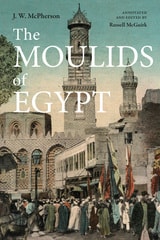
The Moulids of Egypt
Egyptian Saint’s Day FestivalsJ.W. McPherson
Gingko, 2022
First published in Cairo during World War II, The Moulids of Egypt is a study of moulids, the popular Egyptian religious festivals celebrated by both Muslims and Christians in the first half of the twentieth century. The book talks in detail about the secular side of moulids, where sports, games, theatres, dancing, and laughter were as much part of the festivals as the religious processions and the whirling of dervishes. Some of the rites and customs analyzed here date from as far back as the Pharaonic period, but the moulids are gradually dying out; many of the 126 festivals described in Moulids of Egypt have since faded away, making the book of lasting interest.
The Mountainway of the Navajo
Leland C. Wyman; with a myth of the Female Branch recorded and translated by Father Berard Haile, OFM
University of Arizona Press, 1975
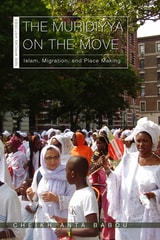
The Muridiyya on the Move
Islam, Migration, and Place MakingCheikh Anta Babou
Ohio University Press, 2021
Highlights the role of transnational space making in the construction of diasporic Muridiyya identity.
The construction of collective identity among the Muridiyya abroad is a communal but contested endeavor. Differing conceptions of what should be the mission of Muridiyya institutions in the diaspora reveal disciples’ conflicting politics and challenge the notion of the order’s homogeneity. While some insist on the universal dimension of Ahmadu Bamba Mbakke’s calling and emphasize dawa (proselytizing), others prioritize preserving Muridiyya identity abroad by consolidating the linkages with the leadership in Senegal. Diasporic reimaginings of the Muridiyya abroad, in turn, inspire cultural reconfigurations at home.
Drawing from a wide array of oral and archival sources in multiple languages collected in five countries, The Muridiyya on the Move reconstructs over half a century of the order’s history, focusing on mobility and cultural transformations in urban settings. In this groundbreaking work, Babou highlights the importance of the dahira (urban prayer circle) as he charts the continuities and ruptures between Muridiyya migrations. Throughout, he delineates the economic, socio-political, and other forces that powered these population movements, including colonial rule, the economic crises of the postcolonial era, and natural disasters.
The Museum on the Roof of the World
Art, Politics, and the Representation of TibetClare E. Harris
University of Chicago Press, 2012
The Muslim Brotherhood
Ideology, History, DescendantsJoas Wagemakers
Amsterdam University Press, 2022
The Mussar Torah Commentary
A Spiritual Path to Living a Meaningful and Ethical LifeRabbi Barry H. Block
Central Conference of American Rabbis, 2020
This Mussar-based commentary is a vital resource for Torah study, offering a thoughtful analysis of each of the 54 weekly parashot. Each essay in this anthology brings a parashah into juxtaposition with one of the Mussar middot (character traits as described within the Jewish school of ethics called Mussar), thereby providing an applied lens of Mussar teachings that helps us to delve deeper into our tradition with increased mindfulness and intention.