Results by title
732 books match the query 'Indigenous' and 169 start with t
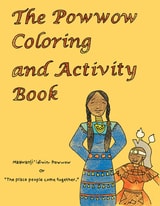
The Powwow Coloring and Activity Book
Ojibwe Traditions Coloring Book SeriesCassie Brown
Wisconsin Historical Society Press, 2018
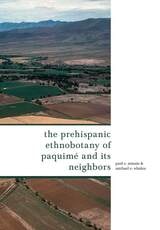
The Prehispanic Ethnobotany of Paquimé and Its Neighbors
Paul E. Minnis and Michael E. Whalen
University of Arizona Press, 2020
This volume is the first large-scale investigation of the prehispanic ethnobotany of this important ancient site and its neighbors. The authors examine ethnobotanical relationships during Medio Period, AD 1200–1450, when Paquimé was at its most influential. Based on two decades of archaeological research, this book examines uses of plants for food, farming strategies, wood use, and anthropogenic ecology. The authors show that the relationships between plants and people are complex, interdependent, and reciprocal. This volume documents ethnobotanical relationships and shows their importance to the development of the Paquimé polity.
How ancient farmers made a living in an arid to semi-arid region and the effects their livelihood had on the local biota, their relations with plants, and their connection with other peoples is worthy of serious study. The story of the Casas Grandes tradition holds valuable lessons for humanity.

The Public Trust and the First Americans
Ruthann Knudson
Oregon State University Press, 1995
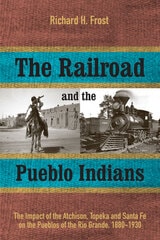
The Railroad and the Pueblo Indians
The Impact of the Atchison, Topeka and Santa Fe on the Pueblos of the Rio Grande, 1880-1930Richard H. Frost
University of Utah Press, 2015
The Pueblo communities responded variously, though mostly conservatively to sustain their traditional communities. This book spotlights two very different responses. Santo Domingo's reaction was hostile, but Laguna chose accommodation. These reactions reveal previously overlooked aspects of these pueblos’ histories that provide compelling reasons behind their varying responses. The book also analyzes the self-contradictory nature of Pueblo constitutional law from 1876 to 1913 and describes conflicted Bureau of Indian Affairs treatment of the Pueblos in the late nineteenth and early twentieth centuries. Each in turn had fateful consequences.
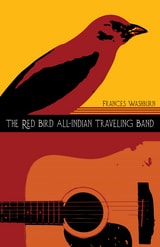
The Red Bird All-Indian Traveling Band
Frances Washburn
University of Arizona Press, 2014
The Red Bird All-Indian Traveling Band is part mystery, part community chronicle. Shaped by a cast of skillfully drawn characters, all of whom at one time or another are potential suspects, at the core of the story is smart and compassionate Sissy. Four years past high school, Sissy’s wry humor punctuates descriptions of reservation life as she learns more about Ames’s potential killer, and as she embarks on a personal search for ways to buck expectations and leave rural South Dakota to attend college.
Ames’s death is just an example of the undercurrents of violence and passions that run through this fast-moving novel of singing, loving, and fighting. Following Sissy as she unravels the mystery of both Buffalo Ames’s death and her own future, The Red Bird All-Indian Traveling Band is the story of Indian Country on the verge of historic change and a woman unwilling to let change pass her by.
The Red Land to the South
American Indian Writers and Indigenous MexicoJames H. Cox
University of Minnesota Press, 2012
The forty years of American Indian literature taken up by James H. Cox—the decades between 1920 and 1960—have been called politically and intellectually moribund. On the contrary, Cox identifies a group of American Indian writers who share an interest in the revolutionary potential of the indigenous peoples of Mexico—and whose work demonstrates a surprisingly assertive literary politics in the era.
By contextualizing this group of American Indian authors in the work of their contemporaries, Cox reveals how the literary history of this period is far more rich and nuanced than is generally acknowledged. The writers he focuses on—Todd Downing (Choctaw), Lynn Riggs (Cherokee), and D’Arcy McNickle (Confederated Salish and Kootenai)—are shown to be on par with writers of the preceding Progressive and the succeeding Red Power and Native American literary renaissance eras.
Arguing that American Indian literary history of this period actually coheres in exciting ways with the literature of the Native American literary renaissance, Cox repudiates the intellectual and political border that has emerged between the two eras.

The Renewed, the Destroyed, and the Remade
The Three Thought Worlds of the Iroquois and the Huron, 1609-1650Roger M. Carpenter
Michigan State University Press, 2004
For three decades, Native American history has been dominated by two major themes. The first is "The Cant of Conquest," the notion that all native peoples who came into contact with Europeans suffered devastating effects due to disease, alcohol, and warfare. However, the argument can be made that in some cases native peoples controlled their own fortunes, at least for awhile. The other dominant theme is the "The Contest of Cultures," the idea that Native American history needs to be examined in the context of dealings with Europeans. Europeans changed the Americas, but this approach concerns colonialism and colonists as well as Native Americans.
The Renewed, the Destroyed, and the Remade examines the changing worldviews of the Huron and the Iroquois in the first half of the seventeenth century, during a period of increasing European contact. From Samuel de Champlain’s armed encounter with the Iroquois, in 1609, to the dispersal of the Huron in the mid-seventeenth century, Carpenter’s book traces the evolving thought worlds of Iroquoian peoples.
The Iroquois and the Huron-peoples with an intertwined history and many cultural similarities-reacted differently to European contact. The Huron thought world began to change when the French initiated intense trade and missionary activity early in the seventeenth century. French missionary efforts resulted in a split within the Huron nation between traditionalists and Christian converts. By contrast, the Iroquois were interested primarily in trade with the newcomers. The Iroquois, like the Huron, accepted European trade goods, but unlike the Huron, they rejected European religion.
The Renewed, the Destroyed, and the Remade differs from other works of Native American history on several counts. Native American historiography has not been overly comparative. This work is a comparative history of two culturally similar Native American nations. It also differs in that, rather than another history of Native-European contacts, it is an Indian-centered history.
The Republic Shall Be Kept Clean
How Settler Colonial Violence Shaped Antileft RepressionTariq D. Khan
University of Illinois Press, 2023
The colonizing wars against Native Americans created the template for anticommunist repression in the United States. Tariq D. Khan’s analysis reveals bloodshed and class war as foundational aspects of capitalist domination and vital elements of the nation’s long history of internal repression and social control. Khan shows how the state wielded the tactics, weapons, myths, and ideology refined in America’s colonizing wars to repress anarchists, labor unions, and a host of others labeled as alien, multi-racial, multi-ethnic urban rabble. The ruling classes considered radicals of all stripes to be anticolonial insurgents. As Khan charts the decades of red scares that began in the 1840s, he reveals how capitalists and government used much-practiced counterinsurgency rhetoric and tactics against the movements they perceived and vilified as “anarchist.”
Original and boldly argued, The Republic Shall Be Kept Clean offers an enlightening new history with relevance for our own time.
The River of Life
Sustainable Practices of Native Americans and Indigenous PeoplesMichael E. Marchand
Michigan State University Press, 2014
The Roads of My Relations
Devon A. Mihesuah
University of Arizona Press, 2001
"I've traveled a lot of roads, but never alone. My relations are with me," says Billie McKenney, one of the matriarchs of the complex family of Choctaws searching for peace as the white world rapidly encroaches on their tribal land, politics, and values. In her first collection of stories, Native American writer Devon A. Mihesuah chronicles the lives of several generations of a close-knit Choctaw family as they are forced from their traditional homeland in nineteenth-century Mississippi and endure unspeakable sorrows during their journey before settling in southeastern Oklahoma.
Blending family lore, stark realism, and vivid imagination, The Roads of My Relations relays a strong sense of Choctaw culture and world view in absorbing tales of history and legend. Unfolding through the voices and actions of family members, confused half-bloods, and unlikely heroes—not all of them living or even human—the stories tell of the horrors of forced removal, the turbulence of post Civil War Indian Territory, the terrifying violence suffered at the hands of immortal Crow witches, and the family's ultimate survival against forces of evil. Time-traveling ghosts, mysterious medicine men, and eerie shape-shifters share the pages with proud matriarchs, mischievous schoolgirls, and loving siblings.
Together, these interwoven stories express the strength and persistence of a tribe whose identity and pride have survived the disruptions of colonialism. With The Roads of My Relations, Devon A. Mihesuah has created a universal and timeless exploration of heritage, spirituality, and the importance of preserving and passing on tradition.
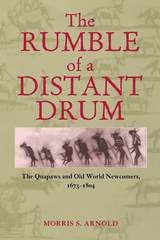
The Rumble of a Distant Drum
The Quapaws and Old World Newcomers, 1673–1804Morris Arnold
University of Arkansas Press, 2007
Winner of the 2001 Booker Worthen Literary Prize
Winner of the 2002 S. G. Ragsdale Award for Arkansas History
The Rumble of a Distant Drum opens in 1673 when Marquette and Jolliet sailed down the Mississippi River and found the Quapaw living in the area where the Arkansas River flowed into the Mississippi. In 1686 Henri de Tonti would found Arkansas Post in this same location. It was the first European settlement in this part of the country, established thirty years before New Orleans and eighty before St. Louis.
Morris S. Arnold draws on his many years of archival research and writing on colonial Arkansas to produce this elegant account of the cultural intersections of the French and Spanish with the native American peoples. He demonstrates that the Quapaws and Frenchmen created a highly symbiotic society in which the two disparate peoples became connected in complex and subtle ways—through intermarriage, trade, religious practice, and political/military alliances.
The San Carlos Indian Cattle Industry
Harry T. Getty
University of Arizona Press, 1963
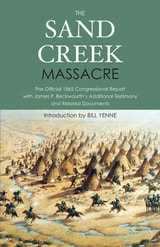
The Sand Creek Massacre
The Official 1865 Congressional Report with James P. Beckwourth's Additional Testimony and Related DocumentsUnited States Congress
Westholme Publishing, 2015
On the morning of November 29, 1864, Colorado state cavalry under the command of Col. John Chivington attacked a peaceful encampment of mostly Cheyenne Indians along the Sand Creek in Colorado, slaughtering perhaps as many as 160 people, mostly women and children. It was one of the most egregious atrocities of the Indian Wars. Even with the country embroiled in a Civil War, the gravity of the situation can be gauged by the fact that within six weeks of the killings, a Joint Committee of Congress conducted a public hearing. Congress vilified Chivington in summarizing his cowardly and racist attack in their published report: “Wearing the uniform of the United States, which should be the emblem of justice and humanity . . . he deliberately planned and executed a foul and dastardly massacre.” The Sand Creek Massacre: The Official 1865 Report contains a facsimile of the “Report of the Joint Committee on the Conduct of the War: Massacre of the Cheyenne Indians” along with unique annotations made by a reader at the time and the attached typescript testimony of the African American pioneer James P. Beckwourth, in which he recounts the atrocity. This edition is introduced by Bill Yenne. who places the Sand Creek Massacre in context within the Civil War and Indian Wars and provides biographical information about the main persons involved.

The Second Palestinian Intifada
A Chronicle of a People's StruggleRamzy Baroud
Pluto Press, 2006
Ramzy Baroud is a veteran journalist and former producer for Al-Jazeera TV. This is his comprehensive account of the momentous events of the last five years which shaped the political landscape not only of Palestine and Israel but of the entire Middle East region.
Addressing the most controversial issues, including the alarming escalation in suicide bombings, and the construction of the Separation Wall, he reports on the huge rate of unemployment and hunger in the Occupied Territories -- statistics so critical that NGOs compare their magnitude to African nations such as the Congo. From the brutality of the Israeli army to the ever-compromising nature of the Palestinian Authority, few are spared Baroud’s thoughtful critique.
The book is clear and concise, with one chapter dedicated to the major events of each year, and includes a comprehensive timeline.
The Seris
David Burckhalter
University of Arizona Press, 1981
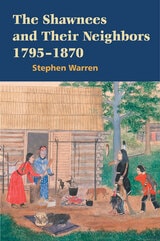
The Shawnees and Their Neighbors, 1795-1870
Stephen Warren
University of Illinois Press, 2004
Until recently, historians have assumed that Central Algonquians derive from politically unified tribes, but by analyzing the crucial role that individuals, institutions, and policies played in shaping modern tribal governments, Warren reveals a messier, more complicated history of migration and conflict. Ultimately, Warren establishes that the form of the modern Shawnee "tribe" was coerced in accordance with the U.S. government's desire for an entity with whom to do business, rather than as a natural development of traditional Shawnee ways.
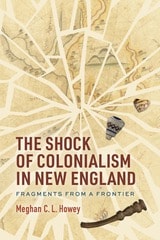
The Shock of Colonialism in New England
Fragments from a FrontierMeghan C. L. Howey
University of Alabama Press, 2025
Explores the untold impacts of colonialism in New England through diverse colonist lives, Indigenous encounters, and environmental legacies.
In The Shock of Colonialism in New England, archaeologist Meghan C. L. Howey uses excavations in the seventeenth-century colonial frontier of the Great Bay Estuary/P8bagok in today’s New Hampshire to trace the connection between European global colonialism and the planetary climate crises. Howey shows how this landscape holds forgotten stories of what it meant to live through the shock of colonialism.
These stories reveal an unexpected diversity and dynamism among English colonists, multifaceted encounters with Indigenous peoples, and lasting environmental damage from labor-intensive industries. Early Euro-American maps and stunning archaeological finds, such as a broken pickaxe embedded in a hearth, and a historical marker for the Oyster River “Massacre” of 1694 complicate our limited views of a shared past.
The reality of English colonialism in the dispossession of Indigenous lands and its wake is not commemorated. Howey’s work is a powerful corrective that traces the rise of intergenerational colonial wealth made possible by land commodified as property, the increased labor required to work newly opened land, the importation of indentured Scots and enslaved Africans to provide that labor, and the resulting degradation of the natural environment. Through Howey’s insights into the stories they tell, these fragments from a frontier can help contemporary readers better understand the past as they seek a more just and sustainable future.
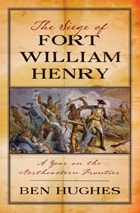
The Siege of Fort William Henry
A Year on the Northeastern FrontierBen Hughes
Westholme Publishing, 2012
Immortalized in The Last of the Mohicans, the True Story of a Pivotal Battle in the British and French War for the North American Continent
The opening years of the French and Indian War were disastrous for the British. In 1755 General Braddock’s troops were routed at the Battle of Monongahela and by the middle of 1756 Fort Oswego on Lake Ontario had fallen. Hindered by quarrelsome provincial councils, incompetent generals, and the redcoats’ inability to adapt to wilderness warfare, Britain was losing the war. In 1757 the 35th Regiment of Foot stepped into the breach. A poorly trained assortment of conscripts, old soldiers, and convicted criminals led by Lieutenant Colonel George Monro, the regiment was destined to take center stage in the most controversial event of the war. Fort William Henry on the southern shore of New York’s Lake George was a key fortification supporting British interests along the frontier with French America. Monro and his regiment occupied the fort in the spring of 1757 while Britain planned its attack on the key French fortress at Louisbourg, Nova Scotia. Learning that most of Britain’s military resources were allocated to Louisbourg, the French launched a campaign along the weakened frontier. French Commander Louis-Joseph de Montcalm and his American Indian allies laid siege to Fort William Henry; Monro could not hold out and was forced to surrender. As part of the terms, the British regiment, colonial militia, and their camp followers would be allowed safe passage to nearby Fort Edward. The French watched in horror, however, as their Indian allies attacked the British column after it left the fort, an episode that sparked outrage and changed the tactics of the war.
Seen through the eyes of participants such as Louis Antoine de Bougainville, a scholarly young aide-de-camp, Jabez Fitch, an amiable Connecticut sergeant, and Kisensik, a proud Nipissing chief whose father once met Louis XIV in the marbled halls of Versailles, The Siege of Fort William Henry: A Year on the Northeastern Frontier uses contemporary newspaper reports, official documents, private letters, and published memoirs to bring the narrative to life. From Indian councils on the banks of the Saint Lawrence River and bustling military camps in northern New York to the narrative’s bloody denouement on the shores of Lake George, the reader is immersed in the colorful, yet brutal world of eighteenth-century northeastern America.
The Silence of the Miskito Prince
How Cultural Dialogue Was ColonizedMatt Cohen
University of Minnesota Press, 2022
Confronting the rifts created by our common conceptual vocabulary for North American colonial studies
How can we tell colonial histories in ways that invite intercultural conversation within humanistic fields that are themselves products of colonial domination? Beginning with a famous episode of failed communication from the narrative of the freed slave Olaudah Equiano, The Silence of the Miskito Prince explores this question by looking critically at five concepts frequently used to imagine solutions to the challenges of cross-cultural communication: understanding, cosmopolitanism, piety, reciprocity, and patience.
Focusing on the first two centuries of North American colonization, Matt Cohen traces how these five concepts of cross-cultural relations emerged from, and continue to evolve within, colonial dynamics. Through a series of revealing archival explorations, he argues the need for a new vocabulary for the analysis of past interactions drawn from the intellectual and spiritual domains of the colonized, and for a historiographical practice oriented less toward the illusion of complete understanding and scholarly authority and more toward the beliefs and experiences of descendant communities.
The Silence of the Miskito Prince argues for new ways of framing scholarly conversations that use past interactions as a site for thinking about intercultural relations today. By investigating the colonial histories of these terms that were assumed to promote inclusion, Cohen offers both a reflection on how we got here and a model of scholarly humility that holds us to our better or worse pasts.
The Silver Man
The Life and Times of Indian Agent John KinziePeter Shrake
Wisconsin Historical Society Press, 2016
In The Silver Man: The Life and Times of John Kinzie, readers witness the dramatic changes that swept the Wisconsin frontier in the early and mid-1800s, through the life of Indian agent John Harris Kinzie. From the War of 1812 and the monopoly of the American Fur Company, to the Black Hawk War and the forced removal of thousands of Ho-Chunk people from their native lands—John Kinzie’s experience gives us a front-row seat to a pivotal time in the history of the American Midwest.
As an Indian agent at Fort Winnebago—in what is now Portage, Wisconsin—John Kinzie served the Ho-Chunk people during a time of turbulent change, as the tribe faced increasing attacks on its cultural existence and very sovereignty, and struggled to come to terms with American advancement into the upper Midwest. The story of the Ho-Chunk Nation continues today, as the tribe continues to rebuild its cultural presence in its native homeland.
Through John Kinzie’s story, we gain a broader view of the world in which he lived—a world that, in no small part, forms a foundation for the world in which we live today.
The Small Shall Be Strong
A History of Lake Tahoe's Washoe IndiansMatthew S. Makley
University of Massachusetts Press, 2018
Perhaps because the Washoe population has always been small or because it has been more peaceful than other tribal communities, its history has never been published. In The Small Shall Be Strong, Matthew S. Makley demonstrates that, in spite of this lack of scholarly attention, Washoe history is replete with broad significance. The Washoes, for example, gained culturally important lands through the 1887 Dawes Act. And during the 1990s, the tribe sought to ban climbing on one of its most sacred sites, Cave Rock, a singular instance of Native sacred concerns leading to restrictions.
The Small Shall Be Strong illustrates a history and raises a broad question: How might greater scholarly attention to the numerous lesser-studied tribes in the United States compel a rethinking of larger historical narratives?
The Social Organization of the Western Apache
Grenville Goodwin; Preface by Keith H. Basso
University of Arizona Press, 1969
The Social Organization of the Western Apache is still one of the most comprehensive descriptions of the social life of an American Indian tribe. Grenville Goodwin knew the Western Apache better than any other ethnographer who ever lived. And he wrote about them from the conviction that his knowledge was important—not only for specialists interested in the tribes of the Southwest, but for all anthropologists concerned with the structure and operation of primitive social systems.
The Sovereign Street
Making Revolution in Urban BoliviaCarwil Bjork-James
University of Arizona Press, 2020
In the early twenty-first century Bolivian social movements made streets, plazas, and highways into the decisively important spaces for acting politically, rivaling and at times exceeding voting booths and halls of government. The Sovereign Street documents this important period, showing how indigenous-led mass movements reconfigured the politics and racial order of Bolivia from 1999 to 2011.
Drawing on interviews with protest participants, on-the-ground observation, and documentary research, activist and scholar Carwil Bjork-James provides an up-close history of the indigenous-led protests that changed Bolivia. At the heart of the study is a new approach to the interaction between protest actions and the parts of the urban landscape they claim. These “space-claiming protests” both communicate a message and exercise practical control over the city. Bjork-James interrogates both protest tactics—as experiences and as tools—and meaning-laden spaces, where meaning is part of the racial and political geography of the city.
Taking the streets of Cochabamba, Sucre, and La Paz as its vantage point, The Sovereign Streetoffers a rare look at political revolution as it happens. It documents a critical period in Latin American history, when protests made headlines worldwide, where a generation of pro-globalization policies were called into question, and where the indigenous majority stepped into government power for the first time in five centuries.
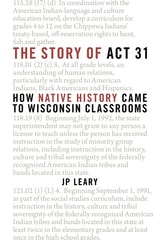
The Story of Act 31
How Native History Came to Wisconsin ClassroomsJ P Leary
Wisconsin Historical Society Press, 2018
Since its passage in 1989, a state law known as Act 31 requires that all students in Wisconsin learn about the history, culture, and tribal sovereignty of Wisconsin’s federally recognized tribes.
The Story of Act 31 tells the story of the law’s inception—tracing its origins to a court decision in 1983 that affirmed American Indian hunting and fishing treaty rights in Wisconsin, and to the violent public outcry that followed the court’s decision. Author J P Leary paints a picture of controversy stemming from past policy decisions that denied generations of Wisconsin students the opportunity to learn about tribal history.
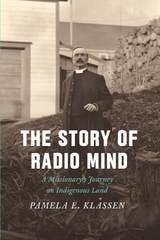
The Story of Radio Mind
A Missionary's Journey on Indigenous LandPamela E. Klassen
University of Chicago Press, 2018
Following Du Vernet’s journey westward from Toronto to Ojibwe territory and across the young nation of Canada, Pamela Klassen examines how contests over the mediation of stories—via photography, maps, printing presses, and radio—lucidly reveal the spiritual work of colonial settlement. A city builder who bargained away Indigenous land to make way for the railroad, Du Vernet knew that he lived on the territory of Ts’msyen, Nisga’a, and Haida nations who had never ceded their land to the onrush of Canadian settlers. He condemned the devastating effects on Indigenous families of the residential schools run by his church while still serving that church. Testifying to the power of radio mind with evidence from the apostle Paul and the philosopher Henri Bergson, Du Vernet found a way to explain the world that he, his church and his country made.
Expanding approaches to religion and media studies to ask how sovereignty is made through stories, Klassen shows how the spiritual invention of colonial nations takes place at the same time that Indigenous peoples—including Indigenous Christians—resist colonial dispossession through stories and spirits of their own.

The Story of the First Pawpsicle
Ariel Ojibway
Fifth Avenue Press, 2025
Did you ever wonder who made the first popsicles? Or if your ancestors made snow cones with maple syrup?
Me too!
I guess we'll never know who made the first frozen treat because the evidence was eaten long ago, but it's always fun to imagine new stories...
Wabooz has a brand new idea for a delicious treat, but will everything turn out as he hoped? Travel with him through the lands where the pawpaws grow in search of the perfect fruit!

The Storytelling Coloring Book
Ojibwe Traditions Coloring Book SeriesCassie Brown
Wisconsin Historical Society Press, 2018

The Sugarbush Coloring Book
Ojibwe Traditions Coloring Book SeriesCassie Brown
Wisconsin Historical Society Press, 2018
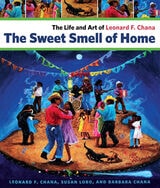
The Sweet Smell of Home
The Life and Art of Leonard F. ChanaLeonard F. Chana, Susan Lobo, and Barbara Chana
University of Arizona Press, 2009
He began his career by creating cards and soon was lending his art to posters and logos for many community-based Native organizations. Winning recognition from these groups, his work was soon actively sought by them. Chana’s work also appears on the covers and as interior art in a number of books on southwestern and American Indian topics.
The Sweet Smell of Home is an autobiographical work, written in Chana’s own voice that unfolds through oral history interviews with anthropologist Susan Lobo. Chana imparts the story of his upbringing and starting down the path toward a career as an artist. Balancing humor with a keen eye for cultural detail, he tells us about life both on and off the reservation.
Eighty pieces of art—26 in color—grace the text, and Chana explains both the impetus for and the evolution of each piece. Leonard Chana was a people’s artist who celebrated the extraordinary heroism of common people’s lives. The Sweet Smell of Home now celebrates this unique artist whose words and art illuminate not only his own remarkable life, but also the land and lives of the Tohono O’odham people
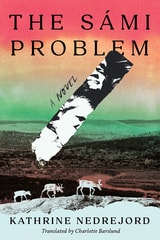
The Sámi Problem
A NovelKathrine Nedrejord
University of Minnesota Press, 2027
An incisive novel illuminating a young mother’s reckoning with her own identity and Sámi lineage through the lives and struggles of her ancestors
As a freelance journalist living in France, Marie Engmo has traveled far and wide to write about languages and local cultures threatened with extinction. But when she returns home to Norway for her áhkku’s (grandmother’s) funeral, she recognizes how far she has strayed from her own sense of self and her Sámi identity. Kathrine Nedrejord’s acclaimed novel—winner of Norway’s national book award—is the lucid and compelling story of Marie’s emotional search through her family’s past for a history and legacy that she might bequeath to her own infant daughter.
In spare and elegant prose, Nedrejord illuminates a young woman’s fierce and clear-eyed reckoning with the sacrifice and oppression that has marked the women and men in her family and generations of Indigenous Sámi communities in the northern reaches of Norway. As Marie awakens to the lengths her mother, grandmother, and great-grandmother traversed to survive discrimination and displacement, she uncovers and embodies their strength and dignity that are her—and her daughter’s—inheritance. What emerges is an unflinching examination of belonging to a minority that can never dominate, that will always have to negotiate and compromise its place in the world. As stirring as it is troubling, The Sámi Problem is itself an awakening and a literary triumph.
Retail e-book files for this title are screen-reader friendly.
The Tarahumara Rebellion of 1690
Embattled Settlers and Missionaries in Northern New SpainJoseph P. Sánchez
University of Arizona Press, 2025
Previous histories have interpreted this revolt, and other borderlands uprisings, as localized and spontaneous events aimed at rectifying specific grievances. Historian Joseph P. Sánchez argues that the revolts of the Tepehuanes and the Tarahumaras in northern New Spain, or Nueva Vizcaya, were well-planned, inspired by outside events, and drew in multiple communities and ethnicities. Drawing on a wealth of primary sources, including Jesuit accounts and archival documents, Sánchez offers a comprehensive narrative that challenges conventional interpretations of colonial Mexican uprisings.
Far from localized, the Indigenous rebellions in the northern Mexican borderlands during the colonial period were part of the overall Indigenous struggle for defense of homeland throughout the Americas. The Tarahumara Rebellion of 1690 brings together a rich history of localized events and broader historical trends and offers a compelling narrative that enriches our understanding of the colonial experience in northern New Spain.
The Trail of Tears across Missouri
Joan Gilbert
University of Missouri Press, 1996
As settlers moved beyond the eastern seaboard during the early nineteenth century, the government forced thousands of American Indians from their ancestral lands. The Cherokees, the largest and most important tribe in the Southeast, fought exile with a combination of passive resistance and national publicity for their plight. Because they had successfully resisted the government's efforts to move them from their homeland, their removal was particularly brutal when it finally came. The Trail of Tears across Missouri is a moving account of the 1837-1838 removal of the Cherokees from the southeastern United States to Indian Territory (now Oklahoma).
After providing an overview of the Cherokees' life in the Southeast and of the events leading up to their exile, Joan Gilbert traces the mass exodus state by state from Tennessee to Arkansas. Successive chapters highlight the experiences and the hardships endured by those forced to travel with inadequate supplies of food, clothing, and transportation. It is estimated that four thousand Cherokees, nearly a quarter of the tribe, died.
In bringing the grim realities of the forced march to life, Gilbert draws from such primary sources as letters, newspaper stories, and the writings of missionaries, guides, and doctors who accompanied them. She focuses on the Cherokees' experiences as they passed through Missouri, using the journals of Dr. W. I. I. Morrow and guide B. B. Cannon.
In addition to chronicling the removal of the Cherokees, Gilbert also brings the story up to date by describing how the nation lives today and how the Trail of Tears has been commemorated.
The Tree That Bends
Discourse, Power, and the Survival of Maskoki PeoplePatricia Riles Wickman
University of Alabama Press, 1999
In her compelling and controversial arguments, Wickman rejects the myths that erase Native Americans from Florida through the agency of Spaniards and diseases and make the area an empty frontier awaiting American expansion. Through research on both sides of the Atlantic and extensive oral history interviews among the Seminoles of Florida and Oklahoma, Wickman shatters current theories about the origins of the people encountered by the Spaniards and presents, for the first time ever, the Native American perspective. She describes the genesis of the groups known today as Creek, Seminole, and Miccosukee—the Maskoki peoples—and traces their common Mississippian heritage, affirming their claims to continuous habitation of the Southeast and Florida. Her work exposes the rhetoric of conquest and replaces it with the rhetoric of survival.
An important cross-disciplinary work, The Tree That Bends reveals the flexibility of the Maskoki people and the sociocultural mechanisms that allowed them to survive the pressures introduced at contact. Their world was capable of incorporating the New without destroying the Old, and their descendants not only survive today but also succeed as a discrete culture as a result.

The Truth About Stories
A Native NarrativeThomas King
University of Minnesota Press, 2005

The Tutor'd Mind
Indian Missionary-Writers in Antebellum AmericaBernd C. Peyer
University of Massachusetts Press, 1997
In the view of the English colonists and their descendants, Indian converts to Christianity were expected to repudiate native traditions and affirm the superiority of European civilization, to serve as role models, and to spread the gospel far into the wilderness. Yet as Bernd C. Peyer shows, Indian missionaries did not always fulfill the expectations of those who trained them. Once the Indians recognized that conversion alone did not guarantee protection from discrimination, they devised a variety of strategies, theological as well as practical, to resist assimilation into the dominant white culture. Making effective use of their literacy and education, they called attention to the discrepancy between the Protestant ideals they had been taught and the Anglo-American practices to which native people were subjected.
By uncovering this subtext of dissent and resistance, Peyer at once alters and enriches our understanding of the evolution of the American Indian literary tradition.
The View from Officers' Row
Army Perceptions of Western IndiansSherry L. Smith
University of Arizona Press, 1990
Capturing military men in contemplation rather than combat, Sherry L. Smith reveals American army officers' views about the Indians against whom they fought in the last half of the nineteenth century. She demonstrates that these officers—and their wives—did not share a monolithic, negative view of their enemies, but instead often developed a great respect for Indians and their cultures. Some officers even came to question Indian policy, expressed misgivings about their personal involvement in the Indian Wars, and openly sympathized with their foe.
The book reviews the period 1848–1890—from the acquisition of the Mexican Cession to the Battle of Wounded Knee—and encompasses the entire trans-Mississippi West. Resting primarily on personal documents drawn from a representative sample of the officer corps at all levels, the study seeks to juxtapose the opinions of high-ranking officers with those of officers of lesser prominence, who were perhaps less inclined to express personal opinions in official reports.
No educated segment of American society had more prolonged contact with Indians than did army officers and their wives, yet not until now has such an overview of their attitudes been presented. Smith's work demolishes the stereotype of the Indian-hating officer and broadens our understanding of the role of the army in the American West.
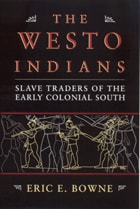
The Westo Indians
Slave Traders of the Early Colonial SouthEric E. Bowne
University of Alabama Press, 2005
A comprehensive study that rescues the Westo from obscurity.
The Westo Indians, who lived in the Savannah River region during the second half of the 17th century, are mentioned in few primary documents and only infrequently in secondary literature. There are no known Westo archaeological sites; no artifacts can be linked to the group; and no more than a single word of their language is known to us today. Yet, from the extant evidence, it is believed that the Westos, who migrated from around Lake Erie by 1656, had a profound effect on the development of the colonial South.
This volume reproduces excerpts from all 19 documents that indisputably reference the Westos, although the Europeans referred to them by a variety of names. Most of the information was written by Lords Proprietors who never met the Westos, or by a handful of Carolinians who did. But the author is able to chart a highly plausible history of this Native group who, for a period, thrived on the Southern frontier.
The narrative traces their northeastern origins and how the Erie conflicts with the Five Nations Iroquois in the Beaver Wars forced them southward, where they found new economic opportunities in the lucrative slave trade. At the height of their influence, between 1659 and 1680, it is believed the Westos captured and sold several thousand Indians from Spanish Florida, often trading them for guns. Eventually, their military advantage over the Indians of the lower South was compromised by the rise of powerful confederacies of native peoples, who could acquire equivalent firearms from the Europeans. Even though the aggressive Westos declined, they had influenced profound change in the Southeast. They furthered the demise of chiefly organization, helped to shift the emphasis from agricultural to hunting economies, and influenced the dramatic decrease in the number and diversity of native polities.
The Wild Ricing Coloring and Activity Book
Ojibwe Traditions Coloring Book SeriesCassie Brown
Wisconsin Historical Society Press, 2018
The Woman At Otowi Crossing
Frank Waters
Ohio University Press, 1987
Based on the real life of Edith Warner, who ran a tearoom at Otowi Crossing, just below Los Alamos, The Woman at Otowi Crossing is the story of Helen Chalmer, a person in tune with her adopted environment and her neighbors in the nearby Indian pueblo and also a friend of the first atomic scientists. The secret evolution of atomic research is a counterpoint to her psychic development.
In keeping with its tradition of allowing the best of its list to thrive, Ohio University Press/Swallow Press is particularly proud to reissue The Woman at Otowi Crossing by best-selling author Frank Waters. This new edition features an introduction by Professor Thomas J. Lyon and a foreword by the author’s widow, Barbara Waters.
The story is quintessential Waters: a parable for the potentially destructive materialism of the mid-twentieth century. The antidote is Helen Chalmer’s ability to understand a deeper truth of her being; beyond the Western notion of selfhood, beyond the sense of a personality distinct from the rest, she experiences a new and wider awareness.
The basis for an opera of the same name, The Woman at Otowi Crossing is the powerful story of the crossing of cultures and lives: a fable for our times.
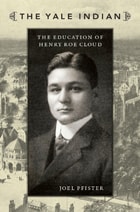
The Yale Indian
The Education of Henry Roe CloudJoel Pfister
Duke University Press, 2009
Roe Cloud’s white-collar activism was entwined with the Progressive Era formation of an Indian professional and managerial class, a Native “talented tenth,” whose members strategically used their contingent entry into arenas of white social, intellectual, and political power on behalf of Indians without such access. His Yale training provided a cross-cultural education in class-structured emotions and individuality. While at Yale, Roe Cloud was informally adopted by a white missionary couple. Through them he was schooled in upper-middle-class sentimentality and incentives. He also learned how interracial romance could jeopardize Indian acceptance into their class. Roe Cloud expanded the range of what modern Indians could aspire to and achieve.
Their Determination to Remain
A Cherokee Community's Resistance to the Trail of Tears in North CarolinaLance Greene
University of Alabama Press, 2023
The remarkable story of a North Carolina Cherokee community who avoided forced removal on the Trail of Tears
During the 1838 forced Cherokee removal by the US government, a number of close-knit Cherokee communities in the Southern Appalachian Mountains refused to relinquish their homelands, towns, and way of life. Using a variety of tactics, hundreds of Cherokees avoided the encroaching US Army and remained in the region.
In his book Their Determination to Remain: A Cherokee Community’s Resistance to the Trail of Tears in North Carolina, Lance Greene explores the lives of wealthy plantation owners Betty and John Welch who lived on the southwestern edge of the Cherokee Nation. John was Cherokee and Betty was White. Although few Cherokees in the region participated in slavery, the Welches held nine African Americans in bondage.
During removal, the Welches assisted roughly 100 Cherokees hiding in the steep mountains. Afterward, they provided land for these Cherokees to rebuild a new community, Welch’s Town. Betty became a wealthy and powerful plantation mistress because her husband could no longer own land. Members of Welch’s Town experienced a transitional period in which they had no formal tribal government or clear citizenship yet felt secure enough to reestablish a townhouse, stickball fields, and dance grounds.
Greene’s innovative study uses an interdisciplinary approach, incorporating historical narrative and archaeological data, to examine how and why the Welches and members of Welch’s Town avoided expulsion and reestablished their ways of life in the midst of a growing White population who resented a continued Cherokee presence. The Welch strategy included Betty’s leadership in demonstrating outwardly their participation in modern Western lifestyles, including enslavement, as John maintained a hidden space—within the boundaries of their land—for the continuation of traditional Cherokee cultural practices. Their Determination to Remain explores the complexities of race and gender in this region of the antebellum South and the real impacts of racism on the community.
They Met at Wounded Knee
The Eastmans' StoryGretchen Cassel Eick
University of Nevada Press, 2020
They Sang for Horses
The Impact of the Horse on Navajo and Apache FolkloreLaVerne Harrell Clark
University Press of Colorado, 2001
No Native American groups placed more emphasis on the horse in their lives than did the Navajo and Apache of the Southwest. They Sang for Horses, first published in 1966 and now considered a classic, remains the only comprehensive treatment of the profound mystical influence that the horse has exerted for more than 300 years.
In this completely redesigned and expanded edition, LaVerne Harrell Clark examines how storytellers, singers, medicine men, and painters created the animal's evolving symbolic significance by adapting existing folklore and cultural symbols. Exploring the horse's importance in ceremonies, songs, prayers, customs, and beliefs, she investigates the period of the horse's most pronounced cultural impact on the Navajo and the Apache, starting from the time of its acquisition from the Spanish in the seventeenth century and continuing to the mid-1960s, when the pickup truck began to replace it as the favored means of transportation. In addition, she presents a look at how Navajos and Apaches today continue to redefine the horse's important role in their spiritual as well as material lives.
This classic work is a must for historians, readers interested in Native American folklore and mythology, and anyone who has ever been captivated by the magic and romance of the horse.
This Is the Route of My Forefathers
The 1837 Ioway MapWilliam Green
University of Iowa Press, 2025
Illustrating nearly 200 years of Ioway history, the 1837 Ioway map provides insights into the tribe’s political and diplomatic strategies, their relationships with neighboring nations, and how they resisted and negotiated in the face of dispossession. This Is the Route of My Forefathers uses an interdisciplinary approach to reveal how group accounts may fade over time, while accounts of origin—legendary histories—remain rich and vibrant.
Those Who Belong
Identity, Family, Blood, and Citizenship among the White Earth AnishinaabegJill Doerfler
Michigan State University Press, 2015
Through an Indian's Looking-Glass
A Cultural Biography of William Apess, PequotDrew Lopenzina
University of Massachusetts Press, 2017
The life of William Apess (1798–1839), a Pequot Indian, Methodist preacher, and widely celebrated writer, provides a lens through which to comprehend the complex dynamics of indigenous survival and resistance in the era of America's early nationhood. Apess's life intersects with multiple aspects of indigenous identity and existence in this period, including indentured servitude, slavery, service in the armed forces, syncretic engagements with Christian spirituality, and Native struggles for political and cultural autonomy. Even more, Apess offers a powerful and provocative voice for the persistence of Native presence in a time and place that was long supposed to have settled its “Indian question” in favor of extinction.
Through meticulous archival research, close readings of Apess's key works, and informed and imaginative speculation about his largely enigmatic life, Drew Lopenzina provides a vivid portrait of this singular Native American figure. This new biography will sit alongside Apess's own writing as vital reading for those interested in early America and indigeneity.

Tiger Duff
India, Madeira and Empire in Eighteenth-Century ScotlandAlistair Mutch
Aberdeen University Press, 2017
Timber!
A Northwoods Story of Lumberjacks, Logging, and the LandSusan Apps-Bodilly
Wisconsin Historical Society Press, 2024
How did the logging boom begin? What was it like to work in the woods? What happened to the land after the trees were cut down? The latest book for young readers from father-daughter duo Jerry Apps and Susan Apps-Bodilly explores the origin story of Wisconsin’s logging boom, the devastation it caused to the land, and the extraordinary efforts to restore the cutover land and log sustainably.
Timber! helps young readers examine a complex and pivotal chapter in our state and nation’s history, covering a wide range of topics, including:
• how Native people used, shared, and relied on natural resources for thousands of years
• the forced removal of Native people from forested lands
• how the lumber industry made possible the westward expansion of the United States
• what it was like to work in a logging camp, on a log drive, and inside a sawmill
• the roles on a logging team, from sawyer to cook
• the destructive legacy of early logging practices and early efforts to restore the land
• the emergence of sustainable forestry practices
This comprehensive yet easy-to-read history includes letters, postcards, and other primary sources paired with discussion questions designed to engage young readers’ creativity and critical-thinking skills. Timber! also features more than 100 images, a glossary, suggested activities, and an extensive list of related resources, including books, websites, teaching materials, museums, and outdoor places to visit. Timber! will inspire readers of all ages to explore, protect, and learn about trees and forests in their own communities.
To Show Heart
Native American Self-Determination and Federal Indian Policy, 1960-1975George Pierre Castile
University of Arizona Press, 1998
To Show Heart is a detailed and unbiased account of one of the least understood periods in Indian affairs. It tells how "termination" became a political embarrassment during the civil rights movement, how Lyndon Johnson's War on Poverty prompted politicians to rethink Indian policy, and how championing self-determination presented an opportunity for Presidents Nixon and Ford to "show heart" toward Native Americans. Along the way, Castile assesses the impact of the Indian activism of the 1960s and 1970s and offers an objective view of the American Indian Movement and the standoff at Wounded Knee. He also discusses the recent history of individual tribes, which gives greater meaning to decisions made at the national level. Castile's work greatly enhances our understanding of the formulation of current Indian policy and of the changes that have occurred since 1975. To Show Heart is an important book not only for anthropologists and historians but also for Native Americans themselves, who will benefit from this inside look at how bureaucrats have sought to determine their destinies.
To Show What an Indian Can Do
Sports at Native American Boarding SchoolsJohn Bloom
University of Minnesota Press, 2005