Results by title
1787 books match the query 'Literary Collections' and 471 start with t

The Integrated Life
Essays, Sketches and PoemsThomas P. Beyer
University of Minnesota Press, 1948
The Integrated Life was first published in 1948. Minnesota Archive Editions uses digital technology to make long-unavailable books once again accessible, and are published unaltered from the original University of Minnesota Press editions.
This volume of essays and poems is representative of the work and life of their author, a professor of English at Hamline University and for any years chairman of the department.
Of the essays, some are personal, others works of literary appreciation, and still others discuss the profession of teaching, in particular the teaching of English; all reveal the man who wrote them.
At Hamlin Dr. Beyer and reading have been almost synonymous. He proposed the general reading course in 1921 and directed it for twelve years. Students alert to this form of inspiration found existing delight not only in the outside reading but in the discussions with faculty members which followed. Colleagues and off-campus friends also came under provocative influence of Dr. Beyer, and his guidance has been frequently and freely acknowledged.
When Dr. Beyer was honored in 1947 for his long fruitful association with Hamline University, a publication fund was established. It was unanimously agreed that a collection of Dr. Beyer's own essays, poems, and sketches should be the first venture. The Integrated Life is that volume. No attempt has been made to bring the material up to date. The collection appears as it was written—full of the flavor and wisdom of a truly honorable teacher and friend.
The Interval of Freedom
Soviet Literature During the Thaw, 1954-1957George Gibian
University of Minnesota Press, 1960
The Interval of Freedom was first published in 1960. Minnesota Archive Editions uses digital technology to make long-unavailable books once again accessible, and are published unaltered from the original University of Minnesota Press editions.
When Boris Pasternak's Doctor Zhivago was published in Europe and America in 1957 and 1958, the Western world was astonished and elated. But Doctor Zhivago is not the only significant literary work to come out of Soviet Russia recently. During four extraordinary years, 1954 to 1957, from Stalin's death to the aftermath of the Hungarian revolt, Soviet Russian authors were able to express their minds with unusual freedom. In this volume Professor Gibian examines various revelations made in Soviet literature during this interval of comparative freedom.
Nearly a score of contemporary Soviet writers are considered in detail. The authors and their works are grouped according to three major subjects to which Soviet writers have devoted much attention: science, love and sex, and the literary villain or "negative" character. Works of the following writers are discussed in depth: Alexander Bek, Leonid Leonov, Daniel Granin, Venyamin Kaverin, Vladimir Dudintsev, Semen Kirsanov, S. Aleshin, Viktor Nekrasov, Nikolai Pogodin, Galina Nikolaeva, Alexander Korneichuk, Alexander Shtein, Alexander Volodin, Nikolai Gorbunov, Nikolai Zhdanov, and Alexander Yahin. An entire chapter is devoted to Doctor Zhivago. In an introductory chapter, the author provides a survey of literary developments during the interval of freedom. In a final chapter he draws conclusions about the nature of the thinking of Soviet literary intelligentsia, comparing it with Western literary thought. The book is illuminating from social and political as well as literary viewpoints.
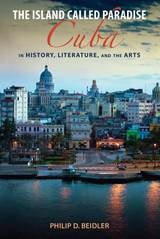
The Island Called Paradise
Cuba in History, Literature, and the ArtsPhilip D. Beidler
University of Alabama Press, 2014
In The Island Called Paradise, Philip D. Beidler shares his personal discovery of the vast, rich, and astonishing history of the island of Cuba and the interrelatedness of Cuba and the US.
Cuba first entered Beidler’s consciousness in the early 1960s when he watched with mesmerized anxiety the televised reports of the Cuban missile crisis, a conflict that reduced a multifaceted, centuries-old history between North America and Cuba to the stark duotones of Cold War politics. Fifty years later, when Beidler traveled to the US’s island neighbor, he found a Cuba unlike the nation portrayed in truculent political rhetoric or in the easy preconceptions of US popular culture. Instead he found an entrancing people and landscape with deep historical connections to the US and a dazzling culture that overwhelmed his creative spirit.
In twelve original essays, Beidler reintroduces to English-speaking readers many of the central figures, both real and literary, of Cuban and Cuban-American history. Meet Cecilia Valdés, the young mixed-race heroine of a 1839 novel that takes readers to the poor streets and sumptuous salons of Spanish colonial Cuba, and Narciso López, a real-life Venezuelan adventurer and filibustero who attempted to foment a Cuban uprising against Spain. Both would have been familiar figures to nineteenth-century Americans. Beidler also visits the twentieth-century lives of “the two Ernestos” (Ernest Hemingway and Che Guevara), and the pop-culture Cuban icon Ricky Ricardo.
A country not with one history but multiple layers of history, Cuba becomes a fertile island for Beidler’s exploration. Art, he argues, perpetually crosses walls erected by politics, history, and nationality. At its core, The Island Called Paradise renews and refreshes our knowledge of an older Atlantic world even as we begin to envision a future in which the old bonds between our nations may be restored.
The Journey of a Caribbean Writer
Maryse Condé
Seagull Books, 2014
Even while paying homage to her intellectual and literary influences—including Frantz Fanon, Leopold Sedar Senghor, and Aimé Césaire—Condé establishes in these pages the singularity of her vision and the reason for the enormous admiration that her writing has garnered from readers and critics alike.
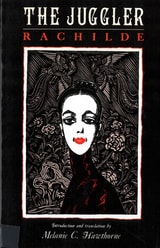
The Juggler
RachildeHawthorne, Melanie C
Rutgers University Press, 1990
The Juggler (La Jongleuse) is a "decadent" novel that was first published in 1900. Its author, Marguerite Vallette-Eymery (1860-1953), who used the pseudonym Rachilde, was a prolific novelist (over sixty works of fiction), playwright, literary critic and reviewer, and a forceful presence in French literary society of her time.
The protagonist of the novel, Eliante Donalger, is in some sense an exaggerated double for her creator--bizarre in appearance, clothing, and interests. Instinctively grasping a medical and psychological truth that the turn-of-the-century scientific world was only beginning to understand, Eliante maintains that there is nothing "natural" about human sexual expression. She claims to be in love with an inanimate (though anthropomorphic and sexually ambiguous) object, a Greek amphora, and the novel traces the rivalry between this faithful partner and an ardent human suitor, a young medical student. It is only through juggling, both literally and metaphorically, that Eliante is able to use her seductive power to maintain desire. The surprise ending challenges the limits of such power in a controversial and surprising twist.
Although Rachilde's work has been neglected in the past, the women's movement and feminist criticism have stimulated renewed interest in her fiction. The Juggler is a major rediscovery.
The Jungles of Arkansas
A Personal History of the Wonder StateRobert Lancaster
University of Arkansas Press, 1989
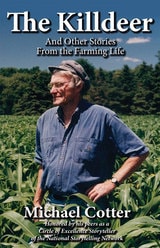
The Killdeer
And Other Stories From the Farming LifeMichael Cotter
Parkhurst Brothers, Inc., 2014
--Rex Ellis, Director of Museum programs, Smithsonian Institution, Washington, D.C.
The Knight and His Shadow
Boubacar Boris Diop
Michigan State University Press, 2015
The Land Still Lives
Jerry Apps
Wisconsin Historical Society Press, 2019
Originally published in 1970, The Land Still Lives is the first book by Wisconsin’s greatest rural philosopher, Jerry Apps. Written when he was still a young agriculture professor at the University of Wisconsin, The Land Still Lives was readers’ first introduction to Jerry’s farm in central Wisconsin, called Roshara, and the surrounding community of Skunk’s Hollow. This special 50th-anniversary edition features a new epilogue, in which Jerry revisits his philosophy of caring for the land so it in turn will care for us. This is vintage Apps, essential reading for Jerry’s legions of fans—and for all who, like Jerry, wish “to develop a relationship with nature and all its mystery and wonder.”
The Landrum-Griffin Act and Union Democracy
Doris B. McLaughlin and Anita L.W. Schoomaker
University of Michigan Press, 1979
The Last Supper of Chicano Heroes
Selected Works of José Antonio BurciagaJosé Antonio Burciaga; Edited by Mimi R. Goldstein and Daniel Chacón
University of Arizona Press, 2008
Best known for his books Weedee Peepo, Drink Cultura, and Undocumented Love, Burciaga was also a poet, cartoonist, founding member of the comedy troupe Cultura Clash, and a talented muralist whose well-known work The Last Supper of Chicano Heroes became almost more famous than the man. This first and only collection of Burciaga’s work features thirty-eight illustrations and incorporates previously unpublished essays and drawings, including selections from his manuscript “The Temple Gang,” a memoir he was writing at the time of his death. In addition, Gladstein and Chacón address Burciaga’s importance to Chicano letters.
A joy to read, this rich compendium is an important contribution not only to Chicano literature but also to the preservation of the creative, spiritual, and political voice of a talented and passionate man.
The Latin American Ecocultural Reader
Edited by Jennifer French and Gisela Heffes
Northwestern University Press, 2021
The Latin American Ecocultural Reader is a comprehensive anthology of literary and cultural texts about the natural world. The selections, drawn from throughout the Spanish-speaking countries and Brazil, span from the early colonial period to the present. Editors Jennifer French and Gisela Heffes present work by canonical figures, including José Martí, Bartolomé de las Casas, Rubén Darío, and Alfonsina Storni, in the context of our current state of environmental crisis, prompting new interpretations of their celebrated writings. They also present contemporary work that illuminates the marginalized environmental cultures of women, indigenous, and Afro-Latin American populations. Each selection is introduced with a short essay on the author and the salience of their work; the selections are arranged into eight parts, each of which begins with an introductory essay that speaks to the political, economic, and environmental history of the time and provides interpretative cues for the selections that follow.
The editors also include a general introduction with a concise overview of the field of ecocriticism as it has developed since the 1990s. They argue that various strands of environmental thought—recognizable today as extractivism, eco-feminism, Amerindian ontologies, and so forth—can be traced back through the centuries to the earliest colonial period, when Europeans first described the Americas as an edenic “New World” and appropriated the bodies of enslaved Indians and Africans to exploit its natural bounty.
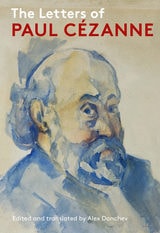
The Letters of Paul Cézanne
Alex Danchev
J. Paul Getty Trust, The, 2013
Revered and misunderstood by his peers and lauded by later generations as the father of modern art, Paul Cézanne (1839-1906) has long been a subject of fascination for artists and art lovers, writers, poets, and philosophers. His life was a ceaseless artistic quest, and he channeled much of his wide-ranging intellect and ferocious wit into his letters. Punctuated by exasperated theorizing and philosophical reflection, outbursts of creative ecstasy and melancholic confession, the artist’s correspondence reveals both the heroic and all-toohuman qualities of a man who is indisputably among the pantheon of all-time greats.
This new translation of Cézanne’s letters includes more than twenty that were previously unpublished and reproduces the sketches and caricatures with which Cézanne occasionally illustrated his words. The letters shed light on some of the key artistic relationships of the modern period—about one third of Cézanne’s more than 250 letters are to his boyhood companion Émile Zola, and he communicated extensively with Camille Pissarro and the dealer Ambroise Vollard. The translation is richly annotated with explanatory notes, and, for the first time, the letters are cross-referenced to the current catalogue raisonné. Numerous inaccuracies and archaisms in the previous English edition of the letters are corrected, and many intriguing passages that were unaccountably omitted have been restored. The result is a publishing landmark that ably conveys Cézanne’s intricacy of expression.
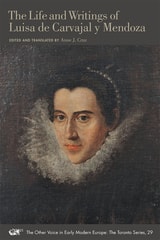
The Life and Writings of Luisa de Carvajal y Mendoza
Luisa de Carvajal y Mendoza, Edited by Anne J. Cruz, Translated by Anne J. Cruz
Iter Press, 2014
The Life of Adam and Eve in Greek
A Critical EditionJohannes Tromp
SBL Press, 2016
A Brill classic now in paperback from SBL Press
This critical edition of the Life of Adam and Eve in Greek is based on all available manuscripts. In the introduction the history of previous research is summarized, and the extant manuscripts are presented. Next comes a description of the grammatical characteristics of the manuscripts’ texts, followed by a detailed study of the genealogical relationships between them, resulting in a reconstruction of the writing’s history of transmission in Greek. On the basis of all this information, the Greek text of the Life of Adam and Eve in its earliest attainable stage, is established.
Features:
- Illustrations of textual relationships and variants
- Indices for subjects, passages, words in the text, variants, and additions and revisions Full critical apparatus with relevant evidence from the manuscripts
The Life of Texts
An Introduction to Literary StudiesKiene Brillenburg Wurth
Amsterdam University Press, 2019
The Life of Texts is designed around particular issues rather than the history of the discipline as such. Each chapter concentrates on a different aspect of 'the life of texts' and introduces the key debates and concepts relevant to its study. The issues discussed range from aesthetics and narrative to intertextuality and intermediality, from reading practices to hermeneutics and semiotics, popular culture to literary canonisation, postcolonial criticism to cultural memory. Key concepts and schools in the field have been highlighted in the text and then collected in a glossary for ease of reference. All chapters are richly illustrated with examples from different language areas.
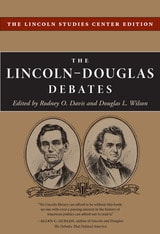
The Lincoln-Douglas Debates
The Lincoln Studies Center EditionEdited by Rodney O. Davis and Douglas L. Wilson
University of Illinois Press, 2014
While the debates between Abraham Lincoln and Stephen A. Douglas are undoubtedly the most celebrated in American history, they may also be the most consequential as well. For the issues so fiercely debated in 1858 were about various interrelated aspects of one momentous, nation-threatening issue: slavery. The contest between Lincoln and Douglas became a testing ground for the viability of conflicting ideals in a nation deeply divided. One of the most colorful and engaging episodes in American history, this series of debates is of enduring interest as an illuminating instance of the ever-recurring dilemma of self-government: what happens when the guiding principle of democracy, "popular sovereignty," confronts a principled stand against a "moral, social, and political evil"? The tragic answer in this case came three years later: civil war.
Important as they are, the Lincoln-Douglas debates have long since ceased to be self-explanatory. This edition is the first to provide a text founded on all known records, rather than following one or another of the partisan and sometimes widely-varying newspaper accounts. Meticulously edited and annotated, it provides numerous aids to help the modern reader understand the debates, including extensive introductory material, commentary, and a glossary. The fullest and most dependable edition of the Lincoln-Douglas debates ever prepared, this edition brings readers as close as possible to the original words of these two remarkable men.

The Literary Guide and Companion to Southern England
Revised EditionRobert M. Cooper
Ohio University Press, 1998
In a series of intriguing routes through the English countryside, Professor Robert Cooper notes those attractions that the casual tourist might unknowingly pass by, such as the house where Dickens wrote A Tale of Two Cities, or the windswept quay where John Fowles’s French Lieutenant’s woman walked. Maps and information about restaurants and accommodations give the traveler the opportunity of having pints of “half and half” where Jane Austen dined or visiting the pub where Blake’s scuffle led to his trial for treason.
This newly revised and updated edition of Robert Cooper’s acclaimed handbook combines the utility of current travel information with the appeal of literary history, biography, and anecdote in a leisurely and flavorful guide to the broad sweep of southern England outside of London. A rich and reliable guide to the landscape that fostered one of our most cherished cultures, The Literary Guide and Companion to Southern England is an indispensable resource for those who wish to experience literature firsthand.
The Literature of the Ozarks
An AnthologyPhillip Douglas Howerton
University of Arkansas Press, 2019
The job of regional literature is twofold: to explore and confront the culture from within, and to help define that culture for outsiders. Taken together, the two centuries of Ozarks literature collected in this ambitious anthology do just that. The fiction, nonfiction, poetry, and drama presented in The Literature of the Ozarks complicate assumptions about backwoods ignorance, debunk the pastoral myth, expand on the meaning of wilderness, and position the Ozarks as a crossroads of human experience with meaningful ties to national literary movements.
Among the authors presented here are an Osage priest, an early explorer from New York, a native-born farm wife, African American writers who protested attacks on their communities, a Pulitzer Prize–winning poet, and an art history professor who created a fictional town and a postmodern parody of the region’s stereotypes.
The Literature of the Ozarks establishes a canon as nuanced and varied as the region’s writers themselves.
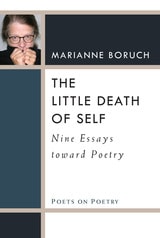
The Little Death of Self
Nine Essays toward PoetryMarianne Boruch
University of Michigan Press, 2017
The line between poetry (the delicate, surprising not-quite) and the essay (the emphatic so-there!) is thin, easily crossed. Both welcome a deep mulling-over, endlessly mixing image and idea and running with scissors; certainly each distrusts the notion of premise or formulaic progression. Marianne Boruch’s essays in The Little Death of Self emerged by way of odd details or bothersome questions that would not quit—Why does the self grow smaller as the poem grows enormous? Why does closure in a poem so often mean keep going? Must we stalk the poem or does the poem stalk us until the world clicks open?
Boruch’s intrepid curiosity led her to explore fields of expertise about which she knew little: aviation, music, anatomy, history, medicine, photography, fiction, neuroscience, physics, anthropology, painting, and drawing. There’s an addiction to metaphor here, an affection for image, sudden turns of thinking, and the great subjects of poetry: love, death, time, knowledge. There’s amazement at the dumb luck of staying long enough in an inkling to make it a poem at all. Poets such as Keats, Stevens, Frost, Plath, Auden, and Bishop, along with painters, inventors, doctors, scientists, composers, musicians, neighbors, friends, and family—all traffic blatantly or under the surface—and one gets a glimpse of such fellow travelers now and then.
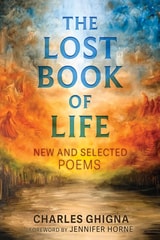
The Lost Book of Life
New and Selected PoemsCharles Ghigna, Foreword by Jennifer Horne
University of Alabama Press, 2026
A poetic journey through five decades of wonder, memory, and love, where the ordinary becomes sacred and every line leads home
Spanning five decades of poetic mastery, The Lost Book of Life: New and Selected Poems is the definitive collection from Charles Ghigna, a beloved and influential voice in contemporary Southern poetry. Drawing from fourteen previous volumes and featuring thirty-seven new poems, this landmark collection captures the full arc of Ghigna’s creative evolution, from his early meditations on nature and family to his later reflections on memory, mortality, and the enduring power of love.
With graceful shifts between free verse and traditional forms, Ghigna’s voice is both intimate and expansive—clear as spring water, alive with wit, and steeped in feeling. His poems open doorways into childhood’s bright dreaming, the quiet complexities of fatherhood, and the sacred hush of daily life. Ghigna invites readers to see the world anew, to find beauty in the familiar, and to embrace the sacred in the ordinary. For longtime admirers and new readers alike, The Lost Book of Life is a luminous testament to a life devoted to poetry. It is both compass and keepsake: a celebration of poetry’s enduring light, and a lasting gift to the literature of the American South.
The Lost Roads Project
A Walk-in Book of ArkansasC.D. Wright
University of Arkansas Press, 1994
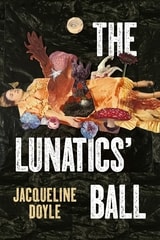
The Lunatics' Ball
Jacqueline Doyle
The Ohio State University Press, 2027
“There must have been more of us, hidden from sight, or slipping off the family tree like leaves in autumn, unnoticed.” Compelled by grief over the suicide of her beloved aunt and by her own bipolar diagnosis, Jacqueline Doyle set out to discover more about their shared disorder and the ways society has punished women it labels “mad.” Her genre-bending collection, The Lunatics’ Ball, grew into something larger than she expected: a collective (auto)biography combining her aunt’s story and her own with those of more than thirty “lunatic” forebears whose histories have been misrepresented or lost. Some are well known, such as Sylvia Plath, Nina Simone, and Zelda Fitzgerald—the latter who died in a locked room in a mental hospital fire. Others are lesser known, such as Lorina Bulwer, who stitched her story into enormous patchwork tapestries; Violet Gibson, incarcerated in an asylum for decades after attempting to assassinate Mussolini; and the writer Janet Frame, who narrowly escaped a lobotomy. In this fearless work that is equal parts imaginative brilliance and exacting historical inquiry, Doyle expands the boundaries of memoir and creates a new community in the face of stigma and repression.
The Maestro, the Magistrate and the Mathematician
A NovelTendai Huchu
Ohio University Press, 2016
The Making of Pioneer Wisconsin
Voices of Early SettlersMichael E. Stevens
Wisconsin Historical Society Press, 2018
The Making of Pioneer Wisconsin provides a unique and intimate glimpse into the lives of these early settlers, as they describe what it felt like to be a teenager in a wagon heading west or an isolated young wife living far from her friends and family. Woven together with context provided by historian Michael E. Stevens, these first-person accounts form a fascinating narrative that deepens our ability to understand and empathize with Wisconsin’s early pioneers.
The Making of a Mystic
New and Selected Letters of Evelyn UnderhillEvelyn Underhill. Edited by Carol Poston.
University of Illinois Press, 2010
In time for the centennial celebration of her classic Mysticism, this volume of Underhill's letters will enable readers and researchers to follow her as she reconciled her beliefs with her daily life. The letters reveal her personal and theological development and clarify the relationships that influenced her life and work. Hardly aloof, she enjoyed the interests, mirth, and compassion of close friendships.
Drawing from collections previously unknown to scholars, The Making of a Mystic shows the range of Evelyn Underhill's mind and interests as well as the immense network of her correspondents, including Sir James Frazier and Nobel Prize laureate Rabindranath Tagore. This substantial selection of Underhill's correspondence demonstrates an exceptional scope, beginning with her earliest letters from boarding school to her mother and extending to a letter written to T. S. Eliot from what was to be her deathbed in London in 1941 as the London Blitz raged around her.

The Male Malady
Fictions of Impotence in the French Romantic NovelWaller, Margaret
Rutgers University Press, 1992
The Man Who Created Paradise
A FableGene Logsdon
Ohio University Press, 2001
Gene Logsdon’s The Man Who Created Paradise is a message of hope at a time when the very concept of earth stewardship is under attack. The fable, inspired by a true story, tells how Wally Spero looked at one of the bleakest places in America—a raw and barren strip-mined landscape—and saw in it his escape from the drudgery of his factory job. He bought an old bulldozer and used the machine to carve patiently, acre by acre, a beautiful little farm out of a seemingly worthless wasteland.
Wally’s story is a charming distillation of the themes that the late, beloved Gene Logsdon returned to again and again in his many books and hundreds of articles. Environmental restoration is the task of our time. The work of healing our land begins in our own backyards and farms, in our neighborhoods and our regions. Humans can turn the earth into a veritable paradise—if they really want to.
Noted photographer Gregory Spaid retraced the trail that Logsdon traveled when he was inspired to write The Man Who Created Paradise. His photographs evoke the same yearning for wholeness, for ties to land and community, that infuses the fable’s poetic prose.
The Man with the Black Coat
Russia's Literature of the AbsurdDaniil Kharms and Alexander Vvedensky
Northwestern University Press, 1997
The Marriage of Heaven and Hell
William Blake
Bodleian Library Publishing, 2011
This new facsimile edition of The Marriage of Heaven and Hell includes a plate-by-plate guide to the texts, interlinear figures, and larger designs in a commentary accompanying the transcript of each reproduced plate. Drawings from Blake’s manuscript notebook, which were used as a basis for the designs, as well as working proof impressions, are also included, demonstrating the evolution of the work. This edition also reproduces a single plate from each of the other eight surviving copies, revealing how over a period of more than thirty years Blake altered the way he finished each copy. An introduction explores the book's literary and historical background, Blake’s printing process, and the book's anonymous initial publication.
This expertly edited work is available for students and scholars in paperback and for collectors in a special hardcover edition. Both versions allow Blake’s vision to reassert its breathtaking power.
The Marriage of Heaven and Hell
William Blake
Bodleian Library Publishing, 2011
This new facsimile edition of The Marriage of Heaven and Hell includes a plate-by-plate guide to the texts, interlinear figures, and larger designs in a commentary accompanying the transcript of each reproduced plate. Drawings from Blake’s manuscript notebook, which were used as a basis for the designs, as well as working proof impressions, are also included, demonstrating the evolution of the work. This edition also reproduces a single plate from each of the other eight surviving copies, revealing how over a period of more than thirty years Blake altered the way he finished each copy. An introduction explores the book's literary and historical background, Blake’s printing process, and the book's anonymous initial publication.
This expertly edited work is available for students and scholars in paperback and for collectors in a special hardcover edition. Both versions allow Blake’s vision to reassert its breathtaking power.
The Martyrdom of Maev and Other Irish Stories
Harold Frederic
Catholic University of America Press, 2015
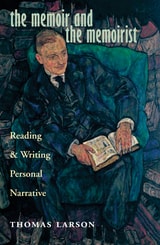
The Memoir and the Memoirist
Reading and Writing Personal NarrativeThomas Larson
Ohio University Press, 2007
The memoir is the most popular and expressive literary form of our time. Writers embrace the memoir and readers devour it, propelling many memoirs by relative unknowns to the top of the best-seller list. Writing programs challenge authors to disclose themselves in personal narrative. Memoir and personal narrative urge writers to face the intimacies of the self and ask what is true.
In The Memoir and the Memoirist, critic and memoirist Thomas Larson explores the craft and purpose of writing this new form. Larson guides the reader from the autobiography and the personal essay to the memoir—a genre focused on a particularly emotional relationship in the author’s past, an intimate story concerned more with who is remembering, and why, than with what is remembered.
The Memoir and the Memoirist touches on the nuances of memory, of finding and telling the truth, and of disclosing one’s deepest self. It explores the craft and purpose of personal narrative by looking in detail at more than a dozen examples by writers such as Mary Karr, Frank McCourt, Dave Eggers, Elizabeth Wurtzel, Mark Doty, Nuala O’Faolain, Rick Bragg, and Joseph Lelyveld to show what they reveal about themselves. Larson also opens up his own writing and that of his students to demonstrate the hidden mechanics of the writing process.
For both the interested reader of memoir and the writer wrestling with the craft, The Memoir and the Memoirist provides guidance and insight into the many facets of this provocative and popular art form.
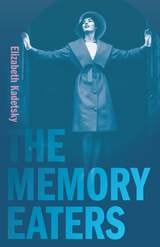
The Memory Eaters
Elizabeth Kadetsky
University of Massachusetts Press, 2020
As her mother loses her grasp on their shared history, Elizabeth Kadetsky sifts through boxes of the snapshots, newspaper clippings, pamphlets, and notebooks that remain, hoping to uncover the memories that her mother is actively losing as her dementia progresses. These remnants offer the false yet beguiling suggestion that the past is easy to reconstruct—easy to hold.
At turns lyrical, poignant, and alluring, The Memory Eaters tells the story of a family's cyclical and intergenerational incidents of trauma, secret-keeping, and forgetting in the context of 1970s and 1980s New York City. Moving from her parents' divorce to her mother's career as a Seventh Avenue fashion model and from her sister's addiction and homelessness to her own experiences with therapy for post-traumatic stress disorder, Kadetsky takes readers on a spiraling trip through memory, consciousness fractured by addiction and dementia, and a compulsion for the past salved by nostalgia.
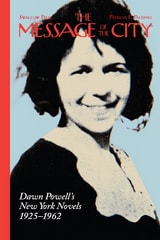
The Message of the City
Dawn Powell’s New York Novels, 1925–1962Patricia E. Palermo
Ohio University Press, 2016
Dawn Powell was a gifted satirist who moved in the same circles as Dorothy Parker, Ernest Hemingway, renowned editor Maxwell Perkins, and other midcentury New York luminaries. Her many novels are typically divided into two groups: those dealing with her native Ohio and those set in New York. “From the moment she left behind her harsh upbringing in Mount Gilead, Ohio, and arrived in Manhattan, in 1918, she dove into city life with an outlander’s anthropological zeal,” reads a recent New Yorker piece about Powell, and it is those New York novels that built her reputation for scouring wit and social observation.
In this critical biography and study of the New York novels, Patricia Palermo reminds us how Powell earned a place in the national literary establishment and East Coast social scene. Though Powell’s prolific output has been out of print for most of the past few decades, a revival is under way: the Library of America, touting her as a “rediscovered American comic genius,” released her collected novels, and in 2015 she was posthumously inducted into the New York State Writer’s Hall of Fame.
Engaging and erudite, The Message of the City fills a major gap in in the story of a long-overlooked literary great. Palermo places Powell in cultural and historical context and, drawing on her diaries, reveals the real-life inspirations for some of her most delicious satire.
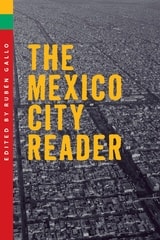
The Mexico City Reader
Edited by Ruben Gallo
University of Wisconsin Press, 2004
Mexico City is one of Latin America’s cultural capitals, and one of the most vibrant urban spaces in the world. The Mexico City Reader is an anthology of "Cronicas"—short, hybrid texts that are part literary essay, part urban reportage—about life in the capital. This is not the "City of Palaces" of yesteryear, but the vibrant, chaotic, anarchic urban space of the1980s and 1990s—the city of garbage mafias, necrophiliac artists, and kitschy millionaires.
Like the visitor wandering through the city streets, the reader will be constantly surprised by the visions encountered in this mosaic of writings—a textual space brimming with life and crowded with flâneurs, flirtatious students, Indian dancers,
food vendors, fortune tellers, political activists, and peasant protesters.
The essays included in this anthology were written by a panoply of writers, from well-known authors like Carlos Monsiváis and Jorge Ibagüengoitia to younger figures like Fabrizio Mejía Madrid and Juieta García González, all of whom are experienced practitioners of the city. The texts collected in this anthology are among the most striking examples of this concomitant "theory and practice" of Mexico City, that most delirious of megalopolises.
“[An] exciting literary journey . . .”—Carolyn Malloy, Multicultural Review
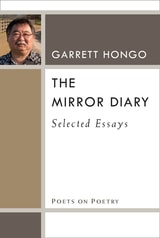
The Mirror Diary
Selected EssaysGarrett Hongo
University of Michigan Press, 2017
The Mirror Diary tracks the emergence of an original poetic voice and a learned consciousness amid multiple and sometimes competing influences of complex literary traditions and regional and ethnic histories. Beginning with a literary inquiry into the history of Japanese Americans in Hawai`i and California, Garrett Hongo draws on his own history to consider the mosaic of American identities—personal, cultural, and poetic—in the context of a postmodern diaspora.
Hongo’s essays attest to the breadth of what he considers his cultural inheritance and literary antecedents, ranging from the poets of China’s T’ang Dynasty to American poets such as Walt Whitman and Charles Olson. He explains free-verse prosody by way of John Coltrane’s jazz; praises his contemporaries, poets David Mura, Edward Hirsch, and Mark Jarman; and acknowledges his mentors, Bert Meyers and Charles Wright. In other pieces he engages with controversies and contestations in contemporary Asian American literature, confronts the politics of race and the legacy of Japanese American internment during World War II, offers paeans to the Hawaiian landscape, and addresses immigrants newly arrived in America with a warm welcome. The Mirror Diary is the work of a poet fully engaged with contemporary politics and poetics and committed to the study and celebration of diverse traditions.
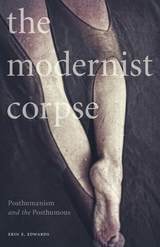
The Modernist Corpse
Posthumanism and the PosthumousErin E. Edwards
University of Minnesota Press, 2018
An unconventional take on the corpse challenges traditional conceptions of who—and what—counts as human, while offering bold insights into the modernist project
Too often regarded as the macabre endpoint of life, the corpse is rarely discussed and largely kept out of the public eye. In The Modernist Corpse, Erin E. Edwards unearths the critically important but previously buried life of the corpse, which occupies a unique place between biology and technology, the living and the dead. Exploring the posthumous as the posthuman, Edwards argues that the corpse is central to understanding relations between the human and its “others,” including the animal, the machine, and the thing.
From photographs of lynchings to documentation of World War I casualties, the corpse is also central to the modernist project. Edwards turns critical attention to the corpse through innovative, posthumanist readings of canonical thinkers such as William Faulkner, Jean Toomer, W. E. B. Du Bois, Mina Loy, Djuna Barnes, and Gertrude Stein, offering new insights into the intersections among race, gender, technical media, and matter presumed to be dead. Edwards’s expansive approach to modernism includes diverse materials such as Hollywood film, experimental photography, autopsy discourses, and the comic strip Krazy Kat, producing a provocatively broad understanding of the modernist corpse and its various “lives.”
The Modernist Corpse both establishes important new directions for modernist inquiry and overturns common thought about the relationship between living and dead matter.
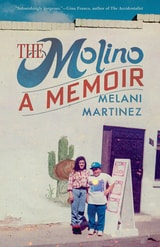
The Molino
A MemoirMelani Martinez
University of Arizona Press, 2024
Set in one of Tucson’s first tamal and tortilla factories, The Molino is a hybrid memoir that reckons with one family’s loss of home, food, and faith.
Weaving together history, culture, and Mexican food traditions, Melani Martinez shares the story of her family’s life and work in the heart of their downtown eatery, El Rapido. Opened by Martinez’s great-grandfather, Aurelio Perez, in 1933, El Rapido served tamales and burritos to residents and visitors to Tucson’s historic Barrio Presidio for nearly seventy years. For the family, the factory that bound them together was known for the giant corn grinder churning behind the scenes—the molino. With clear eyes and warm humor, Martinez documents the work required to prepare food for others, and explores the heartbreaking aftermath of gentrification that forces the multigenerational family business to close its doors.
The Molino is also Martinez’s personal story—that of a young Tucsonense coming of age in the 1980s and ’90s. As a young woman she rejects the work in her father’s popular kitchen, but when the business closes, her world shifts and the family disbands. When she finds her way back home, the tortillería’s iconic mural provides a gateway into history and ruin, ancestry and sacrifice, industrial myth and artistic incarnation—revealing a sacred presence still alive in Tucson.
A must-read for foodies, history lovers, and anyone searching for spiritual truth in the desert, this is a story of belonging and transformation in the borderlands.
The Monster I Am Today
Leontyne Price and a Life in VerseKevin Simmonds
Northwestern University Press, 2021
Structured operatically into overture, acts, and postlude, The Monster I Am Today guides the reader through associative shifts from arias like “weather events” and Price’s forty-two-minute final ovation to memories of Simmonds’s coming of age in New Orleans. As he melds lyric forms with the biography of one of classical music’s greatest virtuosos, Simmonds composes a duet that spotlights Price’s profound influence on him as a person and an artist: “That’s how I hear: Her.”
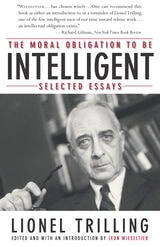
The Moral Obligation to Be Intelligent
Selected EssaysLionel Trilling
Northwestern University Press, 2009
Bringing together the thoughts of one of American literature’s sharpest cultural critics, this compendium will open the eyes of a whole new audience to the work of Lionel Trilling. Trilling was a strenuous thinker who was proud to think “too much.” As an intellectual he did not spare his own kind, and though he did not consider himself a rationalist, he was grounded in the world.
This collection features 32 of Trilling’s essays on a range of topics, from Jane Austen to George Orwell and from the Kinsey Report to Lolita. Also included are Trilling’s seminal essays “Art and Neurosis” and “Manners, Morals, and the Novel.” Many of the pieces made their initial appearances in periodicals such as The Partisan Review and Commentary; most were later reprinted in essay collections. This new gathering of his writings demonstrates again Trilling’s patient, thorough style. Considering “the problems of life”—in art, literature, culture, and intellectual life—was, to him, a vital occupation, even if he did not expect to get anything as simple or encouraging as “answers.” The intellectual journey was the true goal.
No matter the subject, Trilling’s arguments come together easily, as if constructing complicated defenses and attacks were singularly simple for his well-honed mind. The more he wrote on a subject and the more intricate his reasoning, the more clear that subject became; his elaboration is all function and no filler. Wrestling with Trilling’s challenging work still yields rewards today, his ideas speaking to issues that transcend decades and even centuries.
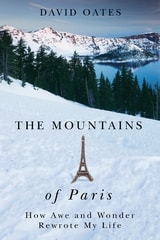
The Mountains of Paris
How Awe and Wonder Rewrote My LifeDavid Oates
Oregon State University Press, 2019
The present tense of the book takes place during the seasons he spends in Paris, sharing an artist’s residency. It is a rare opportunity to consider what it means to be human, through time-stopping moments with music, art, and deep history. The past tense of the book offers memories that intrude into the bustle of Paris life: a Billy Graham crusade at age thirteen, a mountain pass, a love, a loss.
In long years of mountaineering Oates fought the self-loathing which had infused him as the gay kid in the Baptist pew. In The Mountains of Paris, he ascends to a place of wonder through intense, personal narrative encounter with the strangeness of being alive. In his searching, luminous, and inimitable prose, Oates invites readers to share the sense of awe awakened by a Vermeer painting, or the night sky, or the echoing strains of music fading down a Paris street, lifting the curtain on a cosmos filled with a terrifying yet beautiful rightness.
The Multicultural Southwest
A ReaderEdited by A. Gabriel Meléndez, M. Jane Young, Patricia Moore, and Patrick Pynes
University of Arizona Press, 2001
As Americans debate what it means to be a multicultural society, one need only turn for lessons to the Southwest, where distinct peoples have coexisted over centuries. Here difference has not only survived but thrived in a melting pot of races and customs.
This book presents a montage of differing perspectives demonstrating that there is no single, definitive description of the Southwest. It brings together a host of writers, from early travelers and historians to contemporary commentators, who explore a region diverse in its people and ecology and show it to be not just a segment of the nation, but rather a border contact zone.
The editors have assembled an interdisciplinary composite, drawing on history, sociology, anthropology, and geography. Fiction, essays, poetry, newspaper articles, and interviews with local inhabitants add a colorful dimension to the coverage. All of the contributions reveal the tremendous impact that everyday occurrences can have and show how life in the Southwest is affected by the interweaving of social, cultural, and ecological forces. Together they demonstrate the role played by personal and cultural memory in creating alternative views of environment, landscape, human social interaction, conquest, dispossession, technological change, and the survival of cultures.
The Multicultural Southwest is a multifaceted work that shows the many ways in which the past continues to affect the present. It will create in readers an awareness of the phenomena that fuel human imagination and creativity as it opens their eyes to the possibilities of the future.
The Muse in Mexico
A Mid-Century MiscellanyEdited by Thomas Mabry Cranfill and George D. Schade
University of Texas Press, 1959
The Mythologizing of Mark Twain
Sara Davis
University of Alabama Press, 1984
How Samuel Clemens became Mark Twain—and Mark Twain became a myth.
The Mythologizing of Mark Twain explores the enduring fascination with one of America's most celebrated literary figures and examines how Samuel Langhorne Clemens became the cultural icon known around the world as Mark Twain. Bringing together a distinguished group of scholars, this thought-provoking collection investigates Twain not simply as an author, but as a powerful symbol whose life, works, and public persona have become inseparable from larger ideas about American identity, humor, democracy, individualism, and national character.
Readers and critics have long recognized Twain's literary genius, yet explaining the origins and significance of that genius remains an ongoing challenge. The essays in this volume address that challenge by exploring the many ways Twain has been interpreted, celebrated, debated, and transformed into a mythic figure. They examine how his writings helped define an American literary tradition while simultaneously contributing to the creation of a broader cultural mythology that continues to shape public perceptions of the United States and its history.
Rather than seeking a single interpretation of Twain, the contributors employ a range of critical approaches to illuminate the complexity of both the man and the legend. Their analyses reveal how the boundaries between Samuel Clemens, Mark Twain, and the popular image of "America's author" have often blurred, generating new layers of meaning for successive generations of readers and scholars.
The Mythologizing of Mark Twain is an essential resource for students and scholars of American literature, cultural history, and literary criticism. By examining the evolution of Twain's reputation and influence, the collection offers a deeper understanding of how literary figures become cultural myths and why Mark Twain remains one of the most enduring voices in the American imagination.
The Natural History of H. G. Wells
John Robert Reed
Ohio University Press, 1982
This new study offers a general reassessment of H. G. Wells as a writer and thinker. It concentrates upon the close relationship between Wells’ developing philosophy and his literary techniques. The early chapters examine Wells’ treatment of such subjects as confinement and escape, sex, the nature of human identity, the relationship of individual to race, human progress, and the importance of education. At the same time, the describe the emotional topography that Wells created as a mean of vivifying his ideas, a topography constructed from image complexes largely based upon the analogy between individual and racial evolution.
The major contribution of the book comes in its later chapters, which deal with Wells’ metaphysical assumptions and his approach to his craft. His views on free will and strength of will were intimately related to his methods of literary composition. The important later chapters detail this relationship, while describing some of Wells’ characteristic literary devices, such as the intentional violations of certain novelistic conventions or the sly borrowing from and alluding to contemporary works of literature in what amounted to a covert polemic.
On the whole, this study argues for a coherent and consistent, though developing, philosophy operating throughout Wells’ career and manifested in experimental literary works which, while not always successful, were consistently inventive and intelligently crafted in the service of Wells’ principle aim, the education of the human species to a command of its own destiny.
The Nature of Desert Nature
Edited by Gary Paul Nabhan
University of Arizona Press, 2020
Nabhan invites a prism of voices—friends, colleagues, and advisors from his more than four decades of study of deserts—to bring their own perspectives. Scientists, artists, desert contemplatives, poets, and writers bring the desert into view and investigate why these places compel us to walk through their sands and beneath their cacti and acacia. We observe the spines and spears, stings and songs of the desert anew. Unexpected. Surprising. Enchanting. Like the desert itself, each essay offers renewed vocabulary and thoughtful perceptions.
The desert inspires wonder. Attending to history, culture, science, and spirit, The Nature of Desert Nature celebrates the bounty and the significance of desert places.
Contributors
Thomas M. Antonio
Homero Aridjis
James Aronson
Tessa Bielecki
Alberto Búrquez Montijo
Francisco Cantú
Douglas Christie
Paul Dayton
Alison Hawthorne Deming
Father David Denny
Exequiel Ezcurra
Thomas Lowe Fleischner
Jack Loeffler
Ellen McMahon
Rubén Martínez
Curt Meine
Alberto Mellado Moreno
Paul Mirocha
Gary Paul Nabhan
Ray Perotti
Larry Stevens
Stephen Trimble
Octaviana V. Trujillo
Benjamin T. Wilder
Andy Wilkinson
Ofelia Zepeda
The Nearest Thing to Life
James Wood
Brandeis University Press, 2015
The Negro in Illinois
The WPA PapersEdited by Brian Dolinar
University of Illinois Press, 2013
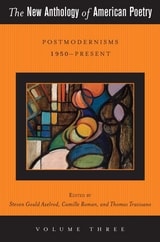
The New Anthology of American Poetry
Postmodernisms 1950-PresentAxelrod, Steven Gould
Rutgers University Press, 2012
Steven Gould Axelrod, Camille Roman, and Thomas Travisano continue the standard of excellence set in Volumes I and II of this extraordinary anthology. Volume III provides the most compelling and wide-ranging selection available of American poetry from 1950 to the present. Its contents are just as diverse and multifaceted as America itself and invite readers to explore the world of poetry in the larger historical context of American culture.
Nearly three hundred poems allow readers to explore canonical works by such poets as Elizabeth Bishop, Robert Lowell, and Sylvia Plath, as well as song lyrics from such popular musicians as Bob Dylan and Queen Latifah. Because contemporary American culture transcends the borders of the continental United States, the anthology also includes numerous transnational poets, from Julia de Burgos to Derek Walcott. Whether they are the works of oblique avant-gardists like John Ashbery or direct, populist poets like Allen Ginsberg, all of the selections are accompanied by extensive introductions and footnotes, making the great poetry of the period fully accessible to readers for the first time.