Results by title
18284 books match the query 'United States' and 3764 start with t

The School of the Americas
Military Training and Political Violence in the AmericasLesley Gill
Duke University Press, 2004
Based on her unprecedented level of access to the School of the Americas, Gill describes the School’s mission and training methods and reveals how its students, alumni, and officers perceive themselves in relation to the dirty wars that have raged across Latin America. Assessing the School’s role in U.S. empire-building, she shows how Latin America’s brightest and most ambitious military officers are indoctrinated into a stark good-versus-evil worldview, seduced by consumer society and the “American dream,” and enlisted as proxies in Washington’s war against drugs and “subversion.”

The Schultz Site at Green Point
A Stratified Occupation Area in the Saginaw Valley of MichiganEdited by James E. Fitting
University of Michigan Press, 1972

The Science and Politics of Racial Research
William H. Tucker
University of Illinois Press, 1994

The Science of Deception
Psychology and Commerce in AmericaMichael Pettit
University of Chicago Press, 2012

The Science of Play
How to Build Playgrounds That Enhance Children's DevelopmentSusan G. Solomon
University Press of New England, 2014
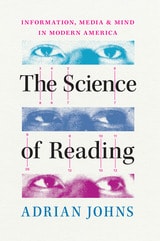
The Science of Reading
Information, Media, and Mind in Modern AmericaAdrian Johns
University of Chicago Press, 2023
Reading is perhaps the essential practice of modern civilization. For centuries, it has been seen as key to both personal fulfillment and social progress, and millions today depend on it to participate fully in our society. Yet, at its heart, reading is a surprisingly elusive practice. This book tells for the first time the story of how American scientists and others have sought to understand reading, and, by understanding it, to improve how people do it.
Starting around 1900, researchers—convinced of the urgent need to comprehend a practice central to industrial democracy—began to devise instruments and experiments to investigate what happened to people when they read. They traced how a good reader’s eyes moved across a page of printed characters, and they asked how their mind apprehended meanings as they did so. In schools across the country, millions of Americans learned to read through the application of this science of reading. At the same time, workers fanned out across the land to extend the science of reading into the social realm, mapping the very geography of information for the first time. Their pioneering efforts revealed that the nation’s most pressing problems were rooted in drastic informational inequities, between North and South, city and country, and white and Black—and they suggested ways to tackle those problems.
Today, much of how we experience our information society reflects the influence of these enterprises. This book explains both how the science of reading shaped our age and why, with so-called reading wars still plaguing schools across the nation, it remains bitterly contested.

The Scientific Enterprise in America
Readings from IsisEdited by Ronald L. Numbers and Charles E. Rosenberg
University of Chicago Press, 1996
Contributions include Sally Gregory Kohlstedt, "Parlors, Primers, and Public Schooling: Education for Science in Nineteenth-Century America;" Margaret Rossiter, "'Women's Work' in Science, 1880-1910;" Philip J. Pauly, "The Development of High School Biology: New York City, 1900-1925;" Susan E. Lederer, "Political Animals: The Shaping of Biomedical Research Literature in Twentieth-Century America;" Stanley Goldberg, "Inventing a Climate of Opinion: Vannevar Bush and the Decision to Build the Bomb;" Daniel J. Kevles, "The National Science Foundation and the Debate over Postwar Research Policy, 1942-1945: A Political Interpretation of Science: The Endless Frontier;" David A. Hollinger, "Science as a Weapon in Kulturkämpfe in the United States During and After World War II;" and others.
These essays originally were published in Isis, a publication of the History of Science Society.

The Scientific Life
A Moral History of a Late Modern VocationSteven Shapin
University of Chicago Press, 2008
Conventional wisdom has long held that scientists are neither better nor worse than anyone else, that personal virtue does not necessarily accompany technical expertise, and that scientific practice is profoundly impersonal. Shapin, however, here shows how the uncertainties attending scientific research make the virtues of individual researchers intrinsic to scientific work. From the early twentieth-century origins of corporate research laboratories to the high-flying scientific entrepreneurship of the present, Shapin argues that the radical uncertainties of much contemporary science have made personal virtues more central to its practice than ever before, and he also reveals how radically novel aspects of late modern science have unexpectedly deep historical roots. His elegantly conceived history of the scientific career and character ultimately encourages us to reconsider the very nature of the technical and moral worlds in which we now live.
Building on the insights of Shapin’s last three influential books, featuring an utterly fascinating cast of characters, and brimming with bold and original claims, The Scientific Life is essential reading for anyone wanting to reflect on late modern American culture and how it has been shaped.

The Scientific-Military State
How Enlightened Engineers Reinvented Early American GovernmentSveinn M. Jóhannesson
University of Chicago Press, 2026
In The Scientific-Military State, Sveinn M. Jóhannesson charts the emergence of a new kind of governance in early-nineteenth-century America: the scientific-military state. Federal officials used mathematics, science, and other forms of enlightened knowledge to launch the nation’s very first experiments in scientific education and expert administration. These figures forged a new intellectual elite that socially elevated itself above ordinary soldiers, workers, and civilians and reshaped the military state itself beyond familiar models of standing army or militia. Originating primarily from the US Military Academy at West Point, these experts, who were often engineers, debated statecraft, analyzed topography, designed fortifications, manufactured weapons, built infrastructure, and exercised military power as the United States spread across the continent. But the even deeper result was a transformed relationship between the government and its citizens, one that echoes today.

The Scots Irish of Early Pennsylvania
A Varied PeopleJudith A. Ridner
Temple University Press, 2018
The Scots Irish were one of early Pennsylvania’s largest non-English immigrant groups. They were stereotyped as frontier ruffians and Indian haters. In The Scots Irish of Early Pennsylvania, historian Judith Ridner insists that this immigrant group was socio-economically diverse. Servants and free people, individuals and families, and political exiles and refugees from Ulster, they not only pioneered new frontier settlements, but also populated the state’s cities—Philadelphia and Pittsburgh—and its towns, such as Lancaster, Easton, and Carlisle.
Ridner provides a much-overdue synthesis and reassessment of this immigrant group, tracing a century of Scotch-Irish migration from 1720 to 1820. These men and women brought their version of Ulster to the colonies in their fierce commitments to family, community, entrepreneurship, Presbyterianism, republican politics, and higher education. The settlements they founded across the state, including many farms, businesses, meetinghouses, and colleges, ensured that Pennsylvania would be their cradle in America, and these settlements stand as powerful testaments to their legacy to the state’s history and development.

The Scrapbook in American Culture
Susan Tucker
Temple University Press, 2006

The Scripps Newspapers Go to War, 1914-18
Dale Zacher
University of Illinois Press, 2007
Zacher's account delves into details inside a major newspaper operation during World War I and provides fascinating accounts of its struggles with competition, attending to patriotic duties, and internal editorial dissent. Zacher also looks at war-related issues, considering the newspapers' relationship with President Woodrow Wilson, American neutrality, the move to join the war, and fallout from disillusionment over the actuality of war. As Zacher shows, the progressive spirit and political independence at the Scripps newspapers came under attack and was changed forever during the era.
The Script of Life in Modern Society
Entry into Adulthood in a Changing WorldMarlis Buchmann
University of Chicago Press, 1989
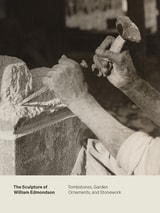
The Sculpture of William Edmondson
Tombstones, Garden Ornaments, and StoneworkMarin R. Sullivan
Vanderbilt University Press, 2021
William Edmondson (1874–1951) was the first African American sculptor to have a one-person exhibition at the Museum of Modern Art. Edmondson started sculpting in his late fifties, after the Nashville Women's Hospital, where he worked as a janitor, closed. During his life he was well known for his yard art, such as whimsical birdbaths and "critters" of real and imaginary provenance, and the grave markers he carved for African American families. His sculptures are now highly sought after by collectors.
The Sculpture of William Edmondson: Tombstones, Garden Ornaments, and Stonework is the first large-scale museum examination of artist William Edmondson's career in over twenty years. Organized by Cheekwood Curator-at-Large Marin R. Sullivan, the exhibition draws upon new scholarship and methodologies to contextualize Edmondson's sculpture, both within the histories of Nashville during the Interwar years and the art histories of modern art in the United States.
Edmondson has largely been confined to narratives that focus on his artistic discovery by white patrons in the 1930s, his work's formal resonance with so-called primitivism and direct carving techniques, and his place in the traditions of African American "outsider" art. This exhibition revisits Edmondson's work within these frameworks, but also seeks to reevaluate his sculpture on its own terms and as part of a comprehensive practice that included the creation of commercial objects rather than strictly fine art.
The exhibition's title references the sign that hung on the outside of Edmondson's studio, advertising what was for sale and on view to the public in his yard, including tombstones, birdbaths, and statuary meant to be used and intended for outdoor rather than gallery display.
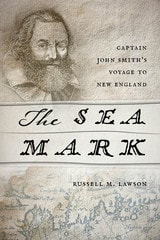
The Sea Mark
Captain John Smith’s Voyage to New EnglandRussell M. Lawson
University Press of New England, 2015

The Search for Justice
Lawyers in the Civil Rights Revolution, 1950–1975Peter Charles Hoffer
University of Chicago Press, 2019
The Search for Justice is a look the role of the lawyers throughout the period, focusing on one of the central issues of the time: school segregation. The most notable participants to address this issue were the public interest lawyers of the NAACP’s Legal Defense Fund, whose counselors brought lawsuits and carried out appeals in state and federal courts over the course of twenty years. But also playing a part in the story were members of the bar who defended Jim Crow laws explicitly or implicitly and, in some cases, also served in state or federal government; lawyers who sat on state and federal benches and heard civil rights cases; and, finally, law professors who analyzed the reasoning of the courts in classrooms and public forums removed from the fray. With rich, copiously researched detail, Hoffer takes readers through the interactions of these groups, setting their activities not only in the context of the civil rights movement but also of their full political and legal legacies, including the growth of corporate private legal practice after World War II and the expansion of the role of law professors in public discourse, particularly with the New Deal. Seeing the civil rights era through the lens of law enables us to understand for the first time the many ways in which lawyers affected the course and outcome of the movement.
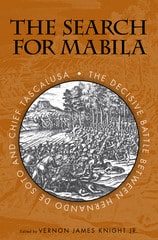
The Search for Mabila
The Decisive Battle between Hernando de Soto and Chief TascalusaEdited by Vernon James Knight Jr.
University of Alabama Press, 2009
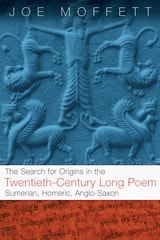
The Search for Origins in the Twentieth-Century Long Poem
Sumerian, Homeric, Anglo-SaxonJOE W. MOFFETT
West Virginia University Press, 2007
In this new, scholarly text—an ambitious study of contemporary poetics—Joe W. Moffett deciphers the twentieth-century long poem, searching for a better understanding of why long-poem writers are preoccupied with a search for origins.
Moffett focuses on issues like postcolonialism, nation, modernism, and postmodernism. He conceptualizes his theories by using what he calls “originiary moments”: historical periods or specific events from which a poet contends our culture descends. These moments enlighten and inspire the modern poet to use origin or “source” as a way to examine present culture and social conditions. The poems also encourage modern readers to question, revise, and repudiate. Moffett organizes his argument by arranging specific examples into three categories of originary moments: Sumerian, Homeric, and Anglo-Saxon.
According to Moffett, the long poem is appealing because it “lacks strict conventions that govern other genres.” Using a wide variety of poems to support his arguments, Moffett asks many stimulating questions and also provides provocative answers.
Questions of when and where It All Began have been off the critical agenda for some time now, embargoed by poststructuralism. Undeterred, Joe Moffett boldly revisits the search for cultural origins, which preoccupied major poets throughout the twentieth century. Capacious in his scope, eclectic in his choices, Moffett rounds up unusual subjects, including long poems by Armand Schwerner, Derek Walcott, Geoffrey Hill, and Judy Grahn, with excursions into Charles Olson, Seamus Heaney, and others. Nowhere will you find clearer, more intelligent, or better-informed readings of these poems than Moffett’s.
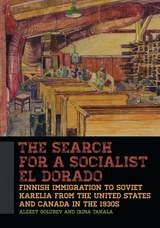
The Search for a Socialist El Dorado
Finnish Immigration to Soviet Karelia from the United States and Canada in the 1930sAlexey Golubev and Irina Takala
Michigan State University Press, 2014

The Seasons Of Fire
Reflections On Fire In The WestDavid J. Strohmaier
University of Nevada Press, 2001
Fire is a fearsome constant in the America West. As the author David J. Strohmaier notes, "Whether we have tended a campfire along Oregon's Deschutes River in March, engaged the advancing front of a Great Basin wildfire in the torrid heat of August, or watched fire settle into the subdued, smoldering leaf piles of October, all of our lives, to one degree or another, are bracketed by fire." In The Seasons of Fire, Strohmaier effectively blends nature writing, personal essay, and philosophical analysis as he deliberately crosses disciplinary boundaries. He discusses the "moral" dimensions of fire—not only whether fires are good, bad, or indifferent phenomena, but also how fire, more generally understood, shapes meaning for human life. The consequences of discussing the moral side of fire speak directly to the contours of the human soul, and to our sense of our place on the land. Strohmaier, a long-term firefighter himself, includes accurate and sometimes gut-wrenching descriptions of the firefighter's experience.

The Second Amendment on Trial
Critical Essays on District of Columbia v. HellerSaul A. Cornell
University of Massachusetts Press, 2013
On the final day of its 2008 term, a sharply divided U.S. Supreme Court issued a 5-to-4 decision striking down the District of Columbia's stringent gun control laws as a violation of the Second Amendment. Reversing almost seventy years of settled precedent, the high court reinterpreted the meaning of the “right of the people to keep and bear arms” to affirm an individual right to own a gun in the home for purposes of self-defense. The landmark ruling not only opened a new chapter in the contentious history of gun rights and gun control but also revealed both the strengths and problems of originalist constitutional theory and jurisprudence.
This volume brings together some of the best scholarship on the Heller case, with essays by legal scholars and historians representing a range of ideological viewpoints and applying different interpretive frameworks. Following the editors' introduction, which describes the issues involved and the arguments on each side, the essays are organized into four sections. The first includes two of the most important historical briefs filed in the case, while the second offers different views of the role of originalist theory. Section three presents opposing interpretations of the ruling and its relationship to modern constitutional doctrine. The final section explores historical research post-Heller, including new findings on patterns of gun ownership in colonial and Revolutionary America.
In addition to the editors, contributors include Nelson Lund, Joyce Lee Malcolm, Jack Rakove, Reva B. Siegel, Cass R. Sunstein, Kevin M. Sweeney, and J. Harvie Wilkinson III.

The Second Battle for Africa
Garveyism, the US Heartland, and Global Black FreedomErik S. McDuffie
Duke University Press, 2024

The Second Estate
How the Tax Code Made an American AristocracyRay D. Madoff
University of Chicago Press, 2025
Named by The New Yorker as one of the Best Books of 2025 and featured on the Armchair Expert podcast with Dax Shepherd.
A revelatory book that lifts the curtain on America’s most consequential public deception: how the rich get richer using tools the government gave them.
Amid conflicting narratives about the drivers of wealth and inequality in the United States, one constant hovers in the background: the US tax code. No political force has been more consequential—or more utterly opaque—than the 7,000-page document that details who pays what in American society and government. Most of us have a sense that it’s an unfair system. But does anyone know exactly how it’s unfair?
Legal scholar Ray D. Madoff knows. In The Second Estate, she offers an unprecedented look behind the scenes of America’s byzantine system of taxation, laying bare not only its capacity to consolidate wealth but also the mechanisms by which it has created two fundamentally separate American societies: the working Americans who pay and the ultra-rich who benefit.
This is not a story of offshore accounts or secret tax havens. In The Second Estate, Madoff shows that the US system itself has, over time, been stripped and reconstituted such that it now offers a series of secret paths, hidden in plain sight, for wealthy people in the know to avoid taxation altogether. Through the strategic avoidance of traditional income, leveraging of investments and debt, and exploitation of rules designed to promote charitable giving, America’s wealthy do more than just pay less than their share; they remove themselves from the tax system entirely. Wealth becomes its own sovereign state, and the living is surprisingly—and maddeningly—cheap.
The Second Generation of African American Pioneers in Anthropology
Ira E. Harrison, Deborah Johnson-Simon, Erica Lorraine Williams
University of Illinois Press, 2018

The Second Great Emancipation
The Mechanical Cotton Picker, Black Migration, and How They Shaped the Modern SouthDonald Holley
University of Arkansas Press, 2000
In The Second Great Emancipation, Donald Holley uses statistical and narrative analysis to demonstrate that farm mechanization occurred in the Delta region of Arkansas, Louisiana, and Mississippi after the region’s population of farm laborers moved away for new opportunities. Rather than pushing labor off the land, Holley argues, the mechanical cotton picker enabled the continuation of cotton cultivation in the post-plantation era, opening the door for the civil rights movement, while ushering a period of prosperity into the South.
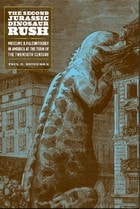
The Second Jurassic Dinosaur Rush
Museums and Paleontology in America at the Turn of the Twentieth CenturyPaul D. Brinkman
University of Chicago Press, 2010
The so-called “Bone Wars” of the 1880s, which pitted Edward Drinker Cope against Othniel Charles Marsh in a frenzy of fossil collection and discovery, may have marked the introduction of dinosaurs to the American public, but the second Jurassic dinosaur rush, which took place around the turn of the twentieth century, brought the prehistoric beasts back to life. These later expeditions—which involved new competitors hailing from leading natural history museums in New York, Chicago, and Pittsburgh—yielded specimens that would be reconstructed into the colossal skeletons that thrill visitors today in museum halls across the country.
Reconsidering the fossil speculation, the museum displays, and the media frenzy that ushered dinosaurs into the American public consciousness, Paul Brinkman takes us back to the birth of dinomania, the modern obsession with all things Jurassic. Featuring engaging and colorful personalities and motivations both altruistic and ignoble, The Second Jurassic Dinosaur Rush shows that these later expeditions were just as foundational—if not more so—to the establishment of paleontology and the budding collections of museums than the more famous Cope and Marsh treks. With adventure, intrigue, and rivalry, this is science at its most swashbuckling.
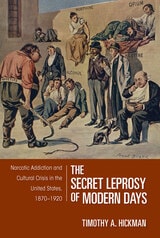
The Secret Leprosy of Modern Days
Narcotic Addiction and Cultural Crisis in the United States, 1870-1920Timothy A. Hickman
University of Massachusetts Press, 2007
Although the topic of habitual narcotic use first surfaced in the United States during the 1820s, it was not until after the Civil War that it became a subject of widespread public attention. Beginning in the 1870s, an increasingly urgent discussion of what some described as a national epidemic of “drug addiction” could be found in both medical journals and the popular press. Today, nearly a century and a half later, the term is so commonplace we speak of people being “addicted” to just about anything. Yet as Timothy A. Hickman argues in this revealing interdisciplinary study, the meaning of addiction has always been as much cultural as scientific and never fixed.
In The Secret Leprosy of Modern Days, Hickman resituates the idea of addiction within its original late nineteenth- and early twentieth-century context. Through close readings of a broad range of literary, medical, and legal texts, he shows how Americans of that era conceptualized the dangers of drug addiction in terms of other preoccupations and fears. Anxieties about the accelerating pace of technological change, the loss of personal autonomy, and the degeneration of society attributed to both foreign influences and a decline of manliness all fed into a widespread sense of cultural crisis—a crisis of which the spiraling “drug problem” was seen as both contributing cause and consequence. Not surprisingly, Hickman points out, deeply held assumptions of class, race, and gender also figured into the popular understanding of addiction. While white middle-class addicts were often depicted as helpless victims of the social and economic pressures of modern life, their less privileged and nonwhite counterparts were regarded as morally weak. Over time the distinction between “addict as patient” and “addict as criminal” came to be accepted by the emerging medical establishment and codified into law, eventually finding expression in the Harrison Narcotics Act of 1914, the first national anti-narcotic legislation in the history of the United States—and the basis for much thinking about addiction and drug policy ever since.

The Secret Life Of John C. Van Dyke
Selected LettersDavid W. Teague
University of Nevada Press, 1997
The author of The Desert, the book that made the American landscape accessible to the mainstream mind, was much less like his fellow environmental prophets John Muir and Henry David Thoreau than he would have had us believe. Van Dyke claimed to have wandered "alone on horseback for thousands of miles through the American Southwest and northern Mexico," as readers of The Desert—now in the millions since the book was published in 1901—were told. He did not. In The Secret Life of John C. Van Dyke, Teague and Wild unmask the desert saint with Van Dyke’s own recently discovered letters. These letters depict a privileged, patrician, and pampered member of the upper-class. His incriminating correspondence reveals that he saw most of the desert from plush railroad cars and grand hotel rooms. In the introduction, the editors clear up many misconceptions scholars currently hold about Van Dyke’s ecological principles, about his outdoorsmanship, and about his trip through the desert itself. As the centennial of the publication of The Desert approaches, this lively collection of letters helps set the record straight. The John C. Van Dyke unveiled in The Secret Life is a more varied character than we had supposed—still worthy of much admiration for his remarkable accomplishments, but still mysterious, and not the man we thought him to be.
The Secret Lives of Citizens
Pursuing the Promise of American LifeThomas Geoghegan
University of Chicago Press, 2000
"This is unlike any public-policy book I've ever read: part Catcher in the Rye, part The Road to Wigan Pier, part The Federalist Papers, it is mesmerizing, rueful, painfully honest, and never, ever dull."—Nicholas Lemann, author of The Big Test
"Extraordinary. It has the essential trait of a memorable book, in that after reading it you look at daily life in a lastingly different way." —James Fallows, author of Breaking the News
"[Geoghegan] has written a book that is not only compelling to read but that provokes us to seriously reflect on the choices we make and how we spend our time." —Jonathan Coleman, Washington Post Book World
"Geoghegan's language is playful. . . . Personal reminiscence mixing with historical anecdote, dipping into complex themes . . . shifting from wistful nostalgia to dark comedy." —Robert B. Reich, New York Times Book Review
"A truly strange and wonderful book." — William Finnegan

The Secret Trust of Aspasia Cruvellier Mirault
The Life and Trials of a Free Woman of Color in Antebellum GeorgiaJanice L. Sumler-Edmond
University of Arkansas Press, 2008

The Secret of M. Dulong
A MemoirColette Inez
University of Wisconsin Press, 2005

The Secret of the Hardy Boys
Leslie McFarlane and the Stratemeyer SyndicateMarilyn S. Greenwald
Ohio University Press, 2004
For generations of readers, the Hardy Boys were the creations of the legendary Franklin W. Dixon—except Dixon never existed. Behind the iconic series stood the Stratemeyer Syndicate, a powerhouse of children’s publishing, and one gifted but largely unrecognized writer: Leslie McFarlane.
In The Secret of the Hardy Boys, acclaimed biographer Marilyn S. Greenwald uncovers the remarkable story of the man who first brought Frank and Joe Hardy to life. A young Canadian journalist with ambitions beyond formula fiction, McFarlane infused the Syndicate’s rigid plots with wit, atmosphere, and narrative vitality—helping to shape one of the most enduring franchises in children’s literature.
Bound by contract and reluctant to claim authorship, McFarlane kept his role a secret for decades, receiving little financial reward for books that sold in the millions. Yet his story is far from one of regret. Drawing on extensive research, Greenwald paints a vivid portrait of a versatile writer who navigated the shifting landscape of twentieth-century media, from pulp magazines to radio and film.
Rich in literary history and human insight, The Secret of the Hardy Boys is both a revealing behind-the-scenes account of a cultural phenomenon and an inspiring testament to creativity, resilience, and the quiet architects of beloved stories.

The Secrets of the Hopewell Box
Stolen Elections, Southern Politics, and a City's Coming of AgeJames D. Squires
Vanderbilt University Press, 1996
—Kirkus Reviews
"His richly textured narrative charts the Nashville machine's rupture with the state's top political boss, Edward Crump of Memphis, and traces the sweeping reforms that shattered rural white control of the state legislature. Squires dramatically reenacts the downfall of Nashville lawyer Tommy Osborn, convicted of jury tampering in 1964 after defending Teamsters boss Jimmy Hoffa. He follows Nashville's transformation into a crucible of the civil rights movement in this stirring chronicle of the South's coming-of-age."
—Publishers Weekly

The Seduction of Brazil
The Americanization of Brazil during World War IIBy Antonio Pedro Tota
University of Texas Press, 2009
Following completion of the U.S. air base in Natal, Brazil, in 1942, U.S. airmen departing for North Africa during World War II communicated with Brazilian mechanics with a thumbs-up before starting their engines. This sign soon replaced the Brazilian tradition of touching the earlobe to indicate agreement, friendship, and all that was positive and good—yet another indication of the Americanization of Brazil under way during this period.
In this translation of O Imperialismo Sedutor, Antonio Pedro Tota considers both the Good Neighbor Policy and broader cultural influences to argue against simplistic theories of U.S. cultural imperialism and exploitation. He shows that Brazilians actively interpreted, negotiated, and reconfigured U.S. culture in a process of cultural recombination. The market, he argues, was far more important in determining the nature of this cultural exchange than state-directed propaganda efforts because Brazil already was primed to adopt and disseminate American culture within the framework of its own rapidly expanding market for mass culture. By examining the motives and strategies behind rising U.S. influence and its relationship to a simultaneous process of cultural and political centralization in Brazil, Tota shows that these processes were not contradictory, but rather mutually reinforcing.
The Seduction of Brazil brings greater sophistication to both Brazilian and American understanding of the forces at play during this period, and should appeal to historians as well as students of Latin America, culture, and communications.

The Seductions of Quantification
Measuring Human Rights, Gender Violence, and Sex TraffickingSally Engle Merry
University of Chicago Press, 2016
With The Seductions of Quantification, leading legal anthropologist Sally Engle Merry investigates the techniques by which information is gathered and analyzed in the production of global indicators on human rights, gender violence, and sex trafficking. Although such numbers convey an aura of objective truth and scientific validity, Merry argues persuasively that measurement systems constitute a form of power by incorporating theories about social change in their design but rarely explicitly acknowledging them. For instance, the US State Department’s Trafficking in Persons Report, which ranks countries in terms of their compliance with antitrafficking activities, assumes that prosecuting traffickers as criminals is an effective corrective strategy—overlooking cultures where women and children are frequently sold by their own families. As Merry shows, indicators are indeed seductive in their promise of providing concrete knowledge about how the world works, but they are implemented most successfully when paired with context-rich qualitative accounts grounded in local knowledge.
The Selected Letters of Bernard DeVoto and Katharine Sterne
Mark DeVoto
University of Utah Press, 2012
A busy man with a busy life, DeVoto found time to write and answer letters in abundance. In 1933 he received a fan letter from Katharine Sterne, a young woman hospitalized with tuberculosis; his reply touched off an extraordinary eleven-year correspondence. Sterne had graduated with honors from Wellesley College in 1928 and had served as an assistant art critic at the New York Times before her illness. Despite her enforced invalidism she maintained an active intellectual life. Sterne and DeVoto wrote to each other until her death in 1944, sometimes in many pages and as often as twice a week, exchanging opinions about life, literature, art, current events, family news, gossip, and their innermost feelings. DeVoto’s biographer, Wallace Stegner, states that in these letters DeVoto “expressed himself more intimately than in any other writings.” Although their correspondence amounted to more than 868 letters (and is virtually complete on both sides), DeVoto and Sterne never met, both of them doubtless realizing that physical remoteness permitted a psychological proximity that was deeply nourishing.
This volume contains 140 of their letters. They have been selected by DeVoto’s son Mark, who has also provided detailed notes clarifying ambiguities and obscure references. Readers will enjoy these letters for their wit and literary flair, but they will also gain insight into the cultural and historical crosscurrents of the 1930s and ’40s while taking an intimate and engaging look at a friendship forged entirely through words.

The Selected Letters of Ezra Pound to John Quinn
1915–1924Timothy Materer, ed.
Duke University Press, 1991
Pound wrote to John Quinn—a New York lawyer, an expert in business law, and a collector of unusual taste and discrimination—about these artists and many more, urging him to support their journals, collect their manuscripts, and buy and exhibit their paintings and sculptures. Quinn at one time owned manuscripts of Ulysses and The Waste Land, Brancusi’s sculpture Mlle. Pogany, and Picasso’s painting Three Musicians. Yet he was often skeptical about the value of new schools of art, such as Vorticism, and disturbed by the outspokenness of authors such as Joyce. Pound’s letters are unusually tactful when he counters Quinn’s doubts and explains the premises of experimental art. Pound’s letters to Quinn are touched with his characteristic humor and wordplay and are especially notable for their lucidity of expression, engendered by Pound’s deep respect for Quinn.
The Selected Papers of Edward Shils, Volume 3
The Calling of Sociology and Other Essays on the Pursuit of LearningEdward Shils
University of Chicago Press, 1980

The Selected Papers of Elizabeth Cady Stanton and Susan B. Anthony
Against an Aristocracy of Sex, 1866 to 1873Gordon, Ann D
Rutgers University Press, 2000
The second volume picks up the story of Stanton and Anthony at the end of 1866, when they launched their drive to make universal suffrage the priority of Reconstruction. Through letters, speeches, articles, and diaries, this volume recounts their years as editor and publisher of the weekly paper the Revolution, their extensive travels, and their lobbying with Congress. It touches on the bitter division that occurred among suffragists over such controversial topics as marriage and divorce, and a national debate over the citizenship of women under the Fourteenth and Fifteenth Amendments. By the summer of 1873, when this volume ends, Anthony stood convicted of the federal crime of illegal citizenship of women under the Fourteenth and Fifteenth Amendments. By the summer of 1873, when this volume ends, Anthony stood convicted of the federal crime of illegal voting. An irate Stanton warned, "I felt afresh the mockery of this boasted chivalry of man towards woman."

The Selected Papers of Elizabeth Cady Stanton and Susan B. Anthony
An Awful Hush, 1895 to 1906Gordon, Ann D
Rutgers University Press, 2012
The “hush” of the title comes suddenly, when first Elizabeth Cady Stanton dies on October 26, 1902, and three years later Susan B. Anthony dies on March 13, 1906. It is sudden because Stanton, despite near blindness and immobility, wrote so intently right to the end that editors had supplies of her articles on hand to publish several months after her death. It is sudden because Anthony, at the age of eighty-five, set off for one more transcontinental trip, telling a friend on the Pacific Coast, “it will be just as well if I come to the end on the cars, or anywhere, as to be at home.”
Volume VI of this extraordinary series of selected papers is inescapably about endings, death, and silence. But death happens here to women still in the fight. An Awful Hush is about reformers trained “in the school of anti-slavery” trying to practice their craft in the age of Jim Crow and a new American Empire. It recounts new challenges to “an aristocracy of sex,” whether among the bishops of the Episcopal church, the voters of California, or the trustees of the University of Rochester. And it sends last messages about woman suffrage. As Stanton wrote to Theodore Roosevelt on the day before she died, “Surely there is no greater monopoly than that of all men, in denying to all women a voice in the laws they are compelled to obey.”
With the publication of Volume VI, this series is now complete.
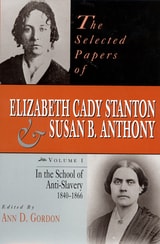
The Selected Papers of Elizabeth Cady Stanton and Susan B. Anthony
In the School of Anti-Slavery, 1840 to 1866Gordon, Ann D
Rutgers University Press, 1997
In the School of Anti-Slavery, 1840-1866 is the first of six volumes of The Selected Papers of Elizabeth Cady Stanton and Susan B. Anthony. The collection documents the lives and accomplishments of two of America's most important social and political reformers. Though neither Stanton nor Anthony lived to see the passage of the Nineteenth Amendment in 1920, each of them devoted fifty-five years to the cause. Their names were synonymous with woman suffrage in the United States and around the world as they mobilized thousands of women to fight for the right to a political voice.
Opening when Stanton was twenty-five and Anthony was twenty, and ending when Congress sent the Fourteenth Amendment to the states for ratification, this volume recounts a quarter of a century of staunch commitment to political change. Readers will enjoy an extraordinary collection of letters, speeches, articles, and diaries that tells a story-both personal and public-about abolition, temperance, and woman suffrage.
When all six volumes are complete, the Selected Papers of Stanton and Anthony will contain over 2,000 texts transcribed from their originals, the authenticity of each confirmed or explained, with notes to allow for intelligent reading. The papers will provide an invaluable resource for examining the formative years of women's political participation in the United States. No library or scholar of women's history should be without this original and important collection.

The Selected Papers of Elizabeth Cady Stanton and Susan B. Anthony
National Protection for National Citizens, 1873 to 1880Gordon, Ann D
Rutgers University Press, 2003
National Protection for National Citizens, 1873 to 1880 is the third of six planned volumes of TheSelected Papers of Elizabeth Cady Stanton and Susan B. Anthony. The entire collection documents the friendship and accomplishments of two of America's most important social and political reformers. Though neither Stanton nor Anthony lived to see passage of the Nineteenth Amendment in 1920, each of them devoted fifty-five years to the cause of woman suffrage.
The third volume of the Selected Papers of Elizabeth Cady Stanton and Susan B. Anthony opens while woman suffragists await the decision of the U.S. Supreme Court in cases testing whether the Constitution recognized women as voters within the terms of the Fourteenth and Fifteenth Amendments. At its close they are pursuing their own amendment to the Constitution and pressing the presidential candidates of 1880 to speak in its favor. Through their letters, speeches, articles, and diaries, the volume recounts the national careers of Elizabeth Cady Stanton and Susan B. Anthony as popular lecturers, their work with members of Congress to expand women's rights, their protests during the Centennial Year of 1876, and the launch that same year of their campaign for a Sixteenth Amendment.
The Selected Papers of Elizabeth Cady Stanton and Susan B. Anthony
Their Place Inside the Body-Politic, 1887 to 1895Gordon, Ann D
Rutgers University Press, 2009
At the beginning, Stanton and Anthony focus their attention on organizing the International Council of Women in 1888. Late in 1887, Lucy Stone’s American Woman Suffrage Association announced its desire to merge with the national association led by Stanton and Anthony. Two years of fractious negotiations preceded the 1890 merger, and years of sharp disagreements followed. Stanton made her last trip to Washington in 1892 to deliver her famous speech “Solitude of Self.” Two states enfranchised women—Wyoming in 1890 and Colorado in 1893—but failures were numerous. Anthony returned to grueling fieldwork in South Dakota in 1890 and Kansas and New York in 1894. From the campaigns of 1894, Stanton emerged as an advocate of educated suffrage and staunchly defended her new position.
The Selected Papers of Elizabeth Cady Stanton and Susan B. Anthony
When Clowns Make Laws for Queens, 1880-1887Gordon, Ann D
Rutgers University Press, 2006
At the opening of the fourth volume, suffragists hoped to speed passage of a sixteenth amendment to the Constitution through the creation of Select Committees on Woman Suffrage in Congress. Congress did not vote on the amendment until January 1887. Then, in a matter of a week, suffragists were dealt two major blows: the Senate defeated the amendment and the Senate and House reached agreement on the Edmunds-Tucker Act, disenfranchising all women in the Territory of Utah.
As evidenced in this volume's selection of letters, articles, speeches, and diary entries, these were years of frustration. Suffragists not only lost federal and state campaigns for partial and full voting rights, but also endured an invigorated opposition. In spite of these challenges, Stanton and Anthony continued to pursue their life's work. In 1880 both women retired from lecturing to devote attention to their monumental History of Woman Suffrage. They also opened a new transatlantic dialogue about woman's rights during a trip to Europe in 1883.
The Selected Papers of Jane Addams, Volume 4
Moving Beyond Hull-House, 1901-1907Jane Addams; Edited by Stacy Lynn with Cathy Moran Hajo and Victoria Sciancalepore
University of Illinois Press, 2026
The fourth volume in the series follows Addams’s increasingly busy life. Her activities included greater participation in the women’s suffrage movement and speaking tours of twenty-five states and the District of Columbia to discuss child labor, settlement work, and women’s issues. At the same time, she maintained relationships with an intimate circle of female friends, her extended family, the Hull-House community, and most importantly her companion Mary Rozet Smith. The editors provide an extensive collection of documents on this side of Addams’s life while rooting her in the unique time and place of an era of fast and far-reaching change.

The Selected Papers of Jane Addams
Vol. 2: Venturing into UsefulnessEdited by Mary Lynn McCree Bryan, Barbara Bair, and Maree de Angury; with the assistance of Elizabeth Stevens, Stewart Burns, and Ellen Skerrett
University of Illinois Press, 2009
Artfully annotated, The Selected Papers of Jane Addams offers an evocative choice of correspondence, photographs, and other primary documents, presenting a multi-layered narrative of Addams's personal and emerging professional life. Themes inaugurated in the previous volume are expanded here, including dilemmas of family relations and gender roles; the history of education; the dynamics of female friendship; religious belief and ethical development; changes in opportunities for women; and the evolution of philanthropy, social welfare, and reform ideas.

The Selected Papers of Jane Addams
Vol. 3: Creating Hull-House and an International Presence, 1889-1900Jane Addams Edited by Mary Lynn McCree Bryan, Maree de Angury, and Ellen Skerrett: with the assistance of Richard R. Seidel,
University of Illinois Press, 2019
The third volume in this acclaimed series documents Addams’s creation of Hull-House and her rise to worldwide fame as the acknowledged female leader of progressive reform. It also provides evidence of her growing commitment to pacifism. Here we see Addams, a force of thought, action, and commitment, forming lasting relationships with her Hull-House neighbors and the Chicago community of civic, political, and social leaders, even as she matured as an organizer, leader, and fund-raiser, and as a sought-after speaker, and writer. The papers reveal her positions on reform challenges while illuminating her strategies, successes, and responses to failures. At the same time, the collection brings to light Addams’s private life. Letters and other documents trace how many of her Hull-House and reform alliances evolved into deep, lasting friendships and also explore the challenges she faced as her role in her own family life became more complex.
Fully annotated and packed with illustrations, The Selected Papers of Jane Addams, Volume 3 is a portrait of a woman as she changed—and as she changed history.

The Selected Papers of Jane Addams
vol. 1: Preparing to Lead, 1860-81Edited by Mary Lynn McCree Bryan, Barbara Bair, and Maree de Angury
University of Illinois Press, 2002

The Selected Papers of Margaret Sanger, Volume 1
The Woman Rebel, 1900-1928Margaret Sanger, Edited by Esther Katz
University of Illinois Press, 2002

The Selected Papers of Margaret Sanger, Volume 4
Round the World for Birth Control, 1920-1966Margaret Sanger: Edited by Esther Katz: Peter C. Engelman and Cathy Moran Hajo, Associate Editors
University of Illinois Press, 2016
This volume focuses on Sanger from her groundbreaking overseas advocacy during the interwar years through her postwar role in creating the International Planned Parenthood Federation. The documents reconstruct Sanger's dramatic birth control advocacy tours through early 1920s Germany, Japan, and China in the midst of significant government and religious opposition to her ideas. They also trace her tireless efforts to build a global movement through international conferences and tours. Letters, journal entries, writings, and other records reveal Sanger's contentious dealings with other activists, her correspondence with the likes of Albert Einstein and Eleanor Roosevelt, and Sanger's own dramatic evolution from gritty grassroots activist to postwar power broker and diplomat.
A powerful documentary history of a transformative twentieth-century figure, The Selected Papers of Margaret Sanger, Volume 4 is a primer for the debates on individual choice, sex education, and planned parenthood that remain all-too-pertinent in our own time.