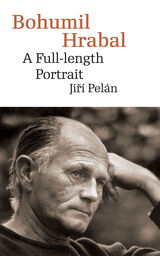
front cover of Bohumil Hrabal
Bohumil Hrabal
A Full-Length Portrait
Jirí Pelán
Karolinum Press, 2019
Described by Parul Sehgal in the New York Times Book Review as “one of the great prose stylists of the twentieth century; the scourge of state censors; the gregarious bar hound and lover of gossip, beer, cats, and women (in roughly that order),” Bohumil Hrabal is one of the most important, most translated, and most idiosyncratic Czech authors. In Bohumil Hrabal: A Full-Length Portrait, Jiří Pelán makes the case that this praise is far too narrow. A respected scholar of French and Italian literature, Pelán approaches Hrabal as a comparatist, expertly situating him within the context of European and world literature as he explores the entirety of Hrabal’s oeuvre and its development over sixty years. Concise, clear, and as compulsively readable as the works of Hrabal himself, Bohumil Hrabal was universally praised by critics in its original Czech edition as one of best works of Hrabal criticism. Here it is beautifully rendered into English for the first time by David Short, a celebrated translator of Hrabal’s works. Also featuring a fascinating selection of black-and-white images from Hrabal’s life, Bohumil Hrabal is essential reading for anyone interested in this crucial Czech author.
[more]

front cover of Booker T. Washington Papers Volume 10
Booker T. Washington Papers Volume 10
1909-11. Assistant editors, Geraldine McTigue and Nan E. Woodruff
Booker T. Washington
University of Illinois Press, 1981

front cover of Booker T. Washington Papers Volume 11
Booker T. Washington Papers Volume 11
1911-12. Assistant editor, Geraldine McTigue
Booker T. Washington
University of Illinois Press, 1981

front cover of Booker T. Washington Papers Volume 3
Booker T. Washington Papers Volume 3
1889-95. Assistant editors, Stuart B. Kaufman and Raymond W. Smock
Booker T. Washington. Edited by Louis R. Harlan, Assistant editors, Stuart B. Kaufman and Raymond W. Smock
University of Illinois Press, 1974
Washington's gradual rise to prominence as an educator, race leader, and shrewd political broker is revealed in this volume, which covers his career from May 1889 to September 1895, when he delivered the famous speech often called the Atlanta Compromise address. Much of the volume relates to Washington's role as principal of Tuskegee Institute, where he built a powerful base of operations for his growing influence with white philanthropists in the North, southern white leaders, and the black community.  
[more]

logo for American Library Association
Books Under Fire
Pat R. Scales
American Library Association, 2015

logo for American Library Association
Books Under Fire
A Hit List of Banned and Challenged Children's Books
Pat R. Scales
American Library Association, 2021

In our polarized environment, the censorship and outright banning of children’s books which some deem to be controversial or objectionable remains a major concern for libraries. Intellectual freedom champion Scales returns to the fray with a new edition of her matchless guide, updating the focus to titles published since 2015 which have been the target of challenges. School and public librarians, LIS students, and classroom educators will find the assistance and support they need to defend these challenged books with an informed response while ensuring access to young book lovers. For each of the dozens of titles covered, readers will find

  • a book summary;
  • a report of the specific challenges; 
  • quotes from reviews, plus a list of awards and accolades; 
  • talking points for discussing the book's issues and themes; 
  • links to the book's website, additional resources about the book, and suggested further reading; and 
  • read-alikes that have been challenged for similar reasons.
[more]

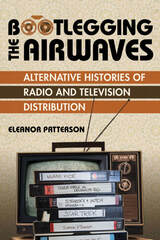
front cover of Bootlegging the Airwaves
Bootlegging the Airwaves
Alternative Histories of Radio and Television Distribution
Eleanor Patterson
University of Illinois Press, 2024
How fan passion and technology merged into a new subculture

Long before internet archives and the anytime, anywhere convenience of streaming, people collected, traded, and shared radio and television content via informal networks that crisscrossed transnational boundaries.

Eleanor Patterson’s fascinating cultural history explores the distribution of radio and TV tapes from the 1960s through the 1980s. Looking at bootlegging against the backdrop of mass media’s formative years, Patterson delves into some of the major subcultures of the era. Old-time radio aficionados felt the impact of inexpensive audio recording equipment and the controversies surrounding programs like Amos ‘n’ Andy. Bootlegging communities devoted to buddy cop TV shows like Starsky and Hutch allowed women to articulate female pleasure and sexuality while Star Trek videos in Australia inspired a grassroots subculture built around community viewings of episodes. Tape trading also had a profound influence on creating an intellectual pro wrestling fandom that aided wrestling’s growth into an international sports entertainment industry.
[more]

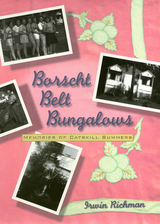
front cover of Borscht Belt Bungalows
Borscht Belt Bungalows
Memoirs Of Catskill Summers
Irwin Richman
Temple University Press, 2003
Every year between 1920 and 1970, almost one million of New York City's Jewish population summered in the Catskills. Hundreds of thousands still do. While much has been written about grand hotels like Grossinger's and the Concord, little has appeared about the more modest bungalow colonies and kuchaleins ("cook for yourself" places) where more than 80 percent of Catskill visitors stayed.

These were not glamorous places, and middle-class Jews today remember the colonies with either aversion or fondness. Irwin Richman's narrative, anecdotes, and photos recapture everything from the traffic jams leaving the city to the strategies for sneaking into the casinos of the big hotels. He brings to life the attitudes of the renters and the owners, the differences between the social activities and swimming pools advertised and what people actually received. He reminisces about the changing fashion of the guests and owners—everything that made summers memorable.

The author remembers his boyhood: what it was like to spend summers outside the city, swimming in the Neversink, "noodling around," and helping with the bungalow operation, while Grandpa charged the tenants and acted as president of Congregation B'nai Israel of Woodbourne, N.Y. He also traces the changes in the Catskills, including the influx of Hasidic families. Richman talks about what it's like to go back and to see the ghosts of resorts along the roads he once traveled.
[more]

front cover of Bound by Creativity
Bound by Creativity
How Contemporary Art Is Created and Judged
Hannah Wohl
University of Chicago Press, 2021
What is creativity? While our traditional view of creative work might lead us to think of artists as solitary visionaries, the creative process is profoundly influenced by social interactions even when artists work alone. Sociologist Hannah Wohl draws on more than one hundred interviews and two years of ethnographic research in the New York contemporary art market to develop a rich sociological perspective of creativity. From inside the studio, we see how artists experiment with new ideas and decide which works to abandon, destroy, put into storage, or exhibit. Wohl then transports readers into the art world, where we discover how artists’ understandings of their work are shaped through interactions in studio visits, galleries, international art fairs, and collectors’ homes.
 
Bound by Creativity reveals how artists develop conceptions of their distinctive creative visions through experimentation and social interactions. Ultimately, we come to appreciate how judgment is integral to the creative process, both resulting in the creation of original works while also limiting an artist’s ability to break new ground. Exploring creativity through the lens of judgment sheds new light on the production of cultural objects, markets, and prestige. 
[more]

front cover of Bounded Lives, Bounded Places
Bounded Lives, Bounded Places
Free Black Society in Colonial New Orleans, 1769–1803
Kimberly S. Hanger
Duke University Press, 1997
During Louisiana’s Spanish colonial period, economic, political, and military conditions combined with local cultural and legal traditions to favor the growth and development of a substantial group of free blacks. In Bounded Lives, Bounded Places, Kimberly S. Hanger explores the origin of antebellum New Orleans’ large, influential, and propertied free black—or libre—population, one that was unique in the South. Hanger examines the issues libres confronted as they individually and collectively contested their ambiguous status in a complexly stratified society.
Drawing on rare archives in Louisiana and Spain, Hanger reconstructs the world of late-eighteenth-century New Orleans from the perspective of its free black residents, and documents the common experiences and enterprises that helped solidify libres’ sense of group identity. Over the course of three and a half decades of Spanish rule, free people of African descent in New Orleans made their greatest advances in terms of legal rights and privileges, demographic expansion, vocational responsibilities, and social standing. Although not all blacks in Spanish New Orleans yearned for expanded opportunity, Hanger shows that those who did were more likely to succeed under Spain’s dominion than under the governance of France, Great Britain, or the United States.
The advent of U.S. rule brought restrictions to both manumission and free black activities in New Orleans. Nonetheless, the colonial libre population became the foundation for the city’s prosperous and much acclaimed Creoles of Color during the antebellum era.
[more]

logo for American Library Association
A Box Full of Tales
Kathy MacMillan
American Library Association, 2008

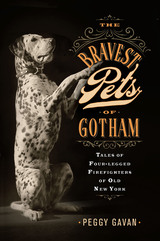
front cover of The Bravest Pets of Gotham
The Bravest Pets of Gotham
Tales of Four-Legged Firefighters of Old New York
Peggy Gavan
Rutgers University Press, 2024
In the late 1800s and early 1900s, the New York Fire Department permitted firemen to keep one dog, one cat, or singing birds in their firehouse. Since the firemen were required to live and work at the firehouse full-time, these animal mascots—along with the horses that pulled the fire trucks—were their constant companions, making a dangerous workplace feel more like home. 
 
The Bravest Pets of Gotham takes readers on a fun historical tour of Old New York, sharing touching and comical stories about the bond between FDNY firefighters and their four-legged or feathered friends. The book contains more than one hundred astonishing, emotional, and sometimes hilariously absurd tales of the FDNY animal mascots whose extraordinary intelligence, acts of bravery, and funny antics deserve to be remembered. Some anecdotes depict fire companies that broke the one-pet rule and welcomed a veritable menagerie of animals into their firehouses, including goats, turtles, and even monkeys. Whether you are an animal lover, a history buff, or a fan of firefighting, The Bravest Pets of Gotham is full of stories that will thrill and amuse you. 

 
[more]

front cover of Bridges Over the Delaware River
Bridges Over the Delaware River
A History of Crossings
Frank T. Dale
Rutgers University Press, 2003

When Washington made his famous crossing of the Delaware River, it is a shame he couldn't have invited local historian Frank T. Dale along for the ride. Dale could have suggested the easiest crossing points.

Fortunately for contemporary readers, Dale has written a fascinating book chronicling thirty-five of the most historic bridges crossing the Delaware, some of which have served the residents of New Jersey, Pennsylvania, and New York for almost two centuries. Many of us take these bridges for granted as we speed across, impatient to reach our destination, but their histories are too interesting to ignore.

Dale brings us the stories behind each bridge, covering design, engineering, ownership, finances, and politics. He chronicles the life of each, from the original construction, through modifications, and, sometimes, through the bridges' multiple destructions and reconstructions. Along the way, Dale recounts the history of the area surrounding each bridge, including the demise of ferry services, reasons why each bridge was built, politics surrounding construction, debates over public versus privately owned bridges, and stories of the floods and fires that threatened not only the bridges, but the local residents. Dozens of rare photos give readers a captivating window back into the past.

These fine old structures have become integral parts of Delaware River life and have an exciting past of their own. Bridges over the Delaware River will ensure that their legacies endure.

[more]

front cover of Brightening Glance
Brightening Glance
Art and Life
Pat Lipsky
University of Iowa Press, 2025
For more than five decades, Pat Lipsky has been a leading figure in American color field painting. In loosely connected vignettes, this extraordinary book looks back on a life starting in 1970s SoHo: from her pioneering days juggling painting and single motherhood in a redesigned factory loft on Wooster Street; to Paris, where an enchanting friendship develops with the former director of the Louvre, Pierre Rosenberg; to her yearslong close friendship with legendary art critic Clement Greenberg; to a marvelous love affair with the charismatic art dealer Richard Bellamy. We glimpse Lipsky’s first introduction to Cézanne as a child in 1950s Brooklyn and her studies with the mythic artist Tony Smith, who would become her mentor. There is a visit with Lee Krasner at her home in Springs and another at Lipsky’s Manhattan apartment, late-night, smoke-filled loft parties, and evenings at Max’s Kansas City where Lou Reed and Nico sing in the background while rival groups of earthwork artists, pop artists, conceptual artists, and color field painters pretend to ignore each other at the bar. Along the way we experience Lipsky’s emergence at the forefront of her generation of painters.

Brightening Glance offers a stunningly self-revealing portrait of the struggles and sacrifices, joys and excitement inherent in a modern painter’s life, and captures the evergreen allure of New York’s art world between 1970 and 2010. In stripped down, elegant prose, Lipsky summons a New York that no longer exists and ponders why we love (and hate) the art world. Ultimately, it’s a story of a contemporary woman, a mother, and a painter, who dares a career in a field where only a handful of women have succeeded.
 
[more]

logo for University of Chicago Press Journals
The British Journal for the Philosophy of Science, volume 72 number 3 (September 2021)
The University of Chicago Press
University of Chicago Press Journals, 2021

front cover of The British Journal for the Philosophy of Science, volume 73 number 3 (September 2022)
The British Journal for the Philosophy of Science, volume 73 number 3 (September 2022)
The University of Chicago Press
University of Chicago Press Journals, 2022
This is volume 73 issue 3 of The British Journal for the Philosophy of Science. Since 1950, The British Journal for the Philosophy of Science (BJPS) has presented the best new work in the discipline. An international leader in the philosophy of science, BJPS showcases outstanding research on a variety of topics, from the nature of models and simulations to mathematical explanation and foundational issues in the physical, life, and social sciences. Published on behalf of the British Society for the Philosophy of Science, the journal offers innovative and thought-provoking papers that open up new areas of inquiry or shed new light on well-known issues.
[more]

front cover of The British Journal for the Philosophy of Science, volume 74 number 3 (September 2023)
The British Journal for the Philosophy of Science, volume 74 number 3 (September 2023)
The University of Chicago Press
University of Chicago Press Journals, 2023
This is volume 74 issue 3 of The British Journal for the Philosophy of Science. Since 1950, The British Journal for the Philosophy of Science (BJPS) has presented the best new work in the discipline. An international leader in the philosophy of science, BJPS showcases outstanding research on a variety of topics, from the nature of models and simulations to mathematical explanation and foundational issues in the physical, life, and social sciences. Published on behalf of the British Society for the Philosophy of Science, the journal offers innovative and thought-provoking papers that open up new areas of inquiry or shed new light on well-known issues.
[more]

front cover of The British Journal for the Philosophy of Science, volume 75 number 3 (September 2024)
The British Journal for the Philosophy of Science, volume 75 number 3 (September 2024)
The University of Chicago Press
University of Chicago Press Journals, 2024
This is volume 75 issue 3 of The British Journal for the Philosophy of Science. Since 1950, The British Journal for the Philosophy of Science (BJPS) has presented the best new work in the discipline. An international leader in the philosophy of science, BJPS showcases outstanding research on a variety of topics, from the nature of models and simulations to mathematical explanation and foundational issues in the physical, life, and social sciences. Published on behalf of the British Society for the Philosophy of Science, the journal offers innovative and thought-provoking papers that open up new areas of inquiry or shed new light on well-known issues.
[more]

front cover of The British Journal for the Philosophy of Science, volume 76 number 3 (September 2025)
The British Journal for the Philosophy of Science, volume 76 number 3 (September 2025)
The University of Chicago Press
University of Chicago Press Journals, 2025
This is volume 76 issue 3 of The British Journal for the Philosophy of Science. Since 1950, The British Journal for the Philosophy of Science (BJPS) has presented the best new work in the discipline. An international leader in the philosophy of science, BJPS showcases outstanding research on a variety of topics, from the nature of models and simulations to mathematical explanation and foundational issues in the physical, life, and social sciences. Published on behalf of the British Society for the Philosophy of Science, the journal offers innovative and thought-provoking papers that open up new areas of inquiry or shed new light on well-known issues.
[more]

front cover of The British Journal for the Philosophy of Science, volume 77 number 3 (September 2026)
The British Journal for the Philosophy of Science, volume 77 number 3 (September 2026)
The University of Chicago Press
University of Chicago Press Journals, 2026
This is volume 77 issue 3 of The British Journal for the Philosophy of Science. Since 1950, The British Journal for the Philosophy of Science (BJPS) has presented the best new work in the discipline. An international leader in the philosophy of science, BJPS showcases outstanding research on a variety of topics, from the nature of models and simulations to mathematical explanation and foundational issues in the physical, life, and social sciences. Published on behalf of the British Society for the Philosophy of Science, the journal offers innovative and thought-provoking papers that open up new areas of inquiry or shed new light on well-known issues.
[more]

logo for The Institution of Engineering and Technology
British Television
The formative years
Russell Burns
The Institution of Engineering and Technology, 1986
On 2 November 1936 the world's first high definition television station was inaugurated at Alexandra Palace. Two competing companies, Marconi-EMI Television Company Ltd and Baird Television Ltd, provided studio and transmitting equipment for the new service which operated, on an alternate basis, with the systems of the two companies. After a trial period the 405-line system of the Marconi-EMI company was adopted and the last transmission by the 240-line system of Baird Television Ltd was sent out on 30 January 1937.
[more]

logo for Intellect Books
British TV and Film Culture in the 1950s
Coming to a TV Near You
Su Holmes
Intellect Books, 1995
This book focuses on the emerging historical relations between British television and film culture in the 1950s. Drawing upon archival research, it does this by exploring the development of the early cinema programme on television - principally Current Release (BBC, 1952-3), Picture Parade (BBC, 1956) and Film Fanfare (ABC, 1956-7) - and argues that it was these texts which played the central role in the developing relations between the media. Particularly when it comes to Britain, the early co-existence of television and cinema has been seen as hostile and antagonistic, but in situating these programmes within the contexts of their institutional production, aesthetic construction and reception, the book aims to ‘reconstruct’ television’s coverage of the cinema as crucial to the fabric of British film and television culture at the time. It demonstrates how the roles of cinema and television - as media industries and cultural forms, but crucially as sites of screen entertainment - effectively came together at this time in such a way that is unique to this decade.
[more]

logo for Intellect Books
Britpop Cinema
From Trainspotting to This is England
Matt Glasby
Intellect Books, 2019
The Britpop movement of the mid-1990s defined a generation, and the films were just as exciting as the music. Beginning with Shallow Grave, hitting its stride with Trainspotting, and going global with The Full Monty, Lock, Stock and Two Smoking Barrels, Shaun of the Dead, and This Is England, Britpop cinema pushed boundaries, paid Hollywood no heed, and placed the United Kingdom all too briefly at the center of the movie universe. Featuring exclusive interviews with key players such as Simon Pegg, Irvine Welsh, Michael Winterbottom and Edgar Wright, Britpop Cinema combines eyewitness accounts, close analysis, and social history to celebrate a golden age for UK film.
[more]

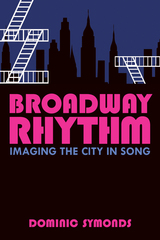
front cover of Broadway Rhythm
Broadway Rhythm
Imaging the City in Song
Dominic Symonds
University of Michigan Press, 2017
Broadway Rhythm is a guide to Manhattan like nothing you've ever read. Author Dominic Symonds calls it a performance cartography, and argues that the city of New York maps its iconicity in the music of the Broadway songbook. A series of walking tours takes the reader through the landscape of Manhattan, clambering over rooftops, riding the subway, and flying over skyscrapers. Symonds argues that Broadway's songs can themselves be used as maps to better understand the city though identifiable patterns in the visual graphics of the score, the auditory experience of the music, and the embodied articulation of performance, recognizing in all of these patterns, corollaries inscribed in the terrain, geography, and architecture of the city.

Through musicological analyses of works by Gershwin, Bernstein, Copland, Sondheim and others, the author proposes that performance cartography is a versatile methodology for urban theory, and establishes a methodological approach that uses the idea of the map in three ways: as an impetus, a metaphor, and a tool for exploring the city.
 
[more]

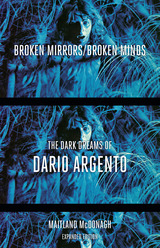
front cover of Broken Mirrors/Broken Minds
Broken Mirrors/Broken Minds
The Dark Dreams of Dario Argento
Maitland McDonagh
University of Minnesota Press, 2010
Italian filmmaker Dario Argento’s horror films have been described as a blend of Alfred Hitchcock and George Romero—psychologically rich, colorful, and at times garish, excelling at taking the best elements of the splatter and exploitation genres and laying them over a dark undercurrent of human emotions and psyches. Broken Mirrors/Broken Minds, which dissects such Argento cult films as Two Evil Eyes, The Bird with the Crystal Plumage, Suspiria, and Deep Red, includes a new introduction discussing Argento’s most recent films, from The Stendahl Syndrome to Mother of Tears; an updated filmography; and an interview with Argento.
[more]

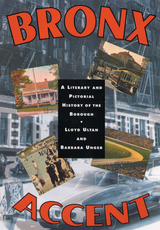
front cover of Bronx Accent
Bronx Accent
A Literary and Pictorial History of the Borough
Ultan, Lloyd
Rutgers University Press, 2000
For the last three hundred years, and through all its social and economic transformations, The Bronx has been a major literary center that many prominent writers have called home.

Bringing together a variety of past literary figures as well as emerging talents, this comprehensive book captures the Zeitgeist of the neighborhood through the eyes of its writers. Included are selections from the writings of Jack Kerouac, Mark Twain, James Baldwin, James Fenimore Cooper, Tom Wolfe, Herman Wouk, Theodore Dreiser, Washington Irving, Clifford Odets, Cynthia Ozick, Grace Paley, Edgar Allan Poe, Chaim Potok, Kate Simon, Leon Trotsky, and Sholem Aleichem.

Lloyd Ultan and Barbara Unger place the literature of these and other writers in historical context and reproduce one hundred vintage photographs that bring the writings to life. Filtered through the imaginations of authors of different times, ethnic groups, social classes, and literary styles, the borough of The Bronx emerges not only as a shaper of destinies and lives, but as an important literary mecca.
[more]

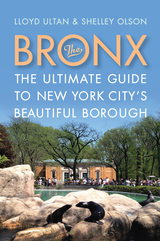
front cover of The Bronx
The Bronx
The Ultimate Guide to New York City's Beautiful Borough
Ultan, Lloyd
Rutgers University Press, 2015
Often overlooked by most tourists and locals alike, the Bronx—one of five boroughs that comprise the city of New York—is rich in cultural and historical attractions. From the Bronx Zoo (the largest urban zoo in the United States) to the New York Botanical Garden (one of the most visited botanical gardens in the world), this borough has something for everyone. Visitors can explore historical locations (including where George Washington slept and where Edgar Allan Poe lived and worked), watch a game in one of the most famous baseball stadiums in the United States—Yankee Stadium—and sample delicious Italian food in New York’s real “Little Italy” on Arthur Avenue and New England style seafood at City Island along the edge of Long Island Sound. Author and foremost historian of the Bronx Lloyd Ultan and educator Shelley Olson have teamed up to create a handy guidebook with detailed maps that will provide all the information prospective visitors need for planning their adventures to famous and little-known sites, including the hours, admission fees, and directions to featured attractions.
 
The Bronx—which includes thirty-six color photographs—provides visitors with informative chapters on more than twelve of the borough’s extraordinary destinations as well as self-guided walking tours of some of the most ethnically, architecturally, and historically diverse neighborhoods. History buffs will find beautifully preserved eighteenth- and nineteenth-century homes, the Hall of Fame for Great Americans (which pays homage to many familiar faces in American history), and Woodlawn Cemetery (the final resting place for prominent Americans including Duke Ellington, Joseph Pulitzer, Gloria Vanderbilt Whitney, and Thomas Nast). In addition to the botanical garden, nature lovers can enjoy the beautiful Pelham Bay Park and Van Cortlandt Park. The Bronx also highlights the surprising number of art galleries, museums, and performance venues that visitors are sure to enjoy, further demonstrating the borough’s cultural prominence. .
 
 
[more]

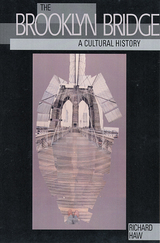
front cover of The Brooklyn Bridge
The Brooklyn Bridge
A Cultural History
Haw, Richard
Rutgers University Press, 2008

Hailed by some as the Eighth Wonder of the World when it opened in 1883, the Brooklyn Bridge is one of the world’s most recognizable and beloved icons. For over one hundred years it has excited and fascinated with stories of ingenuity and heroism, and it has been endorsed as a flawless symbol of municipal improvement and a prime emblem of American technological progress.

Despite its impressive physical presence, however, Brooklyn’s grand old bridge is much more than a testament of engineering and architectural achievement. As Richard Haw shows in this first of its kind cultural history, the Brooklyn Bridge owes as much to the imagination of the public as it does to the historical events and technical prowess that were integral to its construction.

Bringing together more than sixty images of the bridge that, over the years, have graced postcards, magazine covers, and book jackets and appeared in advertisements, cartoons, films, and photographs, Haw traces the diverse and sometimes jarring ways in which this majestic structure has been received, adopted, and interpreted as an American idea. Haw’s account is not a history of how the bridge was made, but rather of what people have made of the Brooklyn Bridge—in film, music, literature, art, and politics—from its opening ceremonies to the blackout of 2003.

Classic accounts from such writers and artists as H. G. Wells, Charles Reznikoff, Hart Crane, Lewis Mumford, Joseph Pennell, Walker Evans, and Georgia O’Keeffe, among many others, present the bridge as a deserted, purely aestheticized romantic ideal, while others, including Henry James, Joseph Stella, Yun Gee, Ernest Poole, Alfred Kazin, Paul Auster, and Don DeLillo, offer a counter-narrative as they question not only the role of the bridge in American society, but its function as a profoundly public, communal place. Also included are never-before-published photographs by William Gedney and a discussion of Alexis Rockman’s provocative new mural Manifest Destiny.

Drawing on hundreds of cultural artifacts, from the poignant, to the intellectual, to the downright quirky, The Brooklyn Bridge sheds new light on topics such as ethnic and foreign responses to America, nationalism, memory, parade culture, commemoration, popular culture, and post-9/11 America icons. In the end, we realize that this impressive span is as culturally remarkable today as it was technologically and physically astounding in the nineteenth century.
 

[more]

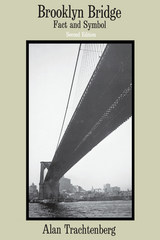
front cover of Brooklyn Bridge
Brooklyn Bridge
Fact and Symbol
Alan Trachtenberg
University of Chicago Press, 1979
Fourteen of Walker Evans's evocative photographs of Brooklyn Bridge, most of which have never been published, appear in this edition of Alan Trachenberg's Brooklyn Bridge: Fact and Symbol. In the new afterword Trachenberg explores the history of Hart Crane's The Bridge, especially the poem's integral relationship with the powerful photography of Evans.

"[Brooklyn Bridge] is familiar in so many movies, in so many stage sets and, as Mr. Trachtenberg shows in this brilliant . . . book, it is at least as much a symbol as a reality. . . . Mr. Trachtenberg is always exciting and illuminating."—Times Literary Supplement 

"The book is a skillful and insightful synthesis of materials about Brooklyn Bridge from such diverse fields as history, engineering, literature and art. Essentially it asks the question of why Brooklyn Bridge achieved such great impact on the nineteenth century American imagination and why it has continued to have a significant impact on twentieth century art and literature. In addition to its exploration of the bridge's symbolic significance, which includes perceptive analyses of such particular works as Hart Crane's great poem cycle and the paintings of artists like Joseph Stella, the book also includes a solidly researched account of the conception, planning and construction of the bridge. Trachtenberg's account of the intellectual and cultural sources of the bridge is particularly fascinating in its demonstration of the convergence of many different philosophical and ideological currents of the time around this great engineering enterprise, illustrating as effectively as any discussion I know the complex interplay of ideas and material culture."—John G. Cawelti, University of Chicago

"Alan Trachtenberg's Brooklyn Bridge is a fascinating story, the philosophic genesis of the idea in Europe, John Roebling's heroic effort to translate it into masonry and steel, and the meanings that Americans attached to the physical object as an emblem of their aspirations."—Leo Marx, Amherst College, author of The Machine in the Garden
[more]

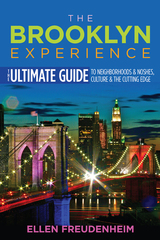
front cover of The Brooklyn Experience
The Brooklyn Experience
The Ultimate Guide to Neighborhoods & Noshes, Culture & the Cutting Edge
Freudenheim, Ellen
Rutgers University Press, 2016
From Paris to Rio, everyone’s curious about hot, new Brooklyn. The Brooklyn Experience, Ellen Freudenheim’s fourth comprehensive Brooklyn guidebook, offers a true insider’s guide, complete with photographs, itineraries, and insights  into one of the most creative, dynamic cities in the modern world. 
 
Walk over the Brooklyn Bridge at dawn or sunset, discover thirty-eight unique Brooklyn neighborhoods, and experience the borough like a native. Find out where to go to the beach and to eat great pizza, what to do with the kids, how to enjoy free and cheap activities, and where to savor Brooklyn’s famous cuisines. Visit cool independent shops, greenmarkets, festivals, and delve into the vibrant new cultural scene at the Brooklyn Academy of Music, Barclays Center, and the lively exploding neighborhoods of DUMBO, Williamsburg, and Bushwick.
 
Included in the book are essays and the pithy, sometimes funny comments of sixty cultural, literary, and culinary movers and shakers, culled from exclusive interviews with experts from the James Beard Foundation to the cofounder of the famous Brooklyn Book Festival, as well as MacArthur “genius” award winners, to young entrepreneurs, hipsters, and activists, all of whom have something to say about Brooklyn’s stunning renaissance.  Neighborhood profiles are rich in user-friendly information and details, including movies, celebrities, and novels associated with each neighborhood. There are also 800 listings of great restaurants, bars, shops, parks, cultural institutions, and historical sites, complete with contact information.  

Targeting the independent, curious traveler, The Brooklyn Experience includes a dozen “do-it-yourself” tours, including a visit to Woody Allen’s childhood neighborhood, and amazing Revolutionary and Civil War sites. 
 
Freudenheim draws clear—and sometimes surprising—connections between old and new Brooklyn. Written by an author with an astounding knowledge of all Brooklyn has to offer, The Brooklyn Experience will guide both first-time and repeat visitors, and will be a fun resource for Brooklynites who enjoy exploring their own hometown. 
 

[more]

front cover of Brooklyn Odyssey
Brooklyn Odyssey
My Journey out of Hasidism
Zalman Newfield
Temple University Press, 2026

Growing up in Crown Heights, Brooklyn as a member of the Chabad-Lubavitch Hasidic Orthodox Jewish community, Zalman Newfield was raised in an atmosphere of strict gender segregation, rigorous religious education, and nearly all-consuming ritual practices. Trained to be a Lubavitch emissary, he traveled around the world doing Jewish outreach to help usher in the messianic redemption. However, after exposure to the wider world, he abandoned the faith of his youth.

Brooklyn Odyssey is Newfield’s poignant and hopeful memoir about exiting Orthodoxy. He recounts asserting his individuality and taking the radical step of shaving his beard. Reflective about his upbringing, Newfield is open to and curious about a world beyond Brooklyn while also maintaining his profound bond with his family and Jewish tradition. He writes candidly about his emotional, intellectual, and social experiences in and out of the Lubavitch community.  

From pivotal moments of devastation, including the illness and death of his younger brother and of his revered spiritual leader Rabbi Menachem Mendel Schneerson, to moments of joyful resolve, including the decision to pursue a doctorate and marry a non-Orthodox Jew, Newfield takes readers on his moving and impactful journey.
[more]

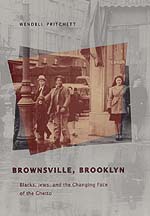
front cover of Brownsville, Brooklyn
Brownsville, Brooklyn
Blacks, Jews, and the Changing Face of the Ghetto
Wendell E. Pritchett
University of Chicago Press, 2001
From its founding in the late 1800s through the 1950s, Brownsville, a section of eastern Brooklyn, was a white, predominantly Jewish, working-class neighborhood. The famous New York district nurtured the aspirations of thousands of upwardly mobile Americans while the infamous gangsters of Murder, Incorporated controlled its streets. But during the 1960s, Brownsville was stigmatized as a black and Latino ghetto, a neighborhood with one of the city's highest crime rates. Home to the largest concentration of public housing units in the city, Brownsville came to be viewed as emblematic of urban decline. And yet, at the same time, the neighborhood still supported a wide variety of grass-roots movements for social change.

The story of these two different, but in many ways similar, Brownsvilles is compellingly told in this probing new work. Focusing on the interaction of Brownsville residents with New York's political and institutional elites, Wendell Pritchett shows how the profound economic and social changes of post-World War II America affected the area. He covers a number of pivotal episodes in Brownsville's history as well: the rise and fall of interracial organizations, the struggles to deal with deteriorating housing, and the battles over local schools that culminated in the famous 1968 Teachers Strike. Far from just a cautionary tale of failed policies and institutional neglect, the story of Brownsville's transformation, he finds, is one of mutual struggle and frustrated cooperation among whites, blacks, and Latinos.

Ultimately, Brownsville, Brooklyn reminds us how working-class neighborhoods have played, and continue to play, a central role in American history. It is a story that needs to be read by all those concerned with the many challenges facing America's cities today.
[more]

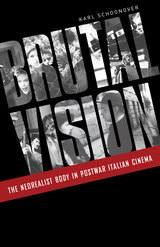
front cover of Brutal Vision
Brutal Vision
The Neorealist Body in Postwar Italian Cinema
Karl Schoonover
University of Minnesota Press, 2012

Film history identifies Italian neorealism as the exemplar of national cinema, a specifically domestic response to wartime atrocities. Brutal Vision challenges this orthodoxy by arguing that neorealist films—including such classics as Rome, Open City; Paisan; Shoeshine; and Bicycle Thieves—should be understood less as national products and more as complex agents of a postwar reorganization of global politics. For these films, cinema facilitates the liberal humanist sympathy required to usher in a new era of world stability.

In his readings of crucial films and newly discovered documents from the archives of neorealism’s international distribution, Karl Schoonover reveals how these films used images of the imperiled body to reconstitute the concept of the human and to recalibrate the scale of human community. He traces how Italian neorealism emerges from and consolidates the transnational space of the North Atlantic, with scenarios of physical suffering dramatizing the geopolitical stakes of a newly global vision. Here we see how—in their views of injury, torture, and martyrdom—these films propose a new mode of spectating that answers the period’s call for extranational witnesses, makes the imposition of limited sovereignty palatable, and underwrites a new visual politics of liberal compassion that Schoonover calls brutal humanism.

These films redefine moviegoing as a form of political action and place the filmgoer at the center of a postwar geopolitics of international aid. Brutal Vision interrogates the role of neorealism’s famously heart-wrenching scenes in a new global order that requires its citizenry to invest emotionally in large-scale international aid packages, from the Marshall Plan to the liberal charity schemes of NGOs. The book fundamentally revises ideas of cinematic specificity, the human, and geopolitical scale that we inherit from neorealism and its postwar milieu—ideas that continue to set the terms for political filmmaking today.
[more]

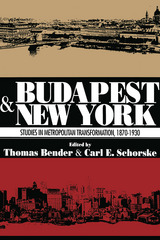
front cover of Budapest and New York
Budapest and New York
Studies in Metropolitan Transformation, 1870-1930
Thomas Bender
Russell Sage Foundation, 1994
Little over a century ago, New York and Budapest were both flourishing cities engaging in spectacular modernization. By 1930, New York had emerged as an innovating cosmopolitan metropolis, while Budapest languished under the conditions that would foster fascism. Budapest and New York explores the increasingly divergent trajectories of these once-similar cities through the perspectives of both Hungarian and American experts in the fields of political, cultural, social and art history. Their original essays illuminate key aspects of urban life that most reveal the turn-of-the-century evolution of New York and Budapest: democratic participation, use of public space, neighborhood ethnicity, and culture high and low. What comes across most strikingly in these essays is New York's cultivation of social and political pluralism, a trend not found in Budapest. Nationalist ideology exerted tremendous pressure on Budapest's ethnic groups to assimilate to a single Hungarian language and culture. In contrast, New York's ethnic diversity was transmitted through a mass culture that celebrated ethnicity while muting distinct ethnic traditions, making them accessible to a national audience. While Budapest succumbed to the patriotic imperatives of a nation threatened by war, revolution, and fascism, New York, free from such pressures, embraced the variety of its people and transformed its urban ethos into a paradigm for America. Budapest and New York is the lively story of the making of metropolitan culture in Europe and America, and of the influential relationship between city and nation. In unifying essays, the editors observe comparisons not only between the cities, but in the scholarly outlooks and methodologies of Hungarian and American histories. This volume is a unique urban history. Begun under the unfavorable conditions of a divided world, it represents a breakthrough in cross-cultural, transnational, and interdisciplinary historical work.
[more]

front cover of The Buffalo Book
The Buffalo Book
The Full Saga Of The American Animal
David A. Dary
Ohio University Press, 1989
The journals and memoirs of nineteeth-century explorers and travelers in the American West often told of viewing buffalo massed together as far as the eye could see. This book appropriately covers the subject of the buffalo as extensively as that animal covered the plains. Other recent accounts of the buffalo have focused on two or three aspects, emphasizing its natural history, the hunters and the hunted in prehistoric time, the relationship between the buffalo and the American Indian. David Dary’s treatment stretches from horizon to horizon. Of course he discusses the origin of the buffalo in North America, its locations and migrations, its habits, its significance and role in both Indian and white cultures, its near demise, its salvation. But more. Dary weaves throughout his fact-filled book fascinating threads of lore and legend of this animal that literally helped mold who and what America is. Further, in addition to detailing the extinction which almost befell this mythic beast and the attempts to give life again to the herds, Dary concentrates significant attention on the buffalo as part of America in terms of captivity, husbandry, and symbol.
[more]

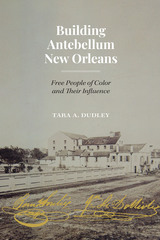
front cover of Building Antebellum New Orleans
Building Antebellum New Orleans
Free People of Color and Their Influence
By Tara A. Dudley
University of Texas Press, 2021

2024 Spiro Kostof Book Award, Society of Architectural Historians
2022 PROSE Award in Architecture and Urban Planning
2022 Summerlee Book Prize in Nonfiction, Center for History and Culture of Southeast Texas and the Upper Gulf Coast
2022 Best Book Prize, Southeast Chapter of the Society of Architectural Historians
2022 On the Brinck Book Award, University of New Mexico School of Architecture + Planning

A significant and deeply researched examination of the free nineteenth-century Black developers who transformed the cultural and architectural legacy of New Orleans.

The Creole architecture of New Orleans is one of the city’s most-recognized features, but studies of it largely have focused on architectural typology. In Building Antebellum New Orleans, Tara A. Dudley examines the architectural activities and influence of gens de couleur libres—free people of color—in a city where the mixed-race descendants of whites and other free Blacks could own property.

Between 1820 and 1850 New Orleans became an urban metropolis and industrialized shipping center with a growing population. Amidst dramatic economic and cultural change in the mid-antebellum period, the gens de couleur libres thrived as property owners, developers, building artisans, and patrons. Dudley writes an intimate microhistory of two prominent families of Black developers, the Dollioles and Souliés, to explore how gens de couleur libres used ownership, engagement, and entrepreneurship to construct individual and group identity and stability. With deep archival research, Dudley re-creates in fine detail the material culture, business and social history, and politics of the built environment for free people of color and adds new, revelatory information to the canon on New Orleans architecture.
[more]

front cover of Building Filipino Hawai'i
Building Filipino Hawai'i
Roderick Labrador
University of Illinois Press, 2015
Drawing on ten years of interviews and ethnographic and archival research, Roderick Labrador delves into the ways Filipinos in Hawai'i have balanced their pursuit of upward mobility and mainstream acceptance with a desire to keep their Filipino identity.
 
In particular, Labrador speaks to the processes of identity making and the politics of representation among immigrant communities striving to resist marginalization in a globalized, transnational era. Critiquing the popular image of Hawai'i as a postracial paradise, he reveals how Filipino immigrants talk about their relationships to the place(s) they left and the place(s) where they've settled, and how these discourses shape their identities. He also shows how the struggle for community empowerment, identity territorialization, and the process of placing and boundary making continue to affect how minority groups construct the stories they tell about themselves, to themselves and others.
[more]

front cover of Building the Metropolis
Building the Metropolis
Architecture, Construction, and Labor in New York City, 1880–1935
Alexander Wood
University of Chicago Press, 2025
A sweeping history of New York that chronicles the construction of one of the world’s great cities.
 
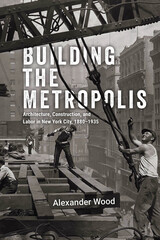
Between the 1880s and the 1930s, New York City experienced explosive growth as nearly a million buildings, dozens of bridges and tunnels, hundreds of miles of subway lines, and thousands of miles of streets were erected to meet the needs of an ever-swelling population. This landscape—jagged with skyscrapers, rattling with the sound of mass transit, alive with people—made the city world-famous.
 
Building the Metropolis offers a revelatory look at this era of urban development by asking, “Who built New York, and how?” Focusing on the work of architects, builders, and construction workers, Alexander Wood chronicles the physical process of the city’s rapid expansion. New York’s towering buildings and busy thoroughfares aren’t just stylish or structural marvels, Wood shows, but the direct result of the many colorful personalities who worked in one of the city’s largest industries. This development boom drew on the resources of the whole community and required money, political will, creative vision, entrepreneurial drive, skilled workmanship, and hard physical labor. Wood shows this to be an even larger story as well. As cities became nodes in a regional, national, and global economy, the business of construction became an important motor of economic, political, and social development. While they held drastically different views on the course of urban growth, machine politicians, reformers, and radicals alike were all committed to city building on an epic scale.
 
Drawing on resources that include city archives and the records of architecture firms, construction companies, and labor unions, Building the Metropolis tells the story of New York in a way that’s epic, lively, and utterly original.
[more]

front cover of Bulldaggers, Pansies, and Chocolate Babies
Bulldaggers, Pansies, and Chocolate Babies
Performance, Race, and Sexuality in the Harlem Renaissance
James F. Wilson
University of Michigan Press, 2011
Bulldaggers, Pansies, and Chocolate Babies shines the spotlight on historically neglected plays and performances that challenged early twentieth-century notions of the stratification of race, gender, class, and sexual orientation. On Broadway stages, in Harlem nightclubs and dance halls, and within private homes sponsoring rent parties, African American performers of the 1920s and early 1930s teased the limits of white middle-class morality. Blues-singing lesbians, popularly known as "bulldaggers," performed bawdy songs; cross-dressing men vied for the top prizes in lavish drag balls; and black and white women flaunted their sexuality in scandalous melodramas and musical revues. Race leaders, preachers, and theater critics spoke out against these performances that threatened to undermine social and political progress, but to no avail: mainstream audiences could not get enough of the riotous entertainment.James F. Wilson has based his rich cultural history on a wide range of documents from the period, including eyewitness accounts, newspaper reports, songs, and play scripts, combining archival research with an analysis grounded in a cultural studies framework that incorporates both queer theory and critical race theory. Throughout, he argues against the widely held belief that the stereotypical forms of black, lesbian, and gay show business of the 1920s prohibited the emergence of distinctive new voices. Figuring prominently in the book are African American performers including Gladys Bentley, Ethel Waters, and Florence Mills, among others, and prominent writers, artists, and leaders of the era, including Langston Hughes, Wallace Thurman, Zora Neale Hurston, and W. E. B. Du Bois. The study also engages with contemporary literary critics, including Henry Louis Gates and Houston Baker. "James F. Wilson uncovers fascinating new material on the Harlem Renaissance, shedding light on the oft-forgotten gay and lesbian contributions to the era's creativity and Civil Rights. Extremely well researched, compellingly written, and highly informative."
—David Krasner, author of A Beautiful Pageant: African American Theatre, Drama, and Performance in the Harlem Renaissance, 1910-1927
[more]

front cover of Bullets and Fire
Bullets and Fire
Lynching and Authority in Arkansas, 1840-1950
Guy Lancaster
University of Arkansas Press, 2017
Bullets and Fire is the first collection on lynching in Arkansas, exploring all corners of the state from the time of slavery up to the mid-twentieth century and covering stories of the perpetrators, victims, and those who fought against vigilante violence.

Among the topics discussed are the lynching of slaves, the Arkansas Council of the Association of Southern Women for the Prevention of Lynching, the 1927 lynching of John Carter in Little Rock, and the state’s long opposition to a federal anti-lynching law.

Throughout, the work reveals how the phenomenon of lynching—as the means by which a system of white supremacy reified itself, with its perpetrators rarely punished and its defenders never condemned—served to construct authority in Arkansas. Bullets and Fire will add depth to the growing body of literature on American lynching and integrate a deeper understanding of this violence into Arkansas history.
[more]

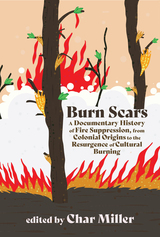
front cover of Burn Scars
Burn Scars
A Documentary History of Fire Suppression, from Colonial Origins to the Resurgence of Cultural Burning
Char Miller
Oregon State University Press, 2024
The first documentary history of wildfire management in the United States, Burn Scars probes the long efforts to suppress fire, beginning with the Spanish invasion of California in the eighteenth century and continuing through the US Forest Service’s relentless nationwide campaign in the twentieth century. The Forest Service argued that suppression was critical for good forest management, especially but not exclusively in the American West. In recent years, suppression has come under increasing scrutiny as a contributing factor to our current era of megafires.
 
In Burn Scars, historian Char Miller assembles a collection of primary sources focused on debates over “light burning” (as prescribed or controlled burning was called). These historic documents show that not only was fire suppression controversial, but that it was also driven by explicitly racist and colonial beliefs. Yet the suppression paradigm contained within it the seeds of its destruction: Indigenous people continued to use fire as did non-Indigenous land managers. By the 1920s, scientific evidence was beginning to reveal that fire was essential for regenerating grasslands and forests; by the 1930s even the Forest Service was testing fire’s ecological benefits.
 
Burn Scars focuses on the burning debates of the early twentieth century, but Miller also provides evidence of a powerful counternarrative emerging from southern non-Indigenous foresters who used fire to revive longleaf pine ecosystems. The volume begins and ends with contributions from Indigenous practitioners discussing the long history and resurgent practice of cultural burning as part of traditional land management.
 
[more]

logo for Pluto Press
The Business of America
The Cultural Production of a Post-War Nation
Graham Thompson
Pluto Press, 2004
The Business of America examines the complex linking of business and nationhood in post-war United States literature against the backdrop of changing concepts of the nation in the field of American Studies. 

The first part of the book examines how white male literary culture has been largely hostile to business during this period and how it has represented transnational shifts in the nature of business as threats to supposedly American values like the individual, the family, or freedom. The book charts the way that such an uneasiness towards business relies upon a discourse about America, business and empire that is increasingly untenable in the post-war world. 

By way of comparison, The Business of America looks at how literature by women and by writers from different racial, ethnic and sexual groups often deals with business from the more localised angle of work. Graham Thompson shows how this attention to work provides a less abstract and more oppositional approach to the connection between business and America.

[more]

front cover of By Fire
By Fire
Writings on the Arab Spring
Tahar Ben Jelloun, translated and with an introduction by Rita Nezami
Northwestern University Press, 2016

Tahar Ben Jelloun’s By Fire, the first fictional account published on the Arab Spring, reimagines the true-life self-immolation of Mohamed Bouazizi in Tunisia, an event that has been credited with setting off the Tunisian revolt. The novella depicts the days leading up to Bouazizi’s self-immolation. Ben Jelloun’s deliberate ambiguity about the location of the story, set in an unnamed Islamic country, allows the reader to imagine the experiences and frustrations of other young men who have endured physical violence and persecution in places beyond Tunisia. The tale begins and ends in fire, and the imagery of burning frames the political accounts in The Spark, Ben Jelloun’s nonfiction writings on the Tunisian events that provide insight into the despotic regimes that drove Bouazizi to such despair. Rita S. Nezami’s elegant translations and critical introduction provide the reader with multiple strategies for approaching these potent texts.
[more]

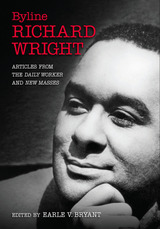
front cover of Byline, Richard Wright
Byline, Richard Wright
Articles from the DAILY WORKER and NEW MASSES
Edited by Earle V. Bryant
University of Missouri Press, 2015

A writer perhaps best known for the revolutionary works Black Boy and Native Son, Richard Wright also worked as a journalist during one of the most explosive periods of the 20th century. From 1937 to 1938, Wright turned out more than two hundred articles for the Daily Worker, the newspaper that served as the voice of the American Communist Party. Byline, Richard Wright assembles more than one hundred of those articles plus two of Wright’s essays from New Masses, revealing to readers the early work of an American icon.

As both reporter and Harlem bureau chief, Wright covered most of the major and minor events, personalities, and issues percolating through the local, national, and global scenes in the late 1930s. Because the Daily Worker wasn’t a mainstream paper, editors gave Wright free rein to cover the stories he wanted, and he tackled issues that no one else covered. Although his peers criticized his journalistic writing, these articles offer revealing portraits of Depression-era America rendered in solid, vivid prose.

Featuring Earle V. Bryant’s informative, detailed introduction and commentary contextualizing the compiled articles, Byline, Richard Wright provides insight into the man before he achieved fame as a novelist, short story writer, and internationally recognized voice of social protest. This collection opens new territory in Wright studies, and fans of Wright’s novels will delight in discovering the lost material of this literary great.

[more]


Send via email Share on Facebook Share on Twitter