
 A SCHOLARLY BOOK REPOSITORY
240 start with C start with C
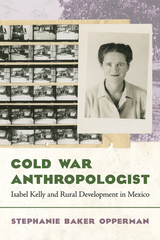
Kelly’s transition from a prominent archaeologist to a key figure in applied anthropology is meticulously chronicled, unveiling her pivotal role in shaping rural development strategies in Mexico amidst the geopolitical context of the Cold War. Through an extensive examination of her correspondence, archival material, and scholarly output, Kelly’s evolving viewpoints offer profound insights into the intricate dynamics of U.S.-Mexico relations and the challenges encountered by female academics during this era.
Organized chronologically, each chapter of this work delves into distinct facets of Kelly’s international journey, with a particular emphasis on her involvement in cooperative programs aimed at fostering diplomatic relations with Mexico. Through this narrative framework, readers are immersed in a compelling exploration of Kelly’s enduring impact on both the field of anthropology and the realm of international diplomacy.
This book is indispensable for historians, anthropologists, and individuals intrigued by the nuanced complexities of Cold War politics, presenting pioneering research at the intersection of history and anthropology. Opperman skillfully brings to light the previously untold narratives of Isabel Kelly, unveiling her influence on mid-twentieth-century Mexico.
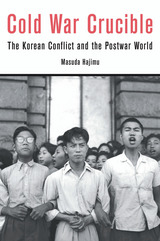
The end of World War II did not mean the arrival of peace. The major powers faced social upheaval at home, while anticolonial wars erupted around the world. American–Soviet relations grew chilly, but the meaning of the rivalry remained disputable. Cold War Crucible reveals the Korean War as the catalyst for a new postwar order. The conflict led people to believe in the Cold War as a dangerous reality, a belief that would define the fears of two generations.
In the international arena, North Korea’s aggression was widely interpreted as the beginning of World War III. At the domestic level, the conflict generated a wartime logic that created dividing lines between “us” and “them,” precipitating waves of social purges to stifle dissent. The United States allowed McCarthyism to take root; Britain launched anti-labor initiatives; Japan conducted its Red Purge; and China cracked down on counterrevolutionaries. These attempts to restore domestic tranquility were not a product of the Cold War, Masuda Hajimu shows, but driving forces in creating a mindset for it. Alarmed by the idea of enemies from within and faced with the notion of a bipolar conflict that could quickly go from chilly to nuclear, ordinary people and policymakers created a fantasy of a Cold War world in which global and domestic order was paramount.
In discovering how policymaking and popular opinion combined to establish and propagate the new postwar reality, Cold War Crucible offers a history that reorients our understanding of what the Cold War really was.
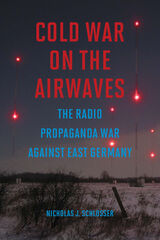
Nicholas J. Schlosser draws on broadcast transcripts, internal memoranda, listener letters, and surveys by the U.S. Information Agency to profile RIAS. Its mission: to undermine the German Democratic Republic with propaganda that, ironically, gained in potency by obeying the rules of objective journalism. Throughout, Schlosser examines the friction inherent in such a contradictory project and propaganda's role in shaping political culture. He also portrays how RIAS's primarily German staff influenced its outlook and how the organization both competed against its rivals in the GDR and pushed communist officials to alter their methods in order to keep listeners.
From the occupation of Berlin through the airlift to the construction of the Berlin Wall, Cold War on the Airwaves offers an absorbing view of how public diplomacy played out at a flashpoint of East-West tension.
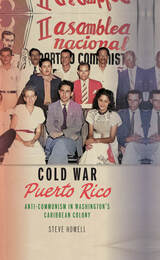
A gripping history of FBI surveillance, political repression, and the fight for Puerto Rican independence
In the 1940s, with the construction of a naval base and a bombing range, Puerto Rico became a major geo-political military outpost for the United States. For a power claiming global leadership in a decolonizing world, however, the archipelago’s colonial condition underscored the dissonance between American democratic rhetoric and its imperial reality. The solution was a deal that, in 1952, gave Puerto Rico a degree of self-government without changing its legal status as an “unincorporated” US territory. The US then publicly claimed Puerto Rico was now more autonomous while using repressive tactics such as FBI surveillance, arrests, destabilization, and other methods developed in Washington to silence activists and political parties pushing for full independence.
In Cold War Puerto Rico, Steve Howell examines how J. Edgar Hoover and the FBI targeted Puerto Rican communists as part of an offensive against pro-independence parties and activists generally. Howell’s US-born father, who fell afoul of Hoover for producing radical cartoons while working in San Juan in the 1940s, remained on the FBI’s watch list long after exiling himself in Britain. His close friends, the Puerto Rican author César Andreu Iglesias and Jane Speed de Andreu, were meanwhile arrested and imprisoned three times during the 1950s. Drawing on a wealth of new sources, including interviews and FBI files, Howell tells their stories along with those of other activists who battled indictment in 1954 under the Smith Act, challenged the jurisdiction of the House Un-American Activities Committee in San Juan in 1959, and revived the Puerto Rican independence movement in the 1960s, despite the FBI deploying the covert tactics of COINTELPRO against them.
Puerto Rico is virtually invisible in histories of what is generally called McCarthyism, yet anti-communist repression was in many ways more intense there than in the mainland US. Now, with Puerto Rico’s future currently hanging in the balance, Howell’s compelling history demonstrates why we need to understand the long enforcement of its colonial status.
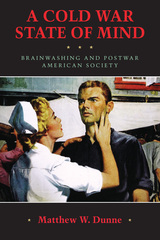
First popularized during the 1950s, the concept of “brainwashing” is often viewed as an example of Cold War paranoia, an amusing relic of a bygone era. Yet as Matthew W. Dunne shows in this study, over time brainwashing came to connote much more than a sinister form of Communist mind control, taking on broader cultural and political meanings.
Moving beyond well-known debates over Korean War POWs and iconic cultural texts like The Manchurian Candidate, Dunne explores the impact of the idea of brainwashing on popular concerns about freedom, individualism, loyalty, and trust in authority. By the late 1950s the concept had been appropriated into critiques of various aspects of American life such as an insistence on conformity, the alleged “softening” of American men, and rampant consumerism fueled by corporate advertising that used “hidden” or “subliminal” forms of persuasion. Because of these associations and growing anxieties about the potential misuse of psychology, concerns about brainwashing contributed to a new emphasis on individuality and skepticism toward authority in the 1960s. The notion even played an unusual role in the 1968 presidential race, when Republican frontrunner George Romney's claim that he had been “brainwashed” about the Vietnam War by the Johnson administration effectively destroyed his campaign.
In addition to analyzing the evolving meaning of brainwashing over an extended period of time, A Cold War State of Mind explores the class and gender implications of the idea, such as the assumption that working-class POWs were more susceptible to mind control and that women were more easily taken in by the manipulations of advertisers.
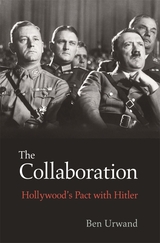
To continue doing business in Germany after Hitler's ascent to power, Hollywood studios agreed not to make films that attacked the Nazis or condemned Germany's persecution of Jews. Ben Urwand reveals this bargain for the first time—a "collaboration" (Zusammenarbeit) that drew in a cast of characters ranging from notorious German political leaders such as Goebbels to Hollywood icons such as Louis B. Mayer.
At the center of Urwand's story is Hitler himself, who was obsessed with movies and recognized their power to shape public opinion. In December 1930, his Party rioted against the Berlin screening of All Quiet on the Western Front, which led to a chain of unfortunate events and decisions. Fearful of losing access to the German market, all of the Hollywood studios started making concessions to the German government, and when Hitler came to power in January 1933, the studios—many of which were headed by Jews—began dealing with his representatives directly.
Urwand shows that the arrangement remained in place through the 1930s, as Hollywood studios met regularly with the German consul in Los Angeles and changed or canceled movies according to his wishes. Paramount and Fox invested profits made from the German market in German newsreels, while MGM financed the production of German armaments. Painstakingly marshaling previously unexamined archival evidence, The Collaboration raises the curtain on a hidden episode in Hollywood—and American—history.

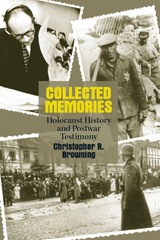
Despite these controversies and challenges, Browning delineates the ways in which the critical use of such problematic sources can provide telling evidence for writing Holocaust history. He examines and discusses two starkly different sets of "collected memories"—the voluminous testimonies of notorious Holocaust perpetrator Adolf Eichmann and the testimonies of 175 survivors of an obscure complex of factory slave labor camps in the Polish town of Starachowice.
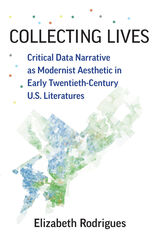
On a near-daily basis, data is being used to narrate our lives. Categorizing algorithms draw from amassed personal data to assign narrative destinies to individuals at crucial junctures, simultaneously predicting and shaping the paths of our lives. Data is commonly assumed to bring us closer to objectivity, but the narrative paths these algorithms assign seem, more often than not, to replicate biases about who an individual is and could become.
While the social effects of such algorithmic logics seem new and newly urgent to consider, Collecting Lives looks to the late nineteenth and early twentieth century US to provide an instructive prehistory to the underlying question of the relationship between data, life, and narrative. Rodrigues contextualizes the application of data collection to human selfhood in the late nineteenth and early twentieth century US in order to uncover a modernist aesthetic of data that offers an alternative to the algorithmic logic pervading our sense of data’s revelatory potential. Examining the work of W. E. B. Du Bois, Henry Adams, Gertrude Stein, and Ida B. Wells-Barnett, Rodrigues asks how each of these authors draw from their work in sociology, history, psychology, and journalism to formulate a critical data aesthetic as they attempt to answer questions of identity around race, gender, and nation both in their research and their life writing. These data-driven modernists not only tell different life stories with data, they tell life stories differently because of data.

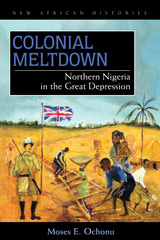
Historians of colonial Africa have largely regarded the decade of the Great Depression as a period of intense exploitation and colonial inactivity. In Colonial Meltdown, Moses E. Ochonu challenges this conventional interpretation by mapping the determined, at times violent, yet instructive responses of Northern Nigeria’s chiefs, farmers, laborers, artisans, women, traders, and embryonic elites to the British colonial mismanagement of the Great Depression. Colonial Meltdown explores the unraveling of British colonial power at a moment of global economic crisis.
Ochonu shows that the economic downturn made colonial exploitation all but impossible and that this dearth of profits and surpluses frustrated the colonial administration which then authorized a brutal regime of grassroots exactions and invasive intrusions. The outcomes were as harsh for Northern Nigerians as those of colonial exploitation in boom years.
Northern Nigerians confronted colonial economic recovery measures and their agents with a variety of strategies. Colonial Meltdown analyzes how farmers, women, laborers, laid-off tin miners, and NorthernNigeria’s emergent elite challenged and rebelled against colonial economic recovery schemes with evasive trickery, defiance, strategic acts of revenge, and criminal self-help and, in the process, exposed the weak underbelly of the colonial system.
Combined with the economic and political paralysis of colonial bureaucrats in the face of crisis, these African responses underlined the fundamental weakness of the colonial state, the brittleness of its economicmission, and the limits of colonial coercion and violence. This atmosphere of colonial collapse emboldened critics of colonial policies who went on to craft the rhetorical terms on which the anticolonial struggle of the post–World War II period was fought out.
In the current climate of global economic anxieties, Ochonu’s analysis will enrich discussions on the transnational ramifications of economic downturns. It will also challenge the pervasive narrative of imperial economic success.
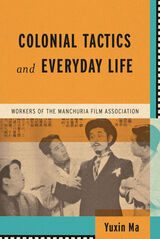
By focusing on the daily challenges and experiences of the Chinese workers at the corporation, Ma examines how life was actually lived by people navigating between practical and ideological concerns. She illustrates how the inhabitants of Manchukuo navigated social opportunities, economic depression, educational reforms, fascist rule, commercial interests, practical daily needs, and more—and reveals ways in which these conflicting preoccupations sometimes manifested as tension and ambiguity on screen. In the battle between repression and expression, these Chinese actors, directors, writers, and technicians adopted defensive and opportunistic tactics. They did so in colonial spaces, often rejecting modernist representations of Manchukuo in favor of venerating traditional Chinese culture and values. The expertise, skills, and professional networks they developed extended well beyond the occupation into the postwar period, and may individuals reestablished themselves as cinema professionals in the socialist era.

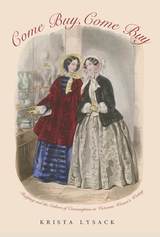
From the 1860s through the early twentieth century, Great Britain saw the rise of the department store and the institutionalization of a gendered sphere of consumption. Come Buy, Come Buy considers representations of the female shopper in British women’s writing and demonstrates how women’s shopping practices are materialized as forms of narrative, poetic, and cultural inscription, showing how women writers emphasize consumerism as productive of pleasure rather than the condition of seduction or loss. Krista Lysack examines works by Christina Rossetti, Mary Elizabeth Braddon, George Eliot, and Michael Field, as well as the suffragette newspaper Votes for Women, in order to challenge the dominant construction of Victorian femininity as characterized by self-renunciation and the regulation of appetite.
Come Buy, Come Buy considers not only literary works, but also a variety of archival sources (shopping guides, women’s fashion magazines, household management guides, newspapers, and advertisements) and cultural practices (department store shopping, shoplifting and kleptomania, domestic economy, and suffragette shopkeeping). With this wealth of sources, Lysack traces a genealogy of the woman shopper from dissident domestic spender to aesthetic connoisseur, from curious shop-gazer to political radical.
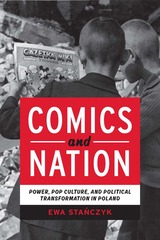
Winner, BASEES George Blazyca Award in East European Studies
Comics and Nation offers a fresh perspective on the role of popular culture in the one-hundred-year history of the Polish state, from its foundation in 1918 to the present. Drawing on dozens of press articles, interviews, and readers’ letters, Ewa Stanczyk discusses how journalists, artists, and audiences used comics to probe the boundaries of national culture and scrutinize the established notions of Polishness. Critical moments of Poland’s political transformation ––the establishment of the interwar Polish Republic, the Cold War, the liberalization of the 1970s, the 1989 democratic transition, the turn to memory politics in the 2000s––have all been reflected in the history of Polish comics. Stanczyk offers new insights into how the production of homegrown comics and the influx of foreign works enabled commentators to express their fears, hopes, and disillusionment with political, economic, and cultural changes in Poland and beyond. At its core, Comics and Nation rethinks the impact of popular culture and transnational exchange on Polish nation building, citizenship formation, and the legitimation of power.

“Brilliant...full of perceptions and rewards that send one scurrying back to the text.” —John Bayley, New York Review of Books
The finest reader of her generation retraces four great poets’ first steps across the threshold of genius.
To find a personal style is, for a writer, to become an adult; and to write one’s first “perfect” poem—a poem that wholly and successfully embodies that style—is to come of age as a poet. By looking at the precedents, circumstances, and artistry of the first perfect poems composed by John Milton, John Keats, T. S. Eliot, and Sylvia Plath, Coming of Age as a Poet offers rare insight into this mysterious process, and into the indispensable period of learning and experimentation that precedes such poetic achievement.
Milton’s “L’Allegro,” Keats’s “On First Looking into Chapman’s Homer,” Eliot’s “The Love Song of J. Alfred Prufrock,” and Plath’s “The Colossus” are the poems that Helen Vendler considers, exploring each as an accession to poetic confidence, mastery, and maturity. In meticulous and sympathetic readings of the poems, and with reference to earlier youthful compositions, she delineates the context and the terms of each poet’s self-discovery—illuminating the private, intense, and ultimately heroic effort and endurance that precede the creation of any memorable poem.
With characteristic precision, authority, and grace, Vendler helps us to appreciate anew the conception and the practice of poetry, and to observe firsthand the living organism that breathes through the lines of a great poem.

Between 1793 and 1794, thousands of French citizens were imprisoned and hundreds sent to the guillotine by a powerful dictatorship that claimed to be acting in the public interest. Only a few years earlier, revolutionaries had proclaimed a new era of tolerance, equal justice, and human rights. How and why did the French Revolution’s lofty ideals of liberty, equality, and fraternity descend into violence and terror?
“By attending to the role of emotions in propelling the Terror, Tackett steers a more nuanced course than many previous historians have managed…Imagined terrors, as…Tackett very usefully reminds us, can have even more political potency than real ones.”
—David A. Bell, The Atlantic
“[Tackett] analyzes the mentalité of those who became ‘terrorists’ in 18th-century France…In emphasizing weakness and uncertainty instead of fanatical strength as the driving force behind the Terror…Tackett…contributes to an important realignment in the study of French history.”
—Ruth Scurr, The Spectator
“[A] boldly conceived and important book…This is a thought-provoking book that makes a major contribution to our understanding of terror and political intolerance, and also to the history of emotions more generally. It helps expose the complexity of a revolution that cannot be adequately understood in terms of principles alone.”
—Alan Forrest, Times Literary Supplement
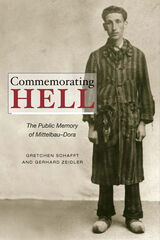
Prisoners at Mittelbau-Dora built the V-1 and V-2 missiles, some of them coming into direct contact with Wernher von Braun and Arthur Rudolph, who later became leading engineers in the U.S. space program. Through the continuing story of Mittelbau-Dora, from its operation as a labor camp to its social construction as a monument, Schafft and Zeidler reflect an abiding interest in the memory and commemoration of notorious national events. In extending the analysis of Mittelbau-Dora into post-war and present-day Germany, Commemorating Hell uncovers the intricate relationship between the politics of memory and broader state and global politics, revealing insights about the camp's relationship to the American space pioneers and the fate of the nearby city of Nordhausen.
This Critique is the only writing in which Kant weaves his thoughts on practical reason into a unified argument. Lewis White Beck offers a classic examination of this argument and expertly places it in the context of Kant's philosophy and of the moral philosophy of the eighteenth century.
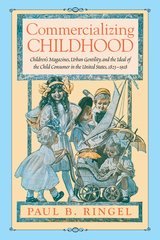
In this deeply researched and engaging book, Paul B. Ringel combines an analysis of the stories in nineteenth-century American children's magazines with the backstories of their authors, editors, and publishers to explain how this hugely successful industry trained generations of American children to become genteel consumers. Ringel demonstrates how these publications, which were read in hundreds of thousands of homes, played to two conflicting impulses within American families: to shield children from commercial influences by offering earnest and moral entertainment and to help children learn how to prosper in an increasingly market-driven society.


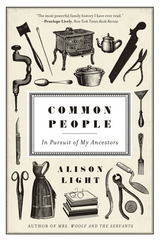
Most of us, however, give up a few generations back. We run into a gap, get embarrassed by a ne’er-do-well, or simply find our ancestors are less glamorous than we’d hoped. That didn’t stop Alison Light: in the last weeks of her father’s life, she embarked on an attempt to trace the history of her family as far back as she could reasonably go. The result is a clear-eyed, fascinating, frequently moving account of the lives of everyday people, of the tough decisions and hard work, the good luck and bad breaks, that chart the course of a life. Light’s forebears—servants, sailors, farm workers—were among the poorest, traveling the country looking for work; they left few lasting marks on the world. But through her painstaking work in archives, and her ability to make the people and struggles of the past come alive, Light reminds us that “every life, even glimpsed through the chinks of the census, has its surprises and secrets.”
What she did for the servants of Bloomsbury in her celebrated Mrs. Woolf and the Servants Light does here for her own ancestors, and, by extension, everyone’s: draws their experiences from the shadows of the past and helps us understand their lives, estranged from us by time yet inextricably interwoven with our own. Family history, in her hands, becomes a new kind of public history.
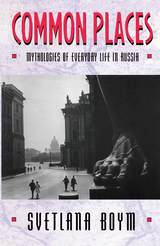
What is the “real Russia”? What is the relationship between national dreams and kitsch, between political and artistic utopia and everyday existence? Commonplaces of daily living would be perfect clues for those seeking to understand a culture. But all who write big books on Russian life confess their failure to get properly inside Russia, to understand its “doublespeak.”
Svetlana Boym is a unique guide. A member of the last Soviet Generation, the Russian equivalent of our Generation X, she grew up in Leningrad and has lived in the West for the past thirteen years. Her book provides a view of Russia that is historically informed, replete with unexpected detail, and everywhere stamped with authority. Alternating analysis with personal accounts of Russian life, Boym conveys the foreignness of Russia and examines its peculiar conceptions of private life and common good, of Culture and Trash, of sincerity and banality. Armed with a Dictionary of Untranslatable Terms, we step around Uncle Fedia asleep in the hall, surrounded by a puddle of urine, and enter the Communal Apartment, the central exhibit of the book. It is the ruin of the communal utopia and a unique institution of Soviet daily life; a model Soviet home and a breeding ground for grassroots informants. Here, privacy is forbidden; here the inhabitants defiantly treasure their bits of “domestic trash,” targets of ideological campaigns for the transformation (perestroika) of everyday life.
Against the Russian and Soviet myths of national destiny, the trivial, the ordinary, even the trashy, take on a utopian dimension. Boym studies Russian culture in a broad sense of the word; she ranges from nineteenth- and twentieth-century intellectual thought to art and popular culture. With her we go walking in Moscow and Leningrad, eavesdrop on domestic life, and discover jokes, films, and TV programs. Boym then reflects on the 1991 coup that marked the end of the Soviet Union and evoked fin-de-siècle apocalyptic visions. The book ends with a poignant reflection on the nature of communal utopia and nostalgia, on homesickness and the sickness of being home.

Common sense has always been a cornerstone of American politics. In 1776, Tom Paine’s vital pamphlet with that title sparked the American Revolution. And today, common sense—the wisdom of ordinary people, knowledge so self-evident that it is beyond debate—remains a powerful political ideal, utilized alike by George W. Bush’s aw-shucks articulations and Barack Obama’s down-to-earth reasonableness. But far from self-evident is where our faith in common sense comes from and how its populist logic has shaped modern democracy. Common Sense: A Political History is the first book to explore this essential political phenomenon.
The story begins in the aftermath of England’s Glorious Revolution, when common sense first became a political ideal worth struggling over. Sophia Rosenfeld’s accessible and insightful account then wends its way across two continents and multiple centuries, revealing the remarkable individuals who appropriated the old, seemingly universal idea of common sense and the new strategic uses they made of it. Paine may have boasted that common sense is always on the side of the people and opposed to the rule of kings, but Rosenfeld demonstrates that common sense has been used to foster demagoguery and exclusivity as well as popular sovereignty. She provides a new account of the transatlantic Enlightenment and the Age of Revolutions, and offers a fresh reading on what the eighteenth century bequeathed to the political ferment of our own time. Far from commonsensical, the history of common sense turns out to be rife with paradox and surprise.

The Communist States in Disarray, 1965–1971 was first published in 1972. Minnesota Archive Editions uses digital technology to make long-unavailable books once again accessible, and are published unaltered from the original University of Minnesota Press editions.
Through a survey and analysis of recent developments in the communist states and in their relations with one another and with other nations this volume provides a revealing picture of a changing communist world. Indeed, as the book makes clear, it is no longer appropriate to think of the communist countries as one world, since a major development during the period covered in this study has been the disintegration of the communist monolith and the reemergence of separate national entities in Eastern Europe.
The sixteen chapters by fifteen contributors provide studies of the individual communist states as well as several chapter-length discussions of general trends and patterns. The contributors also project the likely course of developments for the rest of the 1970s. Throughout the book the twin themes of an aggregation of the Sino-Soviet conflict and the spread of nationalism point to the conclusion that the communist states are now in disarray.
The contents: Patters of Political change, Teresa Rakowska-Harmstone; Polycentrism in Eastern Europe, Adam Bromke; The Sino-Soviet Dispute, John W. Strong; Czechoslovakia, H, Gordon Skilling; East Germany, Melvin Croan; Rumania, Gabriel Fischer; Yugoslavia, John C. Campbell; Albania, Peter R. Prifti; Outer Mongolia, Paul F. Langer; North Korea and North Vietnam, Paul F. Langer; Cuba, C. Ian Lumsden; Patterns of Economic Relations, Philip E. Uren; External Forces in Eastern Europe, Andrew Gyorgy.
Contributors: Christopher Catanese, James Caudle, Marilyn Francus, Christine Jackson-Holzberg, Claudia Thomas Kairoff, Elizabeth Lambert, Anthony W. Lee, James E. May, John Radner, and Lance Wilcox.
Published by Bucknell University Press. Distributed worldwide by Rutgers University Press.
Including an exclusive interview with bestselling American novelist Elizabeth Strout, this groundbreaking study will engage literature scholars and general readers alike.
Written in accessible language, this book is the first to offer a sustained analysis of Elizabeth Strout’s work. A recipient of the Pulitzer Prize and the O. Henry Award, among other accolades, Strout has achieved a vast popular following as well. Amy and Isabelle was made into a television movie; Olive Kitteridge, which sold more than one million copies, was adapted as a miniseries; The Burgess Boys has been optioned for HBO; and My Name Is Lucy Barton was reimagined for the stage in London and on Broadway. Oh William!, the sequel to My Name Is Lucy Barton, appeared in 2021, and Strout’s latest book, Lucy by the Sea, is slated for release in fall 2022.
At the height of her literary powers as a chronicler of American life and particularly the lives of American women, Strout is currently enjoying both commercial and critical success. Her sales and perennial presence on book club lists indicate a tremendous impact on the popular realm and the growing attention to her in academia charts her importance in American letters. This book will satisfy readers looking for a serious, in-depth introduction to Strout’s work, as well as those interested in women’s writing, contemporary fiction, ethics, and literature. It includes a new interview with Strout in which she discusses these issues.
Montwieler traces the evolution of Strout’s voice, themes, and characters, which uniquely address American twenty-first-century feminine perspectives and sensibilities. From classic domestic spats between a mother and daughter to hate crimes aimed at mosques, from sweeping forays into decades past to snapshots of contemporary life, Strout compassionately portrays humanity at its most brutal and its most intimate. Though her canvas is vast, her eye for detail is astute and her ear for nuance is keen. Looking across Strout’s work, Montwieler explores how she portrays the endurance of hope, the complexities of family, the effects of trauma on individuals and communities, the sustaining power of the natural world, and the effects of place on personal and collective character.
Strout’s creations cultivate empathy in her readers, teaching them to be attuned to the suffering of others and to the human need for connection. Across her work and in the new interview included within this book, Strout shows her readers that they are not alone in this impersonal, often violent world. The connection that acknowledges our limitations, our woundedness, our capability to do harm, our remorse, and our recognition of beauty and humor distinguishes Strout’s unique contribution to contemporary American letters.

The Compelling Image will delight the art-lover who does not yet realize that Chinese painting can be as original and moving as El Greco or Cézanne. With a graceful authority, James Cahill explores the radiant painting of that tumultuous era when the collapse of the Ming Dynasty and the Manchu conquest of China dramatically changed the lives and thinking of artists and intellectuals.
The brilliant masters of the seventeenth century were reconsidering their artistic relationship to nature and to the painting of earlier times, while European pictorial arts introduced by Jesuit missionaries were profoundly influencing Chinese techniques. The reader/viewer is presented with a series of crucial distinctions of style and approach in a richly illustrated book that illuminates the whole character of Chinese painting.
Cahill begins with a relatively neglected artist, Chang Hung, who moved traditional forms ever closer to literal descriptions of nature, in contrast with the theorist painter Tung Ch’i-ch’ang, who turned the same traditional forms into powerful abstractions. A chapter focused on Wu Pin offers new and controversial ideas about the impact of European art, as well as a related phenomenon: revival of the highly descriptive early Sung styles. Looking especially at Ch’en Hung-shou, the greatest of the late Ming figure painters, Cahill examines a curious mixing of real people and conventionally rendered surroundings in portrait art of the period. He analyzes the expressionist experiments of the masters known as Individualists, and distinguishes these artists from the Orthodox school, concluding with a bold reassessment of the most eloquent of later Chinese painters, Tao-chi.
Over 250 illustrations, including twelve color plates, are drawn from collections in the United States, Europe, Japan, and China. This is a book for anyone interested in China, its past, and its art, and for the enthusiast who wishes to broaden the horizons of enjoyment by exposure to a most engaging writer on an exquisite era.
Download the open access ebook here.
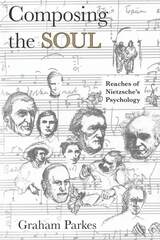
Composing the Soul is the first study to pay sustained attention to this pronouncement and to examine the contours of Nietzsche's psychology in the context of his life and psychological makeup. Beginning with essays from Nietzsche's youth, Graham Parkes shows the influence of such figures as Goethe, Byron, and Emerson on Nietzsche's formidable and multiple talents. Parkes goes on to chart the development of Nietzsche's psychological ideas in terms of the imagery, drawn from the dialogues of Plato as well as from Nietzsche's own quasi-mystical experiences of nature, in which he spoke of the soul. Finally, Parkes analyzes Nietzsche's most revolutionary idea—that the soul is composed of multiple "drives," or "persons," within the psyche. The task for Nietzsche's psychology, then, was to identify and order these multiple persons within the individual—to compose the soul.
Featuring all new translations of quotations from Nietzsche's writings, Composing the Soul reveals the profundity of Nietzsche's lifelong personal and intellectual struggles to come to grips with the soul. Extremely well-written, this landmark work makes Nietzsche's life and ideas accessible to any reader interested in this much misunderstood thinker.
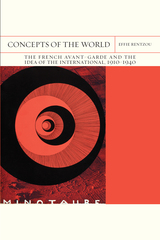
The writers and artists of the French avant-garde aspired to reach a global audience that would be wholly transformed by their work. In this study, Effie Rentzou delves deep into their depictions of the interwar world as an international and modern landscape, one marked by a varied cosmopolitanism. The avant-garde’s conceptualization of the world paralleled, rejected, or expanded prevailing notions of the global sphere.
The historical avant garde—which encompassed movements like futurism, Dada, and surrealism—was self-consciously international, operating across global networks and developed with the whole world as its horizon and its public. In the heady period between the end of the Belle Époque and the tumult of World War II, both individual artists (including Guillaume Apollinaire, Blaise Cendrars, Francis Picabia, Louis Aragon, Leonora Carrington, and Nicolas Calas) and collective endeavors (such as surrealist magazines and exhibitions) grappled with contemporary anxieties about economic growth, imperialism, and colonialism, as well as various universalist, cosmopolitan, and internationalist visions. By probing these works, Concepts of the World offers an alternative narrative of globalization, one that integrates the avant-garde’s enthusiasm for, as well as resistance to, the process. Rentzou identifies within the avant-garde a powerful political language that expressed the ambivalence of living and creating in an increasingly globalized world—a language that profoundly shaped the way the world has been conceptualized and is experienced today.
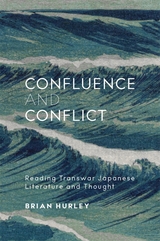
Writers and intellectuals in modern Japan have long forged dialogues across the boundaries separating the spheres of literature and thought. This book explores some of their most intellectually and aesthetically provocative connections in the volatile transwar years of the 1920s to 1950s. Reading philosophical texts alongside literary writings, the study links the intellectual side of literature to the literary dimensions of thought in contexts ranging from middlebrow writing to avant-garde modernism, and from the wartime left to the postwar right.
Chapters trace these dynamics through the novelist Tanizaki Jun’ichirō’s collaboration with the nativist linguist Yamada Yoshio on a modern translation of The Tale of Genji; the modernist writer Yokomitsu Riichi’s dialogue with Kyoto School philosophers around the question of “worldliness”; the Marxist poet Nakano Shigeharu’s and the philosopher Tosaka Jun’s thinking about prosaic everyday language; and the postwar rumination on liberal society that surrounded the scholar Edwin McClellan while he translated Natsume Sōseki’s classic 1914 novel Kokoro as a graduate student in the United States working with the famed economist Friedrich Hayek. Revealing unexpected intersections of literature, ideas, and politics in a global transwar context, the book concludes by turning to Murakami Haruki and the resonances of those intersections in a time closer to our own.
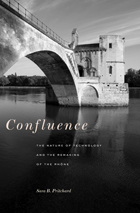
Because of its location, volume, speed, and propensity for severe flooding, the Rhône, France’s most powerful river, has long influenced the economy, politics, and transportation networks of Europe. Humans have tried to control the Rhône for over two thousand years, but large-scale development did not occur until the twentieth century. The Rhône valley has undergone especially dramatic changes since World War II. Hydroelectric plants, nuclear reactors, and industrialized agriculture radically altered the river, as they simultaneously fueled both the physical and symbolic reconstruction of France.
In Confluence, Sara B. Pritchard traces the Rhône’s remaking since 1945. She interweaves this story with an analysis of how state officials, technical elites, and citizens connected the environment and technology to political identities and state-building. In the process, Pritchard illuminates the relationship between nature and nation in France.
Pritchard’s innovative integration of science and technology studies, environmental history, and the political history of modern France makes a powerful case for envirotechnical analysis: an approach that highlights the material and rhetorical links between ecological and technological systems. Her groundbreaking book demonstrates the importance of environmental management and technological development to culture and politics in the twentieth century. As Pritchard shows, reconstructing the Rhône remade France itself.
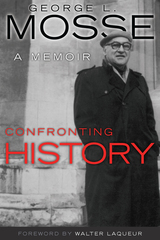
Confronting History describes Mosse's opulent childhood in Weimar Berlin; his exile in Paris and England, including boarding school and study at Cambridge University; his second exile in the U.S. at Haverford, Harvard, Iowa, and Wisconsin; and his extended stays in London and Jerusalem. Mosse discusses being a Jew and his attachment to Israel and Zionism, and he addresses his gayness, his coming out, and his growing scholarly interest in issues of sexuality. This touching memoir—told with the clarity, passion, and verve that entranced thousands of Mosse's students—is guided in part by his belief that "what man is, only history tells" and, most of all, by the importance of finding one's self through the pursuit of truth and through an honest and unflinching analysis of one's place in the context of the times.
The first author to address the impact of geopolitics on the courts’ representation of Nazi euthanasia, Bryant argues that international power relationships wreaked havoc on the prosecutions.
Drawing on primary sources, this provocative investigation of the Nazi campaign against the mentally ill and the postwar quest for justice will interest general readers and provide critical information for scholars of Holocaust studies, legal history, and human rights. Support for this publication was generously provided by the Eugene M. Kayden Fund at the University of Colorado.
Mosse considers a broad range of topics, from Nazi book burnings to Americans’ search for unifying national symbols during the Great Depression, exploring how the development of particular modes of art, architecture, and mass movements served nationalist agendas by dictating who was included in the image of the nation. These essays retain their significance today in their examination of the cultural and social implications of contemporary nationalism. A new critical introduction by Shulamit Volkov, professor emerita of history at Tel Aviv University, situates Mosse’s analysis within its historiographical context.
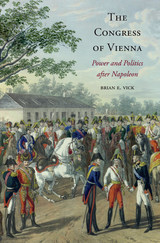
Convened following Napoleon’s defeat in 1814, the Congress of Vienna is remembered as much for the pageantry of the royals and elites who gathered there as for the landmark diplomatic agreements they brokered. Historians have nevertheless generally dismissed these spectacular festivities as window dressing when compared with the serious, behind-the-scenes maneuverings of sovereigns and statesmen. Brian Vick finds this conventional view shortsighted, seeing these instead as two interconnected dimensions of politics. Examining them together yields a more complete picture of how one of the most important diplomatic summits in history managed to redraw the map of Europe and the international system of the nineteenth and twentieth centuries.
The Congress of Vienna investigates the Vienna Congress within a broad framework of influence networks that included unofficial opinion-shapers of all kinds, both men and women: artists and composers, entrepreneurs and writers, hosts and attendees of fashionable salons. In addition to high-profile negotiation and diplomatic wrangling over the post-Napoleonic fates of Germany, Italy, and Poland, Vick brings into focus other understudied yet significant issues: the African slave trade, Jewish rights, and relations with Islamic powers such as the Ottoman Empire and Barbary Corsairs. Challenging the usual portrayal of a reactionary Congress obsessed with rolling back Napoleon’s liberal reforms, Vick demonstrates that the Congress’s promotion of limited constitutionalism, respect for religious and nationality rights, and humanitarian interventions was influenced as much by liberal currents as by conservative ones.
A bold new look at war and diplomacy in Europe that traces the idea of a unified continent in attempts since the eighteenth century to engineer lasting peace.
Political peace in Europe has historically been elusive and ephemeral. Stella Ghervas shows that since the eighteenth century, European thinkers and leaders in pursuit of lasting peace fostered the idea of European unification.
Bridging intellectual and political history, Ghervas draws on the work of philosophers from Abbé de Saint-Pierre, who wrote an early eighteenth-century plan for perpetual peace, to Rousseau and Kant, as well as statesmen such as Tsar Alexander I, Woodrow Wilson, Winston Churchill, Robert Schuman, and Mikhail Gorbachev. She locates five major conflicts since 1700 that spurred such visionaries to promote systems of peace in Europe: the War of the Spanish Succession, the Napoleonic Wars, World War I, World War II, and the Cold War. Each moment generated a “spirit” of peace among monarchs, diplomats, democratic leaders, and ordinary citizens. The engineers of peace progressively constructed mechanisms and institutions designed to prevent future wars.
Arguing for continuities from the ideals of the Enlightenment, through the nineteenth-century Concert of Nations, to the institutions of the European Union and beyond, Conquering Peace illustrates how peace as a value shaped the idea of a unified Europe long before the EU came into being. Today the EU is widely criticized as an obstacle to sovereignty and for its democratic deficit. Seen in the long-range perspective of the history of peacemaking, however, this European society of states emerges as something else entirely: a step in the quest for a less violent world.

The colonial society and economy of Latin America were based on local communities of three principal types: Spanish towns, Indian villages, and landed estates or haciendas. Of these, it was the latter that provided the economic foundations for the aristocratic social system. This book tells how and why the Spaniards who settled the Peruvian coastal valleys originally came to establish their estates. Some of the questions it attempts to answer are: Why did the hacienda system arise in the second half of the sixteenth century? Was it primarily a product of Spanish history and culture? Was it an inevitable result of the conquest? What did it owe to Indian customs and traditions? To local geography? To economic and social conditions?
Concentrating on seven major valleys of the central coast, the author investigates varying local conditions and circumstances as they appear in wills, bills of sale, contracts, and other notarial documents. The story begins with the indigenous coastal societies before the conquest and concludes with the consolidation of the hacienda system in the early seventeenth century.
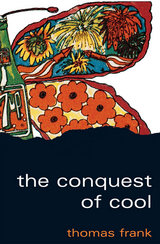
"[Thomas Frank is] perhaps the most provocative young cultural critic of the moment."—Gerald Marzorati, New York Times Book Review
"An indispensable survival guide for any modern consumer."—Publishers Weekly, starred review
"Frank makes an ironclad case not only that the advertising industry cunningly turned the countercultural rhetoric of revolution into a rallying cry to buy more stuff, but that the process itself actually predated any actual counterculture to exploit."—Geoff Pevere, Toronto Globe and Mail
"The Conquest of Cool helps us understand why, throughout the last third of the twentieth century, Americans have increasingly confused gentility with conformity, irony with protest, and an extended middle finger with a populist manifesto. . . . His voice is an exciting addition to the soporific public discourse of the late twentieth century."—T. J. Jackson Lears, In These Times
"An invaluable argument for anyone who has ever scoffed at hand-me-down counterculture from the '60s. A spirited and exhaustive analysis of the era's advertising."—Brad Wieners, Wired Magazine
"Tom Frank is . . . not only old-fashioned, he's anti-fashion, with a place in his heart for that ultimate social faux pas, leftist politics."—Roger Trilling, Details

Spanning nine time zones from Norway to the Bering Strait, the immense Russian Arctic was mostly unexplored before the twentieth century. This changed rapidly in the 1920s, when the Soviet Union implemented plans for its conquest. The Conquest of the Russian Arctic, a definitive political and environmental history of one of the world’s remotest regions, details the ambitious attempts, from Soviet times to the present, to control and reshape the Arctic, and the terrible costs paid along the way.
Paul Josephson describes the effort under Stalin to assimilate the Arctic into the Soviet empire. Extraction of natural resources, construction of settlements, indoctrination of nomadic populations, collectivization of reindeer herding—all was to be accomplished so that the Arctic operated according to socialist principles. The project was in many ways an extension of the Bolshevik revolution, as planners and engineers assumed that policies and plans that worked elsewhere in the empire would apply here. But as they pushed ahead with methods hastily adopted from other climates, the results were political repression, destruction of traditional cultures, and environmental degradation. The effects are still being felt today. At the same time, scientists and explorers led the world in understanding Arctic climes and regularities.
Vladimir Putin has redoubled Russia’s efforts to secure the Arctic, seen as key to the nation’s economic development and military status. This history brings into focus a little-understood part of the world that remains a locus of military and economic pressures, ongoing environmental damage, and grand ambitions imperfectly realized.

Kaplan simulates the response to a long visit to the new Holocaust museum in Washington, D.C., which, crucially for Kaplan, is sited in direct view of the Jefferson and Lincoln monuments, powerful symbols of humanist democracy. He insists the Holocaust be viewed not only in terms of personal ethics but modern political ethics as well: for Kaplan the affirmative legacy of the Holocaust is its focus on the dangers of nationalism, racism, and all forms of separatist group identities. It challenges the historicism, cults of power, and scientistic politics of modernity. And it challenges the moral passivity and relativism of mass politics in Western and Eastern societies.
The opening of the Holocaust museum has sparked a debate that reflects a larger debate over the Holocaust's "meaning," its translatability for ordinary understanding. Some deny any possible response except that of overwhelming grief and horror. For others, the "lesson" of the Holocaust implies, in the words of Robert Nozick, that "mankind has fallen. . . . Humanity has lost its claim to continue." The moral life and political institutions will remain endlessly tormented by the Holocaust. That, Kaplan tells us, is the ultimate content of its "meaning," and is what makes the discussion of "meaning" much more than a mourner's symposium.
The Museum itself, according to Kaplan, has become an impressive memorial to the principle of humanism, instructing the collective memory of this democracy and that of nations everywhere which aspire to civil existence. Out of its awful darkness the Holocaust throws the light of conscience for those capable of receiving it.

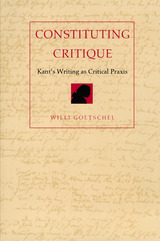
Constituting Critique traces the stages in Kant’s development to reveal how he redefined philosophy as a critical task. Following the philosopher through the experiments of his early essays, Goetschel demonstrates how Kant tests, challenges, and transforms the philosophical essay in his pursuit of a new self-reflective literary genre. From these experiments, critique emerges as the philosophical form for the critical project of the Enlightenment. The imperatives of its transcendental style, Goetschel contends, not only constitute and inform the critical moment of Kant’s philosophical praxis, but also have an enduring place in post-Kantian philosophy and literature.
By situating the Critiques within the context of Kant’s early essays, this work will redirect the attention of Kant scholars to the origins of their form. It will also encourage contemporary critical theorists to reconsider their own practice through an engagement with its source in Kant.
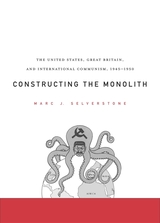
As the Cold War took shape during the late 1940s, policymakers in the United States and Great Britain displayed a marked tendency to regard international communism as a “monolithic” conspiratorial movement. The image of a “Communist monolith” distilled the messy realities of international relations into a neat, comprehensible formula. Its lesson was that all communists, regardless of their native land or political program, were essentially tools of the Kremlin.
Marc Selverstone recreates the manner in which the “monolith” emerged as a perpetual framework on both sides of the Atlantic. Though more pervasive and millennial in its American guise, this understanding also informed conceptions of international communism in its close ally Great Britain, casting the Kremlin’s challenge as but one more in a long line of threats to freedom.
This illuminating and important book not only explains the Cold War mindset that determined global policy for much of the twentieth century, but also reveals how the search to define a foreign threat can shape the ways in which that threat is actually met.

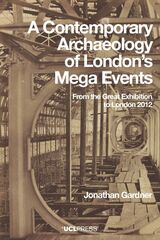
This book explores the traces of London’s most significant modern “mega events”: the Great Exhibition of 1851, the 1951 Festival of Britain’s South Bank Exhibition, and the 2012 Olympic and Paralympic Games. Though only open for a few weeks or months, mega events permanently and disruptively reshape their host cities and societies: they demolish and rebuild whole districts, they draw in materials and participants from around the globe, and their organizers self-consciously seek to leave a “legacy” that will endure for decades or more. The book argues that these spectacles must thus be seen as long-lived and persistent, rather than simply transient or short-term phenomena. It explores the long-term history of each event through contemporary archaeology, examining the contents and building materials of the Great Exhibition’s Crystal Palace and their extraordinary afterlife at Sydenham, South London; how the Festival of Britain’s South Bank Exhibition employed displays of ancient history to construct a new postwar British identity; and how London 2012 dealt with competing visions of the past as archaeology, waste, and heritage in creating a vision of the future.
George L. Mosse (1918–99) was one of the most influential cultural and intellectual historians of modern Europe. A refugee from Nazi Germany, he was an early leader in the study of fascism and the history of sexuality and masculinity, authoring more than two dozen books. In Contemporary Europe in the Historical Imagination, an international assembly of leading scholars explore Mosse’s enduring methodologies in German studies and modern European cultural history. Considering Mosse’s life and work historically and critically, the book begins with his intellectual biography and goes on to reread his writings in light of historical developments since his death, and to use, extend, and contend with Mosse’s legacy in new contexts he may not have addressed or even foreseen.
The volume wrestles with intertwined questions that continue to emerge from Mosse’s pioneering research, including: What role do sexual and racial stereotypes play in European political culture before and after 1945? How are gender and Nazi violence bound together? And what does commemoration reveal about national culture? Importantly, the contributors pose questions that are inspired by Mosse’s work but that he did not directly examine. For example, to what extent were Nazism and Italian Fascism colonial projects? How have popular radical right parties reinforced and reimagined ethnonationalism and nativism? And how did Nazi perpetrators construct a moral system that accommodated genocide? Much like Mosse’s own work, the chapters in this book inspire new interventions into the history of gender and sexuality, Jewish identity during the rise of the Third Reich, and the many reincarnations of fascist pageantry and mass politics.
Contributors: Adi Armon, Steven E. Aschheim, Aleida Assmann, Darcy Buerkle, Skye Doney, Arie M. Dubnov, Rebekka Grossmann, David Harrisville, Meike Hoffmann, Andreas Huyssen, Elissa Mailänder, Frank Mecklenburg, Mary Nolan, Stefanie Schüler-Springorum, Roger Strauch, Enzo Traverso, Marc Volovici, Elisabeth Wagner, Sarah Wobick-Segev, Robert Zwarg

Examining Ali Smith’s The Accidental and Hotel World, Barbara Kingsolver’s The Poisonwood Bible, Toni Morrison’s Beloved, Kate Atkinson’s A God in Ruins and Life After Life, and Ruth Ozeki’s A Tale for the Time Being, Weese demonstrates how various narratological theories inform rather than compete with one another. Through an expanded rhetorical poetics, including a refined version of James Phelan’s MTS (mimetic, thematic, synthetic) model, she reframes post-postmodern theorists’ concerns with communicative function through a narratological lens to make the case that exploring the rhetorical function of unnatural devices challenges and extends the claims of narrow metamodern readings.
Contemporary Novelists and the Aesthetics of Twenty-First Century American Life gives us a new way to view contemporary art novels, asking the key question: How do contemporary writers imagine aesthetic experience? Examining the works of some of the most popular names in contemporary fiction and art criticism, including Zadie Smith, Teju Cole, Siri Hustvedt, Ben Lerner, Rachel Kushner, and others, Alexandra Kingston-Reese finds that contemporary art novels are seeking to reconcile the negative feelings of contemporary life through a concerted critical realignment in understanding artistic sensibility, literary form, and the function of the aesthetic.
Kingston-Reese reveals how contemporary writers refract and problematize aesthetic experience, illuminating an uneasiness with failure: firstly, about the failure of aesthetic experiences to solve and save; and secondly, the literary inability to articulate the emotional dissonance caused by aesthetic experiences now.
Several contributors examine how the experiences of indigenous groups and the imperial past are incorporated into public histories in British Commonwealth nations: in Te Papa, New Zealand’s national museum; in the First Peoples’ Hall at the Canadian Museum of Civilization; and, more broadly, in late-twentieth-century Australian culture. Still others focus on the role of governments in mediating contested racialized histories: for example, the post-apartheid history of South Africa’s Voortrekker Monument, originally designed as a tribute to the Voortrekkers who colonized the country’s interior. Among several essays describing how national narratives have been challenged are pieces on a dispute over how to represent Nepali history and identity, on representations of Afrocuban religions in contemporary Cuba, and on the installation in the French Pantheon in Paris of a plaque honoring Louis Delgrès, a leader of Guadeloupean resistance to French colonialism.
Contributors. Paul Amar, Paul Ashton, O. Hugo Benavides, Laurent Dubois, Richard Flores, Durba Ghosh, Albert Grundlingh, Paula Hamilton, Lisa Maya Knauer, Charlotte Macdonald, Mark Salber Phillips, Ruth B. Phillips, Deborah Poole, Anne M. Rademacher, Daniel J. Walkowitz

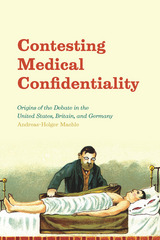
In Contesting Medical Confidentiality, Andreas-Holger Maehle travels back to the origins of this increasingly relevant issue. He offers the first comparative analysis of professional and public debates on medical confidentiality in the United States, Britain, and Germany during the late nineteenth and early twentieth centuries, when traditional medical secrecy first came under pressure from demands of disclosure in the name of public health. Maehle structures his study around three representative questions of the time that remain salient today: Do physicians have a privilege to refuse court orders to reveal confidential patient details? Is there a medical duty to report illegal procedures to the authorities? Should doctors breach confidentiality in order to prevent the spread of disease? Considering these debates through a unique historical perspective, Contesting Medical Confidentiality illuminates the ethical issues and potentially grave consequences that continue to stir up public debate.
In this groundbreaking work, Christa Davis Acampora offers a profound rethinking of Friedrich Nietzsche’s crucial notion of the agon. Analyzing an impressive array of primary and secondary sources and synthesizing decades of Nietzsche scholarship, she shows how the agon, or contest, organized core areas of Nietzsche’s philosophy, providing a new appreciation of the subtleties of his notorious views about power. By focusing so intensely on this particular guiding interest, she offers an exciting, original vantage from which to view this iconic thinker: Contesting Nietzsche.

In the spring of 1929, Martin Heidegger and Ernst Cassirer met for a public conversation in Davos, Switzerland. They were arguably the most important thinkers in Europe, and their exchange touched upon the most urgent questions in the history of philosophy: What is human finitude? What is objectivity? What is culture? What is truth?
Over the last eighty years the Davos encounter has acquired an allegorical significance, as if it marked an ultimate and irreparable rupture in twentieth-century Continental thought. Here, in a reconstruction at once historical and philosophical, Peter Gordon reexamines the conversation, its origins and its aftermath, resuscitating an event that has become entombed in its own mythology. Through a close and painstaking analysis, Gordon dissects the exchange itself to reveal that it was at core a philosophical disagreement over what it means to be human.
But Gordon also shows how the life and work of these two philosophers remained closely intertwined. Their disagreement can be understood only if we appreciate their common point of departure as thinkers of the German interwar crisis, an era of rebellion that touched all of the major philosophical movements of the day—life-philosophy, philosophical anthropology, neo-Kantianism, phenomenology, and existentialism. As Gordon explains, the Davos debate would continue to both inspire and provoke well after the two men had gone their separate ways. It remains, even today, a touchstone of philosophical memory.
This clear, riveting book will be of great interest not only to philosophers and to historians of philosophy but also to anyone interested in the great intellectual ferment of Europe’s interwar years.
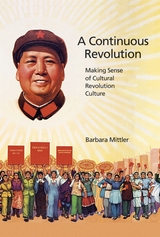
Cultural Revolution Culture, often denigrated as nothing but propaganda, was liked not only in its heyday but continues to be enjoyed today. A Continuous Revolution sets out to explain its legacy. By considering Cultural Revolution propaganda art—music, stage works, prints and posters, comics, and literature—from the point of view of its longue durée, Barbara Mittler suggests it was able to build on a tradition of earlier art works, and this allowed for its sedimentation in cultural memory and its proliferation in contemporary China.
Taking the aesthetic experience of the Cultural Revolution (1966–1976) as her base, Mittler juxtaposes close readings and analyses of cultural products from the period with impressions given in a series of personal interviews conducted in the early 2000s with Chinese from diverse class and generational backgrounds. By including much testimony from these original voices, Mittler illustrates the extremely multifaceted and contradictory nature of the Cultural Revolution, both in terms of artistic production and of its cultural experience.
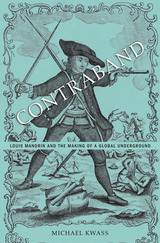
Louis Mandrin led a gang of bandits who brazenly smuggled contraband into eighteenth-century France. Michael Kwass brings new life to the legend of this Gallic Robin Hood and the thriving underworld he helped to create. Decades before the storming of the Bastille, surging world trade excited a revolution in consumption that transformed the French kingdom. Contraband exposes the dark side of this early phase of globalization, revealing hidden connections between illicit commerce, criminality, and popular revolt.
France's economic system was tailor-made for an enterprising outlaw like Mandrin. As French subjects began to crave colonial products, Louis XIV lined the royal coffers by imposing a state monopoly on tobacco from America and an embargo on brilliantly colored calico cloth from India. Vigorous black markets arose through which traffickers fed these exotic goods to eager French consumers. Flouting the law with unparalleled panache, Mandrin captured widespread public attention to become a symbol of a defiant underground.
This furtive economy generated violent clashes between gangs of smugglers and customs agents in the borderlands. Eventually, Mandrin was captured by French troops and put to death in a brutal public execution intended to demonstrate the king's absolute authority. But the spectacle only cemented Mandrin's status as a rebel folk hero in an age of mounting discontent. Amid cycles of underground rebellion and agonizing penal repression, the memory of Mandrin inspired ordinary subjects and Enlightenment philosophers alike to challenge royal power and forge a movement for radical political change.

However, problems occurred during the development process and costs risings went so out of control that the whole project was almost cancelled a few times. Strategic Air Command was initially against ordering the B-58 for service, not only because of its complexity but also since they saw no advantage of a Mach 2 bomber over other types. Despite this the B-58 entered service at S.A.C. in 1960. It would have a relatively short operational career.
The Other Voice in Early Modern Europe - The Toronto Series volume 73
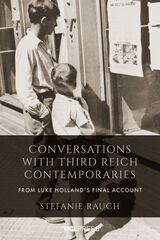
Conversations with Third Reich Contemporaries presents excerpts from filmed interviews conducted by British documentary filmmaker Luke Holland across a span of over a decade. These interviews were compiled into the German-language documentary film Final Account (2020), completed shortly before Holland’s death. Most interviewees were young adults when the war ended; some had benefited from Nazism, and others had directly enacted persecution or state violence. In addition to making this vital interview collection more widely accessible, the sourcebook raises critical awareness of issues around representation, authenticity, memory, and the co-production of narratives, reshaping discussions around the role of “ordinary” citizens under the Third Reich. It is the first sourcebook to engage directly with issues of representation and identity after 1945.

From romanticism through postmodernism, the imagination has become an indispensable reference point for thinking about the self, culture, philosophy, and politics. How has imagination so thoroughly influenced our understanding of experience and its possibilities? In a bold reinterpretation of a crucial development in modern European intellectual history, Matthew W. Maguire uncovers a history of French thought that casts the imagination as a dominant faculty in our experience of the world.
Pascal, turning Augustinianism inside out, radically expanded the powers of imagination implicit in the work of Montaigne and Descartes, and made imagination the determinative faculty of everything from meaning and beauty to political legitimacy and happiness. Maguire traces the ways that others, including Montesquieu and Voltaire, developed and assigned limits to this exalted imagination. But it is above all Rousseau's diverse writings that engage with an expansive imagination. And in the writings of Rousseau's careful readers, particularly Alexis de Tocqueville, imagination is increasingly understood as the medium for an ineffable human freedom against the constrictive power of a new order in politics and culture.
Original and thought-provoking, The Conversion of Imagination will interest a range of readers across intellectual history, political theory, literary and cultural studies, and the history of religious thought.
In the most wide-ranging history of phenomenology since Herbert Spiegelberg’s The Phenomenological Movement over fifty years ago, Baring uncovers a new and unexpected force—Catholic intellectuals—behind the growth of phenomenology in the early twentieth century, and makes the case for the movement’s catalytic intellectual and social impact.
Of all modern schools of thought, phenomenology has the strongest claim to the mantle of “continental” philosophy. In the first half of the twentieth century, phenomenology expanded from a few German towns into a movement spanning Europe. Edward Baring shows that credit for this prodigious growth goes to a surprising group of early enthusiasts: Catholic intellectuals. Placing phenomenology in historical context, Baring reveals the enduring influence of Catholicism in twentieth-century intellectual thought.
Converts to the Real argues that Catholic scholars allied with phenomenology because they thought it mapped a path out of modern idealism—which they associated with Protestantism and secularization—and back to Catholic metaphysics. Seeing in this unfulfilled promise a bridge to Europe’s secular academy, Catholics set to work extending phenomenology’s reach, writing many of the first phenomenological publications in languages other than German and organizing the first international conferences on phenomenology. The Church even helped rescue Edmund Husserl’s papers from Nazi Germany in 1938. But phenomenology proved to be an unreliable ally, and in debates over its meaning and development, Catholic intellectuals contemplated the ways it might threaten the faith. As a result, Catholics showed that phenomenology could be useful for secular projects, and encouraged its adoption by the philosophical establishment in countries across Europe and beyond.
Baring traces the resonances of these Catholic debates in postwar Europe. From existentialism, through the phenomenology of Paul Ricoeur and Maurice Merleau-Ponty, to the speculative realism of the present, European thought bears the mark of Catholicism, the original continental philosophy.

In this wide-ranging discussion of events and ideas, Baudrillard moves between poetry and waterfalls, strikes and stealth bombers, Freud and La Cicciolina, shadows and simulacra, deconstruction and the zodiac, Reagan’s smile and Kennedy’s death, the “curse” on South America and the future of the West, the last tango of French intellectual life and the exemplary disappearing act of Italian politics. Writing at the site where the philosophic and the poetic merge, he once again offers us commentary in the form of the riveting insight, the short distillation of reality that establishes its truth with the force of recognition.
Cool Memories II, Baudrillard’s latest commentary on the technopresent and future, an installment of his reflections on the reality of contemporary western culture, will entice all readers concerned with postmodernism and the current state of theory.
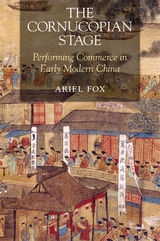
The long seventeenth century in China was a period of tremendous commercial expansion, and no literary genre was better equipped to articulate its possibilities than southern drama. As a form and a practice, southern drama was in the business of world-building—both in its structural imperative to depict and reconcile the social whole and in its creation of entire economies dependent on its publication and performance. However, the early modern commercial world repelled rather than engaged most playwrights, who consigned its totems—the merchant and his money—to the margins as sources of political suspicion and cultural anxiety.
In The Cornucopian Stage, Ariel Fox examines a body of influential yet understudied plays by a circle of Suzhou playwrights who enlisted the theatrical imaginary to very different ends. In plays about long-distance traders and small-time peddlers, impossible bargains and broken contracts, strings of cash and storehouses of silver, the Suzhou circle placed commercial forms not only at center stage but at the center of a new world coming into being. Here, Fox argues, the economic character of early modern selfhood is recast as fundamentally productive—as the basis for new subject positions, new kinds of communities, and new modes of art.
Winner of Two Colorado Book Awards
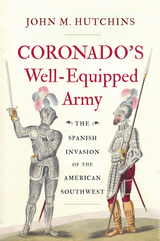
The historic 1540–1542 expedition of Captain-General Francisco Vasquez de Coronado is popularly remembered as a luckless party of exploration which wandered the American Southwest and then blundered onto the central Great Plains of Texas, Oklahoma, and Kansas. The expedition, as historian John M. Hutchins relates in Coronado’s Well-Equipped Army: The Spanish Invasion of the American Southwest, was a military force of about 1,500 individuals, made up of Spanish soldiers, Indian warrior allies, and camp followers. Despite the hopes for a peaceful conquest of new lands—including those of a legendary kingdom of Cibola—the expedition was obliged to fight a series of battles with the natives in present-day Sonora, California, Arizona, and New Mexico. The final phase of the invasion was less warlike, as the members of the expedition searched the Great Plains in vain for a wealthy civilization called Quivira.While much has been written about the march of Coronado and his men, this is the first book to address the endeavor as a military campaign of potential conquest like those conducted by other conquistadors. This helps to explain many of the previously misunderstood activities of the expedition. In addition, new light is cast on the non-Spanish participants, including Mexican Indian allies and African retainers, as well as the important roles of women.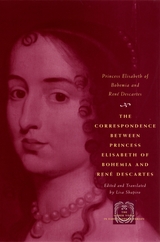
Between the years 1643 and 1649, Princess Elisabeth of Bohemia (1618–80) and René Descartes (1596–1650) exchanged fifty-eight letters—thirty-two from Descartes and twenty-six from Elisabeth. Their correspondence contains the only known extant philosophical writings by Elisabeth, revealing her mastery of metaphysics, analytic geometry, and moral philosophy, as well as her keen interest in natural philosophy. The letters are essential reading for anyone interested in Descartes’s philosophy, in particular his account of the human being as a union of mind and body, as well as his ethics. They also provide a unique insight into the character of their authors and the way ideas develop through intellectual collaboration.
Philosophers have long been familiar with Descartes’s side of the correspondence. Now Elisabeth’s letters—never before available in translation in their entirety—emerge this volume, adding much-needed context and depth both to Descartes’s ideas and the legacy of the princess. Lisa Shapiro’s annotated edition—which also includes Elisabeth’s correspondence with the Quakers William Penn and Robert Barclay—will be heralded by students of philosophy, feminist theorists, and historians of the early modern period.
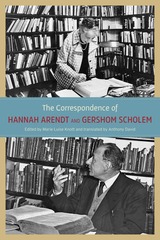
Arendt and Scholem met in 1932 in Berlin and quickly bonded over their mutual admiration for and friendship with Walter Benjamin. They began exchanging letters in 1939, and their lively correspondence continued until 1963, when Scholem’s vehement disagreement with Arendt’s Eichmann in Jerusalem led to a rupture that would last until Arendt’s death a dozen years later. The years of their friendship, however, yielded a remarkably rich bounty of letters: together, they try to come to terms with being both German and Jewish, the place and legacy of Germany before and after the Holocaust, the question of what it means to be Jewish in a post-Holocaust world, and more. Walter Benjamin is a constant presence, as his life and tragic death are emblematic of the very questions that preoccupied the pair. Like any collection of letters, however, the book also has its share of lighter moments: accounts of travels, gossipy dinner parties, and the quotidian details that make up life even in the shadow of war and loss.
In a world that continues to struggle with questions of nationalism, identity, and difference, Arendt and Scholem remain crucial thinkers. This volume offers us a way to see them, and the development of their thought, anew.
In the seventeenth century, a vision arose which was to captivate the Western imagination for the next three hundred years: the vision of Cosmopolis, a society as rationally ordered as the Newtonian view of nature. While fueling extraordinary advances in all fields of human endeavor, this vision perpetuated a hidden yet persistent agenda: the delusion that human nature and society could be fitted into precise and manageable rational categories. Stephen Toulmin confronts that agenda—its illusions and its consequences for our present and future world.
Mariano Siskind’s groundbreaking debut book redefines the scope of world literature, particularly regarding the place of Latin America in its imaginaries and mappings. In Siskind’s formulation, world literature is a modernizing discursive strategy, a way in which cultures negotiate their aspirations to participate in global networks of cultural exchange, and an original tool to reorganize literary history. Working with novels, poems, essays, travel narratives, and historical documents, Siskind reads the way Latin American literary modernity was produced as a global relation, from the rise of planetary novels in the 1870s and the cosmopolitan imaginaries of modernism at the turn of the twentieth century, to the global spread of magical realism. With its unusual breadth of reference and firm but unobtrusive grounding in philosophy, literary theory, and psychoanalysis, Cosmopolitan Desires will have a major impact in the fields of Latin American studies and comparative literature.
How to remake the world with neurodivergence at its heart
What if we embraced neurodivergent ways of being not as deviations to be corrected but as vital ways of inhabiting the world? What new realities might emerge? Bringing a much-needed humanistic perspective to the study of autism and other forms of neurodivergence, Counter-cartographies offers a bold reimagining of neurological difference, moving beyond rigid diagnostic frameworks to uncover more expansive, generative modes of existence.
Engaging the work of Fernand Deligny to trace how modern taxonomies of neurodivergence have hardened over time, Leon J. Hilton questions how these categories might instead serve as tools for remapping the world with neurodivergence at its center. At the heart of Counter-cartographies is an exploration of performance and performativity that reveals how the norm of neurotypical reality is continually reinforced through acts of doing, redoing, and undoing.
Charting the historical shift away from “mind” and toward “brain” and moving fluidly across disciplines—from digital art and documentary cinema to cybernetics and radical mental health movements—Hilton illuminates the deep interconnections between performance, perception, and the historical construction of the “neurotypical.” Through close readings of works by William Pope.L, Mel Baggs, Wu Tsang, and others, Hilton also examines how neurodivergence has been represented, embodied, and materialized in contemporary art and media. Restless, engrossing, and persistently attuned to moments of rupture when the neurotypical order falters, Counter-cartographies charts a path toward a more capacious, imaginative world.
Retail e-book files for this title are screen-reader friendly with images accompanied by short alt text and/or extended descriptions.
Between 1751 and 1784, the Qianlong emperor embarked upon six southern tours, traveling from Beijing to Jiangnan and back. These tours were exercises in political theater that took the Manchu emperor through one of the Qing empire's most prosperous regions.
This study elucidates the tensions and the constant negotiations characterizing the relationship between the imperial center and Jiangnan, which straddled the two key provinces of Jiangsu and Zhejiang. Politically, economically, and culturally, Jiangnan was the undisputed center of the Han Chinese world; it also remained a bastion of Ming loyalism and anti-Manchu sentiment. How did the Qing court constitute its authority and legitimate its domination over this pivotal region? What were the precise terms and historical dynamics of Qing rule over China proper during the long eighteenth century?
In the course of addressing such questions, this study also explores the political culture within and through which High Qing rule was constituted and contested by a range of actors, all of whom operated within socially and historically structured contexts. The author argues that the southern tours occupied a central place in the historical formation of Qing rule during a period of momentous change affecting all strata of the eighteenth-century polity.
“A must-read.” —Joel Mokyr, Nobel Prize–winning author of A Culture of Growth: The Origins of the Modern Economy
An illuminating, fine-grained account of how Indo-Arabic numerals facilitated the spread of practical knowledge in Western Europe—reshaping both commerce and mathematics in the process.
In the thirteenth-century Mediterranean, commerce transformed as merchants shifted from Roman to Indo-Arabic numerals—an alternative that better facilitated complex calculations. It has long been known that this transition stemmed from Europe’s increasing exchanges with India, Persia, and the Arabic world. Yet much remains to be understood about how Indo-Arabic numerals—and the practical arithmetic they enabled—actually spread across Europe. As Raffaele Danna shows, it was hundreds of ordinary merchants, schoolmasters, and artisans who nurtured these changes, thereby driving key advances in both commerce and mathematics.
Drawing on an original catalog of more than 1,200 practical arithmetic manuals, Danna charts the incremental spread of the new figures with unprecedented precision. While Italian merchants were the early adopters, it took nearly three centuries for Indo-Arabic numerals to become established in northern Europe. As Danna shows, adoption did not follow the routes of maritime trade. Rather, Indo-Arabic numerals moved gradually across the continent through inland networks of practitioners. Everywhere they went, the ten figures enhanced commercial practices and facilitated the emergence of a coherent language of mathematical craft. The growing social circulation of this knowledge, in turn, had a lasting impact on the economic trajectory of Western Europe. By the late sixteenth century, even academics were absorbing lessons from the vernacular tradition—a development that led to the first major breakthroughs in European mathematical theory since antiquity.
Combining economic history with the social history of mathematics, The Craft of Indo-Arabic Numerals illuminates the integral role of practical arithmetic in both intellectual and commercial transformations across Western Europe.
Now, after fifty years as a renowned cultural historian, Franklin offers a set of hard-learned lessons about modern American history. Crash Course is essential reading for anyone who wonders how America ended up where it is today: with a deeply divided and disillusioned populace, led by a dysfunctional government, and mired in unwinnable wars. It also finds startling parallels between America’s foreign military exploits and the equally brutal tactics used on the home front to crush organized labor, antiwar, and civil rights movements.
More than just a memoir or a history book, Crash Course gives readers a unique firsthand look at the building of the American empire and the damage it has wrought. Shocking and gripping as any thriller, it exposes the endless deception of the American public, and reveals from inside how and why many millions of Americans have been struggling for decades against our own government in a fight for peace and justice.
For tens of thousands of Union veterans, Patrick Kelly argues, the Civil War never ended. Many Federal soldiers returned to civilian life battling the lifelong effects of combat wounds or wartime disease. Looking to the federal government for shelter and medical assistance, war-disabled Union veterans found help at the National Home for Disabled Volunteer Soldiers. Established by Congress only weeks prior to the Confederate surrender, this network of federal institutions had assisted nearly 100,000 Union veterans by 1900. The National Home is the direct forebear of the Veterans Administration hospital system, today the largest provider of health care in the United States.
Kelly places the origins of the National Home within the political culture of U.S. state formation. Creating a National Home examines Congress's decision to build a federal network of soldiers' homes. Kelly explores the efforts of the Home's managers to glean support for this institution by drawing upon the reassuring language of domesticity and "home." He also describes the manner in which the creators of the National Homes used building design, landscaping, and tourism to integrate each branch into the cultural and economic life of surrounding communities, and to promote a positive image of the U.S. state.
Drawing upon several fields of American history--political, cultural, welfare, gender--Creating a National Home illustrates the lasting impact of war on U.S. state and society. The building of the National Home marks the permanent expansion of social benefits offered to citizen-veterans. The creation of the National Home at once defined an entitled group and prepared the way for the later expansion of both the welfare and the warfare states.
China is a multicultural country home to fifty-five ethnic minority groups, yet due to linguistic and cultural barriers many of these groups remain understudied or unknown in the West. The Qiang, one of modern China’s officially recognized ethnic minorities, is also China’s longest-standing ethnoracial identity marker that has existed since the earliest recorded history of China. Creative Belonging investigates the formation and evolution of the Qiang as a people, a concept, and a cultural history in China. It further examines how the contemporary Qiang ethnic group interacts strategically with mainstream Chinese society, challenging the historically entrenched hierarchies between the sociocultural “centers” of China and its ethnic “peripheries.”
This book is based on years of ethnographic and textual-archival research in the Himalayan regions of southwest China, where the contemporary Qiang group resides. Drawing on a diverse range of official and local political discourses and previously unstudied literary, historiographical, and cinematic works, Yanshuo Zhang illuminates how the Qiang have carved out spaces of “creative belonging” within the parameters of multiculturalism in contemporary China. Rooted in ethnographic and textual-archival research, the book presents original materials produced by Qiang indigenous writers, scholars, artists, grassroots village cultural activists, and entrepreneurs at both the local and the global levels. Creative Belonging invites readers to rethink ethnicity and national belonging in China by centering minority groups’ efforts to expand the meanings and implications of “Chinese culture.”
"A powerful ending that explains how the experience with the Barbary states compelled many Americans to look inward . . . with increasing doubts about the institution of slavery." —David W. Lesch, Middle East Journal
"Allison's incisive and informative account of the fledgling republic's encounter with the Muslim world is a revelation with a special pertinence to today's international scene." —Richard W. Bulliet, Journal of Interdisciplinary History
"This book should be widely read. . . . Allison's study provides a context for understanding more recent developments, such as America's tendency to demonize figures like Iran's Khumaini, Libya's Qaddafi, and Iraq's Saddam." —Richard M. Eaton, Eighteenth Century Studies
Russians from all walks of life poured into the streets of the imperial capital after the February Revolution of 1917, joyously celebrating the end of Tsar Nicholas II’s monarchy. One year later, with Lenin’s Bolsheviks now in power, Petrograd’s deserted streets presented a very different scene. No celebrations marked the Revolution’s anniversary. Amid widespread civil strife and lawlessness, a fearful citizenry stayed out of sight.
In Crime and Punishment in the Russian Revolution, Tsuyoshi Hasegawa offers a new perspective on Russia’s revolutionary year through the lens of violent crime and its devastating effect on ordinary people. When the Provisional Government assumed power after Nicholas II’s abdication, it set about instituting liberal reforms, including eliminating the tsar’s regular police. But dissolving this much-hated yet efficient police force and replacing it with a new municipal police led rapidly to the breakdown of order and services. Amid the chaos, crime flourished. Gangs of criminals, deserters, and hooligans brazenly roamed the streets. Mass prison escapes became common. And vigilantism spread widely as ordinary citizens felt compelled to take the law into their own hands, often meting out mob justice on suspected wrongdoers.
The Bolsheviks swept into power in the October Revolution but had no practical plans to reestablish order. As crime continued to escalate and violent alcohol riots almost drowned the revolutionary regime, they redefined it as “counterrevolutionary activity,” to be dealt with by the secret police, whose harshly repressive, extralegal means of enforcement helped pave the way for a Communist dictatorship.
Demonstrating how emotion became central to the legal and literary meanings of piracy in nineteenth-century America
Pirates have long occupied a central yet unstable place in American law and national identity. In the decades leading up to and including the U.S. Civil War, the charge of piracy was leveled against an unusually wide range of figures: foreign heads of state, imperial filibusters, transoceanic enslavers, enslaved mutineers, radical abolitionists, and others who challenged established forms of authority. Early American literature reflects this instability, portraying pirates who vary dramatically in politics, race, gender, and allegiance. As Mark B. Kelley shows, these characters are united less by ideology than by their challenge to landed social norms and fixed national belonging. The pirate, in both law and literature, emerges as an individual defined by multiplicity rather than political coherence.
Crimes Against Feeling examines how Americans made sense of this ambiguous figure by turning to emotion. Drawing on legal materials including treaties, trial transcripts, congressional debates, and U.S. Supreme Court decisions, as well as popular sentimental fiction (often written by women), Kelley argues that piracy was codified as an offense against moral feeling rather than being a singular political position. Legal thinkers and writers such as John Quincy Adams, Abraham Lincoln, Jefferson Davis, Catharine Maria Sedgwick, Harriet Beecher Stowe, and Maria S. Cummins relied on shared affective frameworks—sympathy, sentiment, and domestic vulnerability—to render piracy legible and punishable. American pirate law, Kelley demonstrates, was shaped by the same emotional logics that structured the era’s popular fiction.
By tracing piracy across debates over domestic sovereignty, global enslavement and abolition, imperial expansion, postbellum reparations, and international copyright, Crimes Against Feeling reveals the pirate as a key figure for understanding gender, home, family, and nation in early America. Reading law and literature together, the book shows how emotional judgment—not political consensus—became a foundational tool for managing oceanic violence and transnational disorder in the nineteenth-century United States.
How we view ourselves and how we wish to be seen by others cannot be separated from the stories we tell about our past. In this sense all memory is in crisis, torn between conflicting motives of historical reflection, political expediency, and personal or collective imagination. In Crises of Memory and the Second World War, Susan Suleiman conducts a profound exploration of contested terrain, where individual memories converge with public remembrance of traumatic events.
Suleiman is one of a handful of scholars who have shaped the interdisciplinary study of memory, with its related concepts of trauma, testimony, forgetting, and forgiveness. In this book she argues that memories of World War II, while nationally specific, transcend national boundaries, due not only to the global nature of the war but also to the increasingly global presence of the Holocaust as a site of collective memory. Among the works she discusses are Jean-Paul Sartre’s essays on the occupation and Resistance in France; Marcel Ophuls’ innovative documentary on Klaus Barbie, tried for crimes against humanity; István Szabó’s film Sunshine, a chronicle of Jewish identity in central Europe; literary memoirs by Jorge Semprun and Elie Wiesel; and experimental writing by child survivors of the Holocaust.
George L. Mosse (1918–99) was a legendary scholar, teacher, and mentor. A refugee from Nazi Germany, in 1955 he joined the Department of History at the University of Wisconsin–Madison, where he was both influential and popular. Mosse was an early leader in the study of modern European cultural and intellectual history, fascism, and the history of sexuality and masculinity. Over his career he authored more than two dozen books.
In the aftermath of the Second World War, French thinker and writer Georges Bataille forged a singular path through the moral and political impasses of his age. In 1946, animated by “a need to live events in an increasingly conscious way,” and to reject any compartmentalization of intellectual life, Bataille founded the journal Critique. Adopting the format of the review essay, he surveyed the post-war cultural landscape while advancing his reflections on excess, non-knowledge, and the general economy. Focusing on literature as a mode of sovereign uselessness, he tackled prominent and divisive figures such as Henry Miller and Albert Camus.
In keeping with Critique’s mission to explore the totality of human knowledge, Bataille’s articles did not just focus on the literary but featured important reflections on the science of sexuality, the Chinese Revolution, and historical accounts of drunkenness, among other matters. Throughout, he was attuned to how humanity would deal with the excessive forces of production and destruction it had unleashed, his aim being a way of thinking and living that would inhabit that excess.
This is the first of three volumes collecting Bataille’s post-war essays. Beginning with an article on Nietzsche and fascism written shortly after the liberation of Paris and running to the end of 1948, these texts make available for the first time in English the systematic diversity of Bataille’s post-war thought.
From Kant to Kierkegaard, from Hegel to Heidegger, continental philosophers have indelibly shaped the trajectory of Western thought since the eighteenth century. Although much has been written about these monumental thinkers, students and scholars lack a definitive guide to the entire scope of the continental tradition. The most comprehensive reference work to date, this eight-volume History of Continental Philosophy will both encapsulate the subject and reorient our understanding of it. Beginning with an overview of Kant’s philosophy and its initial reception, the History traces the evolution of continental philosophy through major figures as well as movements such as existentialism, phenomenology, hermeneutics, and poststructuralism. The final volume outlines the current state of the field, bringing the work of both historical and modern thinkers to bear on such contemporary topics as feminism, globalization, and the environment. Throughout, the volumes examine important philosophical figures and developments in their historical, political, and cultural contexts.
The first reference of its kind, A History of Continental Philosophy has been written and edited by internationally recognized experts with a commitment to explaining complex thinkers, texts, and movements in rigorous yet jargon-free essays suitable for both undergraduates and seasoned specialists. These volumes also elucidate ongoing debates about the nature of continental and analytic philosophy, surveying the distinctive, sometimes overlapping characteristics and approaches of each tradition. Featuring helpful overviews of major topics and plotting road maps to their underlying contexts, A History of Continental Philosophy is destined to be the resource of first and last resort for students and scholars alike.
READERS
Browse our collection.
PUBLISHERS
See BiblioVault's publisher services.
STUDENT SERVICES
Files for college accessibility offices.
RECENTLY PUBLISHED



UChicago Accessibility Resources
home | accessibility | search | about | contact us
BiblioVault ® 2001 - 2026
The University of Chicago Press