
 A SCHOLARLY BOOK REPOSITORY
127 start with E start with E
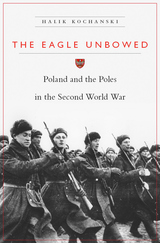
The Second World War gripped Poland as it did no other country in Europe. Invaded by both Germany and the Soviet Union, it remained under occupation by foreign armies from the first day of the war to the last. The conflict was brutal, as Polish armies battled the enemy on four different fronts. It was on Polish soil that the architects of the Final Solution assembled their most elaborate network of extermination camps, culminating in the deliberate destruction of millions of lives, including three million Polish Jews. In The Eagle Unbowed, Halik Kochanski tells, for the first time, the story of Poland's war in its entirety, a story that captures both the diversity and the depth of the lives of those who endured its horrors.
Most histories of the European war focus on the Allies' determination to liberate the continent from the fascist onslaught. Yet the "good war" looks quite different when viewed from Lodz or Krakow than from London or Washington, D.C. Poland emerged from the war trapped behind the Iron Curtain, and it would be nearly a half-century until Poland gained the freedom that its partners had secured with the defeat of Hitler. Rescuing the stories of those who died and those who vanished, those who fought and those who escaped, Kochanski deftly reconstructs the world of wartime Poland in all its complexity-from collaboration to resistance, from expulsion to exile, from Warsaw to Treblinka. The Eagle Unbowed provides in a single volume the first truly comprehensive account of one of the most harrowing periods in modern history.

Éamon de Valera embodies Irish independence much as de Gaulle personifies French resistance and Churchill exemplifies British resolve. Ronan Fanning offers a reappraisal of the man who remains the most famous, and most divisive, political figure in modern Irish history, reconciling de Valera’s shortcomings with a recognition of his achievement as the statesman who single-handedly severed Ireland’s last ties to England.
Born in New York in 1882, de Valera was sent away to be raised by his mother’s family in Ireland, where a solitary upbringing forged the extraordinary self-sufficiency that became his hallmark. Conservative in his youth, he changed his name from Edward to Éamon when he became a member of the Gaelic League, the Irish language revival movement, in 1908. Five years later, he joined the Irish Volunteers, a nationalist military organization, and participated in the 1916 Easter Rising. Escaping execution afterward, he used his prestige as the senior surviving rebel officer to become the leader of Ireland’s revolutionary nationalists. But the iron will that was usually his strength became a fateful weakness when he stubbornly rejected the Anglo-Irish Treaty, sparking the Irish Civil War of 1922–1923.
De Valera’s vision for Ireland was blinkered: he had little interest in social and economic progress. But without him, Ireland might never have achieved independence. The nation was spared decades of unproductive debate on the pros and cons of remaining tied to Britain, and by 1973 it had enough self-confidence to surrender some of its sovereignty by joining the European Community.

Arte da Lingua Malabar is a grammar of the Tamil spoken in the sixteenth century by the Parava pearl fisher community on the east coast of South India between Kanyakumari and Rameswaram. Fr. Henrique Henriques, S.J., a Portuguese Jesuit missionary to South India, was the first diligent student of Tamil from Europe. He wrote this grammar in Portuguese around 1549 CE for the benefit of his colleagues engaged in learning the local language for spreading their religious beliefs. Consequently, Arte da Lingua Malabar reflects the first linguistic contact between India and the West.
This grammar is unique in many aspects. It is not based on traditional Indian grammars; rather, it uses Latin grammatical categories to describe sixteenth-century Tamil. The effort to describe a language (Tamil) in terms of an unrelated language (Portuguese) has resulted in several inaccuracies in transliteration and scribing. Yet, Arte da Lingua Malabar is the best evidence for showing how sixteenth-century Tamil was heard and written by a sixteenth-century Portuguese. This English translation by Jeanne Hein and V. S. Rajam also includes analysis of the grammar and a description of the political context in which it was written.
Examining the role of changes in print technologies and poetics in the early novel
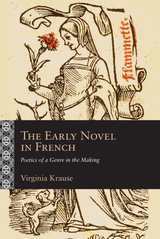
Around the same time that Aristotle’s Poetics was reemerging from obscurity, Rabelais was composing his Pantagruel series, while a host of influential works in a chivalric, sentimental, or pastoral vein were being imported from Spain and Italy. From this emergent corpus, Rabelais’s is the only name to have unambiguously made it into our modern canon of literary history, where he appears to stand alone as an early pioneer of the novel. The Early Novel in French: Poetics of a Genre in the Making explores the literary, cultural, and eminently material soil in which these early forms of what we would come to know as the novel originally took root, showing how they were imaginatively responding to the practices and uncertainties of the literary texts of their own era as well as to works of classical antiquity.
Within the flowering of experimental fictional forms in mid-sixteenth-century France, Virginia Krause identifies historical subplots shaping the development of this genre. As rhetorical culture continued to animate fictions through an active literary tradition, print culture was changing the very fabric of books. The early novel was thus at once rhetorically fashioned and technologically manufactured. Meanwhile, the legacy of medieval romance adventure persisted, making the early novel in French both a new laboratory for Aristotelian immersion and a vehicle for a mysterious and fugitive romanesque. Krause sheds fresh light on this new and rapidly evolving genre: its lifelike personas or “person-fictions”; its material forms, from pocket-sized volumes to vast literary serials; its immersive powers; and its underappreciated role in the production of the modern author.
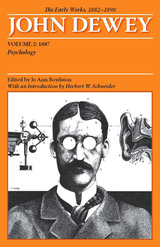
With an original publication date of 1887, Psychology us Volume 2 of "The Early Works." It appears first in the series to introduce scholars and general readers to the use of modern textual criticism in a work outside the literary field. Designed as a "scholar's reading edition," the volumes presents the text of Dewey's work as the author intended, clear of editorial footnotes. All apparatus is conveniently arranged in appendix form. As evidence of its wide adoption and use as a college textbook, Psychology had a publishing history of twenty-six printings. For two of the reprintings, Dewey made extensive revisions in content to incorporate developments in the field of psychology as well as in his own thinking. The textual appendices include a thorough tabulation of these changes and detailed evidence for editorial decisions.
In recognition of the high quality and scholarly standards of the textual editing, this edition of Psychology is the first nonliterary work awarded the Seal of the Modern Language Association Center for Editions of American Authors. By applying to the work of a philosopher the procedures used in modern textual editions of American writers such as Hawthorne, the Southern Illinois University Dewey edition is establishing a pattern for future collected editions of the writings of American philosophers.
At the time Dewey wrote Psychology, the relation between psychology and philosophy was in dispute, and he attempted to incorporate the new physiological psychology represented by G. Stanley Hall into the philosophical system and ethics of George Sylvester Morris. He wrote in May, 1886, that he wanted his textbook in psychology to be one "with the greatest possible unity of principle, so that without ceasing to be a psychology, it shall be an introduction to philosophy in general." His goal, expressed in these terms, foreshadowed the direction of his work in the years that followed, with its continuing emphasis on the interrelations among the various disciplines rather than on separate specializations. In his long and fruitful professional career, this was to be his only attempt to treat the whole field of psychology systematically. Although he maintained a lively interest in psychology, that interest was expressed in connection with his writing in other areas such as ethics, education, logic, social philosophy and aesthetics.


A sweeping exploration of survival, resilience, and the fate of one family amid Europe’s most turbulent century.
Echoes of Exile reveals the seismic disruptions of twentieth-century European history through the intimate lens of one family’s struggle to survive. Setting out to record the life of her mother, Ruth, Daniela Spenser unearthed personal facts and stories that additionally illuminate the shared traumas and experiences of millions of Czech, Polish, and German Jews who died in the Holocaust, as well as the stories of those who survived and lived under Communism and the Cold War. Her resulting work is a fascinating hybrid that combines family letters and interviews with deeply researched political history spanning from the collapse of the Austro-Hungarian Empire to the fall of the Berlin Wall.
Spenser’s fascinating work reveals the difficult choices her mother and family faced, the tests to their loves and loyalties, and the lingering scars of exile. More than a family history, it weaves personal and historical narratives with mundane and momentous threads to create a fresh, distinctive fabric. Spenser recovers fragments of the past that contribute to a map of the present and possibilities for the future. An engrossing account of survival, resilience, and the enduring human spirit amid the maelstrom of Europe’s savage twentieth century, Echoes of Exile will interest readers who value firsthand accounts of significant events and who seek to understand the complexities of survival, identity, and political change through intimate, lived experiences.
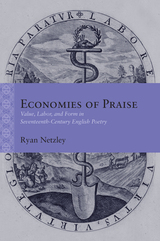
Reevaluates early modern poems of praise as, paradoxically, challenging an artistic economy that values exchange and productivity
Early modern poems of praise typically insist that they do not have a purpose or enact real labor beyond their effortless listing of laudable qualities. And yet the poets discussed in this study, including Ben Jonson, Andrew Marvell, Anne Bradstreet, Lucy Hutchinson, and John Milton, hint at an alternative aesthetic economy at work in their verse. Poetic praise, it turns out, might show us a social world outside the organizing principle of exchange.
In Economies of Praise: Value, Labor, and Form in Seventeenth‑Century English Poetry, Ryan Netzley explores how poems of praise imagine alternatives to market and gift economies and point instead to a self-contained aesthetic economy that works against a more expansive and productivist understanding of literary art. By depicting exchange as inconsequential, unproductive, and redundant rather than a necessary constituent of social order, these poems model for modern readers a world without the imperative to create, appraise, and repeatedly demonstrate one’s own value.
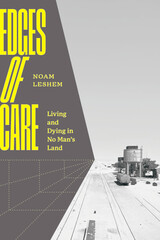
“No man’s land” invokes stretches of barren landscape, twisted barbed wire, desolation, and the devastation of war. But this is not always the reality. According to Noam Leshem in Edges of Care, the term also reveals radical abandonment by the state. From the Northern Sahara to the Amazon rainforests, people around the world find themselves in places that have been stripped of sovereign care. Leshem is committed to defining these spaces and providing a more intimate understanding of this urgent political reality.
Based on nearly a decade of research in some of the world’s most challenging conflict zones, Edges of Care offers a profound account of abandoned lives and lands, and how they endure and sometimes thrive once left to fend for themselves. Leshem interrogates no man’s land as a site of radical uncaring: abandoned by a sovereign power in a relinquishment of responsibility for the space or anyone inside it. To understand the ramifications of such uncaring, Leshem takes readers through a diverse series of abandoned places, including areas in Palestine, Syria, Colombia, Sudan, and Cyprus. He shows that no man’s land is not empty of life, but almost always inhabited and, in fact, often generative of new modes of being. Beautifully written and evocative, Edges of Care reveals the unexamined complexities and political dynamics hidden within and around places governed by callous indifference.

Marilyn G. Miller has written the first study to focus exclusively on this important voice in Jewish–Latin American letters. Only after returning to Guatemala and regaining his command of Spanish through reading literature did Halfon begin to build his life as a writer and translator. Nonetheless, the author admits that “one thing is stubbornly true, and it’s this: every sentence that I write, every verb or adjective that I painstakingly insert or remove, every literary thought that I have while writing, always . . . begins and ends in English.” Halfon’s translated works are never parallel texts, however. Thus, translation and its side effects (foreign words, linguistic lacunae, multilingual modes of perception) offer us crucial keys to understanding the author’s fictional world as a vehicle for retelling and surviving Jewish trauma and finding his own particular plurilingual voice.
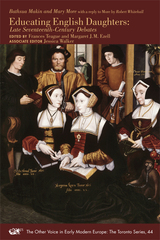
This edition offers texts from Bathsua Makin and Mary More, and Robert Whitehall’s response to More’s argument. Makin describes the appropriate education for London merchants’ daughters, arguing that girls should be educated and should aspire to follow learned women in history, and that educated women improve their families and themselves. More argues that women have the right to an education, and that such an education shows that the inequality of married women under English law is a man-made institution. More’s argument drew objections from her Oxford reader, Robert Whitehall, who preserved her manuscript with his own. Makin and More enjoyed a measure of public recognition and esteem, yet after their deaths, they and their texts were largely ignored until the late twentieth century.
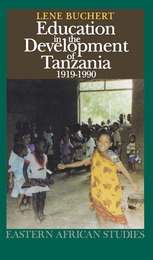
Deals with the realities of education in a debt-ridden African country trying to cope with the pressures of externally imposed educational budgets.
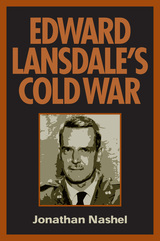
The man widely believed to have been the model for Alden Pyle in Graham Greene's The Quiet American, Edward G. Lansdale (1908–1987) was a Cold War celebrity. A former advertising executive turned undercover CIA agent, he was credited during the 1950s with almost single-handedly preventing a communist takeover of the Philippines and with helping to install Ngo Dinh Diem as president of the American-backed government of South Vietnam. Adding to his notoriety, during the Kennedy administration Lansdale was put in charge of Operation Mongoose, the covert plot to overthrow the government of Cuba's Fidel Castro by assassination or other means.
In this book, Jonathan Nashel reexamines Lansdale's role as an agent of American Cold War foreign policy and takes into account both his actual activities and the myths that grew to surround him. In contrast to previous portraits, which tend to depict Lansdale either as the incarnation of U.S. imperialist ambitions or as a farsighted patriot dedicated to the spread of democracy abroad, Nashel offers a more complex and nuanced interpretation. At times we see Lansdale as the arrogant “ugly American,” full of confidence that he has every right to make the world in his own image and utterly blind to his own cultural condescension. This is the Lansdale who would use any conceivable gimmick to serve U.S. aims, from rigging elections to sugaring communist gas tanks. Elsewhere, however, he seems genuinely respectful of the cultures he encounters, open to differences and new possibilities, and willing to tailor American interests to Third World needs.
Rather than attempting to reconcile these apparently contradictory images of Lansdale, Nashel explores the ways in which they reflected a broader tension within the culture of Cold War America. The result is less a conventional biography than an analysis of the world in which Lansdale operated and the particular historical forces that shaped him—from the imperatives of anticommunist ideology and the assumptions of modernization theory to the techniques of advertising and the insights of anthropology.
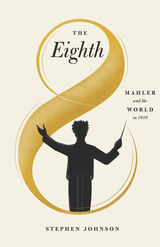
September 12, 1910: The world premiere of Gustav Mahler’s Eighth Symphony and the artistic breakthrough for which the composer had yearned all his life. Munich’s new Musik Festhalle was filled to capacity on two successive evenings for the performances, which were received with rapturous applause. Representatives of many European royal houses were in attendance, along with an array of stars from the musical and literary world, including Thomas Mann and the young Arnold Schoenberg. Also present were Alma Mahler, the composer’s wife, and Alma’s longtime lover, the architect Walter Gropius. Knowledge of their relationship would precipitate an emotional crisis in Mahler that, compounded with his heart condition and the loss of his young daughter Maria, would lead to his premature death the next year.
In The Eighth, Stephen Johnson provides a masterful account of the symphony’s far-reaching consequences and its effect on composers, conductors, and writers of the time. The Eighth looks behind the scenes at the demanding one-week rehearsal period leading up to the premiere—something unheard of at the time—and provides fascinating insight into Mahler’s compositional habits, his busy life as a conductor, his philosophical and literary interests, and his personal and professional relationships. Johnson expertly contextualizes Mahler’s work among the prevailing attitudes and political climate of his age, considering the art, science, technology, and mass entertainment that informed the world in 1910. The Eighth is an absorbing history of a musical masterpiece and the troubled man who created it.
Examining the conflicted legacy of Ernst Jünger’s thought and its relationship to critical theory
In the 1920s, Ernst Jünger’s journalistic advocacy of a militaristic, antidemocratic nationalism played a central role in the rise of German fascism. At the same time, Jünger developed an increasingly acute account of how the mobilizing force of industrial technology embodied a will to power that, on the one hand, anticipated an authoritarian state but, on the other, assumed a planetary perspective that made national identifications redundant. What he called the Gestalt of the worker expresses the “elemental powers” that, he believed, mark the limits of Enlightenment conceptions of historical progress.
Today, Jünger appears in intellectual history primarily as a representative of protofascist decisionism, reactionary modernism, or the so-called conservative revolution. Andrew McCann puts these aspects of Jünger’s early work into dialogue with the posthistorical orientation that he developed after the Second World War, in order to offer a fresh reading that demonstrates how Jünger’s obsession with the transience of cultural and historical forms displays deep structural affinities with the idea of natural history developed by Walter Benjamin and Theodor Adorno. By tracing this thread in intellectual history, McCann charts the currents of influence and confluence between what are usually understood as sharply polarized political positions and the conceptual postures that accompany them: immanence and transcendence, reason and myth, class and nation, relations of production and the forces of nature.

Why do some surprises delight—the endings of Agatha Christie novels, films like The Sixth Sense, the flash awareness that Pip’s benefactor is not (and never was!) Miss Havisham? Writing at the intersection of cognitive science and narrative pleasure, Vera Tobin explains how our brains conspire with stories to produce those revelatory plots that define a “well-made surprise.”
By tracing the prevalence of surprise endings in both literary fiction and popular literature and showing how they exploit our mental limits, Tobin upends two common beliefs. The first is cognitive science’s tendency to consider biases a form of moral weakness and failure. The second is certain critics’ presumption that surprise endings are mere shallow gimmicks. The latter is simply not true, and the former tells at best half the story. Tobin shows that building a good plot twist is a complex art that reflects a sophisticated understanding of the human mind.
Reading classic, popular, and obscure literature alongside the latest research in cognitive science, Tobin argues that a good surprise works by taking advantage of our mental limits. Elements of Surprise describes how cognitive biases, mental shortcuts, and quirks of memory conspire with stories to produce wondrous illusions, and also provides a sophisticated how-to guide for writers. In Tobin’s hands, the interactions of plot and cognition reveal the interdependencies of surprise, sympathy, and sense-making. The result is a new appreciation of the pleasures of being had.
A Times Literary Supplement Best Book of the Year
The story of the most acclaimed literary biography of the twentieth century—an ingeniously plotted, behind-the-scenes account of how the literary critic and scholar Richard Ellmann shaped James Joyce’s reputation.
Richard Ellmann’s James Joyce, published in 1959, was hailed by Anthony Burgess as “the greatest literary biography of the twentieth century.” Frank Kermode thought the book would “fix Joyce’s image for a generation,” a prediction that was if anything too cautious. The biography won the National Book Award and durably secured Joyce’s standing as a preeminent modernist.
Ellmann’s Joyce provides the biography of the biography, exploring how Ellmann came to his subject, gained the cooperation of Joyce’s family and estate, shrewdly, doggedly collected vital papers and interviews, placated publishers, thwarted competitors, and carefully balanced narrative with literary analysis. Ellmann’s Joyce also removes the veil from the biographer—richly rewarded in public, admirable in private life, but also possessed of a startling secret life. An eminent biographer himself, Zachary Leader constructs a powerful argument not only in support of Ellmann’s intellectual and artistic claims but also on behalf of literary biography generally. In the process, he takes readers on a rare tour through midcentury publishing houses in New York and London, as well as the corridors and classrooms of elite universities, from Yale to Oxford. The influence of Ellmann’s book, recognized instantly, persists to this day, among literary scholars and Joyce fans alike.
Filled with surprising details, tales of intrigue from the heyday of literary publishing, and intimate portraits of the Joyce and Ellmann families, Ellmann’s Joyce is as immersive as a walk around town with Leopold Bloom and as moving as the thickly drifted snow on Michael Furey’s grave.
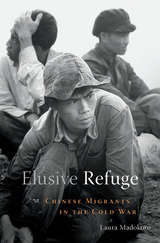
The 1949 Chinese Communist Revolution is a subject of inexhaustible historical interest, but the plight of millions of Chinese who fled China during this tumultuous period has been largely forgotten. Elusive Refuge recovers the history of China’s twentieth-century refugees. Focusing on humanitarian efforts to find new homes for Chinese displaced by civil strife, Laura Madokoro points out a constellation of factors—entrenched bigotry in countries originally settled by white Europeans, the spread of human rights ideals, and the geopolitical pressures of the Cold War—which coalesced to shape domestic and international refugee policies that still hold sway today.
Although the United States, Canada, Australia, New Zealand, and South Africa were home to sizeable Asian communities, Chinese migrants were a perpetual target of legislation designed to exclude them. In the wake of the 1949 Revolution, government officials and the broader public of these countries questioned whether Chinese refugees were true victims of persecution or opportunistic economic migrants undeserving of entry. It fell to NGOs such as the Lutheran World Federation and the World Council of Churches to publicize the quandary of the vast community of Chinese who had become stranded in Hong Kong.
These humanitarian organizations achieved some key victories in convincing Western governments to admit Chinese refugees. Anticommunist sentiment also played a role in easing restrictions. But only the plight of Southeast Asians fleeing the Vietnam War finally convinced the United States and other countries to adopt a policy of granting permanent residence to significant numbers of refugees from Asia.
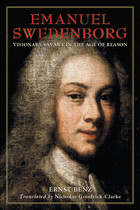
Originally written more than fifty years ago by eminent scholar Ernst Benz, this volume stands as one of the most comprehensive biographies of Emanuel Swedenborg (1688–1772) ever published.
Benz examines Swedenborg’s life through the lens of the intellectual atmosphere of the eighteenth century. Growing up at a time when the classical view of the world was being challenged by the new philosophers and scientists of the Enlightenment, Swedenborg was deeply immersed both in the religious teachings of the Lutheran church and the explorations of rational science. His quest for understanding eventually led to his spiritual awakening and the unique insights that continue to inspire seekers and thinkers today.
Now available for the first time in paperback, Nicholas Goodrick-Clarke’s eminently readable translation shines a new light on the Swedish seer.
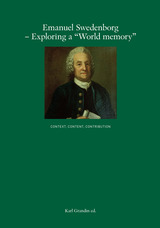
The conference attracted presenters from all over the world, including some top scholars. Papers were divided into three categories. “Content” describes Swedenborg’s thought, from his use of spheres in his scientific writings to his views on sexuality and marriage to analyses of his theological writings. “Context” explores his times, putting Swedenborg in the context of eighteenth-century philosophy and looking at the organization of the earliest Swedenborgian church. “Contribution” looks at Swedenborg’s influence on philosophy and the arts, from Ralph Waldo Emerson and Czeslaw Milocz to Elizabeth Barrett Browning and William James.
These papers present a rare insight into Swedenborg. Although only a limited number of attendees were invited to the conference, now the research is available to all.
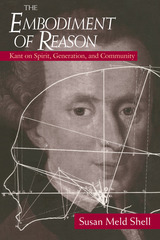
Shell argues that the central animating issues of Kant's lifework concerned the perplexing relation of spirit to body. Through an exacting analysis of individual writings, Shell maps the philosophical contours of Kant's early intellectual struggles and their relation to his more mature thought. The paradox of mind in matter and the tensions it generates—between freedom and determinacy, independence and community, ideal and real—are shown to inform the whole of his work. Shell's fresh, penetrating analysis of the precritical works will surely catapult them to new prominence in Kant studies.
Shell's critique goes further to consider the context of contemporary intellectual life. She explores the fascinating realm of Kant's sexual and medical idiosyncracies, linking them to the primary concerns of his critical philosophy. She develops a sure-to-be controversial treatment of the connection between Kant's philosophy and his chronic hypochondria, and illuminates previously unforeseen connections in a remarkable convergence of life and thought, with important theoretical and practical implications for modern times.
Scott Warren’s ambitious and enduring work sets out to resolve the ongoing identity crisis of contemporary political inquiry. In the Emergence of Dialectical Theory, Warren begins with a careful analysis of the philosophical foundations of dialectical theory in the thought of Kant, Hegel, and Marx. He then examines how the dialectic functions in the major twentieth-century philosophical movements of existentialism, phenomenology, neomarxism, and critical theory. Numerous major and minor philosophers are discussed, but the emphasis falls on two of the greatest dialectical thinkers of the previous century: Maurice Merleau-Ponty and Jürgen Habermas.
Warren’s shrewd critique is indispensable to those interested in the history of social and political thought and the philosophical foundations of political theory. His work offers an alternative for those who find postmodernism to be at a philosophical impasse.

In a book that moves between philosophy and history, and with lasting significance for both, Arnold Davidson elaborates a powerful new method for considering the history of concepts and the nature of scientific knowledge, a method he calls "historical epistemology." He applies this method to the history of sexuality, with important consequences for our understanding of desire, abnormality, and sexuality itself.
In Davidson's view, it was the emergence of a science of sexuality that made it possible, even inevitable, for us to become preoccupied with our true sexuality. Historical epistemology attempts to reveal how this new form of experience that we call "sexuality" is linked to the emergence of new structures of knowledge, and especially to a new style of reasoning and the concepts employed within it. Thus Davidson shows how, starting in the second half of the nineteenth century, a new psychiatric style of reasoning about diseases emerges that makes possible, among other things, statements about sexual perversion that quickly become commonplace in discussions of sexuality.
Considering a wide range of examples, from Thomas Aquinas to Freud, Davidson develops the methodological lessons of Georges Canguilhem and Michel Foucault in order to analyze the history of our experience of normativity and its deviations.
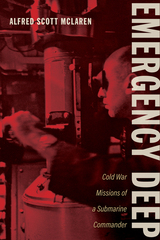
A compelling naval memoir of Arctic submarine duty—operations, engineering realities, and split‑second leadership choices in Emergency Deep.
Captain Alfred Scott McLaren served as commander of the USS Queenfish (SSN 651) from September 1969 to May 1973, the very height of the Cold War. As commander, McLaren led at least six major clandestine operations, including the first-ever exploration of the entire Siberian Continental Shelf: a perilous voyage detailed in his previous book Unknown Waters.
Emergency Deep: Cold War Missions of a Submarine Commander conveys the entire spectrum of Captain McLaren’s experiences commanding the USS Queenfish, mainly in the waters of the Russian Far East and also off Vietnam. McLaren offers a riveting and deeply human story that illuminates the intensity and pressures of commanding a nuclear attack submarine in some of the most difficult circumstances imaginable.
Relying on his own notes and records, as well as discussions with former officers and shipmates, McLaren focuses on operational matters both great and small. He recounts his unique perspectives on attack-submarine tactics and exploratory techniques in high-risk or uncharted areas, matters of leadership and team-building and the morale of his crews, and the innumerable and often unforeseen ways his philosophy of command played out on a day-to-day basis, with consequences that ran the gamut from the mundane to the dire and life-threatening.
Readers are also treated to significant new information and insight on submarine strategy, maneuvers, and culture. Such details illuminate and bring to life, with both great humor and gravitas, the intensity and pressures on those engaged in covert missions on nuclear attack submarines.
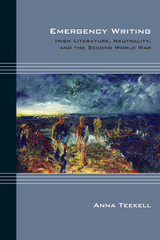
Taking seriously Ireland’s euphemism for World War II, “the Emergency,” Anna Teekell’s Emergency Writing asks both what happens to literature written during a state of emergency and what it means for writing to be a response to an emergency.
Anchored in close textual analysis of works by Samuel Beckett, Elizabeth Bowen, Flann O’Brien, Louis MacNeice, Denis Devlin, and Patrick Kavanagh, and supported by archival material and historical research, Emergency Writing shows how Irish late modernism was a response to the sociopolitical conditions of a newly independent Irish Free State and to a fully emerged modernism in literature and art. What emerges in Irish writing in the wake of Independence, of the Gaelic Revival, of Yeats and of Joyce, is a body of work that invokes modernism as a set of discursive practices with which to counter the Free State’s political pieties.
Emergency Writing provides a new approach to literary modernism and to the literature of conflict, considering the ethical dilemma of performing neutrality—emotionally, politically, and rhetorically—in a world at war.

For as long as there have been nations, there has been an “international”—a sphere of cross-border relations. But for most of human history, this space was sparsely occupied. States and regions were connected by long-distance commerce and the spasms of war, yet in their development they remained essentially separate. The century after 1750 marked a major shift. Fleeting connection gave way to durable integration. Culture, politics, and society were increasingly, and indelibly, entangled across continents. An Emerging Modern World charts this transformative period, addressing major questions about the roots of the present from a distinctly global perspective.
Why, for instance, did industrialization begin in England and not in China? Was there early capitalist development outside of the West? Was the Enlightenment exclusively a European event? Led by editors Sebastian Conrad and Jürgen Osterhammel, a distinguished group of historians tackles these issues, along with the roles of nomads and enslaved people in fostering global integration, the development of a bourgeoisie outside Euro-America, Hinduism’s transformation from local practices into a universal system, the invention of pan-Islamic identity, and the causes and effects of the revolution in time regimes. The world appeared to be undergoing such a radical renewal that the impression of an epochal watershed was widespread.
This fourth volume in the six-volume series A History of the World engages the political, economic, social, and intellectual ferment of the eighteenth and nineteenth centuries outside Europe and North America. In doing so, it bears witness to the birth of the modern world.

From Kant to Kierkegaard, from Hegel to Heidegger, continental philosophers have indelibly shaped the trajectory of Western thought since the eighteenth century. Although much has been written about these monumental thinkers, students and scholars lack a definitive guide to the entire scope of the continental tradition. The most comprehensive reference work to date, this eight-volume History of Continental Philosophy will both encapsulate the subject and reorient our understanding of it. Beginning with an overview of Kant’s philosophy and its initial reception, the History traces the evolution of continental philosophy through major figures as well as movements such as existentialism, phenomenology, hermeneutics, and poststructuralism. The final volume outlines the current state of the field, bringing the work of both historical and modern thinkers to bear on such contemporary topics as feminism, globalization, and the environment. Throughout, the volumes examine important philosophical figures and developments in their historical, political, and cultural contexts.
The first reference of its kind, A History of Continental Philosophy has been written and edited by internationally recognized experts with a commitment to explaining complex thinkers, texts, and movements in rigorous yet jargon-free essays suitable for both undergraduates and seasoned specialists. These volumes also elucidate ongoing debates about the nature of continental and analytic philosophy, surveying the distinctive, sometimes overlapping characteristics and approaches of each tradition. Featuring helpful overviews of major topics and plotting road maps to their underlying contexts, A History of Continental Philosophy is destined to be the resource of first and last resort for students and scholars alike.

Longlisted for the 2026 Plutarch Award
Ellen Tucker Emerson and Edith Emerson Forbes, the daughters of Lidian Jackson and Ralph Waldo Emerson, grew up in the heart of Concord, Massachusetts’s famed literary community. In a culture that celebrated self-reliance, Ellen and Edith formed a partnership that only strengthened as their paths diverged, with Ellen remaining in the family home and Edith marrying William Forbes, moving to Milton, Massachusetts, and having eight children. The partnership allowed them to tend to the demands and opportunities created by their father’s career, including serving as his secretaries and editors, and helped them shape his posthumous image. It also enabled them to adapt to historical developments stretching from the Civil War to American imperialism as well as personal ones, including Edith’s growing family and travel and study abroad, and inevitable ones brought on by the aging processes of their parents and themselves.
Emerson’s Daughters is a biography of a sisterhood, the first full-length study of Ellen’s and Edith’s lives. Building on archival research into the extensive correspondence between the sisters, it adds to the growing body of work on women’s contribution to Transcendentalism while opening a window onto the rich, and understudied, family life of the “Sage of Concord.”

Between 1880 and 1915, thirteen million Italians left their homeland, launching the largest emigration from any country in recorded world history. As the young Italian state struggled to adapt to the exodus, it pioneered the establishment of a “global nation”—an Italy abroad cemented by ties of culture, religion, ethnicity, and economics.
In this wide-ranging work, Mark Choate examines the relationship between the Italian emigrants, their new communities, and their home country. The state maintained that emigrants were linked to Italy and to one another through a shared culture. Officials established a variety of programs to coordinate Italian communities worldwide. They fostered identity through schools, athletic groups, the Dante Alighieri Society, the Italian Geographic Society, the Catholic Church, Chambers of Commerce, and special banks to handle emigrant remittances. But the projects aimed at binding Italians together also raised intense debates over priorities and the emigrants’ best interests. Did encouraging loyalty to Italy make the emigrants less successful at integrating? Were funds better spent on supporting the home nation rather than sustaining overseas connections?
In its probing discussion of immigrant culture, transnational identities, and international politics, this fascinating book not only narrates the grand story of Italian emigration but also provides important background to immigration debates that continue to this day.
An institution in decline, possessing little power in an age dominated by warriors? Or a still-potent symbol of social and political legitimacy? Emperor and Aristocracy in Japan traces the fate of the imperial Japanese court from its lowest point during the turbulent, century-long sengoku, when the old society, built upon the strength and influence of the court, the priesthood, and a narrow warrior elite, was shaken to its foundations, to the Tokugawa era, when court culture displayed renewed vitality, and tea gatherings, flower arranging, and architecture flourished.
In determining how the court managed to persist and survive, Butler looks into contemporary documents, diaries, and letters to reveal the court's internal politics and protocols, hierarchies, finances, and ceremonial observances. Emperor and courtiers adjusted to the prominence of the warrior elite, even as they held on to the ideological advantages bestowed by birth, tradition, and culture. To this historical precedent the new wielders of power paid dutiful homage, ever mindful that ranks and titles, as well as the political blessing of the emperor, were advantageous marks of distinction.
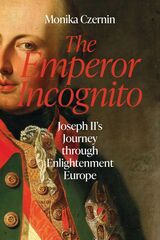
It is the end of the eighteenth century, and the European royal houses are beginning to falter. The young Habsburg emperor Joseph II realizes that reform is inevitable, and he eagerly soaks up Enlightenment ideas. Incognito, and without the usual pomp and entourage, he travels through his vast empire to see with his own eyes how his subjects live, suffer, and starve.
Along with princes and kings, he meets ordinary people and visits hospitals and factories in his search for new insights that will help him build a modern state. When he visits his sister Marie Antoinette in Versailles, he can see the French Revolution looming on the horizon. By the end of his journey, he had spent a quarter of his twenty-five-year reign on the road. With an introduction by Dominic Lieven and based on countless sources, Monika Czernin’s The Emperor Travels Incognito tells the story of an extraordinary man in an age of great upheaval, who was far ahead of his time.
The compilation of the Complete Library of the Four Treasuries (Ssu-k’u ch’üan-shu) was one of the most ambitious intellectual projects of the Ch’ing dynasty. Initiated by imperial command in 1772, the project sought to evaluate, edit, and reproduce the finest Chinese writings in the four traditional categories: Confucian classics, histories, philosophy, and belles lettres. The final products, created over a 22-year period, were an annotated catalog of some 10,000 titles and seven new manuscript libraries of nearly 3,600 titles. The project had its darker side as well, for together with the evaluation of books there developed a campaign of censorship and proscription.
R. Kent Guy’s study gives a balanced account of the project and its significance. Dozens of celebrated Chinese scholars willingly participated in the project, though it was sponsored by the Manchu emperor, and Guy explains their reasons for doing so. He also reconsiders the issue of censorship, arguing that it grew as much from tensions and jealousies within the intellectual elite as from imperial command. Guy’s work will be useful to all those interested in the relationship between intellectuals and the state in late imperial China.
Several essays provide historical perspective on contemporary U.S.–hemispheric relations. These include an analysis of the nature and dynamics of imperial domination, an assessment of financial relations between the United States and Latin America since the end of World War II, an account of Native American resistance to colonialism, and a consideration of the British government’s decision to abolish slavery in its colonies. Other essays focus on present-day conflicts in the Americas, highlighting various modes of domination and dissent, resistance and accommodation. Examining southern Mexico’s Zapatista movement, one contributor discusses dissent in the era of globalization. Other contributors investigate the surprisingly conventional economic policies of Brazil’s president, Luiz Inácio Lula da Silva; Argentina’s recovery from its massive 2001 debt default; the role of coca markets in the election of Bolivia’s first indigenous president, Evo Morales; and the possibilities for extensive social change in Venezuela. A readers’ guide offers a timeline of key events from 1823 through 2007, along with a list of important individuals, institutions, and places.
Contributors: Daniel A. Cieza, Gregory Evans Dowd, Steve Ellner, Neil Harvey, Alan Knight, Carlos Marichal, John Richard Oldfield, Silvia Rivera, Fred Rosen, Jeffrey W. Rubin
In the century after the French Revolution, the South American outpost of Guiana became a depository for exiles—outcasts of the new French citizenry—and an experimental space for the exercise of new kinds of power and violence against marginal groups. Miranda Spieler chronicles the encounter between colonial officials, planters, and others, ranging from deported political enemies to convicts, ex-convicts, vagabonds, freed slaves, non-European immigrants, and Maroons (descendants of fugitive slaves in the forest). She finds that at a time when France was advocating the revolutionary principles of liberty, equality, and fraternity, Guiana’s exiles were stripped of their legal identities and unmade by law, becoming nonpersons living in limbo.
The French Revolution invented the notion of the citizen, but as Spieler shows, it also invented the noncitizen—the person whose rights were nonexistent. Empire and Underworld discovers in Guiana’s wilderness a haunting prehistory of current moral dilemmas surrounding detainees of indeterminate legal status. Pairing the history of France with that of its underworld and challenging some of the century’s most influential theorists from Hannah Arendt to Michel Foucault, Spieler demonstrates how rights of the modern world can mutate into an apparatus of human deprivation.
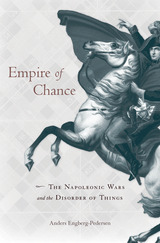
Napoleon’s campaigns were the most complex military undertakings in history before the nineteenth century. But the defining battles of Austerlitz, Borodino, and Waterloo changed more than the nature of warfare. Concepts of chance, contingency, and probability became permanent fixtures in the West’s understanding of how the world works. Empire of Chance examines anew the place of war in the history of Western thought, showing how the Napoleonic Wars inspired a new discourse on knowledge.
Soldiers returning from the battlefields were forced to reconsider basic questions about what it is possible to know and how decisions are made in a fog of imperfect knowledge. Artists and intellectuals came to see war as embodying modernity itself. The theory of war espoused in Carl von Clausewitz’s classic treatise responded to contemporary developments in mathematics and philosophy, and the tools for solving military problems—maps, games, and simulations—became models for how to manage chance. On the other hand, the realist novels of Balzac, Stendhal, and Tolstoy questioned whether chance and contingency could ever be described or controlled.
As Anders Engberg-Pedersen makes clear, after Napoleon the state of war no longer appeared exceptional but normative. It became a prism that revealed the underlying operative logic determining the way society is ordered and unfolds.
Scholars have both neglected Trifonov in recent years and focused their limited attention on the author’s most famous works, produced in the 1960s through 1980s. Yet almost half of his output was written before then. In Empire of Objects, Benjamin Sutcliffe takes care to consider the author’s entire oeuvre. Trifonov’s work reflects the paradoxes of a culture that could neither honestly confront the past nor create a viable future, one that alternated between trying to address and attempting to obscure the trauma of Stalinism. He became increasingly incensed by what he perceived as the erosion of sincerity in public and private life, by the impact of technology, and by the state’s tacit support of greed and materialism. Trifonov’s work, though fictional, offers a compelling window into Soviet culture.

Empire of the Dharma explores the dynamic relationship between Korean and Japanese Buddhists in the years leading up to the Japanese annexation of Korea. Conventional narratives cast this relationship in politicized terms, with Korean Buddhists portrayed as complicit in the “religious annexation” of the peninsula. However, this view fails to account for the diverse visions, interests, and strategies that drove both sides.
Hwansoo Ilmee Kim complicates this politicized account of religious interchange by reexamining the “alliance” forged in 1910 between the Japanese Soto sect and the Korean Wonjong order. The author argues that their ties involved not so much political ideology as mutual benefit. Both wished to strengthen Buddhism’s precarious position within Korean society and curb Christianity’s growing influence. Korean Buddhist monastics sought to leverage Japanese resources as a way of advancing themselves and their temples, and missionaries of Japanese Buddhist sects competed with one another to dominate Buddhism on the peninsula. This strategic alliance pushed both sides to confront new ideas about the place of religion in modern society and framed the way that many Korean and Japanese Buddhists came to think about the future of their shared religion.

This history of administrative thought and practice in colonial Kenya looks at the ways in which white people tried to engineer social change.
It asks four questions:
- Why was Kenya’s welfare operation so idiosyncratic and spartan compared with that of other British colonies?
- Why did a transformation from social welfare to community development produce further neglect of the very poor?
- Why was there no equivalent to the French tradition of community medicine?
- If there was a transformatory element of colonial rule that sought to address poverty, where and why did it fall down?
The answers offer revealing insight into the dynamics of rule in the late colonial period in Kenya.
Between 1350 and 1750—a time of empires, exploration, and exposure to radically different lands and cultures—the world reached a tipping point of global connectedness. In this volume of the acclaimed series A History of the World, noted international scholars examine five critical geographical areas during this pivotal period: Eurasia between Russia and Japan; the Muslim world of the Ottoman and Persian empires; Mughal India and the Indian Ocean trading world; maritime Southeast Asia and Oceania; and a newly configured transatlantic rim. While people in many places remained unaware of anything beyond their own village, an intense period of empire building led to expanding political, economic, and cultural interaction on every continent—early signals of a shrinking globe.
By the early fourteenth century Eurasia’s Mongol empires were disintegrating. Concurrently, followers of both Islam and Christianity increased exponentially, with Islam exerting a powerful cultural influence in the spreading Ottoman and Safavid empires. India came under Mughal rule, experiencing a significant growth in trade along the Indian Ocean and East African coastlines. In Southeast Asia, Muslims engaged in expansion on the Malay Peninsula, Sumatra, Java, and the Philippines. And both sides of the Atlantic responded to the pressure of European commerce, which sowed the seeds of a world economy based on the resources of the Americas but made possible by the subjugation of Native Americans and the enslavement of Africans.
Empires and the Reach of the Global brings the history of empires into sharp focus by showing how imperialism has been a shaping force not just in international politics but in the economies and cultures of today’s world. Focusing on both the strengths and limits of imperial power, Tony Ballantyne and Antoinette Burton describe the creation and disintegration of the reigning world order in the period from 1870 to 1945.
Using the British, Japanese, and Ottoman empires as case studies, the authors trace the communication, transportation, and economic networks that were instrumental to empire building. They highlight the role of empires as place-making regimes that organize geographic space as distinct territories. Militaries and missionaries, workplaces and households, all served as key domains of interaction within these territories, as colonial officials sought to manage the customs and lifeways of indigenous populations. Imperial connections contributed to the shrinking of time and space, but colonial encroachments also provoked opposition, which often played out in locations of everyday activity, from fields and factories to schools and prisons. Colonized territories sponsored a variety of forms of organized resistance, with full-fledged nationalist movements erupting onto the global scene in the interwar period.
Ballantyne and Burton stress that empire was not something fabricated in European capitals and implemented “out there.” Rather, imperial systems, with their many racial, gendered, and economic forms, affected empires in all of their parts—the metropole as well as the farthest outpost.

Empires on the Waterfront offers a new spatial framework for understanding Japan’s extended transition into the modern world of nation-states. This study examines a largely unacknowledged system of “special trading ports” that operated under full Japanese jurisdiction in the shadow of the better-known treaty ports. By allowing Japan to circumvent conditions imposed on treaty ports, the special trading ports were key to achieving autonomy and regional power.
Catherine L. Phipps uses an overtly geographic approach to demonstrate that the establishment of Japan’s maritime networks depended on initiatives made and carried out on multiple geographical scales—global, national, and local. The story of the special trading ports unfolds in these three dimensions. Through an in-depth assessment of the port of Moji in northern Kyushu, Empires on the Waterfront recasts the rise of Japan’s own empire as a process deeply embedded in the complicated system of maritime relations in East Asia during the pivotal second half of the nineteenth century.

Empires to Nations was first published in 1974. Minnesota Archive Editions uses digital technology to make long-unavailable books once again accessible, and are published unaltered from the original University of Minnesota Press editions.
This history traces the growth of the Euroamerican societies in the Western Hemisphere during the eighteenth-century period of European expansion. Professor Savelle reviews the continuation and completion of the exploration of the American continent and describes the evolution of the New World empires of the English, French, Spanish, Portuguese, and Dutch, He devotes separate chapters to the development of the political structures of the colonies and the rivalries, wars, and diplomatic exchanges among the empires. He also reviews and analyzes the economic history of the colonial societies in their three-way relationships – with their mother countries, with each other, and within themselves as regional or local entities. Final chapters are devoted to the birth and growth of national self-consciousness among the new societies.


Scholars and practitioners from both sides of the divide, Czech and Slovak, as well as international experts, take an in-depth look at the causes of Czechoslovakia's break-up, and explain why a seemingly successful country should disintegrate so quickly after the collapse of the communist regime. Besides exploring the political processes leading to the split, the authors analyse the underlying social, economic and cultural differences between the two nations and examine the historical roots of the problems. Particular attention is paid to changing Czech and Slovak attitudes towards the common state and towards each other, from the heyday of the First Republic to the disillusionment of the post-1989 period.
The End of the Cold War was first published in 1990. Minnesota Archive Editions uses digital technology to make long-unavailable books once again accessible, and are published unaltered from the original University of Minnesota Press editions.
Against the backdrop of unprecedented change in the world political and social order, Bogdan Denitch charts the unique opportunities and potential pitfalls that accompany the increased economic and political integration of the European Community. Historically, any move toward unification has had broad ramifications. This, coming as it does in the wake of recent democratic upheavals in Europe, will bring to a close an entire era -- an era of a world dominated by superpowers and the cold war that defined there confrontations.

- erosion of economic and fiscal strength needed for military power on a global scale
- misuse of military power through micro-military misadventures
- breakdown of alliances among major powers
- weakened controls over the subordinate elites critical for any empire’s exercise of global power
- insufficient technological innovation to sustain global force projection.

For a long period, Yasuoka was at the center of the Japanese literary establishment, serving on prize committees and winning the major literary prizes of the era: the Akutagawa, the Noma, the Yomiuri, and the Kawabata. But what makes Yasuoka fascinating as a writer is the way that he consciously, deliberately resisted accepted narratives of modern Japanese history through his approach to personal and collective memory.
In Enduring Postwar, the first literary and biographical study of Yasuoka in English, Kendall Heitzman explores the element of memory in Yasuoka's work in the context of his life and evolving understanding of postwar Japan.
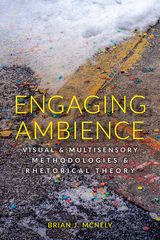
By articulating theoretically sound methodologies and methods for the empirical study of rhetoric conceived as originary, immanent, and enveloping, Brian McNely contributes a methodological perspective that furthers new materialist theories of rhetoric. McNely demonstrates how scholars’ emergent theories of rhetoric call for new methodologies that can extend their reach, and in the process, he proposes a new conception of visual rhetoric. Engaging Ambience delineates methodologies and methods that help researchers in rhetoric and writing studies discover the ambient environments that condition and support everyday communication in all its forms.
Engaging Ambiencedetails and demonstrates visual and multisensory methodologies and methods for exploring the wondrous complexity of everyday communication. It will appeal to scholars and students of rhetorical theory, visual and multisensory rhetorics, and composition and writing studies.

Which European and non-European ideas and practices facilitated the shaping of European unity? Or rather, which pursuits led to deadlocks in the cooperation between states?
The book seeks answers to these questions by surveying the historical attempts at realizing supranational patterns of governance in Europe since the Middle Ages. The main focus is on the nineteenth and twentieth century organizational models of European unification.
The analysis draws on an abundance of historical and legal source material. While the author encourages critical thinking about European integration, the exploration is admittedly based on specific values. Éva Bóka claims that the struggle for the humanization of power with its democratic creative force has been the major driver in the development of the system of liberties and the idea of European unity. The analysis of the historical process up to the Lisbon Treaty (2007) with the recognition of common, shared, and supported competences meets the author’s set of values to a great extent. The last part of the book examines whether the European Union can serve as a political and economic organizational model for other parts of the world.

The Lower Danube—the stretch of Europe’s second longest river between the Romanian-Serbian border and the confluence to the Black Sea—was effectively transformed during the late eighteenth and nineteenth centuries. In describing this lengthy undertaking, Luminita Gatejel proposes that remaking two key stretches—the Iron Gates and the delta—not only physically altered the river but also redefined it in a legal and political sense.
Since the late eighteenth century, military conflicts and peace treaties changed the nature of sovereignty over the area, as the expansionist tendencies of the Habsburg and British Empires encountered rival Ottoman and Russian imperial plans. The inconvenience that the river’s physical shape obstructed free navigation and the growth of commercial traffic, was an increasing concern to all parties. This book shows that alongside imperial aspirations, transnational actors like engineers, commissioners and entrepreneurs were the driving force behind the river regulation. In this highly original, deeply researched, and carefully crafted study, Gatejel explores the formation of international cooperation, the emergence of technical expertise and the emergence of engineering as a profession. This constellation turned the Lower Danube into a laboratory for experimenting with new forms of international cooperation, economic integration, and nature transformation.
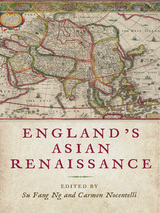
Published by the University of Delaware Press. Distributed worldwide by Rutgers University Press.

In 1654, England’s Lord Protector Oliver Cromwell conceived a plan of breathtaking ambition: the conquest of Spain’s vast American empire. As the first phase of his Western Design, a large expedition sailed to the West Indies, under secret orders to take Spanish colonies. The English Conquest of Jamaica presents entrenched imperial fantasies confronting Caribbean realities. It captures the moment when the revolutionary English state first became a major player in the Atlantic arena.
Although capturing Jamaica was supposed to be only the first step in Cromwell’s scheme, even that relatively modest acquisition proved difficult. The English badly underestimated the myriad challenges they faced, starting with the unexpectedly fierce resistance offered by the Spanish and other residents who tenaciously defended their island. After sixteen long years Spain surrendered Jamaica and acceded to an English presence in the Americas in the 1670 Treaty of Madrid. But by then, other goals—including profit through commerce rather than further conquest—had superseded the vision behind the Western Design.
Carla Gardina Pestana situates Cromwell’s imperial project in the context of an emerging Atlantic empire as well as the religious strife and civil wars that defined seventeenth-century England. Though falling short of its goal, Cromwell’s plan nevertheless reshaped England’s Atlantic endeavors and the Caribbean region as a whole. Long before sugar and slaves made Jamaica Britain’s most valuable colony, its acquisition sparked conflicts with other European powers, opened vast tropical spaces to exploitation by the purportedly industrious English, and altered England’s engagement with the wider world.
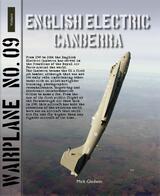
The story of the Canberra came to a close for the RAF on the 22nd June 2006 when the last remaining Canberra PR.9s retiring from service life after returning from operational duties. The author had the honour to serve with them in their twilight days of their careers.
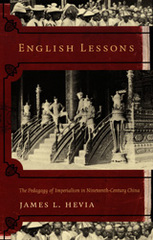
Hevia analyzes British Foreign Office documents, diplomatic memoirs, auction house and museum records, nineteenth-century scholarly analyses of Chinese history and culture, campaign records, and photographs. He shows how Britain refigured its imperial project in
China as a cultural endeavor through examinations of the circulation of military loot in Europe, the creation of an art history of “things Chinese,” the construction of a field of knowledge about China, and the Great Game rivalry between Britain, Russia, and the Qing empire in Central Asia. In so doing, he illuminates the impact of these elements on the colonial project and the creation of a national consciousness in China.
What was the Enlightenment? Though many scholars have attempted to solve this riddle, none has made as much use of contemporary answers as Dan Edelstein does here. In seeking to recover where, when, and how the concept of “the Enlightenment” first emerged, Edelstein departs from genealogies that trace it back to political and philosophical developments in England and the Dutch Republic. According to Edelstein, by the 1720s scholars and authors in France were already employing a constellation of terms—such as l’esprit philosophique—to describe what we would today call the Enlightenment. But Edelstein argues that it was within the French Academies, and in the context of the Quarrel of the Ancients and the Moderns, that the key definition, concepts, and historical narratives of the Enlightenment were crafted.
A necessary corrective to many of our contemporary ideas about the Enlightenment, Edelstein’s book turns conventional thinking about the period on its head. Concise, clear, and contrarian, The Enlightenment will be welcomed by all teachers and students of the period.
By broadening the conversation surrounding Swedenborg’s source and reception histories, Stengel hopes to counter the reductive lenses through which certain of Swedenborg’s experiences have been filtered. In the author’s own words, “this will serve to highlight the perspectives contained within the historical discourse, tracing their seminal influence on later religious and philosophical discussions that, in turn, gave rise, from the eighteenth century onward, to the psychohistorical interpretations of associated supernatural phenomena such as Swedenborg’s visionary propensity.”
Enlightenment All the Way to Heaven is the twenty-fourth installment in the Swedenborg Studies scholarly series.
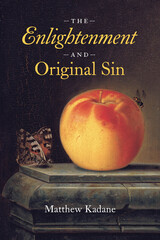
What was the Enlightenment? This question has been endlessly debated. In The Enlightenment and Original Sin, historian Matthew Kadane advances the bold claim that the Enlightenment is best defined through what it set out to accomplish, which was nothing short of rethinking the meaning of human nature.
Kadane argues that this project centered around the doctrine of original sin and, ultimately, its rejection, signaling the radical notion that an inherently flawed nature can be overcome by human means. Kadane explores this and other wide-ranging themes through the story of a previously unknown figure, Pentecost Barker, an eighteenth-century purser and wine merchant. By examining Barker’s personal diary and extensive correspondence with a Unitarian minister, Kadane tracks the transformation of Barker’s consciousness from a Puritan to an Enlightenment outlook, revealing through one man’s journey the large-scale shifts in self-understanding whose philosophical reverberations have shaped debates on human nature for centuries.
Greece sits at the center of a geopolitical storm that threatens the stability of the European Union. To comprehend how this small country precipitated such an outsized crisis, it is necessary to understand how Greece developed into a nation in the first place, Paschalis Kitromilides contends. Enlightenment and Revolution identifies the intellectual trends and ideological traditions that shaped a religiously defined community of Greek-speaking people into a modern nation-state--albeit one in which antiliberal forces have exacted a high price.
Kitromilides takes in the vast sweep of the Greek Enlightenment in the eighteenth and nineteenth centuries, assessing key developments such as the translation of Voltaire, Locke, and other modern authors into Greek; the conflicts sparked by the Newtonian scientific revolution; the rediscovery of the civilization of classical Greece; and the emergence of a powerful countermovement. He highlights Greek thinkers such as Voulgaris and Korais, showing how these figures influenced and converged with currents of the Enlightenment in the rest of Europe.
In reconstructing this history, Kitromilides demonstrates how the confrontation between Enlightenment ideas and Church-sanctioned ideologies shaped the culture of present-day Greece. When the Greek nation-state emerged from a decade-long revolutionary struggle against the Ottoman Empire in the early nineteenth century, the Enlightenment dream of a free Greek polity was soon overshadowed by a romanticized nationalist and authoritarian vision. The failure to create a modern liberal state at that decisive historic moment, Kitromilides insists, is at the root of Greece's recent troubles.
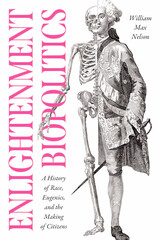
In Enlightenment Biopolitics, historian William Max Nelson pursues the ambitious task of tracing the context in which biopolitical thought emerged and circulated. He locates that context in the Enlightenment when emancipatory ideals sat alongside the horrors of colonialism, slavery, and race-based discrimination. In fact, these did not just coexist, Nelson argues; they were actually mutually constitutive of Enlightenment ideals.
In this book, Nelson focuses on Enlightenment-era visions of eugenics (including proposals to establish programs of selective breeding), forms of penal slavery, and spurious biological arguments about the supposed inferiority of particular groups. The Enlightenment, he shows, was rife with efforts to shape, harness, and “organize” the minds and especially the bodies of subjects and citizens. In his reading of the birth of biopolitics and its transformations, Nelson examines the shocking conceptual and practical connections between inclusion and exclusion, equality and inequality, rights and race, and the supposed “improvement of the human species” and practices of dehumanization.
The Enlightenment's leading figures cast their light in an irregular and unequal way: areas and environments in which new ideas penetrated and took effect alternated with shadowy patches. The fundamental structures of society may have remained stable, but new ways of producing, of being, and of appearing made sometimes abrupt headway. Attitudes toward life, birth, love, marriage and sexuality, and death had begun to change.
The twilight of the Enlightenment came at the end of the eighteenth century, part of a sequence of events of which the French Revolutions was simply the paroxysm.
A subtle and complex study of the Enlightenment, this book allows contemporary readers to reflect on how nineteenth- and twentieth-century scholars have constructed their views on eighteenth-century man.
Contributors: Suzanne Conklin Akbari, Ingo Berensmeyer, Eva von Contzen, Alex Davis, Andrew James Johnston, Wolfram R. Keller, Alexis Kellner Becker, Kathryn Mogk Wagner, Martha Rust, James Simpson

Ennobling Japan’s Savage Northeast is the first comprehensive account in English of the discursive life of the Tōhoku region in postwar Japan from 1945 through 2011. The Northeast became the subject of world attention with the March 2011 triple disaster of earthquake, tsunami, and nuclear meltdown. But Tōhoku’s history and significance to emic understandings of Japanese self and nationhood remain poorly understood. When Japan embarked on its quest to modernize in the mid-nineteenth century, historical prejudice, contemporary politics, and economic calculation together led the state to marginalize Tōhoku, creating a “backward” region in both fact and image. After 1945, a group of mostly local intellectuals attempted to overcome this image and rehabilitate the Northeast as a source of new national values. This early postwar Tōhoku recuperation movement has proved to be a critical source for the new Kyoto school’s neoconservative valorization of native Japanese identity, fueling that group’s antimodern, anti-Western discourse since the 1980s.
Nathan Hopson unravels the contested postwar meanings of Tōhoku to reveal the complex and contradictory ways in which that region has been incorporated into Japan’s shifting self-images since World War II.

Robert Hart was one of those empire builders of the Victorian age who had a long and nearly uninterrupted experience in China, from 1854, when as a young Irishman from Belfast he landed in Ningpo, until 1908, when as a man in his seventies he finally retired to England. His years as the Ch’ing government’s Inspector General of the Maritime Customs Service have been copiously recorded in letters to his London agent, beginning in 1868, published as a 2-volume collection, The I. G. in Peking (Harvard, Belknap Press, 1975).
In 1970, a second lode of Hart materials came to light, the 77 volumes of his journals, begun on the day of his arrival in China in 1854 and ending at his departure in 1908, with two short but significant gaps in the first decade where he himself destroyed entries of too personal a nature.
Entering China’s Service presents a complete and annotated transcript of the surviving journals through 1863, alternating with chapters devoted to Hart’s North Ireland background, the China he encountered, the Ch’ing officials who trusted him, and the unfolding of his career. His reactions to the Chinese as well as to his fellow Westerners cast an invaluable light on nineteenth-century China.
A sweeping analysis of the lasting effects of neocolonial extractivism in Latin American aesthetic modernity from 1920 to the present
Looking to the extractive frontier as a focal point of Latin American art, literature, music, and film, Jens Andermann asks what emerges at the other end of landscape. Art in the Global South has long represented and interrogated “insurgent nature”—organic and inorganic matter, human and nonhuman life, thrown into turmoil.
In Entranced Earth: Art, Extractivism, and the End of Landscape, Andermann traces the impact of despaisamiento—world-destroying un-landscaping—throughout the Latin American modernist archive. At the same time, he explores innovative, resilient modes of allyship forged between diverse actors through their shared experiences of destruction. From the literary regionalism of the 1930s to contemporary bio art, from modernist garden architecture to representations of migration and displacement in sound art and film, Entranced Earth tracks the crisis of landscape and environmental exhaustion beyond despair toward speculative, experimental forms of survival.
Kristen Guest and Monica Mattfeld place the modern period front and center in this collection, illuminating the largely untold story of how the horse has responded to the accelerated pace of modernity. The book’s contributors explore equine cultures across the globe, drawing from numerous interdisciplinary sources to show how horses have unexpectedly influenced such distinctively modern fields as photography, anthropology, and feminist theory. Equestrian Cultures boldly steps forward to redefine our view of the most recent developments in our long history of equine partnership and sets the course for future examinations of this still-strong bond.

The Panama Canal's untold history—from the Panamanian point of view. Sleuth and scholar Marixa Lasso recounts how the canal’s American builders displaced 40,000 residents and erased entire towns in the guise of bringing modernity to the tropics.
The Panama Canal set a new course for the modern development of Central America. Cutting a convenient path from the Atlantic to the Pacific oceans, it hastened the currents of trade and migration that were already reshaping the Western hemisphere. Yet the waterway was built at considerable cost to a way of life that had characterized the region for centuries. In Erased, Marixa Lasso recovers the history of the Panamanian cities and towns that once formed the backbone of the republic.
Drawing on vast and previously untapped archival sources and personal recollections, Lasso describes the canal’s displacement of peasants, homeowners, and shop owners, and chronicles the destruction of a centuries-old commercial culture and environment. On completion of the canal, the United States engineered a tropical idyll to replace the lost cities and towns—a space miraculously cleansed of poverty, unemployment, and people—which served as a convenient backdrop to the manicured suburbs built exclusively for Americans. By restoring the sounds, sights, and stories of a world wiped clean by U.S. commerce and political ambition, Lasso compellingly pushes back against a triumphalist narrative that erases the contribution of Latin America to its own history.

In Eric Warburg, Jeanette Erazo Heufelder tells the story of the nephew of the art historian Aby Warburg, whose world-famous library Eric saved from the Nazis. He was a Jew, a banker, a helper of escapees, an intelligence officer in the US Army, a transatlantic bridge builder, and a Cold Warrior. With the help of the cooperation channels he set up, West German and US social groups were aligned with the West amidst the turmoil of postwar Europe.
The history of the transatlantic partnership has become highly topical; since the Russian invasion of Ukraine on February 24, 2022, it has been invoked in Europe as a key reassurance. Eric Warburg’s life, and that of Aby Warburg’s library, tells the story of Europe's twentieth century, the legacy of which continues to inform and inspire the transatlantic partnership today.
An idea charged with paradox, eros has always defied categorization, and yet it cannot—it will not—be ignored. Erotikon aims to raise the difficult question of what, if anything, unifies the erotic manifold. How is eros in a sculpture like eros in a poem? Does the ancient story of Cupid and Psyche still speak meaningfully to modern readers, and if so, why? Is Plato's eros the same as Freud's? Or Proust's? And what is the erotic dimension in Nietzsche's thought? While each essay takes on a specific issue, together they constitute a wide-ranging conversation in which these broader questions are at play. A compilation of the latest, best efforts to reckon with eros, Erotikon will appeal not just to scholars and educators, but also to artists and critics, to the curious and the disillusioned, to the prurient and the prudent.

In the early years of World War II, thousands of political refugees traveled from France to Vichy-controlled Martinique in the French Caribbean, en route to what they hoped would be safer shores in North, Central, and South America. While awaiting transfer from the colony, the exiles formed influential ties—with one another and with local black dissidents. Escape from Vichy recounts this flight from the refugees’ perspectives, using novels, unpublished diaries, archives, memoirs, artwork, and other materials to explore the unlikely encounters that fueled an anti-fascist artistic and intellectual movement.
The refugees included Spanish Republicans, anti-Nazi Germans and Austrians, anti-fascist Italians, Jews from across Europe, and others fleeing violence and repression. They were met with hostility by the Vichy government and rejection by the nations where they hoped to settle. Martinique, however, provided a site propitious for creative ferment, where the revolutionary Victor Serge conversed with the anthropologist Claude Lévi-Strauss, and the Surrealist André Breton met Negritude thinkers René Ménil and Aimé and Suzanne Césaire. As Eric T. Jennings shows, these interactions gave rise to a rich current of thought celebrating blackness and rejecting racism.
What began as expulsion became a kind of rescue, cut short by Washington’s fears that wolves might be posing in sheep’s clothing.
A harrowing account of Jewish refugees in the Philippines
With the rise of Nazism in the 1930s more than a thousand European Jews sought refuge in the Philippines, joining the small Jewish population of Manila. When the Japanese invaded the islands in 1941, the peaceful existence of the barely settled Jews filled with the kinds of uncertainties and oppression they thought they had left behind.
In this book Frank Ephraim, who fled to Manila with his parents, gathers the testimonies of thirty-six refugees, who describe the difficult journey to Manila, the lives they built there upon their arrival, and the events surrounding the Japanese invasion. Combining these accounts with historical and archival records, Manila newspapers, and U.S. government documents, Ephraim constructs a detailed account of this little-known chapter of world history.
A family’s flight from Nazi terror to an unexpected refuge in Chile.
Escaping Hitler is the personal story of Eva Wyman and her family’s escape from Nazi Germany to Chile in the sociohistorical context of 1930s and 1940s, a time when the Chilean Nazi party had an active presence in the country’s major institutions.
Based primarily on interviews with German Jewish refugees and family correspondence, Eva Goldschmidt Wyman provides an intimate account of Jews in Germany in the 1930s as Nazi controls tightened and family members were taken to Riga concentration camp. Wyman recounts Kristallnacht in Stuttgart, where her father was principal of the Jewish school, his imprisonment in Dachau, and his release and immigration to Great Britain. Escaping Hitler details the family’s escape from Germany and subsequent life in Chile, providing an intimate look at daily life on the steam ship Conte Grande during the voyage from Italy to Chile in 1939, Nazi espionage and anti-Semitic activity in Chile, and the Nazi influence in South America in general.
Recounted in an intimate and personal style, Escaping Hitler immerses the reader in an extraordinary chapter of contemporary Jewish history both inside Germany and South America.
A pioneering scholar of Shakespeare and early modern letters provides an overview of work in the field
For more than twenty-five years, Karen Newman has brought her critical acumen to bear on early modern studies. In this collection of her essays on Shakespeare—some acknowledged classics and others never before published—Newman shows how changing theoretical trends have shaped Shakespeare studies, from new historicism and gender studies to critical race studies and globalization.
Central to Newman’s work is social exchange, or the circulation of people and objects. At least two of these essays have had a powerful and lasting impact on Shakespeare studies: “Renaissance Family Politics and Shakespeare’s The Taming of the Shrew” and “‘And wash the Ethiop White’: Femininity and the Monstrous in Othello.” Three essays appear in print for the first time: an examination of clothing of the poor and the portrayal of the king as a beggar in Richard II; a stinging review of Harold Bloom’s book Shakespeare: The Invention of the Human; and a rethinking of claims about the globalization of culture and cultural translation.Essaying Shakespeare chronicles Newman’s own critical development to provide a significant map of critical work on Shakespeare.
The final work of this essential thinker.
Essays Critical and Clinical is the final work of the late Gilles Deleuze, one of the most important and vital figures in contemporary philosophy. It includes essays, all newly revised or published here for the first time, on such diverse literary figures as Herman Melville, Walt Whitman, D. H. Lawrence, T. E. Lawrence, Samuel Beckett, Leopold von Sacher-Masoch, Alfred Jarry, and Lewis Carroll, as well as philosophers such as Plato, Spinoza, Kant, Nietzsche, and Heidegger.
For Deleuze, every literary work implies a way of living, a form of life, and must be evaluated not only critically but also clinically. As Proust said, great writers invent a new language within language, but in such a way that language in its entirety is pushed to its limit or its own “outside.” This outside of language is made up of affects and precepts that are not linguistic, but which language alone nonetheless makes possible. In Essays Critical and Clinical, Deleuze is concerned with the delirium-the process of Life-that lies behind this invention, as well as the loss that occurs, the silence that follows, when this delirium becomes a clinical state. Taken together, these eighteen essays present a profoundly new approach to literature by one of the greatest twentieth-century philosophers.

G. E. M. Anscombe's Intention, firmly established the philosophy of action as a distinctive field of inquiry. Donald Davidson called this 94-page book "the most important treatment of action since Aristotle." But until quite recently, few scholars recognized the magnitude of Anscombe's philosophical achievement. This collection of ten essays elucidates some of the more challenging aspects of Anscombe's work and affirms her reputation as one of our most original philosophers.
Born in 1919, Anscombe studied at St. Hugh's College, Oxford, where she later held a research fellowship. In 1941 she married philosopher Peter Geach, with whom she had seven children. A close friend of Wittgenstein, in 1946 she joined Oxford's Somerville College and spent the next twenty-four years there before being appointed to the Chair of Philosophy at Cambridge that Wittgenstein had held. She died in 2001 after her long career as a highly regarded analytic philosopher.
This volume brings together fresh interpretations of Intention written by some of today's leading philosophers of action. It will enlighten Anscombe's readers who struggle with concepts they find puzzling or obscure, while providing a bracing corrective to doubts about Intention's significance and the gravity of what is at stake.
Also contained in this volume is a major interpretative essay by Alice S. Rossi on Mill and Harriet Taylor which describes and analyzes their long personal and intellectual relationship.
Although she died cruelly at Auschwitz at the age of twenty-nine, Etty Hillesum left a lasting legacy of mystical thought in her letters and diaries. Hillesum was a complex and powerful witness to the openness of the human spirit to the call of God, even under the most harrowing circumstances. Her life was as much shaped by Hitler’s regime as was that of philosopher Eric Voegelin, and as Meins Coetsier reveals, her thought lends itself to interpretation from a uniquely Voegelinian perspective.
Etty Hillesum and the Flow of Presence analyzes the life and writings of Hillesum from the standpoint of Voegelin’s views on consciousness—especially his philosophy of luminous participation in the transcendent ground of being. Through a careful reading of her letters and diaries, Coetsier reveals the inner development of Hillesum’s mystically grounded resistance to Nazism as he guides readers through the symbolism of her spiritual journey, making effective use of Voegelin’s analytics of experience and symbolization to trace her path to spiritual truth.
Intertwining the lives, works, and visions of these two mystical thinkers, Coetsier demonstrates his mastery of both Voegelin’s philosophy and Hillesum’s Dutch-language materials. He shows how mystical attunement to the “flow of presence”—Voegelin’s designation for human responsiveness to the divine—is the key to the development of Hillesum’s life and writings. He displays a special affinity for the suffering and grace-filled transformation that she underwent as she approached the end of her life and gained insight into the ultimate purpose of each individual’s contribution to the well-being and maintenance of the human spirit.
Retrieving one of the lesser-known but most compelling figures of the Holocaust, Etty Hillesum and the Flow of Presence is an original contribution to both Voegelin and Hillesum scholarship that reflects these writers’ strong valuation of the human person. It presents Hillesum’s life and work in an original and provocative context, shedding new light on her experiences and their symbolizations while further broadening the application of Voegelin’s thought
A long-awaited corrective to the controversial idea of world literature, from a major voice in the field.
Katerina Clark charts interwar efforts by Soviet, European, and Asian leftist writers to create a Eurasian commons: a single cultural space that would overcome national, cultural, and linguistic differences in the name of an anticapitalist, anti-imperialist, and later antifascist aesthetic. At the heart of this story stands the literary arm of the Communist International, or Comintern, anchored in Moscow but reaching Baku, Beijing, London, and parts in between. Its mission attracted diverse networks of writers who hailed from Turkey, Iran, India, and China, as well as the Soviet Union and Europe. Between 1919 and 1943, they sought to establish a new world literature to rival the capitalist republic of Western letters.
Eurasia without Borders revises standard accounts of global twentieth-century literary movements. The Eurocentric discourse of world literature focuses on transatlantic interactions, largely omitting the international left and its Asian members. Meanwhile, postcolonial studies have overlooked the socialist-aligned world in favor of the clash between Western European imperialism and subaltern resistance. Clark provides the missing pieces, illuminating a distinctive literature that sought to fuse European and vernacular Asian traditions in the name of a post-imperialist culture.
Socialist literary internationalism was not without serious problems, and at times it succumbed to an orientalist aesthetic that rivaled any coming from Europe. Its history is marked by both promise and tragedy. With clear-eyed honesty, Clark traces the limits, compromises, and achievements of an ambitious cultural collaboration whose resonances in later movements can no longer be ignored.
READERS
Browse our collection.
PUBLISHERS
See BiblioVault's publisher services.
STUDENT SERVICES
Files for college accessibility offices.
RECENTLY PUBLISHED

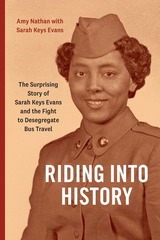



UChicago Accessibility Resources
home | accessibility | search | about | contact us
BiblioVault ® 2001 - 2026
The University of Chicago Press