
 A SCHOLARLY BOOK REPOSITORY


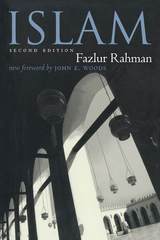

This book provides a concise yet panoramic overview of Islam, unlike most introductory books, which focus mainly on the development of Islamic institutions in the classical period.
To place Islam in perspective, Neal Robinson discusses the problems raised by Western perceptions of Islam and provides a brief account of Islamic history down to the present. He then explains major topics in Islamic worship to help readers understand it as a living faith. Appendices guide the novice through the structure of Arabic names, transliteration, and the Islamic calendar and festivals.
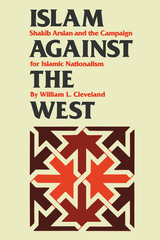
This book gives a unique perspective on the interwar history of the Middle East. By telling the life story of one man, it illuminates the political and cultural struggles of an era. Shakib Arslan (1869–1946) was a leading member of the generation of Ottoman Arabs who came to professional maturity just before the final defeat of the Ottoman Empire. Born to a powerful Lebanese Druze family, Arslan grew up perfectly suited to his time and place in history. He was one of the leading writers of his day and a dexterous, ambitious politician. But, by the end of World War I, Arslan and others of his generation found themselves adrift in a world no longer of their choosing, as the once great Ottoman state lay broken before the West.
Rather than retreating from public life in those dark days, however, Arslan emerged militant in his opposition to Western encroachment on Islamic lands and tireless in his crusade to bring the organizing principles of a universalist Islam to the age of emerging nation-states. Organizer, pamphleteer, diplomat, spokesman, and symbol, Arslan became one of the dominant, and most controversial, Muslim political figures in the two decades between the wars. His involvements were so varied and intense that to study his life is to bring into focus all the major political issues and intellectual currents of the era. By the end of his career he was both praised and vilified, but he was arguably the most widely read Arab author of his day.
Curiously, Arslan has received relatively little attention in English-language research. This may well be due less to his contemporary importance than to the perspective from which Western scholarship has viewed Middle Eastern intellectual history. Arslan was not one of the winners. For many his evocation of the old imperial ideal and his insistence on the strategic importance of Islamic ideals seemed to be simply archaic protest in a secular age. But this impeccably researched and beautifully written biography demonstrates the power and importance of Arslan’s activist heritage, reinterpreting it for its own time and showing its importance for ours.
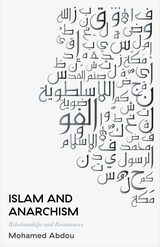
Discourse around Muslims and Islam all too often lapses into a false dichotomy of Orientalist and fundamentalist tropes. A popular reimagining of Islam is urgently needed. Yet it is a perhaps unexpected political philosophical tradition that has the most to offer in this pursuit: anarchism.
Islam and Anarchism is a highly original and interdisciplinary work, which simultaneously disrupts two commonly held beliefs - that Islam is necessarily authoritarian and capitalist; and that anarchism is necessarily anti-religious and anti-spiritual. Deeply rooted in key Islamic concepts and textual sources, and drawing on radical Indigenous, Islamic anarchistic and social movement discourses, Abdou proposes 'Anarcha-Islam'.
Constructing a decolonial, non-authoritarian and non-capitalist Islamic anarchism, Islam and Anarchism philosophically and theologically challenges the classist, sexist, racist, ageist, queerphobic and ableist inequalities in both post- and neo-colonial societies like Egypt, and settler-colonial societies such as Canada and the USA.

Islam is the religion of over one billion people and is practiced in virtually every country on earth. The articulation of an Islamic environmental ethic in contemporary terms is all the more urgent because Western-style conservation efforts do not fit all cultural and philosophical traditions.
This volume outlines the Islamic view of the cosmic order and reviews the ways an Islamic world view can be interpreted, reassessed, and applied to such environmental problems as pollution and water scarcity. Sections on social justice and on issues of sustainability and development look at the history and roots of the current environmental crisis; at the broader context of women's rights of equal access to both natural and social resources; and at the interconnectedness of environmental protection and the alleviation of human poverty.
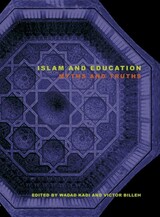
In this timely volume based on a special issue of Comparative Education Review, leading comparative education scholars explore the world of education in Islam from the medieval era to today, illuminating the continuing struggle among Islamic scholars and educators over whether to reform or resist as a way of preserving identity. Islam and Education offers a rare overview of the great diversity in forms of Islamic education, dispelling misinterpretations and documenting the ever-evolving relationship of Islamic education to the West. It should be necessary reading for all humanists and social scientists wishing to understand the nexus between schools and societies, the spiritual dimensions of learning, and the social configuration of educational institutions.
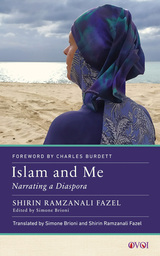
In Islam and Me, Fazel tells her story and shares the experiences of other Muslim women living in Italy, revealing the wide variety of Muslim identities and the common prejudices they encounter. Looking at Italian school textbooks, newspapers, and TV programs, she invites us to change the way Muslim immigrants, and especially women, are depicted in both news reports and scholarly research. Islam and Me is a meditation on our multireligious, multiethnic, and multilingual reality, as well as an exploration of how we might reimagine national culture and identity so that they become more diverse, inclusive, and anti-racist.
"In this work, Professor Fazlur Rahman presents a positively ambitious blueprint for the transformation of the intellectual tradition of Islam: theology, ethics, philosophy and jurisprudence. Over the voices advocating a return to Islam or the reestablishment of the Sharia, the guide for action, he astutely and soberly asks: What and which Islam? More importantly, how does one get to 'normative' Islam? The author counsels, and passionately demonstrates, that for Islam to be actually what Muslims claim it to be—comprehensive in scope and efficacious for every age and place—Muslim scholars and educationists must reevaluate their methodology and hermeneutics. In spelling out the necessary and sound methodology, he is at once courageous, serious and profound."—Wadi Z. Haddad, American-Arab Affairs

Winner of the Ernst Fraenkel Prize, Wiener Holocaust Library
An Open Letters Monthly Best History Book of the Year
A New York Post “Must-Read”
In the most crucial phase of the Second World War, German troops confronted the Allies across lands largely populated by Muslims. Nazi officials saw Islam as a powerful force with the same enemies as Germany: the British Empire, the Soviet Union, and the Jews. Islam and Nazi Germany’s War is the first comprehensive account of Berlin’s remarkably ambitious attempts to build an alliance with the Islamic world.
“Motadel describes the Mufti’s Nazi dealings vividly…Impeccably researched and clearly written, [his] book will transform our understanding of the Nazi policies that were, Motadel writes, some ‘of the most vigorous attempts to politicize and instrumentalize Islam in modern history.’”
—Dominic Green, Wall Street Journal
“Motadel’s treatment of an unsavory segment of modern Muslim history is as revealing as it is nuanced. Its strength lies not just in its erudite account of the Nazi perception of Islam but also in illustrating how the Allies used exactly the same tactics to rally Muslims against Hitler. With the specter of Isis haunting the world, it contains lessons from history we all need to learn.”
—Ziauddin Sardar, The Independent

Islam and Politics in East Africa was first published in 1980. Minnesota Archive Editions uses digital technology to make long-unavailable books once again accessible, and are published unaltered from the original University of Minnesota Press editions.
Focusing on the interplay of religion, society, and politics, August Nimtz examines the role of sufi tariqas (brotherhoods) in Tanzania, where he observed an African Muslim society at first hand. Nimtz opens this book with a historical account of Islam in East Africa, and in subsequent chapters analyzes the role of tariqas in Tanzania and, more specifically, in the coastal city of Bagamoyo. Using a conceptual framework derived from contemporary political theories on social cleavages and individual interests. Nimtz explains why the tariqa is important in the process of political change.
The fundamental cleavage in Muslim East Africa, he notes, is that of "whites" versus blacks. Nimtz contends that the tariqus, in serving the interest of blacks (that is, Africans), became in turn vehicles for the mass mobilization of African Muslims during the anti-colonial struggle. In Bagamoyo he finds a similar process and, in addition, reveals that the tariqas have served African interests in opposition to those of "whites" because of the individual benefits they provide. At the same time, Nimtz concludes, the social structure of East African Muslim society has ensured that Africans would be particularly attracted to these benefits. This work will interest both observers of African political development and specialists in the Islamic studies.

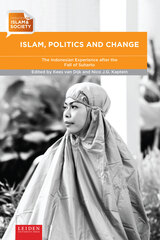
This book examines the Masyumi Party from its roots in early 20th-century Muslim reformism to its contemporary legacy, and offers a perspective on political Islam which provides an alternative to the more widely-studied model of Middle-Eastern Islam. The party’s experience teaches us much about the fine line separating a moderate form of Islam open to democracy and a certain degree of secularisation from the sort of religious intransigence which can threaten the country’s denominational coexistence.
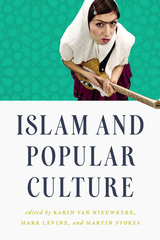
Popular culture serves as a fresh and revealing window on contemporary developments in the Muslim world because it is a site where many important and controversial issues are explored and debated. Aesthetic expression has become intertwined with politics and religion due to the uprisings of the “Arab Spring,” while, at the same time, Islamist authorities are showing increasingly accommodating and populist attitudes toward popular culture. Not simply a “westernizing” or “secularizing” force, as some have asserted, popular culture now plays a growing role in defining what it means to be Muslim.
With well-structured chapters that explain key concepts clearly, Islam and Popular Culture addresses new trends and developments that merge popular arts and Islam. Its eighteen case studies by eminent scholars cover a wide range of topics, such as lifestyle, dress, revolutionary street theater, graffiti, popular music, poetry, television drama, visual culture, and dance throughout the Muslim world from Indonesia, Africa, and the Middle East to Europe. The first comprehensive overview of this important subject, Islam and Popular Culture offers essential new ways of understanding the diverse religious discourses and pious ethics expressed in popular art productions, the cultural politics of states and movements, and the global flows of popular culture in the Muslim world.
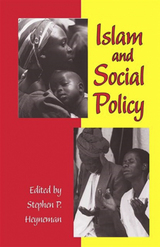
The essays encompass many regional cultures and draw on court records and legal debates, field work on government ministries, and an extensive reading of Islamic law. In his overview of waqf (similar to the Western idea of a foundation, in which an endowment is set aside in perpetuity for specified purposes), Ahmad Dallal explains how charity, a central organizing principle in Islam, is itself organized and how waqf, traditionally a source of revenue for charitable purposes, can also become a source of tension and conflict. Donna Lee Bowen, in her essay on the position of women in Islamic law, points out the crucial differences between the Islamic principles of family equity and the Western notion of individual equality. In a subsequent essay, Bowen addresses the problems surrounding family planning and the dilemmas that have arisen within the Muslim world over differing ideas about birth control. The two final essays look at specific instances of how the modern state has treated Islamic social policy. Gail Richardson examines zakat, an Islamic tax used to assist the poor, and its administration in Pakistan. Carol Underwood, meanwhile, explores public health policy in Iran, both before and after the Islamic revolution that deposed the Shah.
Addressing some of the most profound misunderstandings between Islamic and Western societies, Islam and Social Policy will be of vital interest not only to scholars and policymakers but to anyone concerned with Islam's critical place in the modern world.
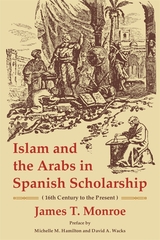
Spanish Arabism was a touchstone of the major intellectual and political issues facing Spain as it emerged from its imperial past into its current form as a modern nation-state. James T. Monroe’s survey of four centuries of Spanish scholarship on the cultural history of al-Andalus (Muslim Spain) establishes Spanish scholars on the forefront of European scholars confronting the Orientalism and colonialism at the heart of their national projects.
This reissue of James T. Monroe’s classic study of Spanish Arabism features a new foreword by Michelle M. Hamilton and David A. Wacks that offers an overview of its impact and of how the investigation of Spanish Arabism has blossomed since the publication of Monroe’s pathbreaking study.
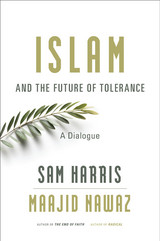
“A civil but honest dialogue…As illuminating as it is fascinating.”
—Ayaan Hirsi Ali
Is Islam a religion of peace or war? Is it amenable to reform? Why do so many Muslims seem to be drawn to extremism? And what do words like jihadism and fundamentalism really mean? In a world riven by misunderstanding and violence, Sam Harris—a famous atheist—and Maajid Nawaz—a former radical—demonstrate how two people with very different religious views can find common ground and invite you to join in an urgently needed conversation.
“How refreshing to read an honest yet affectionate exchange between the Islamist-turned-liberal-Muslim Maajid Nawaz and the neuroscientist who advocates mindful atheism, Sam Harris…Their back-and-forth clarifies multiple confusions that plague the public conversation about Islam.”
—Irshad Manji, New York Times Book Review
“It is sadly uncommon, in any era, to find dialogue based on facts and reason—but even more rarely are Muslim and non-Muslim intellectuals able to maintain critical distance on broad questions about Islam. Which makes Islam and the Future of Tolerance something of a unicorn…Most conversations about religion are marked by the inability of either side to listen, but here, at last, is a proper debate.”
—New Statesman

This book compares Islamic and Western political formulations, highlighting areas of agreement and disparity. Building on this analysis, the author goes on to show that political Islam offers a serious alternative to the dominant political system and ideology of the West.
Sabet argues that rather than leading to a "Clash of Civlizations" or the assimilation of Islam into the Western system, a positive process of interactive self-reflection between Islam and liberal democracy is the best way forward.
Beginning this process, Sabet highlights key concepts of Islamic political thought and brings them into dialogue with Western modernity. The resulting synthesis is essential reading for advanced undergraduate and graduate students of Islamic and Middle Eastern politics, political theory, comparative politics and international relations.
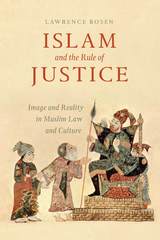
With Islam and the Rule of Justice, Lawrence Rosen analyzes a number of these misperceptions. Drawing on specific cases, he explores the application of Islamic law to the treatment of women (who win most of their cases), the relations between Muslims and Jews (which frequently involve close personal and financial ties), and the structure of widespread corruption (which played a key role in prompting the Arab Spring). From these case studie the role of informal mechanisms in the resolution of local disputes. The author also provides a close reading of the trial of Zacarias Moussaoui, who was charged in an American court with helping to carry out the 9/11 attacks, using insights into how Islamic justice works to explain the defendant’s actions during the trial. The book closes with an examination of how Islamic cultural concepts may come to bear on the constitutional structure and legal reforms many Muslim countries have been undertaking.
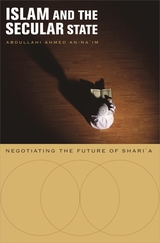
What should be the place of Shari‘a—Islamic religious law—in predominantly Muslim societies of the world? In this ambitious and topical book, a Muslim scholar and human rights activist envisions a positive and sustainable role for Shari‘a, based on a profound rethinking of the relationship between religion and the secular state in all societies.
An-Na‘im argues that the coercive enforcement of Shari‘a by the state betrays the Qur’an’s insistence on voluntary acceptance of Islam. Just as the state should be secure from the misuse of religious authority, Shari‘a should be freed from the control of the state. State policies or legislation must be based on civic reasons accessible to citizens of all religions. Showing that throughout the history of Islam, Islam and the state have normally been separate, An-Na‘im maintains that ideas of human rights and citizenship are more consistent with Islamic principles than with claims of a supposedly Islamic state to enforce Shari‘a. In fact, he suggests, the very idea of an “Islamic state” is based on European ideas of state and law, and not Shari‘a or the Islamic tradition.
Bold, pragmatic, and deeply rooted in Islamic history and theology, Islam and the Secular State offers a workable future for the place of Shari‘a in Muslim societies.
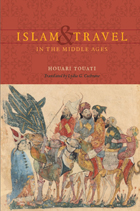
In the Middle Ages, Muslim travelers embarked on a rihla, or world tour, as surveyors, emissaries, and educators. On these journeys, voyagers not only interacted with foreign cultures—touring Greek civilization, exploring the Middle East and North Africa, and seeing parts of Europe—they also established both philosophical and geographic boundaries between the faithful and the heathen. These voyages thus gave the Islamic world, which at the time extended from the Maghreb to the Indus Valley, a coherent identity.
Islam and Travel in the Middle Ages assesses both the religious and philosophical aspects of travel, as well as the economic and cultural conditions that made the rihla possible. Houari Touati tracks the compilers of the hadith who culled oral traditions linked to the prophet, the linguists and lexicologists who journeyed to the desert to learn Bedouin Arabic, the geographers who mapped the Muslim world, and the students who ventured to study with holy men and scholars. Travel, with its costs, discomforts, and dangers, emerges in this study as both a means of spiritual growth and a metaphor for progress. Touati’s book will interest a broad range of scholars in history, literature, and anthropology.
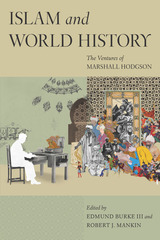
In our post-9/11 world, Hodgson’s historical vision and moral engagement have never been more relevant. A towering achievement, Islam and World History will prove to be the definitive statement on Hodgson’s relevance in the twenty-first century and will introduce his influential work to a new generation of readers.

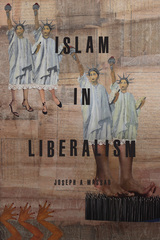
Joseph Massad’s Islam in Liberalism explores what Islam has become in today’s world, with full attention to the multiplication of its meanings and interpretations. He seeks to understand how anxieties about tyranny, intolerance, misogyny, and homophobia, seen in the politics of the Middle East, are projected onto Islam itself. Massad shows that through this projection Europe emerges as democratic and tolerant, feminist, and pro-LGBT rights—or, in short, Islam-free. Massad documents the Christian and liberal idea that we should missionize democracy, women’s rights, sexual rights, tolerance, equality, and even therapies to cure Muslims of their un-European, un-Christian, and illiberal ways. Along the way he sheds light on a variety of controversial topics, including the meanings of democracy—and the ideological assumption that Islam is not compatible with it while Christianity is—women in Islam, sexuality and sexual freedom, and the idea of Abrahamic religions valorizing an interfaith agenda. Islam in Liberalism is an unflinching critique of Western assumptions and of the liberalism that Europe and Euro-America blindly present as a type of salvation to an assumingly unenlightened Islam.
The Internet is an increasingly important source of information for many people in the Muslim world. Many Muslims in majority and minority contexts rely on the Internet -- including websites and e-mail -- as a primary source of news, information and communication about Islam. As a result, a new media culture is emerging which is having a significant impact on areas of global Muslim consciousness. Post-September 11th, this phenomenon has grown more rapidly than ever.
Gary R. Bunt provides a fascinating account of the issues at stake, identifying two radical new concepts:
Firstly, the emergence of e-jihad ('Electronic Jihad') originating from diverse Muslim perspectives -- this is described in its many forms relating to the different definitions of 'jihad', including on-line activism (ranging from promoting militaristic activities to hacking, to co-ordinating peaceful protests) and Muslim expression post 9/11.
Secondly, he discusses religious authority on the Internet -- including the concept of on-line fatwas and their influence in diverse settings, and the complexities of conflicting notions of religious authority.
Justice (al-‘adl) is one of the principal values of the Islamic faith. In Islam, Justice, and Democracy, Sabri Ciftci explores the historical, philosophical, and empirical foundations of justice to examine how religious values relate to Muslim political preferences and behavior. He focuses on Muslim agency and democracy to explain how ordinary Muslims use the conceptions of divine justice—either servitude to God or exercising free will against oppressors—to make sense of real-world problems.
Using ethnographic research, interviews, and public opinion surveys as well as the works of Islamist ideologues, archives of Islamist journals, and other sources, Ciftci shows that building contemporary incarnations of Islamist justice is, in essence, a highly practical political project that has formative effects on Muslim political attitudes. Islam, Justice, and Democracy compares the recent Arab Spring protests to the constitutionalist movements of the nineteenth and twentieth centuries in the Middle East to demonstrate the continuities and rifts a century apart.
By putting justice at the center of democratic thinking in the Muslim world, Ciftci reconsiders Islam's potential in engendering both democratic ideals and authoritarian preferences.

Mr. Geertz begins his argument by outlining the problem conceptually and providing an overview of the two countries. He then traces the evolution of their classical religious styles which, with disparate settings and unique histories, produced strikingly different spiritual climates. So in Morocco, the Islamic conception of life came to mean activism, moralism, and intense individuality, while in Indonesia the same concept emphasized aestheticism, inwardness, and the radical dissolution of personality. In order to assess the significance of these interesting developments, Mr. Geertz sets forth a series of theoretical observations concerning the social role of religion.
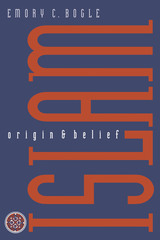
Islam is the fastest-growing religion in the world today. An understanding of its beliefs and practices has become essential knowledge not only for religious and political leaders but also for ordinary citizens who increasingly interact with Muslims as neighbors, coworkers, and schoolmates.
This book is designed to offer the general public a concise overview of the origins, basic beliefs, and common practices of Islam, as well as the reasons for its dramatic resurgence in recent times. Emory Bogle details the life mission of the prophet Muhammad and describes the spread of Islam after his death. He accounts for the rise and contemporary influence of Shi'i Islam, a topic of particular interest to Western readers. Bogle also explains the basic beliefs ("The Five Pillars") of Islam, as well as the role played by the Qur'an (Islam's scriptures), the hadith (the words and behavior of Muhammad), and the shari'a (Islamic law).
Ziauddin Sardar is a prolific writer and an insightful cultural commentator. His latest book, Why Do People Hate America?, has been a regular feature in bestseller lists in several countries. In the UK, he is known as a leading intellectual and his regular contributions to the Observer, the Independent and the New Statesman have brought his writings to a wide audience. As one of our most high-profile Muslim intellectuals, he has also become an increasingly important voice in the media since the events of September 11th 2001.
This is the first collection of his writings that offers a comprehensive introduction to his thought. Starting with his analysis of his own position as a British Muslim and a writer, it goes on to explore issues of Islam and cultural change, education, identity, post-modernism and the future. Drawn from a broad range of his work in scholarly journals as well as from his many books on aspects of culture and society, it includes his most frequently cited papers and makes an ideal introduction to the immense scope of his work in cultural studies.
Ziaddin Sardar is currently the editor of Third Text and Visiting Professor of Cultural Studies at City University, London. His books for Pluto Press include Postmodernism and the Other and Aliens R Us.
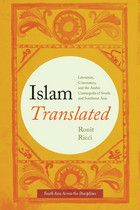
In Islam Translated, Ronit Ricci uses the Book of One Thousand Questions—from its Arabic original to its adaptations into the Javanese, Malay, and Tamil languages between the sixteenth and twentieth centuries—as a means to consider connections that linked Muslims across divides of distance and culture. Examining the circulation of this Islamic text and its varied literary forms, Ricci explores how processes of literary translation and religious conversion were historically interconnected forms of globalization, mutually dependent, and creatively reformulated within societies making the transition to Islam.

For the last several decades an influential group of Egyptian scholars and public intellectuals has been having a profound effect in the Islamic world. Raymond Baker offers a compelling portrait of these New Islamists--Islamic scholars, lawyers, judges, and journalists who provide the moral and intellectual foundations for a more fully realized Islamic community, open to the world and with full rights of active citizenship for women and non-Muslims.
The New Islamists have a record of constructive engagement in Egyptian public life, balanced by an unequivocal critique of the excesses of Islamist extremists. Baker shows how the New Islamists are translating their thinking into action in education and the arts, economics and social life, and politics and foreign relations despite an authoritarian political environment. For the first time, Baker allows us to hear in context the most important New Islamist voices, including Muhammad al Ghazzaly, Kamal Abul Magd, Muhammad Selim al Awa, Fahmy Huwaidy, Tareq al Bishry, and Yusuf al Qaradawy--regarded by some as the most influential Islamic scholar in the world today. A potentially transformative force in global Islam, the New Islamists define Islam as a civilization that engages others and searches for common ground through shared values such as justice, peace, human rights, and democracy.
Islam without Fear is an impressive achievement that contributes to the understanding of Islam in general and the possibilities of a centrist Islamist politics in particular.
In the hysteria surrounding Political Islam, it is difficult to find analysis that doesn't feel the need to justify the existence of Islamic leaders or react to the West's fear of 'extremists'. In Islamic Activists, Deina Ali Abdelkader shows us what Islamic leaders and activists believe and what they think about just governance.
Explaining and comparing Islamist ideas, including those about leadership, justice and minority rights, Abdelkader explains how these have been represented in the writings of important historical and contemporary Islamists. In doing so, Abdelkader reveals that democracy is not the sole preserve of those who support Enlightenment values, offering the reader a chance to understand the populist non-violent side of Islamic activism. This includes an examination of the ideas of the leaders of the populist Islamist movements in Egypt, Tunisia and Morocco.
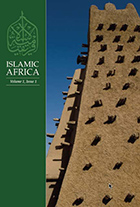
Islamic Africa promotes interaction between scholars of Islam and Africa across all continents and across historical periods. We welcome papers on any aspect of Islam and Muslim life pertaining to Africa and/or Africans from the humanities and the social sciences, especially those originating from the African continent.
Islamic Africa promotes interaction between scholars of Islam and Africa across all continents and across historical periods. We welcome papers on any aspect of Islam and Muslim life pertaining to Africa and/or Africans from the humanities and the social sciences, especially those originating from the African continent.
Islamic Africa promotes interaction between scholars of Islam and Africa across all continents and across historical periods. We welcome papers on any aspect of Islam and Muslim life pertaining to Africa and/or Africans from the humanities and the social sciences, especially those originating from the African continent.
Islamic Africa promotes interaction between scholars of Islam and Africa across all continents and across historical periods. We welcome papers on any aspect of Islam and Muslim life pertaining to Africa and/or Africans from the humanities and the social sciences, especially those originating from the African continent.
Islamic Africa promotes interaction between scholars of Islam and Africa across all continents and across historical periods. We welcome papers on any aspect of Islam and Muslim life pertaining to Africa and/or Africans from the humanities and the social sciences, especially those originating from the African continent.
Islamic Africa promotes interaction between scholars of Islam and Africa across all continents and across historical periods. We welcome papers on any aspect of Islam and Muslim life pertaining to Africa and/or Africans from the humanities and the social sciences, especially those originating from the African continent.
Islamic Africa promotes interaction between scholars of Islam and Africa across all continents and across historical periods. We welcome papers on any aspect of Islam and Muslim life pertaining to Africa and/or Africans from the humanities and the social sciences, especially those originating from the African continent.
Islamic Africa Electronic Journal
Volume 4, Issue 1 Spring 2013
Islamic Africa promotes interaction between scholars of Islam and Africa across all continents and across historical periods. We welcome papers on any aspect of Islam and Muslim life pertaining to Africa and/or Africans from the humanities and the social sciences, especially those originating from the African continent.
Islamic Africa promotes interaction between scholars of Islam and Africa across all continents and across historical periods. We welcome papers on any aspect of Islam and Muslim life pertaining to Africa and/or Africans from the humanities and the social sciences, especially those originating from the African continent.
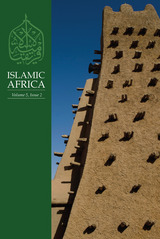
Islamic Africa promotes interaction between scholars of Islam and Africa across all continents and across historical periods. We welcome papers on any aspect of Islam and Muslim life pertaining to Africa and/or Africans from the humanities and the social sciences, especially those originating from the African continent.


This book brings together scholars from architectural studies, design, art history, and other fields to challenge and expand concepts of Islamic architecture. Ranging from eighteenth-century Ottoman tents to manifestations of Islamic motifs in 1960s Hawaii, this richly illustrated volume raises key questions about Islamic architecture, and, more broadly, about how we can rethink our understanding of material, artistic, and cultural mobility in the modern world.
From the Alhambra to the Taj Mahal, from the Dome of the Rock to the ever evolving art of calligraphy, Barbara Brend traces the development of classic Islamic art from the seventh through the twentieth century.
The term "Islamic art" suggests a unity of style and purpose, and these works are in fact instantly recognizable for their subtlety of line and sumptuous detail. The Islamic world--from Arabia to North Africa and Spain, from Turkey to Central Asia and India--has a shared cultural heritage of extraordinary richness. Yet it is a common tradition that divides into a diversity of styles. So Brend narrates this history region by region, illustrating her discussion with superb examples drawn from all areas in which Muslim artists and craftsmen have excelled--mosque and palace architecture; the art of the book (calligraphy, painting, and bindings); and the decorative arts, including metalwork, carvings, mosaics, pottery, textiles, and carpets. Throughout, the author elucidates forms, aesthetic principles, themes, and imagery. And she points to sources and influences in the different periods--for example, the prominence of jade and chinoiserie after the Mongol invasion. In Islamic Art Brend expertly guides us through the splendors and delicacies of this classic tradition.

How do we know Islamic art? What tells us that images and artifacts are products of the Muslim world, a culture that has historically extended from Spain to Southeast Asia and spanned a period from A.D. 622 to our day? This exquisitely and extensively illustrated book allows readers to identify those elements and themes that define art forms as Islamic, and to examine them in works of painting and metalwork, in calligraphy and manuscripts, ceramics, glass, wood, and ivory comprising one of the most imposing collections of arts from across the Muslim world.
Arranged thematically--in chapters focusing on religion and belief, the supernatural and natural worlds, feasting, the hunt, war, music, and power--Islamic Art in Detail provides a much-needed cultural context for these widely varied works while pointing out exceptional features. In its exploration of selected works, the book juxtaposes images of each object with enlarged details--details that might otherwise be virtually invisible to the naked eye--affording surprising comparisons between seemingly unrelated pieces and offering a rare multifaceted view of the art, technique, and iconography of some of the Islamic world's most beautiful images and artifacts.
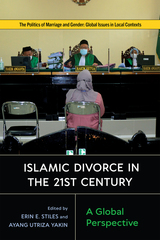
For more than a millennium, fatwas have guided and shaped Muslim understandings of Islamic law. The whole world knows of Ayatollah Khomeini’s fatwa in the Salman Rushdie case, yet this key institution in Muslim society has not been the subject of a major examination until now.
Ranging in import from the routine to the revolutionary, and in form from one-line answers to short treatises, fatwas have served to reaffirm received wisdom, caution against error, and chart novel responses to changing circumstances. The interpreters, the muftis of Islam, have included the greatest independent scholars of the ages, heads of large state bureaucracies, and unassuming jurists in local districts. Their vital task, which continues today in published collections as well as on radio and television, is to strive to interpret God’s design for the Muslim community.
Islamic Legal Interpretation uses an approach unique in Islamic studies, a casebook of expert analyses of fatwas from a wide range of times and places. The editors’ first chapter sets forth the origins, classical diversity, and modern development of the fatwa, while the following chapters illustrate particular opinions and their contexts. The approach throughout is interdisciplinary, as historians, lawyers, language specialists, and social scientists address fatwas as fundamental sources on both Islamic legal thought and Islamic social history.
One of the most far-reaching developments in the history of Islam was the rise of the four classic Sunni schools of law between the ninth and eleventh centuries CE. Consolidation of these schools went hand in hand with the establishment of jurists’ dominance over religious discourse and social institutions. Orthodoxy came to be defined as the consensus (ijma’) of the Sunni jurists. Devin Stewart argues that it is to the margins of the emerging system that investigators must look to understand its historical dynamics. The development of Twelve Shi’ite jurisprudence in relation and reaction to the Sunni schools is particularly informative.
In Islamic Legal Orthodoxy, Stewart explores the process by which Shi’ite jurists participated in the mainstream of Islamic jurisprudence and were influenced by Sunni legal doctrines. He identifies three main reactions to Sunni legal definitions of othodoxy and the concept of consensus on which it was based. The Akhbaris rejected Sunni legal consensus and juristic authority for a scripture-based system; many Shi’ite outwardly accepted the ground rules of Sunni legal consensus and joined the Shafi’i school of jurisprudence; a third option was to adopt the concept of consensus to create a “fifth,” Shi’ite, legal system.
The development of the Sunni legal system effectively set the ground rules for the marginal sect’s negotiation of their identity with respect to Islamic legal orthodoxy. Accordingly, Shi’ite jurists developed a legal institution that is structurally similar to the four Sunni madhhabs and even today serves as means to position themselves in the Muslim world. Stewart points to an underlying tension in Shi’ite intellectual history between assimilationist and nativist impulses in the debate over consensus, dissmulation (taqiyyah) and the lives of certain Shi’ite scholars who lived and studies among Sunnis.
The Islamic political community presents special problems to the development of an indigenous liberalism. That community is conceived of as divinely ordained, and its notions of the good are to be derived from scriptural revelation, not arrived at through rational discourse. Liberal politics would seem to stand little chance of surviving in such an atmosphere, let alone thriving.
Binder responds to the challenge of Edward Said's critique of Orientalism, of a range of neo-Marxian development theorists, of Sayyid Qutb's fundamentalist vision, of Samir Amin's vision of Egypt's role in the Arab awakening, of Tariq al-Bishri's new populism, of Zaki Najib Mahmud's pragmatism, and the structuralism of Arkoun and Laroui. The deconstruction of these varied texts produces a number of persuasive hermeneutical conclusions that are sequentially woven together in a critical argument that refocuses our attention on the central question of political freedom and democracy. In the course of constructing this argument, Binder reopens the dialogue between Western modernity and Islamic authenticity and reveals the surprising extent to which there is a convergent interest in liberal, democratic, civil society. Finally, in a concluding chapter, he addresses the prospects for liberalism in the three major bourgeois states of Islam—Egypt, Turkey, and Iran.
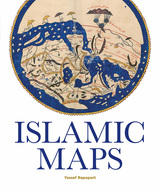
Islamic Maps examines Islamic visual interpretations of the world in their historical context through the map-makers themselves. What was the purpose of their maps, what choices did they make, and what arguments about the world were they trying to convey? Lavishly illustrated with stunning manuscripts, beautiful instruments, and Qibla charts, this book shows how maps constructed by Muslim map-makers capture the many dimensions of Islamic civilization across the centuries.
It is often said that marriage in Islamic law is a civil contract, not a sacrament. If this is so, this means that the marriage contract is largely governed by the same rules as other contracts, such as sale or hire. But at the same time marriage is a profound concern of the Islamic scriptures of Qur’an and Sunna, and thus at the very core of the law and morality of Islam and of the individual, familial, and social life of Muslims. This volume collects papers from many disciplines examining the Muslim marriage contract. Articles cover doctrines as to marriage contracts (e.g., may a wife stipulate monogamy?); historical instances (e.g., legal advice from thirteenth-century Spain); comparisons with Jewish and canon law; contemporary legal and social practice; and projects of activists for women worldwide.
Demonstrating a new and powerful focus for comparative and historical inquiries into Islamic law and social practices, this book marks a fresh point of departure for the study of Muslim women.
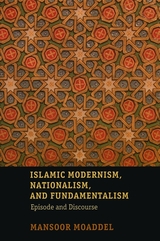
An ambitious comparative historical analysis of ideological production in the Islamic world from the mid-1800s to the present, Mansoor Moaddel's Islamic Modernism, Nationalism, and Fundamentalism provides a unique perspective for understanding the social conditions of these discourses. Moaddel characterizes these movements in terms of a sequence of cultural episodes characterized by ideological debates and religious disputations, each ending with a revolution or military coup. Understanding how the leaders of these movements formulated their discourses is, for Moaddel, the key to understanding Middle Eastern history. This premise allows him to unlock for readers the historical process that started with Islamic modernism and ended with fundamentalism.
Since its establishment in the late 1970s, Israel’s Islamic Movement has grown from a small religious revivalist organization focused on strengthening the faith of Muslim Palestinian citizens of Israel to a countrywide sociopolitical movement with representation in the Israeli legislature. But how did it get here? How does it differ from other Islamic movements in the region? And why does its membership continue to grow?
Tilde Rosmer examines these issues in The Islamic Movement in Israel as she tells the story of the movement, its identity, and its activities. Using interviews with movement leaders and activists, their documents, and media reports from Israel and beyond, she traces the movement’s history from its early days to its 1996 split over the issue of its relationship to the state. She then explores how the two factions have functioned since, revealing that while leaders of the two branches have pursued different approaches to the state, until the outlawing of the Northern Branch in 2015, both remained connected and dedicated to providing needed social, education, and health services in Israel’s Palestinian towns and villages. The first book in English on this group, The Islamic Movement in Israel is a timely study about how an Islamist movement operates within the unique circumstances of the Jewish state.
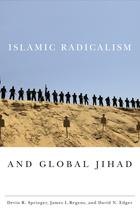
Jihadist ideology inspires a diverse and decentralized collection of radical groups to fight alleged enemies of Islam and to attempt to “restore” a holy caliphate to unite Muslim peoples across the Middle East, Africa, and Asia. Islamic Radicalism and Global Jihad provides unique insights into the philosophical foundations, strategic vision, organizational dynamics, and tactics of the modern jihadist movement—with specific attention to its primary driver, Al-Qa’ida.
Springer, Regens, and Edger draw heavily on Arabic language sources seldom seen in the West to explain what jihadists want and how radical thinkers have distorted the teachings of Islam to convince followers to pursue terrorism as a religious duty. With sophisticated and systematic analysis, the authors lead their readers on a fascinating intellectual journey through the differing ideas, goals, and vulnerabilities of the jihadist movement as it has evolved over time. The authors also impart wisdom from their own professional experience with terrorism, counterinsurgency, and intelligence to provide scholars, students, counterterrorism professionals, and general readers with this accessible overview of key radical Islamic thinkers and today’s jihadists.

Loimeier's careful scholarship combines astute readings of the work of previous scholars--both published and unpublished--with archival material and the findings of his own fieldwork in Nigeria. His work fills a substantial gap in contemporary Nigerian studies. This book provides invaluable and essential reading for serious students of Nigerian politics and of Islamic movements in Africa.
"Harvey not only examines the politics of the Nasrids, but also the Islamic communities in the Christian kingdoms of the peninsula. This innovative approach breaks new ground, enables the reader to appreciate the situation of all Spanish Muslims and is fully vindicated. . . . An absorbing and thoroughly informed narrative."—Richard Hitchcock, Times Higher Education Supplement
"L. P. Harvey has produced a beautifully written account of an enthralling subject."—Peter Linehan, The Observer
Now, as Islamic State (also known as ISIS) is moving to take over broad swathes of territory throughout the Middle East, Griffin is back once again, ready to offer nuanced insight, analysis, history, and context for readers looking to understand this new and frightening threat.
An experienced journalist, Griffin tells the story of the development of the Islamic State in his usual fast-paced, narrative driven style, helping us to understand the long roots of the Islamic State in Iraq, their quiet involvement in the Arab Spring, and their rapid rise amid the chaos generated by the Syrian war. He clearly and carefully presents the interlocking web of influence, arms, and money from Saudi Arabia, Qatar, Turkey, and Iraq that have fuelled the rise of Islamic State, and highlights the importance of the uprising against Assad in Syria and the West’s relative inability to influence or support it. Ultimately, Griffin offers a portrait of a complicated, multivalent movement, one with roots in numerous real or perceived grievances and historical mistakes and one with the potential to foment unrest and violence throughout the Middle East for some time to come.

Will Saudi Arabia join the democratic wave in the Middle East? The uprisings and revolutions of 2011 do not, yet, seem to have affected the stability of the House of Saud, which remains secretive, highly repressive and propped up by the West.
The Islamic Utopia uses a range of sources including first-hand reporting and recently released WikiLeaks documents to examine Saudi Arabia in the decade after the 9/11 attacks, when King Abdullah’s 'reform' agenda took centre stage in public debate. It considers Saudi claims of 'exemption' from the democratic demands of the Arab Spring.
Andrew Hammond argues that for too long Western media and governments have accepted Saudi leaders' claims to be a buttress against jihadist Islam and that a new policy is needed towards the House of Saud.
Integrating the Islamic faith with modern psychotherapy is at the forefront of the spiritually integrated psychotherapy movement. To bring this work to wider attention and to promote its continuation, Dr. Carrie York Al-Karam has brought together the present volume of nine essays, each of which is written by a Muslim clinician who practices Islamically integrated psychotherapy (IIP)—a modern approach that unites the teachings, principles, and interventions of the faith with Western therapeutic approaches.
As delineated in the Introduction, IIP has emerged from a variety of domains including the psychology of religion and spirituality, multicultural psychology and counseling, transpersonal psychology, Muslim Mental Health, and Islamic Psychology. The individual chapters then describe a variety of ways IIP is practiced by Muslim clinicians in their service provision with Muslim clients.
The contributors discuss a wide range of topics, such as how Islam can be viewed as a system for psychological wellbeing, or a “science of the soul”; what marital counseling can look like from an Islamically-integrated perspective; Prophet Mohammed as a psycho-spiritual exemplar in a new approach called The HEART Method; the use of Quranic stories in family therapy; as well as using Islamic teachings when working with Muslim children and adolescents.
A description of the various approaches is supplemented with discussions of their theoretical underpinnings as well as research-based recommendations for advancing clinical application. What emerges is a vital resource for Muslim and non-Muslim clinicians alike as well as the lay Muslim reader wanting to know more about how the Islamic faith and psychotherapy are engaging with each other in a modern clinical context.

Islamicate Sexualities: Translations across Temporal Geographies of Desire explores different genealogies of sexuality and questions some of the theoretical emphases and epistemic assumptions affecting current histories of sexuality. Concerned with the dynamic interplay between cultural constructions of gender and sexuality, the anthology moves across disciplinary fields, integrating literary criticism with social and cultural history, and establishes a dialogue between historians (Kathryn Babayan, Frédéric Lagrange, Afsaneh Najmabadi, and Everett Rowson), comparative literary scholars (Sahar Amer and Leyla Rouhi), and critical theorists of sexualities (Valerie Traub, Brad Epps, and Dina al-Kassim).
As a whole, the anthology challenges Middle Eastern Studies with questions that have arisen in recent studies of sexualities, bringing into conversation Euro-American scholarship of sexuality with that of scholars engaged in studies of sexualities across a vast cultural (Iberian, Arabic, and Iranian) and temporal field (from the tenth century to the medieval and the modern).
While many previous books have probed the causes of Iran's Islamic Revolution of 1979, few have focused on the power of religion in shaping a national identity over the decades leading up to it. Islamism and Modernism captures the metamorphosis of the Islamic movement in Iran, from encounters with Great Britain and the United States in the 1920s through twenty-first-century struggles between those seeking to reform Islam's role and those who take a hardline defensive stance.
Capturing the views of four generations of Muslim activists, Farhang Rajahee describes how the extremism of the 1960s brought more confidence to concerned Islam-minded Iranians and radicalized the Muslim world while Islamic alternatives to modernity were presented. Subsequent ideologies gave rise to the revolution, which in turn has fed a restructuring of Islam as a faith rather than as an ideology.
Presenting thought-provoking discussions of religious thinkers such as Ha'eri, Burujerdi, Bazargan, and Shari'ati, along with contemporaries such as Kadivar, Soroush, and Shabestari, the author sheds rare light on the voices fueling contemporary Islamic thinking in Iran. A comprehensive study of these interwoven aspects of politics, religion, society, and identity, Islamism and Modernism offers crucial new insight into the aftermath of the Iranian Constitutional Revolution fought one hundred years ago—and its ramifications for the newest generation to face the crossroads of modernity and Islamic discourse in modern Iran today.
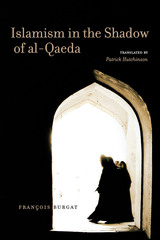
A renowned authority on Islamic movements, François Burgat lived for eighteen years in the Arab world, including his time as director of the French Center for Archaeology and Social Sciences at Yemen. He also dedicated many months to fieldwork in North Africa. Bringing Burgat's decades of expertise to the complex dialogues that have marked the post-9/11 world, Islamism in the Shadow of al-Qaeda delivers much-needed clarity and historical perspective.
In Burgat's eyes, most of the West's political and media rhetoric has only fueled al-Qaeda's case, revealing a woeful lack of comprehension regarding the violent authoritarianism that divides the Middle East and creates a breeding ground for terrorism. Islamism in the Shadow of al-Qaeda provides a primer of the three eras of political Islam, from the 1928 founding of the Muslim Brothers to the rise of post-colonial dictatorships and the current radicalization of "Generation al-Qaeda." Offering a new roadmap for stability, Burgat bridges the ideologies—political, religious, and cultural—that must be traversed if the deadly sectarianism is to be superseded.
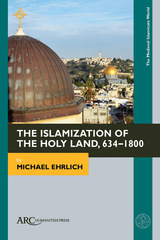
From the seventh century onwards the population of the Near East gradually became Muslim. Nevertheless, other religious communities continued to exist, maintaining an enduring presence in the region, despite being surrounded by Muslims and by people becoming Muslims.
This book argues that the causes that led to the conversion of most of the Holy Land's population, as well as the survival of some religious communities, are essentially social and geographic in nature, rather than theological, and that two parallel processes were the main catalysts of Islamization: de-urbanization and urbanization.
This book examines the political dimension of Islam in predivided Pakistan (1947-1971), one of the first new Muslim nations to commit itself to an Islamic political order and one in which the national debate on Islamic, political, and ideological issues has been the most persistent, focused, and rich of any dialogues in the contemporary Muslim world.
Nasim Jawed draws on the findings of a survey he conducted among two influential social groups—the ulama (traditional religious leaders) and the modern professionals—as well as on the writings of Muslim intellectuals. He probes the major Islamic positions on critical issues concerning national identity, the purpose of the state, the form of government, and free, socialist, and mixed economies.
This study contributes to an enhanced understanding of Islam's political culture worldwide, since the issues, positions, and arguments are often similar across the Muslim world. The empirical findings of the study not only outline the ideological backdrop of contemporary Islamic reassertion, but also reveal diversity as well as tensions within it.
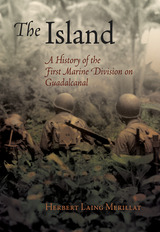
A First Hand Contemporary Account of the Guadalcanal Campaign
“This is the real story, soberly, honestly, authoritatively told.”—New York Times
“This is a tale of dogged resistance, courage and sacrifice that will remain imperishable in our history.” —Weekly Book Review
In August 1942, U.S. Marines landed on the island of Guadalcanal in the South Pacific and defeated Japanese forces for the first time, turning the tide of World War II against Japan. Written by a historian who fought alongside his fellow Marines for the entire four-month campaign, The Island is an indispensable story of this hard-fought victory.
A small canoe with Polynesians brought the first humans to Easter Island in 700 CE, and when boat travel in the South Pacific drastically decreased around 1500, the Easter Islanders were forced to adapt in order to survive their isolation. Adaptation, Fischer asserts, was a continuous thread in the life of Easter Island: the first European visitors, who viewed the awe-inspiring monolithic busts in 1722, set off hundreds of years of violent warfare, trade, and disease—from the smallpox, wars, and Great Death that decimated the island to the late nineteenth-century Catholic missionaries who tried to "save" it to a despotic Frenchman who declared sole claim of the island and was soon killed by the remaining 111 islanders. The rituals, leaders, and religions of the Easter Islanders evolved with all of these events, and Fischer is just as attentive to the island's cultural developments as he is to its foreign invasions.
Bringing his history into the modern era, Fischer examines the colonization and annexation of Easter Island by Chile, including the Rapanui people's push for civil rights in 1964 and 1965, by which they gained full citizenship and freedom of movement on the island. As travel to and interest in the island rapidly expand, Island at the End of the World is an essential history of this mysterious site.
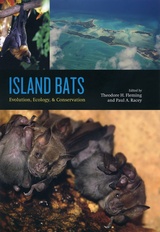
The second largest order of mammals, Chiroptera comprises more than one thousand species of bats. Because of their mobility, bats are often the only native mammals on isolated oceanic islands, where more than half of all bat species live. These island bats represent an evolutionarily distinctive and ecologically significant part of the earth’s biological diversity.
Island Bats is the first book to focus solely on the evolution, ecology, and conservation of bats living in the world’s island ecosystems. Among other topics, the contributors to this volume examine how the earth’s history has affected the evolution of island bats, investigate how bat populations are affected by volcanic eruptions and hurricanes, and explore the threat of extinction from human disturbance. Geographically diverse, the volume includes studies of the islands of the Caribbean, the Western Indian Ocean, Micronesia, Indonesia, the Philippines, and New Zealand.
With its wealth of information from long-term studies, Island Bats provides timely and valuable information about how this fauna has evolved and how it can be conserved.
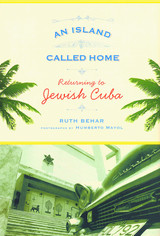
Yiddish-speaking Jews thought Cuba was supposed to be a mere layover on the journey to the United States when they arrived in the island country in the 1920s. They even called it “Hotel Cuba.” But then the years passed, and the many Jews who came there from Turkey, Poland, and war-torn Europe stayed in Cuba. The beloved island ceased to be a hotel, and Cuba eventually became “home.” But after Fidel Castro came to power in 1959, the majority of the Jews opposed his communist regime and left in a mass exodus. Though they remade their lives in the United States, they mourned the loss of the Jewish community they had built on the island.
As a child of five, Ruth Behar was caught up in the Jewish exodus from Cuba. Growing up in the United States, she wondered about the Jews who stayed behind. Who were they and why had they stayed? What traces were left of the Jewish presence, of the cemeteries, synagogues, and Torahs? Who was taking care of this legacy? What Jewish memories had managed to survive the years of revolutionary atheism?
An Island Called Home is the story of Behar’s journey back to the island to find answers to these questions. Unlike the exotic image projected by the American media, Behar uncovers a side of Cuban Jews that is poignant and personal. Her moving vignettes of the individuals she meets are coupled with the sensitive photographs of Havana-based photographer Humberto Mayol, who traveled with her.
Together, Behar’s poetic and compassionate prose and Mayol’s shadowy and riveting photographs create an unforgettable portrait of a community that many have seen though few have understood. This book is the first to show both the vitality and the heartbreak that lie behind the project of keeping alive the flame of Jewish memory in Cuba.
Reader Guide (http://rutgerspress.rutgers.
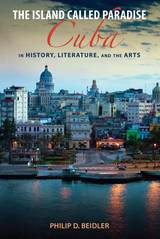
In The Island Called Paradise, Philip D. Beidler shares his personal discovery of the vast, rich, and astonishing history of the island of Cuba and the interrelatedness of Cuba and the US.
Cuba first entered Beidler’s consciousness in the early 1960s when he watched with mesmerized anxiety the televised reports of the Cuban missile crisis, a conflict that reduced a multifaceted, centuries-old history between North America and Cuba to the stark duotones of Cold War politics. Fifty years later, when Beidler traveled to the US’s island neighbor, he found a Cuba unlike the nation portrayed in truculent political rhetoric or in the easy preconceptions of US popular culture. Instead he found an entrancing people and landscape with deep historical connections to the US and a dazzling culture that overwhelmed his creative spirit.
In twelve original essays, Beidler reintroduces to English-speaking readers many of the central figures, both real and literary, of Cuban and Cuban-American history. Meet Cecilia Valdés, the young mixed-race heroine of a 1839 novel that takes readers to the poor streets and sumptuous salons of Spanish colonial Cuba, and Narciso López, a real-life Venezuelan adventurer and filibustero who attempted to foment a Cuban uprising against Spain. Both would have been familiar figures to nineteenth-century Americans. Beidler also visits the twentieth-century lives of “the two Ernestos” (Ernest Hemingway and Che Guevara), and the pop-culture Cuban icon Ricky Ricardo.
A country not with one history but multiple layers of history, Cuba becomes a fertile island for Beidler’s exploration. Art, he argues, perpetually crosses walls erected by politics, history, and nationality. At its core, The Island Called Paradise renews and refreshes our knowledge of an older Atlantic world even as we begin to envision a future in which the old bonds between our nations may be restored.

READERS
Browse our collection.
PUBLISHERS
See BiblioVault's publisher services.
STUDENT SERVICES
Files for college accessibility offices.
RECENTLY PUBLISHED


UChicago Accessibility Resources
home | accessibility | search | about | contact us
BiblioVault ® 2001 - 2025
The University of Chicago Press