
 A SCHOLARLY BOOK REPOSITORY
511 start with L start with L

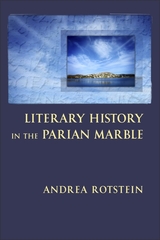
Inscribed some time after 264 BCE, the Parian Marble offers a chronological list of events with an exceptional emphasis on literary matters. Literary History in the Parian Marble explores the literary and historiographical qualities of the inscription, the genre to which it belongs, and the emerging patterns of time. Endorsing the hypothesis that the inscription was originally displayed at a Parian shrine honoring Archilochus, Andrea Rotstein argues that literary history was one of its main concerns. Though it may be conventional in its focus on the chronology of poets, their inventions and victories, the Parian Marble is nonetheless idiosyncratic in the range of authors displayed. By reconstructing the methods by which information might have been obtained, Rotstein contributes to an understanding of the way literary history was practiced within the local communities of ancient Greece, away from the major Hellenistic centers of scholarship.
The Parian chronicle has not been the subject of a comprehensive study for almost a century. Literary History in the Parian Marble brings to the English-speaking audience up-to-date information about the inscription, including a revision of Felix Jacoby’s Greek text and a complete translation.

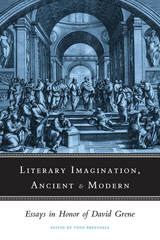
Ranging as widely as Grene's own interests in Greek and Roman antiquity, in drama, poetry, and the novel, in the art of translation, and in English history, these essays include discussions of the Odyssey and Ulysses, the Metamorphoses of Ovid and Apuleius, Mallarmé's English and T. S. Eliot's religion, and the mutually antipathetic minds of Edmund Burke and Thomas Jefferson. The introduction by Todd Breyfogle sketches for the first time the contours of Grene's own thought.
Classicists, political theorists, intellectual historians, philosophers, and students of literature will all find much of value in the individual essays here and in the juxtaposition of their themes.
Contributors: Saul Bellow, Seth Benardete, Todd Breyfogle, Amirthanayagam P. David, Wendy Doniger, Mary Douglas, Joseph N. Frank, Victor Gourevitch, Nicholas Grene, W. R. Johnson, Brendan Kennelly, Edwin McClellan, Françoise Meltzer, Stephanie Nelson, Conor Cruise O'Brien, Martin Ostwald, Robert B. Pippin, James Redfield, Sandra F. Siegel, Norma Thompson, and David Tracy

What drove leading thinkers, including those of the avant-garde who publicly embraced intellectual freedom, to serve as government informants? Why were they content to work within a repressive system rather than challenging it outright? This collection of interviews with more than two dozen writers and literary scholars, including several Stasi informants, provides a gripping, often dismaying picture of the motivations, compromises, and illusions of East German intellectual life.
In conversations with Robert von Hallberg, writers such as best-selling novelist Hermann Kant, playwright Christoph Hein, and avant-garde poet-publisher Sascha Anderson talk about their lives and work before the fall of the wall in 1989—about the constraints and privileges of Communist Party membership, experiences of government censorship and self-censorship, and relations with their readers. They reflect on why the possibilities of opposition to the state seemed so limited, and on how they might have found ways to resist more aggressively. Turning to the controversies that have emerged since reunification, including the Stasi scandals involving Anderson and Christa Wolf, they discuss their feelings of complicity and the need for further self-examination. Two interviews with Anderson—one conducted before he was exposed as a Stasi collaborator and one conducted afterward—offer unique insight into the double life led by many writers and scholars in the German Democratic Republic.

Is there such a thing as a specifically literary discourse, distinguishable from other modes of thought and writing? Is there any way to defend the intuition that a work of literature says something that can't be said in any other way? Drawing on recent work in the philosophies of language and action, Steven Knapp presents a challenging new definition of “the literary” in a forceful analysis that will radically change the sometimes heated debate about formalism.
Formalist theorists have maintained that the uniqueness of the literary lies in the special nature of literary language. Their critics argue that to draw sharp distinctions between literary and nonliterary language is to privilege one kind of text and to insulate cultural activity from social conflict and political change. In the course of a rigorous engagement with such literary theorists, old and new, Knapp develops a provocative defense of the notion of a uniquely literary mode of discourse—a defense that challenges proponents as well as critics of formalism. He extends and deepens current debates about the literary canon, the purpose of literary study, and the aims and implications of the recent critical return to history. His bold and surprising argument has significance for the ethical and political role of literary studies that no one interested in literary theory or the philosophy of art will be able to ignore. Literary Interest will engage theorists, literary critics in all fields, and philosophers addressing issues of aesthetics and language.
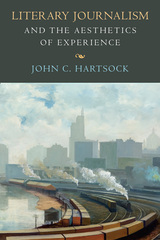
Proponents and practitioners of narrative literary journalism have sought to assert its distinctiveness as both a literary form and a type of journalism. In Literary Journalism and the Aesthetics of Experience, John C. Hartsock argues that this often neglected kind of journalism—exemplified by such renowned works as John Hersey's Hiroshima, James Agee's Let Us Now Praise Famous Men, and Joan Didion's Slouching Towards Bethlehem—has emerged as an important genre of its own, not just a hybrid of the techniques of fiction and the conventions of traditional journalism.
Hartsock situates narrative literary journalism within the broader histories of the American tradition of “objective” journalism and the standard novel. While all embrace the value of narrative, or storytelling, literary journalism offers a particular “aesthetics of experience” lacking in both the others. Not only does literary journalism disrupt the myths sustained by conventional journalism and the novel, but its rich details and attention to everyday life question readers' cultural assumptions. Drawing on the critical theories of Nietzsche, Bakhtin, Benjamin, and others, Hartsock argues that the aesthetics of experience challenge the shibboleths that often obscure the realities the other two forms seek to convey.
At a time when print media appear in decline, Hartsock offers a thoughtful response to those who ask, “What place if any is there for a narrative literary journalism in a rapidly changing media world?”
From the Iowa Writers Workshop to the halls of Congress and the National Endowment for the Arts, from the world of literary magazines and writers' conferences to the bizarre realm of the late-twentieth-century American English department, Literary Luxuries takes the reader on a guided tour of American literary life in our time--and the forces threatening its existence.
Joe David Bellamy has been a significant figure on the literary scene during the last three decades; as a "literary Everyman," he offers in Literary Luxuries a distinctive and valuable perspective on the culture wars, on education and the imagination, on particular writers and major literary and aesthetic movements, on the role of government in fostering cultural development, and on the day-to-day strife of the writer's life in the United States.
As director of the literature program of the National Endowment for the Arts, Bellamy had the unenviable task of trying to persuade Congress and ordinary citizens that American literature is worthy of support, and in Literary Luxuries he continues that debate and helps us to understand its implications: "Literature is our national treasury of language and style and our best reckoning about human life, as it is lived in this time and place."
Part memoir, part critique, part impassioned defense of American literary culture and the values it espouses and struggles to uphold, Literary Luxuries offers unforgettable commentary on the literary life in the United States during the last decades of the twentieth century as described from the perspective of one of its key participants.

The new edition reissues Luckyj’s critical work in light of current political developments and reflects the revision of previous findings. Luckyj originally drew on published Soviet sources and the important unpublished papers of a Soviet Ukrainian writer who defected to the West to describe how the brief literary revival in the Soviet Ukraine in the 1920s was abruptly halted by Communist Party controls. The present volume features a new preface, an additional chapter covering recent Soviet attitudes toward the literature of the 1920s and 1930s, and an updated bibliography.
Available for the first time in paperback, this book is a succinct distillation of the work and thought of William Charvat, a pioneer in the study of the history of the American book. This burgeoning field of inquiry investigates the social and cultural context of the act of literary creation by relating it to the modes of its production and distribution. This new edition of Literary Publishing in America contains an afterword by Michael Winship that discusses scholarship in the field since publication of Charvat's groundbreaking work.
Harlem Renaissance writer Dorothy West led a charmed life in many respects. Born into a distinguished Boston family, she appeared in Gershwin’s Porgy and Bess, then lived in the Soviet Union with a group that included Langston Hughes, to whom she proposed marriage. She later became friends with Jacqueline Kennedy Onassis, who encouraged her to finish her second novel, The Wedding, which became the octogenarian author’s first bestseller.
Literary Sisters reveals a different side of West’s personal and professional lives—her struggles for recognition outside of the traditional literary establishment, and her collaborations with talented African American women writers, artists, and performers who faced these same problems. West and her “literary sisters”—women like Zora Neale Hurston and West’s cousin, poet Helene Johnson—created an emotional support network that also aided in promoting, publishing, and performing their respective works. Integrating rare photos, letters, and archival materials from West’s life, Literary Sisters is not only a groundbreaking biography of an increasingly important author but also a vivid portrait of a pivotal moment for African American women in the arts.
Jurij Striedter provides a dynamic introduction to and critique of Russian Formalism and Czech Structuralism. He makes clear the pathbreaking contribution of these European schools to modern literary theory and criticism, placing them in their contemporary contexts and at the same time relating them to ongoing debates in America.
Striedter gives an authoritative account of the development of Russian Formalism from its birth around 1915 through its forced end in the late 1920s, focusing on the contributions of Roman Jakobson, Mikhail Bakhtin, and others to the theory and analysis of literary history, literary genres and narrative prose. He compares the concepts of the literary work, literature as system, and literary evolution in both Russian Formalism and Czech Structuralism to show how these early formalistic approaches led to an elaborated structuralist and semiotic concept of literature as a historically changing system correlated to society and cultural change. He sets forth the work of Jan Mukarovsky and Felix Vodicka, whose Czech Structuralist theory of literary evolution and literary reception (or reader response) anticipated much recent theorizing.
Finally, Striedter brings these ideas into play by showing how they can contribute to the debate of the last few years in North America and Europe about the key issue of literary evaluation. This book and the theories it discusses challenge our contemporary understanding of literature, its history, and its functions in society and human life.
Eaton attempted to disguise her Chinese heritage by writing under a hypothetically Japanese pen name. In legal documents, she usually claimed a "white" racial identity. In her fiction, Eaton portrayed Japanese, Chinese, Irish, and American characters, relying on the accepted stereotypes of the day. Jean Lee Cole shows that the many voices Eaton adopted show her deep preoccupations with "American" identity as a whole. The author attempts to reconcile all of these "voices," examining how Eaton survived in a climate hostile to minority writers in the early twentieth century, and how her seemingly anomalous works conjoin Asian American and American literary history.
Spelling out her main arguments clearly and succinctly, Rita Felski explains how feminism has changed the ways people read and think about literature. She organizes her book around four key questions: Do women and men read differently? How have feminist critics imagined the female author? What does plot have to do with gender? And what do feminists have to say about the relationship between literary and political value? Interweaving incisive commentary with literary examples, Felski advocates a double critical vision that can do justice to the social and political meanings of literature without dismissing or scanting the aesthetic.

Recent commentators have portrayed feminist critics as grim-faced ideologues who are destroying the study of literature. Feminists, they claim, reduce art to politics and are hostile to any form of aesthetic pleasure. Literature after Feminism is the first work to comprehensively rebut such caricatures, while also offering a clear-eyed assessment of the relative merits of various feminist approaches to literature.
Spelling out her main arguments clearly and succinctly, Rita Felski explains how feminism has changed the ways people read and think about literature. She organizes her book around four key questions: Do women and men read differently? How have feminist critics imagined the female author? What does plot have to do with gender? And what do feminists have to say about the relationship between literary and political value? Interweaving incisive commentary with literary examples, Felski advocates a double critical vision that can do justice to the social and political meanings of literature without dismissing or scanting the aesthetic.

Literature Among Discourses was first published in 1986. Minnesota Archive Editions uses digital technology to make long-unavailable books once again accessible, and are published unaltered from the original University of Minnesota Press editions.
Literature in the High Middle Ages referred to anything written. Those who institutionalized the study of literature in the eighteenth and nineteenth centuries ignored this medieval meaning, and literary history, especially in the hands of teachers, became what Wlad Godzich and Nicholas Spadaccini call a peregrination from one masterpiece to another. In Spanish literature, a cluster of such masterpieces came to be identified quite early, constituting a siglo de oro,a Golden Age. These outstanding works of the sixteenth and seventeenth centuries became a paradigm of achievement for the German romantics who formulated the project of literary history; for this reason, the authors of Literature among Discourses have chosen to begin their own exploratory voyage with the Spanish Golden Age.
Their intent is not simply to complete the historical record by studying "popular" texts alongside the canonical works, nor is it to establish these texts as a treasure trove of raw materials awaiting entry into and transformation by the masterpiece. They ask, rather, why the masterpiece came to occupy its place—how specific texts (or classes of texts) came to be differentiated from other discursive entities and labeled "literature." Taken together, their essays reveal an era in which literature is never a given, but is instead constantly being forged in a manner as complex as the social dynamic itself.
Contributors include: the editors, José Antonio Maravall, Michael Nerlich, Ronald Sousa, Constance Sullivan, Jenaro Talens, José Luís Canet, and Javier Herrero. Wlad Godzich is director of the Center for Humanistic Studies, and Nicholas Spadaccini, professor of Spanish and Portuguese, at the University of Minnesota.
In a new approach to interdisciplinary literary theory, Literature, Analytically Speaking integrates literary studies with analytic aesthetics, girded by neo-Darwinian evolution. Scrutinizing narrative fiction through a lens provided by analytic philosophy, revered literary theorist Peter Swirski puts new life into literary theory while fashioning a set of practical guidelines for critics in the interpretive trenches.
Dismissing critical inquirers who deny intention its key role in the study of literary reception, Swirski extends the defense of intentionality to art and to human behavior in general. In the process, Swirski takes stock of the recent work in evolutionary theory, arguing that the analysis of narrative truth may be grounded in the neo-Darwinian paradigm which forms the empirical backbone behind his analytic approach. Literature, Analytically Speaking provides a series of precepts designed to capture the ways in which we do interpret (and ought to interpret) works of literature. Reflecting a resounding shift from the poststructuralist paradigm, Swirski's lively and colorful presentation, backed up by a dazzling variety of examples and case studies, reconceptualizes the aesthetics of literature and literary studies.
Drawing on an eclectic range of sources including newspaper arrest reports, prison reform periodicals, popular literary magazines, transatlantic travel narratives, popular crime novels, anthologies of prison poetry, and the memoirs of prison chaplains, Ostrowski analyzes how authors as canonical as Nathaniel Hawthorne and as obscure as counterfeiter/poet/prison inmate Christian Meadows adapted, manipulated, or rejected prevailing narratives about criminality to serve their artistic and rhetorical ends. These narratives led to the creation of new literary subgenres while also ushering in psychological interiority as an important criterion by which serious fiction was judged. Ostrowski joins and extends recent scholarly conversations on subjects including African American civic agency, literary sentimentalism, outsider authorship, and the racial politics of antebellum prison reform.
Only when influenced by the principle of equality does a narrative deliberately deny readers knowledge beyond those they are reading about--privileged knowledge. This book argues that such a turn, in the hands of masters of the novel, changed narrative itself into an exploration of the limits of knowledge; that the portrayal of persons unknown to history transformed the novel into an investigation of the unknown. If the novel is the literary form of limited knowledge, the fullest expression of that form is found in the great fictional experiments of the nineteenth century, the age when the social question--the question of human equality--broke upon the world. Justman looks into some of those experiments for their own sake, but also for the light they cast on the nature and history of the novel. Focusing on Great Expectations, War and Peace, The Death of Ivan Ilych, and The Brothers Karamazov, Justman explores what happens when we, as readers, are denied knowledge not only for the sake of suspense, but because ignorance belongs to what we have in common, the human condition.
Gustavo Perez Firmat examines three of these marginal or liminal phenomena—paying particular attention to the distinction between "center" and "periphery"—as they appear in Hispanic literature. Carnival (the traditional festival in which normal behavior is overturned), choteo (an insulting form of humor), and disease are three liminal entities discussed. Less an attempt to frame a general theory of such "liminalities" than an effort to demonstrate the interpretive power of the liminality concept, this work challenges conventional boundaries of critical sense and offers new insights into a variety of questions, among them the notion of convertability in psychoanalysis and the relation of New World culture to its European forebears.
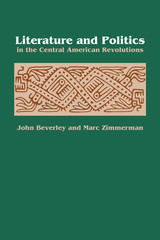
“This book began in what seemed like a counterfactual intuition . . . that what had been happening in Nicaraguan poetry was essential to the victory of the Nicaraguan Revolution,” write John Beverley and Marc Zimmerman. “In our own postmodern North American culture, we are long past thinking of literature as mattering much at all in the ‘real’ world, so how could this be?” This study sets out to answer that question by showing how literature has been an agent of the revolutionary process in Nicaragua, El Salvador, and Guatemala.
The book begins by discussing theory about the relationship between literature, ideology, and politics, and charts the development of a regional system of political poetry beginning in the late nineteenth century and culminating in late twentieth-century writers. In this context, Ernesto Cardenal of Nicaragua, Roque Dalton of El Salvador, and Otto René Castillo of Guatemala are among the poets who receive detailed attention.
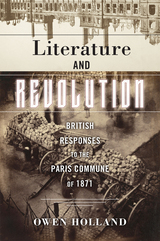
This book examines how a heterogeneous group of authors in Britain responded to the Commune. In doing so, it provides the first full-length critical study of the reception and representation of the Commune in Britain during the closing decades of the nineteenth century, showing how discussions of the Commune functioned as a screen to project hope and fear, serving as a warning for some and an example to others. Writers considered in the book include John Ruskin, Edward Bulwer-Lytton, Eliza Lynn Linton, Mary Elizabeth Braddon, Anne Thackeray Ritchie, Margaret Oliphant, George Gissing, Henry James, William Morris, Alfred Austin and H.G. Wells. As the book shows, many, but not all, of these writers responded to the Commune with literary strategies that sought to stabilize bourgeois subjectivity in the wake of the traumatic shock of a revolutionary event. The book extends critical understanding of the Commune’s cultural afterlives and explores the relationship between literature and revolution.
The essays address the mutual impact of literature and science through a range of issues: “geek novels” as a subgenre of literature about science, the relationship of narrative form to risk analysis and ecological disaster, the impact of realism and contemporary developments in neurology and brain biology, and the use of technology in the humanities. The essays also examine how the humanities explore scientific issues such as in vitro fertilization and human existence, cloning and molecular biology, and the concept of time.
Contributors. Jay Clayton, Wai Chee Dimock, N. Katherine Hayles, Ursula Heise, Randall Knoper, Martha Nell Smith, Stephanie Turner, Priscilla Wald, Robyn Wiegman
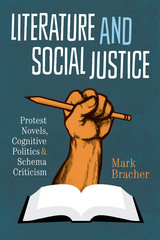
Can reading social protest novels actually produce a more just world? Literature and Social Justice offers a scientifically informed, evidence-based affirmative answer to that crucial question, arguing that literature has the potential—albeit largely unrealized—to produce lasting, socially transformative psychological changes in readers. Moving beyond traditional social criticism in its various forms, including feminist, gender, queer, and postcolonialist approaches, Mark Bracher uses new knowledge concerning the cognitive structures and processes that constitute the psychological roots of social injustice to develop a detailed, systematic critical strategy that he calls “schema criticism,” which can be applied to literature and other discourses to maximize and extend their potential for promoting social justice.
Bracher draws on studies in social cognition, social neuroscience, evolutionary psychology, political psychology, and psychoanalysis to uncover the root cognitive structures that cause misunderstandings among people and give rise to social injustice. Using the novels The Jungle, The Grapes of Wrath, and Native Son, he then demonstrates how schema criticism can correct these faulty cognitive structures and enable readers to develop more accurate and empathetic views of those they deem “Other,” as well as become more aware of their own cognitive processes. Calling the book “insightful, erudite, and humane,” Cognitive Approaches to Literature and Culture Series coeditor Patrick Colm Hogan says, “This inspiring book should be welcomed by literary critics, political activists, and anyone who cares about social justice.”
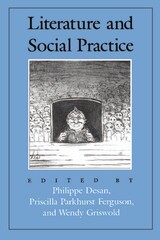
Convinced that literature and society are essentially related to each other, the contributors to this collection attempt to define the various sociological practices of literature and to give expression to this enterprise and the commitments of its partisans. In various ways, the essays assembled here seek to integrate text, institution, and individual (both author and critic) as necessary parts of the analysis of literature. Diverse, sometimes contradictory approaches to literature (Marxism, publishing history, new historicism, and others) are utilized as the contributors explore such topics as text, author-function, and appropriation; the reality of representation; the sociology of exchange; the uses of "serious" fiction; poetry and politics; publishing history; and the literary field.
This collection captures the sense—at times the ordeal—of the 1930s literary experience in America. Fourteen essayists deal with the experience of being a writer in a time of overwhelming economic depression and political ferment, and thereby illuminate the social, political, intellectual, and aesthetic problems and pressures that characterized the experience of American writers and influenced their works.
The essays, as a group, constitute a reevaluation of the American literature of the 1930s. At the same time they support and reinforce certain assumptions about the decade of the Great Depression—that it was grim, desperate, a time when dreams died and poverty became something other than genteel—they challenge other assumptions, chief among them in the notion that 1930s literature was uniform in content, drab in style, anti-formalist, and always political or sociological in nature. They leave us with an impression that there was variety in American writing of the 1930s and a convincing argument that the decade was not a retreat from the modernism of the 1920s. Rather it was a transitional period in which literary modernism was very much an issue and a force that bore imaginative fruit.
The volume includes writers whose origins lie in Central Europe, South Africa, Israel, Cuba, Chile, Somalia, and Turkey. Through their testimony of the creative process in exile, we gain insight into the forces which affect the creative process as a whole.
Contributors. William Gass, Yury Miloslavsky, Jan Vladislav, Jiri Grusa, Guillermo Cabrera Infante, Horst Bienek, Edward Limonov, Nedim Gursel, Nuruddin Farah, Jaroslav Vejvoda, Anton Shammas, Joseph Brodsky, Wojciech Karpinski, Thomas Venclova, Yuri Druzhnikov
The period between the World Wars was one of the richest and most inventive in the long history of British literature. Interwar literature, David Trotter argues, stood apart by virtue of the sheer intelligence of the enquiries it undertook into the technological mediation of experience. After around 1925, literary works began to portray communication by telephone, television, radio, and sound cinema—and to examine the sorts of behavior made possible for the first time by virtual interaction. And they filled up, too, with the look, sound, smell, taste, and feel of the new synthetic and semi-synthetic materials that were reshaping everyday modern life.
New media and new materials gave writers a fresh opportunity to reimagine both how lives might be lived and how literature might be written. Today, Trotter observes, such material and immaterial mediations have become even more decisive. Communications technology is an attitude before it is a machine or a set of codes. It is an idea about the prosthetic enhancement of our capacity to communicate. The writers who first woke up to this fact were not postwar, postmodern, or post-anything else: some of the best of them lived and wrote in the British Isles in the period between the World Wars. In defining what they achieved, this book creates a new literary canon of works distinguished formally and thematically by their alertness to the implications of new media and new materials.
Examining British and American essays, poems, novels, and stories from the seventeenth through the nineteenth centuries, O’Brien pursues the idea of incorporation as a trope discernible in a wide range of texts. Key authors include John Locke, Eliza Haywood, Harriet Martineau, and Edgar Allan Poe, and each chapter is oriented around a type of corporation reflected in their works, such as insurance companies or banks. In exploring issues such as whether sentimental interest is the same as economic interest, these works bear witness to capitalism’s effect on history and human labor, desire, and memory. This period’s imaginative writing, O’Brien argues, is where the unconscious of that process left its mark. By revealing the intricate ties between literary models and economic concepts, Literature Incorporated shows us how the business corporation has shaped our understanding of our social world and ourselves.
Tom Bishop has, for over sixty years, helped shape the literary, philosophical, cultural, artistic, and political conversation between Paris and New York. As professor and director of the Center for French Civilization and Culture at New York University, he made the Washington Square institution one of the great bridges between French innovation and a New York scene in full transformation. Bishop was close to Beckett, championed Robbe-Grillet in the United States, befriended Marguerite Duras and Hélène Cixous, and organized historic public encounters—such as the one between James Baldwin and Toni Morrison. He was also a scholar, a recognized specialist in the avant-garde, notably the Nouveau Roman and the Nouveau Théâtre.
In 2012, Bishop invited Donatien Grau to give a talk at NYU. This invitation led to conversations—many of which are presented in this book—and a friendship. Literature Is a Voyage of Discovery gathers their dialogues, retracing Bishop’s career, his own history, his departure from Vienna, his studies, his meetings, his choices, his conception of literature and life, his relationship to the political and economic world, and the way he helped define the profession of “curator” as it is practiced today, offering a thought-provoking look into one of the leading minds of our time.
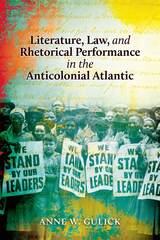
Responses to this question take shape across the black Atlantic from Haiti to South Africa, in texts ranging from Haiti’s Declaration of Independence and work by C. L. R. James to South Africa’s Freedom Charter, Aimé Césaire’s poem Notebook of a Return to the Native Land, and Ngugi wa Thiong’o’s A Grain of Wheat. These texts constitute a robust transatlantic tradition of challenging colonial and imperial authority through rhetorical performance. Drawing on the cosmopolitan aspirations and emancipatory energies of the political declaration, this tradition aims to radically reinvent the possibilities for law and political belonging in the postcolonial future.
Frequent and complex representations of jealousy in early modern Spanish literature offer symbolically rich and often contradictory images. Steven Wagschal examines these occurrences by illuminating the theme of jealousy in the plays of Lope de Vega, the prose of Miguel de Cervantes, and the complex poetry of Luis de Góngora. Noting the prevalence of this emotion in their work, he reveals what jealousy offered these writers at a time when Spain was beginning its long decline.

Nonfiction books for children—from biographies and historical accounts of communities and events to works on science and social justice—have traditionally been most highly valued by educators and parents for their factual accuracy. This approach, however, misses an opportunity for young readers to participate in the generation and testing of information.
In A Literature of Questions, Joe Sutliff Sanders offers an innovative theoretical approach to children’s nonfiction that goes beyond an assessment of a work’s veracity to develop a book’s equivocation as a basis for interpretation. Addressing how such works are either vulnerable or resistant to critical engagement, Sanders pays special attention to the attributes that nonfiction shares with other forms of literature, including voice and character, and those that play a special role in the genre, such as peritexts and photography.
The first book-length work to theorize children’s nonfiction as nonfiction from a literary perspective, A Literature of Questions carefully explains how the genre speaks in unique ways to its young readers and how it invites them to the project of understanding. At the same time, it clearly lays out a series of techniques for analysis, which it then applies and nuances through extensive close readings and case studies of books published over the past half century, including recent award-winning books such as Tanya Lee Stone’s Almost Astronauts: Thirteen Women Who Dared to Dream and We Are the Ship: The Story of Negro League Baseball by Kadir Nelson. By looking at a text’s willingness or reluctance to let children interrogate its information and ideological context, Sanders reveals how nonfiction can make young readers part of the project of learning rather than passive recipients of information.
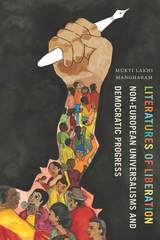
In this way, she posits that these universalisms reconceptualize democratic ideals not as Western imports into precolonial societies but as regional phenomena tied to local relations of power and resistance. In charting these alternative democratic trajectories, Mangharam examines oft-overlooked regional and vernacular literary forms and provides a fresh approach to current theorizations of postcolonial and world literatures.
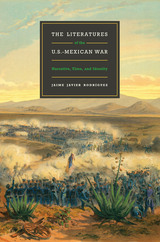
The literary archive of the U.S.-Mexican War (1846–1848) opens to view the conflicts and relationships across one of the most contested borders in the Americas. Most studies of this literature focus on the war's nineteenth-century moment of national expansion. In The Literatures of the U.S.-Mexican War, Jaime Javier Rodríguez brings the discussion forward to our own moment by charting a new path into the legacies of a military conflict embedded in the cultural cores of both nations.
Rodríguez's groundbreaking study moves beyond the terms of Manifest Destiny to ask a fundamental question: How do the war's literary expressions shape contemporary tensions and exchanges among Anglo Americans, Mexicans, and Mexican Americans. By probing the war's traumas, anxieties, and consequences with a fresh attention to narrative, Rodríguez shows us the relevance of the U.S.-Mexican War to our own era of demographic and cultural change. Reading across dime novels, frontline battle accounts, Mexican American writings and a wide range of other popular discourse about the war, Rodríguez reveals how historical awareness itself lies at the center of contemporary cultural fears of a Mexican "invasion," and how the displacements caused by the war set key terms for the ways Mexican Americans in subsequent generations would come to understand their own identities. Further, this is also the first major comparative study that analyzes key Mexican war texts and their impact on Mexico's national identity.
Funny happenings.
The rollicking comedies of Plautus, who brilliantly adapted Greek plays for Roman audiences ca. 205–184 BC, are the earliest Latin works to survive complete and are cornerstones of the European theatrical tradition from Shakespeare and Molière to modern times. This fourth volume of a new Loeb edition of all twenty-one of Plautus’ extant comedies presents The Little Carthaginian, Pseudolus, and The Rope with freshly edited texts, lively modern translations, introductions, and ample explanatory notes.

A poetics for reading the everyday objects that populate a hard drive
Bespoke online archives like PennSound and Eclipse host an astounding array of “old media” artifacts, posing a handcrafted counterpoint to the immense databases aggregated by digital titans like Google and Facebook. In The Little Database, Daniel Scott Snelson argues for the significance of these comparatively “small” collections, exploring how digital archives dramatically transform the artifacts they host and how they might help us better understand our own private collections in turn.
Examining curated collections such as Textz, UbuWeb, and the Electronic Poetry Center, Snelson explores media-specific works by poets and artists, including William Carlos Williams, Tracie Morris, bill bissett, Nam June Paik, and Vicki Bennett. He develops creative tools and contingent methods for reading cultural data, whether found on the internet or in our own collections of TXT, JPG, MP3, and MOV artifacts, presenting case studies to show how these objects have come to find revised meaning in their digital contexts. Along the way, experimental poetic interludes give readers practical entry points into the creative practice of producing new meanings in any given little database.
Inventive and interdisciplinary, The Little Database grapples with the digitized afterlives of cultural objects, showing how the past is continually reconfigured to shape the present. It invites readers to find playful and personal means for unpacking their own data collections, in the process discovering idiosyncratic ways to explore and connect with digital archives.
Retail e-book files for this title are screen-reader friendly with images accompanied by short alt text and/or extended descriptions.
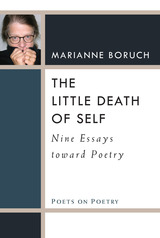
The line between poetry (the delicate, surprising not-quite) and the essay (the emphatic so-there!) is thin, easily crossed. Both welcome a deep mulling-over, endlessly mixing image and idea and running with scissors; certainly each distrusts the notion of premise or formulaic progression. Marianne Boruch’s essays in The Little Death of Self emerged by way of odd details or bothersome questions that would not quit—Why does the self grow smaller as the poem grows enormous? Why does closure in a poem so often mean keep going? Must we stalk the poem or does the poem stalk us until the world clicks open?
Boruch’s intrepid curiosity led her to explore fields of expertise about which she knew little: aviation, music, anatomy, history, medicine, photography, fiction, neuroscience, physics, anthropology, painting, and drawing. There’s an addiction to metaphor here, an affection for image, sudden turns of thinking, and the great subjects of poetry: love, death, time, knowledge. There’s amazement at the dumb luck of staying long enough in an inkling to make it a poem at all. Poets such as Keats, Stevens, Frost, Plath, Auden, and Bishop, along with painters, inventors, doctors, scientists, composers, musicians, neighbors, friends, and family—all traffic blatantly or under the surface—and one gets a glimpse of such fellow travelers now and then.
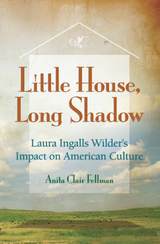
Beyond their status as classic children’s stories, Laura Ingalls Wilder’s Little House books play a significant role in American culture that most people cannot begin to appreciate. Millions of children have sampled the books in school; played out the roles of Laura and Mary; or visited Wilder homesites with their parents, who may be fans themselves. Yet, as Anita Clair Fellman shows, there is even more to this magical series with its clear emotional appeal: a covert political message that made many readers comfortable with the resurgence of conservatism in the Reagan years and beyond.
In Little House, Long Shadow, a leading Wilder scholar offers a fresh interpretation of the Little House books that examines how this beloved body of children’s literature found its way into many facets of our culture and consciousness—even influencing the responsiveness of Americans to particular political views. Because both Wilder and her daughter, Rose Wilder Lane, opposed the New Deal programs being implemented during the period in which they wrote, their books reflect their use of family history as an argument against the state’s protection of individuals from economic uncertainty. Their writing emphasized the isolation of the Ingalls family and the family’s resilience in the face of crises and consistently equated self-sufficiency with family acceptance, security, and warmth.
Fellman argues that the popularity of these books—abetted by Lane’s overtly libertarian views—helped lay the groundwork for a negative response to big government and a positive view of political individualism, contributing to the acceptance of contemporary conservatism while perpetuating a mythic West. Beyond tracing the emergence of this influence in the relationship between Wilder and her daughter, Fellman explores the continuing presence of the books—and their message—in modern cultural institutions from classrooms to tourism, newspaper editorials to Internet message boards.
Little House, Long Shadow shows how ostensibly apolitical artifacts of popular culture can help explain shifts in political assumptions. It is a pioneering look at the dissemination of books in our culture that expands the discussion of recent political transformations—and suggests that sources other than political rhetoric have contributed to Americans’ renewed appreciation of individualist ideals.

In this collection, Ian Morris and Joanne Diaz gather the reflections of twenty-three prominent editors whose little magazines have flourished over the past thirty-five years. Highlighting the creativity and innovation driving this diverse and still vital medium, contributors offer insights into how their publications sometimes succeeded, sometimes reluctantly folded, but mostly how they evolved and persevered. Other topics discussed include the role of little magazines in promoting the work and concerns of minority and women writers, the place of universities in supporting and shaping little magazines, and the online and offline future of these publications.
Selected contributors
Betsy Sussler, BOMB; Lee Gutkind, Creative Nonfiction; Bruce Andrews, L=A=N=G=U=A=G=E; Dave Eggers, McSweeney’s; Keith Gessen, n+1; Don Share, Poetry; Jane Friedman, VQR; Amy Hoffman, Women’s Review of Books; and more.
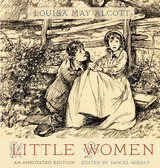
Little Women has delighted and instructed readers for generations. For many, it is a favorite book first encountered in childhood or adolescence. Championed by Gertrude Stein, Simone de Beauvoir, Theodore Roosevelt, and J. K. Rowling, it is however much more than the “girls’ book” intended by Louisa May Alcott’s first publisher. In this richly annotated, illustrated edition, Daniel Shealy illuminates the novel’s deep engagement with issues such as social equality, reform movements, the Civil War, friendship, love, loss, and of course the passage into adulthood.
The editor provides running commentary on biographical contexts (Did Alcott, like Jo, have a “mood pillow”?), social and historical contexts (When may a lady properly decline a gentleman’s invitation to dance?), literary allusions (Who is Mrs. Malaprop?), and words likely to cause difficulty to modern readers (What is a velvet snood? A pickled lime?). With Shealy as a guide, we appreciate anew the confusions and difficulties that beset the March sisters as they overcome their burdens and journey toward maturity and adulthood: beautiful, domestic-minded Meg, doomed and forever childlike Beth, selfish Amy, and irrepressible Jo. This edition examines the novel’s central question: How does one grow up well?
Little Women: An Annotated Edition offers something for everyone. It will delight both new and returning readers, young and old, male and female alike, who will want to own and treasure this beautiful edition full of color illustrations and photographs.

Examined lives.
Diogenes Laertius, author of a work on Greek philosophy, lived probably in the earlier half of the third century, his ancestry and birthplace being unknown. He was an Epicurean philosopher, but his work is not philosophical. The title is History of Philosophy or On the Lives, Opinions, and Sayings of Famous Philosophers; the work, in ten books, is divided unscientifically into two “Successions” or sections: “Ionian” from Anaximander to Theophrastus and Chrysippus, including the Socratic schools; “Italian” from Pythagoras to Epicurus (who fills all the last book), including the Eleatics and Sceptics. It is a collection of quotations and facts, and is of very great value.
The Loeb Classical Library edition of Diogenes Laertius is in two volumes.
Examined lives.
Diogenes Laertius, author of a work on Greek philosophy, lived probably in the earlier half of the third century, his ancestry and birthplace being unknown. He was an Epicurean philosopher, but his work is not philosophical. The title is History of Philosophy or On the Lives, Opinions, and Sayings of Famous Philosophers; the work, in ten books, is divided unscientifically into two “Successions” or sections: “Ionian” from Anaximander to Theophrastus and Chrysippus, including the Socratic schools; “Italian” from Pythagoras to Epicurus (who fills all the last book), including the Eleatics and Sceptics. It is a collection of quotations and facts, and is of very great value.
The Loeb Classical Library edition of Diogenes Laertius is in two volumes.

Frederick Douglass’s fluid, changeable sense of his own life story is reflected in the many conflicting accounts he gave of key events and relationships during his journey from slavery to freedom. Nevertheless, when these differing self-presentations are put side by side and consideration is given individually to their rhetorical strategies and historical moment, what emerges is a fascinating collage of Robert S. Levine’s elusive subject. The Lives of Frederick Douglass is revisionist biography at its best, offering new perspectives on Douglass the social reformer, orator, and writer.
Out of print for a hundred years when it was reissued in 1960, The Narrative of the Life of Frederick Douglass (1845) has since become part of the canon of American literature and the primary lens through which scholars see Douglass’s life and work. Levine argues that the disproportionate attention paid to the Narrative has distorted Douglass’s larger autobiographical project. The Lives of Frederick Douglass focuses on a wide range of writings from the 1840s to the 1890s, particularly the neglected Life and Times of Frederick Douglass (1881, 1892), revised and expanded only three years before Douglass’s death. Levine provides fresh insights into Douglass’s relationships with John Brown, Abraham Lincoln, William Lloyd Garrison, and his former slave master Thomas Auld, and highlights Douglass’s evolving positions on race, violence, and nation. Levine’s portrait reveals that Douglass could be every bit as pragmatic as Lincoln—of whom he was sometimes fiercely critical—when it came to promoting his own work and goals.

The papers in this volume are based on a 2018 conference in the Department of the Classics at Harvard University in honor of Richard Tarrant, Pope Professor of the Latin Language and Literature, on the occasion of his retirement.
The breadth of authors, genres, periods, and topics addressed in The Lives of Latin Texts is testament to Richard Tarrant’s wide-ranging influence on the fields of Latin literary studies and textual criticism. Contributions on stylistic, dramatic, metapoetic, and philosophical issues in Latin literature (including authors from Virgil, Horace, and Seneca to Ovid, Terence, Statius, Caesar, and Martial) sit alongside contributions on the history of textual transmission and textual editing. Other chapters treat the musical reception of Latin literature. Taken together, the volume reflects on the impact of Richard Tarrant’s scholarship by addressing the expressive scope and the long history of the Latin language.
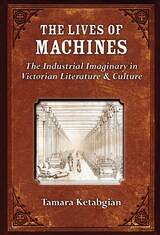
"The Lives of Machines is intelligent, closely argued, and persuasive, and puts forth a contention that will unsettle the current consensus about Victorian attitudes toward the machine."
---Jay Clayton, Vanderbilt University
Today we commonly describe ourselves as machines that "let off steam" or feel "under pressure." The Lives of Machines investigates how Victorian technoculture came to shape this language of human emotion so pervasively and irrevocably and argues that nothing is more intensely human and affecting than the nonhuman. Tamara Ketabgian explores the emergence of a modern and more mechanical view of human nature in Victorian literature and culture.
Treating British literature from the 1830s to the 1870s, this study examines forms of feeling and community that combine the vital and the mechanical, the human and the nonhuman, in surprisingly hybrid and productive alliances. Challenging accounts of industrial alienation that still persist, the author defines mechanical character and feeling not as erasures or negations of self, but as robust and nuanced entities in their own right. The Lives of Machines thus offers an alternate cultural history that traces sympathies between humans, animals, and machines in novels and nonfiction about factory work as well as in other unexpected literary sites and genres, whether domestic, scientific, musical, or philosophical. Ketabgian historicizes a model of affect and community that continues to inform recent theories of technology, psychology, and the posthuman.
The Lives of Machines will be of interest to students of British literature and history, history of science and of technology, novel studies, psychoanalysis, and postmodern cultural studies.
Cover image: "Power Loom Factory of Thomas Robinson," from Andrew Ure, The Philosophy of Manufactures (London: Charles Knight, 1835), frontispiece.
DIGITALCULTUREBOOKS: a collaborative imprint of the University of Michigan Press and the University of Michigan Library
Antiquity’s imperial biographer par excellence.
Suetonius (C. Suetonius Tranquillus, born ca. AD 70), son of a military tribune, was at first an advocate and a teacher of rhetoric, but later became the emperor Hadrian’s private secretary, 119–121. He dedicated to C. Septicius Clarus, prefect of the praetorian guard, his Lives of the Caesars. After the dismissal of both men for some breach of court etiquette, Suetonius apparently retired and probably continued his writing. His other works, many known by title, are now lost except for part of the Lives of Illustrious Men (of letters).
Friend of Pliny the Younger, Suetonius was a studious and careful collector of facts, so that the extant lives of the emperors (including Julius Caesar the dictator) to Domitian are invaluable. His plan in Lives of the Caesars is the emperor’s family and early years; public and private life; death. We find many anecdotes, much gossip of the imperial court, and various details of character and personal appearance. Suetonius’ account of Nero’s death is justly famous.
The Loeb Classical Library edition of Suetonius is in two volumes.
Antiquity’s imperial biographer par excellence.
Suetonius (C. Suetonius Tranquillus, born ca. AD 70), son of a military tribune, was at first an advocate and a teacher of rhetoric, but later became the emperor Hadrian’s private secretary, 119–121. He dedicated to C. Septicius Clarus, prefect of the praetorian guard, his Lives of the Caesars. After the dismissal of both men for some breach of court etiquette, Suetonius apparently retired and probably continued his writing. His other works, many known by title, are now lost except for part of the Lives of Illustrious Men (of letters).
Friend of Pliny the Younger, Suetonius was a studious and careful collector of facts, so that the extant lives of the emperors (including Julius Caesar the dictator) to Domitian are invaluable. His plan in Lives of the Caesars is the emperor’s family and early years; public and private life; death. We find many anecdotes, much gossip of the imperial court, and various details of character and personal appearance. Suetonius’ account of Nero’s death is justly famous.
The Loeb Classical Library edition of Suetonius is in two volumes.
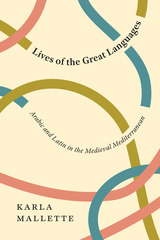
In this ambitious book, Karla Mallette studies the nature and behaviors of the medieval cosmopolitan languages of learning—classical Arabic and medieval Latin—as they crossed the Mediterranean. Through anecdotes of relationships among writers, compilers, translators, commentators, and copyists, Mallette tells a complex story about the transmission of knowledge in the period before the emergence of a national language system in the late Middle Ages and early modernity.
Mallette shows how the elite languages of learning and culture were only tenuously related to the languages of everyday life. These languages took years of study to master, marking the passage from intellectual childhood to maturity. In a coda to the book, Mallette speculates on the afterlife of cosmopolitan languages in the twenty-first century, the perils of monolingualism, and the ethics of language choice. The book offers insight for anyone interested in rethinking linguistic and literary tradition, the transmission of ideas, and cultural expression in an increasingly multilingual world.
Of the distinguished Lemnian family of Philostrati, Flavius Philostratus 'the Athenian', ca. 170205 CE, was a Greek sophist who studied at Athens and later lived in Rome. He was author of the admirable Life of Apollonius of Tyana (Loeb nos. 16 and 17) and of Lives of the Sophists, a treasury of information about notable sophists. Philostratus's sketches of sophists in action yield a fascinating picture of the predominant influence of Sophistic in the educational, social, and political life of the Empire in the second and third centuries.
The Greek sophist and historian Eunapius was born at Sardis in 347 CE, but went to Athens to study and lived much of his life there teaching rhetoric and possibly medicine. He was initiated into the mysteries and was hostile to Christians. His Lives of Philosophers and Sophists (mainly contemporary with himself) is our only source for knowledge of Neo-Platonism in the latter part of the fourth century.
Two sophists on the history of sophistry.
Flavius Philostratus, known as “the Elder” or “the Athenian,” was born to a distinguished family with close ties to Lesbos in the later second century, and died around the middle of the third. A sophist who studied at Athens and later lived in Rome, Philostratus provides in Lives of the Sophists a treasury of information about notable practitioners. His sketches of sophists in action paint a fascinating picture of their predominant influence in the educational, social, and political life of the Empire in his time. He is almost certainly the author also of the Life of Apollonius of Tyana (LCL 16, 17, 458) and Heroicus and Gymnasticus (LCL 521).
Eunapius (ca. 345–415) was born in Sardis but studied and spent much of his life in Athens as a sophist and historian. His Lives of Philosophers and Sophists covers figures of personal or intellectual significance to him in the period from Plotinus (ca. 250) to Chrysanthius (ca. 380), including one remarkable woman, Sosipatra, and then focuses on Iamblichus and his students. The work’s underlying rationale combines personal devotion to teachers and colleagues with a broader attempt to rehabilitate Hellenic cultural icons against the rise of Christianity and the influence of its representatives.
This edition of Philostratus and Eunapius thoroughly revises the original edition by Wilmer C. Wright (1921) in light of modern scholarship.
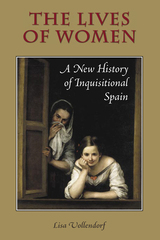
During this period, more women wrote for the public book market and participated in literary culture than ever before. In addition, the rise in convents and female education contributed to a marked increase in texts produced by and about women in religious orders. Vollendorf argues that, in conjunction with Inquisition and legal documents, this wealth of writing offers unprecedented access to women's perspectives on life in early modern Spain, and that those perspectives encompass diverse ethnic backgrounds and class differences. Many of the documents touch on issues of sex and intimacy; others provide new ways of understanding religious practice in the period. Perhaps most important, these writings give a richly textured view of how women reacted to the dominant culture's attempts to define, limit, and contain femininity. Vollendorf shows that the texts reflect a shared preoccupation with redefining gender and creating legitimate spaces for women.
As The Lives of Women vividly illustrates, hundreds, if not thousands, of women's stories await rediscovery in archives. The book provides a roadmap for understanding the experiences and concerns of wives, widows, sisters, and daughters who lived in a key moment in the development of the Spanish nation and the Hispanic world. At its core, The Lives of Women argues for a reconceptualization of history, one that will rely on the experiences of women and minorities as much as on the words and actions of kings and conquistadors.
Comparative biographies of distinguished Greeks and Romans.
Plutarch (Plutarchus), ca. AD 45–120, was born at Chaeronea in Boeotia in central Greece, studied philosophy at Athens, and, after coming to Rome as a teacher in philosophy, was given consular rank by the emperor Trajan and a procuratorship in Greece by Hadrian. He was married and the father of one daughter and four sons. He appears as a man of kindly character and independent thought, studious and learned.
Plutarch wrote on many subjects. Most popular have always been the forty-six Parallel Lives, biographies planned to be ethical examples in pairs (in each pair, one Greek figure and one similar Roman), though the last four lives are single. All are invaluable sources of our knowledge of the lives and characters of Greek and Roman statesmen, soldiers, and orators. Plutarch’s many other varied extant works, about sixty in number, are known as Moralia or Moral Essays. They are of high literary value, besides being of great use to people interested in philosophy, ethics, and religion.
The Loeb Classical Library edition of the Lives is in eleven volumes.
Comparative biographies of distinguished Greeks and Romans.
Plutarch (Plutarchus), ca. AD 45–120, was born at Chaeronea in Boeotia in central Greece, studied philosophy at Athens, and, after coming to Rome as a teacher in philosophy, was given consular rank by the emperor Trajan and a procuratorship in Greece by Hadrian. He was married and the father of one daughter and four sons. He appears as a man of kindly character and independent thought, studious and learned.
Plutarch wrote on many subjects. Most popular have always been the forty-six Parallel Lives, biographies planned to be ethical examples in pairs (in each pair, one Greek figure and one similar Roman), though the last four lives are single. All are invaluable sources of our knowledge of the lives and characters of Greek and Roman statesmen, soldiers, and orators. Plutarch’s many other varied extant works, about sixty in number, are known as Moralia or Moral Essays. They are of high literary value, besides being of great use to people interested in philosophy, ethics, and religion.
The Loeb Classical Library edition of the Lives is in eleven volumes.
Comparative biographies of distinguished Greeks and Romans.
Plutarch (Plutarchus), ca. AD 45–120, was born at Chaeronea in Boeotia in central Greece, studied philosophy at Athens, and, after coming to Rome as a teacher in philosophy, was given consular rank by the emperor Trajan and a procuratorship in Greece by Hadrian. He was married and the father of one daughter and four sons. He appears as a man of kindly character and independent thought, studious and learned.
Plutarch wrote on many subjects. Most popular have always been the forty-six Parallel Lives, biographies planned to be ethical examples in pairs (in each pair, one Greek figure and one similar Roman), though the last four lives are single. All are invaluable sources of our knowledge of the lives and characters of Greek and Roman statesmen, soldiers, and orators. Plutarch’s many other varied extant works, about sixty in number, are known as Moralia or Moral Essays. They are of high literary value, besides being of great use to people interested in philosophy, ethics, and religion.
The Loeb Classical Library edition of the Lives is in eleven volumes.
Comparative biographies of distinguished Greeks and Romans.
Plutarch (Plutarchus), ca. AD 45–120, was born at Chaeronea in Boeotia in central Greece, studied philosophy at Athens, and, after coming to Rome as a teacher in philosophy, was given consular rank by the emperor Trajan and a procuratorship in Greece by Hadrian. He was married and the father of one daughter and four sons. He appears as a man of kindly character and independent thought, studious and learned.
Plutarch wrote on many subjects. Most popular have always been the forty-six Parallel Lives, biographies planned to be ethical examples in pairs (in each pair, one Greek figure and one similar Roman), though the last four lives are single. All are invaluable sources of our knowledge of the lives and characters of Greek and Roman statesmen, soldiers, and orators. Plutarch’s many other varied extant works, about sixty in number, are known as Moralia or Moral Essays. They are of high literary value, besides being of great use to people interested in philosophy, ethics, and religion.
The Loeb Classical Library edition of the Lives is in eleven volumes.
Comparative biographies of distinguished Greeks and Romans.
Plutarch (Plutarchus), ca. AD 45–120, was born at Chaeronea in Boeotia in central Greece, studied philosophy at Athens, and, after coming to Rome as a teacher in philosophy, was given consular rank by the emperor Trajan and a procuratorship in Greece by Hadrian. He was married and the father of one daughter and four sons. He appears as a man of kindly character and independent thought, studious and learned.
Plutarch wrote on many subjects. Most popular have always been the forty-six Parallel Lives, biographies planned to be ethical examples in pairs (in each pair, one Greek figure and one similar Roman), though the last four lives are single. All are invaluable sources of our knowledge of the lives and characters of Greek and Roman statesmen, soldiers, and orators. Plutarch’s many other varied extant works, about sixty in number, are known as Moralia or Moral Essays. They are of high literary value, besides being of great use to people interested in philosophy, ethics, and religion.
The Loeb Classical Library edition of the Lives is in eleven volumes.
Comparative biographies of distinguished Greeks and Romans.
Plutarch (Plutarchus), ca. AD 45–120, was born at Chaeronea in Boeotia in central Greece, studied philosophy at Athens, and, after coming to Rome as a teacher in philosophy, was given consular rank by the emperor Trajan and a procuratorship in Greece by Hadrian. He was married and the father of one daughter and four sons. He appears as a man of kindly character and independent thought, studious and learned.
Plutarch wrote on many subjects. Most popular have always been the forty-six Parallel Lives, biographies planned to be ethical examples in pairs (in each pair, one Greek figure and one similar Roman), though the last four lives are single. All are invaluable sources of our knowledge of the lives and characters of Greek and Roman statesmen, soldiers, and orators. Plutarch’s many other varied extant works, about sixty in number, are known as Moralia or Moral Essays. They are of high literary value, besides being of great use to people interested in philosophy, ethics, and religion.
The Loeb Classical Library edition of the Lives is in eleven volumes.
Comparative biographies of distinguished Greeks and Romans.
Plutarch (Plutarchus), ca. AD 45–120, was born at Chaeronea in Boeotia in central Greece, studied philosophy at Athens, and, after coming to Rome as a teacher in philosophy, was given consular rank by the emperor Trajan and a procuratorship in Greece by Hadrian. He was married and the father of one daughter and four sons. He appears as a man of kindly character and independent thought, studious and learned.
Plutarch wrote on many subjects. Most popular have always been the forty-six Parallel Lives, biographies planned to be ethical examples in pairs (in each pair, one Greek figure and one similar Roman), though the last four lives are single. All are invaluable sources of our knowledge of the lives and characters of Greek and Roman statesmen, soldiers, and orators. Plutarch’s many other varied extant works, about sixty in number, are known as Moralia or Moral Essays. They are of high literary value, besides being of great use to people interested in philosophy, ethics, and religion.
The Loeb Classical Library edition of the Lives is in eleven volumes.
Comparative biographies of distinguished Greeks and Romans.
Plutarch (Plutarchus), ca. AD 45–120, was born at Chaeronea in Boeotia in central Greece, studied philosophy at Athens, and, after coming to Rome as a teacher in philosophy, was given consular rank by the emperor Trajan and a procuratorship in Greece by Hadrian. He was married and the father of one daughter and four sons. He appears as a man of kindly character and independent thought, studious and learned.
Plutarch wrote on many subjects. Most popular have always been the forty-six Parallel Lives, biographies planned to be ethical examples in pairs (in each pair, one Greek figure and one similar Roman), though the last four lives are single. All are invaluable sources of our knowledge of the lives and characters of Greek and Roman statesmen, soldiers, and orators. Plutarch’s many other varied extant works, about sixty in number, are known as Moralia or Moral Essays. They are of high literary value, besides being of great use to people interested in philosophy, ethics, and religion.
The Loeb Classical Library edition of the Lives is in eleven volumes.
Comparative biographies of distinguished Greeks and Romans.
Plutarch (Plutarchus), ca. AD 45–120, was born at Chaeronea in Boeotia in central Greece, studied philosophy at Athens, and, after coming to Rome as a teacher in philosophy, was given consular rank by the emperor Trajan and a procuratorship in Greece by Hadrian. He was married and the father of one daughter and four sons. He appears as a man of kindly character and independent thought, studious and learned.
Plutarch wrote on many subjects. Most popular have always been the forty-six Parallel Lives, biographies planned to be ethical examples in pairs (in each pair, one Greek figure and one similar Roman), though the last four lives are single. All are invaluable sources of our knowledge of the lives and characters of Greek and Roman statesmen, soldiers, and orators. Plutarch’s many other varied extant works, about sixty in number, are known as Moralia or Moral Essays. They are of high literary value, besides being of great use to people interested in philosophy, ethics, and religion.
The Loeb Classical Library edition of the Lives is in eleven volumes.
Comparative biographies of distinguished Greeks and Romans.
Plutarch (Plutarchus), ca. AD 45–120, was born at Chaeronea in Boeotia in central Greece, studied philosophy at Athens, and, after coming to Rome as a teacher in philosophy, was given consular rank by the emperor Trajan and a procuratorship in Greece by Hadrian. He was married and the father of one daughter and four sons. He appears as a man of kindly character and independent thought, studious and learned.
Plutarch wrote on many subjects. Most popular have always been the forty-six Parallel Lives, biographies planned to be ethical examples in pairs (in each pair, one Greek figure and one similar Roman), though the last four lives are single. All are invaluable sources of our knowledge of the lives and characters of Greek and Roman statesmen, soldiers, and orators. Plutarch’s many other varied extant works, about sixty in number, are known as Moralia or Moral Essays. They are of high literary value, besides being of great use to people interested in philosophy, ethics, and religion.
The Loeb Classical Library edition of the Lives is in eleven volumes.
Comparative biographies of distinguished Greeks and Romans.
Plutarch (Plutarchus), ca. AD 45–120, was born at Chaeronea in Boeotia in central Greece, studied philosophy at Athens, and, after coming to Rome as a teacher in philosophy, was given consular rank by the emperor Trajan and a procuratorship in Greece by Hadrian. He was married and the father of one daughter and four sons. He appears as a man of kindly character and independent thought, studious and learned.
Plutarch wrote on many subjects. Most popular have always been the forty-six Parallel Lives, biographies planned to be ethical examples in pairs (in each pair, one Greek figure and one similar Roman), though the last four lives are single. All are invaluable sources of our knowledge of the lives and characters of Greek and Roman statesmen, soldiers, and orators. Plutarch’s many other varied extant works, about sixty in number, are known as Moralia or Moral Essays. They are of high literary value, besides being of great use to people interested in philosophy, ethics, and religion.
The Loeb Classical Library edition of the Lives is in eleven volumes.

Offering a wide-ranging study of contemporary literature, film, visual art, and performance by writers and artists who live and work in the United Kingdom but also maintain strong ties to postcolonial Africa and the Caribbean, Living Cargo explores how contemporary black British culture makers have engaged with the institutional archives of colonialism and the Atlantic slave trade in order to reimagine blackness in British history and to make claims for social and political redress.
Steven Blevins calls this reimagining “unhousing history”—an aesthetic and political practice that animates and improvises on the institutional archive, repurposing it toward different ends and new possibilities. He discusses the work of novelists, including Caryl Phillips, Fred D’Aguiar, David Dabydeen, and Bernardine Evaristo; filmmakers Isaac Julien and Inge Blackman; performance poet Dorothea Smartt; fashion designer Ozwald Boateng; artists Hew Locke and Yinka Shonibare; and the urban redevelopment of Bristol, England, which unfolded alongside the public demand to remember the city’s slave-trading past.
Living Cargo argues that the colonial archive is neither static nor residual but emergent. By reassembling historical fragments and traces consolidated in the archive, these artists not only perform a kind of counter-historiography, they also imagine future worlds that might offer amends for the atrocities of the past.
Physician, literary critic, art historian, Jean Starobinski has been involved in a profound lifelong discourse on literature, and this book provides an unparalleled opportunity for learning about his ideas. As a close reader, Starobinski has much to teach us not only about Rousseau, Stendhal, Shakespeare, and Freud, but also about the techniques of interpretation—the craft of reading sensibly.
At the heart of the book is Starobinski’s fellow Genevan, Jean-Jacques Rousseau, who best embodies Starobinski’s concerns with masks, appearance, and reality, deception, and subjectivity. Starobinski takes a fresh approach to Rousseau’s work and other texts that speak about individuals looking at one another or at themselves, and shows readers in the English-speaking world the central significance of Rousseau today. The second great theme is the relationship between literature and psychoanalysis and the role ascribed in intellectual history to self-reflection and imagination.
All these essays except for the preface, which was written especially for this translation of his writings, appeared in Starobinski’s two major collections, L’Oeil Vivant and La Relation Critique. These are among his best and most renowned essays and the book will give instruction and pleasure to students and general readers interested in nondoctrinaire, down-to-earth approaches to literary style, author biography and psychoanalysis.
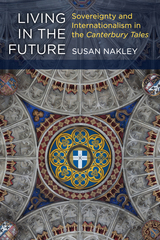
Chaucer uses two extant national ideals, sovereignty and domesticity, to introduce the concept of an English nation into the contemporary popular imagination and reinvent an idealized England as a hallowed homeland. For nationalist thinkers, sovereignty governs communities with linguistic, historical, cultural, and religious affinities. Chaucerian sovereignty appears primarily in romantic and household contexts that function as microcosms of the nation, reflecting a pseudo-familial love between sovereign and subjects and relying on a sense of shared ownership and judgment. This notion also has deep affinities with popular and political theories flourishing throughout Europe. Chaucer’s internationalism, matched with his artistic use of the vernacular and skillful distortions of both time and space, frames a discrete sovereign English nation within its diverse interconnected world.
As it opens up significant new points of resonance between postcolonial theories and medieval ideas of nationhood, Living in the Future marks an important contribution to medieval literary studies. It will be essential for scholars of Middle English literature, literary history, literary political and postcolonial theory, and literary transnationalism.
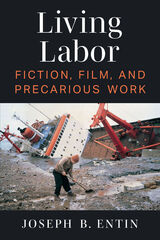
Cover attribution: Allan Sekula, Shipwreck and worker, Istanbul, from TITANIC’s wake, 1998/2000. Courtesy of the Allan Sekula Studio.
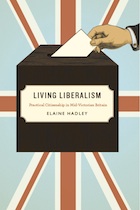
In the mid-Victorian era, liberalism was a practical politics: it had a party, it informed legislation, and it had adherents who identified with and expressed it as opinion. It was also the first British political movement to depend more on people than property, and on opinion rather than interest. But how would these subjects of liberal politics actually live liberalism?
To answer this question, Elaine Hadley focuses on the key concept of individuation—how it is embodied in politics and daily life and how it is expressed through opinion, discussion and sincerity. These are concerns that have been absent from commentary on the liberal subject. Living Liberalism argues that the properties of liberalism—citizenship, the vote, the candidate, and reform, among others—were developed in response to a chaotic and antagonistic world. In exploring how political liberalism imagined its impact on Victorian society, Hadley reveals an entirely new and unexpected prehistory of our modern liberal politics. A major revisionist account that alters our sense of the trajectory of liberalism, Living Liberalism revises our understanding of the presumption of the liberal subject.
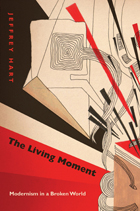
In the spirit of Lionel Trilling, Edmund Wilson, and Susan Sontag, the renowned literary critic Jeffrey Hart writes The Living Moment, a close reading of literature as it intersects with the political. Hart’s book is an even-handed guide for anyone toddling into the mists of the modernist moment, effortlessly moving between such modernist monuments as Eliot’s “The Waste Land,” Hemingway’s A Farewell to Arms, Mann’s Doctor Faustus, and Fitzgerald’s The Great Gatsby. Hart’s most stunning achievement is his brilliant inclusion of Marilynne Robinson’s Gilead as a modernist text, for the way the novel teaches us to see more, to hear more, to feel more. Hart’s dazzling study is an examination of important works of literature as they explore the experience of living in a broken world with thought and sometimes with examples of resolve that possess permanent validity. The Living Moment is for anyone who is wearied by so much of today’s trendy, narrow, and ideologically driven criticism.
We live on the surface, he discovered. It is the land that makes people. If a poet will see, will feel, will interpret his place and then relate that experience to what he knows of the world at large, he will have a life in imagination, a vitality beyond appearances.
John Haines is author of At the End of Summer: Poems 1948-1954; Fables and Distances: New and Selected Essays; and The Owl in the Mask of the Dreamer. He received the Lenore Marshall Poetry Prize in 1991.
Living Translation offers a powerful perspective on the work of distinguished thinker and writer Gayatri Chakravorty Spivak, revealing how, throughout her long career, she has made translation a central concern of the comparative humanities.
Starting with her landmark “Translator’s Preface” to Jacques Derrida’s Of Grammatology in 1976, and continuing with her foreword to Mahasweta Devi’s Draupadi and afterword to Devi’s Chotti MundaandHis Arrow, Spivak has tackled questions of translatability. She has been interested in interrogating the act of translation from the ground up and at the political limit. She sees at play at border checkpoints, at sites of colonial pedagogy, in acts of resistance to monolingual regimes of national language, at the borders of minor literature and schizo-analysis, in the deficits of cultural debt and linguistic expropriation, and, more generally, at theory’s edge, which is to say, where practical criticism yields to theorizing in untranslatables. This volume also addresses how Spivak’s institution-building as director of comparative literature at the University of Iowa—and in her subsequent places of employment—began at the same time. From this perspective, Spivak takes her place within a distinguished line-up of translator-theorists who have been particularly attuned to the processes of cognizing in languages, all of them alive to the coproductivity of thinking, translating, writing.
In closely analyzing the political and spiritual uses of black theatre during the Progressive Era, Mitchell demonstrates that audiences were shown affective ties in black families, a subject often erased in mainstream images of African Americans. Examining lynching plays as archival texts that embody and reflect broad networks of sociocultural activism and exchange in the lives of black Americans, Mitchell finds that audiences were rehearsing and improvising new ways of enduring in the face of widespread racial terrorism. Images of the black soldier, lawyer, mother, and wife helped readers assure each other that they were upstanding individuals who deserved the right to participate in national culture and politics. These powerful community coping efforts helped African Americans band together and withstand the nation's rejection of them as viable citizens.
The Left of Black interview with author Koritha Mitchell begins at 14:00.
An interview with Koritha Mitchell at The Ohio Channel.
Native Americans along the coasts of southern New England and Long Island have had close ties to whales for thousands of years. They made a living from the sea and saw in the world's largest beings special power and meaning. After English settlement in the early seventeenth century, the region's natural bounty of these creatures drew Natives and colonists alike to develop whale hunting on an industrial scale. By the nineteenth century, New England dominated the world in whaling, and Native Americans contributed substantially to whaleship crews.
In Living with Whales, Nancy Shoemaker reconstructs the history of Native whaling in New England through a diversity of primary documents: explorers' descriptions of their “first encounters,” indentures, deeds, merchants' accounts, Indian overseer reports, crew lists, memoirs, obituaries, and excerpts from journals kept by Native whalemen on their voyages. These materials span the centuries-long rise and fall of the American whalefishery and give insight into the far-reaching impact of whaling on Native North American communities. One chapter even follows a Pequot Native to New Zealand, where many of his Maori descendants still reside today.
Whaling has left behind a legacy of ambivalent emotions. In oral histories included in this volume, descendants of Wampanoag and Shinnecock whalemen reflect on how whales, whaling, and the ocean were vital to the survival of coastal Native communities in the Northeast, but at great cost to human life, family life, whales, and the ocean environment.
In the essays collected in Local Transcendence, Alan Liu takes the pulse of such postmodern historicism by tracking two leading indicators of its acceleration in the late twentieth and early twenty-first centuries: postmodern cultural criticism—including the new historicism, the new cultural history, cultural anthropology, the new pragmatism, and postmodern and postindustrial theory—and digital information technology. What is the relation between the new historicist anecdote and the database field, Liu asks, and can either have a critical function in the age of postmodern historicism? Local Transcendence includes two previously unpublished essays and a synthetic introduction in which Liu traverses from his earlier work on the theory of historicism to his recent studies of information culture to propose a theory of contingent method incorporating a special inflection of history: media history.

A paperback anthology of essential Greek and Latin texts with facing English translations.
“It is ideal reading for bar, bus, bed or beach. Everyone, teacher and taught alike, should have one. It is this year’s must-have present.”—The Journal of Classics Teaching
This selection of lapidary nuggets drawn from thirty-three of antiquity’s major authors includes poetry, dialogue, philosophical writing, history, descriptive reporting, satire, and fiction—giving a glimpse at the wide range of arts and sciences, styles and convictions, of Greco-Roman culture. The selections span twelve centuries, from Homer to Saint Jerome. They are given in two sequences in roughly chronological order, the Greeks first, followed by the Romans. The texts and translations are reproduced as they appear in Loeb volumes; footnotes have been reduced in keeping with the needs of this compact sampling. An index to the passages is at the end.
The Loeb Classical Library is the only existing series that, through original text and facing English translation, gives access to all that is important in Greek and Latin literature. This reader can do no more than represent a small portion of the riches in that treasury.
Acclaimed science fiction scholar Edward James traces Bujold's career, showing how Bujold emerged from fanzine culture to win devoted male and female readers despite working in genres--military SF, space opera--perceived as solely by and for males. Devoted to old-school ideas such as faith in humanity and the desire to probe and do good in the universe, Bujold simultaneously subverted genre conventions and experimented with forms that led her in bold creative directions. As James shows, her iconic hero Miles Vorkosigan--unimposing, physically impaired, self-conscious to a fault--embodied Bujold's thematic concerns. The sheer humanity of her characters, meanwhile, gained her a legion of fans eager to provide her with feedback, expand her vision through fan fiction, and follow her into fantasy.

A New York Times Book Review Editors’ Choice
A Telegraph Editor’s Choice
An Evening Standard “Best Books about London” Selection
In popular imagination, London is a city of fog. The classic London fogs, the thick yellow “pea-soupers,” were born in the industrial age of the early nineteenth century. Christine L. Corton tells the story of these epic London fogs, their dangers and beauty, and their lasting effects on our culture and imagination.
“Engrossing and magnificently researched…Corton’s book combines meticulous social history with a wealth of eccentric detail. Thus we learn that London’s ubiquitous plane trees were chosen for their shiny, fog-resistant foliage. And since Jack the Ripper actually went out to stalk his victims on fog-free nights, filmmakers had to fake the sort of dank, smoke-wreathed London scenes audiences craved. It’s discoveries like these that make reading London Fog such an unusual, enthralling and enlightening experience.”
—Miranda Seymour, New York Times Book Review
“Corton, clad in an overcoat, with a linklighter before her, takes us into the gloomier, long 19th century, where she revels in its Gothic grasp. Beautifully illustrated, London Fog delves fascinatingly into that swirling miasma.”
—Philip Hoare, New Statesman
READERS
Browse our collection.
PUBLISHERS
See BiblioVault's publisher services.
STUDENT SERVICES
Files for college accessibility offices.
RECENTLY PUBLISHED


UChicago Accessibility Resources
home | accessibility | search | about | contact us
BiblioVault ® 2001 - 2026
The University of Chicago Press