Results by title
2728 books match the query 'Education' and 609 start with t
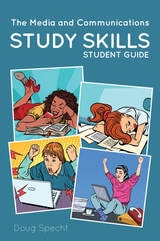
The Media and Communications Study Skills Student Guide
Doug Specht
University of Westminster Press, 2019
All the tips, ideas and advice given to, and requested by, MA students in Media and Communications, are brought together in an easy-to-use accessible guide to help students study most effectively.
Based upon many years of teaching study skills and hundreds of lecture slides and handouts this introduction covers a range of general and generic skills that the author relates specifically towards media and communications studies. As well as the mechanics of writing and presentations, the book also shows how students can work on and engage with the critical and contemplative elements of their degrees whilst retaining motivation and refining timekeeping skills.
Of course the nuts and bolts of reading, writing, listening, seminars and the dreaded dissertation and essays are covered too. In addition advice on referencing, citation and academic style is offered for those with concerns over English grammar and expression.
Aimed primarily at postgraduate students, there is significant crossover with undergraduate work, so this book will also prove of use to upper level undergraduate readers whether using English as a first or second language.
The Middle Works of John Dewey, Volume 1, 1899 - 1924
Journal Articles, Book Reviews, and Miscellany Published in the 1899-1901 Period, and The School and Society, and The Educational SituationJohn Dewey. Edited by Jo Ann Boydston
Southern Illinois University Press, 2008
Includes the complete text of The School and Society and The Educational Situation.
The Middle Works of John Dewey, Volume 10, 1899 - 1924
Journal Articles, Essays, and Miscellany Published in the 1916-1917 PeriodJohn Dewey. Edited by Jo Ann Boydston
Southern Illinois University Press, 2008
The Middle Works of John Dewey, Volume 11, 1899 - 1924
Journal Articles, Essays, and Miscellany Published in the 1918-1919 PeriodJohn Dewey. Edited by Jo Ann Boydston
Southern Illinois University Press, 2008
Volume 11 brings together all of Dewey’s writings for 1918 and 1919. A Modern Language Association Committee on Scholarly Editions textual edition.
Dewey’s dominant theme in these pages is war and its aftermath. In the Introduction, Oscar and Lilian Handlin discuss his philosophy within the historical context: “The First World War slowly ground to its costly conclusion; and the immensely more difficult task of making peace got painfully under way. The armistice that some expected would permit a return to normalcy opened instead upon a period of turbulence that agitated further a society already unsettled by preparations for battle and by debilitating conflict overseas.”
After spending the first half of 1918–19 on sabbatical from Columbia at the University of California, Dewey traveled to Japan and China, where he lectured, toured, and assessed in his essays the relationship between the two nations. From Peking he reported the student revolt known as the May Fourth Movement. The forty items in this volume also include an analysis of Thomas Hobbe’s philosophy; an affectionate commemorative tribute to Theodore Roosevelt, “our Teddy”; the syllabus for Dewey’s lectures at the Imperial University in Tokyo, which were later revised and published as Reconstruction in Philosophy; an exchange with former disciple Randolph Bourne about F. Matthias Alexander’s Man’sSupreme Inheritance; and, central to Dewey’s creed, “Philosophy and Democracy.” His involvement in a study of the Polish-American community in Philadelphia—resulting in an article, two memoranda, and a lengthy report—is discussed in detail in the Introduction and in the Note on the “Confidential Report of Conditions among the Poles in the United States.”
The Middle Works of John Dewey, Volume 12, 1899 - 1924
Essays, Miscellany, and Reconstruction in Philosophy Published during 1920John Dewey. Edited by Jo Ann Boydston
Southern Illinois University Press, 2008
A collection of all of Dewey’s writings for 1920 with the exception of Letters from China and Japan. A Modern Language Association Committee on Scholarly Editions textual edition.
The nineteen items collected here, including his major work, Reconstruction in Philosophy, evolved in the main from Dewey’s travel, touring, lecturing, and teaching in Japan and China. Ralph Ross notes in his Introduction to this volume that Reconstruction in Philosophy is “a radical book . . . a pugnacious book by a gentle man.” It is in this book that Dewey summarizes his version of pragmatism, then called Instrumentalism. For Dewey, the pragmatist, it was people acting on the strength of intelligence modeled on science who could find true ideas, ones “we can assimilate, validate, corroborate, and verify.” Optimism pervades Reconstruction of Philosophy; in keeping with Dewey’s world of open possibilities, the book recognizes that the observation and thought of human striving can make the difference between despair and affirmation of life.
The seven essays on Chinese politics and social tradition that Dewey sent back from the Orient exhibit both the liveliness and the sensitive power of an insightful mind. Set against a backdrop of Japanese hegemony in China, the last days of Manchu imperialism, Europe’s carving of China into concessions, and China’s subsequent refusal to accept the terms of the Treaty of Versailles, the essays were startlingly relevant in this time of Eastern turbulence and change.
At the National University of Peking, Dewey delivered a series of lectures on “Three Contemporary Philosophers: William James, Henri Bergson, and Bertrand Russell.” The James and Bergson lectures are published for the first time in this volume. Dewey chose these philosophers, according to Ralph Ross, because he was trying to show “his oriental audience what he believed and hoped about man and society and was talking about those fellow philosophers who shared the same beliefs and hopes.”
The Middle Works of John Dewey, Volume 13, 1899 - 1924
Journal Articles, Essays, and Miscellany Published in the 1921-1922 PeriodJohn Dewey. Edited by Jo Ann Boydston
Southern Illinois University Press, 2008
Volume 13 in The Middle Works of John Dewey, 1899–1924, series brings together Dewey’s writings for 1921 and 1922,with the exception of Human Nature and Conduct. A Modern Language Association Committee on Scholarly Editions textual edition.
Ralph Ross notes in his Introduction that the 53 items constituting this volume “defend Dewey’s beliefs at 63 and look forward to what he was yet to write.” The essays to which Dewey responded, as well as abstracts of articles that have been published only in Japanese, appear as appendixes.
The article “Valuation and Experimental Knowledge” treats a favorite Dewey theme: “Most of the important crises of life are cases where tastes are the only things worth discussing, and where, if the life of reason is to exist and prevail, judgment must be performed with regard for its logical implications.” The philosophical articles stress Dewey’s view that, as Ross remarks, “philosophies are not timeless and universal, but speak to times, places and conditions.”
The Middle Works of John Dewey, Volume 14, 1899 - 1924
Human Nature and Conduct, 1922John Dewey. Edited by Jo Ann Boydston
Southern Illinois University Press, 2008
Volume 14 of The Middle Works of John Dewey, 1899–1924, series provides an authoritative edition of Dewey’s Human Nature and Conduct. A Modern Language Association Committee on Scholarly Editions textual edition.
Human Nature and Conduct evolved from the West Memorial Foundation lectures at Stanford University. The lectures were extensively rewritten and expanded into one of Dewey’s best-known works. As Murray G. Murphey says in his Introduction, “It was a work in which Dewey sought to make explicit the social character of his psychology and philosophy—something which had long been evident but never so clearly spelled out.”
Subtitled “An Introduction to Social Psychology,” Human Nature and Conduct sets forth Dewey’s view that habits are social functions, and that social phenomena, such as habit and custom and scientific methods of inquiry are moral and natural. Dewey concludes, “Within the flickering inconsequential acts of separate selves dwells a sense of the whole which claims and dignifies them. In its presence we put off mortality and live in the universal.”
The Middle Works of John Dewey, Volume 15, 1899 - 1924
Journal Articles, Essays, and Miscellany Published in the 1923-1924 PeriodJohn Dewey. Edited by Jo Ann Boydston
Southern Illinois University Press, 2008
Volume 15 in The Middle Works of John Dewey, 1899–1924, series brings together Dewey’s writings for the period 1923–1924. A Modern Language Association Committee on Scholarly Editions textual edition.
Volume 15 completes the republication of Dewey’s extensive writings for the 25-year period included in the Middle Works series. Many facets of Dewey’s interests—politics, philosophy, education, and social concerns—are illuminated by the 40 items from 1923 and 1924.
Inspired by his own convictions and those of his friend Salmon O. Levinson, founder of the American Committee for the Outlawry of War, Dewey’s articles became the keystone of the committee’s campaign to outlaw war. His essay, “Logical Method and Law,” is perhaps the most enduring of Dewey’s writings in this volume. Dewey’s philosophical discussions with Daniel Sommer Robinson, David Wight Prall, Arthur Oncken Lovejoy, and Sterling Power Lamprecht are represented here, as is Dewey’s assessment of the Turkish educational system.
The Middle Works of John Dewey, Volume 2, 1899 - 1924
Journal Articles, Book Reviews, and Miscellany in the 1902-1903 Period, and Studies in Logical Theory and The Child and the CurriculumJohn Dewey
Southern Illinois University Press, 2008
Includes the complete text of Dewey’s Studies in Logical Theory and The Child and the Curriculum.
The Middle Works of John Dewey, Volume 3, 1899 - 1924
Journal Articles, Book Reviews, and Miscellany in the 1903-1906 PeriodJohn Dewey. Edited by Jo Ann Boydston
Southern Illinois University Press, 2008
The Middle Works of John Dewey, Volume 4, 1899 - 1924
Journal Articles and Book Reviews in the 1907-1909 Period, and The Pragmatic Movement of Contemporary Thought and Moral Principles in EducationJohn Dewey. Edited by Jo Ann Boydston
Southern Illinois University Press, 2008
The Middle Works of John Dewey, Volume 6
Journal Articles, Book Reviews, Miscellany in the 1910-1911 Period, and How We ThinkJohn Dewey. Edited by Jo Ann Boydston
Southern Illinois University Press, 2008
William James, remarking in 1909 on the differences among the three leading spokesmen for pragmatism—himself, F. C. S. Schiller, and John Dewey—said that Schiller’s views were essentially “psychological,” his own, “epistemological,” whereas Dewey’s “panorama is the widest of the three.”
The two main subjects of Dewey’s essays at this time are also two of the most fundamental and persistent philosophical questions: the nature of knowledge and the meaning of truth. Dewey’s distinctive analysis is concentrated chiefly in seven essays, in a long, significant, and previously almost unknown work entitled “The Problem of Truth,” and in his book How We Think. As a whole, the 1910–11 writings illustrate especially well that which the Thayers identify in their Introduction as Dewey’s “deepening concentration on questions of logic and epistemology as contrasted with the more pronounced psychological and pedagogical treatment in earlier writings.”
The Middle Works of John Dewey, Volume 7, 1899 - 1924
Essays, Books Reviews, Encyclopedia Articles in the 1912-1914 Period, and Interest and Effort in EducationJohn Dewey. Edited by Jo Ann Boydston
Southern Illinois University Press, 2008
During the three years embraced by Volume 7, Dewey published twenty articles and reviews, one of the articles of monograph-length, “The Psychology of Social Behavior,” one small book, Interest and Effort in Education, and seventy encyclopedia articles.
A salient and arresting feature of the essays is the continuing polemic between Dewey and some of his critics. Ralph Ross, whose perceptive Introduction to the volume provides a broad perspective of the various philosophical controversies in which Dewey was engaged, comments that “when Dewey was pitting himself against important adversaries, his talents as a critic were fully evident.”
The Middle Works of John Dewey, Volume 8, 1899 - 1924
Essays and Miscellany in the 1915 Period and German Philosophy and Politics and Schools of To-MorrowJohn Dewey. Edited by Jo Ann Boydston
Southern Illinois University Press, 2008
Volume 8 comprises all Dewey’s published writings for the year 1915—and only for 1915, a year of typically elevated productivity, which saw publication of fifteen articles and miscellaneous pieces and three books, two of which are reprinted here: German Philosophy and Politics and Schools of Tomorrow.
Professor Hook says that the publications in this volume reveal John Dewey at the height of his philosophical powers. Even though his greatest works were still to come—Democracy and Education, Experience and Nature, The Quest for Certainty, and Logic: The Theory of Inquiry—“the themes elaborated therein were already sounded and developed with incisive brevity in the articles and books of this banner year.”
The Middle Works of John Dewey, Volume 9, 1899-1924
Democracy and Education, 1916John Dewey. Edited by Jo Ann Boydston
Southern Illinois University Press, 2008
The Mind's Eye
Image and Memory in Writing about TraumaMarian Mesrobian MacCurdy
University of Massachusetts Press, 2007
MacCurdy begins by discussing what trauma is, how traumatic memories are stored and accessed, and how writing affects them. She then focuses on the processes involved in translating traumatic images into narrative form, showing how the same patterns and problems emerge whether the writers are students or professionals. Using examples drawn from the classroom, MacCurdy investigates the beneficial effects of the study of trauma on communities as well as individuals, witnesses as well as writers, and explores the implications of these relationships for the world at large, particularly as they pertain to issues of justice, retribution, and forgiveness.
Throughout the volume the author draws on her own experience as teacher, writer, survivor, and descendant of survivors to explain how one can engage student work on difficult subjects without appropriating the texts or getting lost in the emotions generated by them. She further shows how appropriate safeguards can be put in place to protect both teacher and student writer. The end result of such a pedagogy, MacCurdy demonstrates, is not simply better writers but more integrated people, capable of converting their own losses and griefs into compassion for others.
The Money Myth
School Resources, Outcomes, and EquityW. Norton Grubb
Russell Sage Foundation, 2009
The Moral Electricity of Print
Transatlantic Education and the Lima Women's Circuit, 1876-1910Ronald Briggs
Vanderbilt University Press, 2017
Moral electricity—a term coined by American transcendentalists in the 1850s to describe the force of nature that was literacy and education in shaping a greater society. This concept wasn't strictly an American idea, of course, and Ronald Briggs introduces us to one of the greatest examples of this power: the literary scene in Lima, Peru, in the nineteenth century.
As Briggs notes in the introduction to The Moral Electricity of Print, "the ideological glue that holds the American hemisphere together is a hope for the New World as a grand educational project combined with an anxiety about the baleful influence of a politically and morally decadent Old World that dominated literary output through its powerful publishing interests." The very nature of living as a writer and participating in the literary salons of Lima was, by definition, a revolutionary act that gave voice to the formerly colonized and now liberated people. In the actions of this literary community, as men and women worked toward the same educational goals, we see the birth of a truly independent Latin American literature.
The Myth of Achievement Tests
The GED and the Role of Character in American LifeEdited by James J. Heckman, John Eric Humphries, and Tim Kautz
University of Chicago Press, 2013
The Myth of Achievement Tests shows that achievement tests like the GED fail to measure important life skills. James J. Heckman, John Eric Humphries, Tim Kautz, and a group of scholars offer an in-depth exploration of how the GED came to be used throughout the United States and why our reliance on it is dangerous. Drawing on decades of research, the authors show that, while GED recipients score as well on achievement tests as high school graduates who do not enroll in college, high school graduates vastly outperform GED recipients in terms of their earnings, employment opportunities, educational attainment, and health. The authors show that the differences in success between GED recipients and high school graduates are driven by character skills. Achievement tests like the GED do not adequately capture character skills like conscientiousness, perseverance, sociability, and curiosity. These skills are important in predicting a variety of life outcomes. They can be measured, and they can be taught.
Using the GED as a case study, the authors explore what achievement tests miss and show the dangers of an educational system based on them. They call for a return to an emphasis on character in our schools, our systems of accountability, and our national dialogue.
Contributors
Eric Grodsky, University of Wisconsin–Madison
Andrew Halpern-Manners, Indiana University Bloomington
Paul A. LaFontaine, Federal Communications Commission
Janice H. Laurence, Temple University
Lois M. Quinn, University of Wisconsin–Milwaukee
Pedro L. Rodríguez, Institute of Advanced Studies in Administration
John Robert Warren, University of Minnesota, Twin Cities
The Myth of Political Correctness
The Conservative Attack on Higher EducationJohn K. Wilson
Duke University Press, 1995
The phrase "political correctness" is on everyone’s lips, on radio and television, and in newspapers and magazines. The phenomenon itself, however, has been deceptively described. Wilson steps into the nation’s favorite cultural fray to reveal that many of the most widely publicized anecdotes about PC are in fact more myth than reality. Based on his own experience as a student and in-depth research, he shows what’s really going on beneath the hysteria and alarmism about political correctness and finds that the most disturbing examples of thought policing on campus have come from the right. The image of the college campus as a gulag of left-wing totalitarianism is false, argues Wilson, created largely through the exaggeration of deceptive stories by conservatives who hypocritically seek to silence their political opponents.
Many of today’s most controversial topics are here: multiculturalism, reverse discrimination, speech codes, date rape, and sexual harassment. So are the well-recognized protagonists in the debate: Dinesh D’Souza, William Bennett, and Lynne Cheney, among others. In lively fashion and in meticulous detail, Wilson compares fact to fiction and lays one myth after another to rest, revealing the double standard that allows "conservative correctness" on college campuses to go unchallenged.
The National PTA, Race, and Civic Engagement, 1897–1970
Christine Woyshner
The Ohio State University Press, 2009
The New Jewish Leaders
Reshaping the American Jewish LandscapeEdited by Jack Wertheimer
Brandeis University Press, 2011
The New Math
A Political HistoryChristopher J. Phillips
University of Chicago Press, 2014
In this history, Christopher J. Phillips examines the rise and fall of the new math as a marker of the period’s political and social ferment. Neither the new math curriculum designers nor its diverse legions of supporters concentrated on whether the new math would improve students’ calculation ability. Rather, they felt the new math would train children to think in the right way, instilling in students a set of mental habits that might better prepare them to be citizens of modern society—a world of complex challenges, rapid technological change, and unforeseeable futures. While Phillips grounds his argument in shifting perceptions of intellectual discipline and the underlying nature of mathematical knowledge, he also touches on long-standing debates over the place and relevance of mathematics in liberal education. And in so doing, he explores the essence of what it means to be an intelligent American—by the numbers.
The Newark Teacher Strikes
Hopes on the LineGolin, Steve
Rutgers University Press, 2002
Winner of the Richard P. McCormick 2003 Prize for Scholarly Publication, given by the New Jersey Historical Commission
For three weeks in 1970 and for eleven weeks in 1971, the schools in Newark, New Jersey, were paralyzed as the teachers went on strike. In the wake of the 1971 strike, almost two hundred were arrested and jailed. The Newark Teachers Union said their members wanted improved education for students. The Board of Education claimed the teachers primarily desired more money. After interviewing more than fifty teachers who were on the front lines during these strikes, historian Steve Golin concludes that another, equally important agenda was on the table, and has been ignored until now. These professionals wanted power, to be allowed a voice in the educational agenda.
Through these oral histories, Golin examines the hopes of the teachers as they picketed, risking arrest and imprisonment. Why did they strike? How did the union represent them? How did their action—and incarceration—change them? Did they continue to teach in impoverished schools? Golin also discusses the tensions arising during that period. These include differences in attitudes toward unions among black, Jewish, and Italian teachers; different organizing strategies of men and women; and conflict between teachers’ professional and working-class identities.
The first part of the book sets the stage by exploring the experience of teachers in Newark from World War II to the 1970 strike. After covering both strikes, Golin brings the story up to 1995 in the epilogue, which traces the connection between educational reform and union democracy. Teacher Power enhances our understanding of what has worked and what hasn’t worked in attempts at reforming urban schools. Equally importantly, the teachers’ vivid words and the author’s perceptive analysis enables us to view the struggles of not just Newark, but the entire United States during a turbulent time.
The Next Generation of Research in Interpreter Education
Pursuing Evidence-Based PracticesCynthia B. Roy
Gallaudet University Press, 2018

The Next Twenty-five Years
Affirmative Action in Higher Education in the United States and South AfricaDavid L. Featherman, Martin Hall, and Marvin Krislov, editors
University of Michigan Press, 2009
"Ambitious, provocative, and wide-ranging, this rich collection of essays from U.S. and South African perspectives reflects the thinking of thoughtful advocates of affirmative action."
---William G. Bowen, President Emeritus, The Andrew W. Mellon Foundation, and President Emeritus, Princeton University
"Thoughtful commentary from outstanding experts on affirmative action’s future in two countries struggling to overcome a legacy of racial injustice."
---Derek Bok, 300th Anniversary University Research Professor, and President Emeritus, Harvard University
"An enormously important comparative study and reflection on affirmative (U.S.) and corrective (South Africa) action with exhaustive and sensitive treatment of a vital topic."
---Kader Asmal, Professor of Law, University of the Western Cape, Cape Town, and former Minister of Education, South Africa
A penetrating exploration of affirmative action's continued place in 21st-century higher education, The Next Twenty-five Years assembles the viewpoints of some of the most influential scholars, educators, university leaders, and public officials. Its comparative essays span the political spectrum and dissect debates in two nations to elucidate the legal, political, social, economic, and moral dimensions of affirmative action in higher education and its role in contributing to a just, equitable, and vital society.
David L. Featherman is Professor of Sociology and Psychology and Founding Director of the Center for Advancing Research and Solutions for Society at the University of Michigan.
Martin Hall is Vice-Chancellor of the University of Salford, Greater Manchester, and previously was Deputy Vice-Chancellor at the University of Cape Town.
Marvin Krislov is President of Oberlin College and previously was Vice President and General Counsel at the University of Michigan.
The Non-Modern Crisis of the Modern University
D. Bret Leraul and Willy Thayer
Northwestern University Press, 2025
A landmark work of critical theory about the Western university from the Southern Cone
Renowned Chilean philosopher Willy Thayer’s La crisis no moderna de la universidad moderna, first published in 1996 and in an updated edition in 2019, is a landmark work of critical theory from the Southern Cone. Presented in English for the first time, The Non-Modern Crisis of the Modern University rewrites the idea of the Western university while also diagnosing the ills of postdictatorship Chile through a philosophically informed dismantling of its neoliberal institutionalization of higher education. Bret Leraul’s translation advances the vital work of globalizing critical university studies by disseminating theory from the Global South. If the university helped to construct Chile’s neoliberal society, Thayer’s polemical deconstruction of both will help readers reconstruct the cultural politics of the era to better understand the global hegemony of neoliberalism today.
The Ocean in the School
Pacific Islander Students Transforming Their UniversityRick Bonus
Duke University Press, 2020
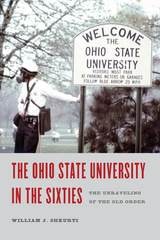
The Ohio State University in the Sixties
The Unraveling of the Old OrderWilliam J. Shkurti
The Ohio State University Press, 2016
Just a year earlier the campus seemed immune to such disruptions. President Nixon considered it safe enough to plan an address at commencement. Yet a year later the campus erupted into a spasm of violent protest exceeding even that of traditional hot spots like Berkeley and Wisconsin. How could conditions have changed so dramatically in just a few short months?
Using contemporary news stories, long overlooked archival materials, and first-person interviews, The Ohio State University in the Sixties explores how these tensions built up over years, why they converged when they did and how they forever changed the university.
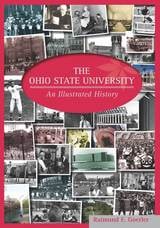
The Ohio State University
An Illustrated HistoryRaimund E. Goerler
The Ohio State University Press, 2011
Raimund E. Goerler, acclaimed archivist and historian, has written the definitive guidebook to the history of The Ohio State University, one of the world's largest universities and a prominent land-grant institution. Using a topical strategy—ranging widely through critical events in OSU's history, vignettes of prominent alumni, and stories of well known campus buildings, historic sites, presidents, student life, traditions, and athletics—The Ohio State University: An Illustrated History is the first one-volume history of the University to appear in more than fifty years.
The Opinionated University
Academic Freedom, Diversity, and the Myth of Neutrality in American Higher EducationBrian Soucek
University of Chicago Press, 2026
Can a university ever truly be neutral in today’s social and political climate? Pushing against the tide of universities increasingly pledging to stay neutral about contentious issues, law professor Brian Soucek argues that their promises are doomed to fail—universities can’t help being opinionated.
In The Opinionated University, Soucek shows that neutrality is a myth by taking a deep dive into several prominent campus controversies of the day, including diversity, equity, and inclusion (DEI) efforts and restrictions on campus speech and protest. Each issue requires universities to choose a side in what they do, if not also in what they say. In everything from curricular and admissions decisions to their response to outside rankings and their evaluation of faculty, universities express the values at the heart of their mission. Soucek argues that those pushing for neutrality are only preventing universities from standing up for their values, whether in today’s current moment of crisis or in periods of political calm.
Both timely and deeply engaging, The Opinionated University calls on universities to dispense with neutrality as a governing principle and focus instead on what their mission should be, and who should determine it.
The Other Boston Busing Story
What's Won and Lost Across the Boundary LineSusan E. Eaton
Brandeis University Press, 2020
The Other Side of Silence
Sign Language and the Deaf Community in AmericaArden Neisser
Gallaudet University Press, 1983
Arden Neisser’s classic book on American Sign Language (ASL) and the Deaf community is again available, with a new prologue. The Other Side of Silence explores the Deaf community through telling interviews and research from across the country.
In widely varying encounters, Neisser heard Deaf individuals recall how their teachers suppressed ASL, how linguists foster conflicting theories, and how various institutions of the deaf dilute ASL to suit hearing patrons. This seminal book reveals the warmth, creativity, and resilience of Deaf people, and offers an update of the community today.

The Other Tongue
English Across CulturesEdited by Braj B. Kachru
University of Illinois Press, 1992
When The Other Tongue appeared in 1982, it was called "required reading for all those concerned with English teaching in non-native situations, from the classroom teacher to the policy planner", Jowhn Platt, English World-Wide) and "an extremely useful and stimulating collection" (William C. Ritchie, Language). It introduced refreshingly new perspectives for understanding the spread and functions of English around the world.
This dramatically revised volume contains eight new chapters, replacing or updating more than half of the first edition. The Other Tongue is the first attempt to integrate and address provocative issues relevant to a deeper understanding of the forms and functions of English within different sociolinguistic, cross-cultural, and cross-linguistic contexts. The volume discusses linguistic, literary, pedagogical, and attitudinal issues related to world Englishes.

The Para-Academic Handbook
A Toolkit for Making-Learning-Creating-ActingAlex Wardrop
Intellect Books, 2014
Para-academics mimic academic practices so they are liberated from the confines of the university. Our work, and our lives, reflect how the idea of a university as a place for knowledge production, discussion and learning, has become distorted by neo-liberal market forces.
We create alternative, genuinely open access, learning-thinking-making-acting spaces on the internet, in publications, in exhibitions, discussion groups or through other mediums that seem appropriate to the situation. We don’t sit back and worry about our career developments paths. We write for the love of it; we think because we have to; we do it because we care.
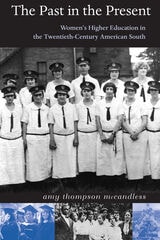
The Past in the Present
Women's Higher Education in the Twentieth-Century American SouthAmy T. McCandless
University of Alabama Press, 1999
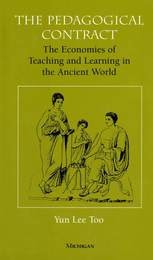
The Pedagogical Contract
The Economies of Teaching and Learning in the Ancient WorldYun Lee Too
University of Michigan Press, 2000
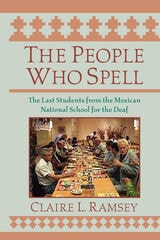
The People Who Spell
The Last Students from the Mexican National School for the DeafClaire L. Ramsey
Gallaudet University Press, 2011
The Escuela Nacional para Sordomudos (ENS), translated as the Mexican National School for the Deaf, opened its doors in the 1860s as part of the republic’s intention to educate its deaf people. The ENS did not use Lengua de Señas Mexicana (LSM), Mexico’s native sign language, for instruction, though they tolerated LSM use by the students. The school was closed permanently in 1972, thus leaving its former students still alive today as the last links to this historic institution. In this compelling social history, Claire L. Ramsey presents these unique Deaf Mexicans from their extraordinary experiences as ENS students and signers to their current personal lives.
One ENS signer, María de los Ángeles Bedolla, inspired the title of the book, The People Who Spell. In her account, she describes herself and her peers as cultured and educated compared to the young deaf people of today. The ENS signers pride themselves on el deletreo, LSM fingerspelling, which they consider key to their sophistication. Ramsey relates each of the signers’ childhoods, marriages, work experiences, and retirements. However, she brings threads of their stories together to reveal a common and abiding disappointment in modern-day Mexico’s failure to educate its deaf citizens according to the promise made more than 100 years ago. The narratives of the ENS signers detail their remarkable lives and heritage but also legitimately question the future of Mexico’s young deaf people.
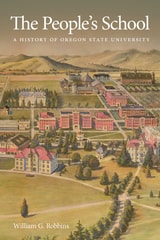
The People's School
A History of Oregon State UniversityWilliam Robbins
Oregon State University Press, 2017
This contextual approach is not to suggest that university presidents are unimportant. Benjamin Arnold (1872-1892), appointed president of Corvallis College by the Methodist Episcopal Church, South, served well beyond the date (1885) when the State of Oregon assumed control of the agricultural college. Robbins uses central administration records and grassroots sources—local and state newspapers, student publications (The Barometer, The Beaver), and multiple and wide-ranging materials published in the university’s digitized ScholarsArchive@OSU, a source for the scholarly work of faculty, students, and materials related to the institution’s mission and research activities. Other voices—extracurricular developments, local and state politics, campus reactions to national crises—provide intriguing and striking addendums to the university’s rich history.
The Perversity of Gratitude
An Apartheid EducationFarred, Grant
Temple University Press, 2024
Unsentimental about his education, Farred’s critique recognizes the impact of four exceptional teachers—all engaging pedagogical figures who cultivated a great sense of possibility in how thinking could be learned through a disenfranchised South African education.
The Perversity of Gratitude brings to bear the work of influential philosophers such as Martin Heidegger and Jacques Derrida. The book tackles broad philosophical concepts—transgression, withdrawal, and the dialectic. This leads to the creation of a new concept, “the diaspora-in-place,” which Farred explains, “is having left a place before one physically removes oneself from this place.”
Farred’s apartheid education in South Africa instilled in him a lifelong commitment to learning thinking. “And for that I am grateful,” Farred writes in The Perversity of Gratitude. His autopoiesis is sure to provoke and inspire readers.
The PhDictionary
A Glossary of Things You Don't Know (but Should) about Doctoral and Faculty LifeHerb Childress
University of Chicago Press, 2016
With more than two decades as a doctoral student, college teacher, and administrator, Herb Childress has tripped over almost every possible misunderstood term, run up against every arcane practice, and developed strategies to deal with them all. He combines current data and personal stories into memorable definitions of 150 key phrases and concepts graduate students will need to know (or pretend to know) as they navigate their academic careers. From ABD to white paper—and with buyout, FERPA, gray literature, and soft money in between—each entry contains a helpful definition and plenty of relevant advice. Wry and knowledgeable, Childress is the perfect guide for anyone hoping to scale the ivory tower.
The Philosophy of John Dewey
Volume 1. The Structure of Experience. Volume 2: The Lived ExperienceJohn Dewey
University of Chicago Press, 1981
John J. McDermott's anthology, The Philosophy of John Dewey, provides the best general selection available of the writings of America's most distinguished philosopher and social critic. This comprehensive collection, ideal for use in the classroom and indispensable for anyone interested in the wide scope of Dewey's thought and works, affords great insight into his role in the history of ideas and the basic integrity of his philosophy.
This edition combines in one book the two volumes previously published separately. Volume 1, "The Structure of Experience," contains essays on metaphysics, the logic of inquiry, the problem of knowledge, and value theory. In volume 2, "The Lived Experience," Dewey's writings on pedagogy, ethics, the aesthetics of the "live creature," politics, and the philosophy of culture are presented. McDermott has prefaced each essay with a helpful explanatory note and has written an excellent general introduction to the anthology.
The Pipeline Is Broken
Graduate Students of Color on Racism, Justice, and Joy in the AcademyOrly Clerge
Utah State University Press, 2026
The Pipeline Is Broken explores the reality of racial exclusion and bias in graduate student education, arguing that the insidious effects of structural and institutional racism substantially chip away at the very pipeline of future BIPOC academics—already limited for other racialized reasons.
A series of letters written by graduate students of color, this collection offers a multifaceted account of the challenges, oppositions, microaggressions, and outright discrimination that these students face in higher education settings. Graduate students describe navigating hostile mentoring relationships and unwelcoming campus cultures and peers and laboring for poverty wages to earn their degrees. Yet these letters celebrate joy, community, and agency, offering a more complete and affirming view of graduate student life. Through these brave personal stories, The Pipeline Is Broken asks readers to interrogate what it means to navigate higher education as a person of color and to understand that the reality of faculty of color’s numerical-minority status is a complicated phenomenon whose genesis rests not at the moment of job interview. Rather, these letters show, this status is an intricate manifestation of a process that begins in elementary schools, is reinforced in high schools and colleges, and is part and parcel of the minefield that is graduate education in America.
Essential reading for anyone who cares about racial equity in education, mentorship, leadership development, or student well-being, The Pipeline Is Broken is a guide, a mirror, and a call to action all in one, challenging graduate programs, faculty, and administrators to examine their complicity in maintaining inequitable systems and offering suggestions for building cultures of care.

The Pivot
One Pandemic, One UniversityRobert J. Bliwise
Duke University Press, 2022
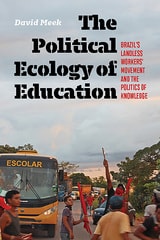
The Political Ecology of Education
Brazil's Landless Workers' Movement and the Politics of KnowledgeDavid Meek
West Virginia University Press, 2020
The Political Ecology of Education examines the opportunities for and constraints on advancing food sovereignty in the 17 de Abril settlement, a community born out of a massacre of landless Brazilian workers in 1996. Based on immersive fieldwork over the course of seven years, David Meek makes the provocative argument that critical forms of food systems education are integral to agrarian social movements’ survival. While the need for critical approaches is especially immediate in the Amazon, Meek’s study speaks to the burgeoning attention to food systems education at various educational levels worldwide, from primary to postgraduate programs. His book calls us to rethink the politics of the possible within these pedagogies.
The Political Use of Racial Narratives
School Desegregation in Mobile, Alabama, 1954-97Richard A. Pride
University of Illinois Press, 2002
Exploring who benefits and who pays when different narratives are accepted as true, Pride offers a step-by-step account of how Mobile's culture changed each time a new and more forceful narrative was used to justify inequality. More than a retelling of Mobile's story of desegregation, The Political Use of Racial Narratives promotes the value of rhetorical and narrative analysis in the social sciences and history.
The Politics of Appalachian Rhetoric
Amanda E Hayes
West Virginia University Press, 2018
In exploring the ways that Appalachian people speak and write, Amanda E. Hayes raises the importance of knowing and respecting communication styles within a marginalized culture. Diving deep into the region’s historical roots—especially those of the Scotch-Irish and their influence on her own Appalachian Ohio—Hayes reveals a rhetoric with its own unique logic, utility, and poetry.
Hayes also considers the headwinds against Appalachian rhetoric, notably ideologies about poverty and the biases of the school system. She connects these to challenges that Appalachian students face in the classroom and pinpoints pedagogical and structural approaches for change.
Throughout, Hayes blends conventional scholarship with autobiography, storytelling, and language, illustrating Appalachian rhetoric’s validity as a means of creating and sharing knowledge.
The Politics of Liberal Education
Darryl Gless and Barbara Herrnstein Smith, eds.
Duke University Press, 1992
Within this area of consensus, however, the contributors display a wide range of approaches, illuminating the issues from the perspectives of their particular disciplines—classics, education, English, history, and philosophy, among others—and their individual experiences as teachers. Among the topics they discuss are canon-formation in the ancient world, the idea of a “common culture,” and the educational implications of such social movements as feminism, technological changes including computers and television, and intellectual developments such as “theory.” Readers interested in the controversies over American education will find this volume an informed alternative to sensationalized treatments of these issues.
Contributors. Stanley Fish, Phyllis Franklin, Henry Louis Gates Jr., Henry A. Giroux, Darryl J. Gless, Gerald Graff, Barbara Herrnstein Smith, George A. Kennedy, Bruce Kuklick, Richard A. Lanham, Elizabeth Kamarck Minnich, Alexander Nehamas, Mary Louise Pratt, Richard Rorty, Eve Kosofsky Sedgwick

The Politics of School Reform, 1870 - 1940
Paul E. Peterson
University of Chicago Press, 1985
Drawing upon rarely examined archival data, Peterson demonstrates that widespread public backing for the common school existed in Atlanta, Chicago, and San Francisco. He finds little evidence of systematic discrimination against white immigrants, at least with respect to classroom crowding and teaching assignments. Instead, his research uncovers solid trade union and other working-class support for compulsory education, adequate school financing, and curricular modernization.
Urban reformers campaigned assiduously for fiscally sound, politically strong public schools. Often they had at least as much support from trade unionists as from business elites. In fact it was the business-backed machine politicians—from San Francisco's William Buckley to Chicago's Edward Kelly—who deprived the schools of funds. At a time when public schools are being subjected to searching criticism and when new educational ideas are gaining political support, The Politics of School Reform, 1870-1940 is a timely reminder of the strength and breadth of those groups that have always supported "free" public schools.
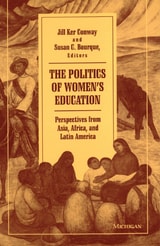
The Politics of Women's Education
Perspectives from Asia, Africa, and Latin AmericaJill Ker Conway and Susan C. Bourque, Editors
University of Michigan Press, 1995