
 A SCHOLARLY BOOK REPOSITORY
511 start with L start with L
Scholars at dinner.
In The Learned Banqueters, Athenaeus describes a series of dinner parties at which the guests quote extensively from Greek literature. The work (which dates to the very end of the second century AD) is amusing reading and of extraordinary value as a treasury of quotations from works now lost. Athenaeus also preserves a wide range of information about different cuisines and foodstuffs; the music and entertainments that ornamented banquets; and the intellectual talk that was the heart of Greek conviviality. S. Douglas Olson has undertaken to produce a complete new edition of the work, replacing the previous seven-volume Loeb Athenaeus (published under the title Deipnosophists).
Scholars at dinner.
In The Learned Banqueters, Athenaeus describes a series of dinner parties at which the guests quote extensively from Greek literature. The work (which dates to the very end of the second century AD) is amusing reading and of extraordinary value as a treasury of quotations from works now lost. Athenaeus also preserves a wide range of information about different cuisines and foodstuffs; the music and entertainments that ornamented banquets; and the intellectual talk that was the heart of Greek conviviality. S. Douglas Olson has undertaken to produce a complete new edition of the work, replacing the previous seven-volume Loeb Athenaeus (published under the title Deipnosophists).
Scholars at dinner.
In The Learned Banqueters, Athenaeus describes a series of dinner parties at which the guests quote extensively from Greek literature. The work (which dates to the very end of the second century AD) is amusing reading and of extraordinary value as a treasury of quotations from works now lost. Athenaeus also preserves a wide range of information about different cuisines and foodstuffs; the music and entertainments that ornamented banquets; and the intellectual talk that was the heart of Greek conviviality. S. Douglas Olson has undertaken to produce a complete new edition of the work, replacing the previous seven-volume Loeb Athenaeus (published under the title Deipnosophists).

In reproducing sixty-six letters in the Carl H. Pforzheimer Library, plus eight letters orportions of letters previously published, thisbook offers one of the best sources availablefor the last fourteen years of Browning'slife.
Written to a dear friend who was also a"learned lady," the letters deal with Browning's poetry, his social life, and his friendships. They also give some of his views onthe nature of poetry, of art, and of religion.The editor's introduction offers the readera view of Mrs. Fitzgerald and her family,of the social background with which manyof the letters are concerned, and of Browning, his sister, and his son.
Notes clarify the many allusions that appear in the letters. An appendix by MarcelleThiébaux includes careful bibliographicaldescriptions of the manuscripts and a classified list of the writing paper Browning used, information which should enable future editors to assign at least approximate dates tosome of the letters Browning himself leftundated.
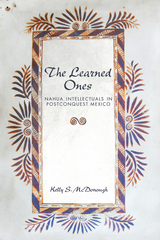
Not so, according to author Kelly S. McDonough, at least not for native speakers of Nahuatl, one of the most widely spoken and best-documented indigenous languages of the Americas. This book focuses on how Nahuas have been deeply engaged with the written word ever since the introduction of the Roman alphabet in the early sixteenth century. Dipping into distinct time periods of the past five hundred years, this broad perspective allows McDonough to show the heterogeneity of Nahua knowledge and writing as Nahuas took up the pen as agents of their own discourses and agendas.
McDonough worked collaboratively with contemporary Nahua researchers and students, reconnecting the theorization of a population with the population itself. The Learned Ones describes the experience of reading historic text with native speakers today, some encountering Nahua intellectuals and their writing for the very first time. It intertwines the written word with oral traditions and embodied knowledge, aiming to retie the strand of alphabetic writing to the dynamic trajectory of Nahua intellectual work.
In exploring the relationship between imaginative invention and that of allegory or fable, the essays in Learning from Other Worlds comment on the field’s most abiding concerns and employ a variety of critical approaches—from intellectual history and genre studies to biographical criticism, feminist cultural studies, and political textual analysis. Among the topics discussed are the works of John Wyndham, Kim Stanley Robinson, Stanislau Lem, H.G. Wells, and Ursula Le Guin, as well as the media’s reactions to the 1997 cloning of Dolly the Sheep. Darko Suvin’s characteristically outspoken and penetrating afterword responds to the essays in the volume and offers intimations of a further stage in his long and distinguished career.
This useful compendium and companion offers a coherent view of science fiction studies as it has evolved while paying tribute to the debt it owes Suvin, one of its first champions. As such, it will appeal to critics and students of science fiction, utopia, and fantasy writing.
Contributors. Marc Angenot, Marleen S. Barr, Peter Fitting, Carl Freedman, Edward James, Fredric Jameson, David Ketterer, Gerard Klein, Tom Moylan, Rafail Nudelman, Darko Suvin

Learning to Be Everyone and No One by Chard deNiord is a striking collection of candid, illuminating interviews with twelve of today’s most influential poets: Robert Hass, Robert Pinsky, Charles Simic, Ruth Stone, Gerald Stern, Chase Twichell, Major Jackson, Bruce Smith, Ada Limón, Dennis Nurkse, T. R. Hummer, and Halyna Kruk. Through piercing yet conversational dialogue, these literary giants share spontaneous, deeply personal reflections on their craft, careers, and the life experiences. This compelling volume is a vibrant tapestry of voices exploring the enduring power of poetry to confront issues of identity, politics, race, gender, and the environment. With wit, wisdom, and candor, these poets affirm why poetry remains “the news that stays the news.”
Since the mid-1960s, the war on crime has reshaped public attitudes about state authority, criminal behavior, and the responsibilities of citizenship. But how have American writers grappled with these changes? What happens when a journalist approaches the workings of organized crime not through its legendary Godfathers but through a workaday, low-level figure who informs on his mob? Why is it that interrogation scenes have become so central to prime-time police dramas of late? What is behind writers’ recent fascination with “cold case” homicides, with private security, or with prisons?
In Learning to Live with Crime, Christopher P. Wilson examines this war on crime and how it has made its way into cultural representation and public consciousness. Under the sway of neoconservative approaches to criminal justice and public safety, Americans have been urged to see crime as an inevitable risk of modern living and to accept ever more aggressive approaches to policing, private security, and punishment. The idea has been not simply to fight crime but to manage its risks; to inculcate personal vigilance in citizens; and to incorporate criminals’ knowledge through informants and intelligence gathering. At its most scandalous, this study suggests, contemporary law enforcement has even come to mimic crime’s own operations.
An experienced teacher of reading and writing and an award-winning historian, E. Jennifer Monaghan brings to vibrant life the process of learning to read and write in colonial America. Ranging throughout the colonies from New Hampshire to Georgia, she examines the instruction of girls and boys, Native Americans and enslaved Africans, the privileged and the poor, revealing the sometimes wrenching impact of literacy acquisition on the lives of learners.
For the most part, religious motives underlay reading instruction in colonial America, while secular motives led to writing instruction. Monaghan illuminates the history of these activities through a series of deeply researched and readable case studies. An Anglican missionary battles mosquitoes and loneliness to teach the New York Mohawks to write in their own tongue. Puritan fathers model scriptural reading for their children as they struggle with bereavement. Boys in writing schools, preparing for careers in counting houses, wield their quill pens in the difficult task of mastering a “good hand.” Benjamin Franklin learns how to compose essays with no teacher but himself. Young orphans in Georgia write precocious letters to their benefactor, George Whitefield, while schools in South Carolina teach enslaved black children to read but never to write.
As she tells these stories, Monaghan clears new pathways in the analysis of colonial literacy. She pioneers in exploring the implications of the separation of reading and writing instruction, a topic that still resonates in today's classrooms.
Monaghan argues that major improvements occurred in literacy instruction and acquisition after about 1750, visible in rising rates of signature literacy. Spelling books were widely adopted as they key text for teaching young children to read; prosperity, commercialism, and a parental urge for gentility aided writing instruction, benefiting girls in particular. And a gentler vision of childhood arose, portraying children as more malleable than sinful. It promoted and even commercialized a new kind of children's book designed to amuse instead of convert, laying the groundwork for the “reading revolution” of the new republic.
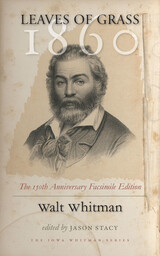
In May 1860, Walt Whitman published a third edition of Leaves of Grass. His timing was compelling. Printed during a period of regional, ideological, and political divisions, written by a poet intimately concerned with the idea of a United States as “essentially the greatest poem,” this new edition was Whitman’s last best hope for national salvation. Now available in a facsimile edition, Leaves of Grass, 1860 faithfully reproduces Whitman’s attempt to create a “Great construction of the New Bible” to save the nation on the eve of civil war and, for the first time, frames the book in historical rather than literary terms.
In his third edition, Whitman added 146 new poems to the 32 that comprised the second edition, reorganized the book into a bible of American civic religion that could be cited chapter and verse, and included erotic poetry intended to bind the nation in organic harmony. This 150th anniversary edition includes a facsimile reproduction of the original 1860 volume, a thought-provoking introduction by antebellum historian and Whitman scholar Jason Stacy that situates Whitman in nineteenth-century America, and annotations that provide detailed historical context for Whitman’s poems.
A profoundly rich product of a period when America faced its greatest peril, this third edition finds the poet transforming himself into a prophet of spiritual democracy and the Whitman we celebrate today—boisterous, barbaric, and benevolent. Reprinting it now continues the poet’s goal of proclaiming for “the whole of America for each / individual, without exception . . . uncompromising liberty and equality.”
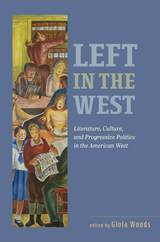
From the early 19th century to the present, a remarkably complex and varied body of literary and cultural production has emerged out of progressive social movements. While the literary left in the West shared many interests with other regional expressions—labor, class, anti-fascism, and anti-imperialism, the influence of Manifest Destiny—the distinct history of settler colonialism in western territories caused western leftists to develop concerns unique to the region.
Chapters in the volume provide an impressive range of analysis, covering artists and movements from suffragist writers to bohemian Californian photographers, from civil rights activists to popular folk musicians, from Latinx memoirists to Native American experimental writers, to name just a few.
The unique consideration of the West as a socio-political region establishes a framework for political critique that moves beyond class consequences, anti-fascism, and civil liberties, and into distinct Western concerns such as Native American sovereignty, environmental exploitation, and the legacies of settler colonialism. What emerges is a deeper understanding of the region and its unique people, places, and concerns.

The story of Don Juan first appeared in writing in seventeenth-century Spain, reaching Russia about a century later. Its real impact, however, was delayed until Russia’s most famous poet, Alexander Pushkin, put his own, unique, and uniquely inspirational, spin on the tale. Published in 1830, TheStone Guest is now recognized, with other Pushkin masterpieces, as part of the Russian literary canon. Alexander Burry traces the influence of Pushkin’s brilliant innovations to the legend, which he shows have proven repeatedly fruitful through successive ages of Russian literature, from the Realist to the Silver Age, Soviet, and contemporary periods. Burry shows that, rather than creating a simple retelling of an originally religious tale about a sinful, consummate seducer, Pushkin offered open-ended scenes, re-envisioned and complicated characters, and new motifs that became recursive and productive parts of Russian literature, in ways that even Pushkin himself could never have predicted.

Bartosik-Velez seeks to explain the meaning of Christopher Columbus throughout the so-called New World, first in the British American colonies and the United States, as well as in Spanish America, during the eighteenth and nineteenth centuries. She argues that, during the pre- and post-revolutionary periods, New World societies commonly imagined themselves as legitimate and powerful independent political entities by comparing themselves to the classical empires of Greece and Rome. Columbus, who had been construed as a figure of empire for centuries, fit perfectly into that framework. By adopting him as a national symbol, New World nationalists appeal to Old World notions of empire.
Considered by many to be the greatest writer of his generation, David Foster Wallace was at the height of his creative powers when he committed suicide in 2008. In a sweeping portrait of Wallace’s writing and thought and as a measure of his importance in literary history, The Legacy of David Foster Wallace gathers cutting-edge, field-defining scholarship by critics alongside remembrances by many of his writer friends, who include some of the world’s most influential authors.
With the untimely death of Edward W. Said in 2003, various academic and public intellectuals worldwide have begun to reassess the writings of this powerful oppositional intellectual. Figures on the neoconservative right have already begun to discredit Said’s work as that of a subversive intent on slandering America’s benign global image and undermining its global authority. On the left, a significant number of oppositional intellectuals are eager to counter this neoconservative vilification, proffering a Said who, in marked opposition to the “anti-humanism” of the great poststructuralist thinkers who were his contemporaries--Jacques Derrida, Jean-Francois Lyotard, Jacques Lacan, Louis Althusser, and Michel Foucault--reaffirms humanism and thus rejects poststructuralist theory.
In this provocative assessment of Edward Said’s lifework, William V. Spanos argues that Said’s lifelong anti-imperialist project is actually a fulfillment of the revolutionary possibilities of poststructuralist theory. Spanos examines Said, his legacy, and the various texts he wrote--including Orientalism,Culture and Imperialism, and Humanism and Democratic Criticism--that are now being considered for their lasting political impact.
Capturing the lively modernist milieu of Kenneth Burke’s early career in Greenwich Village, where Burke arrived in 1915 fresh from high school in Pittsburgh, this book discovers him as an intellectual apprentice conversing with “the moderns.” Burke found himself in the midst of an avant-garde peopled by Malcolm Cowley, Marianne Moore, Jean Toomer, Katherine Anne Porter, William Carlos Williams, Allen Tate, Hart Crane, Alfred Stieglitz, and a host of other fascinating figures.
Burke himself, who died in 1993 at the age of 96, has been hailed as America’s most brilliant and suggestive critic and the most significant theorist of rhetoric since Cicero. Many schools of thought have claimed him as their own, but Burke has defied classification and indeed has often been considered a solitary, eccentric genius immune to intellectual fashions. But Burke’s formative work of the 1920s, when he first defined himself and his work in the context of the modernist conversation, has gone relatively unexamined.
Here we see Burke living and working with the crowd of poets, painters, and dramatists affiliated with Others magazine, Stieglitz’s “291” gallery, and Eugene O’Neill’s Provincetown Players; the leftists associated with the magazines The Masses and Seven Arts; the Dadaists; and the modernist writers working on literary journals like The Dial, where Burke in his capacity as an associate editor saw T. S. Eliot’s “The Wasteland” into print for the first time and provided other editorial services for Thomas Mann, e.e. cummings, Ezra Pound, and many other writers of note. Burke also met the iconoclasts of the older generation represented by Theodore Dreiser and H. L. Mencken, the New Humanists, and the literary nationalists who founded Contact and The New Republic. Jack Selzer shows how Burke’s own early poems, fiction, and essays emerged from and contributed to the modernist conversation in Greenwich Village. He draws on a wonderfully rich array of letters between Burke and his modernist friends and on the memoirs of his associates to create a vibrant portrait of the young Burke’s transformation from aesthete to social critic.
In this tribute to Charlton Laird, ten scholars in the fields of language and linguistics provide ordinary readers with new insight into the workings of the English language. Laird, one of Nevada's treasured authors, was a professor of English at the University of Nevada, Reno.
From Biblical depictions of heroic warriors like King David to the medieval Jewish legend of the Golem (a fierce man of clay created by Cabalistic magic) to the fictional Alexander Portnoy, Jewish ideas of manhood reflect a simultaneous resistance and attraction to violence. According to Rosenberg, it is an ambivalence shaped by millennia of oppression as well as by the clash of Western ideas of masculinity with Eastern European rabbinical injunctions against violent action. The result has been not only gender confusion, but a suppressed rage evident in a broad range of texts created by Jewish men, from nineteenth-century Yiddish stories to contemporary Hollywood films. Isaac Babel, Henry Roth, Norman Mailer, Saul Bellow, Philip Roth, David Mamet, Barry Levinson, and Steven Spielberg are just some of the writers and filmmakers whose lives and works are marked by this legacy of rage.
Yet if the need to affirm masculinity through violence remains an unacknowledged aspect of Jewish male identity, Rosenberg argues, it is not a historical inevitability. As the work of Cynthia Ozick and Tony Kushner suggests, it is possible to construct new ideas of Jewish manhood by exposing the hidden fallacies of the old.

The Enlightenment has come under substantial attack over the past several years, with some going so far as to recommend leaving behind its thinkers and their Eurocentric prejudices. In response, the most orthodox defenders of the Enlightenment have insisted that its values are not just foundational but indispensable and that abandoning them would mean opening the door to nihilism and relativism. For Antoine Lilti, one of the leading scholars of the French Enlightenment, both sides are wrong.
In this tactfully argued series of essays, Lilti emphasizes a non-dogmatic, non-ideological view of the Enlightenment—one that sees its legacy as a critical, attentive approach that can and should serve as its own best critic. Along the way, he engages with everyone from Rousseau and Kant to Foucault and Habermas, as well as prominent contemporary voices, such as Jonathan Israel. The result is a remarkable new reading of the Enlightenment that redraws the stakes of old debates and offers an alternative way to engage with both canonical thinkers and later scholarship that is both honest about the past and useful for the future.
Alison A. Chapman argues that Milton’s Paradise Lost sits at the apex of the early modern period’s long fascination with law and judicial processes. Milton’s world saw law and religion as linked disciplines and thought therefore that in different ways, both law and religion should reflect the will of God. Throughout Paradise Lost, Milton invites his readers to judge actions using not only reason and conscience but also core principles of early modern jurisprudence. Law thus informs Milton’s attempt to “justify the ways of God to men” and points readers toward the types of legal justice that should prevail on earth.
Adding to the growing interest in the cultural history of law, The Legal Epic shows that England’s preeminent epic poem is also a sustained reflection on the role law plays in human society.
“I’m in a business where people come to me with troubles. Big troubles, little troubles, but always troubles they don’t want to take to the cops.” That’s Raymond Chandler’s Philip Marlowe, succinctly setting out our image of the private eye. A no-nonsense loner, working on the margins of society, working in the darkness to shine a little light.
The reality is a little different—but no less fascinating. In The Legendary Detective, John Walton offers a sweeping history of the American private detective in reality and myth, from the earliest agencies to the hard-boiled heights of the 1930s and ’40s. Drawing on previously untapped archival accounts of actual detective work, Walton traces both the growth of major private detective agencies like Pinkerton, which became powerful bulwarks against social and labor unrest and the motley, unglamorous work of small-time operatives. He then goes on to show us how writers like Dashiell Hammett and editors of sensational pulp magazines like Black Mask embellished on actual experiences and fashioned an image of the PI as a compelling, even admirable, necessary evil, doing society’s dirty work while adhering to a self-imposed moral code. Scandals, public investigations, and regulations brought the boom years of private agencies to an end in the late 1930s, Walton explains, in the process fully cementing the shift from reality to fantasy.
Today, as the private detective has long since given way to security services and armed guards, the myth of the lone PI remains as potent as ever. No fan of crime fiction or American history will want to miss The Legendary Detective.
In The Legitimacy of the Middle Ages, modernists and medievalists, as well as scholars specializing in eighteenth-, nineteenth-, and twentieth-century comparative literature, offer a new history of theory and philosophy through essays on secularization and periodization, Marx’s (medieval) theory of commodity fetishism, Heidegger’s scholasticism, and Adorno’s nominalist aesthetics. One essay illustrates the workings of medieval mysticism in the writing of Freud’s most famous patient, Daniel Paul Schreber, author of Memoirs of My Nervous Illness (1903). Another looks at Michael Hardt and Antonio Negri’s Empire, a theoretical synthesis whose conscientious medievalism was the subject of much polemic in the post-9/11 era, a time in which premodernity itself was perceived as a threat to western values. The collection concludes with an afterword by Fredric Jameson, a theorist of postmodernism who has engaged with the medieval throughout his career.
Contributors: Charles D. Blanton, Andrew Cole, Kathleen Davis, Michael Hardt, Bruce Holsinger, Fredric Jameson, Ethan Knapp, Erin Labbie, Jed Rasula, D. Vance Smith, Michael Uebel

Leibniz was first published in 1982. Minnesota Archive Editions uses digital technology to make long-unavailable books once again accessible, and are published unaltered from the original University of Minnesota Press editions.
The past fifteen years have witnessed a renaissance in the study of the history of philosophy, with special attention devoted to the seventeenth century and the work of Descartes and Leibniz. The essays in this collection open new pathways to the study of Leibniz, and will be welcomed not only by historians of philosophy but also by those contemporary philosophers who use logic and the philosophy of language to address metaphysical questions — since Leibniz was the first philosopher to do just that.
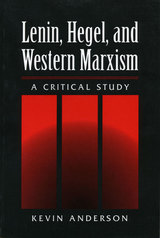
"With impressive argumentation
and wide-ranging scholarship, Anderson presents us with a Lenin that no
one seriously interested in current debates over the relevance of Marxist
theory to socialist practice can afford to miss." -- Bertell Ollman,
author of Dialectical Investigations
"An important contribution
to grasping the conceptual roots of Marxist theory and practice."
-- Tom Rockmore, author of Hegel's Circular Epistomology
"Today Lenin looks like
he did little more than prepare the way for Stalin. You will find the
opposite view in this novel study. . . . I recommend the book to anyone
seriously interested in Russia and revolution." -- George Uri Fischer,
author of The Soviet System and Modern Society
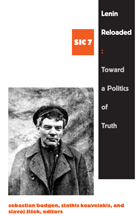
These essays, some of which are appearing in English for the first time, bring Lenin face-to-face with the problems of today, including war, imperialism, the imperative to build an intelligentsia of wage earners, the need to embrace the achievements of bourgeois society and modernity, and the widespread failure of social democracy. Lenin Reloaded demonstrates that truth and partisanship are not mutually exclusive as is often suggested. Quite the opposite—in the present, truth can be articulated only from a thoroughly partisan position.
Contributors. Kevin B. Anderson, Alain Badiou, Etienne Balibar, Daniel Bensaïd, Sebastian Budgen, Alex Callinicos, Terry Eagleton, Fredric Jameson, Stathis Kouvelakis, Georges Labica, Sylvain Lazarus, Jean-Jacques Lecercle, Lars T. Lih, Domenico Losurdo, Savas Michael-Matsas, Antonio Negri, Alan Shandro, Slavoj Žižek
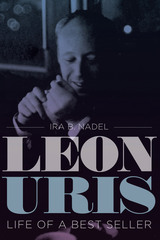
As the best-selling author of Exodus, Mila 18, QB VII, and Trinity, Leon Uris blazed a path to celebrity with books that readers could not put down. Uris's thirteen novels sold millions of copies, spent months on the best-seller lists, appeared in fifty languages, and have been adapted into equally popular movies and TV miniseries. Few other writers equaled Uris's fame in the mid-twentieth century. His success fueled the rise of mass-market paperbacks, movie tie-ins, and celebrity author tours. Beloved by the public, Uris was, not surprisingly, dismissed by literary critics. Until now, his own life—as full of drama as his fiction—has never been the subject of a book.
In Leon Uris: Life of a Best Seller, Ira Nadel traces Uris from his disruptive youth to his life-changing experiences as a marine in World War II. These experiences, coupled with Uris's embrace of his Judaism and desire to write, led to his unprecedented success and the lavish excesses of a career as a best-selling author. Nadel reveals that Uris lived the adventures he described, including his war experiences in the Pacific (Battle Cry), life-threatening travels in Israel (Exodus), visit to Communist Poland (Mila 18), libel trial in Britain (QB VII), and dangerous sojourn in fractious Northern Ireland and the Irish Republic (Trinity). Nadel also demonstrates that Uris's talent for writing action-packed, yet thoroughly researched, novels meshed perfectly with the public's desire to revisit and understand the tumultuous events of recent history. This made him far more popular (and wealthy) than more literary authors, while paving the way for writers such as Irving Wallace and Tom Clancy.

The twenty-five years after the Second World War were a lively and fertile period for the American novel and an era of momentous transformation in American society. Taking his title from the Kafka parable about the leopards who kept racing into the courtyard of the temple, disrupting the sacrifice, until they were made part of the ritual, Morris Dickstein shows how a daring band of outsiders reshaped the American novel and went on to dominate American fiction for the rest of the century.
In fluid prose, offering a social as well as a literary history, Dickstein provides a wide-ranging and frank reassessment of more than twenty key figures—including Jewish writers like Norman Mailer, Saul Bellow, and Philip Roth; African-Americans such as Ralph Ellison and James Baldwin; colorful emigrés like Vladimir Nabokov; and avatars of a new youth culture, including J. D. Salinger and Jack Kerouac.
Disputing the received wisdom about the culture of the Cold War, Dickstein shows why artists turned inward after the war and demonstrates how the writing of the 1960s emerged from the cultural ferment of the preceding decades, including road novels, avant-garde painting, bebop, film, psychoanalysis, and social changes that continue to affect us today.
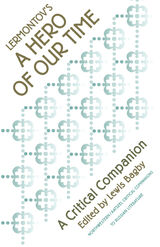

Lermontov's explorations of the virtues and limitations of heroic, self-reliant conduct have subsequently become obscured or misread. This new book focuses upon the peculiar, disturbing, and arguably most central feature of Russian culture: its suspicion of and hostility toward individual achievement and self-assertion. The analysis and interpretation of Lermontov's texts enables Golstein to address broader cultural issues by exploring the reasons behind the persistent misreading of Lermontov's major works and by investigating the cultural attitudes that shaped Russia's reaction to the challenges of modernity.

Mock trial—Roman style.
The Lesser Declamations, dating perhaps from the second century AD and attributed to Quintilian, might more accurately be described as emanating from “the school of Quintilian.” The collection—here made available for the first time in translation—represents classroom materials for budding Roman lawyers.
The instructor who composed these specimen speeches for fictitious court cases adds his comments and suggestions concerning presentation and arguing tactics—thereby giving us insight into Roman law and education. A wide range of scenarios is imagined. Some evoke the plots of ancient novels and comedies: pirates, exiles, parents and children in conflict, adulterers, rapists, and wicked stepmothers abound. Other cases deal with such matters as warfare between neighboring cities, smuggling, historical (and quasi-historical) events, tyrants and tyrannicides. Two gems are the speech opposing a proposal to equalize wealth, and the case of a Cynic youth who has forsworn worldly goods but sues his father for cutting off his allowance.
Of the original 388 sample cases in the collection, 145 survive. These are now added to the Loeb Classical Library in a two-volume edition, a fluent translation by D. R. Shackleton Bailey facing an updated Latin text.

Mock trial—Roman style.
The Lesser Declamations, dating perhaps from the second century AD and attributed to Quintilian, might more accurately be described as emanating from “the school of Quintilian.” The collection—here made available for the first time in translation—represents classroom materials for budding Roman lawyers.
The instructor who composed these specimen speeches for fictitious court cases adds his comments and suggestions concerning presentation and arguing tactics—thereby giving us insight into Roman law and education. A wide range of scenarios is imagined. Some evoke the plots of ancient novels and comedies: pirates, exiles, parents and children in conflict, adulterers, rapists, and wicked stepmothers abound. Other cases deal with such matters as warfare between neighboring cities, smuggling, historical (and quasi-historical) events, tyrants and tyrannicides. Two gems are the speech opposing a proposal to equalize wealth, and the case of a Cynic youth who has forsworn worldly goods but sues his father for cutting off his allowance.
Of the original 388 sample cases in the collection, 145 survive. These are now added to the Loeb Classical Library in a two-volume edition, a fluent translation by D. R. Shackleton Bailey facing an updated Latin text.
Memory, History, and Responsibility: Reassessments of the Holocaust, Implications for the Future contains the highlights from the ninth "Lessons and Legacies" conference. The conference, held during the height of the genocide in Darfur, sought to reexamine how the darkness of the Holocaust continues to shadow human existence more than sixty years after World War II left the Third Reich in ruins.
The collection opens with Saul Friedländer’s call for interdisciplinary approaches to Holocaust research. The essays that follow draw on the latest methodologies in the fields of history, literature, philosophy, religion, film, and gender studies, among others. Together both the leading scholars of the Holocaust and the next generation of scholars engage the difficult reality—as raised by editors Petropoulos, Rapaport, and Roth in their introduction—that the legacies of the Holocaust have not proved sufficient in intervening against human-made mass death, let alone preventing or eliminating it.
Primo Levi opened his memoir Survival in Auschwitz with a call to remember, reflect upon, and teach about the Holocaust—or to face the rejection of subsequent generations. The transmittal of this urgent knowledge between generations was the theme of the eighth Lessons and Legacies Conference on the Holocaust, and it is the focus of this volume. The circular formulation—from generation to generation—points backward and forward: where do we locate the roots of the Holocaust, and how do its repercussions manifest themselves? The contributors address these questions from various perspectives—history, cultural studies, psychiatry, literature, and sociology. They also bring to bear the personal aspect of associated issues such as continuity and rupture. What has the generation of the Shoah passed on to its descendants? What have subsequent generations taken from these legacies? Contributions by scholars, some of whom are survivors and children of survivors, remind us that the Holocaust does—and must—remain present from generation to generation.
The contributions to this volume not only indicate the intellectual vibrancy and diversity of cutting-edge research in Holocaust studies but also reflect multiple approaches to the necessary work of expanding the canon of research in the field and of adopting varied disciplinary perspectives, engaging with global perspectives as well as local studies.
This collection’s chapters manifest three broad categories: history, literature, and memory; at the same time, however, as the interdisciplinary nature of these chapters indicate, these categories should not be regarded as mutually exclusive or discrete. On the contrary, they overlap and intersect in compelling ways, demonstrating the dynamic character of contemporary Holocaust studies, which views history, narrative representation, and commemoration as mutually informative. Further, the contributors continue the recent trend in Holocaust studies whereby specific regional and national narratives are integrated into a more global approach to the event: Newer studies have continued to incorporate what was once termed the periphery into a more global examination of the experiences of Jewish refugees in flight to Latin America, Africa, and the Soviet Union. At the same time, very specific local studies deepen our knowledge of the mechanics of genocide, along with the experiences of refugees in flight, and the subsequent dimensions of Holocaust memory and representation.
Hicks explores the limitations of the sentimental tradition in war representation and asks how the work of artists and writers can help us to move beyond the constraints of that tradition. Ranging from Walt Whitman's writings on the Civil War to the U.S. wars in Iraq and Afghanistan, and focusing on the innovative and creative artistic expressions arising out of the wars of the former Yugoslavia, Hicks examines how war has been perceived, described, and interpreted. He analyzes the limitations on knowledge caused by perspective and narrative position and looks closely at the distinct yet overlapping roles of victims, observers, and aggressors. In the end, he concludes, war stories today should be valued according to the extent they make it impossible for us to see these positions as assigned in advance, and immutable.

“Trenchant and moving.”—Robert Boyers, Los Angeles Times
The inexhaustible man of letters directs his critical gaze at his own profession—teaching.
When we talk about education today, we tend to avoid the rhetoric of “mastery,” with its erotic and inegalitarian overtones. But the charged personal encounter between master and disciple is precisely what interests George Steiner in this book, a sustained reflection on the infinitely complex and subtle interplay of power, trust, and passions in the most profound sorts of pedagogy. Based on Steiner's 2001–2002 Norton Lectures on the art and lore of teaching, Lessons of the Masters evokes a host of exemplary figures, including Socrates and Plato, Virgil and Dante, Heloise and Abelard, Tycho Brahe and Johannes Kepler, Edmund Husserl and Martin Heidegger, along with spiritual leaders from Buddhist and Confucian sages to Jesus and the Baal Shem Tov.
Pivotal in the unfolding of Western culture are Socrates and Jesus, charismatic masters who left no written teachings and founded no schools. In the efforts of their disciples—and in the passion narratives inspired by their deaths—Steiner sees the beginnings of the inward vocabulary, the encoded recognitions of much of our moral, philosophical, and theological idiom. He goes on to consider a diverse array of traditions and disciplines, returning throughout to three underlying themes: the master's power to exploit his student's dependence and vulnerability; the complementary threat of subversion and betrayal of the mentor by his pupil; and the reciprocal exchange of trust and love, of learning and instruction between master and disciple.
Forcefully written and passionately argued, Lessons of the Masters is itself a masterly testament to the high vocation and perilous risks undertaken by true teacher and learner alike.
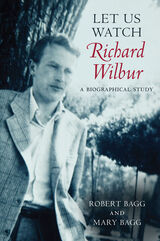
Pulitzer Prize–winning poet Richard Wilbur (b. 1921) is part of a notable literary cohort, American poets who came to prominence in the mid-twentieth century. Wilbur's verse is esteemed for its fluency, wit, and optimism; his ingeniously rhymed translations of French drama by Molière, Racine, and Corneille remain the most often staged in the English-speaking world; his essays possess a scope and acumen equal to the era's best criticism. This biography examines the philosophical and visionary depth of his world-renowned poetry and traces achievements spanning seventy years, from political editorials about World War II to war poems written during his service to his theatrical career, including a contentious collaboration with Leonard Bernstein and Lillian Hellman.
Wilbur's life has been mistakenly seen as blessed, lacking the drama of his troubled contemporaries. Let Us Watch Richard Wilbur corrects that view and explores how Wilbur's perceived “normality” both enhanced and limited his achievement. The authors augment the life story with details gleaned from access to his unpublished journals, family archives, candid interviews they conducted with Wilbur and his wife, Charlee, and his correspondence with Robert Lowell, Elizabeth Bishop, John Berryman, John Malcolm Brinnin, James Merrill, and others.

Ellis explores the curandera in relationship to decoloniality, bioethics, and the topic of healing while recognizing the limitations and spiritual shortcomings of Western medicine. Ellis argues that our contemporary western health-care system does not know how to fully grapple with illnesses that patients face. Ellis reads the curandera’s perennial representation as an ongoing example of decolonial love useful for deconstructing narrow definitions of health and personhood, and for grappling with the effects of neoliberalism and colonialism on the health-care industry.
Letras y Limpias draws from Chicana feminist theory to assert the importance of the mindbodyspirit connection. Ellis conveys theoretical insights about the continual reimagining of the figure of the curandera as a watermark across Mexican American literary texts. This literary figure points to the oppressive forces that create susto and reminds us that healing work requires specific attention to colonialism, its legacy, and an intentional choice to carry forward the traditional practices rooted in curanderismo passed on from prior generations. By turning toward the figure of the curandera, readers are better poised to challenge prevailing ideas about health, and imagine ways to confront the ongoing problems that coloniality creates. Letras y Limpias shows how the figure of the curandera offers us ways to heal that have nothing to do with copays or medical professionals refusing care, and everything to do with honoring the beauty and complexity of any, every, and all humans.
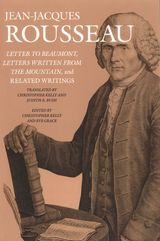

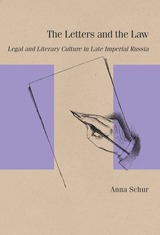
Anna Schur combines historical research and literary analysis to argue that the first generations of Russian trial lawyers shaped their professional identity with an eye to the celebrated figure of the writer and that they considered their own activities to be a form of verbal art. A fuller understanding of writers’ antipathy to the law, Schur contends, must take into account this overlooked cultural backdrop. Laced with the better‑known critique of the lawyer’s legalistic proclivities and lack of moral principle are the writer’s reactions to a whole network of explicit and implicit claims of similarity between the two professions’ goals, methods, and missions that were central to the lawyer’s professional ideal. Viewed in this light, writers’ critiques of the law and lawyers emerge as a concerted effort at protecting literature’s exclusive cultural status in the context of modernization and the rapidly expanding public sphere.
The study draws upon a mix of well-known and rarely studied nineteenth-century authors and texts—with particular attention paid to Fyodor Dostoevsky and Mikhail Saltykov-Shchedrin—and on a wide range of nonliterary sources, including courtroom speeches, guides to forensic oratory, legal treatises, and specialized press.
Belles lettres.
Sidonius Apollinaris, a Gallo-Roman, was born at Lugdunum (Lyon) about AD 430. He married Papianilla, daughter of the Emperor Avitus in whose honor he recited at Rome on 1 January 456 a panegyric in verse. Sidonius later joined a rebellion, it seems, but was finally reconciled to the emperor Majorian and delivered at Lyon in 458 a panegyric on him. After some years in his native land, in 467 he led a Gallo-Roman deputation to the Emperor Anthemius, and on 1 January 468 recited at Rome his third panegyric. He returned to Gaul in 469 and became Bishop of Auvergne with seat at Clermont-Ferrand. He upheld his people in resisting the Visigoths. After Auvergne was ceded to them in 475, he was imprisoned but soon resumed his bishopric. He was canonized after his death.
The Loeb Classical Library edition of Sidonius is in two volumes. The first contains his poetry: the three long panegyrics, and poems addressed to or concerned with friends, apparently written in his youth. Volume I also contains Books 1–2 of his Letters (all dating from before his episcopate); Books 3–9 are in Volume II. Sidonius’ writings shed valued light on Roman culture in the fifth century.
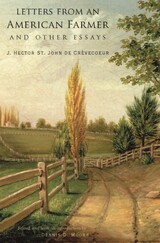
Letters from an American Farmer was published in London in 1782, just as the idea of an “American” was becoming a reality. Those epistolary essays introduced the European public to America’s landscape and customs and have since served as the iconic description of a then-new people. Dennis D. Moore’s convenient, up-to-date reader’s edition situates those twelve pieces from the 1782 Letters in the context of thirteen other essays representative of Crèvecoeur’s writings in English.
The “American Farmer” of the title is Crèvecoeur’s fictional persona Farmer James, a bumpkin from rural Pennsylvania. In his Introduction to this edition, Moore places this self-effacing pose in perspective and charts Crèvecoeur’s enterprising approach to self-promotion, which involved repackaging and adapting his writings for French and English audiences.
Born in Normandy, Crèvecoeur came to New York in the 1750s by way of England and then Canada, traveled throughout the colonies as a surveyor and trader, and was naturalized in 1765. The pieces he included in the 1782 Letters map a shift from hopefulness to disillusionment: its opening selections offer America as a utopian haven from European restrictions on personal liberty and material advancement but give way to portrayals of a land plagued by the horrors of slavery, the threat of Indian raids, and revolutionary unrest. This new edition opens up a broader perspective on this artful, ambitious writer and cosmopolitan thinker who coined America’s most enduring metaphor: a place where “individuals of all nations are melted into a new race of men.”
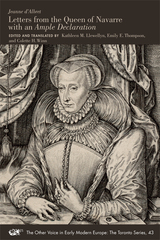
This edition presents in English, for the first time, Jeanne d’Albret’s Letters to the king, his mother, his brother, her own brother-in-law, and the queen of England, together with her Ample Declaration (1568) defending her decampment to the Protestant stronghold of La Rochelle. A historical-biographical introduction situates these writings in the larger context of Reformation politics and examines in detail the specific literary characteristics of her memoir. In her works, Jeanne d’Albret asserts her own position as legal sovereign of Béarn and Navarre and situates herself at the nexus of overlapping political, religious, and familial tensions.
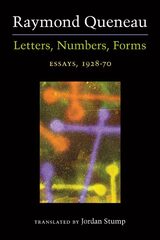
Compiled from two volumes of Raymond Queneau's essays (Bâtons, chiffres et lettres and Le Voyage en Grèce), these selections find Queneau at his most playful and at his most serious, eloquently pleading for a certain classicism even as he reveals the roots of his own wildly original oeuvre. Ranging from the funny to the furious, they follow Queneau from modernism to postmodernism by way of countless fascinating detours, including his thoughts on language, literary fashions, myth, politics, poetry, and other writers (Faulkner, Flaubert, Hugo, and Proust). Translator Jordan Stump provides an introduction as well as explanatory notes about key figures and Queneau himself.
Many years in preparation, this first volume of Lang and Shannon's edition of Tennyson's correspondence lives up to all expectations. In a comprehensive introduction the editors present not only the biographical background, with vivid portrayals of the dramatis personae, but also the story of the manuscripts, the ones that were destroyed and the many that luckily survived.
The Tennyson who emerges in this volume is not a serene or Olympian figure. He is moody, impulsive, often reckless, now full of camaraderie, now plagued by anxiety or resentment, deeply attached to close friends and family and uninterested in the social scene. His early life is unenviable: we see glimpses of the embittered, drunken father, the distraught mother, the swarm of siblings in the rectory at Somersby in Lincolnshire. The happiest period is the three years at Cambridge, terminated when his father dies, and the two years thereafter, with Arthur Hallam engaged to his sister and a frequent visitor at their house. The shock of Hallam's death in 1833, coupled with the savage attack on Tennyson's poems in the Quarterly Review, is followed by depression, bouts of alcoholism, financial problems, and gradually, in the 1840s, increasing recognition of his work. The year 1850 sees the publication of In Memoriam, his long-deferred marriage at age forty to Emily Seliwood, and his acceptance, not without misgivings, of the post of Poet Laureate.
The editors have garnered and selected a large number of letters to and about Tennyson which supplement his own letters, fill in lacunae in the narrative, and reveal him to us as his friends and contemporaries saw him.
The first volume of The Letters of Alfred Lord Tennyson showed the young manbecoming a poet and recorded the experiences--out of which so much of his poetrywas forged--that culminated in three personal triumphs: marriage, In Memoriam,and the Poet Laureateship. Volume IIreveals the gradual emergence of a new anddifferent Tennyson, moving confidentlyamong the great and famous--the intellectual, political, and artistic elite--yetremaining very much a son of Lincolnshire,whose childlike simplicity of manner strikesall who meet him. As a young man, he wasobliged to be paterfamilias of his father'sfamily; now he has a family of his own,with two sons reaching manhood, twohouses, and two lives, one in London andthe other at home.
Through the letters we learn somethingabout his poetry (including "Maud," andThe Idylls of the King), much abouthis dealings with publishers, and evenmore about his travels--in Scotland,Wales, Cornwall, Norway, Switzerland,Auvergne, Brittany, the Pyrenees--and itis clear that all that he met became part ofhim and of his poetry. By the close of thisvolume he is one of the two or three mostfamous names in the English-speakingliterary world.
The edition includes an abundance of letters to and about Tennyson as well as byhim, and its generous annotation has beencommended by reviewers for its range andwit.
Approximately 100 letters are published here for the first time, including almost all of the letters to Jane Humphrey and to Mrs. J. Howard Sweetser. The new material is even more extensive than it might appear, for many of the letters previously published were censored when first made public. This volume, designed to accompany Mr. Johnson’s previously published work, the widely acclaimed Poems of Emily Dickinson, assembles all of Emily Dickinson’s letters (with the exception of letters presumably destroyed). The editors present the letters chronologically, with manuscript location, previous publication data, and notes for each letter, together with a general introduction, and biographical notes on recipients of letters.
The notes for each letter identify persons and events mentioned, and the source of literary allusions and quotations is given wherever known. Since Emily Dickinson rarely dated her letters after 1850, the dates for the most part must be conjectured from careful study of handwriting changes and from internal evidence of the letters. Of the 1,150 letters and prose fragments included in this outstanding edition, the text of about 800 derives from Dickinson autographs.
Having been acquitted of the charge of “outrage of public morals and religion” brought against him upon the publication Madame Bovary, Gustave Flaubert found himself, in 1857, a celebrity and one of the most admired literary men of his day.
Francis Steegmuller’s volume of Flaubert’s letters from the years culminating in that triumph was hailed by the New York Times as “brilliantly edited and annotated…a splendid, intimate account of the development of a writer who changed the nature of the novel.” It went on to garner widespread critical acclaim and to win an American Book Award for Translation.
Now, in the second volume, we see Flaubert in the years of his fame—the years in which he wrote Salammbô, L’Éducation sentimentale, The Temptation of Saint Anthony, Three Tales, and the unfinished Bouvard and Pecuchet. In writing the novels, Flaubert followed his precept, “An author in his book must be like God in the universe, present everywhere and visible nowhere,” but in these letters of his maturity he gives full scope to his feelings and expresses forceful opinions on matters public and private.
We see Flaubert traveling to Tunisia to document the exotic Salammbô, then calling on his own memories and those of his friends to bring to life the Revolution of 1848 and the loves of his hero Frederic Moreau in the pages of L’Éducation sentimentale, which many today consider his greatest novel. Flaubert is taken up by the Second Empire Court of Napoleon III and Eugenie, and becomes a lifelong friend of Princess Mathilde Bonaparte. But the most powerful feminine presence in this volume is the warm, sympathetic George Sand, with whom he maintains a fascinating correspondence for more than ten years. This dialogue on life, letters, and politics between the “two troubadours,” as they called themselves, reveals both of them at their idiosyncratic best.
The deaths of Flaubert’s mother, of his closest friend and mentor, Louis Bouilhet, and of Théophile Gautier, Sainte-Beuve, and other intimates, and Flaubert’s financial ruin at the hands of his beloved niece Caroline and her rapacious husband, make a somber story of the post war years. Despite these and other losses, Flaubert’s last years are brightened by the affection of Guy de Maupassant, Zola, and other younger writers.
Together with Francis Steegmuller’s masterly connecting narrative and essential annotation, these letters, most of which appear here in English for the first time, constitute an intimate and engrossing new biography of the great master of the modern novel.
Gustave Flaubert wrote to his mistress, Louise Colet: “An author in his book must be like God in the universe, present everywhere and visible nowhere.” In his books, Flaubert sought to observe that principle; but in his many impassioned letters he allowed his feelings to overflow, revealing himself in all of his human complexity. Sensuous, witty, exalted, ironic, grave, analytical, the letters illustrate the artist’s life—and they trumpet his artistic opinions—in an outpouring of uninhibited eloquence.
An acknowledged master of translation, Francis Steegmuller has given us by far the most generous and varied selection of Flaubert’s letters in English. He presents these with an engrossing narrative that places them in the context of the writer’s life and times. We follow Flaubert through his unhappy years at law school, through his tumultuous affair with Louise Colet; we share his days and nights amid the temples and brothels of Egypt, then on to Palestine, Turkey, Greece, and Rome. And the letters chronicle one of the central events in literary history—the conception and composition of what has been called the first modern novel, Madame Bovary. Steegmuller’s selection concludes with Flaubert’s standing trial for immoral writing, Madame Bovary’s immediate popular success, and Baudelaire’s celebration of its psychological and literary power.
Throughout this exposition in Flaubert’s own words of his views on life, literature, and the passions, readers of his novels will be powerfully reminded of the fertility of his genius, and delighted by his poetic enthusiasm. “Let us sing to Apollo as in ancient days,” he wrote to Louise Colet, “and breathe deeply of the fresh cold air of Parnassus; let us strum our guitars and clash our cymbals and whirl like dervishes in the eternal hubbub of forms and ideas!”
Flaubert’s letters are documents of life and art; lovers of literature and of the literary adventure can rejoice in this edition.
Here at last is the first volume of the long-awaited edition of Henry James letters by the world’s foremost Jamesian scholar, Leon Edel.
James was a superlative letter-writer; his correspondence constitutes one of the greatest self-portraits in all literature. In this edition Edel, respecting James’s view that only the best of a writer’s letters deserve publication, skims the cream of the fifteen thousand letters collected or discovered, many by the biographer himself, since the novelist’s death in 1916. In Volume I, the first of four, he provides a General Introduction and a necessary minimum of annotation, and prefaces each section—Boyhood and Youth; Beginnings; The Grand Tour; A Season in Cambridge; Travel and Opportunity; and The Choice—with an informative account of James’s attitudes and activities during the period in question. The volume closes, appropriately, with James’s decision in 1875, at age thirty-two, to move permanently to Europe.
The third volume of Leon Edel’s superb edition of Henry James’s letters finds the novelist settled in Europe and his expatriation complete. The letters of this time reflect the growth of James’s literary and personal friendships and introduce the reader to the frescoed palazzos, Palladian villas, and great estates of the Roseberys, the Rothschilds, the Bostonian-Venetian Curtises, and the Florentine-American Boott circle. In all his travels, James closely observes the social scene and the dilemmas of the human beings within it. During this fruitful period he writes The Bostonians, The Princess Casamassima, The Tragic Muse, and some thirty-five of his finest international tales.
Undermining his success, however, are a devastating series of disappointments. Financial insecurity, an almost paraniod defensiveness following the utter failure of his dramatic efforts, and the deaths of his sister, his friend Robert Louis Stevenson, and his ardent admirer Constance Fenimore Woolson all combine to take him to what he recognizes is the edge of an abyss of personal tragedy.
And yet James endures, and throughtout these trials his letters reveal the flourish, the tongue-in-cheek humor, and the social insight that marked his genius. As Edel writes in his Introduction: “The grand style is there, the amusement at the vanities of this world, the insistence that the great ones of the earth lack the imagination he is called upon to supply, and then his boundless affection and empathy for those who have shown him warmth and feeling.”
In an appendix Mr. Edel presents four remarkable unpublished letters from Miss Woolson to James. These throw light on their ambiguous relationship and on James’s feelings of guilt and shock after her suicide in Venice.
In this, the second volume of Leon Edel's superb edition of the letters, we see Henry James in his thirties, pursuing his writing in Paris and London and finding his first literary successes in Daisy Miller and The Portrait of a Lady. The letters of these years, describing for family and friends in Boston the expatriate's days, reveal the usual wit and sophistication, but there is a new tone: James is relentlessly building a personal career and begins to see himself as a professional writer. Few other letters so fully document the process of an artist in the making.
James was a social success in London: in Mr. Edel's words, "England speedily opened its arms to him, as it does to anyone who is at ease with the world." The letters of this period pull us into the atmosphere of Victorian England, its drawing rooms, manors, and clubs, and James's keen American eyes give us views of this world probably unique in our literary annals. He used these observations to forge his great international theme, the confrontation of the Old and New Worlds.
Volumes III and IV of this edition bring together all the extant letters of Henry Wadsworth Longfellow for the period 1844-1865, most of which have never before been published. These letters carry Longfellow through the remarkable period when he was gaining renown both at home and abroad as the poet laureate of America. His influence swelled with the publication of such works as Evangeline, The Song of Hiawatha, The Courtship of Miles Standish, and Part One of Tales of a Wayside Inn. During these twenty-two years his correspondence proliferated, reaching at least 4000 letters, of which 1500 are known to have survived and are reproduced in these two volumes.
The letters offer further insight not only into the poet's personal life but into his time as well. They document the manifold burdens placed on a popular man of letters, from responding to pleas for advice from unpublished poets to dealing with critical attacks on his own poetry to warding off the importunities of scores of admirers.
The letters further reveal a political interest not hitherto suspected in Longfellow. His exchanges with Senator Charles Sumner shed light on the political dramas of the day, including presidential elections, the Mexican War, the slavery controversy, the founding of the Republican party, and the Civil War. From a social viewpoint, the letters provide an absorbing account of the settled and elegant life of a member of the Boston-Cambridge upper class, into which Longfellow had moved with his marriage to Frances Appleton. They also reveal him as a warm-hearted family man, devoted to his wife and children and solicitous for the welfare of an unhappy brother, a widowed sister, and two wayward nephews.
The letters of Volume III span the publication of five volumes of verse, three anthologies, and a novel. They document the numerous private events that vied with literary production for Longfellow's attention, such as the birth of his six children and the complicated summer migrations to Nahant or Newport. They also follow Longfellow through his resignation from the liaryard professorship in 1854, which was prompted by a desire to devote himself more fully to writing.
Andrew Hilen, who is author of Longfellow and Scandinavia and Professor of English at the University of Washington, has included numerous contemporary photographs to illustrate the letters. His scrupulous annotations supply relevant identifications of individuals, explain allusions, and provide information regarding the addresses of letters, endorsements, postmarks, and the location of manuscripts.
These final volumes of Andrew Hilen's admired edition bring together the extant Longfellow letters of 1866–1882, most of which have never before been published. During this period Longfellow's reputation reached its zenith; no American poet before or since has enjoyed a popular following more varied or numerous. Here we see him expanding his already enormous influence with the publication of Poems of Places, a poetic translation of Dante's Divine Comedy, and other works. The letters reveal him as a hard-working writer and editor, as an astute businessman who nevertheless gave freely of his gains to friends and causes, and as an often lonely and struggling individual.
They provide, as well, a view of Longfellow's world—the American literary scene, the publishing business, academic life, politics, religion, and the Reconstruction period. Hilen includes in Volume VI a comprehensive index for the entire six-volume edition, which represents a social document of the times.
Volumes I and II of this projected multi-volume edition bring together for the first time all the extant letters of Henry Wadsworth Longfellow for the period 1814–1843. Most of the letters, which are of prime importance in America’s cultural history, have never before been published. The remainder that have appeared in print frequently did so in emasculated form and in a wide variety of books and journals. In addition to restoring the complete texts of this correspondence, editor Andrew Hilen has provided a distinguished General Introduction in Volume I and prefatory comments at the head of Parts I–IV of the two volumes. Scrupulous annotations supply relevant identifications of individuals, explain allusions, and present information regarding the addresses of letters, endorsements, postmarks, and the location of manuscripts.
Readers of the letters of this period will follow Longfellow through his career at Bowdoin College, both as an undergraduate and as a professor, on his lengthy sojourns in Europe, and through his first years as Smith Professor of Modern Languages at Harvard. They offer a wealth of material that is available nowhere else on many of the leading issues of his day, on its literary and scholarly scene, and most important, on the development of the poet himself. Longfellow emerges from these pages as far more than the mild and studied figure that tradition has made of him.
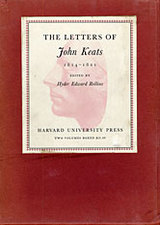
For many years one of the most serious needs in the literary world has been for a definitive edition of the letters of Keats. Now one of the world's foremost Keats authorities, Hyder Edward Rollins of Harvard, has prepared a completely new edition of all the extant letters, with an extensive listing of the letters presumed missing.
With impeccable scholarship and total faithfulness to the originals, Professor Rollins here is able to redate and rearrange sixty of the letters. Through full documentation for each letter, understanding of the content is considerably amplified both through the correction of errors, and through application of the results of the editor's life-long study of Keats and his work. In addition to many letters from Keats' relatives and friends, the present work includes seven letters or other documents signed or written by Keats that appear in no English edition, and also new texts of seven other letters by the poet. Furthermore, all the letters known only in Woodhouse's transcripts and in Jeffrey's transcripts are here printed for the first time exactly as Woodhouse and Jeffrey copied them.
The letters of Joseph Severn describing the last illness and death of Keats are given in their entirety. These letters are invaluable historically and biographically, and are also exceptionally good reading.
For many years one of the most serious needs in the literary world has been for a definitive edition of the letters of Keats. Now one of the world's foremost Keats authorities, Hyder Edward Rollins of Harvard, has prepared a completely new edition of all the extant letters, with an extensive listing of the letters presumed missing.
With impeccable scholarship and total faithfulness to the originals, Professor Rollins here is able to redate and rearrange sixty of the letters. Through full documentation for each letter, understanding of the content is considerably amplified both through the correction of errors, and through application of the results of the editor's life-long study of Keats and his work. In addition to many letters from Keats' relatives and friends, the present work includes seven letters or other documents signed or written by Keats that appear in no English edition, and also new texts of seven other letters by the poet. Furthermore, all the letters known only in Woodhouse's transcripts and in Jeffrey's transcripts are here printed for the first time exactly as Woodhouse and Jeffrey copied them.
The letters of Joseph Severn describing the last illness and death of Keats are given in their entirety. These letters are invaluable historically and biographically, and are also exceptionally good reading.
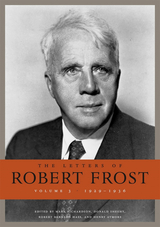
The third installment of Harvard’s five-volume edition of Robert Frost’s correspondence.
The Letters of Robert Frost, Volume 3: 1929–1936 is the latest installment in Harvard’s five-volume edition of the poet’s correspondence. It presents 601 letters, of which 425 are previously uncollected. The critically acclaimed first volume, a Times Literary Supplement Book of the Year, included nearly 300 previously uncollected letters, and the second volume 350 more.
During the period covered here, Robert Frost was close to the height of his powers. If Volume 2 covered the making of Frost as America’s poet, in Volume 3 he is definitively made. These were also, however, years of personal tribulation. The once-tight Frost family broke up as marriage, illness, and work scattered the children across the country. In the case of Frost’s son Carol, both distance and proximity put strains on an already fractious relationship. But the tragedy and emotional crux of this volume is the death of Frost’s youngest daughter, Marjorie. Frost’s correspondence from those dark days is a powerful testament to the difficulty of honoring the responsibilities of a poet’s eminence while coping with the intensity of a parent’s grief.
Volume 3 also sees Frost responding to the crisis of the Great Depression, the onset of the New Deal, and the emergence of totalitarian regimes in Europe, with wit, canny political intelligence, and no little acerbity. All the while, his star continues to rise: he wins a Pulitzer for Collected Poems in 1931 and will win a second for A Further Range, published in 1936, and he is in constant demand as a public speaker at colleges, writers’ workshops, symposia, and dinners. Frost was not just a poet but a poet-teacher; as such, he was instrumental in defining the public functions of poetry in the twentieth century. In the 1930s, Frost lived a life of paradox, as personal tragedy and the tumults of politics interwove with his unprecedented achievements.
Thoroughly annotated and accompanied by a biographical glossary and detailed chronology, these letters illuminate a triumphant and difficult period in the life of a towering literary figure.

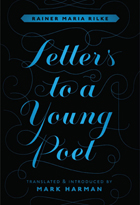
In 1902, a nineteen-year-old aspiring poet named Franz Kappus wrote to Rainer Maria Rilke, then twenty-six, seeking advice on his poetry. Kappus, a student at a military academy in Vienna similar to the one Rilke had attended, was about to embark on a career as an officer, for which he had little inclination. Touched by the innocence and forthrightness of the student, Rilke responded to Kappus’ letter and began an intermittent correspondence that would last until 1908.
Letters to a Young Poet collects the ten letters that Rilke wrote to Kappus. A book often encountered in adolescence, it speaks directly to the young. Rilke offers unguarded thoughts on such diverse subjects as creativity, solitude, self-reliance, living with uncertainty, the shallowness of irony, the uselessness of criticism, career choices, sex, love, God, and art. Letters to a Young Poet is, finally, a life manual. Art, Rilke tells the young poet in his final letter to him, is only another way of living.
With the same artistry that marks his widely acclaimed translations of Kafka’s The Castle and Amerika: The Missing Person, Mark Harman captures the lyrical and spiritual dimensions of Rilke’s prose. In his introduction, he provides biographical contexts for the reader and discusses the challenges of translating Rilke. This lovely hardcover edition makes a perfect gift for any young person starting out in life or for those interested in finding a clear articulation of Rilke’s thoughts on life and art.

The private correspondence of Rome’s most prolific public figure.
To his dear friend Atticus, Cicero reveals himself as to no other of his correspondents except perhaps his brother. In Cicero's Letters to Atticus we get an intimate look at his motivations and convictions and his reactions to what is happening in Rome. These letters also provide a vivid picture of a momentous period in Roman history, years marked by the rise of Julius Caesar and the downfall of the Republic.
When the correspondence begins in November 68 BC, the 38-year-old Cicero is a notable figure in Rome: a brilliant lawyer and orator, he has achieved primacy at the Roman bar and a political career that would culminate in the consulship in 63. Over the next twenty-four years—until November 44, a year before he was put to death by the forces of Octavian and Mark Antony—Cicero wrote frequently to his friend and confidant, sharing news and views and discussing affairs of business and state. It is to this corpus of over 400 letters that we owe most of our information about Cicero's literary activity. Here too is a revealing picture of the staunch republican's changing attitude toward Caesar. And taken as a whole the letters provide a first-hand account of social and political life in Rome.
D. R. Shackleton Bailey's authoritative edition and translation of the Letters to Atticus is a revised version of his Cambridge Classical Texts and Commentaries edition, with full explanatory notes.

The private correspondence of Rome’s most prolific public figure.
To his dear friend Atticus, Cicero reveals himself as to no other of his correspondents except perhaps his brother. In Cicero's Letters to Atticus we get an intimate look at his motivations and convictions and his reactions to what is happening in Rome. These letters also provide a vivid picture of a momentous period in Roman history, years marked by the rise of Julius Caesar and the downfall of the Republic.
When the correspondence begins in November 68 BC, the 38-year-old Cicero is a notable figure in Rome: a brilliant lawyer and orator, he has achieved primacy at the Roman bar and a political career that would culminate in the consulship in 63. Over the next twenty-four years—until November 44, a year before he was put to death by the forces of Octavian and Mark Antony—Cicero wrote frequently to his friend and confidant, sharing news and views and discussing affairs of business and state. It is to this corpus of over 400 letters that we owe most of our information about Cicero's literary activity. Here too is a revealing picture of the staunch republican's changing attitude toward Caesar. And taken as a whole the letters provide a first-hand account of social and political life in Rome.
D. R. Shackleton Bailey's authoritative edition and translation of the Letters to Atticus is a revised version of his Cambridge Classical Texts and Commentaries edition, with full explanatory notes.

The private correspondence of Rome’s most prolific public figure.
To his dear friend Atticus, Cicero reveals himself as to no other of his correspondents except perhaps his brother. In Cicero's Letters to Atticus we get an intimate look at his motivations and convictions and his reactions to what is happening in Rome. These letters also provide a vivid picture of a momentous period in Roman history, years marked by the rise of Julius Caesar and the downfall of the Republic.
When the correspondence begins in November 68 BC, the 38-year-old Cicero is a notable figure in Rome: a brilliant lawyer and orator, he has achieved primacy at the Roman bar and a political career that would culminate in the consulship in 63. Over the next twenty-four years—until November 44, a year before he was put to death by the forces of Octavian and Mark Antony—Cicero wrote frequently to his friend and confidant, sharing news and views and discussing affairs of business and state. It is to this corpus of over 400 letters that we owe most of our information about Cicero's literary activity. Here too is a revealing picture of the staunch republican's changing attitude toward Caesar. And taken as a whole the letters provide a first-hand account of social and political life in Rome.
D. R. Shackleton Bailey's authoritative edition and translation of the Letters to Atticus is a revised version of his Cambridge Classical Texts and Commentaries edition, with full explanatory notes.

The private correspondence of Rome’s most prolific public figure.
To his dear friend Atticus, Cicero reveals himself as to no other of his correspondents except perhaps his brother. In Cicero's Letters to Atticus we get an intimate look at his motivations and convictions and his reactions to what is happening in Rome. These letters also provide a vivid picture of a momentous period in Roman history, years marked by the rise of Julius Caesar and the downfall of the Republic.
When the correspondence begins in November 68 BC, the 38-year-old Cicero is a notable figure in Rome: a brilliant lawyer and orator, he has achieved primacy at the Roman bar and a political career that would culminate in the consulship in 63. Over the next twenty-four years—until November 44, a year before he was put to death by the forces of Octavian and Mark Antony—Cicero wrote frequently to his friend and confidant, sharing news and views and discussing affairs of business and state. It is to this corpus of over 400 letters that we owe most of our information about Cicero's literary activity. Here too is a revealing picture of the staunch republican's changing attitude toward Caesar. And taken as a whole the letters provide a first-hand account of social and political life in Rome.
D. R. Shackleton Bailey's authoritative edition and translation of the Letters to Atticus is a revised version of his Cambridge Classical Texts and Commentaries edition, with full explanatory notes.

The private correspondence of Rome’s most prolific public figure.
Cicero (Marcus Tullius, 106–43 BC), Roman lawyer, orator, politician, and philosopher, of whom we know more than of any other Roman, lived through the stirring era that saw the rise, dictatorship, and death of Julius Caesar in a tottering republic. In his political speeches especially and in his correspondence we see the excitement, tension and intrigue of politics and the part he played in the turmoil of the time. Of about 106 speeches, delivered before the Roman people or the Senate if they were political, before jurors if judicial, fifty-eight survive (a few of them incompletely). In the fourteenth century Petrarch and other Italian humanists discovered manuscripts containing more than 900 letters of which more than 800 were written by Cicero and nearly 100 by others to him. These afford a revelation of the man all the more striking because most were not written for publication. Six rhetorical works survive and another in fragments. Philosophical works include seven extant major compositions and a number of others; and some lost. There is also poetry, some original, some as translations from the Greek.
The Loeb Classical Library edition of Cicero is in twenty-nine volumes.

The private correspondence of Rome’s most prolific public figure.
Cicero (Marcus Tullius, 106–43 BC), Roman lawyer, orator, politician, and philosopher, of whom we know more than of any other Roman, lived through the stirring era that saw the rise, dictatorship, and death of Julius Caesar in a tottering republic. In his political speeches especially and in his correspondence we see the excitement, tension and intrigue of politics and the part he played in the turmoil of the time. Of about 106 speeches, delivered before the Roman people or the Senate if they were political, before jurors if judicial, fifty-eight survive (a few of them incompletely). In the fourteenth century Petrarch and other Italian humanists discovered manuscripts containing more than 900 letters of which more than 800 were written by Cicero and nearly 100 by others to him. These afford a revelation of the man all the more striking because most were not written for publication. Six rhetorical works survive and another in fragments. Philosophical works include seven extant major compositions and a number of others; and some lost. There is also poetry, some original, some as translations from the Greek.
The Loeb Classical Library edition of Cicero is in twenty-nine volumes.

The private correspondence of Rome’s most prolific public figure.
Cicero (Marcus Tullius, 106–43 BC), Roman lawyer, orator, politician, and philosopher, of whom we know more than of any other Roman, lived through the stirring era that saw the rise, dictatorship, and death of Julius Caesar in a tottering republic. In his political speeches especially and in his correspondence we see the excitement, tension and intrigue of politics and the part he played in the turmoil of the time. Of about 106 speeches, delivered before the Roman people or the Senate if they were political, before jurors if judicial, fifty-eight survive (a few of them incompletely). In the fourteenth century Petrarch and other Italian humanists discovered manuscripts containing more than 900 letters of which more than 800 were written by Cicero and nearly 100 by others to him. These afford a revelation of the man all the more striking because most were not written for publication. Six rhetorical works survive and another in fragments. Philosophical works include seven extant major compositions and a number of others; and some lost. There is also poetry, some original, some as translations from the Greek.
The Loeb Classical Library edition of Cicero is in twenty-nine volumes.
The seventy-three surviving letters written by Florentine widow, Alessandra Macinghi Strozzi (c.1406–1471), to her distant sons first appeared in print well over a century ago, but are here translated into English in their entirety for the first time. Whether for the professional historian or for the general reader interested in Renaissance Florence, they constitute a most precious testimony regarding both private and public life in the mid-fifteenth century, with themes ranging from familial relations, motherhood, marriage, and aspects of material culture to the harsh realities of political exile meted out by the Medici to their perceived opponents, these latter including her husband and, subsequently, her sons.
Salinger continues to maintain his silence, but Holden Caulfield, Franny and Zooey, and Seymour Glass—the unforgettable characters of his novel and short stories—continue to speak to generations of readers and writers. Letters to Salinger includes more than 150 personal letters addressed to Salinger from well-known writers, editors, critics, journalists, and other luminaries, as well as from students, teachers, and readers around the world, some of whom have just discovered Salinger for the first time. Their voices testify to the lasting impressions Salinger’s ideas and emotions have made on so many diverse lives.
Contributors include Marvin Bell, Frederick Busch, Stephen Collins, Nicholas Delbanco, Warren French, Herbert Gold, W. P. Kinsella, Molly McQuade, Stewart O’Nan, Robert O’Connor, Ellis Paul, Molly Peacock, Sanford Pinsker, George Plimpton, Gerald Rosen, Sid Salinger, David Shields, Joseph Skibell, Melanie Rae Thon, Alma Luz Villanueva, Katharine Weber, and many others

Celebrated by both the Black Mountain poets in the 1950s and 1960s and the Language poets in the 1970s and 1980s, Larry Eigner’s poems occupy an important place in American poetry and poetics, and his reputation and legacy grow seemingly stronger with each passing year. Letters to Jargon collects all of the known correspondence between Larry Eigner and Jonathan Williams, the influential publisher of Jargon Society Press and himself a poet.
Eigner’s correspondence with Williams began in the early 1950s, as the two were in conversation over the manuscript of On My Eyes, published by Jargon in 1960. Their correspondence continued for many years thereafter, extending into the period when Eigner’s work started to gain recognition from the nascent movement that would become known as “Language” writing.
The letters are quite broad in their range of reference and provide a fuller context for Eigner’s poetry and thinking. Eigner and Williams discuss their own poetic practices, including the source material for specific poems, general writing practices, and small press and little magazine publication. This volume offers considerable insight into their shared literary communities as Eigner reports on his readings in contemporary poetry and poetics, as well as his correspondence and contact with other poets including Charles Olson, Vincent Ferrini, Robert Duncan, Denise Levertov, Robert Grenier, and Barrett Watten.
Also recorded are Eigner’s reactions to current events and explications of his own poems, including the contexts for appropriated lines and distinctions of character spacing. Eigner also shares with Williams details of his home life, his financial difficulties and the daily challenges of his cerebral palsy. Finally, the book features a series of images of the original letters, enabling readers to see Eigner’s specific material-textual practices.

When John Millington Synge and Molly Allgood fell in love, he was thirty-five, she nineteen. Neither knew that he had Hodgkin’s disease, of which he was to die in three years. Synge had already achieved recognition as a playwright—translations of two of his plays had been performed in Berlin and Prague—and he was codirector, with Yeats and Lady Gregory, of the Irish National Theatre Society. Allgood had started her acting career the year before, in the newly opened Abbey Theatre, with a walk-on part in Synge’s Well of the Saints. She had been promoted from crowd scenes to bit parts to lead roles in Riders to the Sea and The Shadow of the Glen. She was still only a member of the company, however, while Synge was a director, whose codirectors disapproved of fraternization. Synge and Allgood also faced the disapproval of two widowed mothers. Barring an occasional holiday trip or company road tour, they could seldom be alone together, except on secret afternoon meetings for long walks in the country. Hence their hundreds of letters.
Molly Allgood’s letters do not survive; they apparently were destroyed when Synge died. But his letters convey her mercurial charm, her openness, her love of life, her impulsiveness, and her temper—as violent as his own. What they convey of him (when he is not reproving her or remonstrating with her, as he does in the early months of their relationship) is the love of nature, the poetic language, the bittersweet irony, the elemental quality of emotion, that we know from the plays. His concern for his craft is seen as he struggles with The Playboy. (“Parts of it are not structurally strong or good. I have been all this time trying to get over weak situations by strong writing, but now I find it won’t do, and I am at my wit’s end.”) Synge was quite unperturbed by the violent outrage and near-riots the play provoked. (“Now we’ll be talked about. We’re an event in the history of the Irish stage,” he wrote cheerily.)
As his illness progresses, following operations in 1907 and 1908, there is great poignancy in the gradual abating of references to marriage plans and in the shift of salutation from “Dearest Changeling” to “My dearest child.” After Synge’s death his friends and biographers discreetly avoided mention of Allgood, who under her stage name of Maire O’Neill became one of the leading actresses of the Irish theater and lived until 1952. His letters to her have not been published before, except for the few quoted in Greene and Stephens’s 1959 biography. A primary source for the study of Synge and the Irish theater movement, the letters include poems inspired by Allgood and extensive information about Abbey Theatre business.
In addition to a biographical introduction, Ann Saddlemyer has included a map of the Wicklow and Dublin areas and numerous photographs of both Synge and Allgood.

Private correspondence and dubious disquisitions.
Cicero had an affectionate relationship with his only brother, Quintus, down to the closing years of their lives. The letters from Cicero to him in this collection offer an intimate look at their world. Cicero’s close friendship with the intensely intellectual Brutus was signalized by Cicero’s dedication of his prized Orator to Brutus. The correspondence between the two collected here dates from the spring and summer of 43 BC, and it conveys some of the drama of the period following the assassination of Julius Caesar.
Shackleton Bailey also provides in this volume a new text and translation of two invective speeches purportedly delivered in the Senate: Sallust attacking Cicero and Cicero attacking Sallust. These are probably anonymous ancient schoolbook exercises, but have come down to us with the works of Sallust and Cicero. Another work in the same category, the Letter to Octavian ostensibly by Cicero but probably dating from the third or fourth century AD, is included as well. Here too (with text by Shackleton Bailey and revised introduction and translation by M. I. Henderson) is the Handbook of Electioneering, a guide said to be written by Quintus to his brother, advising him on campaigning for the consulship of 63 BC. Whether or not this is genuinely the work of Quintus, it remains an interesting treatise on Roman elections. Letter fragments complete the volume; these were not previously available in the Loeb Classical Library.
Theodore Dreiser led a long and controversial life, almost always pursuing some serious question, and not rarely pursuing women. This collection, the second volume of Dreiser correspondence to be published by the University of Illinois Press, gathers previously unpublished letters Dreiser wrote to women between 1893 and 1945, many of them showing personal feelings Dreiser revealed nowhere else. Here he both preens and mocks himself, natters and scolds, relates his jaunts with Mencken and his skirmishes with editors and publishers. He admits his worries, bemoans his longings, and self-consciously embarks on love letters that are unafraid to smolder and flame. To one reader he sends “Kisses, Kisses, Kisses, for your sweety mouth” and urges his needy requests: “Write me a love-letter Honey girl.” Alongside such amorous play, he often expressed his deepest feelings on philosophical, religious, and social issues that characterize his public writing.
Chronologically arranged and meticulously edited by Thomas P. Riggio, these letters reveal how wide and deep Dreiser’s needs were. Dreiser often discussed his writing in his letters to women friends, telling them what he wanted to do, where he thought he succeeded and failed, and seeking approval or criticism. By turns seductive, candid, coy, and informative, these letters provide an intimate view of a master writer who knew exactly what he was after.
Correspondence from a distinguished and eventful life.
The Younger Pliny was born in AD 61 or 62, the son of Lucius Caecilius of Comum (Como) and the Elder Pliny’s sister. He was educated at home and then in Rome under Quintilian. He was at Misenum at the time of the eruption of Vesuvius in 79 (described in two famous letters) when the Elder Pliny died.
Pliny started his career at the Roman bar at the age of eighteen. He moved through the regular offices in a senator’s career, held two treasury appointments and a priesthood, and was consul in September and October 100. On this occasion he delivered the speech of thanks to the emperor Trajan which he afterwards expanded and published as the Panegyricus. After his consulship he returned to advocacy in the court and Senate, and was also president of the Tiber Conservancy Board. His hopes of retirement were cut short when he was chosen by Trajan to go out to the province of Bithynia and Pontus on a special commission as the emperor’s direct representative. He is known to have been there two years, and is presumed to have died there before the end of 113. Book 10 of the Letters contains his correspondence with Trajan during this period, and includes letters about the early Christians.
Pliny's Letters are important as a social document of his times. They tell us about the man himself and his wide interests, and about his many friends, including Tacitus, Martial, and Suetonius. Pliny has a gift for description and a versatile prose style, and more than any of his contemporaries he gives an unprejudiced picture of Rome as he knew it.
The Loeb Classical Library edition of Pliny the Younger is in two volumes; the second contains Books 8–10 of his Letters and Panegyricus.
Correspondence of a Cappadocian Father.
Basil the Great was born ca. AD 330 at Caesarea in Cappadocia into a family noted for piety. He was at Constantinople and Athens for several years as a student with Gregory of Nazianzus and was much influenced by Origen. For a short time he held a chair of rhetoric at Caesarea, and was then baptized. He visited monasteries in Egypt and Palestine and sought out the most famous hermits in Syria and elsewhere to learn how to lead a pious and ascetic life; but he decided that communal monastic life and work were best. About 360 he founded in Pontus a convent to which his sister and widowed mother belonged. Ordained a presbyter in 365, in 370 he succeeded Eusebius in the archbishopric of Caesarea, which included authority over all Pontus. He died in 379. Even today his reform of monastic life in the east is the basis of modern Greek and Slavonic monasteries.
The Loeb Classical Library edition of Basil’s Letters is in four volumes.
Correspondence from a distinguished and eventful life.
The Younger Pliny was born in AD 61 or 62, the son of Lucius Caecilius of Comum (Como) and the Elder Pliny’s sister. He was educated at home and then in Rome under Quintilian. He was at Misenum at the time of the eruption of Vesuvius in 79 (described in two famous letters) when the Elder Pliny died.
Pliny started his career at the Roman bar at the age of eighteen. He moved through the regular offices in a senator’s career, held two treasury appointments and a priesthood, and was consul in September and October 100. On this occasion he delivered the speech of thanks to the emperor Trajan which he afterwards expanded and published as the Panegyricus. After his consulship he returned to advocacy in the court and Senate, and was also president of the Tiber Conservancy Board. His hopes of retirement were cut short when he was chosen by Trajan to go out to the province of Bithynia and Pontus on a special commission as the emperor’s direct representative. He is known to have been there two years, and is presumed to have died there before the end of 113. Book 10 of the Letters contains his correspondence with Trajan during this period, and includes letters about the early Christians.
Pliny's Letters are important as a social document of his times. They tell us about the man himself and his wide interests, and about his many friends, including Tacitus, Martial, and Suetonius. Pliny has a gift for description and a versatile prose style, and more than any of his contemporaries he gives an unprejudiced picture of Rome as he knew it.
The Loeb Classical Library edition of Pliny the Younger is in two volumes; the first contains Books 1–7 of his Letters and an Introduction.
Correspondence of a Cappadocian Father.
Basil the Great was born ca. AD 330 at Caesarea in Cappadocia into a family noted for piety. He was at Constantinople and Athens for several years as a student with Gregory of Nazianzus and was much influenced by Origen. For a short time he held a chair of rhetoric at Caesarea, and was then baptized. He visited monasteries in Egypt and Palestine and sought out the most famous hermits in Syria and elsewhere to learn how to lead a pious and ascetic life; but he decided that communal monastic life and work were best. About 360 he founded in Pontus a convent to which his sister and widowed mother belonged. Ordained a presbyter in 365, in 370 he succeeded Eusebius in the archbishopric of Caesarea, which included authority over all Pontus. He died in 379. Even today his reform of monastic life in the east is the basis of modern Greek and Slavonic monasteries.
The Loeb Classical Library edition of Basil’s Letters is in four volumes.
Correspondence of a Cappadocian Father.
Basil the Great was born ca. AD 330 at Caesarea in Cappadocia into a family noted for piety. He was at Constantinople and Athens for several years as a student with Gregory of Nazianzus and was much influenced by Origen. For a short time he held a chair of rhetoric at Caesarea, and was then baptized. He visited monasteries in Egypt and Palestine and sought out the most famous hermits in Syria and elsewhere to learn how to lead a pious and ascetic life; but he decided that communal monastic life and work were best. About 360 he founded in Pontus a convent to which his sister and widowed mother belonged. Ordained a presbyter in 365, in 370 he succeeded Eusebius in the archbishopric of Caesarea, which included authority over all Pontus. He died in 379. Even today his reform of monastic life in the east is the basis of modern Greek and Slavonic monasteries.
The Loeb Classical Library edition of Basil’s Letters is in four volumes.
Correspondence of a Cappadocian Father.
Basil the Great was born ca. AD 330 at Caesarea in Cappadocia into a family noted for piety. He was at Constantinople and Athens for several years as a student with Gregory of Nazianzus and was much influenced by Origen. For a short time he held a chair of rhetoric at Caesarea, and was then baptized. He visited monasteries in Egypt and Palestine and sought out the most famous hermits in Syria and elsewhere to learn how to lead a pious and ascetic life; but he decided that communal monastic life and work were best. About 360 he founded in Pontus a convent to which his sister and widowed mother belonged. Ordained a presbyter in 365, in 370 he succeeded Eusebius in the archbishopric of Caesarea, which included authority over all Pontus. He died in 379. Even today his reform of monastic life in the east is the basis of modern Greek and Slavonic monasteries.
The Loeb Classical Library edition of Basil’s Letters is in four volumes.
Stories accompany us through life from birth to death. But they do not merely entertain, inform, or distress us—they show us what counts as right or wrong and teach us who we are and who we can imagine being. Stories connect people, but they can also disconnect, creating boundaries between people and justifying violence. In Letting Stories Breathe, Arthur W. Frank grapples with this fundamental aspect of our lives, offering both a theory of how stories shape us and a useful method for analyzing them. Along the way he also tells stories: from folktales to research interviews to remembrances.
Frank’s unique approach uses literary concepts to ask social scientific questions: how do stories make life good and when do they endanger it? Going beyond theory, he presents a thorough introduction to dialogical narrative analysis, analyzing modes of interpretation, providing specific questions to start analysis, and describing different forms analysis can take. Building on his renowned work exploring the relationship between narrative and illness, Letting Stories Breathe expands Frank’s horizons further, offering a compelling perspective on how stories affect human lives.
READERS
Browse our collection.
PUBLISHERS
See BiblioVault's publisher services.
STUDENT SERVICES
Files for college accessibility offices.
RECENTLY PUBLISHED


UChicago Accessibility Resources
home | accessibility | search | about | contact us
BiblioVault ® 2001 - 2026
The University of Chicago Press