
 A SCHOLARLY BOOK REPOSITORY
In Mary Austin’s Southwest, editors Blackbird and Nelson shine light on Austin’s work, revealing her to be a significant trailblazer for literary diversity. With thoughtful introductions to selected writings on Austin’s prose, drama, and poetry as well as an annotated checklist of her published Southwestern literary criticism, this collection is a celebration of a rich mixed heritage as expressed through the written word.
A genteel southern intellectual, saloniste, and wife to a prominent colonel in Jefferson Davis’s inner circle, Mary Chesnut today is remembered best for her penetrating Civil War diary. Composed between 1861 and 1865 and revised thoroughly from the late 1870s until Chesnut’s death in 1886, the diary was published first in 1905, again in 1949, and later, to great acclaim, in 1981. This complicated literary history and the questions that attend it—which edition represents the real Chesnut? To what genre does this text belong?—may explain why the document largely has, until now, been overlooked in literary studies.
Julia A. Stern’s critical analysis returns Chesnut to her rightful place among American writers. In Mary Chesnut’s Civil War Epic, Stern argues that the revised diary offers the most trenchant literary account of race and slavery until the work of Faulkner and that, along with his Yoknapatawpha novels, it constitutes one of the two great Civil War epics of the American canon. By restoring Chesnut’s 1880s revision to its complex, multidecade cultural context, Stern argues both for Chesnut’s reinsertion into the pantheon of nineteenth-century American letters and for her centrality to the literary history of women’s writing as it evolved from sentimental to tragic to realist forms.

Mary Climbs In illuminates this once overlooked but increasingly important and multi-faceted conversation about female audiences for Springsteen’s music. Drawing on unique surveys of fans themselves, the study offers insight into women’s experiences in their own voices. Authors Lorraine Mangione and Donna Luff explore the depth of women fans’ connection to Springsteen and the profound ways this connection has shaped their lives. Reflections from fans enliven each page as readers journey through the camaraderie and joy of concerts, the sorrow and confusion of personal loss and suffering, the love and closeness of community, and the search for meaning and for the self. Viewed through a psychological lens, women fans’ relationship with Springsteen is revealed in all its complexity as never before. Mary Climbs In is an important interdisciplinary contribution to the growing field of Springsteen studies and a must-read for any fan.
An entire chapter (surah) is dedicated to her, and she is the only woman mentioned by name in the Qur’an—indeed, her name appears more frequently than that of either Muhammad or Jesus. From the earliest times to the present day, Mary, the mother of Jesus, continues to be held in high regard by Christians and Muslims alike, yet she has also been the cause of much tension between these two religions.
In this groundbreaking study, Muna Tatari and Klaus von Stosch painstakingly reconstruct the picture of Mary that is presented in the Qur’an and show how veneration of the Blessed Virgin Mary in the Roman Catholic Church intersects and interacts with the testimony of the Qur’an. This sensitive and scholarly treatise offers a significant contribution to contemporary interfaith dialogue.
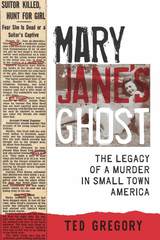
Fast forward fifty years. Eccentric entrepreneur Michael Arians moves to Oregon, opens a roadhouse, gets elected mayor, and becomes obsessed with the crime. He comes up with a scandalous conspiracy theory and starts to believe that Mary Jane’s ghost is haunting his establishment. He also reaches out to the Chicago Tribune for help.
Arians’s letter falls on the desk of general assignment reporter Ted Gregory. For the next thirteen years, while he ricochets from story to story and his newspaper is deconstructed around him, Gregory remains beguiled by the case of the teenaged telephone operator Mary Jane and twenty-eight-year-old Navy vet Stanley—and equally fascinated by Arians’s seemingly hopeless pursuit of whoever murdered them. Mary Jane’s Ghost is the story of these two odysseys.
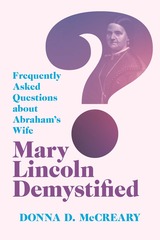
Answering the most enigmatic questions about Mary Lincoln’s life
After portraying Mary Lincoln in hundreds of performances and giving lectures over a more than thirty-year career, Donna D. McCreary has fielded every imaginable inquiry about the First Lady. Gathered here, readers will find answers to the most frequently asked questions to come from live audiences. This first question-and-answer book arises directly from a public’s enduring curiosity with one the country’s most important historical figures. Decades of conversations with audiences, scholars, and relatives of the Todd family frame McCreary’s intimate and devoted research to offer a new and unique portrait of the most tragic First Lady.
Though Mary has been portrayed in books and film, McCreary’s book contains information not found elsewhere—details others have overlooked and those that would not fit well into a narrative history—such as lists of Mary’s beaus, servants, and the people the Todd family enslaved; appendixes that present mini-biographies of families and friends; and a uniquely thorough timeline. Mary Lincoln Demystified covers areas in which McCreary’s audiences have expressed the most interest: Mary’s sanity, her family relationships, her views on slavery and African Americans, her personality and habits, and what happened to her possessions and children after she died.
While sympathetic to the woman she portrayed for two decades, McCreary examines both sides of controversial issues and presents the facts with her trademark style and flair. More than a good read, McCreary’s Q&A factbook, based as it is on decades of extensive research in primary and secondary sources, will be the definitive resource for answers about Mary for years to come.
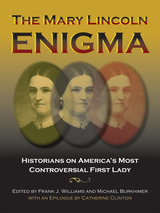
Mary Lincoln is a lightning rod for controversy. Stories reveal widely different interpretations, and it is impossible to write a definitive version of her life that will suit everyone. The thirteen engaging essays in this collection introduce Mary Lincoln’s complex nature and show how she is viewed today.
The authors’ explanations of her personal and private image stem from a variety of backgrounds, and through these lenses—history, theater, graphic arts, and psychiatry—they present their latest research and assessments. Here they reveal the effects of familial culture and society on her life and give a broader assessment of Mary Lincoln as a woman, wife, and mother. Topics include Mary’s childhood in Kentucky, the early years of her marriage to Abraham, Mary’s love of travel and fashion, the presidential couple’s political partnership, and Mary’s relationship with her son Robert.
The fascinating epilogue meditates on Mary Lincoln’s universal appeal and her enigmatic personality, showcasing the dramatic differences in interpretations. With gripping prose and in-depth documentation, this anthology will capture the imagination of all readers.
University Press Books for Public and Secondary Schools 2013 edition
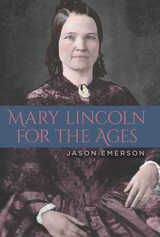
Mary Lincoln for the Ages first articulates how reliance on limited sources has greatly restricted our understanding of the subject, evaluating their flaws and benefits and pointing out the shallowness of using the same texts to study her life. Emerson then presents more than four hundred bibliographical entries of nonfiction books and pamphlets, scholarly and popular articles, journalism, literature, and juvenilia. More than just listings of titles and publication dates, each entry includes Emerson’s deft analysis of these additional works on Mary Lincoln that should be used—but rarely have been—to better understand who she was during her life and why we see her as we do. The volume also includes rarely used illustrations, including some that have never before appeared in print.
A roadmap for a firmer, more complete grasp of Mary Lincoln’s place in the historical record, this is the first and only extensive, analytical bibliography of the subject. In highlighting hundreds of overlooked sources, Emerson changes the paradigm of Mary Lincoln’s legacy.
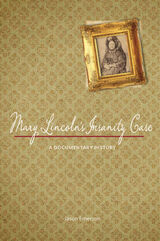
In 1875 Mary Lincoln, the widow of a revered president, was committed to an insane asylum by her son, Robert. The trial that preceded her internment was a subject of keen national interest. The focus of public attention since Abraham Lincoln's election in 1860, Mary Lincoln had attracted plentiful criticism and visible scorn from much of the public, who perceived her as spoiled, a spendthrift, and even too much of a Southern sympathizer. Widespread scrutiny only increased following her husband's assassination in 1865 and her son Tad's death six years later, after which her overwhelming grief led to the increasingly erratic behavior that led to her being committed to a sanitarium. A second trial a year later resulted in her release, but the stigma of insanity stuck. In the years since, questions emerged with new force, as the populace and historians debated whether she had been truly insane and subsequently cured, or if she was the victim of family maneuvering.
In this volume, noted Lincoln scholar Jason Emerson provides a documentary history of Mary Lincoln's mental illness and insanity case, evenhandedly presenting every possible primary source on the subject to enable a clearer view of the facts. Beginning with documents from the immediate aftermath of her husband's assassination and ending with reminiscences by friends and family in the mid-twentieth century, Mary Lincoln's Insanity Case: A Documentary History compiles more than one hundred letters, dozens of newspaper articles, editorials, and legal documents, and the daily patient progress reports from Bellevue Place Sanitarium during Mary Lincoln's incarceration. Including many materials that have never been previously published, Emerson also collects multiple reminiscences, interviews, and diaries of people who knew Mary Lincoln or were involved in the case, including the first-hand recollection of one of the jurors in the 1875 insanity trial.
Suggesting neither accusation nor exoneration of the embattled First Lady, Mary Lincoln's Insanity Case: A Documentary History gives scholars and history enthusiasts incomparable access to the documents and information crucial to understanding this vexing chapter in American history.

Mary McCarthy - American Writers 72 was first published in 1968. Minnesota Archive Editions uses digital technology to make long-unavailable books once again accessible, and are published unaltered from the original University of Minnesota Press editions.
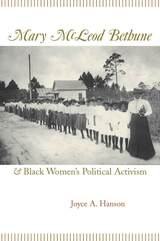
Mary McLeod Bethune was a significant figure in American political history. She devoted her life to advancing equal social, economic, and political rights for blacks. She distinguished herself by creating lasting institutions that trained black women for visible and expanding public leadership roles. Few have been as effective in the development of women’s leadership for group advancement. Despite her accomplishments, the means, techniques, and actions Bethune employed in fighting for equality have been widely misinterpreted.
Examining the historical evolution of African American women’s activism in the critical period between 1920 and 1950, a time previously characterized as “doldrums” for both feminist and civil rights activity, Mary McLeod Bethune and Black Women’s Political Activism is important for understanding the centrality of black women to the political fight for social, economic, and racial justice.
The physical signs of Roman Catholicism pervade the Mexican countryside. Colonial churches and neighborhood chapels, wayside shrines, and mountaintop crosses dot the landscape. Catholicism also permeates the traditional cultures of rural communities, although this ideational influence is less immediately obvious. It is often couched in enigmatic idiom and imagery, and it is further obscured by the vestiges of pagan customs and the anticlerical attitudes of many villagers. These heterodox tendencies have even led some observers to conclude that Catholicism in rural Mexico is little more than a thin veneer on indigenous practice.
In Mary, Michael, and Lucifer John M. Ingham attempts to develop a modern semiotic and structuralist interpretation of traditional Mexican culture, an interpretation that accounts for the culture's apparent heterodoxy. Drawing on field research in Tlayacapan, Morelos, a village in the central highlands, he shows that nearly every domain of folk culture is informed with religious meaning. More precisely, the Catholic categories of spirit, nature, and evil compose the basic framework of the villagers' social relations and subjective experiences.
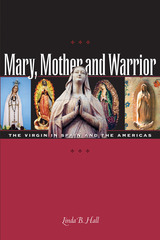
A Mother who nurtures, empathizes, and heals... a Warrior who defends, empowers, and resists oppression... the Virgin Mary plays many roles for the peoples of Spain and Spanish-speaking America. Devotion to the Virgin inspired and sustained medieval and Renaissance Spaniards as they liberated Spain from the Moors and set about the conquest of the New World. Devotion to the Virgin still inspires and sustains millions of believers today throughout the Americas.
This wide-ranging and highly readable book explores the veneration of the Virgin Mary in Spain and the Americas from the colonial period to the present. Linda Hall begins the story in Spain and follows it through the conquest and colonization of the New World, with a special focus on Mexico and the Andean highlands in Peru and Bolivia, where Marian devotion became combined with indigenous beliefs and rituals. Moving into the nineteenth century, Hall looks at national cults of the Virgin in Mexico, Bolivia, and Argentina, which were tied to independence movements. In the twentieth century, she examines how Eva Perón linked herself with Mary in the popular imagination; visits contemporary festivals with significant Marian content in Spain, Peru, and Mexico; and considers how Latinos/as in the United States draw on Marian devotion to maintain familial and cultural ties.
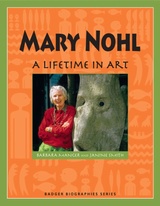
LOOK INSIDE THE LIFE — AND HOME — OF LEGENDARY 'OUTSIDER' ARTIST MARY NOHL
"Mary Nohl: A Lifetime in Art" by Barbara Manger and Janine Smith, tells the story of Milwaukee-born artist, Mary Nohl. A prolific and fanciful maker who worked in a variety of media, Nohl was both a mysterious figure and an iconic "outsider" artist. This new addition to the Badger Biographies series captures her life and will capture the imagination of readers, and artists, of all ages.
Nohl didn't just make art — she lived it. From the time she was young, Mary enjoyed making things, from the model airplane that won her a citywide prize to assignments in shop class, where she learned to work with tools.
Her interests in art blossomed during the years she spent training at the Art Institute of Chicago, leading to a lifetime of curiosity and ventures into new artistic media. From pottery to silver jewelry and oil painting to concrete sculpture, Mary explored new ways of making art. Many of her pieces were made from found objects that other people might think of as junk — like chicken bones, bedsprings and sand that she made into concrete.
Nohl, who made her home on the shores of Lake Michigan, decorated the interior of her cottage with bright colors and eye-catching figures in driftwood and glass. During her later years, her home became known as the "Witch's House" — a place of local legend known far beyond Fox Point. Though she died in 2001, Mary's legacy continues. Her art is held at the John Michael Kohler Arts Center in Sheboygan, and her home is listed on the National Register of Historic Places.
The popular Badger Biographies series for young readers explores the lives of famous and not-so-famous figures in Wisconsin history. The Wisconsin Historical Society Press is proud to celebrate the release of this, the 21st book in the series.
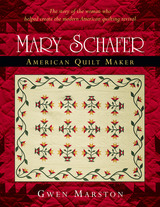
Extensively illustrated, with over 100 drawings and 11 unique Mary Schafer patterns, Mary Schafer, American Quilt Maker is a must-have book for anyone passionate about American quilting.
While we take that passion for granted today, author Gwen Marston shows that it wasn't always so; indeed, one woman, Mary Schafer, was largely responsible for the restoration of interest in one of our greatest folk arts -- long before the American bicentennial turned quilting into what seemed like an overnight sensation.
Marston presents Schafer as an unassuming scholar: the anonymous quilter, remaining humble and somewhat retiring. Behind the modest façade, however, Schafer displayed a remarkable devotion to research, historical accuracy, and community through her efforts to make quilting available to as many people as possible.
Nonquilters will find Mary Schafer, American Quilt Maker a welcome addition to their collection of the work of masters of American folk art, while quilting aficionados will appreciate it not only for the story it tells, but for the generous selection of patterns and illustrations it offers.
Gwen Marston is a nationally known quilt maker, teacher, and author. She is the author of over fifteen books on quilting, including Liberated String Quilts, 70 Classic Quilting Patterns, and Amish Quilting Patterns.
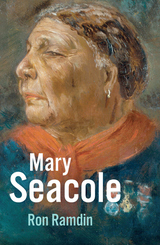
Mary Seacole’s remarkable life began in Jamaica, where she was born a free person, the daughter of a black mother and white Scottish army officer. Ron Ramdin—who, like Seacole, was born in the Caribbean and emigrated to the United Kingdom—tells the remarkable story of this woman, celebrated today as a pioneering nurse.
Refused permission to serve as an army nurse, Seacole took the remarkable step of funding her own journey to the Crimean battlefront, and there, in the face of sometimes harsh opposition, she established a hotel for wounded British soldiers. Unlike Florence Nightingale—whose exploits saw her venerated as the “lady with the lamp” for generations afterward—Seacole cared for soldiers perilously close to the fighting. As Ramdin shows in this biography, Seacole’s time in Crimea, for which she is best known, was only the pinnacle of a life of adventure and travel.


Maryat Lee : a life in the theater, Dope!, and salt -- EcoTheater : the one thing willed -- EcoTheater's significance to the twenty-first century -- The EcoTheater process -- Sample EcoTheater scenes -- Some sayings and writings of Maryat Lee -- Maryat Lee : personal reminiscences -- Chronology
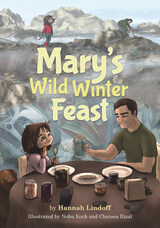
Featuring brilliant collages from artists Nobu Koch and Clarissa Rizal, Mary’s Wild Winter Feast is a celebration of food, family, and finding fun in unexpected places.
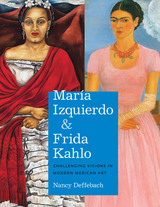
María Izquierdo (1902–1955) and Frida Kahlo (1907–1954) were the first two Mexican women artists to achieve international recognition. During the height of the Mexican muralist movement, they established successful careers as easel painters and created work that has become an integral part of Mexican modernism. Although the iconic Kahlo is now more famous, the two artists had comparable reputations during their lives. Both were regularly included in major exhibitions of Mexican art, and they were invariably the only women chosen for the most important professional activities and honors.
In a deeply informed study that prioritizes critical analysis over biographical interpretation, Nancy Deffebach places Kahlo’s and Izquierdo’s oeuvres in their cultural context, examining the ways in which the artists participated in the national and artistic discourses of postrevolutionary Mexico. Through iconographic analysis of paintings and themes within each artist’s oeuvre, Deffebach discusses how the artists engaged intellectually with the issues and ideas of their era, especially Mexican national identity and the role of women in society. In a time when Mexican artistic and national discourses associated the nation with masculinity, Izquierdo and Kahlo created images of women that deconstructed gender roles, critiqued the status quo, and presented more empowering alternatives for women. Deffebach demonstrates that, paradoxically, Kahlo and Izquierdo became the most successful Mexican women artists of the modernist period while most directly challenging the prevailing ideas about gender and what constitutes important art.
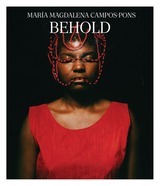
María Magdalena Campos-Pons (b. 1959) makes powerful work that holds and beholds the stories of historically silenced peoples and urges societal change. Her journey as an artist, teacher, and activist has taken her from Cuba through the United States, and her autobiographical compositions honor her Nigerian and Chinese ancestors while also facing the future. With an artistic practice that crosses boundaries, intertwines media—from photography to sculpture, film to performance—and references traditions and beliefs ranging from feminism to Santería, Campos-Pons’s work is deeply layered and complex.
This volume, the first critical look at the artist’s oeuvre in nearly two decades, surveys the concerns, materials, and places invoked throughout her forty-year career. Thoughtful essays explore her vibrant, arresting artwork, which confronts issues of agency and the construction of race and belonging and challenges us to reckon with these issues in our own lives.
This volume, copublished with the Brooklyn Museum, accompanies an exhibition on view at the Brooklyn Museum from September 15, 2023, to January 14, 2024, the Nasher Museum of Art at Duke University from February 15 to June 9, 2024, the Frist Art Museum from September 27, 2024, to January 5, 2025, and the J. Paul Getty Museum at the Getty Center from February 11 to May 4, 2025.
Ben-Yehuda describes how, after nearly 1800 years, the long, complex, and unsubstantiated narrative of Josephus Flavius was edited and augmented in the twentieth century to form a simple and powerful myth of heroism. He looks at the ways this new mythical narrative of Masada was created, promoted, and maintained by pre-state Jewish underground organizations, the Israeli army, archaeological teams, mass media, youth movements, textbooks, the tourist industry, and the arts. He discusses the various organizations and movements that created “the Masada experience” (usually a ritual trek through the Judean desert followed by a climb to the fortress and a dramatic reading of the Masada story), and how it changed over decades from a Zionist pilgrimage to a tourist destination.
Placing the story in a larger historical, sociological, and psychological context, Ben-Yehuda draws upon theories of collective memory and mythmaking to analyze Masada’s crucial role in the nation-building process of modern Israel and the formation of a new Jewish identity. An expert on deviance and social control, Ben-Yehuda looks in particular at how and why a military failure and an enigmatic, troubling case of mass suicide (in conflict with Judaism’s teachings) were reconstructed and fabricated as a heroic tale.


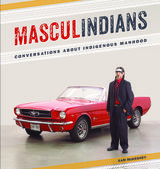
Contributors: Taiaiake Alfred, Kim Anderson, Joanne Arnott, Joseph Boyden, Alison Calder, Warren Cariou, Jessica Danforth, Louise Halfe, Tomson Highway, Daniel Heath Justice, Janice C. Hill Kanonhsyonni, Lee Maracle, Neal McLeod, Daniel David Moses, Gregory Scofield, Thomas Kimeksum Thrasher, and Richard Van Camp.
Examining the legal lives of early modern women through Milton’s literary works
In his History of Britain, John Milton writes, “Laws are Masculin Births . . . nothing [is] more awry from the Law of God and Nature, then that a Woman should give Laws to Men.” In this interdisciplinary study, Lynne Greenberg explores the normative and nonnormative legal lives of early modern women as depicted in Milton’s works—unmarried and married women, mothers, heiresses, widows, and queens—providing cogent overviews of the laws of multiple jurisdictions to offer critical context for each case study. Greenberg explores a wide range of legal-juridical materials and previously unexplored archival and private family documents. As she demonstrates, while Milton’s narratives are at times enmeshed in existing jural paradigms, they also offer resistant responses to marital, custodial, property, inheritance, and criminal laws and even imagine alternative jural paradigms for women. Through Masculine Births: Milton, Women and the Law, Greenberg deftly reveals that Milton both reproduces seventeenth-century legal constructs and gives birth to laws that move us toward greater equality for women.

Fictional masculinity performs a symbolic role in representing and negotiating the contradictions male novelists often encountered in their attempts to professionalize not only as writers, but also as businessmen, professors, lawyers, and politicians. Through specific and recurring figures like the student, the priest, the businessman, and the heir, male novelists portray and represent an increasingly middle-class world at odds with the values and virtues it inherited from an imperial Spanish past, and those it imported from more industrialized nations like England and France. The visual culture of the time and place marks the material turn in middle-class masculinity and sets the stage for discussions of race and sexuality.
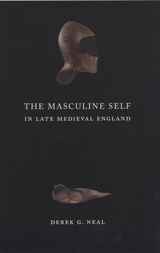
Marshalling a wide array of colorful evidence—including legal records, letters, medical sources, and the literature of the period—Derek G. Neal here plumbs the social and cultural significance of masculinity during the generations born between the Black Death and the Protestant Reformation. He discovers that social relations between men, founded on the ideals of honesty and self-restraint, were at least as important as their domination and control of women in defining their identities. By carefully exploring the social, physical, and psychological aspects of masculinity, The Masculine Self in Late Medieval England offers a uniquely comprehensive account of the exterior and interior lives of medieval men.
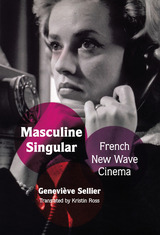
Sellier draws on sociological surveys, box office data, and popular magazines of the period, as well as analyses of specific New Wave films. She examines the development of the New Wave movement, its sociocultural and economic context, and the popular and critical reception of such well-known films as Jules et Jim and Hiroshima mon amour. In light of the filmmakers’ focus on gender relations, Sellier reflects on the careers of New Wave’s iconic female stars, including Jeanne Moreau and Brigitte Bardot. Sellier’s thorough exploration of early New Wave cinema culminates in her contention that its principal legacy—the triumph of a certain kind of cinephilic discourse and of an “auteur theory” recognizing the director as artist—came at a steep price: creativity was reduced to a formalist game, and affirmation of New Wave cinema’s modernity was accompanied by an association of creativity with masculinity.

Scrutinizing depictions of the masculine woman in literature and the popular press, Laura L. Behling explicates the literary, artistic, and rhetorical strategies used to eliminate the "sexually inverted" woman: punishing her by imprisonment or death; "rescuing" her into heterosexuality; subverting her through parody; or removing her from society to some remote or mystical place. Behling also shows how fictional same-sex relationships in the writings of Henry James, Charlotte Perkins Gilman, Gertrude Stein, and others conformed to and ultimately reaffirmed heterosexual models.
The Masculine Woman in America, 1890-1935 demonstrates that the women's suffrage movement did not so much suggest alternatives to women's gender and sexual behavior as it offered men and women afraid of perceived changes a tangible movement on which to blame their fears. A biting commentary on the insubstantial but powerful ghosts stirred up by the media, this study shows how, though legally enfranchised, the new woman was systematically disfranchised socially through scientific theory, popular press illustrations, and fictional predictions of impending sociobiological disaster.
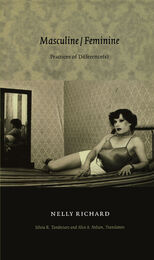
Richard helped to organize the 1987 International Conference on Latin American Women’s Literature in Santiago, one of the most significant literary events to take place under the Pinochet dictatorship. Published in Chile in 1993, Masculine/Feminine develops some of the key issues brought to the fore during that landmark meeting. Richard theorizes why the feminist movement has been crucial not only to the liberation of women but also to understanding the ways in which power operated under the military regime in Chile. In one of her most widely praised essays, she explores the figure of the transvestite, artistic imagery of which exploded during the Chilean dictatorship. She examines the politics and the aesthetics of this phenomenon, particularly against the background of prostitution and shantytown poverty, and she argues that gay culture works to break down the social demarcations and rigid structures of city life. Masculine/Feminine makes available, for the first time in English, one of Latin America’s most significant works of feminist theory.
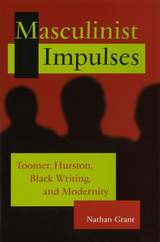
Grant’s book provides close readings of Jean Toomer (Cane and Natalie Mann) and Zora Neale Hurston (Moses, Man of the Mountain, Seraph of the Suwanee, and Their Eyes Were Watching God), for whom the American South was a crucial locus of the African American experience. Toomer and Hurston were virtually alone among the Harlem Renaissance writers of prose who returned to the South for their literary materials. That return, however, allowed their rediscovery of key black masculine values and charted the northern route of those values in the twentieth century to their compromise and destruction.
Grant then moves on to three more recent writers—John Edgar Wideman, Gloria Naylor, and Toni Morrison—who expanded upon and transformed the themes of Toomer and Hurston. Like Toomer and Hurston, these later authors recognized the need for the political union of black men and women in the effort to realize the goals of equity and justice.
Masculinist Impulses discusses nineteenth- and twentieth-century black masculinity as both a feature and a casualty of modernism. Scholars and students of African American literature will find Grant’s nuanced and creative readings of these key literary texts invaluable.
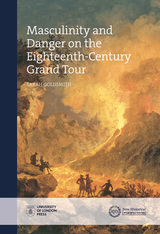
Goldsmith demonstrates that the Grand Tour was a means of constructing Britain’s next generation of leaders. Influenced by aristocratic concepts of honor and inspired by military-style leadership, elite society viewed experiences of danger and hardship as powerfully transformative and therefore as central to constructing masculinity. Scaling mountains, volcanoes, and glaciers, and even encountering war and disease, Grand Tourists willingly tackled a variety of perils. Through her study of these dangers, Goldsmith offers a bold revision of eighteenth-century elite masculine culture and the critical role the Grand Tour played within it.
Martin and Finn consider the factor structure and correlates of masculinity and femininity in the MMPI in multiple samples. Through their analyses, they are able to address such questions as: Is there such a thing as masculinity/femininity? If so, are masculinity and femininity separate constructs, or are they opposite ends of a bipolar dimension? What are the core aspects of masculinity and femininity? Are they the same for men and women? Do the meanings of masculinity and femininity vary across the human life span and in different cultures? To what extent are masculinity and femininity biologically or socially determined? Can masculinity and femininity be adequately measured by the MMPI-2 and MMPI-A?
This insightful work uses solid empirical methods to clarify significant constructs. It will be an essential resource for researchers in the areas of personality, psychological assessment, and gender studies, as well as for clinicians working with clients who have nontraditional gender identities.
Many societies assign sharply distinguished roles to men and women. Personality differences, as well as physical differences, between men and women are used to justify these different sex roles, and women are seen as more emotionally and interpersonally sensitive than men, while men are said to be more competent, achievement oriented, and assertive than women. A widely held view is that not only do men and women differ but that possession of "masculine" characteristics precludes possession of "feminine" characteristics. This bipolar conception has led to the definition of masculinity and femininity as opposites. Acceptance of this idea has caused social scientists and laypersons to consider men and women who possess cross-sex personality characteristics as less emotionally healthy and socially adjusted than those with sex-appropriate traits. Previous research by the authors and others, done almost exclusively with college students, has shown, however, that masculinity and femininity do not relate negatively to each other, thus supporting a dualistic rather than a bipolar conception of these two psychological dimensions.
Spence and Helmreich present data showing that the dualistic conception holds for a large number of groups, varying widely in age, geographical location, socioeconomic status, and patterns of interest, whose psychological masculinity and femininity were measured with an objective instrument, the Personality Attributes Questionnaire, devised by the authors. Many individuals are shown to be appropriately sex-typed; that is, men tend to be high in masculinity and low in femininity and women the reverse. However, a substantial number of men and women are androgynous—high in both masculine and feminine characteristics—while some are not high in either. Importantly, the authors find that androgynous individuals display more self-esteem, social competence, and achievement orientation than individuals who are strong in either masculinity or femininity or are not strong in either.
One of the major contributions of the work is the development of a new, multifaceted measure of achievement motivation (the Work and Family Orientation Questionnaire), which can be used successfully to predict behavior in both males and females and is related to masculinity and femininity in both sexes.
In addition to investigating the correlates of masculinity and femininity, the authors attempt to isolate parental factors that contribute to the development of these characteristics and achievement motivation. The book includes analyses of data from students on their perception of their parents, which enable the authors to examine the influence of parental masculinity and femininity and parental behaviors and child-rearing attitudes on the development of masculinity and femininity and achievement motivation characteristics in their children. The important implications of these findings for theories of sex roles, personality development, and achievement motivation are examined.
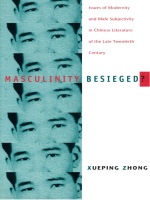
Before the 1990s onslaught of popular culture decentered the role of intellectuals within the nation, they had come to embody Chinese masculinity during the previous decade. The focus on masculinity in literature had become unprecedented in scale and the desire for “real men” began to permeate Chinese popular culture, making icons out of Rambo and Takakura Ken. Stories by Zhang Xianliang and Liu Heng portraying male anxiety about masculine sexuality are employed by Zhong to show how “marginal” males negotiate their sexual identities in relation to both women and the state. Looking at writers popular among not only the well-educated but also the working and middle classes, she discusses works by Han Shaogong, Yu Hua, and Wang Shuo and examines instances of self-loathing male voices, particularly as they are articulated in Mo Yan’s well-known work Red Sorghum. In her last chapter Zhong examines “roots literature,” which speaks of the desire to create strong men as a part of the effort to create a geopolitically strong Chinese nation. In an afterword, Zhong situates her study in the context of the 1990s.
This book will be welcomed by scholars of Chinese cultural studies, as well as in literary and gender studies.
Locating the roots of toxic masculinity and finding its displacement in unruly culture
Masculinity in Transition analyzes shifting relationships to masculinity in canonical works of twentieth-century literature and film, as well as in twenty-first-century media, performance, and transgender poetics. Focusing on “toxic masculinity,” which has assumed new valence since 2016, K. Allison Hammer traces its roots to a complex set of ideologies embedded in the histories of settler colonialism, racial capitalism, and political fraternity, and finds that while toxic strains of masculinity are mainly associated with straight, white men, trans and queer masculinities can be implicated in these systems of power.
Hammer argues, however, that these malignant forms of masculinity are not fixed and can be displaced by “unruly alliances”—texts and relationships that reject the nationalisms and gender politics of white male hegemony and perform an urgently needed reimagining of what it means to be masculine. Locating these unruly alliances in the writings, performances, and films of butch lesbians, gay men, cisgender femmes, and trans and nonbinary individuals, Masculinity in Transition works through an archive of works of performance art, trans poetics, Western films and streaming media, global creative responses to HIV/AIDS, and working-class and “white trash” fictions about labor and unionization.
Masculinity in Transition moves the study of masculinity away from an overriding preoccupation with cisnormativity, whiteness, and heteronormativity, and toward a wider and more generative range of embodiments, identifications, and ideologies. Hammer’s bold rethinking of masculinity and its potentially toxic effects lays bare the underlying fragility of normative masculinity.
Retail e-book files for this title are screen-reader friendly with images accompanied by short alt text and/or extended descriptions.
Throughout this work, Eric Silverman details the dialogics of mothering and manhood throughout Eastern Iatmul culture, including in his analysis cosmology and myth; food- and childraising; architecture and canoes; ethnophysiology and sexuality; shame and hygiene; marriage and kinship; and perhaps most significantly, a ceremonial locus classicus in anthropology: the famous Iatmul naven rite. This book provides the first sustained examination of naven since Bateson, presenting new data and interpretations that are based entirely on original, first-hand ethnographic research.
The sustained engagement with anthropological and psychoanalytic theory coupled with a refreshing examination of a famous and still-enigmatic ritual is sure to make multiple contributions to pressing debates in contemporary anthropology and social theory.
Eric Silverman is Associate Professor of Anthropology, DePauw University.
Mashairi Ya Vita Vya Kuduhu is a presentation and discussion of both manuscript and published versions of poems written by Lamu poets around the time of the Battle of Kuduhu. The poetic dialogue studied in this volume has played a significant role in the history of Swahili poetry, and its primary concern is to inform continued work in this area. The poems contained in this work were transmitted and preserved by speakers of Kiswahili and later collected and preserved by scholars. Chapter One contains the edited poems; Chapter Two consists of the translations. Subsequent chapters include accounts of the Battle of Kuduhu, editing and translating practices, and annotated poems and source versions. This work is presented as an example of the importance of research, fieldwork, and the consideration of available versions and alternative styles of presentation in the study of Swahili poetry.
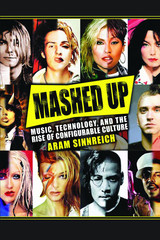
From ancient times to the present day, writers and thinkers have remarked on the unique power of music to evoke emotions, signal identity, and bond or divide entire societies, all without the benefit of literal representation. Even if we can't say precisely what our favorite melody means, we know very well what kind of effect it has on us, and on our friends and neighbors.
According to Aram Sinnreich, this power helps to explain why music has so often been regulated in societies around the globe and throughout history. Institutional authorities ranging from dynastic China's “Office to Harmonize Sounds” to today's copyright collecting societies like BMI and ASCAP leverage the rule of law and the power of the market to make sure that some musical forms and practices are allowed and others are prohibited.
Yet, despite the efforts of these powerful regulators, musical cultures consistently devise new and innovative ways to work around institutional regulations. These workarounds often generate new styles and traditions in turn, with effects far beyond the cultural sphere.
Mashed Up chronicles the rise of “configurability,” an emerging musical and cultural moment rooted in today's global, networked communications infrastructure. Based on interviews with dozens of prominent DJs, attorneys, and music industry executives, the book argues that today's battles over sampling, file sharing, and the marketability of new styles such as “mash-ups” and “techno” presage social change on a far broader scale.
Specifically, the book suggests the emergence of a new ethic of configurable collectivism; an economic reunion of labor; a renegotiation of the line between public and private; a shift from linear to recursive logic; and a new “DJ consciousness,” in which the margins are becoming the new mainstream. Whether these changes are sudden or gradual, violent or peaceful, will depend on whether we heed the lessons of configurability, or continue to police and punish the growing ranks of the mashed up.
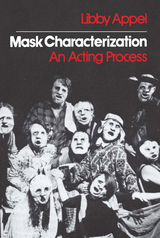
Behind the mask, Appel notes, the student is free to create a personality; paradoxically, because the mask hides the self, it enables the student to probe more deeply into himself.
“This book describes, defines, and discusses the mask characterization process, providing the theory behind the exercises and the step-by-step procedure in the organic development of the character from the masks,” Appel notes. The manual is divided into two parts: “The Instructor’s Guide” and “The Actor’s Guide.” There is also an introductory chapter, “The Class Structure,” which explains mask characterization procedures in the classroom, and a sample class schedule may be found in the back of the manual.
This book adds a new dimension to actor training and learning. It is essential to aspiring actors seeking new ways to create honest dramatic characterizations.
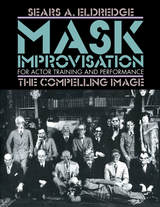
Featuring dozens of improvisational exercises in the innovative spirit of Viola Spolin, and supplemented with practical appendices on mask design and construction, forms and checklists, and other classroom materials, this book is an invaluable tool for teacher and student alike, as well as compelling reading for anyone interested in acquiring a deeper understanding of masks as agents of transformation, creativity, and performance.

From Blurred Lines to gang signs, how does society cause toxic masculinity? How do we define masculinity today? Dominating the world around us, seen in deadly gun violence, higher male suicide rates, and the incels on Reddit, masculinity is perceived to be “toxic,” “fragile,” and “in crisis.” What does that mean for society, and how can we understand it?
In Mask Off, JJ Bola exposes masculinity as a performance that men are socially conditioned into. Using examples of non-Western cultural traditions, music, and sport, he shines light on historical narratives around manhood, debunking popular myths along the way. He explores how LGBTQ men, men of color, and male refugees experience masculinity in diverse ways, revealing its fluidity, how it's strengthened and weakened by different political contexts, such as the patriarchy or the far-right, and perceived differently by those around them. Chapters include:
*Real men: Myths of masculinity
*What’s love got to do with it? Love, sex and consent
*This is a man’s world: The politics of masculinity, the masculinity of politics
*If I were a boy: Gender equality and feminism
*Slamdunk at the funk: masculinity and sport
At the heart of love and sex, the political stage, competitive sports, gang culture, and mental health issues, lies masculinity: Mask Off is an urgent call to unravel masculinity and redefine it. "What do our own perceptions of masculinity and the wider cultural norms around it mean for young boys growing up into manhood? What do they mean for young men and older men grappling with a society that encourages them to hold on to the anger that destroys the lives of women as well as the lives of many men?" Those questions and more offer food for thought for every man.
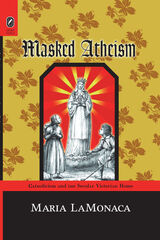
Why did the Victorians hate and fear Roman Catholics so much? This question has long preoccupied literary and cultural scholars alike. Masked Atheism: Catholicism and the Secular Victorian Home by Maria LaMonaca begins with the assumption that anti-Catholicism reveals far more about the Victorians than simple theological disagreements or religious prejudice. An analysis of anti-Catholicism exposes a host of anxieties, contradictions, and controversies dividing Great Britain, the world’s most powerful nation by the mid-nineteenth century.
Noting that Catholicism was frequently caricatured by the Victorians as “masked atheism”—that is, heathenism and paganism masquerading as legitimate Christianity—LaMonaca’s study suggests that much anti-Catholic rhetoric in Victorian England was fueled by fears of encroaching secularism and anxieties about the disappearance of God in the modern world. For both male and female writers, Catholicism became a synonym for larger, “ungodly” forces threatening traditional ways of life: industrialization, rising standards of living, and religious skepticism.
LaMonaca situates texts by Charlotte Brontë, George Eliot, Christina Rossetti, Elizabeth Barrett Browning, Michael Field, and others against a rich background of discourses about the growing visibility of Anglo and Roman Catholicism in Victorian England. In so doing, she demonstrates the influence of both pro- and anti-Catholic sentiment on constructs of Victorian domesticity, and explores how writers appropriated elements of Catholicism to voice anxieties about the growing secularization of the domestic sphere: a bold challenge to sentimental notions of the home as a “sacred” space. Masked Atheism will contribute a fresh perspective to an ongoing conversation about the significance of Catholicism in Victorian literature and culture.

Masked Gods is a vast book, a challenging and profoundly original account of the history, legends, and ceremonialism of the Navajo and Pueblo Indians of the Southwest. Following a brief but vivid history of the two tribes through the centuries of conquest, the book turns inward to the meaning of Native American legends and ritual—Navajo songs, Pueblo dances, Zuni kachina ceremonies. Enduring still, these rituals and ceremonies express a view of life, of man’s place in the creation, which is compared with Taoism and Buddhism—and with the aggressive individualism of the Western world.
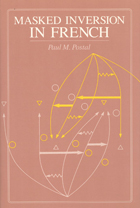
This analysis has significant consequences for contemporary syntactic theories. First, the arguments support the view that a sentence's superficial structure cannot be identified with its syntactic structure, even though such an identification is a fundamental assumption of several currently influential grammatical frameworks. Second, even certain theories that do posit abstract aspects of grammatical form fail to allow for the needed Inversion structures. Postal's study supports theories based on the notion of arc and stratification into levels which provide a natural treatment consistent with the factual requirements.
Masked Inversion in French is the first systematic account of this puzzling French syntactic anomaly, and its findings will stimulate research in many areas of natural language grammatical structure.
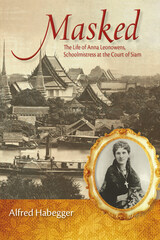
But who was Leonowens and why did her story take hold? Although it has been known for some time that she was of Anglo-Indian parentage and that her tales about the Siamese court are unreliable, not until now, with the publication of Masked, has there been a deeply researched account of her extraordinary life. Alfred Habegger, an award-winning biographer, draws on the archives of five continents and recent Thai-language scholarship to disclose the complex person behind the mask and the troubling facts behind the myth. He also ponders the curious fit between Leonowens’s compelling fabrications and the New World’s innocent dreams—in particular the dream that democracy can be spread through quick and easy interventions.
Exploring the full historic complexity of what it once meant to pass as white, Masked pays close attention to Leonowens’s midlevel origins in British India, her education at a Bombay charity school for Eurasian children, her material and social milieu in Australia and Singapore, the stresses she endured in Bangkok as a working widow, the latent melancholy that often afflicted her, the problematic aspects of her self-invention, and the welcome she found in America, where a circle of elite New England abolitionists who knew nothing about Southeast Asia gave her their uncritical support. Her embellished story would again capture America’s imagination as World War II ended and a newly interventionist United States looked toward Asia.
Best Books for General Audiences, selected by the American Association of School Librarians
Best Regional Special Interest Boosk, selected by the Public Library Reviewers

An ambitious reassessment of the political uses of masking.
Does the mask reveal more than it conceals? What, this book asks, becomes visible and invisible in the masking practiced in Caribbean cultures-not only in the familiar milieu of the carnival but in political language, social conduct, and cultural expressions that mimic, misrepresent, and mislead? Focusing on masking as a socially significant practice in Caribbean cultures, Gerard Aching’s analysis articulates masking, mimicry, and misrecognition as a means of describing and interrogating strategies of visibility and invisibility in Cuba, Trinidad and Tobago, Martinique, and beyond.
Masking and Power uses ethnographic fieldwork, psychoanalysis, and close literary readings to examine encounters between cultural insiders as these locals mask themselves and one another either to counter the social invisibility imposed on them or to maintain their socioeconomic privileges. Aching exposes the ways in which strategies of masking and mimicry, once employed to negotiate subjectivities within colonial regimes, have been appropriated for state purposes and have become, with the arrival of self-government in the islands, the means by which certain privileged locals make a show of national and cultural unity even as they engage in the privatization of popular culture and its public performances.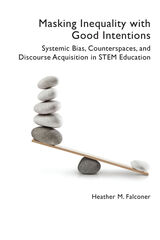
In Masking Inequality with Good Intentions, Heather M. Falconer examines the impact of systemic bias on disciplinary discourse acquisition and identity development by asking “How do the norms and expectations of higher education and STEM, specifically, impact the development of scientific identity and discursive skill?” and “What role do societal markers like race and gender play in the negotiation of identity in STEM learning environments?”
Drawing on the experiences and writings of six students from historically underrepresented backgrounds in STEM, each participating in an undergraduate research program, Falconer discusses how programmatic and pedagogical choices can work to either further marginalize students and disrupt their writing and identity development as scientists or create counterspaces—spaces where students can thrive and push back against dominant, oppressive forces. Practical applications for pedagogy, curriculum, and program design are included.
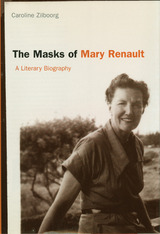
Born Eileen Mary Challans in London in 1905, Mary Renault wrote six successful contemporary novels before turning to the historical fiction about ancient Greece for which she is best known. While Renault's novels are still highly regarded, her life and work have never been completely examined. Caroline Zilboorg seeks to remedy this in The Masks of Mary Renault by exploring Renault's identity as a gifted writer and a sexual woman in a society in which neither of these identities was clear or easy.
Although Renault's life was anything but ordinary, this fact has often been obscured by her writing. The daughter of a doctor, she grew up comfortably and attended a boarding school in Bristol. She received a degree in English from St. Hugh's College in Oxford in 1928, but she chose not to pursue an academic career. Instead, she decided to attend the Radcliffe Infirmary in Oxford, where she trained to be a nurse. With the outbreak of the Second World War, she was assigned to the Winford Emergency Hospital in Bristol and briefly worked with Dunkirk evacuees. She went on to work in the Radcliffe Infirmary's brain surgery ward and was there until 1945.
It was during her nurse's training that Renault met Julie Mullard, who became her lifelong companion. This important lesbian relationship both resolved and posed many problems for Renault, not the least of which was how she was to write about issues at once intensely personal and socially challenging. In 1939, Renault published her first novel under a pseudonym in order to mask her identity. It was a time when she was struggling not only with her vocation (nursing and writing), but also with her sexual identity in the social and moral context of English life during the war.
In 1948, Renault left England with Mullard for South Africa and never returned. It was in South Africa that she made the shift from her early contemporary novels of manners to the mature historical novels of Hellenic life. The classical settings allowed Renault to mask material too explosive to deal with directly while simultaneously giving her an "academic" freedom to write about subjects vital to her—among them war, peace, career, women's roles, female and male homosexuality, and bisexuality.
Renault's reception complicates an understanding of her achievement, for she has a special status within the academic community, where she is both widely read and little written about. Her interest in sexuality and specifically in homosexuality and bisexuality, in fluid gender roles and identities, warrants a rereading and reevaluation of her work. Eloquently written and extensively researched, The Masks of Mary Renault will be of special value to anyone interested in women's studies or English literature.
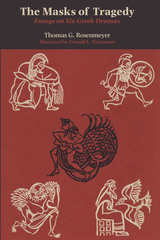
"What matters about a play is not the extent to which it is like any other play, but the way in which it is different," writes Thomas G. Rosenmeyer. "This is, I suggest, how the ancient audiences received the performances.... My purpose, then, in writing these essays is twofold: ... to devote enough space to the discussion of each play to allow its special tone and texture to emerge without hindrance and at leisure ... and to include in one collection analyses of plays so different from one another that the accent will come to rest on the variety of the tragic experience rather than on any one narrowly defined norm."
Greek tragedy is a vehicle for many different ideas and many different intentions. From the wealth of material that has come down to us the author has chosen six plays for analysis. He reminds us that the plays were written to be seen and heard, and only secondarily to be studied. The listeners expected each play to have a specific objective, and to exhibit its own mood. These the author attempts to recover for us, by listening to what each play, in its own right, has to say. His principal concern is with the tragic diction and the tragic ideas, designed to release certain massive responses in the large theater-going group of ancient Athens. In exploring the characters and the situations of the plays he has chosen, the author transports his reader to the world of fifth-century B.C. Greece, and establishes the relevance of that world to our own experience.
The essays are not introductory in nature. No space is given, for instance, to basic information about the playwrights, the history of Greek drama, or the special features of the Attic stage. Yet the book addresses itself to classicists and nonclassicists alike. The outgrowth of a series of lectures to nonspecialists, its particular appeal is to students of literature and the history of Western thought. Parallels are drawn between the writings of the philosophers and the tragedies, and attention is paid to certain popular Greek beliefs that colored the tragic formulations. Ultimately, however, the approach is not historical but critical; it is the author's intention to demonstrate the beauty and the craftsmanship of the plays under discussion.

Drawing on eight years of research and interviews with more than eighty self-published writers, Mass Authorship avoids the polemics, instead showing how writers are actually thinking about and dealing with this brave new world. Timothy Laquintano compares the experiences of self-publishing authors in three distinct genres—poker strategy guides, memoirs, and romance novels—as well as those of writers whose self-published works hit major bestseller lists. He finds that the significance of self-publishing and the challenge it presents to traditional publishing depend on the aims of authors, the desires of their readers, the affordances of their platforms, and the business plans of the companies that provide those platforms.
In drawing a nuanced portrait of self-publishing authors today, Laquintano answers some of the most pressing questions about what it means to publish in the twenty-first century: How do writers establish credibility in an environment with no editors to judge quality? How do authors police their copyrights online without recourse to the law? How do they experience Amazon as a publishing platform? And how do they find an audience when, it sometimes seems, there are more writers than readers?

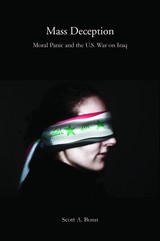
Mass Deception argues that the George W. Bush administration manufactured public support for the war on Iraq. Scott A. Bonn introduces a unique, integrated, and interdisciplinary theory called "critical communication" to explain how and why political elites and the news media periodically create public panics that benefit both parties. Using quantitative analysis of public opinion polls and presidential rhetoric pre- and post-9/11 in the news media, Bonn applies the moral panic concept to the Iraq war. He critiques the war and occupation of Iraq as violations of domestic and international law. Finally, Mass Deception connects propaganda and distortion efforts by the Bush administration to more general theories of elite deviance and state crime.
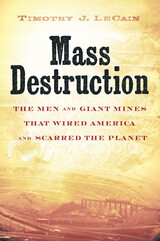
Mass destruction mining soon spread around the nation and the globe, providing raw materials essential to the mass production and mass consumption that increasingly defined the emerging "American way of life." At the dawn of the last century, Jackling's open pit replaced immense but constricted underground mines that probed nearly a mile beneath the earth, to become the ultimate symbol of the modern faith that science and technology could overcome all natural limits. A new culture of mass destruction emerged that promised nearly infinite supplies not only of copper, but also of coal, timber, fish, and other natural resources.
But, what were the consequences? Timothy J. LeCain deftly analyzes how open-pit mining continues to affect the environment in its ongoing devastation of nature and commodification of the physical world. The nation's largest toxic Superfund site would be one effect, as well as other types of environmental dead zones around the globe. Yet today, as the world's population races toward American levels of resource consumption, truly viable alternatives to the technology of mass destruction have not yet emerged.
As United States television programs, movies, music, and other cultural products make their way around the globe, a vigorous debate over "cultural imperialism" is growing in many countries. This book brings together experts in economics, sociology, anthropology, the humanities, and communications to explore what effects the North American Free Trade Agreement will have on the flow of cultural products among Mexico, the United States, and Canada.
After an overview of free trade and the cultural industries, the book covers the following topics: dominance and resistance, cultural trade and identity in relation to Mexico and to French Canada, and intellectual property rights. Based on present trends, the contributors predict that there will be a steadily increasing flow of cultural products from the United States to its neighbors.
This book grew out of a 1994 conference that brought together leaders of the cultural industries, policy makers, and scholars. It represents state-of-the-art thinking about the global influence of U.S. cultural industries.

Although not a comprehensive study of such events, Jannarone’s analysis of the selected mass performance systems yields new theoretical perspectives on these phenomena, a central focus of her study being how political leaders find ways to create a physically coordinated mass body politic, even during times of hardship and war. By interpreting and historicizing mass assemblies of bodies, this study analyzes the choreographies and organizations that brought thousands of people together as an ensemble and kept them together in meaning-making motion.
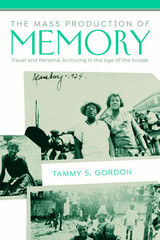
In 1888, the Eastman Dry Plate and Film Company offered the first portable camera that allowed users to conveniently take photos, using leisure travel as a primary marketing feature to promote it. The combination of portability, ease of use, and mass advertising fed into a national trend of popular photography that drew on Americans' increasing mobility and leisure time. The Kodak Company and the first generation of tourist photographers established new standards for personal archiving that amplified the individual's role in authoring the national narrative. But not everyone had equal access to travel and tourism, and many members of the African American, Native American, and gay and lesbian communities used the camera to counter the racism, homophobia, and classism that shaped public spaces.
In this groundbreaking history, Tammy S. Gordon tells the story of the camera's emerging centrality in leisure travel across the late nineteenth and early twentieth centuries and its role in “the mass production of memory,” a process in which users crafted a visual archive attesting to their experiences, values, and circumstances, setting the stage for the customizable visual culture of the digital age.

The traditional definition of torts involves bizarre, idiosyncratic events where a single plaintiff with a physical impairment sues the specific defendant he believes to have wrongfully caused that malady. Yet public attention has focused increasingly on mass personal-injury lawsuits over asbestos, cigarettes, guns, the diet drug fen-phen, breast implants, and, most recently, Vioxx. Richard A. Nagareda’s Mass Torts in a World of Settlement is the first attempt to analyze the lawyer’s role in this world of high-stakes, multibillion-dollar litigation.
These mass settlements, Nagareda argues, have transformed the legal system so acutely that rival teams of lawyers operate as sophisticated governing powers rather than litigators. His controversial solution is the replacement of the existing tort system with a private administrative framework to address both current and future claims. This book is a must-read for concerned citizens, policymakers, lawyers, investors, and executives grappling with the changing face of mass torts.
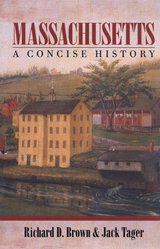
From the moment the first English colonists landed on the shores of Plymouth Bay, the experiences of the people of Massachusetts have been emblematic of larger themes in American history. The story of the first Pilgrim thanksgiving is commemorated as a national holiday, while the Boston Tea Party and Paul Revere's ride have passed into the national mythology. Even the grimmer aspects of the American experience—Indian warfare and the conquest of an ever expanding frontier—were part of the early history of Massachusetts. In this book, Richard D. Brown and Jack Tager survey the rich heritage of this distinctive, and distinctly American, place, showing how it has long exerted an influence disproportionate to its size.
A seedbed of revolt against British colonial rule, Massachusetts has supplied the nation with a long line of political leaders—from Samuel and John Adams to William Lloyd Garrison and Lucy Stone to John, Robert, and Edward Kennedy. Its early textile mills helped shape the industrial revolution, while its experiences with urbanization, immigration, ethnic conflict, and labor strife reflected the growth of the national economy. In the twentieth century, the state continued to lead the country through a series of wrenching economic changes as it moved from the production of goods to the provision of services, eventually becoming a center of the high-tech revolution in telecommunications. If there is one common theme in the Bay State's history, Brown and Tager make clear, it is the capacity to adapt to change. In part this trait can be attributed to the state's unique blend of resources, including its many distinguished colleges and universities. But it can also be credited to the people themselves, who have created a singular sense of place by reconciling claims of tradition with the possibilities of innovation. This book tells their story.
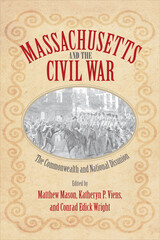
All states are not created equal, at least not when it comes to their influence on American history. That assumption underlies Massachusetts and the Civil War. The volume's ten essays coalesce around the national significance of Massachusetts through the Civil War era, the ways in which the commonwealth reflected and even modeled the Union's precarious but real wartime unification, and the Bay State's postwar return to the schisms that predated the war. Rather than attempting to summarize every aspect of the state's contribution to the wartime Union, the collection focuses on what was distinctive about its influence during the great crisis of national unity.
In the first section, “The Opposition to Slavery,” essays by John Stauffer, Dean Grodzins, Peter Wirzbicki, and Richard S. Newman demonstrate the central role Massachusetts played in the rise of both the antislavery movement and abolitionism. They show how slavery's foes united, planned, and understood their cause, and how they envisioned a postwar nation free of servitude. In the second section, “The War Years,” Matthew Mason, Carol Bundy, and Ronald J. Zboray and Mary Saracino Zboray investigate how the exigencies of war unified the commonwealth across party lines and over the distance between home and the front. In the final section, “Reconciliation,” Sarah J. Purcell, Amy Morsman, and Kanisorn Wongsrichanalai probe postwar efforts to recover from the war's profound disruptions.
Hogarty examines both the process of policymaking and the complexities of on-the-ground implementation, identifying the various participants and their roles and strategies. He describes power struggles that are entangled in intricate webs of personal and political relationships, and explores their historical antecedents.
Based on an extensive review of newspaper and media accounts, a survey of the surprisingly scanty professional literature, a close scrutiny of public documents, and dozens of personal interviews, the book addresses such topics as the delivery of mental health services, urban transportation, environmental protection, public safety, welfare, corrections, the death penalty, public higher education, ethnic politics, and state ethics reform. Hogarty analyzes the shifting problems of accountability that arise when public services are provided by a variety of political actors and organizations with a wide range of ideological motivations and social and cultural commitments.
Well known for its world-renowned art museums—from the Clark Art Institute in Williamstown to the Museum of Fine Arts in Boston—Massachusetts is also home to numerous institutions with more eclectic collections and, oftentimes, lower profiles. These include Mansfield's National Black Doll Museum of History and Culture, Watertown's Plumbing Museum, and Granville's Noble and Cooley Center for Historic Preservation.
In Massachusetts Treasures, Chuck D'Imperio explores more than forty museums scattered throughout the Bay State, from Cape Cod to the Berkshires. Many—but not all—might be considered “offbeat,” and each and every one is enchanting. Through personal visits and interviews with founders and directors, D'Imperio offers an inside glimpse into some of the Commonwealth's most unique museums, providing a valuable guide for road warriors and history buffs discovering Massachusetts either for the first or the tenth time.
On April 30, 1871, an unlikely group of Anglo-Americans, Mexican Americans, and Tohono O’odham Indians massacred more than a hundred Apache men, women, and children who had surrendered to the U.S. Army at Camp Grant, near Tucson, Arizona. Thirty or more Apache children were stolen and either kept in Tucson homes or sold into slavery in Mexico. Planned and perpetrated by some of the most prominent men in Arizona’s territorial era, this organized slaughter has become a kind of “phantom history” lurking beneath the Southwest’s official history, strangely present and absent at the same time.
Seeking to uncover the mislaid past, this powerful book begins by listening to those voices in the historical record that have long been silenced and disregarded. Massacre at Camp Grant fashions a multivocal narrative, interweaving the documentary record, Apache narratives, historical texts, and ethnographic research to provide new insights into the atrocity. Thus drawing from a range of sources, it demonstrates the ways in which painful histories continue to live on in the collective memories of the communities in which they occurred.
Chip Colwell-Chanthaphonh begins with the premise that every account of the past is suffused with cultural, historical, and political characteristics. By paying attention to all of these aspects of a contested event, he provides a nuanced interpretation of the cultural forces behind the massacre, illuminates how history becomes an instrument of politics, and contemplates why we must study events we might prefer to forget.
The route from the Spanish presidial settlements in upper Sonora to the Colorado River was called the Camino del Diablo, the "Road of the Devil." Running through the harshest of deserts, this route was the only way for the Spanish to transport goods overland to their settlements in California. At the end of the route lay the only passable part of the lower Colorado, and the people who lived around the river, the Yumas or Quechans, initially joined into a peaceful union with the Spanish. When the relationship soured and the Yumas revolted in 1781, it essentially ended Spanish settlement in the area, dashed the dreams of the mission builders, and limited Spanish expansion into California and beyond.
In Massacre at the Yuma Crossing, Mark Santiago introduces us to the important and colorful actors involved in the dramatic revolt of 1781: Padre Francisco Garcés, who discovered a path from Sonora to California, made contact with the Yumas and eventually became their priest; Salvador Palma, the informal leader of the Yuman people, whose decision to negotiate with the Spanish earned him a reputation as a peacebuilder in the region, which eventually caused his downfall; and Teodoro de Croix, the Spanish commandant-general, who, breaking with traditional settlement practice, established two pueblos among the Quechans without an adequate garrison or mission, thereby leaving the settlers without any sort of defense when the revolt finally took place.
Massacre at the Yuma Crossing not only tells the story of the Yuma Massacre with new details but also gives the reader an understanding of the pressing questions debated in the Spanish Empire at the time: What was the efficacy of the presidios? How extensive should the power of the Catholic mission priests be? And what would be the future of Spain in North America?

"Rarely do the skills of historians and anthropologists mesh so admirably." —Western Historical Quarterly
"Kroeber and Fontana are meticulous professionals. Their study of this neglected slice of Southwestern history deserves applause." —Evan S. Connell, Los Angeles Times Book Review
"A rich feast for the curious and theorist alike." —Pacific Historical Review
"Kroeber and Fontana describe a little-known event, provide an effective analysis of the cultures of Indian groups in southwestern Arizona, and attempt to understand the broader causes of warfare. The result is an interesting and provocative study." —Journal of American History
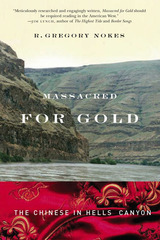
In 1887, more than 30 Chinese gold miners were massacred on the Oregon side of Hells Canyon, the deepest canyon in North America. Massacred for Gold, the first authoritative account of the unsolved crime—one of the worst of the many crimes committed by whites against Chinese laborers in the American West—unearths the evidence that points to an improbable gang of rustlers and schoolboys, one only 15, as the killers.
The crime was discovered weeks after it happened, but no charges were brought for nearly a year, when gang member Frank Vaughan, son of a well-known settler family, confessed and turned state’s evidence. Six men and boys, all from northeastern Oregon’s remote Wallowa country, were charged—but three fled, and the others were found innocent by a jury that a witness admitted had little interest in convicting anyone. A cover-up followed, and the crime was all but forgotten for the next 100 years, until a county clerk found hidden records in an unused safe.
In bringing this story out of the shadows, Nokes examines the once-substantial presence of Chinese laborers in the interior Pacific Northwest, describing why they came, how their efforts contributed to the region’s development, and how too often mistreatment and abuse were their only reward.
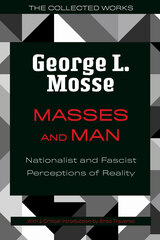
Masses and Man comprises three parts. The first lays out a cultural history of nationalism, essentially the first of its kind, emphasizing the importance of sacred expressions like myths, symbols, and rituals as appropriated in a political context. The second zeroes in on fascism’s most dramatic irruptions in European history in the rise of Italian Fascism and the Nazi Party in Germany, elucidating these as not just political movements but also cultural and even aesthetic ones. The third part considers nationalism and fascism from the particular standpoint of German Jews.
Taken in full, the volume offers an eloquent summation of Mosse’s groundbreaking insights into European nationalism, fascism, and Jewish history in the twentieth century. A new critical introduction by Enzo Traverso helpfully situates Mosse’s work in context and exposes the many ways in which Masses and Man, first published in 1980, remains relevant today.
Masses and Motets is a tale composed of four basic interwoven threads, corresponding to the four-part choral writing of Pierre de la Rue’s service music. The first thread comes from the diaries of a recently murdered priest, Father Andrea Vidal, former secretary to the notorious Father Marcial Maciel. The second thread is the mystery story, a police procedural focusing on the efforts of Denver detective Francesca Fruscella to solve the murder and retrieve Vidal’s diary. The third strand is the story of Father Signelli, a priest sent from the Vatican to “fix” the murder. And the fourth strand explores the best and worst of Catholic culture: art and music created by Catholic artists and sexual abuse by Catholic priests.
Vidal’s narrative is the story of a priest who systematically, sincerely, and hopefully tries to destroy his very self through sex, drinking, and drugs in order to get closer to God. Fruscella’s story is that of a middle-aged, female detective trying to solve a ghastly murder while constantly battling the sexism of the Catholic Church. Signelli’s tale is that of an older career priest who, in doing the bidding of his superiors to fix problems that threaten the order of the Church, has perhaps compromised his own soul. By no means a simple narrative of wicked priests, this is a story of men who desperately want to believe, as well as a story of what this belief might shelter and cost.
Donated in the late fifteenth century to the papal choir, the musical manuscript Cappella Sistina14 reflects a new style of mass composition used by some of the era’s most noted composers. Masses for the Sistine Chapel makes the complete contents of the Cappella Sistina14—held in the Vatican Library—available for the first time.
Featuring fifteen masses and four mass fragments, this volume includes works by such composers as Guillaume Du Fay, Johannes Ockeghem, and Antoine Busnoys. In a comprehensive introduction and critical commentary on each work, Richard Sherr places the choirbook in its historical context, describing its physical makeup as well as the repertory. Sherr’s critical edition of this celebrated manuscript finally provides the insight necessary to inform future performances and recordings of its influential contents.
“It was twenty-five centuries ago in the land of Song, between the Yellow River and the River Huai: Zhuang Zhou was born without a cry with his eyes wide open.”
Welcome to China in the fifth century BCE, a colorful, violent, unstable world into which Zhuang is born. Here royals raise huge armies, constantly waging wars against one another. They have slaves, concubines. Gold is everywhere. And so is hunger. Born rich and entitled, Zhuang learns to refuse any official function. His travels bring him closer to ordinary people, from whom he learns how to live a simple and useful life. This is how he will become one of the greatest Chinese philosophers who gave his name to his legendary book, the Zhuangzi, one of the two foundational texts of Taoism—a magnificent procession of lively stories in which we meet dwarfs, virtuous bandits, butchers, powerful lords in their castles, turtles, charming concubines, and false sages. In this remarkable bildungsroman, award-winning French novelist Patrick Rambaud spins out the extraordinary life of Zhuang Zhou—a poetic, cruel, and often humorous tale, halfway between fable and philosophy.
Building on the work of Foucault, Hammoudi argues that at the heart of Moroccan culture lies a paradigm of authority that juxtaposes absolute authority against absolute submission. Rooted in Islamic mysticism, this paradigm can be observed in the drama of mystic initiation, with its fundamental dialectic between Master and Disciple; in conflict with other cultural forms, and reelaborated in colonial and postcolonial circumstances, it informs all major aspects of Moroccan personal, political, and gender relations. Its influence is so pervasive and so firmly embedded that it ultimately legitimizes the authoritarian structure of power. Hammoudi contends that as long as the Master-Disciple dialectic remains the dominant paradigm of power relations, male authoritarianism will prevail as the dominant political form.
"Connecting political domination to gift exchange, ritual initiation, social loyalty, and gender reversals, Master and Disciple is nothing less than a thoroughgoing revision of our understanding of authoritarian rule in Morocco and in the Arab world in general."—Clifford Geertz, Institute for Advanced Study
Certification as a Master Cheesemaker typically takes almost fifteen years. An applicant must hold a cheesemaking license for at least ten years, create one or two chosen varieties of cheese for at least five years, take more than two years of university courses, consent to constant testing of their cheese and evaluation of their plant, and pass grueling oral and written exams to be awarded the prestigious title.
James Norton and Becca Dilley interviewed these dairy artisans, listened to their stories, tasted their cheeses, and explored the plants where they work. They offer here profiles of forty-three active Master Cheesemakers of Wisconsin, as well as a glossary of cheesemaking terms, suggestions of operations that welcome visitors for tours, tasting notes and suggested food pairings, and tasty nuggets (shall we say curds?) of information on everything to do with cheese.
Master Class: Lessons from Leading Writers gathers more than two decades of wisdom from twenty-nine accomplished authors. It offers previously unpublished interviews along with freshly edited versions of ten interviews from Nancy Bunge's well-received previous collection, Finding the Words. The first section, Theory, incorporates interviews which document the golden age of writing programs in which authors with a strong sense of social and cultural responsibility taught as seriously as they wrote. These conversations delve into the writers' philosophies and teaching methods. The second section, Practice, presents interviews with authors who discuss how they've approached the writing of particular works. Altogether the interviews introduce authors as inspirational models and provide insightful techniques for other writers to try. One piece of advice recurs with striking consistency: to produce fresh, interesting work, aspiring writers must develop a passionate self-trust. This rule has an essential corollary: improving as a writer means constantly stretching oneself with new information and skills. Sure to interest writing and literature teachers as well as writers at every stage of development, Master Class is highly recommended for undergraduate and graduate writing courses.
Interviews with Marvin Bell, Ivan Doig, Sandra Gilbert, Allen Ginsberg, Donald Hall, Jim Harrison, Etheridge Knight, Margot Livesey, Larry McMurtry, James Alan McPherson, Clarence Major, Bobbie Ann Mason, Sue Miller, N. Scott Momaday, Kyoko Mori, Thylias Moss, W. S. Penn, Kit Reed, Alix Kates Shulman, William Stafford, Wallace Stegner, Ruth Stone, Scott Turow, Katherine Vaz, Diane Wakoski, Anne Waldman, Richard Wilbur, Richard Yates, and Helen Yglesias.
From the earliest depictions of Benjamin Franklin and his kite experiment to 21st-century renderings of mad scientists, representations of American scientists in the popular media reveal a great deal about our cultural hopes and fears. In an entertaining and insightful survey of popular media over three hundred years of American history—religious tracts, political cartoons, literature, theater, advertising, art, comic books, radio, music, television, and film—Glen Scott Allen examines the stereotypes assigned to scientists for what they tell us about America's pride in its technological achievements as well as our prejudices about certain “suspect” kinds of scientific investigation.
Working in the tradition of cultural studies, Allen offers an analysis that is historically comprehensive and critically specific. Integrating both “high” literature and “low” comedy, he delves into the assumptions about scientists—good, bad, and mad—that have been shaped by and have in turn shaped American cultural forces. Throughout the book, his focus is on why certain kinds of scientists have been lionized as American heroes, while others have been demonized as anti-American villains.
Allen demonstrates that there is a continuous thread running from the seminal mad scientists of Hawthorne's nineteenth-century fiction to modern megalomaniacs like Dr. Strangelove; that marketing was as important to the reputation of the great independent inventors as technological prowess was; and that cultural prejudices which can be traced all the way back to Puritan ideology are at work in modern scientific controversies over cloning and evolution.
The periods and movements examined are remarkably far-ranging: the literature and philosophy of the Romantics; the technology fairs and utopian fiction of the nineteenth century; political movements of the 1930s and 1940s; the science fiction boom of the 1950s; the space and arms races of the 1960s and 1970s; the resurgence of pseudo-sciences in the 1980s and 1990s. This book will be of interest not just to teachers and students of cultural studies and the history of science and technology but to anyone interested in American culture and how it shapes our experience and defines our horizons.

Into this difficult situation the US placed General William Henry Tunner. He was given a task that seemed doomed to failure—to supply a major city by air with everything it needed to survive from food to a winter’s supply of coal—and made it a brilliant success, astonishing the world in a major public relations defeat for the Soviets, and demonstrating the unexpected capacity of air fleets in a postwar world.
Widely acknowledged as the most important novelist to have written in Latin America before 1940, Machado had a surprisingly modern style. Schwarz notes that the unprecedented wit, sarcasm, structural inventiveness, and mercurial changes of tone and subject matter found in The Posthumous Memoirs of Brás Cubas marked a crucial moment in the history of Latin American literature. He argues that Machado’s vanguard narrative reflects the Brazilian owner class and its peculiar status in both national and international contexts, and shows why this novel’s success was no accident. The author was able to confront some of the most prestigious ideologies of the nineteenth century with some uncomfortable truths, not the least of which was that slavery remained the basis of the Brazilian economy.
A Master on the Periphery of Capitalism will appeal to those with interests in Latin American literature, nineteenth century history, and Marxist literary theory.
Master Plans and Minor Acts examines a “material politics of repair” in post-genocide Rwanda, where in a country saturated with deep historical memory, spatial master planning aims to drastically redesign urban spaces. How is the post-conflict city reconstituted through the work of such planning, and with what effects for material repair and social conciliation?
Through extended ethnographic and qualitative research in Rwanda in the decades after the genocide of 1994, this book questions how repair after conflict is realized amidst large-scale urban transformation. Bridging African studies, urban studies, and human geography in its scope, this work ties Rwanda’s transformation to contexts of urban change in other post-conflict spaces, bringing to the fore critical questions about the ethics of planning in such complex geographies.
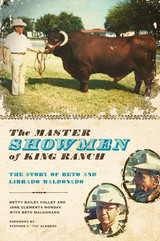
Winner, San Antonio Conservation Society Citation, 2011
Texas's King Ranch has become legendary for a long list of innovations, the most enduring of which is the development of the first official cattle breed in the Americas, the Santa Gertrudis. Among those who played a crucial role in the breed's success were Librado and Alberto "Beto" Maldonado, master showmen of the King Ranch. A true "bull whisperer," Librado Maldonado developed a method for gentling and training cattle that allowed him and his son Beto to show the Santa Gertrudis to their best advantage at venues ranging from the famous King Ranch auctions to a Chicago television studio to the Dallas–Fort Worth airport. They even boarded a plane with the cattle en route to the International Fair in Casablanca, Morocco, where they introduced the Santa Gertrudis to the African continent.
In The Master Showmen of King Ranch, Beto Maldonado recalls an eventful life of training and showing King Ranch Santa Gertrudis. He engagingly describes the process of teaching two-thousand-pound bulls to behave "like gentlemen" in the show ring, as well as the significant logistical challenges of transporting them to various high-profile venues around the world. His reminiscences, which span more than seventy years of King Ranch history, combine with quotes from other Maldonado family members, co-workers, and ranch owners to shed light on many aspects of ranch life, including day-to-day work routines, family relations, women's roles, annual celebrations, and the enduring ties between King Ranch owners and the vaquero families who worked on the ranch through several generations.


Claribel Baird reviews the interpretation of classical texts for theatrical performance. Howard Bay interrupted his stage design career of more than 150 Broadway productions to help students. BernardBeckerman asks if there are approaches to the teaching of dramatic literature that particularly suit drama-as-theatre. Robert Benedetti offers suggestions on the teaching of acting. OscarBrockett treats the problems of the theatre teacher and the processes of learning.
AgnesHaaga shows that the essential quality in heading up child drama programs is a sense of joyous delight. Wallace Smith discusses methods for teaching secondary schooltheatre. Jewel Walker offers a rare written statement about his work as a theatre teacher. Carl Weber conveys the principles and methodology of his mentor, Bertolt Brecht, to beginning directors.

Mastering Academic Reading is meant to challenge advanced academically oriented students of English. The units and the readings within them are long. The comprehension and expansion exercises after them are demanding. The hoped-for outcome is that students trained using this textbook will be able to better hold their own in university classes where the reading volume across disciplines and vocabulary demands are high.
Almost every reading is taken, in minimally adapted form, from a book or academic / professional journal. Two introductory passages have been composed expressly for this book in order to provide narrowly focused background material. Beyond these pieces, readers are in the hands of “real-world” authors and their difficult, lexically diffuse, and allusion-filled creations. Journal articles and book excerpts predominate, but Mastering Academic Reading also offers a book review and a government pamphlet as well.
Since one aspect of reading practice builds on others, the units are laid out in tiers, not in sections. Each unit has been organized into three tiers. In general, there is one reading per tier, although the first tier in Unit 3 contains two passages (both necessary to provide conceptual background for the other two tiers). Each reading is 3,500-5,000 words. The book focuses on the three primary goals of academic reading: reading to learn; reading to integrate, write, and critique texts; and reading for basic comprehension.

Mastering Discourses offers an account of why "theory" fails to deal adequately with the politics of discursive cultures and warns that unless critics take much more seriously their own disciplinary inscriptions they will always reproduce structures of power and knowledge that they claim to oppose. Moreover, Bové argues, they will not fulfill the main role of the post-enlightenment intellectual, namely: to respond effectively to the present, through new theoretical and historical formulations that address the changing world of transnational capitalism and its neoliberal ideologies.
READERS
Browse our collection.
PUBLISHERS
See BiblioVault's publisher services.
STUDENT SERVICES
Files for college accessibility offices.
RECENTLY PUBLISHED


UChicago Accessibility Resources
home | accessibility | search | about | contact us
BiblioVault ® 2001 - 2026
The University of Chicago Press