
 A SCHOLARLY BOOK REPOSITORY
In his first book to be translated into English, Vioulac radicalizes Heidegger’s understanding of truth as disclosure through the notion of truth as apocalypse. This “apocalypse of truth” works as an unveiling that reveals both the finitude and mystery of truth, allowing a full confrontation with truth-as-absence. Engaging with Heidegger, Marx, and St. Paul, as well as contemporary figures including Giorgio Agamben, Alain Badiou, and Slavoj Žižek, Vioulac’s book presents a subtle, masterful exposition of his analysis before culminating in a powerful vision of “the abyss of the deity.” Here, Vioulac articulates a portrait of Christianity as a religion of mourning, waiting for a god who has already passed by, a form of ever-present eschatology whose end has always already taken place. With a preface by Jean-Luc Marion, Apocalypse of Truth presents a major contemporary French thinker to English-speaking audiences for the first time.
Accompanied by incisive commentary, these pieces from Heidegger's student days, his early Freiburg period, and the time of his Marburg lecture courses will contribute substantially to rethinking the making and meaning of Being and Time. The contents are of a depth and quality that make this volume the collection for those interested in Heidegger's work prior to his masterwork. The book will also serve those concerned with Heidegger's relation to such figures as Aristotle, Dilthey, Husserl, Jaspers, and Löwith, as well as scholars whose interests are more topically centered on questions of history, logic, religion, and truth. Important in their own right, these pieces will also prove particularly useful to students of Heidegger's thought and of twentieth-century philosophy in general.
An entirely new approach to both Novalis and Heidegger, this book will interest scholars and students engaged with continental philosophy and the legacy of German Romanticism.
Hobbes's Leviathan, Hegel's Phenomenology of Spirit, and Heidegger's Being and Time dramatize conscience's relation to language and knowledge, morality and duty, and ontology. Feldman investigates how, within these works, conscience is described as binding upon us while at the same time asking how texts themselves may be read as binding.
From Plato’s contempt for “the madness of the multitude” to Kant’s lament for “the great unthinking mass,” the history of Western thought is riddled with disdain for ordinary collective life. But it was not until Kierkegaard developed the term chatter that this disdain began to focus on the ordinary communicative practices that sustain this form of human togetherness.
The Chattering Mind explores the intellectual tradition inaugurated by Kierkegaard’s work, tracing the conceptual history of everyday talk from his formative account of chatter to Heidegger’s recuperative discussion of “idle talk” to Lacan’s culminating treatment of “empty speech”—and ultimately into our digital present, where small talk on various social media platforms now yields big data for tech-savvy entrepreneurs.
In this sense, The Chattering Mind is less a history of ideas than a book in search of a usable past. It is a study of how the modern world became anxious about everyday talk, figured in terms of the intellectual elites who piqued this anxiety, and written with an eye toward recent dilemmas of digital communication and culture. By explaining how a quintessentially unproblematic form of human communication became a communication problem in itself, McCormick shows how its conceptual history is essential to our understanding of media and communication today.
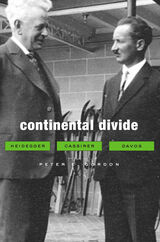
In the spring of 1929, Martin Heidegger and Ernst Cassirer met for a public conversation in Davos, Switzerland. They were arguably the most important thinkers in Europe, and their exchange touched upon the most urgent questions in the history of philosophy: What is human finitude? What is objectivity? What is culture? What is truth?
Over the last eighty years the Davos encounter has acquired an allegorical significance, as if it marked an ultimate and irreparable rupture in twentieth-century Continental thought. Here, in a reconstruction at once historical and philosophical, Peter Gordon reexamines the conversation, its origins and its aftermath, resuscitating an event that has become entombed in its own mythology. Through a close and painstaking analysis, Gordon dissects the exchange itself to reveal that it was at core a philosophical disagreement over what it means to be human.
But Gordon also shows how the life and work of these two philosophers remained closely intertwined. Their disagreement can be understood only if we appreciate their common point of departure as thinkers of the German interwar crisis, an era of rebellion that touched all of the major philosophical movements of the day—life-philosophy, philosophical anthropology, neo-Kantianism, phenomenology, and existentialism. As Gordon explains, the Davos debate would continue to both inspire and provoke well after the two men had gone their separate ways. It remains, even today, a touchstone of philosophical memory.
This clear, riveting book will be of great interest not only to philosophers and to historians of philosophy but also to anyone interested in the great intellectual ferment of Europe’s interwar years.
In The Crisis of Meaning and the Life-World, Ľubica Učník examines the existential conflict that formed the focus of Edmund Husserl’s final work, which she argues is very much with us today: how to reconcile scientific rationality with the meaning of human existence. To investigate this conundrum, she places Husserl in dialogue with three of his most important successors: Martin Heidegger, Hannah Arendt, and Jan Patočka.
For Husserl, 1930s Europe was characterized by a growing irrationalism that threatened to undermine its legacy of rational inquiry. Technological advancement in the sciences, Husserl argued, had led science to forget its own foundations in the primary “life-world”: the world of lived experience. Renewing Husserl’s concerns in today’s context, Učník first provides an original and compelling reading of his oeuvre through the lens of the formalization of the sciences, then traces the unfolding of this problem through the work of Heidegger, Arendt, and Patočka.
Although many scholars have written on Arendt, none until now has connected her philosophical thought with that of Czech phenomenologist Jan Patočka. Učník provides invaluable access to the work of the latter, who remains understudied in the English language. She shows that together, these four thinkers offer new challenges to the way we approach key issues confronting us today, providing us with ways to reconsider truth, freedom, and human responsibility in the face of the postmodern critique of metanarratives and a growing philosophical interest in new forms of materialism.
Kolb offers his own views, proposing the possibility of a meaningful life that is free but still rooted in shared contexts. He concludes with comments on "postmodernity" as discussed by Lyotard and others, arguing persuasively against the presupposition of a unified Modern or Postmodern Age.
Heidegger claimed that Western philosophy ended—failed, even—in the German Idealist tradition. In The Culmination, Robert B. Pippin explores the ramifications of this charge through a masterful survey of Western philosophy, especially Heidegger’s critiques of Hegel and Kant. Pippin argues that Heidegger’s basic concern was to determine sources of meaning for human life, particularly those that had been obscured by Western philosophy’s attention to reason. The Culmination offers a new interpretation of Heidegger, German Idealism, and the fate of Western rationalism.
The author of discipline-defining studies of human cognition and artificial intelligence, John Haugeland was a charismatic, highly original voice in the contemporary forum of Anglo-American analytic philosophy. At his death in 2010, he left behind an unfinished manuscript, more than a decade in the making, intended as a summation of his life-long engagement with one of the twentieth century’s most influential philosophical tracts, Heidegger’s Being and Time (1927). Dasein Disclosed brings together in a single volume the writings of a man widely acknowledged as one of Heidegger’s preeminent and most provocative interpreters.
A labyrinth of notoriously difficult ideas and terminology, Being and Time has inspired copious commentary. Not content merely to explain, Haugeland aspired to a sweeping reevaluation of Heidegger’s magnum opus and its conception of human life as Dasein—a reevaluation focused on Heidegger’s effort to reawaken philosophically dormant questions of what it means “to be.” Interpreting Dasein unconventionally as “the living of a living way of life,” Haugeland put involvement in a shared world, rather than individual persons or their experience, at the heart of Heidegger’s phenomenology of understanding and truth. Individuality, Haugeland insists, emerges in the call to take responsibility for a collective way of being in the world. He traces this thought to Heidegger’s radical conclusion that one does not truly understand philosophical concepts unless that understanding changes how one lives.
As illuminating as it is iconoclastic, Dasein Disclosed is not just Haugeland’s Heidegger—it is a major contribution to philosophy in its own right.
Chapter by chapter, Deep Rhetoric develops an understanding of rhetoric not only in its philosophical dimension but also as a means of guiding and conducting conflicts, achieving justice, and understanding the human condition. Along the way, Crosswhite restores the traditional dignity and importance of the discipline and illuminates the twentieth-century resurgence of rhetoric among philosophers, as well as the role that rhetoric can play in future discussions of ontology, epistemology, and ethics. At a time when the fields of philosophy and rhetoric have diverged, Crosswhite returns them to their common moorings and shows us an invigorating new way forward.
Although it is sometimes said that Martin Heidegger’s later philosophy no longer concerned itself with the theme of authenticity so crucial to Being and Time (1927), this book argues that his interest in authenticity was always strong.
After leaving the seminary to become a philosophy student, Heidegger began to “de–mythologize” religious themes for his own philosophical purposes. Like the Christian notion of faith, Heidegger’s notion of authenticity involves relinquishing the egotistical self–understanding which blocks our openness for possibilities. Yet authenticity as “resoluteness” includes an element of voluntarism foreign to the idea of faith. Heidegger’s brief engagement with National Socialism (1933–1934) helped him to re–think the Nietzschean concept of will which had influenced his early views on authenticity. Although part of the meaning of resoluteness is to allow things to be revealed, it also suggests that an individual can somehow will to be authentic. After about 1936, Heidegger emphasized that an individual can only be released from egoism (inauthenticity) by a power which transcends him. The abiding theological issue concerning the efficacy of works as against the saving power of grace finds expression in the distinction between resoluteness and releasement.

A well-known art historian and an intimate friend of Heidegger's, Heinrich Wiegand Petzet provides a rich portrait of Heidegger that is part memoir, part biography, and part cultural history. By recounting chronologically a series of encounters between the two friends from their meeting in 1929 until the philosopher's death in 1976, as well as between Heidegger and other contemporaries, Petzet reveals not only new aspects of Heidegger's thought and attitudes toward the historical and intellectual events of his time but also the greater cultural and social context in which he articulated his thought.
Beginning at the point where Heidegger encountered Hegel, this volume of provocative essays addresses the respective philosophies of the two men. Leading scholars provide a variety of models from which to view the unique relationship between the bodies of thought of Heidegger and Hegel: bodies of thought that cannot be taken as two objects to be compared, contrasted, and finally evaluated but that must be viewed in dynamic terms, as a relationship in which self-transformations lead to mutual transformations and vice versa.

French philosopher Luce Irigaray has become one of the twentieth century's most influential feminist thinkers. Among her many writings are three books (with a projected fourth) in which she challenges the Western tradition's construals of human beings' relations to the four elements—earth, air, fire, and water—and to nature. In answer to Heidegger's undoing of Western metaphysics as a "forgetting of Being," Irigaray seeks in this work to begin to think out the Being of sexedness and the sexedness of Being.
This volume is the first English translation of L'oubli de l'air chez Martin Heidegger (1983). In this complex, lyrical, meditative engagement with the later work of the eminent German philosopher, Irigaray critiques Heidegger's emphasis on the element of earth as the ground of life and speech and his "oblivion" or forgetting of air.
With the other volumes (Elemental Passions and Marine Lover of Friedrich Nietzsche, published elsewhere) in Irigaray's "elemental" series, The Forgetting of Air offers a fundamental rereading of basic tenets in Western metaphysics. And with its emphasis on dwelling and human habitation, it will be important reading not only in the humanities but also in architecture and the environmental sciences.
Heidegger’s later thought is a thinking of things, so argues Andrew J. Mitchell in The Fourfold. Heidegger understands these things in terms of what he names “the fourfold”—a convergence of relationships bringing together the earth, the sky, divinities, and mortals—and Mitchell’s book is the first detailed exegesis of this neglected aspect of Heidegger’s later thought. As such it provides entrée to the full landscape of Heidegger’s postwar thinking, offering striking new interpretations of the atomic bomb, technology, plants, animals, weather, time, language, the holy, mortality, dwelling, and more. What results is a conception of things as ecstatic, relational, singular, and, most provocatively, as intrinsically tied to their own technological commodification. A major new work that resonates beyond the confines of Heidegger scholarship, The Fourfold proposes nothing less than a new phenomenological thinking of relationality and mediation for understanding the things around us.
In The Fragile "We": Ethical Implications of Heidegger's "Being and Time," Lawrence Vogel presents three interpretations of authentic existence—the existentialist, the historicist, and the cosmopolitan—each of which is a plausible version of the personal ideal depicted in Being and Time. He then draws parallels between these interpretations and three moments in the contemporary liberal-communitarian debate over the relationship of the "I" and the "We." His book contributes both to a diagnosis of what there is about Being and Time that invites moral nihilism and to a sense of how fundamental ontology might be recast so that "the other" is accorded an appropriate place in an account of human existence.
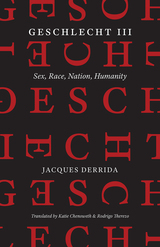
Amid new revelations about Heidegger’s anti-Semitism and the contemporary context of nationalist resurgence, this third piece of the Geschlecht series is timelier and more necessary than ever. Meticulously edited and expertly translated, this volume brings Derrida’s mysterious and much awaited text to light.

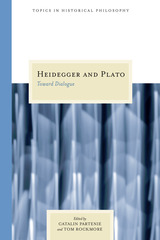
As editors Catalin Partenie and Tom Rockmore remark, a simple way to describe Heidegger's reading of Plato might be to say that what began as an attempt to appropriate Plato (and through him a large portion of Western philosophy) finally ended in an estrangement from both Plato and Western philosophy. The authors of this volume consider Heidegger's thought in relation to Plato before and after the "Kehre" or turn. In doing so, they take up various central issues in Heidegger's Being and Time (1927) and thereafter, and the questions of hermeneutics, truth, and language. The result is a subtle and multifaceted reinterpretation of Heidegger's position in the tradition of philosophy, and of Plato's role in determining that position.
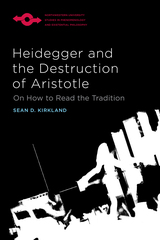
A bold new conception of Heidegger’s project of Destruktion as a method of interpreting history
For Martin Heidegger, our inherited traditions provide the concepts through which we make our world intelligible. Concepts we can also oppose, disrupt, and even exceed. First, however, if Western philosophy is our inheritance, we must submit it to Destruktion—starting with Aristotle. Heidegger and the Destruction of Aristotle: On How to Read the Tradition presents a new conception of Heidegger’s “destruction” as a way of reading.
Situated between Nietzschean genealogy and Derridean deconstruction, this method uncovers in Aristotle the most vital originating articulations of the Western tradition and gives us the means to confront it. Sean D. Kirkland argues this is not a rejection of the past but a sophisticated and indeed timely hermeneutic tool—a complex, illuminating, and powerful method for interpreting historical texts at our present moment. Acknowledging the historical Heidegger as a politically compromised and still divisive figure, Kirkland demonstrates that Heideggerian destruction is a method of interpreting history that enables us to reorient and indeed transform its own most troubling legacies.

While Heidegger’s affiliation with National Socialism is well known, the anti-Semitic dimension of that engagement could not be fully told until now. Trawny traces Heidegger’s development of a grand “narrative” of the history of being, the “being-historical thinking” at the center of Heidegger’s work after Being and Time. Two of the protagonists of this narrative are well known to Heidegger’s readers: the Greeks and the Germans. The world-historical antagonist of this narrative, however, has remained hitherto undisclosed: the Jews, or, more specifically, “world Judaism.” As Trawny shows, world Judaism emerges as a racialized, destructive, and technological threat to the German homeland, indeed, to any homeland whatsoever. Trawny pinpoints recurrent, anti-Semitic themes in the Notebooks, including Heidegger’s adoption of crude cultural stereotypes, his assigning of racial reasons to philosophical decisions (even undermining his Jewish teacher, Edmund Husserl), his endorsement of a Jewish “world conspiracy,” and his first published remarks on the extermination camps and gas chambers (under the troubling aegis of a Jewish “self-annihilation”). Trawny concludes with a thoughtful meditation on how Heidegger’s achievements might still be valued despite these horrifying facets. Unflinching and systematic, this is one of the most important assessments of one of the most important philosophers in our history.

This volume collects and translates Philippe Lacoue-Labarthe’s studies of Heidegger, written and revised between 1990 and 2002. All deal with Heidegger’s relation to politics, specifically through Heidegger’s interpretations of the poetry of Hölderlin. Lacoue-Labarthe argues that it is through Hölderlin that Heidegger expresses most explicitly his ideas on politics, his nationalism, and the importance of myth in his thinking, all of which point to substantial affinities with National Socialism.
Lacoue-Labarthe not only examines the intellectual background--including Romanticism and "German ideology"--of Heidegger's uses and abuses of poetry, he also attempts to reestablish the vexed relationship between poetry and philosophy outside the bounds of the Heideggerian reading. He turns to Walter Benjamin and Theodor Adorno, as well as Paul Celan, arguing for the necessity of poetry as an engagement with history. While Heidegger's readings of Hölderlin attempt to appropriate poetry for mythic and political ends, Lacoue-Labarthe insists that poetry and thought can, and must, converge in another way. Jeff Fort provides a precise translation capturing the spirit and clarity of Lacoue-Labarthe’s writing, as well as an introduction clearly situating the debates addressed in these essays.
Moreover, the book demonstrates why popular critical interpretations of Heidegger's relation to the will are untenable, how his so-called "turn" is not a simple "turnaround" from voluntarism to passivism. Davis explains why the later Heidegger's key notions of "non-willing" and "Gelassenheit" do not imply a mere abandonment of human action; rather, they are signposts in a search for an other way of being, a "higher activity" beyond the horizon of the will. While elucidating this search, his work also provides a critical look at the ambiguities, tensions, and inconsistencies of Heidegger's project, and does so in a way that allows us to follow the inner logic of the philosopher's struggles. As meticulous as it is bold, this comprehensive reinterpretation will change the way we think about Heidegger's politics and about the thrust of his philosophy as a whole.

Martin Heidegger’s Being and Time can be broadly termed a transcendental inquiry into the structures that make human experience possible. Such an inquiry reveals the conditions that render human experience intelligible. Using Being and Time as a model, I attempt to show that Alfred North Whitehead’s Process and Reality not only aligns with Being and Time in opposing many elements of traditional Western philosophy but also exhibits a similar transcendental inquiry.
With this reading, Process and Reality contains concepts much like Being-in-the-world, ecstatic temporality, and others found in Being and Time. More important, this interpretation considers Whitehead’s treatment of human experience paradigmatic for understanding his cosmological scheme in general. Finally, the results of this study are employed to sketch a phenomenology of holy experience.
— Prefatory Note to Heidegger and Whitehead
There are moments when things suddenly seem strange—objects in the world lose their meaning, we feel like strangers to ourselves, or human existence itself strikes us as bizarre and unintelligible. Through a detailed philosophical investigation of Heidegger’s concept of uncanniness (Unheimlichkeit), Katherine Withy explores what such experiences reveal about us. She argues that while others (such as Freud, in his seminal psychoanalytic essay, “The Uncanny”) take uncanniness to be an affective quality of strangeness or eeriness, Heidegger uses the concept to go beyond feeling uncanny to reach the ground of this feeling in our being uncanny.
Heidegger on Being Uncanny answers those who wonder whether human existence is fundamentally strange to itself by showing that we can be what we are only if we do not fully understand what it is to be us. This fundamental finitude in our self-understanding is our uncanniness. In this first dedicated interpretation of Heidegger’s uncanniness, Withy tracks this concept from his early analyses of angst through his later interpretations of the choral ode from Sophocles’s Antigone. Her interpretation uncovers a novel and robust continuity in Heidegger’s thought and in his vision of the human being as uncanny, and it points the way toward what it is to live well as an uncanny human being.
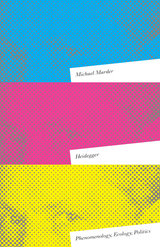
Understanding the political and ecological implications of Heidegger’s work without ignoring his noxious public engagements
The most controversial philosopher of the twentieth century, Martin Heidegger has influenced generations of intellectuals even as his involvement with Nazism and blatant anti-Semitism, made even clearer after the publication of his Black Notebooks, have recently prompted some to discard his contributions entirely. For Michael Marder, Heidegger’s thought remains critical for interpretations of contemporary politics and our relation to the natural environment.
Bringing together and reframing more than a decade of Marder’s work on Heidegger, this volume questions the wholesale rejection of Heidegger, arguing that dismissive readings of his project overlook the fact that it is impossible to grasp without appreciating his lifelong commitment to phenomenology and that Heidegger’s anti-Semitism is an aberration in his still-relevant ecological and political thought, rather than a defining characteristic. Through close readings of Heidegger’s books and seminars, along with writings by other key phenomenologists and political philosophers, Marder contends that neither Heidegger’s politics nor his reflections on ecology should be considered in isolation from his phenomenology. By demonstrating the codetermination of his phenomenological, ecological, and political thinking, Marder accounts for Heidegger’s failures without either justifying them or suggesting that they invalidate his philosophical endeavor as a whole.
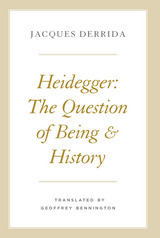
Derrida performs an almost surgical reading of the notoriously difficult text, marrying pedagogical clarity with patient rigor and acting as a lucid guide through the thickets of Heidegger’s prose. At this time in intellectual history, Heidegger was still somewhat unfamiliar to French readers, and Being and Time had only been partially translated into French. Here Derrida mostly uses his own translations, giving his own reading of Heidegger that directly challenges the French existential reception initiated earlier by Sartre. He focuses especially on Heidegger’s Destruktion (which Derrida would translate both into “solicitation” and “deconstruction”) of the history of ontology, and indeed of ontology as such, concentrating on passages that call for a rethinking of the place of history in the question of being, and developing a radical account of the place of metaphoricity in Heidegger’s thinking.
This is a rare window onto Derrida’s formative years, and in it we can already see the philosopher we’ve come to recognize—one characterized by a bravura of exegesis and an inventiveness of thought that are particularly and singularly his.
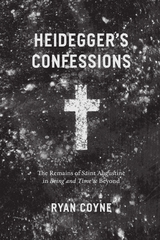
Coyne first examines the role of Augustine in Heidegger’s early period and the development of his magnum opus, Being and Time. He then goes on to show that Heidegger owed an abiding debt to Augustine even following his own rise as a secular philosopher, tracing his early encounters with theological texts through to his late thoughts and writings. Bringing a fresh and unexpected perspective to bear on Heidegger’s profoundly influential critique of modern metaphysics, Coyne traces a larger lineage between religious and theological discourse and continental philosophy.
The contributions to this volume, written by leading scholars in the field of Heidegger research, address many of these questions in close readings of Heidegger’s texts and thus provide sound orientation in the field of contemporary Heidegger research. They show how the different trajectories of Heidegger’s thought—his early interest in the meaning of Being and in Dasein, his discussion of, and involvement with, politics, his understanding of art, poetry, and technology, his concept of truth and the idea of a history of Being—all converge at one point: the question of Being. It thus becomes clear that, all differences notwithstanding, Heidegger followed one very consistent path of thinking.
Heidegger's remarks in this seminar illuminate his interpretations not only of pre-Socratic philosophy, but also of figures such as Hegel and Holderllin. At the same time, Heidegger clarifies many late developments in his own understanding of truth, Being, and understanding. Heidegger and Fink, both deeply rooted in the Freiburg phenomenological tradition, offer two competing approaches to the phenomenological reading of the ancient text-a kind of reading that, as Fink says, is "not so much concerned with the philological problematic . . . as with advancing into the matter itself, that is, toward the matter that must have stood before Heraclitus's spiritual view."
No thinkers have wrestled with the issue of truth and interpretation in more illuminating ways for the Continental tradition of philosophy than Heidegger and Gadamer. Hermeneutics and Truth is a dual focus on Heidegger and Gadamer, but it concentrates primarily on Gadamer's efforts to think through the issue of truth for hermeneutics and only secondarily on Heidegger's thought on this issue.
In a penetrating and lucid discussion of the enigmatic relationship between the work of Edmund Husserl and Martin Heidegger, Steven Galt Crowell proposes that the distinguishing feature of twentieth-century philosophy is not so much its emphasis on language as its concern with meaning. Arguing that transcendental phenomenology is indispensable to the philosophical explanation of the space of meaning, Crowell shows how a proper understanding of both Husserl and Heidegger reveals the distinctive contributions of each to that ongoing phenomenological project.
Framed in response to Martin Heidegger’s influential account of the relation between technological modernity and theological tradition, The Indiscrete Image builds an understanding of creativity as conditioned by insurmountable unknowing and incalculable possibility through alternative readings of Christian theological tradition and technological culture—and the surprising resonance between these two. Carlson concludes that the always ongoing work of world creation, tied essentially to human self-creation, implies neither an idol’s closure nor an icon’s transcendence, but the “indiscrete image” whose love makes possible—by keeping open—both the human and its world.
Combining both historical research in theology (from Pseudo-Dionysius to Aquinas to Eckhart) and contemporary philosophical analysis (from Hegel and Nietzsche to Heidegger, Derrida, and Marion), Indiscretion will interest philosophers, theologians, and other scholars concerned with the possibilities and limits of language surrounding both God and human subjectivity.
The poet Hölderlin posed the question, "Is there a measure on earth?" His own answer was emphatic, "There is none," for he was convinced that the measure for man was to be found only in the domain of the heavenly beings. Such metaphysical assumptions, as well as the attempt to found ethical conduct in the nature of man as a rational being, have been rejected by many contemporary thinkers, particularly Heidegger. Yet these thinkers have not been able to provide a satisfactory alternative to metaphysical foundations of the standards for responsible human conduct.
Marx, therefore, goes beyond Heidegger in demonstrating how several of his most basic notions could be relevant to a secular morality in our age. It is death, Marx claims, that unsettles man and transforms his conduct toward his fellow man. the common experience of mortality nourishes ethical life—and leads to the measures of compassion, love, and recognition of one's fellow human beings.
"It is only on the basis of these 'traditional virtues,'" Marx writes, "that we can find a motive for averting the impending dangers which have often enough been described so vividly and convincingly."

Livingston's formal and phenomenological analysis articulates and defends a realist position about being, time, and their relationship that understands that all of these are structured and constituted in a way that does not depend on the human mind, consciousness, or subjectivity. This approach provides a basis for new logically and phenomenologically based accounts of the structure of linguistic truth in relation to the appearance of objects and of the formal structure of time as given.
Livingston draws on philosophers from Plato and Aristotle to Davidson and Heidegger in this exploration. In it, readers and scholars will discover innovative connections between continental and analytic philosophy.
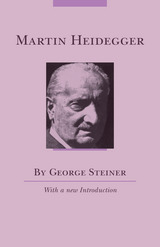
"It would be hard to imagine a better introduction to the work of philosopher Martin Heidegger."—George Kateb, The New Republic

One of the century’s greatest philosophers, without whom there would be no Sartre, no Foucault, no Frankfurt School, Martin Heidegger was also a man of great failures and flaws, a Faustus who made a pact with the devil of his time, Adolf Hitler. The story of Heidegger’s life and philosophy, a quintessentially German story in which good and evil, brilliance and blindness are inextricably entwined and the passions and disasters of a whole century come into play, is told in this brilliant biography.
Heidegger grew up in Catholic Germany where, for a chance at pursuing a life of learning, he pledged himself to the priesthood. Soon he turned apostate and sought a university position, which set him on the path to becoming the star of German philosophy in the 1920s. Rüdiger Safranski chronicles Heidegger’s rise along with the thought he honed on the way, with its debt to Heraclitus, Plato, and Kant, and its tragic susceptibility to the conservatism that emerged out of the nightmare of Germany’s loss in World War I. A chronicle of ideas and of personal commitments and betrayals, Safranski’s biography combines clear accounts of the philosophy that won Heidegger eternal renown with the fascinating details of the loves and lapses that tripped up this powerful intellectual.
The best intellectual biography of Heidegger ever written and a best-seller in Germany, Martin Heidegger: Between Good and Evil does not shy away from full coverage of Heidegger’s shameful transformation into a propagandist for the National Socialist regime; nor does it allow this aspect of his career to obscure his accomplishments. Written by a master of Heidegger’s philosophy, the book is one of the best introductions to the thought and to the life and times of the greatest German philosopher of the century.
Smith argues that, while much of postmodern thought is rooted in Nietzsche and Heidegger, it has ironically attempted, whether unwittingly or by design, to deflect their philosophy back onto a modern path. Other alternative paths emanating from both Nietzschean and Heideggerian thought that might more powerfully speak to postmodern culture have been ignored. Nietzsche and Heidegger, Smith suggests, have made possible a far more revolutionary critique of modernity then even their most ardent postmodern admirers have realized.
Smith contends that the influences on the postmodern in the thought of Nietzsche and Heidegger are founded in a new vision of praxis liberated from theory. Ultimately, these philosophers do transcend the nihilism often found in the guise of postmodernism. Their thought is, moreover, consistent with the possibility of limited constitutional government and the rule of law. Smith's book takes the first step toward recovering these possibilities and posing the fundamental questions of politics and ethics in ways that have heretofore been closed off by late-modern thought.

"Derrida's ruminations should intrigue anyone interested in Post-Structuralism. . . . . This study of Heidegger is a fine example of how Derrida can make readers of philosophical texts notice difficult problems in almost imperceptible details of those texts."—David Hoy, London Review of Books
"Will a more important book on Heidegger appear in our time? No, not unless Derrida continues to think and write in his spirit. . . . Let there be no mistake: this is not merely a brilliant book on Heidegger, it is thinking in the grand style."—David Farrell Krell, Research in Phenomenology
"The analysis of Heidegger is brilliant, provocative, elusive."—Peter C. Hodgson, Religious Studies Review
"This collection may well vie with Vom Wesen des Grundes and Identität and Differenz as definitive statements of Heidegger's ontology."—Library Journal
"The title of the English translation is that of the lead essay, the highly celebrated lecture which Heidegger gave in 1962 and which bears the same title as the never published 'third division' of the 'first half' of Being and Time. This lecture is perhaps the most significant document to be added to the Heideggerian corpus since the Letter of Humanism. . . . Stambaugh's translation is superb."—Stanley O. Hoerr and staff, The Review of Metaphysics

Readings in Interpretation was first published in 1987. Minnesota Archive Editions uses digital technology to make long-unavailable books once again accessible, and are published unaltered from the original University of Minnesota Press editions.
Readings in Interpretation — a volume primarily on the texts of Holderlin, Hegel, and their interpreter Heidegger—locates itself strategically between literature and philosophy. In keeping with this juxtaposition, it treats the question of self-consciousness and reflection on the levels of "theme" and "text." For both Hegel and Holderlin, selfconsciousness and its relation to knowing are explicit themes, but Waminski's readings show that a more disruptive reflection is operative on the level of text.
In an argument that centers on the textual aspects of Hegel's Phenomenology of the Spirit,Warminski demonstrates that the negative moment—which is often interpreted as a prelude to a unified self-consciousness—cannot be accounted for by interpretive models drawn from outside the text—by concepts like the self, consciousness, or the subject. Instead, a completely different practice and theory is necessary. The author's "Prefatory Postscript" at the beginning of the book therefore serves as an introduction to sketch the theoretical basis of the readings that follow and as a "postscript" that explains the difference between "reading" and "interpretation" which those readings make necessary.
Heidegger’s lectures delivered at the University of Freiburg in 1936 on Schelling’s Treatise On Human Freedom came at a crucial turning point in Heidegger’s development. He had just begun his study to work out the term “Ereignis.” Heidegger’s interpretation of Schelling’s work reveals a dimension of his thinking which has never been previously published in English.
While Schelling’s philosophy is less known than that of the other major German Idealists, Fichte and Hegel, he is one of the thinker with whom Heidegger has the most affinity, making this study fruitful for an understanding of both philosophers. Heidegger’s interpretation of On Human Freedom is the most straightforward of the studies to have appeared in English on the Treatise, and is the only work that is devoted to Schelling in Heidegger’s corpus. The basic problems at stake in Schelling’s Treatise lie at the very heart of the idealist tradition: the question of the compatibility of the system and individual freedom, the questions of pantheism and the justification of evil. Schelling was the first thinker in the rationalist-idealist tradition to grapple seriously with the problem of evil.
These are the great questions of the philosophical tradition. They lead Schelling and, with him, Heidegger, to possibilities that come very close to the boundaries of the idealist tradition. For example, Schelling’s concept of the “groundless”—what reason can no longer ground and explain—points back to Jacob Boehme and indirectly forward to the direction of Heidegger’s own inquiry into “Being.” Heidegger’s reading of Schelling, especially of the topics of evil and freedom, clearly shows Schelling’s influence on Heidegger’s views.
In doing so, McMullin argues that Heidegger’s work on the social nature of the self must be located within a philosophical continuum that builds on Kant and Husserl’s work regarding the nature of the a priori and the fundamental structures of human temporality, while also pointing forward to developments of these themes to be found in Heidegger’s later work and in such thinkers as Sartre and Levinas. By developing unrecognized resources in Heidegger’s work, Time and the Shared World is able to provide a Heidegger-inspired account of respect and the intersubjective origins of normativity.
How are we to think and act constructively in the face of today’s environmental and political catastrophes? Gail Stenstad finds inspiring answers in the thought of German philosopher Martin Heidegger. Rather than simply describing or explaining Heidegger’s transformative way of thinking, Stenstad’s writing enacts it, bringing new insight into contemporary environmental, political, and personal issues. Readers come to understand some of Heidegger’s most challenging concepts through experiencing them. This is a truly creative scholarly work that invites all readers to carry Heidegger’s transformative thinking into their own areas of deep concern.
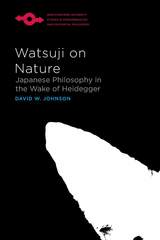
In an engagingly lucid and deft analysis, Watsuji on Nature radically expands our appreciation of twentieth-century Japanese philosophy and shows what it has to offer to a global philosophical conversation.
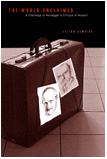
The World Unclaimed argues that Heidegger’s critique of modern epistemology in Being and Time is seriously flawed. Heidegger believes he has done away with epistemological problems concerning the external world by showing that the world is an existential structure of Dasein. However, the author argues that Heidegger fails to make good his claim that he has “rescued” the phenomenon of the world, which he believes the tradition of philosophy has bypassed. Heidegger fails not only to reclaim the world but also to acknowledge its loss. Alweiss thus calls into question Heidegger’s claim that ontology is more fundamental than epistemology.
The World Unclaimed develops its powerful critique of Being and Time by arguing for a return to Husserl. It draws on Husserl’s insight that it is the moving and sensing body that discloses how we are already familiar with the world. Kinaesthesia provides a key for understanding our relation to the world. The author thus suggests that thinkers in the vein of Husserl and Kant -who, for Heidegger, epitomize the tradition of modern philosophy by returning to a “worldless subject”- may provide us with the resources to reclaim the phenomenon of the world that Being and Time sets out to salvage.
Alweiss’s fresh and innovative study demonstrates that it is possible to overcome epistemological skepticism without ever losing sight of the phenomenon of the world. Moreover, Alweiss challenges us to reconsider the relation between Husserl and Heidegger by providing a forceful defense of Husserl’s critique of cognition.
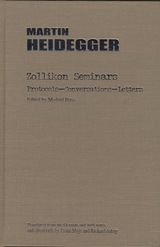
Boss approached Heidegger asking for help in reflective thinking on the nature of Heidegger's work. Soon they were holding annual two-week meetings in Boss's home in Zollikon, Switzerland. The protocols from these seminars, recorded by Boss and reviewed, corrected, and supplemented by Heidegger himself, make up one part of this volume. They are augmented by Boss's record of the conversations he had with Heidegger in the days between seminars and by excerpts from the hundreds of letters the philosopher wrote to Boss between 1947 and 1971.
READERS
Browse our collection.
PUBLISHERS
See BiblioVault's publisher services.
STUDENT SERVICES
Files for college accessibility offices.
RECENTLY PUBLISHED





UChicago Accessibility Resources
home | accessibility | search | about | contact us
BiblioVault ® 2001 - 2024
The University of Chicago Press