
 A SCHOLARLY BOOK REPOSITORY
511 start with L start with L
For decades, Rachel Blau DuPlessis has shown readers how genres, forms, and the literal acts of writing and reception can be understood as sites of struggle. In her own words, “writing is . . . a praxis . . . in which the author disappears into a process, into a community, into discontinuities, and into a desire for discovery.” It is cause for celebration, then, that we have another work of warm, incisive, exploratory writing from DuPlessis in A Long Essay on the Long Poem.
Long poems, DuPlessis notes, are elusive, particularly in the slippery forms that have emerged in the postmodern mode. She cites both Nathaniel Mackey and Anne Waldman in thinking of the poem as a “box,” both in the sense of a vessel that contains and as a machine that processes, an instrument on which language is played. This study’s central attention is on the long poem as a sociocultural Book, distinctively envisioned by a range of authors.
To reckon with these shifting and evolving forms, DuPlessis works in a polyvalent mode, a hybrid of critical analysis and speculative essay. She divides the long poem and the long poets into three genres: epics, quests, and a composite she terms “assemblages.” The poets she surveys include T. S. Eliot, Ezra Pound, H.D., Louis Zukofsky, Gwendolyn Brooks, Charles Olson, Alice Notley, Nathaniel Mackey, Ron Silliman, Robert Duncan, Kamau Brathwaite, and, finally, Mallarmé and Dante. Instead of a traditional lineage, she deliberately seeks intersecting patterns of connection between poems and projects, a nexus rather than a family tree. In doing so she navigates both some challenges of long poems and her own attempt to “essay” them. The result is a fascinating and generous work that defies categorization as anything other than essential.
Larson was only nine years old when he recognized something of his own experience in how Michael Myers hid his true face from the world. This spark of recognition ignited his imagination while he searched for clues to what the future might hold for boys like him, all the while being made to understand his nascent sexuality as deviant and punishable. Like in the movies, his superficially safe suburban childhood was in fact filled with threat: a classmate’s murder, his father’s alcoholism and death, and his own sexual assault by a much older man. The figurative mask Larson learned to wear could not contain his yearning to be seen and desired. In the aftermath of this violence, his boyhood self came to believe that fear and desire would be forever intertwined.
This lyrical memoir expresses a boy’s search for identity while navigating the darkness and isolation of a deeply private inner world. With introspection and tenderness, Larson reflects on how little we understand in the moment about the experiences that mark us forever.
In a stimulating series of conversations, Steiner and journalist Laure Adler discuss a range of topics, including Steiner’s boyhood in Vienna and Paris, his education at the University of Chicago and Harvard, and his early years in academia. Books are a touchstone throughout, but Steiner and Adler’s conversations also range over music, chess, psychoanalysis, the place of Israel in Jewish life, and beyond. Blending thoughts on subjects of broad interest in the humanities—the issue of honoring Richard Wagner and Martin Heidegger in spite of their politics, or Virginia Woolf’s awareness of the novel as a multivocal form, for example—with personal reflections on life and family, Steiner demonstrates why he is considered one of today’s greatest minds. Revealing and exhilarating, A Long Saturday invites readers to pull up a chair and listen in on a conversation with a master.
The jist of what he learned--of what his "lessons" taught him--was (in the sentence of Oliver Wendell Holmes): "Where most men have died, there is the greatest interest." According to Grossman, violence arises not merely from the "barbarian" outside of the culture the poet serves, but from the inner logic of that culture; not, as he would now say, from the defeat of cultural membership but from the terms of cultural membership itself.
Grossman analyzes the "bitter logic of the poetic principle" as it is articulated in exemplary texts and figures, including Bede's Caedmon and Milton. But the heart of The Long Schoolroom is American, ranging from essays on Whitman and Lincoln to an in-depth review of the work of Hart Crane. His final essays probe the example of postmodern Jewish and Christian poetry in this country, most notably the work of Robert Lowell and Allen Ginsburg, as it searches for an understanding of "holiness" in the production and control of violence.
Allen Grossman is author of The Ether Dome and Other Poems: New and Selected, The Sighted Singer: Two Works on Poetry for Readers and Writers (with Mark Halliday), and most recently, The Philosopher's Window. He is Mellon Professor in the Humanities at The Johns Hopkins University.
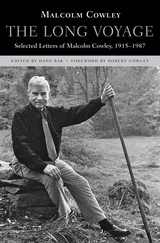
Critic, poet, editor, chronicler of the “lost generation,” and elder statesman of the Republic of Letters, Malcolm Cowley (1898–1989) was an eloquent witness to much of twentieth-century American literary and political life. These letters, the vast majority previously unpublished, provide an indelible self-portrait of Cowley and his time, and make possible a full appreciation of his long and varied career.
Perhaps no other writer aided the careers of so many poets and novelists. Faulkner, Fitzgerald, Hemingway, Kerouac, Tillie Olsen, and John Cheever are among the many authors Cowley knew and whose work he supported. A poet himself, Cowley enjoyed the company of writers and knew how to encourage, entertain, and when necessary scold them. At the center of his epistolary life were his friendships with Kenneth Burke, Allen Tate, Conrad Aiken, and Edmund Wilson. By turns serious and thoughtful, humorous and gossipy, Cowley’s letters to these and other correspondents display his keen literary judgment and ability to navigate the world of publishing.
The letters also illuminate Cowley’s reluctance to speak out against Stalin and the Moscow Trials when he was on staff at The New Republic—and the consequences of his agonized evasions. His radical past would continue to haunt him into the Cold War era, as he became caught up in the notorious “Lowell Affair” and was summoned to testify in the Alger Hiss trials.
Hans Bak supplies helpful notes and a preface that assesses Cowley’s career, and Robert Cowley contributes a moving foreword about his father.
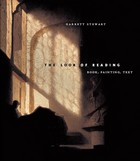
We take for granted that words can describe pictures, but we don’t often consider that the reverse is also true: pictures can depict words, as well as the people reading them. In The Look of Reading, Garrett Stewart explores centuries of painted images of reading, arguing that they collectively constitute an overlooked genre in the history of art.
A stunning array of artists—including Rembrandt, Picasso, Cassatt, and Caravaggio, among many others—have worked in this genre during the past five hundred years. With innovative interpretations of their work, ranging from Bellini’s open Bibles to Bacon’s mangled newsprint, Stewart examines the give-and-take between reading matter depicted in painting and the “look of reading” on the portrayed face. He then traces this kind of interaction from the sixteenth century, when pictured reading generally illustrated people reading holy scriptures, to later periods, when secular painting started to represent the inwardness and absorption associated especially with novel reading. Ultimately, Stewart shows how the subject fell out of such paintings altogether in the late twentieth century, replaced by words, scrawls, and blurs that put the viewer in the place of the reader.
Lavishly illustrated with the paintings it discusses, The Look of Reading charts the life and death of an entire genre. Essential reading for art historians and literary theorists alike, it will become the definitive study of this overlooked aspect of the relationship between images and words.
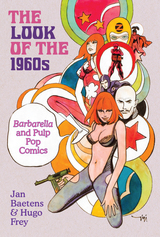
How the classic aesthetic of 1960s pulp comics influenced art, culture, and politics.
As a form of visual art, comic books rely on a distinct and eye-catching aesthetic. This is especially true of the iconic comics, graphic novels, and illustrations of the 1960s and 1970s. The Look of the 1960s explores the sources of inspiration that influenced the world of comics, beginning with the well-known French comics series Barbarella.
Noted comics scholars Jan Baetens and Hugo Frey analyze the impacts of the often-provocative images featured in the comics of the 1960s, which pushed back against French censorship in a politically tense time, and detail how women resisted their objectification in the comic book industry. Barbarella left its mark on the world and gained international attention, inspiring a movie adaptation and changing the look and content of other popular comics. The “Pulp Pop” movement remains relevant today, continuing to influence the art and political world. With new information about artists and an astute analysis of sociopolitical influence, The Look of the 1960s offers deep insights, making it a must read for comics fans all over the world.
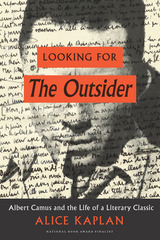
How did a young man in his twenties who had never written a novel turn out a masterpiece that still grips readers more than seventy years later? With Looking for “The Outsider”, Alice Kaplan tells that story. In the process, she reveals Camus’s achievement to have been even more impressive—and more unlikely—than even his most devoted readers knew.
Born in poverty in colonial Algeria, Camus started out as a journalist covering the criminal courts. The murder trials he attended, Kaplan shows, would be a major influence on the development and themes of The Outsider. She follows Camus to France, and, making deft use of his diaries and letters, re-creates his lonely struggle with the novel in Montmartre, where he finally hit upon the unforgettable first-person voice that enabled him to break through and complete The Outsider.
Even then, the book’s publication was far from certain. France was straining under German occupation, Camus’s closest mentor was unsure of the book’s merit, and Camus himself was suffering from near-fatal tuberculosis. Yet the book did appear, thanks in part to a resourceful publisher, Gaston Gallimard, who was undeterred by paper shortages and Nazi censorship.
The initial critical reception of The Outsider was mixed, and it wasn’t until after liberation that The Outsider began its meteoric rise. As France and the rest of the world began to move out of the shadow of war, Kaplan shows, Camus’s book— with the help of an aggressive marketing campaign by Knopf for their 1946 publication of the first English translation—became a critical and commercial success, and Camus found himself one of the most famous writers in the world. Suddenly, his seemingly modest tale of alienation was being seen for what it really was: a powerful parable of the absurd, an existentialist masterpiece.
Few books inspire devotion and excitement the way The Outsider does. And it couldn’t have a better biographer than Alice Kaplan, whose books about twentieth-century French culture and history have won her legions of fans. No reader of Camus will want to miss this brilliant exploration.
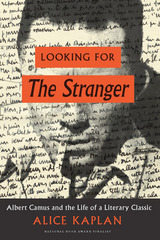
How did a young man in his twenties who had never written a novel turn out a masterpiece that still grips readers more than seventy years later? With Looking for “The Stranger”, Alice Kaplan tells that story. In the process, she reveals Camus’s achievement to have been even more impressive—and more unlikely—than even his most devoted readers knew.
Born in poverty in colonial Algeria, Camus started out as a journalist covering the criminal courts. The murder trials he attended, Kaplan shows, would be a major influence on the development and themes of The Stranger. She follows Camus to France, and, making deft use of his diaries and letters, re-creates his lonely struggle with the novel in Montmartre, where he finally hit upon the unforgettable first-person voice that enabled him to break through and complete The Stranger.
Even then, the book’s publication was far from certain. France was straining under German occupation, Camus’s closest mentor was unsure of the book’s merit, and Camus himself was suffering from near-fatal tuberculosis. Yet the book did appear, thanks in part to a resourceful publisher, Gaston Gallimard, who was undeterred by paper shortages and Nazi censorship.
The initial critical reception of The Stranger was mixed, and it wasn’t until after liberation that The Stranger began its meteoric rise. As France and the rest of the world began to move out of the shadow of war, Kaplan shows, Camus’s book— with the help of an aggressive marketing campaign by Knopf for their 1946 publication of the first English translation—became a critical and commercial success, and Camus found himself one of the most famous writers in the world. Suddenly, his seemingly modest tale of alienation was being seen for what it really was: a powerful parable of the absurd, an existentialist masterpiece.
Few books inspire devotion and excitement the way The Stranger does. And it couldn’t have a better biographer than Alice Kaplan, whose books about twentieth-century French culture and history have won her legions of fans. No reader of Camus will want to miss this brilliant exploration.
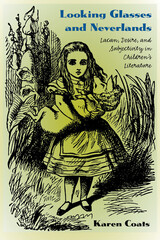
This groundbreaking study introduces and explores Lacan’s complex theories of subjectivity and desire through close readings of canonical children’s books such as Charlotte’s Web, Stellaluna, Holes, Tangerine, and The Chocolate War, providing an introduction to an increasingly influential body of difficult work while making the claim that children’s textual encounters are as significant as their existential ones in constituting their subjectivities and giving shape to their desires.

Reising suggests that these "non-endings" entirely refocus the narrative structures they appear to conclude, accentuate the narrative stresses and ideological fissures that the texts seem to suppress, and reveal "shadow narratives" that trail alongside the dominant story line. He argues that unless the reader notices the ruptures in the closing moments of these works, the social and historical moments in which the narrative and the reader are embedded will be missed. This reading not only offers new interpretive possibilities, but also uncovers startling affinities between the poetry of Phillis Wheatley and the fiction of Henry James, between Charles Brockden Brown’s Wieland and Melville’s least-studied novel, and between Emily Dickinson’s poem "I Started Early—Took My Dog" and Disney’s animated classic.
Pursuing the implications of these failed moments of closure, Reising elaborates on topics ranging from the roots of domestic violence and mass murder in early American religious texts to the pornographic imperative of mid-century nature writing, and from James’s "descent" into naturalist and feminist fiction to Dumbo’s explosive projection of commercial, racial, and political agendas for postwar U. S. culture.
Cain has been ranked as one of the two best dramatic poems written in England in the nineteenth century. Because of its religious heterodoxy, which veiled a political iconoclasm, and also because of Byron’s notoriety, Cain stirred up a storm among Tories and clergymen “from Kentish town to Pisa.” From 1821 to 1830 more was printed about its eighteen hundred alarming lines than about the twenty thousand of Don Juan. One solemn Frenchman even translated the work in order to supply his countrymen with a text that he could then rewrite and confute.
After the initial controversy, readers began to regard Cain not merely as revolutionary propaganda but as a fictional portrait of common youthful experience: a sequence of aspiration, discontent, uncertainty, confusion, misunderstood isolation, fear, frustration, anger, and finally a rash, inevitable, but futile revolt that led to a future of hopeless regret.
Truman Guy Steffan here presents a text, arrived at by collation of the first and several later editions with the original manuscript (presently in the Stark Collection of the Miriam Lutcher Stark Library at the Harry Ransom Center, the University of Texas at Austin).
The first eight essays, which comprise Part I, cover a number of literary topics: Byron’s defense of his purposes in Cain and the relevance of his dramatic theory to the poem; the characterization that is an ideological confrontation, a revelation of personal conflict, as well as a rendering of individuals who have an existence independent of the author; the principles that controlled Byron’s absorption and expansion of biblical materials; the integration of the imagery with the dramatic substance; the incongruities of the language; the metrical heterodoxy; and a description of the manuscript and of Byron’s insertions.
Part II contains the text of Cain, accompanied by notes on the variants, the manuscript cancellations and additions, certain linguistic details, and the scansion of some unusual verses. Then follow annotations on allusions, sources, and analogues, and on a few passages of the play that have elicited unusual conflict over interpretation.
Part III provides a history of Cain criticism, from the opinions of Byron’s social and literary circle and of the major periodicals and pamphlets to the more complicated contribution of the twentieth century.
This important work stands not only as a valuable addition to Byron scholarship but also as an illuminating record of the changing critical and cultural attitudes from the early nineteenth century to the 1960s. Steffan has done a remarkable job in bringing together and synthesizing an enormous body of material.

For this first English edition of his distinguished study of Pythagoreanism, Weisheit und Wissenschajt: Studien zu Pythagoras, Philolaos, und Platon, Walter Burkert has carefully revised text and notes, taking account of additional literature on the subject which appeared between 1962 and 1969.
By a thorough critical sifting of all the available evidence, the author lays a new foundation for the understanding of ancient Pythagoreanism and in particular of the relationship within it of “lore” and “science.” He shows that in the twilight zone when the Greeks were discovering the rational interpretation of the world and quantitative natural science, Pythagoras represented not the origin of the new, but the survival or revival of ancient, pre-scientific lore or wisdom, based on superhuman authority and expressed in ritual obligation.
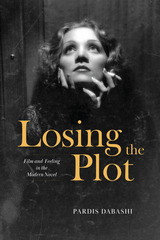
The modernist novel sought to escape what Virginia Woolf called the “tyranny” of plot. Yet even as twentieth-century writers pushed against the constraints of plot-driven Victorian novels, plot kept its hold on them through the influence of another medium: the cinema. Focusing on the novels of Nella Larsen, Djuna Barnes, and William Faulkner—writers known for their affinities and connections to classical Hollywood—Pardis Dabashi links the moviegoing practices of these writers to the tensions between the formal properties of their novels and the characters in them. Even when they did not feature outright happy endings, classical Hollywood films often provided satisfying formal resolutions and promoted normative social and political values. Watching these films, modernist authors were reminded of what they were leaving behind—both formally and in the name of aesthetic experimentalism—by losing the plot.
Part memoir, part imagined history, this unique personal essay depicts the intimate experience of childhood bereavement, lost love affairs, and the complicated realities of motherhood and marriage. Framed by an extended train journey, author Sophie Ratcliffe turns to the novels, novelists, and heroines who have shaped her emotional and romantic landscapes. She transports us with her to survey the messiness of everyday life, all while reflecting on steam propulsion and pop songs, handbags and honeymoons, Anna Karenina and Anthony Trollope, former lovers and forgotten muses. Frank, funny, tender, and transporting, Loss, A Love Story asks why we fall in, and out, of love—and how we might understand doing so amid the ongoing upheavals and unwritten futures of the twenty-first century.
What if we didn’t always historicize when we read Victorian fiction?
Lost Causes shows that Victorian writers frequently appear to have a more supple and interesting understanding of the relationship between history, causality, and narrative than the one typically offered by readers who are burdened by the new historicism. As a return to these writers emphasizes, the press of modern historicism deforms Victorian novels, encouraging us to read deviations from strict historical accuracy as ideological bad faith. By contrast, Jason B. Jones argues through readings of works ranging from The French Revolution to Middlemarch that literature’s engagement with history has to be read otherwise.Perhaps perversely, Lost Causes suggests simultaneously that psychoanalysis speaks pressingly to the vexed relationship between history and narrative, and that the theory is neither a- nor anti-historical. Through his readings of Victorian fiction addressing the recent past, Jones finds in psychoanalysis not a set of truths, but rather a method for rhetorical reading, ultimately revealing how its troubled account of psychic causality can help us follow literary language’s representation of the real. Victorian narratives of the recent past and psychoanalytic interpretation share a fascination with effects that persist despite baffling, inexplicable, or absent causes.
In chapters focusing on Thomas Carlyle, Charles Dickens, Charlotte Brontë, and George Eliot, Lost Causes demonstrates that history can carry an ontological, as well as an epistemological, charge—one that suggests a condition of being in the world as well as a way of knowing the world as it really is. From this point of view, Victorian fiction that addresses the recent past is not a failed realism, as it is so frequently claimed, but rather an exploration of possibility in history.
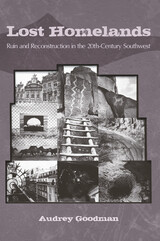
Through analyzing a variety of texts and images, Goodman illuminates the ways that modern forces such as militarization, environmental degradation, internal migration, and an increased border patrol presence have shattered the perception of a secure homeland in the Southwest. The deceptive natural beauty of the Southwest deserts shields a dark history of trauma and decimation that has remained as a shadow on the region’s psyche. The first to really synthesize such wide-ranging material about the effects of the atomic age in the Southwest, Goodman realizes the value of combined visual and verbal art and uses it to put forth her own original ideas about reconstructing a new sense of homeland.
Lost Homelands reminds us of the adversity and dislocation suffered by people of the Southwest by looking at the ways that artists, photographers, filmmakers, and writers have grappled with these problems for decades. In assessing the ruination of the region, however, Goodman argues that those same artists and writers have begun to reassemble a new sense of homeland from these fragments.
Scholars of modernism have long addressed how literature, painting, and music reflected the radical reconceptualization of space and time in the early twentieth century—a veritable revolution in both physics and philosophy that has been characterized as precipitating an “epistemic trauma” around the world. In this wide-ranging study, Benjamin Paloff contends that writers in Central and Eastern Europe felt this impact quite distinctly from their counterparts in Western Europe. For the latter, the destabilization of traditional notions of space and time inspired works that saw in it a new kind of freedom. However, for many Central and Eastern European authors, who were writing from within public discourses about how to construct new social realities, the need for escape met the realization that there was both nowhere to escape to and no stable delineation of what to escape from. In reading the prose and poetry of Czech, Polish, and Russian writers, Paloff imbues the term “Kafkaesque” with a complexity so far missing from our understanding of this moment in literary history.
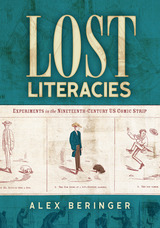
Lost Literacies is the first full-length study of US comic strips from the period prior to the rise of Sunday newspaper comics. Where current histories assume that nineteenth-century US comics consisted solely of single-panel political cartoons or simple “proto-comics,” Lost Literacies introduces readers to an ambitious group of artists and editors who were intent on experimenting with the storytelling possibilities of the sequential strip, resulting in playful comics whose existence upends prevailing narratives about the evolution of comic strips.
Over the course of the nineteenth century, figures such as artist Frank Bellew and editor T. W. Strong introduced sequential comic strips into humor magazines and precursors to graphic novels known as “graphic albums.” These early works reached audiences in the tens of thousands. Their influences ranged from Walt Whitman’s poetry to Mark Twain’s travel writings to the bawdy stage comedies of the Bowery Theatre. Most importantly, they featured new approaches to graphic storytelling that went far beyond the speech bubbles and panel grids familiar to us today. As readers of Lost Literacies will see, these little-known early US comic strips rival even the most innovative modern comics for their diversity and ambition.

Lost Property traces the representation of women writers from Margery Kempe and Christine de Pizan to Elizabeth I and Mary Queen of Scots, exploring how the woman writer became a focal point for emerging theories of literature and authorship in English precisely because of her perceived alienation from tradition. Through original archival research and readings of key literary texts, Summit writes a new history of the woman writer that reflects the impact of such developments as the introduction of printing, the Reformation, and the rise of the English court as a literary center.
A major rethinking of the place of women writers in the histories of books, authorship, and canon-formation, Lost Property demonstrates that, rather than being an unimaginable anomaly, the idea of the woman writer played a key role in the invention of English literature.
Of all the writings on theory and aesthetics—ancient, medieval, or modern—the most important is indisputably Aristotle’s Poetics, the first philosophical treatise to propound a theory of literature. In the Poetics, Aristotle writes that he will speak of comedy—but there is no further mention of comedy. Aristotle writes also that he will address catharsis and an analysis of what is funny. But he does not actually address any of those ideas. The surviving Poetics is incomplete.
Until today. Here, Walter Watson offers a new interpretation of the lost second book of Aristotle's Poetics. Based on Richard Janko’s philological reconstruction of the epitome, a summary first recovered in 1839 and hotly contested thereafter, Watson mounts a compelling philosophical argument that places the statements of this summary of the Aristotelian text in their true context. Watson renders lucid and complete explanations of Aristotle’s ideas about catharsis, comedy, and a summary account of the different types of poetry, ideas that influenced not only Cicero’s theory of the ridiculous, but also Freud’s theory of jokes, humor, and the comic.
Finally, more than two millennia after it was first written, and after five hundred years of scrutiny, Aristotle’s Poetics is more complete than ever before. Here, at last, Aristotle’s lost second book is found again.
What is the value of memory in human culture? More specifically, what role should remembering—and forgetting—play in our daily lives? These are the central questions that David Gross addresses in this original and thought-provoking book.
For centuries, Gross points out, remembering was considered essential not only to the perpetuation of society but to the maintenance of individual existence. Survival often depended on the memory of how to perform specific tasks, what values to honor, and what personal or collective identity to assume. Remembering, in short, put one in touch with the things that mattered, engendering wholeness and wisdom. Forgetting, on the other hand, led to emptiness, ignorance, and death.
With the advent of modernity, however, doubts about the value of memory grew while the negative implications of forgetting were reevaluated. In many quarters, forgetting came to be defended for the way it frees us from the past, opening the door to new perceptions, new possibilities, and new beginnings.
Now, in late modernity, Gross argues, we find ourselves in an unprecedented situation. For the first time in history, we are able to decide, without the pressure of social or cultural constraints, whether we want to remember or forget and to live our lives accordingly. But which is the better choice? Should we build our lives upon the meanings and values of a faded past? If so, what ought we to remember, and for what purpose? Or should we instead opt to forget what has come before and focus our attention on the present and future, thereby perpetually reinventing ourselves and the world we inhabit? According to Gross, our answers to these questions will determine not only who we are but what we will become as we pass from late modernity into the terra incognita of the “postmodern” age.
Published by Bucknell University Press. Distributed worldwide by Rutgers University Press.
In this volume, edited by Andreas Schönle, contributors extend Lotman's theories to a number of fields. Focusing on his less frequently studied later period, Lotman and Cultural Studies engages with such ideas as the "semiosphere," the fluid, dynamic semiotic environment out of which meaning emerges; "auto-communication," the way in which people create narratives about themselves that in turn shape their self-identity; change, as both gradual evolution and an abrupt, unpredictable "explosion"; power; law and mercy; Russia and the West; center and periphery.
As William Mills Todd observes in his afterword, the contributors to this volume test Lotman's legacy in a new context: "Their research agendas-Iranian and American politics, contemporary Russian and Czech politics, sexuality and the body-are distant from Lotman's own, but his concepts and awareness yield invariably illuminating results."
In the book, Ikard explodes the fiction of a postracial society while awakening us to the sobering reality that we must continue to fight for racial equality or risk losing the hard-fought gains of the Civil Rights movement. Through his close reading of novels, films, journalism, and political campaigns, he analyzes willful white blindness and attendant master narratives of white redemption—arguing powerfully that he who controls the master narrative controls the perception of reality. The book sounds the alarm about seemingly innocuous tropes of white redemption that abound in our society and generate the notion that blacks are perpetually indebted to whites for liberating, civilizing, and enlightening them. In Lovable Racists, Magical Negroes, and White Messiahs, Ikard expertly and unflinchingly gives us a necessary critical historical intervention.

The eleventh-century masterpiece The Tale of Genji casts a long shadow across the literary terrain of the Heian period (794-1185). It has dominated critical and popular reception of Heian literary production and become the definitive expression of the aesthetics, poetics, and politics of life in the Heian court.
But the brilliance of Genji has eclipsed the works of later Heian authors, who have since been displaced from the canon and relegated to critical obscurity.
Charo B. D'Etcheverry calls for a reevaluation of late Heian fiction by shedding new light upon this undervalued body of work. D'Etcheverry examines three representative texts—The Tale of Sagoromo, The Tale of the Hamamatsu Middle Counselor, and Nezame at Night—as legitimate heirs to the literary legacy of Genji and as valuable indexes to the literary tastes and readerly expectations that evolved over the Heian period.
Balancing careful analyses of plot, character, and motif with keen insights into the cultural and political milieu of the late Heian period, D'Etcheverry argues that we should read such works not as mere derivatives of a canonical text, but as dynamic fictional commentaries and variations upon the tropes and subplots that continue to resonate with readers of Genji.
Reed identifies abolition literature as an emergent field of inquiry that emphasizes social relationships in the ongoing struggle to dismantle systems of coercion, criminalization, and control. Focusing on love as an affective modality and organizing tool rooted in the Black radical tradition’s insistence on collective sociality amidst unrelenting state violence, Reed provides fresh readings of visionaries such as James Baldwin, Ntozake Shange, Sharon Bridgforth, and vanessa german. Both abolitionist manifesto and examination of how Black queer performance offers affective modulations of tough and tender love, Love and Abolition ultimately calls for a critical reconsideration of the genre of prison literature—and the role of the humanities—during an age of mass incarceration.
Intended for both specialists and non-specialists, Love and Ethics addresses many of the specific concerns of current Gower criticism, provides complete translations of all foreign quotation, and guides the novice reader through Gower's Middle English.
Love and Good Reasons combines postliberal narrative theology—especially Stanley Hauerwas’s Christian ethics and Alasdair MacIntyre’s idea of traditional inquiry—with recent scholarship in literature and ethics including the work of Martha Nussbaum, J. Hillis Miller, Wayne Booth, Jeffrey Stout, and Richard Rorty. Oehlschlaeger offers detailed readings of literature by five major authors—Herman Melville, Jane Austen, Anthony Trollope, Henry James, and Stephen Crane. He examines their works in light of biblical scripture and the grand narratives of Israel, Jesus, and the Church. Discussing the role of religion in contemporary higher education, Oehlschlaeger shares his own experiences of teaching literature from a religious perspective at a state university.
The Latin American Literary Boom was marked by complex novels steeped in magical realism and questions of nationalism, often with themes of surreal violence. In recent years, however, those revolutionary projects of the sixties and seventies have given way to quite a different narrative vision and ideology. Dubbed the new sentimentalism, this trend is now keenly elucidated in Love and Politics in the Contemporary Spanish American Novel.
Offering a rich account of the rise of this new mode, as well as its political and cultural implications, Aníbal González delivers a close reading of novels by Miguel Barnet, Elena Poniatowska, Isabel Allende, Alfredo Bryce Echenique, Gabriel García Márquez, Antonio Skármeta, Luis Rafael Sánchez, and others. González proposes that new sentimental novels are inspired principally by a desire to heal the division, rancor, and fear produced by decades of social and political upheaval. Valuing pop culture above the avant-garde, such works also tend to celebrate agape—the love of one's neighbor—while denouncing the negative effects of passion (eros). Illuminating these and other aspects of post-Boom prose, Love and Politics in the Contemporary Spanish American Novel takes a fresh look at contemporary works.
As a pandemic swept across fourteenth-century Europe, the Decameron offered the ill and grieving a symphony of life and love.
For Florentines, the world seemed to be coming to an end. In 1348 the first wave of the Black Death swept across the Italian city, reducing its population from more than 100,000 to less than 40,000. The disease would eventually kill at least half of the population of Europe. Amid the devastation, Giovanni Boccaccio’s Decameron was born. One of the masterpieces of world literature, the Decameron has captivated centuries of readers with its vivid tales of love, loyalty, betrayal, and sex. Despite the death that overwhelmed Florence, Boccaccio’s collection of novelle was, in Guido Ruggiero’s words, a “symphony of life.”
Love and Sex in the Time of Plague guides twenty-first-century readers back to Boccaccio’s world to recapture how his work sounded to fourteenth-century ears. Through insightful discussions of the Decameron’s cherished stories and deep portraits of Florentine culture, Ruggiero explores love and sexual relations in a society undergoing convulsive change. In the century before the plague arrived, Florence had become one of the richest and most powerful cities in Europe. With the medieval nobility in decline, a new polity was emerging, driven by Il Popolo—the people, fractious and enterprising. Boccaccio’s stories had a special resonance in this age of upheaval, as Florentines sought new notions of truth and virtue to meet both the despair and the possibility of the moment.
Niklas Luhmann is one of the greatest of contemporary social theorists, and his ultimate aim is to develop a conceptual vocabulary supple enough to capture what he sees as the unprecedented structural characteristics of society since the eighteenth century. Ours is a society in which individuals can determine their own sense of self and function rather than have that predetermined by the strict hierarchy of former times, and a key element in the modern sense of individuality is our concept of love, marriage, and lasting personal relationships. This book takes us back to when passionate love took place exclusively outside of marriage, and Luhmann shows by lively references to social customs and literature how a language and code of behavior were developed so that notions of love and intimacy could be made the essential components of married life. This intimacy and privacy made possible by a social arrangement in which home is where the heart is provides the basis for a society of individuals—the foundation for the structure of modern life. Love is now declared to be unfathomable and personal, yet we love and suffer—as Luhmann shows—according to cultural imperatives.
People working in a variety of fields should find this book of major interest. Social scientists will be intrigued by Luhmann’s original and provocative insights into the nature of modern marriage and sexuality, and by the presentation of his theories in concrete, historical detail. His work should also be capital for humanists, since Luhmann’s concern throughout is to develop a semantics for passionate love by means of extensive references to literary texts of the modern period. In showing our moral life in the process of revising itself, he thereby sheds much light on the development of drama and the novel in the seventeenth and eighteenth centuries.
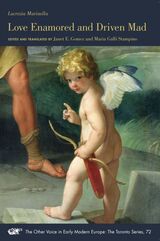
The Other Voice in Early Modern Europe - The Toronto Series, volume 72
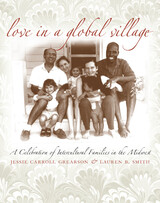
In praise of diversity, Jessie Grearson and Lauren Smith offer Love in a Global Village: A Celebration of Intercultural Families in the Midwest, an account of the triumphs of fifteen intercultural families and the perseverance of their relationships in midwestern America. The couples recount their courtships, their adventures and difficulties, and their individual choices to create families and build lives together despite differences of race, language, religion, and culture.
Welcomed into homes in towns like Kalona, Iowa, and Springfield, Missouri, Grearson and Smith introduce readers to unexpected fusions of culture in middle America. By focusing on small communities where intercultural relationships are exceptions rather than the norm, Smith and Grearson offer affirmation that multicultural households can endure and flourish almost anywhere.
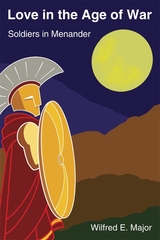
Love in the Age of War explores soldier characters in Menander’s situation comedies, the oldest of their kind. Menander came to dominate and define comedy for centuries, and a soldier served as the central character in many of his plays. This study reveals that these soldier characters are not the bragging buffoons that later became the stereotype in this brand of comedy, but challenging and complex men who struggle to find a place in new families and in their local communities. In contrast to the traditional Greek stories of tragic warriors, these soldiers ultimately succeed in adjusting to civilian life.
Wilfred Major details how Menander dramatized these compelling stories, while later traditions instead turned these characters into clowns. Menander’s original soldiers, however, may be the ones whose stories resonate more powerfully today.
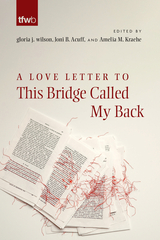
In A Love Letter, creators illuminate, question, and respond to current politics, progressive struggles, transformations, acts of resistance, and solidarity, while also offering readers a space for renewal and healing. The central theme of the original Bridge is honored, exposing the lived realities of women of color at the intersections of race, class, gender, ethnicity, and sexuality, advancing those early conversations on what it means to be Third World feminist conscious.
A Love Letter recognizes the challenges faced by women of color in a twenty-first-century world of climate and economic crises, increasing gun violence, and ever-changing social media constructs for women of color. It also retains the clarion call Bridge set in motion, as Moraga wrote: “A theory in the flesh means one where the physical realities of our lives—our skin color, the land or concrete we grew up on, our sexual longing—all fuse to create a politic born of necessity.”
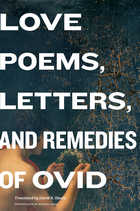
Widely praised for his recent translations of Boethius and Ariosto, David R. Slavitt returns to Ovid, once again bringing to the contemporary ear the spirited, idiomatic, audacious charms of this master poet.
The love described here is the anguished, ruinous kind, for which Ovid was among the first to find expression. In the Amores, he testifies to the male experience, and in the companion Heroides—through a series of dramatic monologues addressed to absent lovers—he imagines how love goes for women. “You think she is ardent with you? So was she ardent with him,” cries Oenone to Paris. Sappho, revisiting the forest where she lay with Phaon, sighs, “The place / without your presence is just another place. / You were what made it magic.” The Remedia Amoris sees love as a sickness, and offers curative advice: “The beginning is your best chance to resist”; “Try to avoid onions, / imported or domestic. And arugula is bad. / Whatever may incline your body to Venus / keep away from.” The voices of men and women produce a volley of extravagant laments over love’s inconstancy and confusions, as though elegance and vigor of expression might compensate for heartache.
Though these love poems come to us across millennia, Slavitt’s translations, introduced by Pulitzer Prize winner Michael Dirda, ensure that their sentiments have not faded with the passage of time. They delight us with their wit, even as we weep a little in recognition.
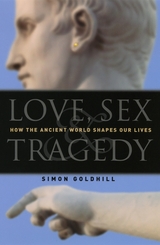
Marx, Clark Gable, George W. Bush, Oscar Wilde, and Freud—Goldhill's range here is enormous, and he takes great delight in tracing both follies and fundamental philosophical questions through the centuries and continents to the birthplace of Western civilization as we know it. Underlying his brisk and learned excursions through history and art is the foundational belief, following Cicero, that learning about the classics makes a critical difference to our self-understanding. Whether we are considering the role of religion in contemporary society, our expectations about the boundaries between public and private life, or even how we spend our free time, recognizing the role of the classics is integral to our comprehension of modern life and our place in it.
When Goldhill asks "Who do you think you are?" he presents us with the rarest of opportunities: the chance to let him lead us, firmly but with a wink, back two thousand years to where we are.
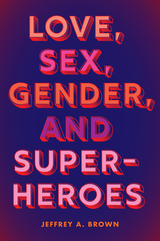
Love, Sex, Gender, and Superheroes examines a full range of superhero media, from comics to films to television to merchandising. With a keen eye for the genre’s complex and internally contradictory mythology, comics scholar Jeffrey A. Brown considers its mixed messages. Superhero comics may reinforce sex roles with their litany of phallic musclemen and slinky femme fatales, but they also blur gender binaries with their emphasis on transformation and body swaps. Similarly, while most heroes have heterosexual love interests, the genre prioritizes homosocial bonding, and it both celebrates and condemns gendered and sexualized violence.
With examples spanning from the Golden Ages of DC and Marvel comics up to recent works like the TV series The Boys, this study provides a comprehensive look at how superhero media shapes our perceptions of love, sex, and gender.
Prior praise for Martín Espada:
"Political poetry at its finest…with his soaring lyrics, Espada broadens our appreciation not only of poetry but of resistance itself."
---The Progressive
"(Espada) writes beautiful poems about terrible realities."
---San Francisco Chronicle
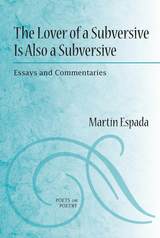
A volume in the Poets on Poetry series, which collects critical works by contemporary poets, gathering together the articles, interviews, and book reviews by which they have articulated the poetics of a new generation.
This collection of essays on poetry and politics comes from the man the New York Times predicted would become "the Latino poet of his generation" and whom Sandra Cisneros called "the Pablo Neruda of North American authors."
Martín Espada defends what Walt Whitman called, "the rights of them the others are down upon." He invokes the spirit of poet-advocates such as Whitman and Edgar Lee Masters to explore his own history as a poet and tenant lawyer in Boston's Latino community. He celebrates the poets of Puerto Rico, imprisoned for espousing the cause of independence, and the poets of the Bronx, writing bilingual poems in the voices of the dead.
Espada writes of forgotten places and reminds us of the poet's responsibility to remember, as Pablo Neruda remembers the anonymous builders of Machu Picchu or Sterling Brown remembers the slave uprising of Nat Turner. He argues that poets should embrace the role of Shelley's "unacknowledged legislator" in their work as writers and in their lives as citizens. He challenges the conventional wisdom that poetry and politics are mutually exclusive, and rejects the poetics of self-marginalization, in keeping with Adrian Mitchell's dictum that, "most people ignore most poetry because most poetry ignores most people."
Martín Espada has published seventeen books as a poet, editor, and translator. The Republic of Poetry, a collection of poems, received a Paterson Award for Sustained Literary Achievement and was a finalist for the Pulitzer Prize. Imagine the Angels of Bread won an American Book Award and was a finalist for the National Book Critics Circle Award. He has received numerous fellowships and awards, including a Guggenheim Fellowship and the National Hispanic Cultural Center Literary Award. Espada is a Professor of English at the University of Massachusetts-Amherst.
A Midsummer Night's Dream, in its "perfection," is Tave's point of departure. Its characters fall neatly into the three groups of Tave's title and fulfill to perfection their functions of desire, foolishness, and power. From the magical concord of Shakespeare's resolution, Tave moves to works whose character face ever greater difficulties in reaching a happy conclusion. From Jonson and Austen to Chekhov and Beckett, he meets comedies on their own terms, illuminating the complex and individual genius of each. A masterpiece of practical criticism, Lovers, Clowns, and Fairies rediscovers the pleasure of reading comedies.

The relationship between the soul and the body was a point of contentious debate among philosophers and theologians in late antiquity. Modern scholarship has inherited this legacy, but split the study of the relation of body and soul between the disciplines of philosophy and religion. Lovers of the Soul, Lovers of the Body integrates, with Plato and Aristotle in the background, philosophical and religious perspectives on the concepts of soul and body in the transformative period of the first six centuries CE, from Philo to Olympiodorus. The polyphonic—but not dissonant—philosophical and theological dialogue is recreated and rethought by an international group of leading experts and up-and-coming scholars in ancient philosophy, theology, and religion.
The synthetic approach of the volume presents the understanding of human psychology in late antiquity, without labels and borders. It invites both experts and enthusiasts to crisscross the pathways of philosophy and religion in pursuit of new crossroads and greater common ground.
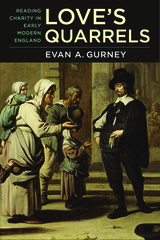
Early modern English writers often complained that “charity had grown cold,” lamenting the dissolution of society's communal bonds. But far from diminishing in scope or influence, charity generated heated debates, animated by social, political, and religious changes that prompted urgent questions about the virtue's powers and functions. Charity was as much a problem as it was a solution, a sure sign of trouble even when invoked on behalf of peace and community.
Love's Quarrels charts charity's complex history from the 1520s to the 1640s and details the ways in which it can be best understood in biblical translations of the early sixteenth century, in Elizabethan polemic and satire, and in the political and religious controversies arriving at the outset of civil war. As key works from Edmund Spenser, Ben Jonson, and John Milton reveal, “reading charity” was fraught with difficulty as early modern England reconsidered its deepest held convictions in the face of mounting social disruption and spiritual pressure.
A case for literary critics and other humanists to stop wallowing in their aestheticized helplessness and instead turn to poetry, comedy, and love.
Literary criticism is an agent of despair, and its poster child is Walter Benjamin. Critics have spent decades stewing in his melancholy. What if, instead, we dared to love poetry, to choose comedy over Hamlet’s tragedy, or to pursue romance over Benjamin’s suicide on the edge of France, of Europe, and of civilization itself?
Paul A. Bové challenges young lit critters to throw away their shades and let the sun shine in. Love’s Shadow is his three-step manifesto for a new literary criticism that risks sentimentality and melodrama and eschews self-consciousness. The first step is to choose poetry. There has been since the time of Plato a battle between philosophy and poetry. Philosophy has championed misogyny, while poetry has championed women, like Shakespeare’s Rosalind. Philosophy is ever so stringent; try instead the sober cheerfulness of Wallace Stevens. Bové’s second step is to choose the essay. He praises Benjamin’s great friend and sometime antagonist Theodor Adorno, who gloried in writing essays, not dissertations and treatises. The third step is to choose love. If you want a Baroque hero, make that hero Rembrandt, who brought lovers to life in his paintings.
Putting aside passivity and cynicism would amount to a revolution in literary studies. Bové seeks nothing less, and he has a program for achieving it.
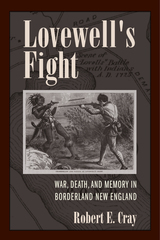
In May 1725, during a three-year conflict between English colonists and the Eastern Abenaki Nation, a thirty-four-man expedition led by Captain John Lovewell set out to ambush their adversaries, acquire some scalp bounties, and hasten the end of the war. Instead, the Abenakis staged a surprise attack of their own at Pigwacket, Maine, that left more than a third of the New Englanders dead or severely wounded. Although Lovewell himself was slain in the fighting, he emerged a martyred hero, celebrated in popular memory for standing his ground against a superior enemy force.
In this book, Robert E. Cray revisits the clash known as “Lovewell's Fight” and uses it to illuminate the themes of war, death, and memory in early New England. He shows how a military operation plagued from the outset by poor decision-making, and further marred by less-than-heroic battlefield behavior, came to be remembered as early America's version of the Alamo. The government of Massachusetts bestowed payouts, pensions, and land on survivors and widows of the battle, while early chroniclers drafted a master narrative for later generations to emboss. William Henry Longfellow, Nathaniel Hawthorne, and Henry David Thoreau kept the story alive for later generations. Although some nineteenth-century New Englanders disapproved of Lovewell's notoriety as a scalp hunter, it did not prevent the dedication of a monument in his honor at the Fryeburg, Maine, battlesite in 1904.
Even as the actual story of “Lovewell's Fight” receded into obscurity—a bloody skirmish in a largely forgotten war—it remained part of New England lore, one of those rare military encounters in which defeat transcends an opponent's victory to assume the mantle of legend.
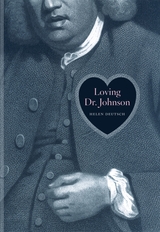
Loving Dr. Johnson uses the enormous popularity of Johnson to understand a singular case of author love and to reflect upon what the love of authors has to do with the love of literature. Helen Deutsch's work is driven by several impulses, among them her affection for both Johnson's work and Boswell's biography of him, and her own distance from the largely male tradition of Johnsonian criticism—a tradition to which she remains indebted and to which Loving Dr. Johnson is ultimately an homage. Limning sharply Johnson's capacious oeuvre, Deutsch's study is also the first of its kind to examine the practices and rituals of Johnsonian societies around the world, wherein Johnson's literary work is now dwarfed by the figure of the writer himself.
An absorbing look at one iconic author and his afterlives, Loving Dr. Johnson will be of enormous value to students of English literature and literary scholars keenly interested in canon formation.
Loving God’s Wildness rediscovers the environmental roots of America’s Puritan heritage. In tracing this history, Jeffrey Bilbro demonstrates how the dualistic Christianity that the Puritans brought to America led them to see the land as an empty wilderness that God would turn into a productive source of marketable commodities. Bilbro carefully explores the effect of this dichotomy in the nature writings of Henry David Thoreau, John Muir, Willa Cather, and Wendell Berry.
Thoreau, Muir, Cather, and Berry imaginatively developed the Puritan theological tradition to propose practical, physical means by which humans should live and worship within the natural temple of God’s creation. They reshaped Puritan dualism, each according to the particular needs of his or her own ecological and cultural contexts, into a theology that demands care for the entire created community. While differing in their approaches and respective ecological ethics, the four authors Bilbro examines all share the conviction that God remains active in creation and that humans ought to relinquish their selfish ends to participate in his wild ecology.
Loving God’s Wildness fills a critical gap in literary criticism and environmental studies by offering a sustained, detailed argument regarding how Christian theology has had a profound and enduring legacy in shaping the contours of the American ecological imagination. Literary critics, scholars of religion and environmental studies, and thoughtful Christians who are concerned about environmental issues will profit from this engaging new book.

That question led Deidre Shauna Lynch into the historical and cultural investigation of Loving Literature. How did it come to be that professional literary scholars are expected not just to study, but to love literature, and to inculcate that love in generations of students? What Lynch discovers is that books, and the attachments we form to them, have played a vital role in the formation of private life—that the love of literature, in other words, is deeply embedded in the history of literature. Yet at the same time, our love is neither self-evident nor ahistorical: our views of books as objects of affection have clear roots in eighteenth- and nineteenth-century publishing, reading habits, and domestic history.
While never denying the very real feelings that warm our relationship to books, Loving Literature nonetheless serves as a riposte to those who use the phrase “the love of literature” as if its meaning were transparent. Lynch writes, “It is as if those on the side of love of literature had forgotten what literary texts themselves say about love’s edginess and complexities.” With this masterly volume, Lynch restores those edges and allows us to revel in those complexities.
What is persuasion? For some, it is the ideal alternative to violence. For others, persuasion is simply a neutral instrumentality—a valued source of soft power. Both positions rest on a fundamental belief: persuasion is a power that resides in a speaker acting on an audience. Loving the World Appropriately asks a different, more fundamental, question: why does an audience need persuasion? In shifting our focus, James Kastely delivers a provocative new history of rhetoric and philosophy, one that describes rhetoric as more than a matter of effective communication and recasts persuasion as a philosophical concern central to notions of human subjectivity. Ultimately, Kastely insists, persuasion enables us to love the world appropriately.
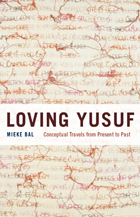
Through this inquiry she develops concepts for the analysis of texts that are both strange and overly familiar—culturally remote yet constantly retold. As she puts personal memories in dialogue with scholarly exegesis, Bal asks how all of these different versions complicate her own and others’ experience of the story, and how the different truths of these texts in their respective traditions illuminate the process of canonization.

In the early nineteenth century, Lowell, Massachusetts, was widely studied and emulated as a model for capitalist industrial development. One of the first cities in the United States to experience the ravages of deindustrialization, it was also among the first places in the world to turn to its own industrial and ethnic history as a tool for reinventing itself in the emerging postindustrial economy. The Lowell Experiment explores how history and culture have been used to remake Lowell and how historians have played a crucial yet ambiguous role in that process.
The book focuses on Lowell National Historical Park, the flagship project of Lowell's new cultural economy. When it was created in 1978, the park broke new ground with its sweeping reinterpretations of labor, immigrant, and women's history. It served as a test site for the ideas of practitioners in the new field of public history—a field that links the work of professionally trained historians with many different kinds of projects in the public realm.
The Lowell Experiment takes an anthropological approach to public history in Lowell, showing it as a complex cultural performance shaped by local memory, the imperatives of economic redevelopment, and tourist rituals—all serving to locate the park's audiences and workers more securely within a changing and uncertain new economy characterized by growing inequalities and new exclusions.
The paradoxical dual role of Lowell's public historians as both interpreters of and contributors to that new economy raises important questions about the challenges and limitations facing academically trained scholars in contemporary American culture. As a long-standing and well-known example of “culture-led re-development,” Lowell offers an outstanding site for exploring questions of concern to those in the fields of public and urban history, urban planning, and tourism studies.
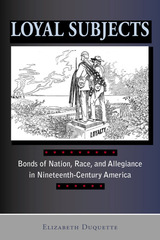
Loyal Subjects considers how the Civil War complicated the cultural value of emotion, especially the ideal of sympathy. Through an analysis of literary works written during and after the conflict-from Nathaniel Hawthorne's "Chiefly About War Matters" through Henry James's The Bostonians and Charles Chestnutt's "The Wife of His Youth," to the Pledge of Allegiance and W.E.B. Du Bois's John Brown, among many others-Duquette reveals that although American literary criticism has tended to dismiss the Civil War's impact, postwar literature was profoundly shaped by loyalty.

In Lu Xun and World Literature, the contributors examine various aspects of Lu Xun, who is known as the father of modern Chinese literature. Essays in this book focus on Lu Xun’s works in relation to the notions of world literature and processes of literary worlding. They offer detailed analyses of Lu Xun’s own literary oeuvre and of foreign works that engage with his writings. This volume also focuses on many facets of the publication and dissemination of Lu Xun’s works, from printing and binding to the discussions and debates that followed their release in China and abroad. This book not only makes an important contribution to the field of Lu Xun studies, but also proposes a reexamination of the category of world literature.
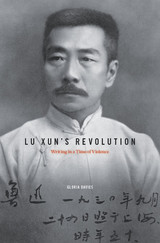
Widely recognized as modern China’s preeminent man of letters, Lu Xun (1881–1936) is revered as the voice of a nation’s conscience, a writer comparable to Shakespeare and Tolstoy in stature and influence. Gloria Davies’s portrait now gives readers a better sense of this influential author by situating the man Mao Zedong hailed as “the sage of modern China” in his turbulent time and place.
In Davies’s vivid rendering, we encounter a writer passionately engaged with the heady arguments and intrigues of a country on the eve of revolution. She traces political tensions in Lu Xun’s works which reflect the larger conflict in modern Chinese thought between egalitarian and authoritarian impulses. During the last phase of Lu Xun’s career, the so-called “years on the left,” we see how fiercely he defended a literature in which the people would speak for themselves, and we come to understand why Lu Xun continues to inspire the debates shaping China today.
Although Lu Xun was never a Communist, his legacy was fully enlisted to support the Party in the decades following his death. Far from the apologist of political violence portrayed by Maoist interpreters, however, Lu Xun emerges here as an energetic opponent of despotism, a humanist for whom empathy, not ideological zeal, was the key to achieving revolutionary ends. Limned with precision and insight, Lu Xun’s Revolution is a major contribution to the ongoing reappraisal of this foundational figure.
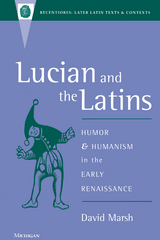
Until now, no study has attempted to connect the Latin translators and imitators of Lucian with his wider European influence. In Lucian and the Latins, David Marsh describes how Renaissance authors rediscovered the comic writings of Lucian. He traces how Lucianic themes and structures made an essential contribution to European literature beginning with a survey of Latin translations and imitations, which gave new direction to European letters in the fifteenth and sixteenth centuries. The Lucianic dialogues of the dead and dialogues of the gods were immensely popular, despite the religious backlash of the sixteenth century. The paradoxical encomium, represented by Lucian's "The Fly" and "The Parasite," inspired so-called serious humanists like Leonardo Bruni and Guarino of Verona. Lucian's "True Story" initiated the genre of the fantastic journey, which enjoyed considerable popularity during the Renaissance age of discovery. Humanist descendants of this work include Thomas More's Utopia and much of Rabelais' Pantagruel.
Lucian and the Latins will attract readers interested in a wide variety of subjects: the classical tradition, the early Italian Renaissance, the origins of modern European literature, and the uses of humor and satire as instruments of cultural critique.
David Marsh is Professor of Italian, Rutgers University.
Antiquity’s satirist supreme.
Lucian (ca. AD 120–190), the satirist from Samosata on the Euphrates, started as an apprentice sculptor, turned to rhetoric and visited Italy and Gaul as a successful traveling lecturer before settling in Athens and developing his original brand of satire. Late in life he fell on hard times and accepted an official post in Egypt.
Although notable for the Attic purity and elegance of his Greek and his literary versatility, Lucian is chiefly famed for the lively, cynical wit of the humorous dialogues in which he satirizes human folly, superstition, and hypocrisy. His aim was to amuse rather than to instruct. Among his best works are A True Story (the tallest of tall tales about a voyage to the moon), Dialogues of the Gods (a “reductio ad absurdum” of traditional mythology), Dialogues of the Dead (on the vanity of human wishes), Philosophies for Sale (great philosophers of the past are auctioned off as slaves), The Fisherman (the degeneracy of modern philosophers), The Carousal or Symposium (philosophers misbehave at a party), Timon (the problems of being rich), Twice Accused (Lucian’s defense of his literary career) and (if by Lucian) The Ass (the amusing adventures of a man who is turned into an ass).
The Loeb Classical Library edition of Lucian is in eight volumes.
Antiquity’s satirist supreme.
Lucian of Samosata on the Euphrates (fl. AD 160–190) ranks among the most dazzlingly creative, virtuosic, and boldly original writers of antiquity. Although he more than once characterizes his writings, many of them intended for public performance, as a combination of dialogue and comedy, in truth the diversity of his extant works is startling, ranging from philosophic and moral dialogue to invective, from mythology to contemporary biography to high fantasy, from mock encomium to Herodotean ethnography, and from generic combinations to unclassifiable novelties, all infused with ebullient wit, elegant humor, and refined satire, and all delivered in sparkling style.
Included in the Loeb edition of Lucian are all of his approximately seventy-five authentic works together with those doubtfully attributed. Among the highlights of Volume I are True Stories, an early science-fiction account of a voyage to the moon, and Symposium, a rollicking dinner conversation among Stoic, Epicurean, Peripatetic, and Cynic philosophers.
This edition, which replaces the original Loeb edition by A. M. Harmon (1913), offers text, translation, and annotation that are fully current with modern scholarship.
Antiquity’s satirist supreme.
Lucian (ca. AD 120–190), the satirist from Samosata on the Euphrates, started as an apprentice sculptor, turned to rhetoric and visited Italy and Gaul as a successful traveling lecturer before settling in Athens and developing his original brand of satire. Late in life he fell on hard times and accepted an official post in Egypt.
Although notable for the Attic purity and elegance of his Greek and his literary versatility, Lucian is chiefly famed for the lively, cynical wit of the humorous dialogues in which he satirizes human folly, superstition, and hypocrisy. His aim was to amuse rather than to instruct. Among his best works are A True Story (the tallest of tall tales about a voyage to the moon), Dialogues of the Gods (a “reductio ad absurdum” of traditional mythology), Dialogues of the Dead (on the vanity of human wishes), Philosophies for Sale (great philosophers of the past are auctioned off as slaves), The Fisherman (the degeneracy of modern philosophers), The Carousal or Symposium (philosophers misbehave at a party), Timon (the problems of being rich), Twice Accused (Lucian’s defense of his literary career) and (if by Lucian) The Ass (the amusing adventures of a man who is turned into an ass).
The Loeb Classical Library edition of Lucian is in eight volumes.
Antiquity’s satirist supreme.
Lucian of Samosata on the Euphrates (fl. AD 160–190) ranks among the most dazzlingly creative, virtuosic, and boldly original writers of antiquity. Although he more than once characterizes his writings, many of them intended for public performance, as a combination of dialogue and comedy, in truth the diversity of his extant works is startling, ranging from philosophic and moral dialogue to invective, from mythology to contemporary biography to high fantasy, from mock encomium to Herodotean ethnography, and from generic combinations to unclassifiable novelties, all infused with ebullient wit, elegant humor, and refined satire, and all delivered in sparkling style.
Included in the Loeb edition of Lucian are all of his approximately seventy-five authentic works together with those doubtfully attributed. Highlights of Volume II include The Downward Journey, a voyage to the underworld; Timon, on the problems of being a rich misanthrope; and Sale of Lives, in which great philosophers of the past are auctioned off as slaves.
This edition, which replaces the original Loeb edition by A. M. Harmon (1915), offers text, translation, and annotation that are fully current with modern scholarship.
Antiquity’s satirist supreme.
Lucian (ca. AD 120–190), the satirist from Samosata on the Euphrates, started as an apprentice sculptor, turned to rhetoric and visited Italy and Gaul as a successful traveling lecturer before settling in Athens and developing his original brand of satire. Late in life he fell on hard times and accepted an official post in Egypt.
Although notable for the Attic purity and elegance of his Greek and his literary versatility, Lucian is chiefly famed for the lively, cynical wit of the humorous dialogues in which he satirizes human folly, superstition, and hypocrisy. His aim was to amuse rather than to instruct. Among his best works are A True Story (the tallest of tall tales about a voyage to the moon), Dialogues of the Gods (a “reductio ad absurdum” of traditional mythology), Dialogues of the Dead (on the vanity of human wishes), Philosophies for Sale (great philosophers of the past are auctioned off as slaves), The Fisherman (the degeneracy of modern philosophers), The Carousal or Symposium (philosophers misbehave at a party), Timon (the problems of being rich), Twice Accused (Lucian’s defense of his literary career) and (if by Lucian) The Ass (the amusing adventures of a man who is turned into an ass).
The Loeb Classical Library edition of Lucian is in eight volumes.
Antiquity’s satirist supreme.
Lucian (ca. AD 120–190), the satirist from Samosata on the Euphrates, started as an apprentice sculptor, turned to rhetoric and visited Italy and Gaul as a successful traveling lecturer before settling in Athens and developing his original brand of satire. Late in life he fell on hard times and accepted an official post in Egypt.
Although notable for the Attic purity and elegance of his Greek and his literary versatility, Lucian is chiefly famed for the lively, cynical wit of the humorous dialogues in which he satirizes human folly, superstition, and hypocrisy. His aim was to amuse rather than to instruct. Among his best works are A True Story (the tallest of tall tales about a voyage to the moon), Dialogues of the Gods (a “reductio ad absurdum” of traditional mythology), Dialogues of the Dead (on the vanity of human wishes), Philosophies for Sale (great philosophers of the past are auctioned off as slaves), The Fisherman (the degeneracy of modern philosophers), The Carousal or Symposium (philosophers misbehave at a party), Timon (the problems of being rich), Twice Accused (Lucian’s defense of his literary career) and (if by Lucian) The Ass (the amusing adventures of a man who is turned into an ass).
The Loeb Classical Library edition of Lucian is in eight volumes.
Antiquity’s satirist supreme.
Lucian (ca. AD 120–190), the satirist from Samosata on the Euphrates, started as an apprentice sculptor, turned to rhetoric and visited Italy and Gaul as a successful traveling lecturer before settling in Athens and developing his original brand of satire. Late in life he fell on hard times and accepted an official post in Egypt.
Although notable for the Attic purity and elegance of his Greek and his literary versatility, Lucian is chiefly famed for the lively, cynical wit of the humorous dialogues in which he satirizes human folly, superstition, and hypocrisy. His aim was to amuse rather than to instruct. Among his best works are A True Story (the tallest of tall tales about a voyage to the moon), Dialogues of the Gods (a “reductio ad absurdum” of traditional mythology), Dialogues of the Dead (on the vanity of human wishes), Philosophies for Sale (great philosophers of the past are auctioned off as slaves), The Fisherman (the degeneracy of modern philosophers), The Carousal or Symposium (philosophers misbehave at a party), Timon (the problems of being rich), Twice Accused (Lucian’s defense of his literary career) and (if by Lucian) The Ass (the amusing adventures of a man who is turned into an ass).
The Loeb Classical Library edition of Lucian is in eight volumes.
Antiquity’s satirist supreme.
Lucian (ca. AD 120–190), the satirist from Samosata on the Euphrates, started as an apprentice sculptor, turned to rhetoric and visited Italy and Gaul as a successful traveling lecturer before settling in Athens and developing his original brand of satire. Late in life he fell on hard times and accepted an official post in Egypt.
Although notable for the Attic purity and elegance of his Greek and his literary versatility, Lucian is chiefly famed for the lively, cynical wit of the humorous dialogues in which he satirizes human folly, superstition, and hypocrisy. His aim was to amuse rather than to instruct. Among his best works are A True Story (the tallest of tall tales about a voyage to the moon), Dialogues of the Gods (a “reductio ad absurdum” of traditional mythology), Dialogues of the Dead (on the vanity of human wishes), Philosophies for Sale (great philosophers of the past are auctioned off as slaves), The Fisherman (the degeneracy of modern philosophers), The Carousal or Symposium (philosophers misbehave at a party), Timon (the problems of being rich), Twice Accused (Lucian’s defense of his literary career) and (if by Lucian) The Ass (the amusing adventures of a man who is turned into an ass).
The Loeb Classical Library edition of Lucian is in eight volumes.
Antiquity’s satirist supreme.
Lucian (ca. AD 120–190), the satirist from Samosata on the Euphrates, started as an apprentice sculptor, turned to rhetoric and visited Italy and Gaul as a successful traveling lecturer before settling in Athens and developing his original brand of satire. Late in life he fell on hard times and accepted an official post in Egypt.
Although notable for the Attic purity and elegance of his Greek and his literary versatility, Lucian is chiefly famed for the lively, cynical wit of the humorous dialogues in which he satirizes human folly, superstition, and hypocrisy. His aim was to amuse rather than to instruct. Among his best works are A True Story (the tallest of tall tales about a voyage to the moon), Dialogues of the Gods (a “reductio ad absurdum” of traditional mythology), Dialogues of the Dead (on the vanity of human wishes), Philosophies for Sale (great philosophers of the past are auctioned off as slaves), The Fisherman (the degeneracy of modern philosophers), The Carousal or Symposium (philosophers misbehave at a party), Timon (the problems of being rich), Twice Accused (Lucian’s defense of his literary career) and (if by Lucian) The Ass (the amusing adventures of a man who is turned into an ass).
The Loeb Classical Library edition of Lucian is in eight volumes.
Antiquity’s satirist supreme.
Lucian (ca. AD 120–190), the satirist from Samosata on the Euphrates, started as an apprentice sculptor, turned to rhetoric and visited Italy and Gaul as a successful traveling lecturer before settling in Athens and developing his original brand of satire. Late in life he fell on hard times and accepted an official post in Egypt.
Although notable for the Attic purity and elegance of his Greek and his literary versatility, Lucian is chiefly famed for the lively, cynical wit of the humorous dialogues in which he satirizes human folly, superstition, and hypocrisy. His aim was to amuse rather than to instruct. Among his best works are A True Story (the tallest of tall tales about a voyage to the moon), Dialogues of the Gods (a “reductio ad absurdum” of traditional mythology), Dialogues of the Dead (on the vanity of human wishes), Philosophies for Sale (great philosophers of the past are auctioned off as slaves), The Fisherman (the degeneracy of modern philosophers), The Carousal or Symposium (philosophers misbehave at a party), Timon (the problems of being rich), Twice Accused (Lucian’s defense of his literary career) and (if by Lucian) The Ass (the amusing adventures of a man who is turned into an ass).
The Loeb Classical Library edition of Lucian is in eight volumes.
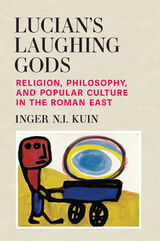
In Lucian's Laughing Gods, author Inger N. I. Kuin argues that in ancient Greek thought, comedic depictions of divinities were not necessarily desacralizing. In religion, laughter was accommodated to such an extent as to actually be constituent of some ritual practices, and the gods were imagined either to reciprocate or push back against human laughter—they were never deflated by it. Lucian uses the gods as comic characters, but in doing so, he does not automatically negate their power. Instead, with his depiction of the gods and of how they relate to humans—frivolous, insecure, callous—Lucian challenges the dominant theologies of his day as he refuses to interpret the gods as ethical models. This book contextualizes Lucian’s comedic performances in the intellectual life of the second century CE Roman East broadly, including philosophy, early Christian thought, and popular culture (dance, fables, standard jokes, etc.). His texts are analyzed as providing a window onto non-elite attitudes and experiences, and methodologies from religious studies and the sociology of religion are used to conceptualize Lucian’s engagement with the religiosity of his contemporaries.

The Thackeray Edition proudly announces two additions to its collection: Catherine and The Luck of Barry Lyndon. The Thackeray Edition is the first full-scale scholarly edition of William Makepeace Thackeray's works to appear in over seventy years, and the only one ever to be based on an examination of manuscripts and relevant printed texts. It is also a concrete attempt to put into practice a theory of scholarly editing that gives new insight into Thackeray's own compositional process.
The Luck of Barry Lyndon, serialized in Fraser's Magazine in 1844, is a wonderfully hard-edged advance upon Thackeray's previous writing: a tour de force dramatization at novelistic length of the moral vacuity of its first person narrator. The inner workings of this narrator are far more complicated than in earlier Thackeray writings, and are presented in a far more subtle, yet not humorless, manner. The mock-Bildungsroman aspect of the novel is brought about by the non-enlightenment of the title-figure, his failure to find a meaningful love-relationship, and his inability to discover a calling that identifies both a significant direction for his individual existence and, at the same time, an appropriate accommodation to his duties to society. Achieved in brilliant, accomplished style, Barry Lyndon is a significant and progressive experiment in narration for Thackeray.
Drawing on interviews with Ulitskaya and sources not readily available to Western scholars, Elizabeth A. Skomp and Benjamin M. Sutcliffe explore the ethical ideals that make Ulitskaya’s novels resonate in today’s Russia—tolerance, sincerity, and diversity—and examine how she uses innovative imagery to personalize history through a focus on body and kinship. This is essential reading for anyone interested in contemporary Russian literature and society.
Instrumental in establishing Mexican literary studies in the United States, Leal’s writings on the topic are especially instructive, ranging from essays on the significance of symbolism, culture, and history in early Chicano literature to studies of the more recent use of magical realism and of individual New Mexican, Tejano, and Mexican authors such as Juan Rulfo, Carlos Fuentes, José Montoya, and Mariano Azuela. Clearly and cogently written, these writings bring to bear an encyclopedic knowledge, a deep understanding of history and politics, and an unparalleled command of the aesthetics of storytelling, from folklore to theory. This collection affords readers the opportunity to consider—or reconsider—Latino literature under the deft guidance of its greatest reader.

"Are you afraid of the sun?" Emily Dickinson asked a friend in 1859.
Wendy Barker states here that that apparently casual query reveals a major theme of Dickinson’s poetry, a theme she shares with women writers ranging from Anne Finch to Anne Sexton. It is a tradition based upon the inversion of the traditional male-centered metaphors of light and dark. Through time the light-giving sun has represented vitality, order, God; the light-swallowing night death, chaos, Satan. These metaphors are reinforced in the writing of Emerson, Thoreau, Hawthorne, and Keats,but Eliot, Brontë, Browning, and Dickinson use the sun and images of light quite differently.
Barker argues that since light was a masculine tradition, ithad come to represent male power, energy, sexuality—not only to Dickinson but to other women writing during the era. To these writers the inversion of the light/darkness metaphor became a countertradition used as a means to express their energies in a society that was hostile to their intelligence. Dickinson, who read avidly, could not have been insensitive to this usage of light as a masculine symbol—of her Calvinist God, of her father, of all that was male—and of darkness as a feminine symbol.
Emily Dickinson thought in a richly symbolic manner. Her most frequently used metaphor is one of light in contrast to darkness, employing single-word references to light more than one thousand times in her 1,775 poems. Barker offers close readings and new interpretations of some previously overlooked or misunderstood poems and demonstrates that "Many of her most ecstatic images are oflittle lights created from darkness." Inanswer to those critics who have characterized her poems as being piecemeal, Barker argues that Dickinson’s consistent use of light as a metaphor unifies her poetry.
In her final chapter, Barker explores the ways in which twentieth-century female writers have carried on the countertradition of the light/darkness metaphor. "That Dickinson was able so brilliantly to transform and transcend the normative metaphoric patterning of her culture, creating, in effect, a metaphor of her own, has much to do with the genius of her art."
Walt Whitman stands freshly illuminated in this powerful portrait of the poet responding to his times.
Whitman’s idealistic expectations of democracy were painfully eroded by the rapidly expanding urban capitalism that, before the Civil War, increasingly threatened the economic and political power of the ordinary American. His poetry during this, his most fruitful period, became the indispensable medium allowing him to adjust to these developments. He succeeded in portraying this modern society as an invigorating natural extension of the artisanal order. After the war, however, American capitalism advanced at a pace that made it impossible for Whitman to redeem it through his poetry. His imagination defeated by realities, he invested more and more in dreams of the future, while his poetry turned to the past, Memory emerging as a central figure.
In this many-sided analysis M. Wynn Thomas relates Whitman’s work to American painting of the period; examines the poet’s evocation of nature, which he sometimes saw as a challenge to man’s confidence in himself; documents the revisions and additions Whitman made to Leaves of Grass in order to demonstrate that “my Book and the War are One”; and pays sympathetic attention to the postwar poetry, usually slighted.
Krell pursues important philosophical motifs such as time, rhythm, and desire, through texts by Nietzsche, Trakl, Empedocles, Kafka, and Garcia Marquez. He surveys instances in which poets or novelists explicitly address philosophical questions, and philosophers confront literary texts—Heidegger's and Derrida's appropriations of Georg Trakl's poetry, Blanchot's obsession with Kafka's tortuous love affairs, and Garcia Marquez's use of Nietzsche's idea of the Eternal Return—all linked by the tragic hero Empedocles.
In his search to understand the insatiable desire for completeness that patterns so much art and philosophy, Krell investigates the identification of the lunar voice with woman in various roles—lover, friend, sister, shadow, and narrative voice.
During her lifetime, Lydia Sigourney was acclaimed as nineteenth-century America's most popular woman poet and published widely as a historian, travel writer, essayist, and educator. While serious critical attention to her work languished following her death and into the twentieth century, a growing number of critics and writers have reexamined Sigourney and her large body of writing and have given her a central place in the “new canon.”
This first collection of original essays devoted to the poet's work puts many of the best scholars on Sigourney together in one place and in conversation with one another. The volume includes critical essays examining her literary texts as well as essays that unpack Sigourney's participation in the cultural movements of her day. Holding powerful opinions about the role of women in society, Sigourney was not afraid to advocate against government policies that, in her view, undermined the promise of America, even as she was held up as a paragon of American womanhood and middle-class rectitude. The resulting portrait promises to engage readers who wish to know more about Sigourney's writing, her career, and the causes that inspired her.
Along with the volume editors, contributors include Ann Beebe, Paula Bernat Bennett, Janet Dean, Sean Epstein-Corbin, Annie Finch, Gary Kelly, Paul Lauter, Amy J. Lueck, Ricardo Miguel-Alfonso, Jennifer Putzi, Angela Sorby, Joan Wry, and Sandra Zagarell.
"The Lying Brain is a study to take seriously. Its argument is timely, clear, and of particular importance to the enlargement of our understanding of the relationships among science studies, literary studies, and technology studies."
---Ronald Schleifer, University of Oklahoma
Real and imagined machines, including mental microscopes, thought translators, and polygraphs, have long promised to detect deception in human beings. Now, via fMRI and EEG, neuroscientists seem to have found what scientists, lawyers, and law enforcement officials have sought for over a century: foolproof lie detection. But are these new lie detection technologies any different from their predecessors? The Lying Brain is the first book to explore the cultural history of an array of lie detection technologies: their ideological assumptions, the scientific and fictional literatures that create and market them, and the literacies required for their interpretation.
By examining a rich archive of materials about lie detection---from science to science fiction---The Lying Brain demonstrates the interconnections of science, literature, and popular culture in the development and dissemination of deception detection in the American cultural imagination. As Melissa Littlefield demonstrates, neuroscience is not building a more accurate lie detector; it is simply recycling centuries-old ideologies about deception and its detection.
Cover art: "Human Brain" © Denis Barbulet, courtesy of Shutterstock.com
Lyric Complicity helps modern readers recover Russian poetry’s former uses and functions—life situations that moved people to quote or perform a specific passage from a poem or a forgotten occasion that created unforgettable verse.

Exploration of our inner life—perception, thought, memory, feeling—once seemed a privileged domain of lyric poetry. Scientific discoveries, however, have recently supplied physiological explanations for what was once believed to be transcendental; the past sixty years have brought wide recognition that the euphoria of love is both a felt condition and a chemical phenomenon, that memories are both representations of lived experience and dynamic networks of activation in the brain. Caught between a powerful but reductive scientific view of the mind and traditional literary metaphors for consciousness that have come to seem ever more naive, American poets since the sixties have struggled to articulate a vision of human consciousness that is both scientifically informed and poetically truthful.
The Lyric in the Age of the Brain examines several contemporary poets—Robert Lowell, A. R. Ammons, Robert Creeley, James Merrill, John Ashbery, Jorie Graham, and experimentalists such as Harryette Mullen and Tan Lin—to discern what new language, poetic forms, and depictions of selfhood this perplexity forces into being. Nikki Skillman shows that under the sway of physiological conceptions of mind, poets ascribe ever less agency to the self, ever less transformative potential to the imagination. But in readings that unravel factional oppositions in contemporary American poetry, Skillman argues that the lyric—a genre accustomed to revealing expansive aesthetic possibilities within narrow formal limits—proves uniquely positioned to register and redeem the dispersals of human mystery that loom in the age of the brain.
Lyric Interventions explores linguistically innovative poetry by contemporary women in North America and Britain whose experiments give rise to fresh feminist readings of the lyric subject. The works discussed by Linda Kinnahan explore the lyric subject in relation to the social: an “I” as a product of social discourse and as a conduit for change.
Contributing to discussions of language-oriented poetries through its focus on women writers and feminist perspectives, this study of lyric experimentation brings attention to the cultural contexts of nation, gender, and race as they significantly shift the terms by which the “experimental” is produced, defined, and understood.
This study focuses upon lyric intervention in distinct but related spheres as they link public and ideological norms of identity. Firstly, lyric innovations with visual and spatial realms of cultural practice and meaning, particularly as they naturalize ideologies of gender and race in North America and the post-colonial legacies of the Caribbean, are investigated in the works of Barbara Guest, Kathleen Fraser, Erica Hunt, and M. Nourbese Philip. Secondly, experimental engagements with nationalist rhetorics of identity, marking the works of Carol Ann Duffy, Denise Riley, Wendy Mulford, and Geraldine Monk, are explored in relation to contemporary evocations of “self” in Britain. And thirdly, in discussions of all of the poets, but particularly accenuated in regard to Guest, Fraser, Riley, Mulford, and Monk, formal experimentation with the lyric “I” is considered through gendered encounters with critical and avant-garde discourses of poetics.
This fresh, energetic study will be of great interest to literary critics and womens studies scholars, as well as poets on both sides of the Atlantic.
Creating paintings with poetic resonances, sometimes with ties to specific lines of poetry, is a practice that began in China in the eleventh century, the Northern Sung period. James Cahill vividly surveys its first great flowering among artists working in the Southern Sung capital of Hangchou, probably the largest and certainly the richest city on earth in this era. He shows us the revival of poetic painting by late Ming artists working in the prosperous city of Suchou. And we learn how artists in Edo-period Japan, notably the eighteenth-century Nanga masters and the painter and haiku poet Yosa Buson, transformed the style into a uniquely Japanese vehicle of expression.
In all cases, Cahill shows, poetic painting flourished in crowded urban environments; it accompanied an outpouring of poetry celebrating the pastoral, escape from the city, immersion in nature. An ideal of the return to a life close to nature—the “lyric journey”—underlies many of the finest, most moving paintings of China and Japan, and offers a key for understanding them.
In poet and critic James Longenbach’s title, the word “now” does double duty, evoking both a lyric sense of the present and twentieth-century writers’ assertion of “nowness” as they crafted their poetry in the wake of Modernism. Longenbach examines the fruitfulness of poetic repetition and indecision, of naming and renaming, and of the evolving search for newness in the construction, history, and life of lyrics. Looking to the work of thirteen poets, from Marianne Moore and T. S. Eliot through George Oppen and Jorie Graham to Carl Phillips and Sally Keith, and several musicians, including Virgil Thomson and Patti Smith, he shows how immediacy is constructed through language. Longenbach also considers the life and times of these poets, taking a close look at the syntax and diction of poetry, and offers an original look at the nowness of lyrics.
READERS
Browse our collection.
PUBLISHERS
See BiblioVault's publisher services.
STUDENT SERVICES
Files for college accessibility offices.
RECENTLY PUBLISHED



UChicago Accessibility Resources
home | accessibility | search | about | contact us
BiblioVault ® 2001 - 2026
The University of Chicago Press