
 A SCHOLARLY BOOK REPOSITORY
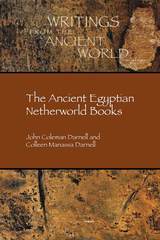
The first, complete English translation of the ancient Egyptian Netherworld Books
The ancient Egyptian Netherworld Books, important compositions that decorated the New Kingdom royal tombs in the Valley of the Kings, present humanity's oldest surviving attempts to provide a scientific map of the unseen realms beyond the visible cosmos and contain imagery and annotations that represent ancient Egyptian speculation (essentially philosophical and theological) about the events of the solar journey through the twelve hours of the night. The Netherworld Books describe one of the central mysteries of Egyptian religious belief—the union of the solar god Re with the underworldly god Osiris—and provide information on aspects of Egyptian theology and cosmography not present in the now more widely read Book of the Dead. Numerous illustrations provide overview images and individual scenes from each Netherworld Book, emphasizing the unity of text and image within the compositions. The major texts translated include the Book of Adoring Re in the West (the Litany of Re), the Book of the Hidden Chamber (Amduat), the Book of Gates, the Book of Caverns, the Books of the Creation of the Solar Disk, and the Books of the Solar-Osirian Unity.
Features:
- Accessible presentations of the main concepts of the Netherworld Books and the chief features of each text
- Notes and commentary address major theological themes within the texts as well as lexicographic and/or grammatical issues
- An overview of later uses of these compositions during the first millennium BCE
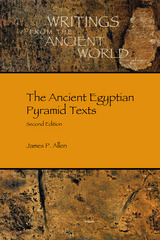
Completely revised and updated
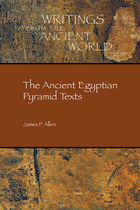
James P. Allen provides a translation of the oldest corpus of ancient Egyptian religious texts from the six royal pyramids of the Fifth and Sixth Dynasties (ca. 2350–2150 BCE). Allen’s revisions take into account recent advances in the understanding of Egyptian grammar.
Features:
- Sequential translations based on all available sources, including texts newly discovered in the last decade
- Texts numbered according to the most widely used numbering system with new numbers from the latest 2013 concordance
- Translations reflect the primarily atemporal verbal system of Old Egyptian, which conveys the timeless quality that the text’s authors understood the texts to have
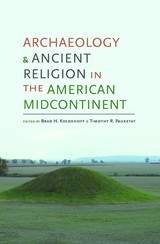
Across North America, huge data accumulations derived from decades of cultural resource management studies, combined with old museum collections, provide archaeologists with unparalleled opportunities to explore new questions about the lives of ancient native peoples. For many years the topics of technology, economy, and political organization have received the most research attention, while ritual, religion, and symbolic expression have largely been ignored. This was often the case because researchers considered such topics beyond reach of their methods and data.
In Archaeology and Ancient Religion in the American Midcontinent, editors Brad H. Koldehoff and Timothy R. Pauketat and their contributors demonstrate that this notion is outdated through their analyses of a series of large datasets from the midcontinent, ranging from tiny charred seeds to the cosmic alignments of mounds, they consider new questions about the religious practices and lives of native peoples. At the core of this volume are case studies that explore religious practices from the Cahokia area and surrounding Illinois uplands. Additional chapters explore these topics using data collected from sites and landscapes scattered along the Mississippi and Ohio River valleys.
This innovative work facilitates a greater appreciation for, and understanding of, ancient native religious practices, especially their seamless connections to everyday life and livelihood. The contributors do not advocate for a reduced emphasis on technology, economy, and political organization; rather, they recommend expanding the scope of such studies to include considerations of how religious practices shaped the locations of sites, the character of artifacts, and the content and arrangement of sites and features. They also highlight analytical approaches that are applicable to archaeological datasets from across the Americas and beyond.
A critical study for those interested in the intersection of art and biblical interpretation
With a special focus on biblical texts and images, this book nurtures new developments in biblical studies and art history during the last two or three decades. Analysis and interpretation of specific works of art introduce guidelines for students and teachers who are interested in the relation of verbal presentation to visual production. The essays provide models for research in the humanities that move beyond traditional disciplinary boundaries erected in previous centuries. In particular, the volume merges recent developments in rhetorical interpretation and cognitive studies with art historical visual exegesis. Readers will master the tools necessary for integrating multiple approaches both to biblical and artistic interpretation.
Features

The Ascension of Authorship traces the history of the idea of the author in the ancient world, beginning with the attribution practices of Second Temple and Rabbinic Judaism. Jed Wyrick explores the testimony of Josephus on the succession of prophetic scribes and their superiority to Greek historiographers, and interprets the formation of the biblical canon in this light.
The Ascension of Authorship also examines the Greek scholarly methodology that questioned traditional connections between names and texts, a methodology perfected by Hellenistic grammarians and inherited by early Christian scholars. Wyrick argues that the fusion of Jewish and Hellenistic approaches toward attribution helped lead to St. Augustine’s reinvention of the writer of scripture as an author whose texts were governed by both divine will and human intent.
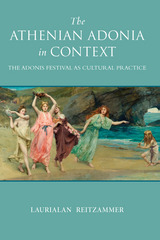
Reitzammer uncovers correlations of the Adonia to Athenian wedding rituals and civic funeral oration and provides illuminating evidence that the festival was a significant cultural template for such diverse works as Aristophanes’ drama Lysistrata and Plato’s dialogue Phaedrus. Her fresh approach is a timely contribution to studies of the ways gender and sexuality intersect with religion and ritual in ancient Greece.
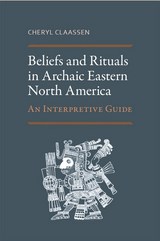
Beliefs and Rituals in Archaic Eastern North America describes, illustrates, and offers nondogmatic interpretations of rituals and beliefs in Archaic America. In compiling a wealth of detailed entries, author Cheryl Claassen has created both an exhaustive reference as well as an opening into new archaeological taxonomies, connections, and understandings of Native American culture.
The material is presented in an introductory essay about Archaic rituals followed by two sections of entries that incorporate reports and articles discussing archaeological sites; studies of relevant practices of ritual and belief; data related to geologic features, artifact attributes, and burial settings; ethnographies; and pilgrimages to specific sites. Claassen’s work focuses on the American Archaic period (marked by the end of the Ice Age approximately 11,000 years ago) and a geographic area bounded by the edge of the Great Plains, Newfoundland, and southern Florida. This period and region share specific beliefs and practices such as human sacrifice, dirt mound burial, and oyster shell middens.
This interpretive guide serves as a platform for new interpretations and theories on this period. For example, Claassen connects rituals to topographic features and posits the Pleistocene-Holocene transition as a major stimulus to Archaic beliefs. She also expands the interpretation of existing data previously understood in economic or environmental terms to include how this same data may also reveal spiritual and symbolic practices. Similarly, Claassen interprets Archaic culture in terms of human agency and social constraint, bringing ritual acts into focus as drivers of social transformation and ethnogenesis.
Richly annotated and cross-referenced for ease of use, Beliefs and Rituals in Archaic Eastern North America will benefit scholars and students of archaeology and Native American culture. Claassen’s overview of the archaeological record should encourage the development of original archaeological and historical connections and patterns. Such an approach, Claassen suggests, may reveal patterns of influence extending from early eastern Americans to the Aztec and Maya.
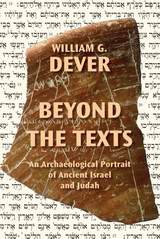
A handbook for biblical scholars and historians of the Ancient Near East
William G. Dever offers a welcome perspective on ancient Israel and Judah that prioritizes the archaeological remains to render history as it was—not as the biblical writers argue it should have been. Drawing from the most recent archaeological data as interpreted from a nontheological point of view and supplementing that data with biblical material only when it converges with the archaeological record, Dever analyzes all the evidence at hand to provide a new history of ancient Israel and Judah that is accessible to all interested readers.
Features
- A new approach to the history of ancient Israel
- Extensive bibliography
- More than eighty maps and illustrations

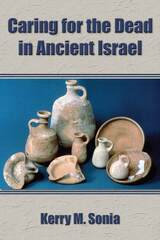
A new reconstruction of cultic practices surrounding death in ancient Israel
In Caring for the Dead in Ancient Israel, Kerry M. Sonia examines the commemoration and care for the dead in ancient Israel against the broader cultural backdrop of West Asia. This cult of dead kin, often referred to as ancestor cult, comprised a range of ritual practices in which the living provided food and drink offerings, constructed commemorative monuments, invoked the names of the dead, and protected their remains. This ritual care negotiated the ongoing relationships between the living and the dead and, in so doing, helped construct social, political, and religious landscapes in relationship to the past. Sonia explores the nature of this cult of dead kin in ancient Israel, focusing on its role within the family and household as well as its relationship to Israel’s national deity and the Jerusalem temple.
Features:
- A reevaluation of whether burial and necromantic rituals were part of the cult of dead kin
- A portrait of the various roles Israelite women played in the cult of dead kin
- A reassessment of biblical writers’ attitudes toward the cult of dead kin
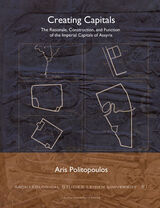
The Assyrian Empire moved and rebuilt its capital city three times—at Kar-Tukulti-Ninurta, Kalhu, Dur-Šarruken, and Nineveh. Creating Capitals explores why and how Assyria constructed these capitals as well as how they functioned within the empire. Drawing on extensive research, Aris Politopoulos offers a sweeping comparative analysis of these four ancient cities and proposes a new framework for understanding the construction of capitals in human history.
Sacrifice—ranging from the sacrifice of virgins to circumcision to giving up what is most valued—is essential to all religions. Could there be a natural, even biological, reason for these practices? Something that might explain why religions of so many different cultures share so many rituals and concepts? In this extraordinary book, one of the world’s leading authorities on ancient religions explores the possibility of natural religion—a religious sense and practice naturally proceeding from biological imperatives.
Because they lack later refinements, the earliest religions from the Near East, Israel, Greece, and Rome may tell us a great deal about the basic properties and dynamics of religion, and it is to these cultures that Walter Burkert looks for answers. His book takes us on an intellectual adventure that begins some 5,000 years ago and plunges us into a fascinating world of divine signs and omens, offerings and sacrifices, rituals and beliefs unmitigated by modern science and sophistication. Tracing parallels between animal behavior and human religious activity, Burkert suggests natural foundations for sacrifices and rituals of escape, for the concept of guilt and punishment, for the practice of gift exchange and the notion of a cosmic hierarchy, and for the development of a system of signs for negotiating with an uncertain environment. Again and again, he returns to the present to remind us that, for all our worldliness, we are not so far removed from the first Homo religiosus.
A breathtaking journey, as entertaining as it is provocative, Creation of the Sacred brings rich new insight on religious thought past and present and raises serious questions about the ultimate reasons for, and the ultimate meaning of, human religiousness.
The fundamental myth is that of Prometheus, who introduced sacrifice and, in the process, both joined us to and separated us from the gods—and ambiguous relation that recurs in marriage and in the growing of grain. Thus we can understand why the ascetic man refuses both women and meat, and why Greek women celebrated the festival of grain-giving Demeter with instruments of butchery.
The ambiguity coded in the consumption of meat generated a mythology of the "other"—werewolves, Scythians, Ethiopians, and other "monsters." The study of the sacrificial consumption of meat thus leads into exotic territory and to unexpected findings.
In The Cuisine of Sacrifice, the contributors—all scholars affiliated with the Center for Comparative Studies of Ancient Societies in Paris—apply methods from structural anthropology, comparative religion, and philology to a diversity of topics: the relation of political power to sacrificial practice; the Promethean myth as the foundation story of sacrificial practice; representations of sacrifice found on Greek vases; the technique and anatomy of sacrifice; the interaction of image, language, and ritual; the position of women in sacrificial custom and the female ritual of the Thesmophoria; the mythical status of wolves in Greece and their relation to the sacrifice of domesticated animals; the role and significance of food-related ritual in Homer and Hesiod; ancient Greek perceptions of Scythian sacrificial rites; and remnants of sacrificial ritual in modern Greek practices.
In A Dark Pathway: Precontact Native American Mud Glyphs from 1st Unnamed Cave, Tennessee, Jan Simek and his colleagues present two decades of research at a precontact dark zone cave art site in East Tennessee. Discovered in 1994, 1st Unnamed Cave ushered in an extensive and systematic effort to research precontact cave art sites in the Eastern Woodlands, where the tradition of cave art production was widespread among ancient peoples. Indeed, when a preliminary report about 1st Unnamed Cave was first published in 1997, there were only seven known cave art sites across the Southeast; today, that number exceeds ninety.
From the tale of the cave’s discovery in chapter 1 to descriptions of its art in later chapters, A Dark Pathway boasts nearly one hundred maps, high-resolution photographs, and illustrations that bring the story of one of North America’s premier cave art sites to life. Importantly, Simek and his colleagues also orient 1st Unnamed Cave within the broader context of cave art sites across the Southeast, elevating them as a whole to the notable prominence they deserve. Yet his analysis does more than present and situate the discovery of 1st Unnamed Cave within the greater realm of regional cave art site studies; it also calls for the protection and preservation of these fragile sites and for the acknowledgment of the still-vibrant indigenous cultures that produced them.
With a foreword by Russell Townsend, tribal historic preservation officer for the Eastern Band of Cherokee Indians, A Dark Pathway is a long-awaited volume more than twenty years in the making. Even as he delivers a comprehensive archaeological analysis, Simek’s clear presentation makes for accessible and thrilling reading not only for students of archaeology, anthropology, and Native American studies, but for interested readers as well.
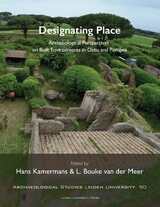
Designating Place showcases the diverse ways archaeologists approach ancient urban spaces—including geophysical, spatial, iconographic, and epigraphic analyses. Drawing on techniques as wide-ranging as Space Syntax, shallow seismic reflection surveys, linguistic landscape studies, and collective memory studies, this international team of scholars presents the latest insights from cutting-edge research into urban societies near Rome and Pompeii.

A reevaluation of the concept of the soul based on the latest evidence
Biblical scholars have long claimed that the Israelites “could not conceive of a disembodied nefesh [soul].” Steiner rejects that claim based on a broad spectrum of textual, linguistic, archaeological, and anthropological evidence spanning the millennia from prehistoric times to the present. The biblical evidence includes a prophecy of Ezekiel condemning women who pretend to trap the wandering souls of sleeping people. The extrabiblical evidence suggests that a belief in the existence of disembodied souls was part of the common religious heritage of the peoples of the ancient Near East.
Features
- A re-examination of the evidence for and against disembodied souls in the Hebrew Bible
- A new look at the nature and behavior of disembodied souls in the Hebrew Bible
- A new study of the meaning and sociolinguistic background of the Katumuwa inscription
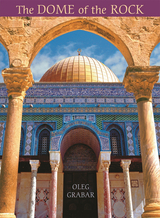
The Dome of the Rock, the beautiful Muslim shrine in the walled Old City of Jerusalem, was fully restored to its original state in the last half-century. Thus, this structure, sited on the third holiest spot on earth for Muslims, is at once a product of the seventh century and almost entirely the work of our own times--a paradox in keeping with the complexities and contradictions of history and religion, architecture and ideology that define this site.
This book tells the story of the Dome of the Rock, from the first fateful decades of its creation--on the esplanade built in the fourth decade B.C.E. for the Second Jewish Temple--to its engulfment in the clashes of the Crusades and the short-lived Christianization of all of Jerusalem, to its modern acquisition of different and potent meanings for Muslim, Christian, and Jewish cultures.
Oleg Grabar's presentation combines what we know of the building with the views of past observers and with the broader historical, cultural, and aesthetic implications of the monument. Primarily it is as a work of art that the Dome of the Rock stands out from these pages, understood for the quality that allows it to transcend the constrictions of period and perhaps even those of faith and culture. Finally, Grabar grapples with the question this monumental work of art so eloquently poses: whether the pious requirements of a specific community can be reconciled with universal aesthetic values.
A comprehensive history of a state on Judah’s border
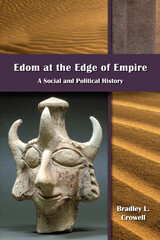
Edom at the Edge of Empire combines biblical, epigraphic, archaeological, and comparative evidence to reconstruct the history of Judah's neighbor to the southeast. Crowell traces the material and linguistic evidence, from early Egyptian sources that recall conflicts with nomadic tribes to later Assyrian texts that reference compliant Edomite tribal kings, to offer alternative scenarios regarding Edom's transformation from a collection of nomadic tribes and workers in the Wadi Faynan as it relates to the later polity centered around the city of Busayra in the mountains of southern Jordan. This is the first book to incorporate the important evidence from the Wadi Faynan copper mines into a thorough account of Edom's history, providing a key resource for students and scholars of the ancient Near East and the Hebrew Bible.
This volume brings together studies of Ephesos—a major city in the Greco-Roman period and a primary center for the spread of Christianity into the Western world—by an international array of scholars from the fields of classics, fine arts, history of religion, New Testament, ancient Christianity, and archaeology. The studies were presented at a spring 1994 Harvard Divinity School symposium on Ephesos, focusing on the results of one hundred years of archaeological work at Ephesos by members of the Austrian Archaeological Institute.
The contributors to this volume discuss some of the most interesting and controversial results of recent investigations: the Processional Way of Artemis, the Hadrianic Olympieion and the Church of Mary, the so-called Temple of Domitian, and the heroes Androkolos and Arsinoe.
Since very little about the Austrian excavations at Ephesos has been published in English, this volume should prove useful in introducing the archaeology of this metropolis to a wider readership.
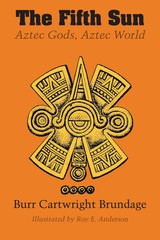
The ancient Aztecs dwelt at the center of a dazzling and complex cosmos. From this position they were acutely receptive to the demands of their gods. The Fifth Sun represents a dramatic overview of the Aztec conception of the universe and the gods who populated it—Quetzalcoatl, the Plumed Serpent; Tezcatlipoca, the Smoking Mirror; and Huitzilopochtli, the Southern Hummingbird. Burr Cartwright Brundage explores the myths behind these and others in the Aztec pantheon in a way that illuminates both the human and the divine in Aztec life.
The cult of human sacrifice is a pervasive theme in this study. It is a concept that permeated Aztec mythology and was the central preoccupation of the aggressive Aztec state. Another particularly interesting belief explored here is the “mask pool,” whereby gods could exchange regalia and, thus, identities.
This vivid and eminently readable study also covers the use of hallucinogens; cannibalism; the calendars of ancient Mexico; tlachtli, the life-and-death ball game; the flower wars; divine transfiguration; and the evolution of the war god of the Mexica. A splendid introduction to Aztec religion, The Fifth Sun also contains insights for specialists in ethnohistory, mythology, and religion.
A fresh look at early urban churches
This collection of essays examines the urban context of early Christian churches in the first-century Roman world. A city-by-city investigation of the early churches in the New Testament clarifies the challenges, threats, and opportunities that urban living provided for early Christians. Readers will come away with a better understanding of how scholars assemble an accurate picture of the cities in which the first Christians flourished.
Features:
- Analysis of urban evidence of the inscriptions, papyri, archaeological remains, coins, and iconography
- Discussion of how to use different types of evidence responsibly
- Outline of what constitutes proper methodological use for establishing a nuanced, informed portrait of ancient urban life
Investigate the challenges, threats, and opportunities experienced by the early church
Volume two of The First Urban Churches focuses on the urban context of Christian churches in first-century Roman Corinth. An investigation of the material evidence of Corinth helps readers today understand properly the challenges, threats, and opportunities that the early Corinthian believers faced in the city. The essays demonstrate decisively the difference that such an approach makes in grappling with the meaning and context of the Corinthian epistles in the New Testament.
Features:
- Analysis of urban evidence of the inscriptions, papyri, archaeological remains, coins, and iconography
- Proposed reeconstructions of the past and its social, religious, and political significance
- A nuanced, informed portrait of ancient urban life in Corinth
Investigate the challenges, threats, and opportunities experienced by the early church in Ephesus
The third installment of The First Urban Churches focuses on the urban context of Christian churches in first-century Ephesus. As with previous volumes, contributors illustrate how an investigation of the material evidence will help readers understand properly the challenges, threats, and opportunities that the early Ephesian believers faced in that city. Brad Bitner, James R. Harrison, Michael Haxby, Fredrick J. Long, Guy M. Rogers, Michael Theophilos, Paul Trebilco, and Stephan Witetschek demonstrate decisively the difference that such an approach makes in grappling with the meaning and context of the New Testament writings, particularly Ephesians, Acts, and Revelation.
Features
- Analysis of urban evidence of the inscriptions, papyri, archaeological remains, coins, and iconography
- Proposed reconstructions of the past and its social, religious and political significance
- A nuanced, informed portrait of ancient urban life in Ephesus
Investigate the challenges and opportunities experienced by the early church
This fourth installment of The First Urban Churches, edited by James R. Harrison and L. L. Welborn, focuses on the urban context of Christian churches in first-century Roman Philippi. The international team of New Testament and classical scholars contributing to the volume present essays that use inscriptions, papyri, archaeological remains, coins, and iconography to examine the rivalries, imperial context, and ecclesial setting of the Philippian church.
Features:
- Analysis of the material and epigraphic evidence relating to first- and second-century CE Roman Philippi
- Examination of important passages from Philippians within their ancient urban context
- Investigation of the social composition and membership of the Philippian church from the archaeological and documentary evidence
A fresh examination of early Christianity by an international team of New Testament and classical scholars
Volume 5 of The First Urban Churches investigates the urban context of Christian churches in first-century Roman Colossae, Hierapolis, and Laodicea. Building on the methodologies introduced in the first volume and supplementing the in-depth studies of Corinth, Ephesus, and Philippi (vols. 2-4), essays in this volume challenge readers to reexamine preconceived understandings of the early church and to grapple with the meaning and context of Christianity in its first-century Roman colonial context.
Features:
- Analysis of urban evidence found in inscriptions, papyri, archaeological remains, coins, and iconography
- Proposed reconstructions of the past and its social, religious, and political significance
- A nuanced, informed portrait of ancient urban life in the cities of the Lycus Valley
An examination of early Roman Christianity by New Testament and classical scholars
Building on the methodologies introduced in the first volume of The First Urban Churches and supplementing the in-depth studies of Corinth, Ephesus, Philippi, Colossae, Hierapolis, and Laodicea (vols. 2–5), essays in this volume challenge readers to reexamine what we know about the early church within Rome and the port city of Ostia. In the introductory section of the book, James R. Harrison discusses the material and documentary evidence of both cities, which sets the stage for the essays that follow. In the second section, Mary Jane Cuyler, James R. Harrison, Richard Last, Annelies Moeser, Thomas A. Robinson, Michael P. Theophilos, and L. L. Welborn examine a range of topics, including the Ostian Synagogue, Romans 1:2–4 against the backdrop of Julio-Claudian adoption and apotheosis traditions, and the epistle of 1 Clement. In the final section of this volume, Jutta Dresken-Welland and Mark Reasoner engage Peter Lampe’s magnum opus From Paul to Valentinus; Lampe wraps up the section and the volume with a response. Throughout, readers are provided with a rich demonstration of how the material evidence of the city of Rome illuminates the emergence of Roman Christianity, especially in the first century CE.
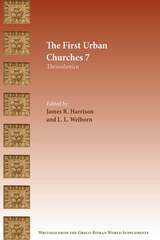
The First Urban Churches 7 includes essays focused on the development of early Christianity from the mid-first century through the sixth century CE in the ancient Macedonian city of Thessalonica. An international group of contributors traces the emergence of Thessalonica’s house churches through a close study of the archaeological remains, inscriptions, coins, iconography, and Paul’s two letters to the Thessalonians. After a detailed introduction to the city, including the first comprehensive epigraphic profile of Thessalonica from the Hellenistic age to the Roman Empire, topics discussed include the Roman emperor’s divine honors, coins and inscriptions as sources of imperial propaganda, Thessalonian family bonds, Paul’s apostolic self-image, the role of music at Thessalonica and in early Christianity, and Paul’s response to the Thessalonian Jewish community. Contributors include D. Clint Burnett, Alan H. Cadwallader, Rosemary Canavan, James R. Harrison, Julien M. Ogereau, Isaac T. Soon, Angela Standhartinger, Michael P. Theophilos, and Joel R. White.
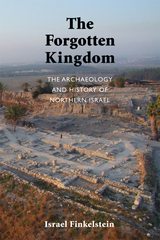
A new understanding of the history of the northern kingdom from 1350 B.C.E. to 720 B.C.E.
Beginning with the Canaanite city-states, through the Saulide dynasty, to the fall of Israel, Finkelstein presents the first comprehensive history of Israel integrating the analysis of more than thirty years of archaeological work with interpretation of ancient Near Eastern and biblical texts. Though Judah dominates the pages of the Hebrew Bible and contemporary studies, Israel dominates here as Finkelstein reveals the glory of the Omride dynasty, outlines how the two kingdoms of Israel and Judah developed parallel to one another, and highlights Israel’s transformation from kingdom to foundational idea.
Features:
- Archaeological analysis of the region of the northern kingdom
- Primary and secondary textual analysis from the ancient Near East and the biblical narrative
- Maps, tables, and images
- Discussion of Israel’s legacy
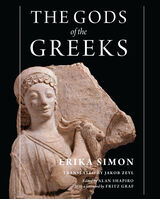
This careful and fluid translation finally makes Simon’s landmark edition accessible to English-language readers. With an abundance of beautiful illustrations, the book examines portrayals of the thirteen major gods in art over the course of two millennia. Scholars who study the lives and practices of those living in ancient Greece will value this newest contribution.
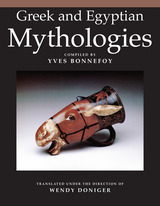
"In a world that remains governed by powerful myths, we must deepen our understanding of ourselves and others by considering more carefully the ways in which the mythological systems to which we cling and social institutions and movements to which we are committed nourish each other. Yves Bonnefoy's Mythologies not only summarizes the progress that has already been made toward this end, but also lays the foundation for the difficult work that lies ahead."—Mark C. Taylor, New York Times Book Review
"The almost 100 contributors combine, with characteristic precision and élan, the arts of science and poetry, of analysis and translation. The result is a treasury of information, brilliant guesswork, witty asides, and revealing digressions. This is a work of genuine and enduring excitement."—Thomas D'Evelyn, Christian cience Monitor
A thorough case for a later date for of Ezra, Nehemiah, and Chronicles
In this collection of essays, Israel Finkelstein deals with key topics in Ezra, Nehemiah, and 1 and 2 Chronicles, such as the list of returnees, the construction of the city wall of Jerusalem, the adversaries of Nehemiah, the tribal genealogies, and the territorial expansion of Judah in 2 Chronicles. Finkelstein argues that the geographical and historical realities cached behind at least parts of these books fit the Hasmonean period in the late second century BCE. Seven previously published essays are supplemented by maps, updates to the archaeological material, and references to recent publications on the topics.
Features:
- Analysis of geographical chapters of Ezra, Nehemiah, and Chronicles
- Study of the Hasmonean period in the late second century BCE
- Unique arguments regarding chronology and historical background
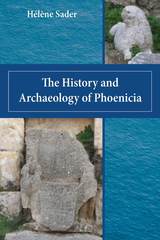
An insightful historical account of Phoenicia that illustrates its cities, culture, and daily life
Hélène Sader presents the history and archaeology of Phoenicia based on the available contemporary written sources and the results of archaeological excavations in Phoenicia proper. Sader explores the origin of the term Phoenicia; the political and geographical history of the city-states Arwad, Byblos, Sidon, and Tyre; and topography, climate, and natural resources of the Phoenician homeland. Her limited focus on Phoenicia proper, in contrast to previous studies that included information from Phoenician colonies, presents the bare realities of the opportunities and difficulties shaping Phoenician life. Sader’s evaluation and synthesis of the evidence offers a corrective to the common assumption of a unified Phoenician kingdom.
Features
- Historical as well as modern maps with the locations of all relevant archaeological sites
- Faunal and floral analyses that shed light on the Phoenician diet
- Petrographic analysis of pottery that sheds light on trading patterns and developments
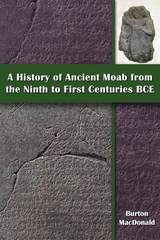
An essential resource for scholars and students of the Hebrew Bible and history
A History of Ancient Moab from the Ninth to First Centuries BCE incorporates archaeological, epigraphic, biblical, and postbiblical evidence to construct a picture of the formation of Moabite society, polity, religion, and economy. MacDonald prioritizes the archaeological evidence as our most secure source for constructing Moabite history, while drawing on the ninth-century Mesha Inscription, later Assyrian texts, the Hebrew Bible, and Josephus’s Jewish Antiquities to supplement the historical account. MacDonald presents the argument that the Moabites were indigenous Transjordanian, agro-pasturalists called Shûtu or Shasu in Egyptian sources. When provided an opening by warring neighbors, Moab emerged as a nation on the international stage and prospered from the eighth to early sixth centuries under the Assyrian Empire until the rise of the Neo-Babylonians led to their demise.
Features:
- Maps specifying archaeological sites, survey areas, and locations mentioned in texts and inscriptions
- Images of Moabite architectural features and other important artifacts
- An analysis of Neo-Babylonian trade routes that shifted eastward, leading to Moab’s decline
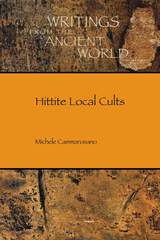
An innovative translation and analysis of Hittite local festivals and of their economic and social dimensions for students and scholars
This English translation of the Hittite cult inventories provides a vivid portrait of the religion, economy, and administration of Bronze Age provincial towns and villages of the Hittite Empire. These texts report the state of local shrines and festivals and document the interplay between the central power and provincial communities on religious affairs. Brief introductions to each text make the volume accessible to students and scholars alike.
Features:
- Critical editions of Hittite cult inventories, some of which are edited for the first time, with substantial improvements in readings and interpretations
- The first systematic study of the linguistic aspects of Hittite administrative jargon
- An up-to-date study of Hittite cult images and iconography of the gods
Michele Cammarosano currently leads a Deutsche Forschungsgemeinschaft-funded project on Hittite cultic administration at Julius-Maximilians-Universität Würzburg. His research interests focus on cuneiform palaeography and Hittite religion.
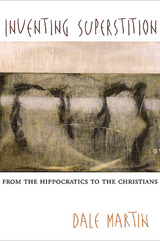
The Roman author Pliny the Younger characterizes Christianity as “contagious superstition”; two centuries later the Christian writer Eusebius vigorously denounces Greek and Roman religions as vain and impotent “superstitions.” The term of abuse is the same, yet the two writers suggest entirely different things by “superstition.”
Dale Martin provides the first detailed genealogy of the idea of superstition, its history over eight centuries, from classical Greece to the Christianized Roman Empire of the fourth century C.E. With illuminating reference to the writings of philosophers, historians, and medical teachers he demonstrates that the concept of superstition was invented by Greek intellectuals to condemn popular religious practices and beliefs, especially the belief that gods or other superhuman beings would harm people or cause disease. Tracing the social, political, and cultural influences that informed classical thinking about piety and superstition, nature and the divine, Inventing Superstition exposes the manipulation of the label of superstition in arguments between Greek and Roman intellectuals on the one hand and Christians on the other, and the purposeful alteration of the idea by Neoplatonic philosophers and Christian apologists in late antiquity.
Inventing Superstition weaves a powerfully coherent argument that will transform our understanding of religion in Greek and Roman culture and the wider ancient Mediterranean world.
An incomparable interdisciplinary study of the history of Judah
Experts from a variety of disciplines examine the history of Judah during the seventh century BCE, the last century of the kingdom’s existence. This important era is well defined historically and archaeologically beginning with the destruction layers left behind by Sennacherib’s Assyrian campaign (701 BCE) and ending with levels of destruction resulting from Nebuchadnezzar’s Babylonian campaign (588-586 BCE). Eleven essays develop the current ongoing discussion about Judah during this period and extend the debate to include further important insights in the fields of archaeology, history, cult, and the interpretation of Old Testament texts.
Features
- A new chronological frame for the Iron Age IIB-IIC
- Close examinations of archaeology, texts, and traditions related to the reigns of Hezekiah, Manasseh, and Josiah
- An evaluation of the religious, cultic, and political landscape < /UL>
A focused, interdisciplinary examination of a tumultuous, history-making era
The Middle Maccabees lays out the charged, complicated beginnings of the independent Jewish state founded in the second century BCE. Contributors offer focused analyses of the archaeological, epigraphic, numismatic, and textual evidence, framed within a wider world of conflicts between the Ptolemies of Egypt, the Seleucids of Syria, and the Romans. The result is a holistic view of the Hasmonean rise to power that acknowledges broader political developments, evolving social responses, and the particularities of local history. Contributors include Uzi ‘Ad, Donald T. Ariel, Andrea M. Berlin, Efrat Bocher, Altay Coşkun, Benedikt Eckhardt, Gerald Finkielsztejn, Christelle Fischer-Bovet, Yuval Gadot, Erich Gruen, Sylvie Honigman, Jutta Jokiranta, Paul J. Kosmin, Uzi Leibner, Catharine Lorber, Duncan E. MacRae, Dvir Raviv, Helena Roth, Débora Sandhaus, Yiftah Shalev, Nitsan Shalom, Danny Syon, Yehiel Zelinger, and Ayala Zilberstein.
Features
- Up-to-date, generously illustrated essays analyzing the relevant archaeological remains
- A revised understanding of how local and imperial histories overlapped and intersected
- New analysis of the book of 1 Maccabees as a tool of Hasmonean strategic interest
Experience a lifetime of adventure
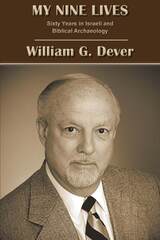
This autobiography of prominent American archaeologist William G. Dever is unabashedly his story, in which he offers candid, often brutally honest, reflections on his life and sixty-five-year career. Dever places himself in the midst of a remarkable generation of giants in archaeology in Israel during a period when the fields of biblical and Israeli archaeology were evolving. With technical expertise developed over a lifetime of working alongside four generations of Israeli and foreign excavators, he recalls their exploits and shares numerous personal stories that few others would know. His memoir concludes with a postscript on the likely future of biblical archaeology and an annotated bibliography for serious readers who wish to explore some of the scholarly literature to flesh out Dever’s narrative.
In Vergil's Aeneid, the poet implies that those who have been initiated into mystery cults enjoy a blessed situation both in life and after death. This collection of essays brings new insight to the study of mystic cults in the ancient world, particularly those that flourished in Magna Graecia (essentially the area of present-day Southern Italy and Sicily).
Implementing a variety of methodologies, the contributors to Mystic Cults in Magna Graecia examine an array of features associated with such "mystery religions" that were concerned with individual salvation through initiation and hidden knowledge rather than civic cults directed toward Olympian deities usually associated with Greek religion. Contributors present contemporary theories of ancient religion, field reports from recent archaeological work, and other frameworks for exploring mystic cults in general and individual deities specifically, with observations about cultural interactions throughout. Topics include Dionysos and Orpheus, the Goddess Cults, Isis in Italy, and Roman Mithras, explored by an international array of scholars including Giulia Sfameni Gasparro ("Aspects of the Cult of Demeter in Magna Graecia") and Alberto Bernabé ("Imago Inferorum Orphica"). The resulting volume illuminates this often misunderstood range of religious phenomena.

For thousands of years, our world has been shaped by biblical monotheism. But its hallmark—a distinction between one true God and many false gods—was once a new and radical idea. Of God and Gods explores the revolutionary newness of biblical theology against a background of the polytheism that was once so commonplace.
Jan Assmann, one of the most distinguished scholars of ancient Egypt working today, traces the concept of a true religion back to its earliest beginnings in Egypt and describes how this new idea took shape in the context of the older polytheistic world that it rejected. He offers readers a deepened understanding of Egyptian polytheism and elaborates on his concept of the “Mosaic distinction,” which conceives an exclusive and emphatic Truth that sets religion apart from beliefs shunned as superstition, paganism, or heresy.
Without a theory of polytheism, Assmann contends, any adequate understanding of monotheism is impossible.
Best Books for General Audiences, selected by the American Association of School Librarians, and Best Books for Special Interests, selected by the Public Library Association
In perhaps as few as one hundred years, the Inka Empire became the largest state ever formed by a native people anywhere in the Americas, dominating the western coast of South America by the early sixteenth century. Because the Inkas had no system of writing, it was left to Spanish and semi-indigenous authors to record the details of the religious rituals that the Inkas believed were vital for consolidating their conquests. Synthesizing these arresting accounts that span three centuries, Thomas Besom presents a wealth of descriptive data on the Inka practices of human sacrifice and mountain worship, supplemented by archaeological evidence.
Of Summits and Sacrifice offers insight into the symbolic connections between landscape and life that underlay Inka religious beliefs. In vivid prose, Besom links significant details, ranging from the reasons for cyclical sacrificial rites to the varieties of mountain deities, producing a uniquely powerful cultural history.
More than fifty years ago the discovery of scrolls in eleven caves beside the Dead Sea ignited the imagination of the world--and launched a vast academic field. Expectations abounded that the scrolls would reveal actual contemporaneous accounts of the birth of Christianity, perhaps even of the life of Jesus. The research that followed--its inner logic, and what its impassioned and often highly controversial theories reveal about the framing of facts and the interpreting of texts--is what interests philosopher Edna Ullmann-Margalit in this thoroughly absorbing book.
Since the inception of Dead Sea Scrolls research, a central theory has emerged. Known as the Qumran-Essene Hypothesis, it asserts that the scrolls belonged to the Essenes, a sect whose center was at the nearby site of Qumran. In Out of the Cave, Ullmann-Margalit focuses on this theory and the vicissitudes of its career. Looking at the Essene connection, the archaeology of Qumran, and the sectarian nature of the scrolls community, she explores the different arenas, and ways, in which contesting theories of the scrolls do battle. In this context she finds fascinating examples of issues that exercise philosophers of science as well as the general public--issues that only amplify the already intrinsic interest of the Dead Sea scrolls.
Ancient iconography of Paul is dominated by one image: Paul as martyr. Whether he is carrying a sword—the traditional instrument of his execution—or receiving a martyr's crown from Christ, the apostle was remembered and honored for his faithfulness to the point of death. As a result, Christians created a cult of Paul, centered on particular holy sites and characterized by practices such as the telling of stories, pilgrimage, and the veneration of relics. This study integrates literary, archaeological, artistic, and liturgical evidence to describe the development of the Pauline cult within the cultural context of the late antique West.
The Hebrew Bible contains a prohibition against divine images (Exod 20:2-5a). Explanations for this command are legion, usually focusing on the unique status of Israel's deity within the context of the broader Near Eastern and Mediterranean worlds. Doak explores whether or not Israel was truly alone in its severe stance against idols. This book focuses on one particular aspect of this iconographic context in Israel's Iron Age world: that of the Phoenicians. The question of whether Phoenicians employed aniconic (as opposed to iconic) representational techniques has significance not only for the many poorly understood aspects of Phoenician religion generally, but also for the question of whether aniconism can be considered a broader trend among the Semitic populations of the ancient Near East.
Features:
- More than fifty images and illustrations
- Examination of textual and archaeological evidence
- Application of art historical methods
K. Lawson Younger Jr. presents a political history of the Arameans from their earliest origins to the demise of their independent entities. The book investigates their tribal structures, the development of their polities, and their interactions with other groups in the ancient Near East. Younger utilizes all of the available sources to develop a comprehensive picture of this complex, yet highly important, people whose influence and presence spanned the Fertile Cresent.
Features:
- The best, recent understanding of tribal political structures, aspects of mobile pastoralism, and models of migration
- A regional rather than a monolithic approach to the rise of Aramean polities
- Thorough integration of the complex relationships and interactions of the Arameans with the Luwians, the Assyrians, the Israelites, and others
Public Spectacles in Roman and Late Antique Palestine introduces readers to the panoply of public entertainment that flourished in Palestine from the first century BCE to the sixth century CE. Drawing on a trove of original archaeological and textual evidence, Zeev Weiss reconstructs an ancient world where Romans, Jews, and Christians intermixed amid a heady brew of shouts, roars, and applause to watch a variety of typically pagan spectacles.
Ancient Roman society reveled in many such spectacles—dramatic performances, chariot races, athletic competitions, and gladiatorial combats—that required elaborate public venues, often maintained at great expense. Wishing to ingratiate himself with Rome, Herod the Great built theaters, amphitheaters, and hippodromes to bring these forms of entertainment to Palestine. Weiss explores how the indigenous Jewish and Christian populations responded, as both spectators and performers, to these cultural imports. Perhaps predictably, the reactions of rabbinic and clerical elites did not differ greatly. But their dire warnings to shun pagan entertainment did little to dampen the popularity of these events.
Herod’s ambitious building projects left a lasting imprint on the region. His dream of transforming Palestine into a Roman enclave succeeded far beyond his rule, with games and spectacles continuing into the fifth century CE. By then, however, public entertainment in Palestine had become a cultural institution in decline, ultimately disappearing during Justinian’s reign in the sixth century.
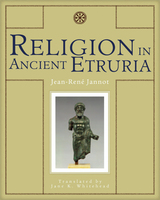
Provocative insights and thoughtful discussions contribute to an understanding of the prophetic nature of Etruscan culture. Jannot investigates the elaborate systems of defining space and time that so distinctly characterize this ancient society. Religion in Ancient Etruria offers a unique perspective that illuminates the origins of some of our own "modern" religious beliefs.
This updated edition includes more than 100 illustrations that demonstrate early temples, statues, mirrors, tablets, and sculptures.
1998 French edition, Picard
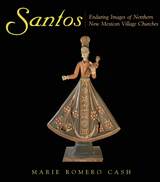
Along with photographer Jack Parsons, Marie Romero Cash visited every church in the region and documented, identified, and measured each santos. Together they photographed more than 500 pieces, including 19 moradas (places of worship for Penitentes) and the Archdiocese of Santa Fe Collection housed at the Museum of International Folk Art.
Cash's extensive research into these formerly "anonymous" artisans fills a gap in the study of this unique form, making Santos indispensable for art historians and the general reader interested in the culture and art of the American Southwest.
Ponder questions of the united monarchy under Saul and David in light of current historical and archaeological evidence
Reconstructing the emergence of the Israelite monarchy involves interpreting historical research, approaching questions of ancient state formation, synthesizing archaeological research from sites in the southern Levant, and reexamining the biblical traditions of the early monarchy embedded in the books of Samuel and Kings. Integrating these approaches allows for a nuanced and differentiated picture of one of the most crucial periods in the history of ancient Israel. Rather than attempting to harmonize archaeological data and biblical texts or to supplement the respective approach by integrating only a portion of data stemming from the other, both perspectives come into their own in this volume presenting the results of an interdisciplinary Tübingen–Tel Aviv Research Colloquium.
Features:
- Essays on Israel's monarchy by experts in biblical archaeology and biblical studies
- Methods for integrating archaeology and biblical traditions in reconstructing ancient Israel's history
- New research on the sociopolitical process of state formation in Israel and Judah
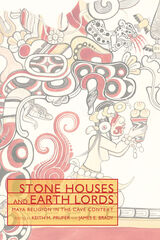
Demonstrating the importance of these subterranean spaces to Maya archaeology, contributors provide interpretations of archaeological remains that yield insights into Maya ritual and cosmology. Compiling the best current scholarship in this fast-growing area of research, Stone Houses and Earth Lords is a vital reference for Mayanists, Mesoamerican specialists, and others interested in the human use of caves in the New World. Contributors include: Juan Luis Bonor, James E. Brady, Robert Burnett, Allan B. Cobb, Pierre Robert Colas, Cesar Espinosa, Sergio Garza, David M. Glassman, Christina T. Halperin, Amalia Kenward, Andrew Kindon, Patricia McAnany, Christopher Morehart, Holley Moyes, Vanessa A. Owen, Shankari Patel, Polly Peterson, Keith M. Prufer, Timothy. W. Pugh, Frank Saul, Julie Saul, Ann M. Scott, Andrea Stone, and Vera Tiesler.
From the veils of the first-century Jewish temple, to the Orthodox iconostasis, to the tramezzi of Renaissance Italy, screens of various shapes, sizes, and materials have been used to separate spaces and order communities in religious buildings. Drawn from papers presented at a recent Dumbarton Oaks Byzantine Studies symposium, the contributors to this volume use a variety of perspectives to approach the history of religious screens and examine the thresholds that they mark. Focusing on the Middle Ages and Renaissance in the East and West, the volume includes discussions of screens in Egypt, Byzantium, the Gothic West and Italy. Some authors argue that screens, and particularly the one marking the threshold between the sanctuary/choir and nave, were conduits rather than barriers. Other authors emphasize the critical role of screens in dividing the laity and clergy, men and women, the pure and impure.
This volume provides new research on the history of religious screen and important insights into the many ways in which the sacred and profane are separated within ecclesiastical contexts.
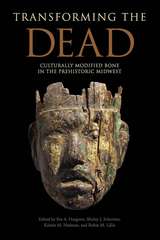
Most research addressing modified human bone has focused on cut marks and trauma associated with warfare, trophy taking, and burial practices. The editors and contributors of Transforming the Dead document the varied and often overlooked ways that human bone was intentionally modified through drilling, incising, cutting, and polishing for utilitarian, ornamental, spiritual, or ritual use. Examples include bracelets and gorgets to be worn, as well as musical rasps, pipe stems, masks, and protective talismans. The form and function of these objects are not unusual; their construction from the remains of “another” sets them apart.
Through a flexible but systematic analysis of the archaeological record, the contributors bring into focus how the careful selection, modification, and retention of particular bones or body parts of an individual after death offer insights into concepts of personhood, the body, life, and death among the prehistoric Native Americans in the Midwest.
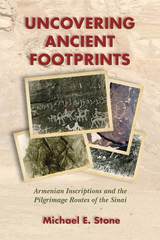
Explore pilgrimage routes, epigraphy, and the history of writing with an expert guide
From the late 1970s through 1982, Michael E. Stone conducted a number of expeditions to the Sinai peninsula, searching for ancient inscriptions. In this book Stone describes his search, crowned by the discovery of the most ancient Armenian inscriptions known. Here Stone describes not only the inscriptions discovered along his journeys but also the Sinai, its past and present, its human inhabitants, its flora and fauna, and its history. Though once common, well-informed travel books to the Middle East with a broad academic interest and a specific focus have become rare. Stone’s diary of his expeditions in the Sinai fill this gap with vivid descriptions, poetry, and illustrations.
Features
- An account of five expeditions into the Sinai
- Thirteen poems written by Stone
- Twenty-six figures and five maps
This book discusses the history, topography, and urban development of Corinth with special attention to civic and private religious practices in the Roman colony. Expert analysis of the latest archaeological data is coupled with consideration of what can be known about the emergence and evolution of religions in Corinth. Several scholars consider specific aspects of archaeological evidence and ask how enhanced knowledge of such topics as burial practice, water supply, and city planning strengthens our understanding of religious identity and practice in the ancient city. This volume seeks to gain insight into the nature of the Greco-Roman city visited by Paul, and the ways in which Christianity gradually emerged as the dominant religion.
This is a collaborative effort by scholars of archaeology, Greco-Roman studies, and early Christian literature who met at Harvard University in January 2002. It is the third in a series of volumes on ancient cities utilizing an interdisciplinary approach to understand urban life in ancient times. The earlier books are Ephesos, Metropolis of Asia (1995) and Pergamon: Citadel of the Gods (1998).
Roman women were the procreators and nurturers of life, both in the domestic world of the family and in the larger sphere of the state. Although deterred from participating in most aspects of public life, women played an essential role in public religious ceremonies, taking part in rituals designed to ensure the fecundity and success of the agricultural cycle on which Roman society depended. Thus religion is a key area for understanding the contributions of women to Roman society and their importance beyond their homes and families.
In this book, Sarolta A. Takács offers a sweeping overview of Roman women's roles and functions in religion and, by extension, in Rome's history and culture from the republic through the empire. She begins with the religious calendar and the various festivals in which women played a significant role. She then examines major female deities and cults, including the Sibyl, Mater Magna, Isis, and the Vestal Virgins, to show how conservative Roman society adopted and integrated Greek culture into its mythic history, artistic expressions, and religion. Takács's discussion of the Bona Dea Festival of 62 BCE and of the Bacchantes, female worshippers of the god Bacchus or Dionysus, reveals how women could also jeopardize Rome's existence by stepping out of their assigned roles. Takács's examination of the provincial female flaminate and the Matres/Matronae demonstrates how women served to bind imperial Rome and its provinces into a cohesive society.
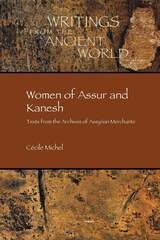
Vivid sources for reconstructing the lives of Assyrian women
In this collection Cécile Michel translates into English texts related to wives and daughters of merchants and to their activities in nineteenth-century BCE Aššur and Kaneš. Discovered in excavations of the Old Assyrian private archives at Kültepe (ancient Kaneš) in Central Anatolia, these letters sent from Aššur reflect the preeminent role of Assyrian women within the family and in the domestic economy, as well as their contribution to long-distance trade. Contracts and other legal texts excavated at Kültepe attest to Assyrian and Anatolian women as parties in marriage and divorce contracts, last wills, loans, and purchase contracts. These unique finds paint a vivid portrait of women who aspire to be socially respected and provide a rare opportunity to reconstruct their daily lives as both businesswomen and housewives.
Features
- More than three hundred letters and documents transliterated and translated with commentary
- An overview of the study of women and gender in Assyriology
- A reconstruction of women's roles as textile producers, investors, and creditors within a long-distance commercial network
Cécile Michel is Senior Researcher at the National Center for Scientific Research (CNRS, France) and Professor at Hamburg University (Germany). She is a member of the international group of scholars in charge of the decipherment of the 23,000 tablets found at Kültepe (ancient Kaneš) and of the Kültepe archaeological team. She is the coeditor of and contributor to The Role of Women in Work and Society in the Ancient Near East (2016), Textile Terminologies from the Orient to the Mediterranean and Europe, 1000 BC to 1000 AD (2017), and Mathematics, Administrative and Economic Activities in Ancient Worlds (2020).
READERS
Browse our collection.
PUBLISHERS
See BiblioVault's publisher services.
STUDENT SERVICES
Files for college accessibility offices.
RECENTLY PUBLISHED




UChicago Accessibility Resources
home | accessibility | search | about | contact us
BiblioVault ® 2001 - 2024
The University of Chicago Press