
 A SCHOLARLY BOOK REPOSITORY
Why have humans repeatedly devoted immense intellectual energy to inventing writing? In world history, writing was independently created four times—by the Sumerians, Egyptians, Chinese, and Mayans. These traditions developed universal scripts, systems of symbols theoretically capable of recording any utterance in the spoken language. On this basis, a long-standing scholarly view has held that the origins of writing are inseparable from the rise of states and bureaucracies.
However, this book turns our attention to another trajectory. Between 1700 and 1900, prophets and shamans in Native American societies devised “bounded” forms of writing. Unlike universal scripts, these were not intended to capture the entirety of speech. Instead, they served a precise function: to ensure the faithful transmission of ritual discourses within ceremonial frameworks. Their principles of notation differed profoundly from those of the great phonographic traditions.
Pierre Déléage’s analysis not only illuminates these overlooked episodes in the history of writing but also advances a methodological shift: rather than treating selective scripts as “failed” or “incomplete,” he interprets them on their own terms. In doing so, he opens up a broader framework for understanding writing as a diverse cultural practice, one that can emerge outside of state power, bureaucracy, or universal phonographic systems.
Now published in English translation, Inventing Writing makes the work of a leading French scholar available to new readers. It offers a groundbreaking perspective: writing does not emerge only as a universal technology of language, but also as a bounded tool shaped by ritual, institution, and culture.
Authorial invention in the Middle Ages is the base of a national tradition that English writers in the Renaissance saw as stable and capable of emulating the canons of classical languages and the Italian and French vernaculars. In Invention and Authorship in Medieval England, Robert R. Edwards brings new interpretive perspectives to Walter Map, Marie de France, John Gower, Geoffrey Chaucer, Thomas Hoccleve, and John Lydgate. He offers a critical reading of key moments that define the emergence of medieval English authorship by showing how writers adapt the commonplaces of authorship to define themselves and their works externally and to construct literary meaning internally.

The school of Greek philosopher Epicurus, which became known as the Garden, famously put great stock in happiness and pleasure. As a philosophical community, and a way of seeing the world, Epicureanism had a centuries-long life in Athens and Rome, as well as across the Mediterranean.
The Invention and Gendering of Epicurusstudies how the Garden's outlook on pleasure captured Greek and Roman imaginations---particularly among non-Epicureans---for generations after its legendary founding. Unsympathetic sources from disparate eras generally focus not on historic personages but on the symbolic Epicurean. And yet the traditions of this imagined Garden, with its disreputable women and unmanly men, give us intermittent glimpses of historical Epicureans and their conceptions of the Epicurean life.
Pamela Gordon suggests how a close hearing and contextualization of anti-Epicurean discourse leads us to a better understanding of the cultural history of Epicureanism. Her primary focus is on sources hostile to the Garden, but her Epicurean-friendly perspective is apparent throughout. Her engagement with ancient anti-Epicurean texts makes more palpable their impact on modern responses to the Garden.
Intended both for students and for scholars of Epicureanism and its response, the volume is organized primarily according to the themes common among Epicurus' detractors. It considers the place of women in Epicurean circles, as well as the role of Epicurean philosophy in Homer and other writers.
The act of inventing relates to the process of inquiry, to creativity, to poetic and aesthetic invention.
Building on the work of rhetoricians, philosophers, linguists, and theorists in other disciplines, Karen Burke LeFevre challenges a widely-held view of rhetorical invention as the act of an atomistic individual. She proposes that invention be viewed as a social act, in which individuals interact dialectically with society and culture in distinctive ways.
Even when the primary agent of invention is an individual, invention is pervasively affected by relationships of that individual to others through language and other socially shared symbol systems. LeFevre draws implications of a view of invention as a social act for writers, researchers, and teachers of writing.
Henry Petroski’s previous bestsellers have delighted readers with intriguing stories about the engineering marvels around us, from the lowly pencil to the soaring suspension bridge. In this book, Petroski delves deeper into the mystery of invention, to explore what everyday artifacts and sophisticated networks can reveal about the way engineers solve problems.
Engineering entails more than knowing the way things work. What do economics and ecology, aesthetics and ethics, have to do with the shape of a paper clip, the tab of a beverage can, the cabin design of a turbojet, or the course of a river? How do the idiosyncrasies of individual engineers, companies, and communities leave their mark on projects from Velcro® to fax machines to waterworks? Invention by Design offers an insider’s look at these political and cultural dimensions of design and development, production and construction.
Readers unfamiliar with engineering will find Petroski’s enthusiasm contagious, whether the topic is the genesis of the Ziploc® baggie or the averted collapse of Manhattan’s sleekest skyscraper. And those who inhabit the world of engineering will discover insights to challenge their customary perspective, whether their work involves failure analysis, systems design, or public relations. Written with the flair that readers have come to expect from his books, Invention by Design reaffirms Petroski as the master explicator of the principles and processes that turn thoughts into the many things that define our made world.
This is the first empirical, mixed-methods study of copyright issues that speaks to writing specialists and legal scholars about the complicated intersections of rhetoric, technology, copyright law, and writing for the Internet. Martine Courant Rife opens up new conversations about how invention and copyright work together in the composing process for digital writers and how this relationship is central to contemporary issues in composition pedagogy and curriculum.
In this era of digital writing and publishing, composition and legal scholars have identified various problems with writers’ processes and the law’s construction of textual ownership, such as issues of appropriation, infringement, and fair use within academic and online contexts. Invention, Copyright, and Digital Writing unpacks digital writers’ complex perceptions of copyright, revealing how it influences what they choose to write and how it complicates their work. Rife uses quantitative and qualitative approaches and focuses on writing as a tool and a technology-mediated activity, arguing the copyright problem is about not law but invention and the attendant issues of authorship.
Looking at copyright and writing through a rhetorical lens, Rife leverages the tools and history of rhetoric to offer insights into how some of our most ancient concepts inform our understanding of the problems copyright law creates for writers. In this innovative study that will be of interest to professional and technical writers, scholars and students of writing and rhetoric, and legal professionals, Rife offers possibilities for future research, teaching, curriculum design, and public advocacy in regard to composition and changing copyright laws.
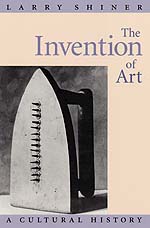
With The Invention of Art, Larry Shiner challenges our conventional understandings of art and asks us to reconsider its history entirely, arguing that the category of fine art is a modern invention—that the lines drawn between art and craft resulted from key social transformations in Europe during the long eighteenth century.
A gulf of centuries separates the Byzantine Empire from the academic field of Byzantine studies. This book offers a new approach to the history of Byzantine scholarship, focusing on the attraction that Byzantium held for Early Modern Europeans and challenging the stereotype that they dismissed the Byzantine Empire as an object of contempt.
The authors in this book focus on how and why the Byzantine past was used in Early Modern Europe: to diagnose cultural decline, to excavate the beliefs and practices of early Christians, to defend absolutism or denounce tyranny, and to write strategic ethnography against the Ottomans. By tracing Byzantium’s profound impact on everything from politics to painting, this book shows that the empire and its legacy remained relevant to generations of Western writers, artists, statesmen, and intellectuals as they grappled with the most pressing issues of their day.
Refuting reductive narratives of absence or progress, this book shows how “Byzantium” underwent multiple overlapping and often discordant reinventions before the institutionalization of “Byzantine studies” as an academic discipline. As this book suggests, it was precisely Byzantium’s ambiguity—as both Greek and Roman, ancient and medieval, familiar and foreign—that made it such a vibrant and vital part of the Early Modern European imagination.
Clearly, they did not go willingly. As Michael Perelman shows, they were forced into the factories with the active support of the same economists who were making theoretical claims for capitalism as a self-correcting mechanism that thrived without needing government intervention. Directly contradicting the laissez-faire principles they claimed to espouse, these men advocated government policies that deprived the peasantry of the means for self-provision in order to coerce these small farmers into wage labor. To show how Adam Smith and the other classical economists appear to have deliberately obscured the nature of the control of labor and how policies attacking the economic independence of the rural peasantry were essentially conceived to foster primitive accumulation, Perelman examines diaries, letters, and the more practical writings of the classical economists. He argues that these private and practical writings reveal the real intentions and goals of classical political economy—to separate a rural peasantry from their access to land.
This rereading of the history of classical political economy sheds important light on the rise of capitalism to its present state of world dominance. Historians of political economy and Marxist thought will find that this book broadens their understanding of how capitalism took hold in the industrial age.
Wagner breaks new ground by arguing that culture arises from the dialectic between the individual and the social world. Rooting his analysis in the relationships between invention and convention, innovation and control, and meaning and context, he builds a theory that insists on the importance of creativity, placing people-as-inventors at the heart of the process that creates culture. In an elegant twist, he shows that this very process ultimately produces the discipline of anthropology itself.
Tim Ingold’s foreword to the new edition captures the exhilaration of Wagner’s book while showing how the reader can journey through it and arrive safely—though transformed—on the other side.

Dolores del Río first came to Hollywood from Mexico in 1925 and within a year had become an international star for her role in Raoul Walsh's 1926 film What Price Glory. She would go on to work with Hollywood’s top directors, including John Ford and King Vidor, and star opposite such leading men as Henry Fonda, Fred Astaire, Orson Welles (with whom she had a scandalous affair), and Elvis Presley. Voted by Photoplay magazine in 1933 as having "the most perfect feminine figure in Hollywood," del Río was billed as one of cinema’s most "exotic" and "aristocratic" beauties. This image-carefully crafted by her producers, her studio publicists, and by del Río herself-reveals many fascinating insights into Hollywood’s evolving attitudes toward race and femininity.
In The Invention of Dolores del Río, Joanne Hershfield explores the intersection of ethnicity, gender, and stardom in American popular culture through the lens of del Río’s successful and unusually lengthy career, which lasted until the 1960s. Hershfield offers close readings of del Río’s films—discussing in detail the roles she played, her costumes and makeup, the music and mise-en-scène, advertising, publicity, and reviews—that provide a nuanced understanding of how Hollywood constructed del Río as an exotic commodity and blunted the inherent challenge her sexual and ethnic image posed to both prevailing standards of white femininity and widespread injunctions against miscegenation. Throughout this astute and imaginative case study, Hershfield looks at del Río’s Hollywood films in relation to shifting ideologies about nationality, gender, and race between the 1920s and 1960s, offering an important contribution to the debate surrounding Hollywood’s ability to both reflect the nation’s racial and sexual obsessions and influence its perceptions about ethnic and gender identity.
Who invented God? When, why, and where? Thomas Römer seeks to answer these questions about the deity of the great monotheisms—Yhwh, God, or Allah—by tracing Israelite beliefs and their context from the Bronze Age to the end of the Old Testament period in the third century BCE.
That we can address such enigmatic questions at all may come as a surprise. But as Römer makes clear, a wealth of evidence allows us to piece together a reliable account of the origins and evolution of the god of Israel. Römer draws on a long tradition of historical, philological, and exegetical work and on recent discoveries in archaeology and epigraphy to locate the origins of Yhwh in the early Iron Age, when he emerged somewhere in Edom or in the northwest of the Arabian peninsula as a god of the wilderness and of storms and war. He became the sole god of Israel and Jerusalem in fits and starts as other gods, including the mother goddess Asherah, were gradually sidelined. But it was not until a major catastrophe—the destruction of Jerusalem and Judah—that Israelites came to worship Yhwh as the one god of all, creator of heaven and earth, who nevertheless proclaimed a special relationship with Judaism.
A masterpiece of detective work and exposition by one of the world’s leading experts on the Hebrew Bible, The Invention of God casts a clear light on profoundly important questions that are too rarely asked, let alone answered.
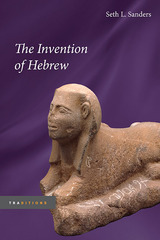
Seth L. Sanders connects the Bible's distinctive linguistic form--writing down a local spoken language--to a cultural desire to speak directly to people, summoning them to join a new community that the text itself helped call into being. Addressing the people of Israel through a vernacular literature, Hebrew texts reimagined their audience as a public. By comparing Biblical documents with related ancient texts in Hebrew, Ugaritic, and Babylonian, this book shows Hebrew's distinctiveness as a self-conscious political language. Illuminating the enduring stakes of Biblical writing, Sanders demonstrates how Hebrew assumed and promoted a source of power previously unknown in written literature: "the people" as the protagonist of religion and politics.
“Heterosexuality,” assumed to denote a universal sexual and cultural norm, has been largely exempt from critical scrutiny. In this boldly original work, Jonathan Ned Katz challenges the common notion that the distinction between heterosexuality and homosexuality has been a timeless one. Building on the history of medical terminology, he reveals that as late as 1923, the term “heterosexuality” referred to a "morbid sexual passion," and that its current usage emerged to legitimate men and women having sex for pleasure. Drawing on the works of Sigmund Freud, James Baldwin, Betty Friedan, and Michel Foucault, The Invention of Heterosexuality considers the effects of heterosexuality’s recently forged primacy on both scientific literature and popular culture.
“Lively and provocative.”—Carol Tavris, New York Times Book Review
“A valuable primer . . . misses no significant twists in sexual politics.”—Gary Indiana, Village Voice Literary Supplement
“One of the most important—if not outright subversive—works to emerge from gay and lesbian studies in years.”—Mark Thompson, The Advocate
For much of history, strangers were routinely classified as barbarians and inferiors, seldom as fellow human beings. The notion of a common humanity was counterintuitive and thus had to be invented. Siep Stuurman traces evolving ideas of human equality and difference across continents and civilizations from ancient times to the present.
Despite humans’ deeply ingrained bias against strangers, migration and cultural blending have shaped human experience from the earliest times. As travelers crossed frontiers and came into contact with unfamiliar peoples and customs, frontier experiences generated not only hostility but also empathy and understanding. Empires sought to civilize their “barbarians,” but in all historical eras critics of empire were able to imagine how the subjected peoples made short shrift of imperial arrogance.
Drawing on the views of a global mix of thinkers—Homer, Confucius, Herodotus, the medieval Muslim scholar Ibn Khaldun, the Haitian writer Antenor Firmin, the Filipino nationalist Jose Rizal, and more—The Invention of Humanity surveys the great civilizational frontiers of history, from the interaction of nomadic and sedentary societies in ancient Eurasia and Africa, to Europeans’ first encounters with the indigenous peoples of the New World, to the Enlightenment invention of universal “modern equality.” Against a backdrop of two millennia of thinking about common humanity and equality, Stuurman concludes with a discussion of present-day debates about human rights and the “clash of civilizations.”
Most economists believe that growth is the surest path to better lives. This has proven to be one of humanity’s most powerful and dangerous ideas. It shapes policy across the globe, but it fatally undermines the natural ecosystems necessary to sustain human life. How did we get here? In The Invention of Infinite Growth, environmental historian Christopher F. Jones takes us through two hundred and fifty years of economic thinking to examine the ideal of growth, its powerful influence, and the crippling burdens many decisions made in its name have placed on us all. Jones argues that the pursuit of growth has never reflected its costs, because economists downplay environmental degradation. What’s worse, skyrocketing inequality and diminishing improvements in most people’s well-being mean growth too often delivers too little for too many. Jones urges economists to engage more broadly with other ways of thinking, as well as with citizens and governments to recognize and slow infinite growth’s impact on the real world.
Both accessible and eye-opening, The Invention of Infinite Growth offers hope for the future. Humans have not always believed that economic growth could or should continue, and so it is possible for us to change course. We can still create new ideas about how to promote environmental sustainability, human welfare, and even responsible growth, without killing the planet and ourselves.

Jane Ellen Harrison (1850-1928) is the most famous female Classicist in history, the author of books that revolutionized our understanding of Greek culture and religion. A star in the British academic world, she became the quintessential Cambridge woman--as Virginia Woolf suggested when, in A Room of One's Own, she claims to have glimpsed Harrison's ghost in the college gardens.
This lively and innovative portrayal of a fascinating woman raises the question of who wins (and how) in the competition for academic fame. Mary Beard captures Harrison's ability to create her own image. And she contrasts her story with that of Eugénie Sellers Strong, a younger contemporary and onetime intimate, the author of major work on Roman art and once a glittering figure at the British School in Rome--but who lost the race for renown. The setting for the story of Harrison's career is Classical scholarship in this period--its internal arguments and allegiances and especially the influence of the anthropological strain most strikingly exemplified by Sir James Frazer. Questioning the common criteria for identifying intellectual "influence" and "movements," Beard exposes the mythology that is embedded in the history of Classics. At the same time she provides a vivid picture of a sparkling intellectual scene. The Invention of Jane Harrison offers shrewd history and undiluted fun.
Law is a specific form of social regulation distinct from religion, ethics, and even politics, and endowed with a strong and autonomous rationality. Its invention, a crucial aspect of Western history, took place in ancient Rome. Aldo Schiavone, a world-renowned classicist, reconstructs this development with clear-eyed passion, following its course over the centuries, setting out from the earliest origins and moving up to the threshold of Late Antiquity.
The invention of Western law occurred against the backdrop of the Roman Empire's gradual consolidation—an age of unprecedented accumulation of power which transformed an archaic predisposition to ritual into an unrivaled technology for the control of human dealings. Schiavone offers us a closely reasoned interpretation that returns us to the primal origins of Western legal machinery and the discourse that was constructed around it—formalism, the pretense of neutrality, the relationship with political power. This is a landmark work of scholarship whose influence will be felt by classicists, historians, and legal scholars for decades.
Li Yu (1610–1680) was a brilliant comic writer and entertainer, a thoroughgoing professional whose life was in his work-plays, stories, a novel, criticism, essays, and poems. Patrick Hanan places him in the society of his day, where even his precarious livelihood, his constant search for patronage, did not dampen his versatility, his irreverent wit, or his jocund spirit. Li was also an epicure, an inventor, a pundit, and a designer of houses and gardens. He was an exceptional figure in Chinese culture for two reasons: his disregard of the authority of tradition, and his dedication to the cause of comedy.
Hanan uses the term “invention” in his title in several ways: Li Yu’s invention of himself, his public image-his originality and inventiveness in a multitude of fields and the literary products of his inventiveness. With expert and entertaining translations Hanan explores the key features of Li Yu’s work, summarizing, describing, and quoting extensively to convey Li’s virtuosity, his unconventionality, his irreverence, his ribaldry. This is a splendid introduction to the art and persona of a Chinese master of style and ingenuity.
Focusing on typically marginalized historical actors, including municipal functionaries and the urban poor, The Invention of Madness shifts our attention from the elite desire for modern medical care to the ways in which psychiatric discourses were implemented and redeployed in the midst of everyday life. New meanings and practices of madness, Baum argues, were not just imposed on the Beijing public but continuously invented by a range of people in ways that reflected their own needs and interests. Exhaustively researched and theoretically informed, The Invention of Madness is an innovative contribution to medical history, urban studies, and the social history of twentieth-century China.

The invention of photography 150 years ago changed profoundly the way we learn about the world. Photographs can make the distant and exotic familiar, and the familiar strange; they can rewrite history, challenge aesthetic notions, and arrest time.
In this volume eight scholars share their insights concerning the impact of photography on their fields, illustrating their essays with a rich and varied selection of photographs from the resources of Harvard, Radcliffe, and the collection of Harrison D. Horblit. The fields range from art history to anthropology to medicine; among the 96 photographs are nineteenth-century views of Florence and Beirut, impressionist landscapes, Civil War battlefield scenes, family portraits, haunting studies of inmates of the mental hospital of Sainte-Anne. As Eugenia Parry Janis says in her introductory essay, photographs of “science, reportage, physiognomy of illness and health, visions of modern cities in war time or of ancient ruins, even a shred of cloth isolated under the camera eye, all increase our learning by utterly removing things from the grasp of actuality…we begin to ponder on all that is known, and how we know it, and what to believe because of it.”

The underlying concern of these poems is the very notion of secrecy, and in his explorations Citino investigates the lives, and credentials, of our saints—both secular and otherworldly. Ramses the Great, the prophet Hosea, the Roman emperor Vespasian, Caravaggio, the Wicked Witch of the West, Padre Pio, Mario Lanza, and Princess Diana are among the larger-than-life personages materializing on these pages. Continually in these poems, the past is read by light of the present and the present from perspectives of the past.
Accessible yet ambitious, and treating all of history as the concern of those living today, these poems seek to measure the span of our lives and the distance that separates one life from another.
"A crucial contribution to our understanding of the tortured and tortuous relationship between men who love men, and the Christian religion—indeed, between our kind and Western society as a whole. . . . The true power of Jordan's study is that it gives back to gay and lesbian people our place in history and that it places before modern theologians and church leaders a detailed history of fear, inconsistency, hatred and oppression that must be faced both intellectually and pastorally."—Michael B. Kelly, Screaming Hyena
"[A] detailed and disturbing tour through the back roads of medieval Christian thought."—Dennis O'Brien, Commonweal
"Being gay and being Catholic are not necessarily incompatible modes of life, Jordan argues. . . . Compelling and deeply learned."—Virginia Quarterly Review
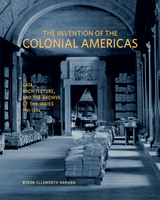
The Invention of the Colonial Americas is an architectural history and media-archaeological study of changing theories and practices of government archives in Enlightenment Spain. It centers on an archive created in Seville for storing Spain’s pre-1760 documents about the New World. To fill this new archive, older archives elsewhere in Spain—spaces in which records about American history were stored together with records about European history—were dismembered. The Archive of the Indies thus constructed a scholarly apparatus that made it easier to imagine the history of the Americas as independent from the history of Europe, and vice versa.
In this meticulously researched book, Byron Ellsworth Hamann explores how building layouts, systems of storage, and the arrangement of documents were designed to foster the creation of new knowledge. He draws on a rich collection of eighteenth-century architectural plans, descriptions, models, document catalogs, and surviving buildings to present a literal, materially precise account of archives as assemblages of spaces, humans, and data—assemblages that were understood circa 1800 as capable of actively generating scholarly innovation.

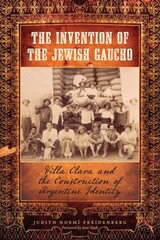
By the mid-twentieth century, Eastern European Jews had become one of Argentina's largest minorities. Some represented a wave of immigration begun two generations before; many settled in the province of Entre Ríos and founded an agricultural colony. Taking its title from the resulting hybrid of acculturation, The Invention of the Jewish Gaucho examines the lives of these settlers, who represented a merger between native cowboy identities and homeland memories.
The arrival of these immigrants in what would be the village of Villa Clara coincided with the nation's new sense of liberated nationhood. In a meticulous rendition of Villa Clara's social history, Judith Freidenberg interweaves ethnographic and historical information to understand the saga of European immigrants drawn by Argentine open-door policies in the nineteenth century and its impact on the current transformation of immigration into multicultural discourses in the twenty-first century. Using Villa Clara as a case study, Freidenberg demonstrates the broad power of political processes in the construction of ethnic, class, and national identities. The Invention of the Jewish Gaucho draws on life histories, archives, material culture, and performances of heritage to enhance our understanding of a singular population—and to transform our approach to social memory itself.
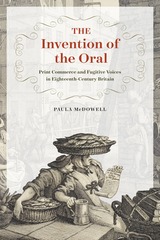
Drawing on an impressive array of sources including travel narratives, elocution manuals, theological writings, ballad collections, and legal records, McDowell re-creates a world in which everyone from fishwives to philosophers, clergymen to street hucksters, competed for space and audiences in taverns, marketplaces, and the street. She argues that the earliest positive efforts to theorize "oral tradition," and to depict popular oral culture as a culture (rather than a lack of culture), were prompted less by any protodemocratic impulse than by a profound discomfort with new cultures of reading, writing, and even speaking shaped by print.
Challenging traditional models of oral versus literate societies and key assumptions about culture’s ties to the spoken and the written word, this landmark study reorients critical conversations across eighteenth-century studies, media and communications studies, the history of the book, and beyond.
Why are there restaurants? Why would anybody consider eating to be an enjoyable leisure activity or even a serious pastime? To find the answer to these questions, we must accompany Rebecca Spang back to France in the eighteenth century, when a restaurant was not a place to eat but a thing to eat: a quasi-medicinal bouillon that formed an essential element of prerevolutionary France's nouvelle cuisine. This is a book about the French Revolution in taste and of the table--a book about how Parisians invented the modern culture of food, thereby changing their own social life and that of the world.
During the 1760s and 1770s, those who were sensitive and supposedly suffering made public show of their delicacy by going to the new establishments known as "restaurateurs' rooms" and there sipping their bouillons. By the 1790s, though, the table was variously seen as a place of decadent corruption or democratic solidarity. The Revolution's tables were sites for extending frugal, politically correct hospitality, and a delicate appetite was a sign of counter-revolutionary tendencies. The restaurants that had begun as purveyors of health food became symbols of aristocratic greed. In the early nineteenth century, however, the new genre of gastronomic literature worked within the strictures of the Napoleonic police state to transform the notion of restaurants and to confer star status upon oysters and champagne. Thus, the stage was set for the arrival of British and American tourists keen on discovering the mysteries of Frenchness in the capital's restaurants. From restoratives to Restoration, Spang establishes the restaurant at the very intersection of public and private in French culture--the first public place where people went to be private.
Winner of the Louis Gottschalk Prize
Winner of the Thomas J. Wilson Memorial Prize
“Witty and full of fascinating details.”
—Los Angeles Times
Why are there restaurants? Why would anybody consider eating alongside perfect strangers in a loud and crowded room to be an enjoyable pastime? To find the answer, Rebecca Spang takes us back to France in the eighteenth century, when a restaurant was not a place to eat but a quasi-medicinal bouillon not unlike the bone broths of today.
This is a book about the French revolution in taste—about how Parisians invented the modern culture of food, changing the social life of the world in the process. We see how over the course of the Revolution, restaurants that had begun as purveyors of health food became symbols of aristocratic greed. In the early nineteenth century, the new genre of gastronomic literature worked within the strictures of the Napoleonic state to transform restaurants yet again, this time conferring star status upon oysters and champagne.
“An ambitious, thought-changing book…Rich in weird data, unsung heroes, and bizarre true stories.”
—Adam Gopnik, New Yorker
“[A] pleasingly spiced history of the restaurant.”
—New York Times
“A lively, engrossing, authoritative account of how the restaurant as we know it developed…Spang is…as generous in her helpings of historical detail as any glutton could wish.”
—The Times
Oyewumi traces the misapplication of Western, body-oriented concepts of gender through the history of gender discourses in Yoruba studies. Her analysis shows the paradoxical nature of two fundamental assumptions of feminist theory: that gender is socially constructed and that the subordination of women is universal. The Invention of Women demonstrates, to the contrary, that gender was not constructed in old Yoruba society, and that social organization was determined by relative age.
A meticulous historical and epistemological account of an African culture on its own terms, this book makes a persuasive argument for a cultural, context-dependent interpretation of social reality. It calls for a reconception of gender discourse and the categories on which such study relies. More than that, the book lays bare the hidden assumptions in the ways these different cultures think. A truly comparative sociology of an African culture and the Western tradition, it will change the way African studies and gender studies proceed.

In this ambitious study, Tomoko Masuzawa examines the emergence of "world religions" in modern European thought. Devoting particular attention to the relation between the comparative study of language and the nascent science of religion, she demonstrates how new classifications of language and race caused Buddhism and Islam to gain special significance, as these religions came to be seen in opposing terms-Aryan on one hand and Semitic on the other. Masuzawa also explores the complex relation of "world religions" to Protestant theology, from the hierarchical ordering of religions typical of the Christian supremacists of the nineteenth century to the aspirations of early twentieth-century theologian Ernst Troeltsch, who embraced the pluralist logic of "world religions" and by so doing sought to reclaim the universalist destiny of European modernity.

Rodolphe Gasché, one of the world's foremost—and most provocative—authorities on Jacques Derrida, has news for deconstruction's devotees, whose traffic in the terms of “difference” signals privileged access to the most radically chic of intellectual circles: they do not know their Derrida. A deconstruction of the criticism that goes by deconstruction's name, this book reveals the true philosophical nature of Derrida's thought, its debt to the tradition it engages, and its misuse by some of its most fervent admirers.
Gasché's Inventions of Difference explodes the current myth of Derrida's singularity and sets in its place a finely informed sense of the philosopher's genuine accomplishment. Derrida's recent turn from philosophical concerns to matters literary, historical, and political has misled many of his self-styled followers, Gasché contends. Though less overtly philosophical, Derrida's later writings can be properly understood only in relation to a certain philosophical tradition, which Inventions of Difference cogently traces.
Gasché shows that terms like “difference” and “other” are devoid of meaning outside the context of identity, a context that draws not only on Husserl's phenomenology and Heidegger's writings but also on the work of Hegel. By setting forth this affinity with Hegel, Gasché clarifies the philosophical weight and direction of Derrida's recent work and the philosophical engagement of his larger project. His book puts a stop to the loose talk of deconstruction and points to the real rigors and pleasures of knowing Derrida.
Applying interactionist discourse theory to show how we create novel beliefs
Inventive Intercourse: From Rhetorical Conflict to the Ethical Creation of Novel Truth offers a theory of discursive interaction, illustrating how we can understand human communication without resorting to the notion of language. Using the perspective of interactionist discourse theory, author Stephen Yarbrough investigates how we create novel beliefs, beliefs we could not have inferred from our established beliefs.
The volume considers a central dilemma of post-modern thought: If language is a system of conventions and rules that limit what we can say and think, how can we deliberately produce anything truly novel? While postmodernism concludes that linguistic and conceptual change within our incommensurable worlds is driven by contingency and blind mechanical forces, Yarbrough argues that this view is wrong because the notion that language mediates our perception is wrong.
Beginning with philosopher Donald Davidson’s assertion that "there is no such thing as language" in the sense of a system of conventions and rules, Yarbrough develops an interactionist theory of discourse and uses it to revise the major elements of Aristotelian rhetoric to explain how we deliberately invent novel concepts that we come to believe.
Yarbrough suggests that all conceptual change is initiated by a shift in our ethical apperception of elements of a situation and that an ethical change will have emotional consequences. Changes in our emotional responses to things will change the ways we interact with them, he says, and changes in our interaction with things will create new technical relations which we can communicate to others only by altering our habitual shared way of using signs, metaphors, and other tropes.
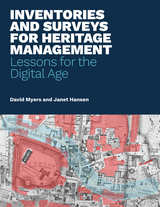
A critical first step in the conservation of cultural heritage is to identify and understand the places we want to protect. Inventories and surveys are essential tools in this effort, and their use in managing national, regional, and local heritage is mandated in heritage-related legislation across the globe. Despite the widespread understanding of the importance of inventories and surveys, however, practical, up-to-date guidance on how they should be created, implemented, and maintained has been substantially lacking—until now.
This publication draws from the Getty Conservation Institute’s ongoing work with heritage inventories and on the Los Angeles Office of Historic Resources’ experience with SurveyLA. It provides technical advice, guidance, and lessons learned for employing inventories and surveys as tools for heritage conservation and management.
The free online edition of this open-access publication is available at www.getty.edu/publications/inventories-and-surveys. Also available are free PDF and EPUB downloads of the book.

The Inventors includes a brief introduction to Char’s life and work, as well as a series of notes on the backstories of the works, which explain allusions that may not be immediately familiar to the English-speaking reader. These new translations stay true to the originals, while at the same time conveying much of the music and beauty of the French poems.
Praise for René Char
“Char, I believe, is a poet who will tower over twentieth-century French poetry.”—George Steiner
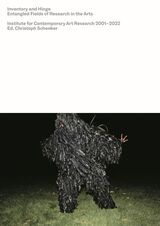
Artistic work connects multiple competencies, areas of knowledge, and ways of life. The Institute for Contemporary Art Research (IFCAR) has made this principle its guiding ethos through organizing research projects in correspondence with this transgressive gesture, manifesting as interdisciplinary, networked knowledge production.
Inventory and Hinge offers an overview of the research projects performed over the last two decades at IFCAR through project descriptions, plentiful illustrations, and, most importantly, links and QR codes that grant access to nearly all publications and websites that were created by the individual projects he discusses.
Although art as research has a long tradition outside of institutions, Inventory and Hinge chronicles IFCAR’s drive to introduce this new discipline and establish a new artistic genre.


In this work of hybrid historiography, Sam Creely modulates the English sentence to map the ways anglophone imperial self-fashioning moves in and out of social coherence, investigating how syntactic requirements reflect colonial history and how the rules of language structure thought. Through scenes including intimate encounters with dye, fabric, and garments, Creely reveals the sexual and racial grammars of empire.
Inventorys takes as its point of departure the voyage, shipwreck, and eventual excavation of the Spanish trade vessel El Nuevo Constante. Animated by the image of sixty thousand pounds of dye bleeding into the Gulf of Mexico, this six-part poetic documentation follows the wreckage of the Constante linguistically, moving among early modern lexicography, and ultimately toward enmeshed histories of catalog, fabrication, and revision.
Inventorys is the winner of the 2022 Omnidawn Poetry Open Book Contest, selected by Shane McCrae.

Part Baudelairian flâneur, an Arcadian shepherd, the speaker in John Isles’s brave new Inverse Sky encounters a fragmented history. It is nineteenth-century California, and the missions are still burning after the Americans establish the Bear Flag Republic; it is the twenty-first century, and the miners of '49 are relegated to a mural in an arcade. Both a loner and a lover, Isles’s pilgrim-poet takes us on a journey where Native Americans are “missing persons” outside a diorama of their ancestors, then sets us adrift in settings ranging from film noir to the clear-cut hills of modern-day California landscapes, under siege but not defeated.
Inverse Sky evokes the paradigm of a shocked and disbelieving child dealing with a broken promise, yet the poems carry within themselves the knowledge that promises will be kept. The only response to broken promises is “to come undone / to come and go in a single breath.” But this is a beginning as well as an end. Each poem becomes a new world—for if there is anything on earth worth loving, it is something made with the world as it has been handed down to us. Inverse Sky is an insistent effort to "love the things not loving back.”


The author also discusses the theory of pencils of circles, and he uses the acquired techniques in a proof of Ptolemy's theorem. In the final chapter, the idea of a group is introduced with applications of group theory to geometry. The author demonstrates the group-theoretic basis for the distinction between Euclidean and Lobachevskian geometry.

Expanding Bourdieu's concepts of cultural field and symbolic capital beyond national boundaries, The Inverted Conquest shows how modernismo originated in Latin America and traveled to Spain, where it provoked a complete renovation of Spanish letters and contributed to a national identity crisis. In the process, described by Latin American writers as a reversal of colonial relations, modernismo wrested literary and cultural authority away from Spain, moving the cultural center of the Hispanic world to the Americas.
Mejias-Lopez further reveals how Spanish American modernistas confronted the racial supremacist claims and homogenizing force of an Anglo-American modernity that defined the Hispanic as un-modern. Constructing a new Hispanic genealogy, modernistas wrote Spain as the birthplace of modernity and themselves as the true bearers of the modern spirit, moved by the pursuit of knowledge, cosmopolitanism, and cultural miscegenation, rather than technology, consumption, and scientific theories of racial purity.
Bound by the intrinsic limits of neocolonial and postcolonial theories, scholarship has been unwilling or unable to explore modernismo's profound implications for our understanding of Western modernities.
Who hasn’t wished for a surefire formula for riches and a ticket to the good life? For three centuries, investment advisers of all kinds, legit and otherwise, have guaranteed that they alone can illuminate the golden pathway to prosperity—despite strong evidence to the contrary. In fact, too often, they are singing a siren song of devastation. And yet we keep listening.
Invested tells the story of how the genre of investment advice developed and grew in the United Kingdom and the United States, from its origins in the eighteenth century through today, as it saturates our world. The authors analyze centuries of books, TV shows, blogs, and more, all promising techniques for amateur investors to master the ways of the market: from Thomas Mortimer’s pathbreaking 1761 work, Every Man His Own Broker, through the Gilded Age explosion of sensationalist investment manuals, the early twentieth-century emergence of a vernacular financial science, and the more recent convergence of self-help and personal finance. Invested asks why, in the absence of evidence that such advice reliably works, guides to the stock market have remained perennially popular. The authors argue that the appeal of popular investment advice lies in its promise to level the playing field, giving outsiders the privileged information of insiders. As Invested persuasively shows, the fantasies sold by these writings are damaging and deceptive, peddling unrealistic visions of easy profits and the certainty of success, while trying to hide the fact that there is no formula for avoiding life’s economic uncertainties and calamities.

Invested examines the perennial and nefarious appeal of financial advice manuals.
Who hasn’t wished for a surefire formula for riches and a ticket to the good life? For three centuries, investment advisers of all kinds, legit and otherwise, have guaranteed that they alone can illuminate the golden pathway to prosperity—despite strong evidence to the contrary. In fact, too often, they are singing a siren song of devastation. And yet we keep listening.
Invested tells the story of how the genre of investment advice developed and grew in the United Kingdom and the United States, from its origins in the eighteenth century through today, as it saturates our world. The authors analyze centuries of books, TV shows, blogs, and more, all promising techniques for amateur investors to master the ways of the market: from Thomas Mortimer’s pathbreaking 1761 work, Every Man His Own Broker, through the Gilded Age explosion of sensationalist investment manuals, the early twentieth-century emergence of a vernacular financial science, and the more recent convergence of self-help and personal finance. Invested asks why, in the absence of evidence that such advice reliably works, guides to the stock market have remained perennially popular. The authors argue that the appeal of popular investment advice lies in its promise to level the playing field, giving outsiders the privileged information of insiders. As Invested persuasively shows, the fantasies sold by these writings are damaging and deceptive, peddling unrealistic visions of easy profits and the certainty of success, while trying to hide the fact that there is no formula for avoiding life’s economic uncertainties and calamities.

Despite the World Bank’s profound impact on economic, political, and social conditions during the post–World War II era, cultural critics who rigorously theorize other institutions of colonialism and globalization have largely ignored the institution. Working to correct this blind spot, Bret Benjamin’s Invested Interests presents the first extended cultural analysis of the World Bank.
In Invested Interests, Benjamin contends that the World Bank has, from its inception, trafficked in culture. From the political context in which the Bank was chartered to its evolution into an interventionist development agency with vast, unchecked powers, Benjamin explores the Bank’s central role in the global dissemination of Fordist-Keynesianism, its conflicted support for nationalism and the nation-state, and its emerging awareness of the relationships between economics and culture. Benjamin argues that the Bank shapes, and is in turn shaped by, historical pressures of the age—most significantly the rise of third world national liberation movements. Reading a broad array of midcentury archival materials, Benjamin examines not only the Bank’s own growing attentiveness to cultural work but also its prominent place in the thinking of such anti-imperialist intellectuals as Aimé Césaire, Frantz Fanon, and Richard Wright.
Benjamin maps the Bank’s contemporary rhetorical maneuvering in the wake of ever-intensifying protests, offering close readings of the World Bank’s corporate literature, the activities of the antiglobalization World Social Forum, and the writings of prominent Bank critic Arundhati Roy, including her novel The God of Small Things.
Deftly investigating the World Bank’s ideological struggles over six decades, Invested Interests develops a conceptually and politically nuanced critique of the Bank as a cultural institution deeply enmeshed in the last century’s historical transformations of imperial power and anti-imperial struggle.
Bret Benjamin is associate professor of English and director of undergraduate studies at the University of Albany, SUNY.

2006 History Division Book Award of the Association for Education in Journalism and Mass Communication,
2006 Frank Luther Mott/Kappa Tau Alpha Communications Award, and
2005 Donald McGannon Award for Social and Ethical Relevance in Communications Policy Research
The public often views television investigative reporting as a watchdog on the government. In fact, some of the centerpiece moments of TV muckraking relied heavily on official sources for inspiration, information, and regulatory protection from critics. At the same time, criticism by government officials and overt threats to regulate the television industry influenced the decision-making and content that went into some of broadcast news's iconic moments.
Chad Raphael's looks at the relationship between journalism and regulation during the celebrated period of muckraking that took place on American television between 1960 and 1975. Raphael offers new insights into the economic, political, and industrial forces that shaped documentaries like Harvest of Shame, Hunger in America, and Banks and the Poor while placing the investigative television documentary into its institutional, regulatory, and cultural context. Throughout, Raphael exposes the complex strands of influence used by government officials to shape--and attack--investigative reporting, and highlights how these tactics created a troubling legacy for the regulation of television news today.
Chapter 10 is available Open Access here (https://www.ncbi.nlm.nih.gov/books/NBK395883)
Investigations in Healthcare Interpreting consists of ten chapters contributed by a broad array of international scholars. They address topics as diverse as the co-construction of medical conversation between interlocutors, healthcare interpretation in Ireland, and how interpreters make requests for clarification in their work. Using a variety of methodological approaches including ethnography, questionnaires, observation, and diary accounts, these scholars report on trials of simultaneous video interpreting in Austrian hospitals; direct, interpreted, and translated healthcare information for Australian deaf people; the interpretation of medical interview questions from English into ASL; and specialized psychological/psychiatric diagnostic tests for deaf and hard of hearing clients. Researchers, practitioners, and students, as well as all healthcare professionals, will find this volume to be an invaluable resource.

The central contribution of Ströker’s investigations is a careful and strict analysis of the relationship between experienced space, Euclidean space, and non-Euclidean spaces. Her study begins with the question of experienced space, inclusive of mood space, space of action and perception, of practical activities and bodily orientations, and ends with the controversies of the proponents of geometric and mathematical understanding of space. Within the context of experienced space, Ströker includes historical discussions of place, topology, depth, perspectivity, homogeneity, orientation, and the questions of empty and full spaces. Her investigation concludes that any strict analysis of space must be founded upon an unavoidable ontology.
Philosophical Investigations of Space addresses a number of methodological controversies. It tests the limitations of a variety of scientific, phenomenological, geometric, and logical methods in order to demonstrate limitations of both methodology and underlying assumption. In addition to the richness of her historical and systematic discussion, Ströker’s work is a model of thoroughly documented philosophical scholarship and conceptual precision.

One of the most well-established relationships in the economics of aging is that between health and wealth. Yet this relationship is also changing in conjunction with a rapidly aging population as well as a broad evolution in how people live later in life.
Building on findings from earlier editions in this National Bureau of Economic Research series, Investigations in the Economics of Aging focuses on the changing financial circumstances of the elderly and the relationship of these circumstances to health and health care. Among the topics addressed are the significance of out-of-pocket health care costs, the effects of inflation on social security, and the impact of the recent financial crisis on Americans’ well-being. Encompassing new data and advances in research methodology, the developments presented in this volume will have important implications for economies worldwide.
A closely annotated translation of Merleau-Ponty’s lecture notes on literary language
Investigations into the Literary Use of Language presents an annotated translation of Maurice Merleau-Ponty’s lecture notes from one of the two courses that he gave during his inaugural year teaching at the Collège de France. In his notes from the concurrent course, The Sensible World and the World of Expression, Merleau-Ponty contends that our embodied perceptual engagement with the sensible world already involves the same spontaneity that underlies cultural expression. Approaching it from the other side, he revisits here the analysis of language that he had undertaken in the unfinished manuscript The Prose of the World.
Focusing on the work of Paul Valéry (1871–1945) and Stendhal (Marie-Henri Beyle, 1783–1842), Merleau-Ponty explores how the spontaneity of literary language sheds light on the relation between lived experience and language more broadly, and how cultural expression remains grounded in embodied perceptual experience in a way that is homologous yet irreducible to it. Specifically, Merleau-Ponty shows how Stendhal had already overcome Valéry’s skepticism concerning literary sincerity by effectively incorporating what the latter called the linguistic “implex”—in effect, language as institution—and thus achieving a “total style” of improvisational spontaneity in which the “conquering function” characteristic of the literary use of language gives shape to an immanent model of political engagement.

College education is one of the most important investments a family will make. But between the viewbooks, websites, insider gossip, and magazine rankings, students and their worried parents face a dizzying array of options. What do the rankings really mean? Is it wise to choose the most prestigious school a student can get into? What are the payoffs of higher education, and, by the way, how do we pay for them?
In a unique approach to these conundrums, an economist and award-winning teacher walks readers through the opportunities, risks, and rewards of heading off to college. Warning against the pitfalls of numerical rankings, Malcolm Getz poses questions to guide a student toward not necessarily the best college but the right one. Famous professors suggest quality--but do they teach undergraduates? Are smaller classes always better? When is a state university the best deal around?
In a concise overview of decades of research, Getz reviews findings on the long-term returns of college education in different careers, from law to engineering, from nursing to financial management. Sorting through personal, professional, and institutional variables, he helps families determine when paying $40,000 a year might make sense, and when it merely buys an expensive rear window decal. He breaks down the formidable admissions game into strategies to improve the odds of acceptance, and he offers tips on tax breaks, subsidized loans, federal grants, 529 accounts, merit scholarships, and much more.
Shrewd and sensible, Investing in College is an invaluable resource and a beacon of sanity for college-bound students and the families who support them.
Investing in Natural Capital presents the results of a workshop held following the second biannual conference of the International Society for Ecological Economics. It focuses on the relation of human development to natural capital, and the relation of natural capital to environmental processes.
Because we are capable of understanding our impact on the environment and the importance of managing it sustainably, humans play a special role in our ecosystem. The book emphasizes the essential connections between natural ecosystems and human socioeconomic systems, and the importance of insuring that both remain resilient. Specific chapters deal with methodology, case material, and policy questions, and offer a thorough exploration of this provocative and important alternative to conventional economics.
In 2004, U.S. consumers spent $5.2 billion purchasing bottled water while the government only invested 5 percent of that amount to purchase critical watersheds, parks, and wildlife refuges-systems vital to clean water and healthy environments. How can we reverse the direction of such powerful economic forces?
A group of dedicated business-people-turned-environmental-entrepreneurs is pioneering a new set of tools for land conservation deals and other market-based strategies. These pragmatic visionaries have already used these methods to protect millions of acres of land and to transform the practices of entire industries. They are transforming the very nature of conservation by making it profitable.
Drawing on his vast experience in both business and land conservation at The Nature Conservancy (TNC), William Ginn offers a practical guide to these innovative methods and a road map to the most effective way to implement them. From conservation investment banking, to emerging markets for nature's goods and services, to new tax incentives that encourage companies to do the "right" thing, Ginn goes beyond the theories to present real-world applications and strategies. And, just as importantly, he looks at the lessons learned from what has not worked, including his own failed efforts in Papua New Guinea and TNC's controversial compatible development approach in Virginia. In an era of dwindling public resources and scarce charitable dollars, these tools reveal a new, and perhaps the only, pathway to achieving biodiversity goals and protecting our lands.
Conservation professionals, students of land conservation, and entrepreneurs interested in green business will find Ginn's tales of high-finance deals involving vast tracts of pristine land both informative and exciting. More than just talk, Investing in Nature will teach you how to think big about land conservation.
With budgets squeezed at every level of government, cost-benefit analysis (CBA) holds outstanding potential for assessing the efficiency of many programs. In this first book to address the application of CBA to social policy, experts examine ten of the most important policy domains: early childhood development, elementary and secondary schools, health care for the disadvantaged, mental illness, substance abuse and addiction, juvenile crime, prisoner reentry programs, housing assistance, work-incentive programs for the unemployed and employers, and welfare-to-work interventions. Each contributor discusses the applicability of CBA to actual programs, describing both proven and promising examples.
The editors provide an introduction to cost-benefit analysis, assess the programs described, and propose a research agenda for promoting its more widespread application in social policy. Investing in the Disadvantaged considers how to face America’s most urgent social needs with shrinking resources, showing how CBA can be used to inform policy choices that produce social value.

Graham’s analysis draws on new data from face-to-face interviews with the managers of over 450 foreign firms operating in two developing countries: Georgia and the Philippines. Diaspora-owned and diaspora-managed firms are better connected than other foreign firms and they use social ties to resolve disputes and influence government policy. At the same time, Graham shows that diaspora-affiliated firms are no more socially responsible than their purely foreign peers—at root, they are profit-seeking enterprises, not development NGOs. Graham identifies implications for policymakers seeking to capture the development potential of diaspora investment and for managers of multinational firms who want to harness diasporans as a source of sustained competitive advantage.
Investing Japan demonstrates that foreign investment is a vital and misunderstood aspect of Japan’s modern economic development. The drive to become a modern industrial power from the 1860s to the 1930s necessitated the adoption and internalization of foreign knowledge. This goal could only be achieved by working within the overarching financial and technological frameworks of Western capitalism. Foreign borrowing, supported by the gold standard, was the crux of Japan’s pre-war capital formation. It simultaneously financed domestic industrial development, the conduct of war, and territorial expansion on the Asian continent. Foreign borrowing also financed the establishment of infrastructure in Japan’s largest cities, the nationalization of railways, the interlinked capital-raising programs of “special banks” and parastatal companies, and the rapid electrification of Japanese industry in the 1920s.
Simon James Bytheway investigates the role played by foreign companies in the Japanese experience of modernization while highlighting their identity as key agents in the processes of industrialization and technology transfer. Investing Japan delivers a complex, multifaceted analysis, intersecting with the histories of formal and informal economic imperialism, diplomacy, war financing, domestic and international financial markets, parastatal and multinational enterprise, and Japan’s “internationalization” vis-à-vis the emerging global market.
Section I considers the experiences of high-income countries, examining the limitations of industrialization for the advancement of women; returns to secondary education for women; and state control of women's education and labor market productivity through the design of tax systems and the public subsidy of children.
The remaining four sections investigate health, education, household structure and labor markets, and measurement issues in low-income countries, including the effect of technological change on transfers of wealth to and from children in India; women's and men's responses to the costs of medical care in Kenya; the effects of birth order and sex on educational attainment in Taiwan; wage returns to schooling in Indonesia and in Cote d'Ivoire; and the increasing prevalence of female-headed households and the correlates of gender differences in wages in Brazil.
Presented here for the first time is the history of Boston's evolution as a center of American money management from early settlement to the twenty-first century. Within a few decades after the Revolution, Bostonians built up an impressive mercantile and industrial economy, and used wealth accrued from the China trade, New England mills, and other ventures to establish the most important stock exchange in America. They also created the “Boston trustee,” a unique professional who managed private fortunes over generations. During the late nineteenth century, Boston financial institutions were renowned as bastions of stability and conservatism in an era of recurrent economic panics and frequent failures.
It was not until the twentieth century that Boston became better known for its role in investment management. In 1924, local financiers created the first mutual fund, an innovation almost a century in the making. After World War II, Boston originated venture capital with the founding of American Research & Development. This was soon followed by the development of private equity, the growth of the mutual fund industry, the pension “revolution” that changed and strengthened money management, the evolution in management of institutional endowments, and the rise of new family offices and hedge funds. The contributions of fiduciaries and investment managers have played an important part in the rise of the “New Boston” and made the city one of the most vibrant financial capitals in the world.
Investment Management in Boston is published in association with Massachusetts Historical Society.
In Investment, Profit, and Tenancy Dennis P. Kehoe defines the economic mentality of upper-class Romans by analyzing the assumptions that Roman jurists in the Digest of Justinian made about investment and profit in agriculture as they addressed legal issues involving private property. In particular the author analyzes the duties of guardians in managing the property of their wards, and the bequeathing of agricultural property. He bases his analysis on Roman legal sources, which offer a comprehensive picture of the economic interests of upper-class Romans. Farm tenancy was crucial to these interests, and Kehoe carefully examines how Roman landowners contended with the legal, social, and economic institutions surrounding farm tenancy as they pursued security from their agricultural investments.
Kehoe argues that Roman jurists offer a consistent picture of agriculture as a form of investment that was grounded in upper-class conceptions of the Roman economy. In the eyes of the jurists, agriculture represented the only form of investment capable of providing upper-class Romans with economic security, and this situation had important implications for the relationship between landowners and tenants. Landowners who sought economic stability from their agricultural holdings preferred to simplify the task of managing their estates by delegating the work and costs to their tenants. This tended to make landowners depend on the expertise and resources of tenants, which in turn gave the tenants significant bargaining power. This dynamic relationship is traced in the jurists' regulation of farm tenancy, as the jurists adapted Roman law to the economic realities of the Roman empire.
Investment, Profit, and Tenancy will be of interest to classicists as well as to scholars of preindustrial comparative economics.
Dennis P. Kehoe is Professor of Classical Studies, Tulane University.

—Kathleen Kleinman, Executive Director, TRPIL (Transitional Paths to Independent Living)
Profoundly deafened as an infant, Don Fulk didn’t learn his name or go to school until the age of ten. When he was eighteen years old and a budding superstar on his football and basketball teams, he broke his neck in a swimming accident, and became paralyzed. After his injury, he was confined to a bed in his parents’ home for eight years, unable to move and barely able to communicate. After his family could no longer care for him, he spent nine years in a nursing home where he suffered from abuse and neglect.
Yet through a life marred by isolation and frustration, Fulk endured with strength, humor, and grace. He never gave up pursuing his dreams for independence and self-worth, and improving the lives of others. He fought a system that was unfair and discriminatory, and helped pave the way for people with disabilities to live independently. Don Fulk signed his story to author Janet Allen, describing his difficult home life, the incredible friends who changed his life, and his dramatic escape from an abusive nursing home. An Invincible Spirit is a story of hope, empowerment, and the battles people with disabilities have fought—and continue to fight—to improve the quality of their lives.

—Kathleen Kleinman, Executive Director, TRPIL (Transitional Paths to Independent Living)
Profoundly deafened as an infant, Don Fulk didn’t learn his name or go to school until the age of ten. When he was eighteen years old and a budding superstar on his football and basketball teams, he broke his neck in a swimming accident, and became paralyzed. After his injury, he was confined to a bed in his parents’ home for eight years, unable to move and barely able to communicate. After his family could no longer care for him, he spent nine years in a nursing home where he suffered from abuse and neglect.
Yet through a life marred by isolation and frustration, Fulk endured with strength, humor, and grace. He never gave up pursuing his dreams for independence and self-worth, and improving the lives of others. He fought a system that was unfair and discriminatory, and helped pave the way for people with disabilities to live independently. Don Fulk signed his story to author Janet Allen, describing his difficult home life, the incredible friends who changed his life, and his dramatic escape from an abusive nursing home. An Invincible Spirit is a story of hope, empowerment, and the battles people with disabilities have fought—and continue to fight—to improve the quality of their lives.
A rich literary study of AfroLatinx life writing, this book traces how AfroLatinxs have challenged their erasure in the United States and Latin America over the last century.
Invisibility and Influence demonstrates how a century of AfroLatinx writers in the United States shaped life writing, including memoir, collective autobiography, and other formats, through depictions of a wide range of “Afro-Latinidades.” Using a woman-of-color feminist approach, Regina Marie Mills examines the work of writers and creators often excluded from Latinx literary criticism. She explores the tensions writers experienced in being viewed by others as only either Latinx or Black, rather than as part of their own distinctive communities. Beginning with Arturo (Arthur) Schomburg, who contributed to wider conversations about autobiographical technique, Invisibility and Influence examines a breadth of writers, including Jesús Colón; members of the Young Lords; Piri Thomas; Lukumi santera and scholar Marta Moreno Vega; and Black Mexican American poet Ariana Brown. Mills traces how these writers confront the distorted visions of AfroLatinxs in the United States, Latin America, and the Caribbean, and how they created and expressed AfroLatinx spirituality, politics, and self-identity, often amidst violence. Mapping how AfroLatinx writers create their own literary history, Mills reveals how AfroLatinx life writing shapes and complicates discourses on race and colorism in the Western Hemisphere.

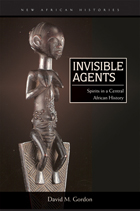
Invisible Agents shows how personal and deeply felt spiritual beliefs can inspire social movements and influence historical change. Conventional historiography concentrates on the secular, materialist, or moral sources of political agency. Instead, David M. Gordon argues, when people perceive spirits as exerting power in the visible world, these beliefs form the basis for individual and collective actions. Focusing on the history of the south-central African country of Zambia during the nineteenth and twentieth centuries, his analysis invites reflection on political and religious realms of action in other parts of the world, and complicates the post-Enlightenment divide of sacred and profane.
The book combines theoretical insights with attention to local detail and remarkable historical sweep, from oral narratives communicated across slave-trading routes during the nineteenth century, through the violent conflicts inspired by Christian and nationalist prophets during colonial times, and ending with the spirits of Pentecostal rebirth during the neoliberal order of the late twentieth century. To gain access to the details of historical change and personal spiritual beliefs across this long historical period, Gordon employs all the tools of the African historian. His own interviews and extensive fieldwork experience in Zambia provide texture and understanding to the narrative. He also critically interprets a diverse range of other sources, including oral traditions, fieldnotes of anthropologists, missionary writings and correspondence, unpublished state records, vernacular publications, and Zambian newspapers.
Invisible Agents will challenge scholars and students alike to think in new ways about the political imagination and the invisible sources of human action and historical change.

Invisible Asians offers an engaging account that makes an important contribution to our understanding of race in America, and illuminates issues of power and identity in a globalized world.

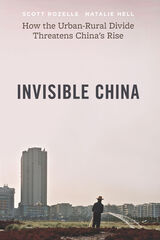
As the glittering skyline in Shanghai seemingly attests, China has quickly transformed itself from a place of stark poverty into a modern, urban, technologically savvy economic powerhouse. But as Scott Rozelle and Natalie Hell show in Invisible China, the truth is much more complicated and might be a serious cause for concern.
China’s growth has relied heavily on unskilled labor. Most of the workers who have fueled the country’s rise come from rural villages and have never been to high school. While this national growth strategy has been effective for three decades, the unskilled wage rate is finally rising, inducing companies inside China to automate at an unprecedented rate and triggering an exodus of companies seeking cheaper labor in other countries. Ten years ago, almost every product for sale in an American Walmart was made in China. Today, that is no longer the case. With the changing demand for labor, China seems to have no good back-up plan. For all of its investment in physical infrastructure, for decades China failed to invest enough in its people. Recent progress may come too late. Drawing on extensive surveys on the ground in China, Rozelle and Hell reveal that while China may be the second-largest economy in the world, its labor force has one of the lowest levels of education of any comparable country. Over half of China’s population—as well as a vast majority of its children—are from rural areas. Their low levels of basic education may leave many unable to find work in the formal workplace as China’s economy changes and manufacturing jobs move elsewhere.
In Invisible China, Rozelle and Hell speak not only to an urgent humanitarian concern but also a potential economic crisis that could upend economies and foreign relations around the globe. If too many are left structurally unemployable, the implications both inside and outside of China could be serious. Understanding the situation in China today is essential if we are to avoid a potential crisis of international proportions. This book is an urgent and timely call to action that should be read by economists, policymakers, the business community, and general readers alike.
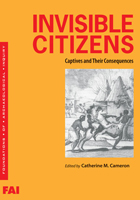
The contributors to this volume explore the remarkable range in the conditions and experiences of captives, from abject drudge to quasi kinswoman and from war captive to sexual concubine. Developing methods for identifying captives in the archaeological record are established in light of the silence that surrounded captive-taking and enslavement in many parts of the world.
Invisible Citizens promises to attract attention from a number of fields concerned with the comparative, historical study of social inequality. It challenges scholars to develop robust, empirically grounded insights into the practices of slavery while attending to the forms and saliencies of its memories. .
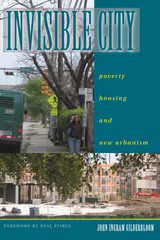

The late nineteenth and early twentieth century marked a tumultuous period in Poland’s history, with artists and writers working under difficult sociopolitical conditions. This book contains the first English- language translations of four plays by Polish writers in the modernist tradition: Snow by Stanislaw Przybyszewski, In a Small House by Tadeusz Rittner, Ashanti by Wlodzimierz Perzynski, and All the Same by Leopold Staff. Well-chosen and carefully annotated, these translations provide important insight into this underexplored area of Polish dramatic history and practice and facilitate greater understanding of its role in the development of European theater. Also included is a broad discussion of the characteristics of translation for the theater.
In 1952 Ralph Ellison won the National Book Award for his Kafkaesque and claustrophobic novel about the life of a nameless young black man in New York City. Although Invisible Man has remained the only novel that Ellison published in his lifetime, it is generally regarded as one of the most important works of fiction in our century.
This new reading of a classic work examines Ellison's relation to and critique of the American literary canon by demonstrating that the pattern of allusions in Invisible Man forms a literary-critical subtext which challenges the accepted readings of such major American authors as Emerson, Melville, and Twain.
Modeling his argument on Foucault's analysis of the asylum, Nadel analyzes the institution of the South to show how it moved blacks from "enslavement" to "slavery" to "invisibility"—all in the interest of maintaining an organization of power based on racial caste. He then demonstrates the ways Ellison wrote in the modernist/surreal tradition to trace symbolically the history of blacks in America as they moved not only from the nineteenth century to the twentieth, and from the rural South to the urban North, but as they moved (sometimes unnoticed) through American fiction.
It is on this latter movement that Nadel focuses his criticism, first demonstrating theoretically that allusions can impel reconsideration of the alluded-to text and thus function as a form of literary criticism, and then reading the specific criticism implied by Ellison's allusions to Emerson's essays and Lewis Mumford's The Golden Days, as well as to "Benito Cereno" and The Adventures of Huckleberry Finn. Nadel also considers Ellison's allusions to Whitman, Eliot, Joyce, and the New Testament.
Invisible Criticism will be of interest not only to students of American and Afro-American literature but also to those concerned about issues of literary theory, particularly in the areas of intertextual relationships, canonicity, and rehistoricism.

Invisible Darkness offers a striking interpretation of the tortured lives of the two major novelists of the Harlem Renaissance: Jean Toomer, author of Cane (1923), and Nella Larsen, author of Quicksand (1928) and Passing (1929). Charles R. Larson examines the common belief that both writers "disappeared" after the Harlem Renaissance and died in obscurity; he dispels the misconception that they vanished into the white world and lived unproductive and unrewarding lives.
In clear, jargon-free language, Larson demonstrates the opposing views that both writers had about their work vis-à-vis the incipient black arts movement; he traces each writer's troubled childhood and describes the unresolved questions of race that haunted Toomer and Larsen all of their lives. Larson follows Toomer through the wreckage of his personal life as well as the troubled years of his increasingly quirky spiritual quest until his death in a nursing home in 1967. Using previously unpublished letters and documents, Larson establishes for the first time the details of Larsen's life, illustrating that virtually every published fact about her life is incorrect.
With an innovative chronology that breaks the conventions of the traditional biographical form, Larson narrates what happened to both of these writers during their supposed years of withdrawal. He demonstrates that Nella Larsen never really gave up her fight for creative and personal fulfillment and that Jean Toomer's connection to the Harlem Renaissance—and the black world—is at best a dubious one. This strong revisionist interpretation of two major writers will have a major i mpact on African American literary studies.
The Invisible Dragon made a lot of noise for a little book When it was originally published in 1993 it was championed by artists for its forceful call for a reconsideration of beauty—and savaged by more theoretically oriented critics who dismissed the very concept of beauty as naive, igniting a debate that has shown no sign of flagging.
With this revised and expanded edition, Hickey is back to fan the flames. More manifesto than polite discussion, more call to action than criticism, The Invisible Dragon aims squarely at the hyper-institutionalism that, in Hickey’s view, denies the real pleasures that draw us to art in the first place. Deploying the artworks of Warhol, Raphael, Caravaggio, and Mapplethorpe and the writings of Ruskin, Shakespeare, Deleuze, and Foucault, Hickey takes on museum culture, arid academicism, sclerotic politics, and more—all in the service of making readers rethink the nature of art. A new introduction provides a context for earlier essays—what Hickey calls his "intellectual temper tantrums." A new essay, "American Beauty," concludes the volume with a historical argument that is a rousing paean to the inherently democratic nature of attention to beauty.
Written with a verve that is all too rare in serious criticism, this expanded and refurbished edition of The Invisible Dragon will be sure to captivate a new generation of readers, provoking the passionate reactions that are the hallmark of great criticism.

This timely anthology describes how and why the Ku Klux Klan became one of the most influential social movements in modern American history.
For decades historians have argued that the spectacular growth of the Ku Klux Klan in the 1920s was fueled by a postwar surge in racism, religious bigotry, and status anxiety among working-class white Americans. In recent years, however, a growing body of scholarship has complicated that appraisal, emphasizing the KKK's strong links to mainstream society and its role as a medium of corrective civic action.
Addressing a set of common questions, Lay and six other contributors to this volume examine local Klan chapters in Denver, Salt Lake City, El Paso, Anaheim and, in Oregon, Eugene and La Grande. Far from being composed of marginal men prone to violence and irrationality, the Klan drew membership from a generally balanced cross-section of the white male, Protestant population.
Overt racism and religious bigotry were major drawing cards for the Hooded Order, but intolerance frequently intertwined with community issues such as improved law enforcement, better public education, and municipal reform. The authors consolidate, focus, and expand upon new scholarship to provide insight into the complex reasons for the Klan's popularity.
Martini reinforces his assessment of American diplomacy with an analysis of the "cultural front"—the movies, myths, memorials, and other phenomena that supported continuing hostility toward Vietnam while silencing opposing views of the war and its legacies. He thus demonstrates that the "American War on Vietnam" was as much a battle for the cultural memory of the war within the United States as it was a lengthy economic, political, and diplomatic campaign to punish a former adversary.
Mapping the transformative personal journeys of the displaced
The travel writing genre has long been associated with a certain kind of privileged and autonomous journey, encouraged by society and geared toward individual growth. Presenting an important counterpoint to this tradition, Invisible Exile considers a diverse set of narratives that explore travel undertaken as a result of displacement. In this creative work of cultural geography, Kimberley Kinder sheds light on the transformative accounts of those who must navigate across and within spatial boundaries due to marginalization and violence.
Unfolding as an extended trip, with each chapter marking out the next phase of one imaginatively constructed itinerary, Invisible Exile analyzes forty works in which the authors grapple with themes of loss and alienation. Kinder emphasizes the aspect of travel writing that posits spatial movement as a means of reinventing oneself, showcasing the personal insight and renewal these travelers find on their paths into, through, and partially out of exile.
By foregrounding the experiences of forced and reluctant migrants and refugees, Invisible Exile poses a critical challenge to the existing genre of travel literature, expanding its scope. Examining a vast range of twenty-first-century writings, Kinder crafts a moving, episodic journey that carries readers through displacement, transformation, and redemption.
Retail e-book files for this title are screen-reader friendly.
Although Elizabeth Barrett Browning and Benjamin Robert Haydon never met, their lively and topical conversation, initiated in 1842, continued unabated until 1845, about a year before the painter’s suicide. It was a somewhat lopsided correspondence in which ninety-four letters written by Haydon, most of which have not been published before, received fewer replies from Miss Barrett, twenty-eight of which are included in this book. Judging from the contents of the letters, the epistolary friendship was truly meaningful to both. To Miss Barrett, Haydon was “my dear kind friend”; he was far more effusive, addressing her as “you Ingenious little darling invisible” and “my dearest dream & invisible intellectuality.”
In spite of Haydon’s frequent pleas for a meeting, Miss Barrett never agreed to receive him. However, as the correspondence progressed, they exchanged more and more confidences and each recognized the other as a responsive and sympathetic listener. With complete candor Haydon admitted at one point that egotism was the basis of his pleasure in the correspondence; “I never ask what you are doing,” he wrote, “but take it for granted what I am doing must be delightful to you.”
Evincing warmth and poignancy, the letters range over a variety of colorful subjects covering art, literature, current events, and gossip. The Elgin Marbles and Queen Victoria are discussed, and the correspondents air opposing views on mesmerism and Napoleon versus Wellington. After a thoughtful introduction which provides background information on Miss Barrett and Haydon, Willard Pope presents the letters—carefully annotated with identifying information on people, places, and current events—in chronological order.
READERS
Browse our collection.
PUBLISHERS
See BiblioVault's publisher services.
STUDENT SERVICES
Files for college accessibility offices.
RECENTLY PUBLISHED




UChicago Accessibility Resources
home | accessibility | search | about | contact us
BiblioVault ® 2001 - 2025
The University of Chicago Press